1. Introduction
The Carboniferous Period represents a critically important time in Earth's history. The final assembly of the Pangaean supercontinent was underway as Gondwana collided with Laurussia, which fundamentally changed global oceanic circulation patterns (Mii et al. Reference Mii, Grossman and Yancey1999) and resulted in the Himalayan-scale Variscan Orogeny in Western Europe (Guion et al. Reference Guion, Gutteridge, Davies, Woodcock and Strachan2000; Davies et al. Reference Davies, Guion, Gutteridge, Woodcock and Strachan2012; Warr, Reference Warr, Woodcock and Strachan2012). These events were broadly coincident with a major phase of land plant diversification and enhanced widespread burial of organic carbon as coal, which signalled major changes in atmospheric composition (Willis & McElwain, Reference Willis and McElwain2013). These changes to global floras also stimulated a profound shift in terrestrial weathering and drainage patterns (Gibling & Davies, Reference Gibling and Davies2012; Davies & Gibling, Reference Davies and Gibling2013).
As a result of several global-scale factors, the Carboniferous palaeoclimatic regime shifted from hothouse to icehouse conditions (the Late Palaeozoic Ice Age; e.g. Frakes et al. Reference Frakes, Francis and Syktus1992), leading to pronounced sea-level fluctuations (Veevers & Powell, Reference Veevers and Powell1987; Smith & Read, Reference Smith and Read2000; Wright & Vanstone, Reference Wright and Vanstone2001; Isbell et al. Reference Isbell, Lenaker, Askin, Miller and Babcock2003). Several glacial episodes occurred during Serpukhovian (Late Mississippian) and Bashkirian (Early Pennsylvanian) time (Saltzman, Reference Saltzman2003; Grossman et al. Reference Grossman, Yancey, Jones, Bruckschen, Chuvashov, Mazzullo and Mii2008; Buggisch et al. Reference Buggisch, Joachimski, Sevastopulo and Morrow2008; Bishop et al. Reference Bishop, Montanez, Gulbranson and Brenckle2009). More recently, it has been proposed that cooling began slightly earlier during late Viséan (Middle Mississippian) time (Barham et al. Reference Barham, Joachimski, Murray and Williams2012; see Fig. 1 for chronostratigraphic subdivisions). Glaciation has been suggested as one causal factor of the ensuing Serpukhovian biodiversity crises by McGhee et al. (Reference McGhee, Sheehan, Bottjer and Droser2012), who ranked it within the top five biosphere catastrophes of the Phanerozoic based on ecological impact.
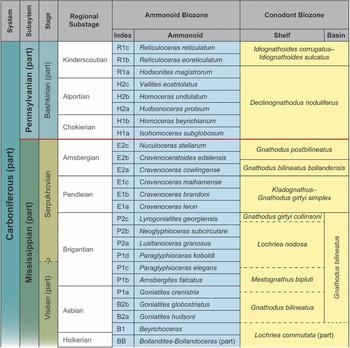
Summary of Carboniferous chronostratigraphic and biostratigraphic subdivisions relevant to this work. Modified from Riley (Reference Riley1993), Heckel & Clayton (Reference Heckel and Clayton2006), Sevastopulo (Reference Sevastopulo, Holland and Sanders2009), Sevastopulo & Wyse Jackson (Reference Sevastopulo, Jackson, Holland and Sanders2009), Barham (unpub. Ph.D. thesis, National University of Ireland, Galway, 2010), Dean et al. (Reference Dean, Browne, Waters and Powell2011), Waters et al. (Reference Waters, Somerville, Stephenson, Cleal, Long, Waters, Somerville, Jones, Cleal, Collinson, Waters, Besly, Dean, Stephenson, Davies, Freshney, Jackson, Mitchell, Powell, Barclay, Browne, Leveridge, Long and McLean2011) and Waters & Condon (Reference Waters and Condon2012) with colour coding according to the Commission for the Geological Map of the World, Paris, France. The mid-Carboniferous Boundary is indicated with a red line. Regional substages are those used in Britain and Ireland. The base of the Serpukhovian Stage is placed in the Brigantian Regional Substage following Sevastopulo & Barham (Reference Sevastopulo and Barham2014). Dashed lines represent uncertainty in boundary placement.

Calibrating the timing of all of these events is extremely important, particularly when trying to establish the degree to which they were contemporaneous and possibly interlinked. Global Boundary Stratotype Section and Points (GSSPs) have been formally ratified for each of the Mississippian Stage boundaries, with the exception of the Viséan–Serpukhovian boundary (Fig. 1). The first appearance datum (FAD) of the conodont Lochriea ziegleri (Nemirovskaya et al. Reference Nemirovskaya, Perret and Meischner1994) has been proposed as the best candidate for defining the base of the Serpukhovian Stage (Richards et al. Reference Richards, Aretz, Barnett, Barskov, Blanco-Ferrera, Brenckle, Clayton, Dean, Ellwood, Gibshman, Hecker, Konovalova, Korn, Kulagina, Lane, Mamet, Nemyrovska, Nikolaeva, Pazukhin, Qi, Sanz-López, Saltzman, Titus, Utting and Wang2011); however, problems have recently been highlighted relating to the choice of this index fossil (Barham et al. Reference Barham, Murray, Sevastopulo and Williams2015; Sevastopulo & Barham, Reference Sevastopulo and Barham2014). The GSSP for the succeeding Serpukhovian–Bashkirian Stage boundary (equivalent to the Mississippian–Pennsylvanian Subsystem or mid-Carboniferous boundary) has officially been ratified. Significant problems (discussed in Section 1.a below) have also emerged in relation to the choice of this GSSP.
1.a. Conodont biostratigraphy of the mid-Carboniferous boundary
A substantial turnover of marine fauna is apparent around the mid-Carboniferous boundary (Mississippian–Pennsylvanian; see Fig. 1). For example, conodonts were a widely distributed group which suffered a marked reduction in diversity during this interval, followed by a renewed phase of evolution during Pennsylvanian time (Grayson et al. Reference Grayson, Merrill and Lambert1990; Sanz-López et al. Reference Sanz-López, Blanco-Ferrera, García-López and Sánchez de Posada2006, Reference Sanz-López, Blanco-Ferrera, García-López and Sánchez de Posada2013). The FAD of the conodont Declinognathodus noduliferus (Ellison & Graves, Reference Ellison and Graves1941) sensu lato, in its presumed evolutionary transition from Gnathodus girtyi simplex Dunn, Reference Dunn1966, was chosen to identify this important boundary (Fig. 1) as it occurs abundantly in most marine palaeoenvironments, from clastic to carbonate facies, and could therefore facilitate correlations between deep- and shallow-water palaeoenvironments (Lane et al. Reference Lane, Brenckle, Baesemann and Richards1999).
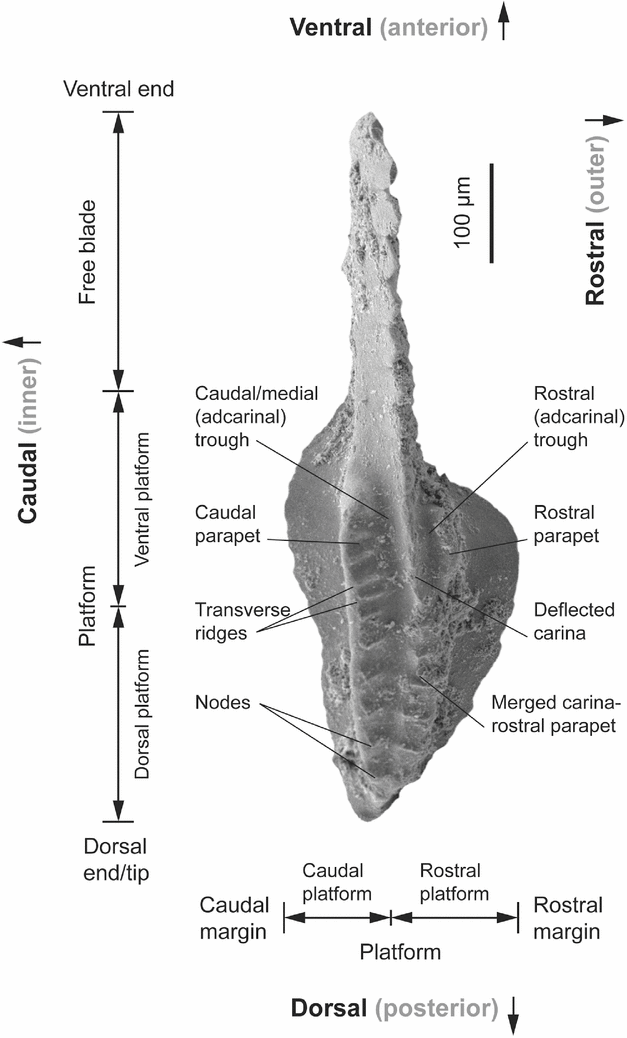
Lane et al. (Reference Lane, Brenckle, Baesemann and Richards1999) envisaged the evolutionary transition of the D. noduliferus P1 element from its supposed precursor G. g. simplex via the development of a rostral parapet to the dorsal tip of the carina, followed by the gradual shifting or kinking of the carina further rostrally (see Fig. 2 for terminology as prescribed by Purnell et al. Reference Purnell, Donoghue and Aldridge2000). While populations with each of these morphological gradations were subsequently elevated to the status of species by some authors, Lane et al. (Reference Lane, Brenckle, Baesemann and Richards1999) included within D. noduliferus s.l. the following subspecies: D. n. inaequalis (Higgins, Reference Higgins1975), D. n. japonicus (Igo & Koike, Reference Igo and Koike1964), D. n. lateralis (Higgins & Bouckaert, Reference Higgins and Bouckaert1968) and D. n. noduliferus (Higgins, Reference Higgins1975). D. praenoduliferus Nigmadganov & Nemirovskaya, Reference Nigmadganov and Nemirovskaya1992 and D. bernesgae Sanz-López et al. Reference Sanz-López, Blanco-Ferrera, García-López and Sánchez de Posada2006 were later described as early members of the D. noduliferus group (Sanz-López & Blanco-Ferrera, Reference Sanz-López and Blanco-Ferrera2013). As a consequence of selecting the first occurrence datum (FOD) of a very broad species grouping as the biostratigraphic tool with which the GSSP of the mid-Carboniferous boundary was picked, the boundary elsewhere has been identified using the first occurrence of any member of the D. noduliferus plexus, regardless of whether it is now considered a species or subspecies (Sanz-López et al. Reference Sanz-López, Blanco-Ferrera, García-López and Sánchez de Posada2013).
P1 conodont element descriptive terminology. Anatomical and orientation terminology used is that prescribed by Purnell et al. (Reference Purnell, Donoghue and Aldridge2000). The formerly used terms are provided in brackets. A P1 element of Declinognathodus noduliferus inaequalis (Higgins, Reference Higgins1975), recovered during this study (sample BBN N16, cat. no. JMM.PF12.D2), is shown (in oral view) as an example.

The GSSP for the Mississippian–Pennsylvanian boundary is located 82.90 m above the top of the Battleship Wash Formation within the lower part of the Bird Spring Formation, a shallow-water, dominantly carbonate sequence at Arrow Canyon in the Great Basin, Nevada, USA (Lane et al. Reference Lane, Brenckle, Baesemann and Richards1999). It coincides with the first occurrence of D. noduliferus s.l. From the examples illustrated by Brenckle et al. (Reference Brenckle, Baesemann, Lane, West, Webster, Langenheim, Brand, Richard, Brenckle and Page1997a, Reference Brenckle, Baesemann, Lane, West, Webster, Langenheim, Brand and Richardb, pl. 1, figs 2–4), the specimens that occur at this level appear to be D. n. inaequalis and this is corroborated by the faunal list provided. The FOD of this latter taxon should therefore be considered the principal marker event for global correlation of this boundary (Sanz-López et al. Reference Sanz-López, Blanco-Ferrera, García-López and Sánchez de Posada2006).
However, the suitability of the mid-Carboniferous GSSP at Arrow Canyon has been questioned by several authors on both litho- and biostratigraphic grounds. Barnett & Wright (Reference Barnett and Wright2008) reported the presence of numerous palaeokarstic surfaces and palaeosols which reflect depositional hiatuses, and noted a particularly well-developed palaeosol horizon less than 1 m above the mid-Carboniferous boundary (coincident with a significant facies change). These authors commented that the Arrow Canyon section therefore violates the guidelines of the International Commission on Stratigraphy for the establishment of a GSSP. Barnett & Wright (Reference Barnett and Wright2008) also compared cyclostratigraphic patterns between Arrow Canyon and north England and noted numerous missing glacio-eustatic sea-level oscillation events in the former section, potentially representing 1–2.5 million years of missing time. Riley et al. (Reference Riley, Claoué-Long, Higgins, Owens, Spears, Taylor and Varker1994) highlighted that a refined calibration of the first appearance of D. noduliferus is not possible at Arrow Canyon due to the lack of ammonoid control and also commented that the section contains an undesirable overlap of conodont elements characteristic of the G. bilineatus Biozone with those of the D. noduliferus Biozone (see Fig. 1). Barnett & Wright (Reference Barnett and Wright2008) concluded that the almost singular focus on the first appearance of a single taxon to the exclusion of other valuable data ‘has resulted in the ratification of a flawed GSSP’.
The identification of the mid-Carboniferous boundary internationally has also raised questions as to the relationship of Pennsylvanian conodont species to their precursors in the Mississippian. In contrast to the hypothesis of the evolution of D. noduliferus s.l. from G. g. simplex (Lane et al. Reference Lane, Brenckle, Baesemann and Richards1999), certain authors (e.g. Varker, Reference Varker1994) have supported an alternative origination from the Gnathodus bilineatus (Roundy, Reference Roundy1926) clade. Grayson et al. (Reference Grayson, Merrill and Lambert1990) advocated this hypothesis based on comparison of the P2 elements of hypothetical apparatuses of various mid-Carboniferous conodont genera reconstructed from discrete elements. Subsequent examination of isolated P1 elements by Nemirovskaya & Nigmadganov (Reference Nemirovskaya and Nigmadganov1994) offered further support and these authors suggested the possible derivation of the D. noduliferus P1 element through the evolutionary sequence of G. b. bollandensis Higgins & Bouckaert, Reference Higgins and Bouckaert1968, G. postbilineatus Nigmadganov & Nemirovskaya, Reference Nigmadganov and Nemirovskaya1992 and D. praenoduliferus. In general, this would have occurred through a narrowing of the rostral cup and a decrease in its ornamentation, with the increase in the length of the caudal parapet to the dorsal tip of the carina and the development of a rostral parapet in the ventral half of the platform. Nemirovskaya & Nigmadganov (Reference Nemirovskaya and Nigmadganov1994) also suggested a possible synchronous evolutionary event at different localities with the convergent evolution of two homeomorphs of D. noduliferus, one originating from the shallow-water North American G. g. simplex while the other evolved from the deep-water Central Asian G. postbilineatus.
In a more recent study of P1 elements within the Barcaliente Formation in the Cantabrian Mountains, NW Spain, Sanz-López & Blanco-Ferrera (Reference Sanz-López and Blanco-Ferrera2013) proposed that Declinognathodus first appeared with the evolution of D. bernesgae and/or D. praenoduliferus from G. postbilineatus in the upper Arnsbergian (Serpukhovian). This was then followed by the diversification of the Declinognathodus group, with the derivation of D. n. inaequalis, D. n. noduliferus and D. n. japonicus from D. bernesgae and D. lateralis from D. praenoduliferus, from the end of Arnsbergian time to early Chokierian time (Sanz-López et al. Reference Sanz-López, Blanco-Ferrera, García-López and Sánchez de Posada2013). These findings therefore raise serious concerns over the accuracy of correlation of the mid-Carboniferous boundary to the GSSP.
1.b. Geological background of the Shannon Basin region
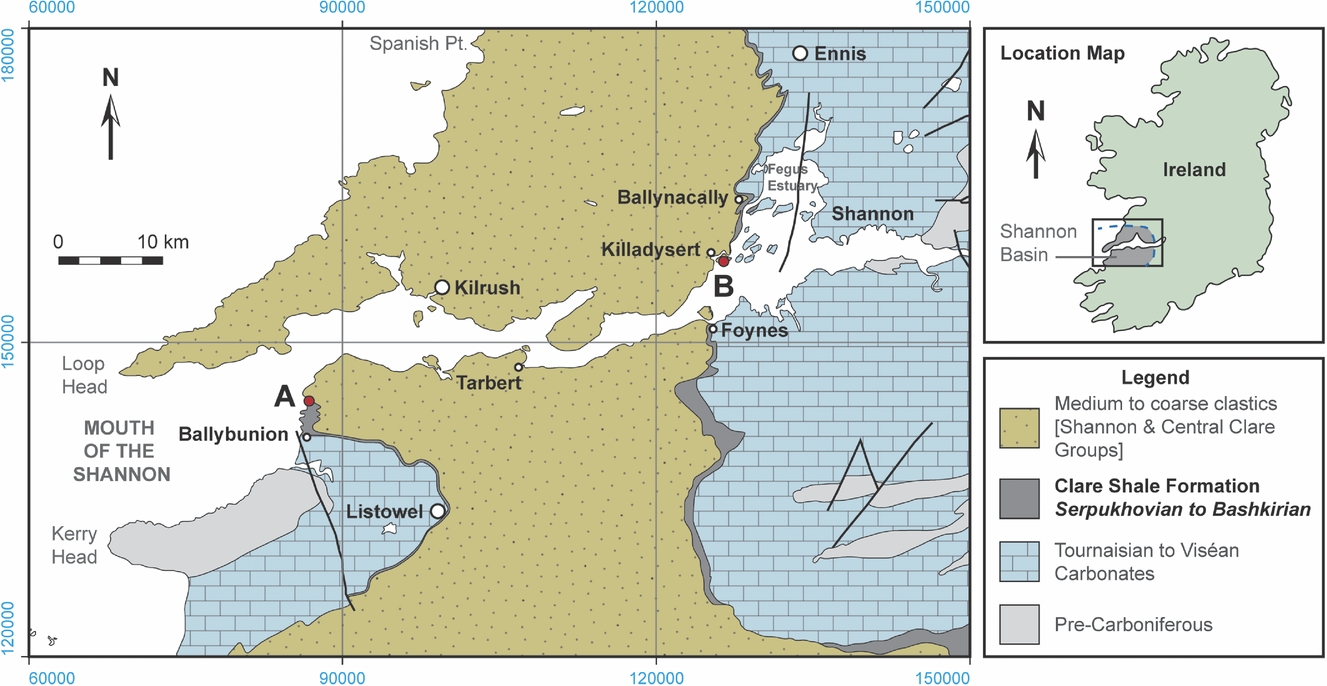
During Carboniferous time, several shallow-marine intracratonic basins developed across Britain and Ireland (Leeder, Reference Leeder1982, Reference Leeder, Miller, Adams and Wright1987; Somerville, Reference Somerville2008). The Shannon Basin in Western Ireland (Fig. 3) was one such depocentre and it was characterized by extensive carbonate deposition during Tournaisian and Viséan times (e.g. Strogen, Reference Strogen1988; Somerville & Strogen, Reference Somerville and Strogen1992; Strogen et al. Reference Strogen, Somerville, Pickard, Jones, Fleming, Strogen, Somerville and Jones1996). Carbonate production across the basin subsequently ceased following widespread deposition of non-calcareous, organic-rich, dark shales (the Clare Shale Formation) during Serpukhovian time. Later, during Bashkirian time, a thick sequence of turbiditic siltstones and sandstones (the Ross Sandstone Formation) was deposited in the central axis of the basin, with the Clare Shale Formation continuing to be deposited around the margins (Rider, Reference Rider1974). These units were then succeeded by the Gull Island Formation and the Central Clare Group, the former representing a mudstone-rich basin floor and slope deposit while the latter consists of cyclothemic shallower-water deltaic deposits (e.g. Collinson et al. Reference Collinson, Martinsen, Bakken and Kloster1991; Wignall & Best, Reference Wignall and Best2000; Sevastopulo, Reference Sevastopulo, Holland and Sanders2009).
Geological map of the Shannon Basin region in Western Ireland. Modified from the Geological Survey of Ireland 1:100,000 scale Bedrock Map Series (1993–2003), the Geological Survey of Ireland Bedrock Geological Map of Ireland 1:500,000 scale (2006) and the Ordnance Survey of Ireland 1:600,000 Series with the use of the Irish National Grid reference system. Letters accompanying red dots refer to rock sections examined during this study. A – Ballybunion; B – Inishcorker. The approximate location of the Shannon Basin is shown in the inset map (top right).
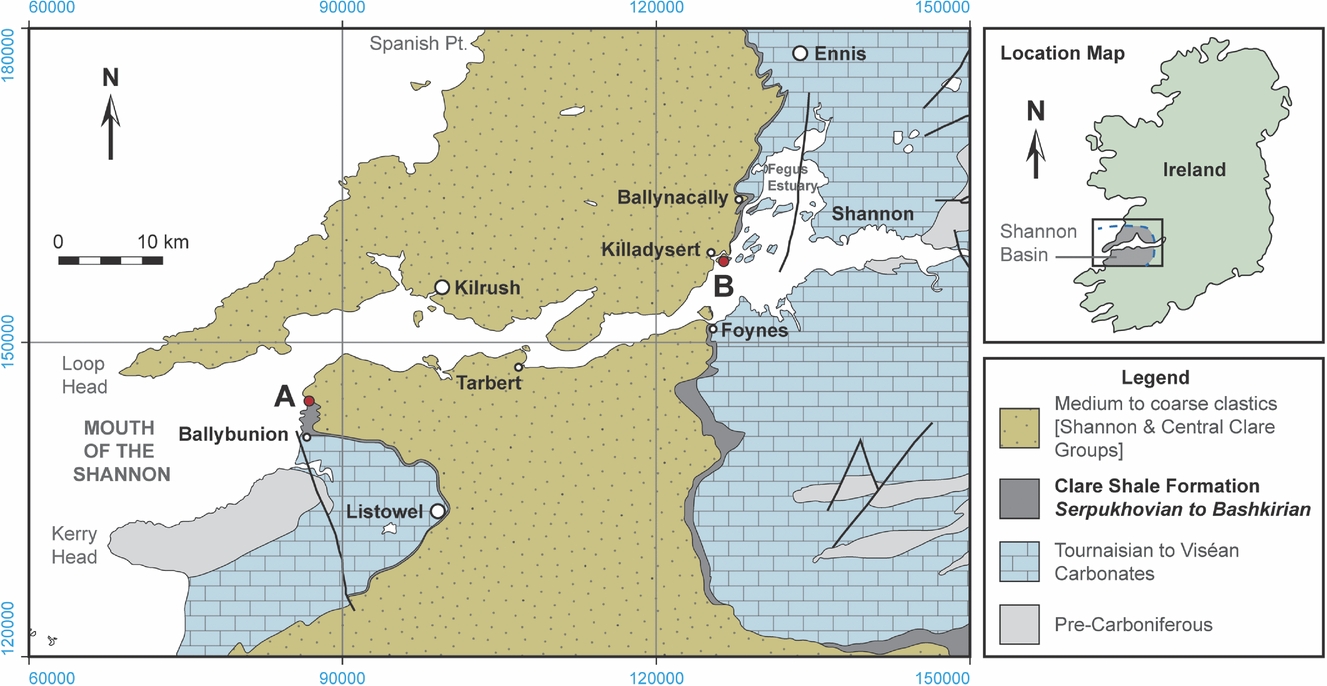
The Clare Shale Formation occurs between the Mississippian carbonates and succeeding Pennsylvanian coarser siliciclastics. It is generally barren of fossils and has usually been interpreted to represent hypoxic to anoxic bottom water conditions (e.g. Braithwaite, Reference Braithwaite1993). Thin, discrete and distinct fossiliferous (‘marine’) bands containing a largely pelagic fauna occur within the shales and these have allowed previous workers (e.g. Hodson, Reference Hodson1953, Reference Hodson1954; Hodson & Lewarne, Reference Hodson and Lewarne1961) to establish a detailed ammonoid biozonation. The latter authors noted the thickest development of the Clare Shale Formation around the area of the present-day Shannon Estuary (see Fig. 3 for general location) and proposed that this region might represent the axial portion of the basin. For example, Hodson & Lewarne (Reference Hodson and Lewarne1961) described a particularly extensive exposure of the unit on the south side of Inishcorker in County Clare, with an estimated total thickness of c. 200 m of shales which ranged in age from at least E1 (Pendleian) to H2 (Alportian). The Clare Shale Formation was also examined by Kelk (unpub. Ph.D. thesis, University of Reading, 1960) further west along the axis of the Shannon Basin at Ballybunion in northwest County Kerry (Fig. 3). He recorded some 188 m of shale strata there, ranging in age from P2 (Brigantian) to H1 (Chokierian).
This difference in age of the base of the Clare Shale Formation becomes more pronounced moving away from the axis of the basin, a point initially established by Hodson & Lewarne (Reference Hodson and Lewarne1961). Further north in County Clare, around Lisdoonvarna, the unit thins to a few tens of metres with the basal ammonoid band being H1 (Chokierian) in age and much of the Serpukhovian deposits being represented by a very thin phosphatic lag horizon (Hodson, Reference Hodson1953; Barham, unpub. Ph.D. thesis, National University of Ireland, Galway, 2010; Barham et al. Reference Barham, Murray, Sevastopulo and Williams2014). The highly condensed successions to the north (and also to the south) of the basin axis and diachronous base of the shales suggested to Hodson & Lewarne (Reference Hodson and Lewarne1961) onlap of sediment upslope, away from the axial region.
Debate continues to the present over the precise details of the orientation of the Shannon Basin, its lateral extent and the location of its sediment sources (see discussion in Wignall & Best, Reference Wignall and Best2000; Martinsen & Collinson, Reference Martinsen and Collinson2002; Pointon et al. Reference Pointon, Cliff and Chew2012). The reasons for the pronounced shift from predominantly carbonate to siliciclastic sediment deposition is also not clear. The influx of terrigenous sediment may have been due to the development of large river systems as a consequence of climate change as Laurussia moved northwards, combined with tectonic uplift of the source area (Sevastopulo, Reference Sevastopulo, Holland and Sanders2009; see also Blakey, Reference Blakey, Fielding, Frank and Isbell2008).
1.c. Aims and objectives
The present study examines the stratigraphic ranges of conodont elements within the Clare Shale Formation in Western Ireland and is based on detailed analysis of two sections (Ballybunion and Inishcorker; see Fig. 3) which both span the mid-Carboniferous boundary. Braithwaite (Reference Braithwaite1993) commented that the latter of these (Inishcorker) was, on the basis of ammonoid faunas, perhaps the most biostratigraphically complete of its kind within Ireland.
Conodont faunas from both of these sections have not received much attention in the past. The appendix to Austin (Reference Austin1972) noted that the Isohomoceras subglobosum (H1a, Chokierian; see Fig. 1) levels at Inishcorker produced few conodont elements, despite extensive sampling. The same report produced a conodont faunal list for the Homoceras beyrichianum (H1b, Chokierian) level located further north in Co. Clare at Phosphate Mine, Roadford, which included several forms of Declinognathodus. Conodont faunas from Ballybunion have never been reported before. The reason for this lack of investigation is principally due to the largely non-calcareous nature of the Clare Shale Formation, which is unsuitable for precessing in order to recover conodont elements. Both sections do, however, contain several horizons bearing diagenetic calcareous nodules interbedded within the shales, which are amenable to acid digestion techniques. The biostratigraphic ranges of the conodont elements they contain are presented here for the first time. These results allow some comment to be made on the nature of the Gnathodus–Declinognathodus evolutionary transition in Western Europe and the relationship of the mid-Carboniferous boundary, identified using conodont elements, to the established ammonoid biozones.
2. Materials and methods
2.a. Geographical location and geology of the sampled sections
The sections through the Clare Shale Formation at Ballybunion and Inishcorker were logged in detail (centimetre scale) in the field and a total of 27 calcareous nodules were collected for processing for conodont elements.
-
1. Eleven calcareous nodules were sampled from eleven separate stratigraphic horizons within the Clare Shale Formation at Ballybunion, while four calcareous nodules were sampled from four separate stratigraphic horizons within the overlying Ross Sandstone Formation at this location.
-
2. Twelve calcareous nodules were sampled from eleven separate stratigraphic horizons within the Clare Shale Formation on Inishcorker.
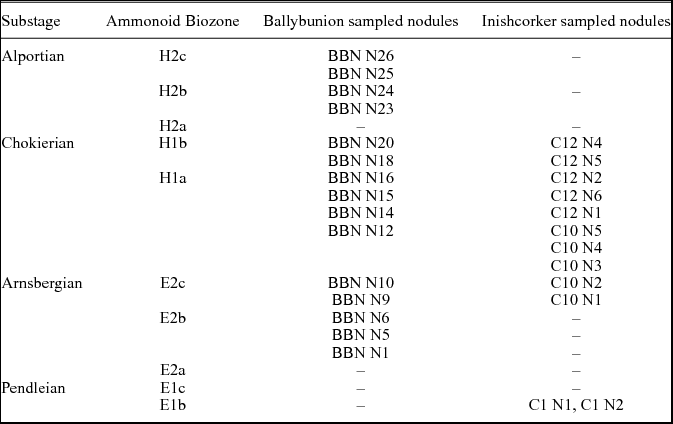
Correlation of the sampled nodule horizons to the ammonoid (goniatite) bands of Kelk (unpub. Ph.D. thesis, University of Reading, 1960) for Ballybunion and Hodson & Lewarne (Reference Hodson and Lewarne1961) for Inishcorker permits an approximate age assignation for each of the sampled nodules (Table 1). It also suggests that the upper part of the Clare Shale Formation at Inishcorker is laterally equivalent to part of the Ross Sandstone Formation at Ballybunion, which is apparently absent at Inishcorker.
Age determinations of the calcareous nodules sampled for conodont element processing based on comparison with previous ammonoid biostratigraphic schemes developed by Kelk (unpub. Ph.D. thesis, University of Reading, 1960) and Hodson & Lewarne (Reference Hodson and Lewarne1961) for Ballybunion and Inishcorker, respectively.

More detailed tables listing the lithologies and samples from this study and the corresponding units of Kelk (unpub. Ph.D. thesis, University of Reading, 1960) for Ballybunion and Hodson & Lewarne (Reference Hodson and Lewarne1961) for Inishcorker are presented in the online Supplementary Material (Tables S1, S2, available at http://journals.cambridge.org/geo) together with field photographs of the measured sections (supplementary Figs S1, S2) and the stratigraphic heights, GPS co-ordinates, weights and photographs of all sampled calcareous nodules (supplementary Tables S3, S4; Figs S3–S7). Grid references cited throughout the text refer to Irish National Grid co-ordinates.
2.a.1. Ballybunion
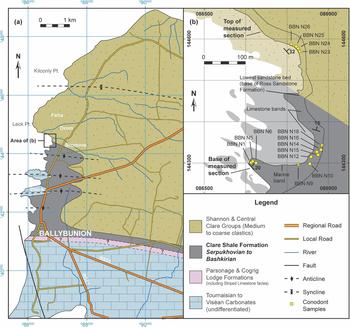
The Ballybunion section is located in a bay approximately 3 km north of the castle ruins in Ballybunion, north County Kerry, Ireland (Fig. 4). The northern limit of this bay is accessible via a sequence of stepped sandstone and shale beds on the south bank of the Coosheen Stream immediately where it ends in a small waterfall (approximately Q 86500 44800 Irish National Grid). It is only safely traversable two hours either side of low tide.
Location map of the measured section at Ballybunion, north Co. Kerry, Ireland. Ordnance Survey of Ireland base map has been overlain (approximately) with gridlines (Irish National Grid) taken from the Ordnance Survey of Ireland 1:50,000 Series (2010). See Figure 3 for a simplified geology of the area and an indication of its location relative to the whole of Ireland. The retrieved calcareous samples are marked with yellow dots.

The stratigraphically lowest beds recorded, belonging to the Clare Shale Formation, occur at approximately Q 86713 44301 (±5 m); however, the full thickness of the underlying shale could not be measured because of an impassable (constantly submerged) southern bay (supplementary Fig. S1a, available at http://journals.cambridge.org/geo). A c. 70.5 m stratigraphic section through this formation at Ballybunion was recorded in detail and spans the E2b to H1b Ammonoid Biozones according to Kelk (unpub. Ph.D. thesis, University of Reading, 1960). It consists predominantly of non-calcareous, organic-rich, black, flaky shale, interbedded with ferruginous shale bands (1–20 cm thick), dark grey calcilutite bands (1–2 cm thick) and dark grey calcareous nodules (6–30 cm thick and 17–150 cm in lateral extent).
Some 50 m of strata belonging to the overlying Ross Sandstone Formation was also examined at this location (see Fig. 4b). The base of this formation is taken here to be the base of the first sandstone bed (medium grey, fine grained and measuring 21 cm thick) in the sequence above the Clare Shale Formation, just south of the large waterfall of Glenachoor Stream, some 3.3 km north of the castle ruins at Ballybunion at approximately Q 86850 44462 (±12 m; supplementary Fig. S1b available at http://journals.cambridge.org/geo). This stratigraphic interval corresponds to the ‘Cosheen Beds’ of Kelk (unpub. Ph.D. thesis, University of Reading, 1960), who considered that it spanned the H1b to H2c Ammonoid Biozones. It consists of subordinate fine-grained sandstone beds (up to 110 cm thick) separated by 1–22-m-thick units of non-calcareous, black shale, interbedded with non-calcareous, dark grey siltstones (30–40 cm thick), ferruginous shale bands (5–12 cm thick) and dark grey calcareous nodules (6–12 cm thick and 19–70 cm in lateral extent). The top of the Ross Sandstone Formation was not recorded and therefore the total thickness of the unit at Ballybunion could not be constrained. The top of the measured section is marked by two conspicuous fine-grained sandstone beds (the lower and upper beds measuring 75 cm and 110 cm thick, respectively) separated by a 20-cm-thick non-calcareous black shale located at approximately Q 86731 44622 (±11 m; supplementary Fig. S1c–d, available at http://journals.cambridge.org/geo). These two sandstone beds can be traced by eye to the top of the cliff where a waterfall of Glenachoor Stream pours over the upper surface of the upper sandstone bed.
2.a.2. Inishcorker
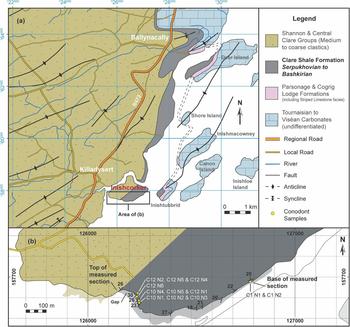
The second section investigated is located on the south side of the small island of Inishcorker (Fig. 5) towards the southern limit of the River Fergus and close to its junction with the River Shannon, near the village of Killadysert in south County Clare. This island is accessible via a land bridge; however, the section is only exposed approximately 2.5–3 hours either side of low tide. A c. 193.5 m stratigraphic section through the Clare Shale Formation was recorded on the south side of Inishcorker and spans the E1b (Pendleian) to H2a (Alportian) Ammonoid Biozones (Hodson & Lewarne, Reference Hodson and Lewarne1961). The base of the exposed section occurs at approximately R 26787 57686 (±4 m; supplementary Fig. S2a, available at http://journals.cambridge.org/geo). The thickness of shale beneath the lowest recorded beds could not be constrained with certainty as it is submerged by the Fergus Estuary between Inishcorker and neighbouring Inishtubbrid (Fig. 5a). The basal beds of the Clare Shale Formation are exposed on the island of Inishtubbrid but were not examined during this study. Hodson & Lewarne (Reference Hodson and Lewarne1961) noted this lower exposed part of the succession as apparently unfossiliferous, and make no mention of calcareous nodules.
Location map of the measured section at Inishcorker, Killadysert, Co. Clare, Ireland. Ordnance Survey of Ireland base map has been overlain (approximately) with gridlines (Irish National Grid) taken from the Ordnance Survey of Ireland 1:50,000 Series (2010). See Figure 3 for a simplified geology of the area and an indication of its location relative to the whole of Ireland. The retrieved calcareous samples are marked with yellow dots.

The main section through the Clare Shale Formation exposed on Inishcorker consists predominantly of non-calcareous, organic-rich, black, pencil, platy and flaky shales, intermittently interbedded with ferruginous shale bands (3–34 cm thick), ferruginous shale nodules (3–34 cm thick and 20–106 cm in lateral extent) and dark grey calcareous nodules (8–35 cm thick and 20–120 cm in lateral extent).
A number of enigmatic paired orange cylindrical vertical pyrite tubes, measuring 5–18 mm in diameter and up to 47 mm in length, are present within the flaky shale at R 26312 57528 (±6 m), between c. 118 m and c. 119 m above the base of the measured section (ABS; supplementary Fig. S2b–d, available at http://journals.cambridge.org/geo). The two tubes forming a pair are commonly separated by less than 1 cm of intervening sediment, and each ‘pairing’ is separated from others by 3–15 cm. Braithwaite (Reference Braithwaite1993) recorded similar tubes up to 60 cm in length at this location and considered them to be diagenetic features rather than burrows due to the absence of any other evidence for benthos at this horizon or linkage between the tubes. Although the available evidence is equivocal, this conclusion is tentatively accepted here.
Towards the top of the Clare Shale Formation on Inishcorker, four successive platy shale units occur which contain flattened goniatites. A conspicuous stratigraphic gap is also present, immediately above the highest sampled calcareous nodule in an inlet on the western half of the southern shore of the island (see Fig. 5b and supplementary Fig. S2e, available at http://journals.cambridge.org/geo), and has been estimated to represent c. 28 m of section. The top of the Clare Shale Formation and contact with the overlying Gull Island Formation (using the lithostratigraphic nomenclature of Sleeman & Pracht, Reference Sleeman and Pracht1999) is exposed above this gap at R 26159 57640 (±6 m) and is marked by the abrupt appearance of the first sandstone bed (medium grey, fine-grained and measuring 8 cm thick) in the sequence (supplementary Fig. S2f, available at http://journals.cambridge.org/geo). Only the succeeding c. 4 m of strata was recorded and therefore the entire thickness of this formation on Inishcorker was not measured in this study. The sandstone beds are separated by 4–85-cm-thick units of non-calcareous black shale, with the former becoming more dominant upwards. The top of the measured section is marked by a 155-cm-thick medium grey, fine-grained sandstone bed.
2.b. Microfossil processing
Conodont element extraction from the sampled calcareous nodules follows a slightly modified version of the formic acid digestion technique outlined by Armstrong & Brasier (Reference Armstrong and Brasier2005) and subsequently described by Barham (unpub. Ph.D. thesis, National University of Ireland, Galway, 2010). All rock samples (c. 2 kg each) were initially scrubbed of any surficial material such as clay, lichen or moss, and broken into 1–5-cm3-sized fragments. Samples were then etched for 24–72 hours in buffered c. 6% formic acid. The resulting residues were then carefully wet sieved and transferred into labelled filter papers which were dried in an oven at c. 70°C. The 250 μm and 500 μm fractions of the dried residues were systematically picked through under a Zeiss Stemi DV4 binocular microscope.
A selection of the best-preserved conodont elements were attached to 25-mm-diameter aluminium Scanning Electron Microscope (SEM) stubs using an adhesive carbon pad. These were subsequently gold coated using a sputter coater and then imaged using a Hitachi S2600N Variable Pressure SEM (generally at 10.0 kV) in the Centre for Microscopy and Imaging at the National University of Ireland, Galway. Digital images were then prepared and compiled using photo-editing software. All material imaged in this study have been deposited into the James Mitchell Museum in the National University of Ireland, Galway (prefix JMM).
3. Conodont element biostratigraphy
3.a. Ballybunion
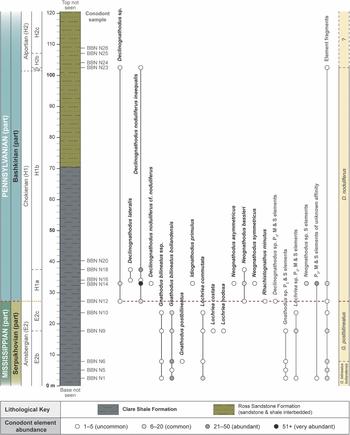
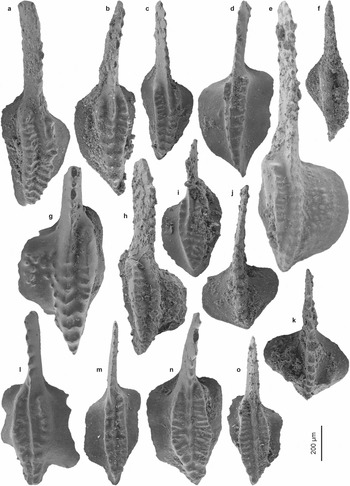
A total of 364 conodont elements were recovered from the 15 samples collected from both the Clare Shale and Ross Sandstone formations at Ballybunion. The condition of the recovered elements varied from poorly preserved (i.e. encrusted and fragmented) in the poorly productive samples to very well preserved in the more fossiliferous samples. Poorly preserved P1 elements were generally missing the majority of the free blade and valuable diagnostic features on the platform were often obscured by (still adhering) rock matrix; these were therefore difficult to identify. A number of P2, M and S elements were recovered; however, these were poorly preserved even in the fossiliferous samples. These particular elements were generally only tentatively assigned to the genus of the predominant P1 elements found in association with them. Figure 6 provides a summary of the stratigraphic distribution of conodont elements in the Ballybunion section, while Figure 7 illustrates a selection of the important P1 conodont elements recovered from the succession. A detailed table listing the conodont element distribution for the measured section at Ballybunion is presented in the online Supplementary Material (Table S5, available at http://journals.cambridge.org/geo).
Conodont element ranges within the measured section at Ballybunion, north Co. Kerry. A general correlation of the measured section with the goniatite bands recorded by Kelk (unpub. Ph.D. thesis, University of Reading, 1960) is shown. Columns on the left record (from left to right) the Subsystem, Stage, Regional Substage and Ammonoid Biozone. The column on the right illustrates the Conodont Biozones recognized here. The lowest Isohomoceras subglobosum goniatite band (the Arnsbergian–Chokierian boundary) identified by Kelk (unpub. Ph.D. thesis, University of Reading, 1960) is highlighted with a dashed orange line. The first occurrence of Declinognathodus noduliferus inaequalis, and therefore the mid-Carboniferous boundary, is indicated with a dashed red line.

Oral views of selected P1 conodont elements from the Clare Shale Formation at Ballybunion, Co. Kerry, Ireland. (a) Declinognathodus lateralis (Higgins & Bouckaert, Reference Higgins and Bouckaert1968), sample BBN N16, cat. no. JMM.PF12.D3; (b, c) Declinognathodus noduliferus inaequalis (Higgins, Reference Higgins1975), (b) sample BBN N12, cat. no. JMM.PF12.B4, (c) sample BBN N16, cat. no. JMM.PF12.D2; (d) Declinognathodus noduliferus cf. noduliferus (Ellison & Graves, Reference Ellison and Graves1941), sample BBN N14, cat. no. JMM.PF12.C6; (e, h) Gnathodus bilineatus bollandensis Higgins & Bouckaert, Reference Higgins and Bouckaert1968, (e) sample BBN N1, cat. no. JMM.PF11.A3, (h) sample BBN N10, cat. no. JMM.PF12.A2; (f) Rhachistognathus minutus (Higgins & Bouckaert, Reference Higgins and Bouckaert1968), sample BBN N12, cat. no. JMM.PF12.B3; (g) Gnathodus postbilineatus Nigmadganov & Nemirovskaya, Reference Nigmadganov and Nemirovskaya1992, sample BBN N6, cat. no. JMM.PF11.C4; (i) Idiognathodus primulus Higgins, Reference Higgins1975, sample BBN N14, cat. no. JMM.PF12.C5; (j) Lochriea commutata (Branson & Mehl, Reference Branson and Mehl1941), sample BBN N6, cat. no. JMM.PF11.C1; (k) Lochriea nodosa (Bischoff, Reference Bischoff1957), sample BBN N9, cat. no. JMM.PF11.D3; (l) Neognathodus asymmetricus (Stibane, Reference Stibane1967), sample BBN N14, cat. no. JMM.PF12.C2; (m) Neognathodus symmetricus Lane, Reference Lane1967, sample BBN N14, cat. no. JMM.PF20.A4; (n, o) Neognathodus bassleri (Harris & Hollingsworth, Reference Harris and Hollingsworth1933), (n) sample BBN N14, cat. no. JMM.PF12.C3, (o) sample BBN N14, cat. no. JMM.PF20.A3.

Five conodont genera are unequivocally identified in the Ballybunion section: Declinognathodus, Gnathodus, Lochriea, Neognathodus and Rhachistognathus. A sixth genus, Idiognathodus, may also be represented, based on the one P1 element tentatively identified as Idiognathodus primulus. A total of 13 conodont species/subspecies are identified and three Conodont Biozones are recognized in this section: the Gnathodus bilineatus bollandensis and Gnathodus postbilineatus Biozones in the Serpukhovian deposits and the Declinognathodus noduliferus Biozone in the Bashkirian deposits (Fig. 6).
The lower part of the studied section at Ballybunion belongs to the G. b. bollandensis Biozone. The lower limit of this biozone could not be constrained within this section as the precise location of the FOD of G. b. bollandensis could not be determined. The single identified occurrence of G. postbilineatus in sample BBN N6 (c. 7.9 m ABS; Fig. 7g) suggests that the top of the G. b. bollandensis Biozone and the base of the succeeding G. postbilineatus Biozone be placed at this level (at the latest). Without additional material, however, a more definitive statement on the precise location of this boundary cannot be made. Correlation with the work of Kelk (unpub. Ph.D. thesis, University of Reading, 1960) indicates that this single occurrence of G. postbilineatus lies between the Cravenoceratoides nitidus and Nuculoceras nuculum goniatite bands, that is, the E2b2 and E2c2–E2c4 Ammonoid Biozones, respectively (Waters & Condon, Reference Waters and Condon2012). G. postbilineatus has been recorded in the Arnsbergian E2c3 and E2c4 Ammonoid Biozones at Stonehead Beck, England (Riley et al. Reference Riley, Varker, Owens, Higgins, Ramsbottom, Brenckle, Lane and Manger1987, Reference Riley, Claoué-Long, Higgins, Owens, Spears, Taylor and Varker1994; Varker et al. Reference Varker, Owens and Riley1990; Varker, Reference Varker1994) and from the E2c1 Ammonoid Biozone of the Donets Basin, Ukraine (Nemyrovska, Reference Nemyrovska1999). It has also been reported in the E2c Zone in the Cantabrian Mountains, NW Spain (Sanz-López et al. Reference Sanz-López, Blanco-Ferrera, García-López and Sánchez de Posada2013). The occurrence of G. postbilineatus in the Ballybunion section could therefore possibly indicate a correlation of this level with the E2c Zone. As noted by Riley et al. (Reference Riley, Claoué-Long, Higgins, Owens, Spears, Taylor and Varker1994) and Sanz-López et al. (Reference Sanz-López, Blanco-Ferrera, García-López and Sánchez de Posada2013), forms intermediate between G. b. bollandensis and G. postbilineatus from the E2b2 Ammonoid Biozone in England have been illustrated by Higgins (Reference Higgins1975; pl. 11, figs 5, 8, 9) and an older age may therefore be possible for this horizon at Ballybunion.
The base of the D. noduliferus Biozone, and therefore the position of the mid-Carboniferous boundary at Ballybunion, is marked by the FOD of D. n. inaequalis in sample BBN N12 (c. 27.3 m ABS; Fig. 7b, c). Both D. n. cf. noduliferus and D. lateralis are younger in occurrence at Ballybunion, being present in samples BBN N14 (c. 33.1 m ABS; Fig. 7d) and BBN N16 (c. 34.1 m; Fig. 7a) respectively. The horizon containing the first occurrence of D. n. inaequalis is also the lowest Isohomoceras subglobosum goniatite band recorded by Kelk (unpub. Ph.D. thesis, University of Reading, 1960) and therefore also represents the Arnsbergian–Chokierian regional substage boundary. D. n. inaequalis ranges upwards to BBN N23 (c. 102.5 m ABS, based on one identified P1 element), which possibly correlates to the bullion band that Kelk (unpub. Ph.D. thesis, University of Reading, 1960) suggested was the base of the H2b Ammonoid Biozone. The D. noduliferus Biozone therefore possibly extends to the base of the H2b Ammonoid Biozone, and into the Alportian, at Ballybunion. Since no specimens of Idiognathoides corrugatus have been recovered, the upper limit of the D. noduliferus Biozone could not be constrained at this location.
3.b. Inishcorker
A total of 100 conodont elements were recovered from the 12 samples collected and processed from the Clare Shale Formation at Inishcorker. A particularly low number of conodont elements were recovered from the H1a Ammonoid Biozone at this location, a point which was also noted by Austin (Reference Austin1972). Element preservation was generally poor in all samples. The majority of elements were partially encrusted with host matrix, which commonly obscured morphological features, and many elements had also suffered fragmentation. Figure 8 provides a summary of the conodont element biostratigraphy for Inishcorker, while Figure 9 illustrates selected important P1 conodont elements recovered. A detailed table listing the conodont element distribution for the measured section at Inishcorker is presented in the online Supplementary Material (Table S6, available at http://journals.cambridge.org/geo).
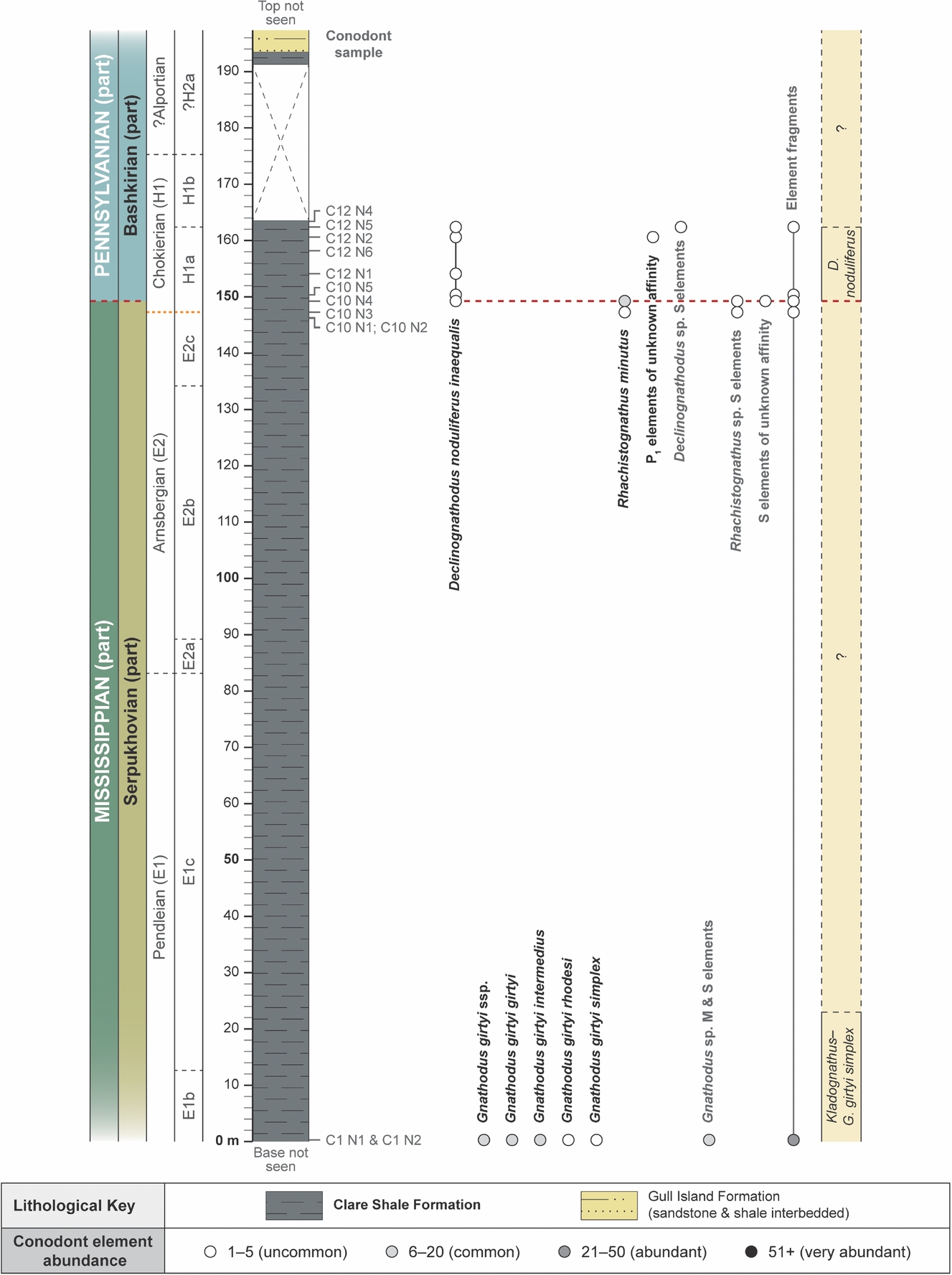
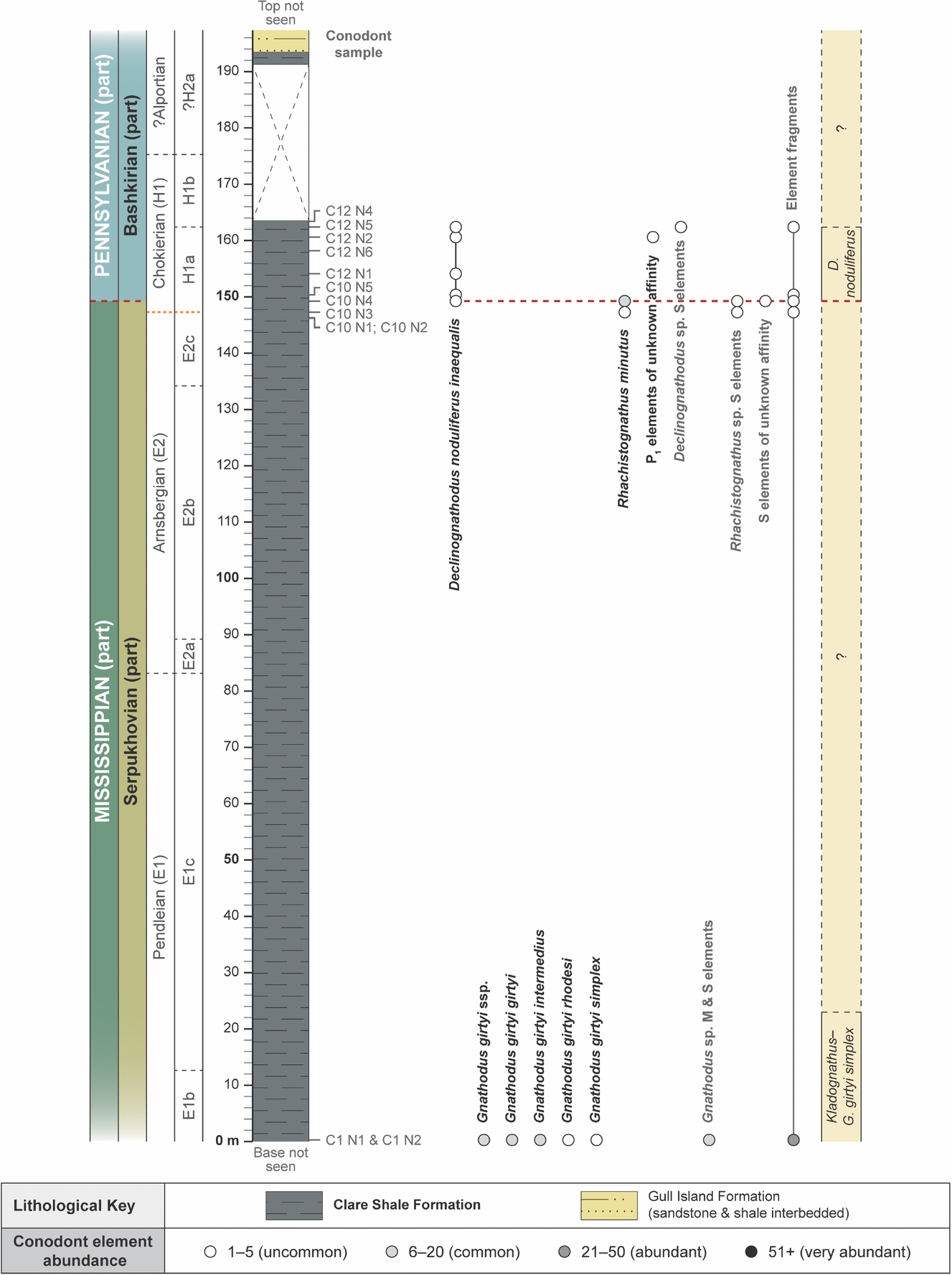
Conodont element ranges within the measured section at Inishcorker, Killadysert, Co. Clare. A general correlation of the measured section with the goniatite bands recorded by Hodson & Lewarne (Reference Hodson and Lewarne1961) is shown. Columns on the left record (from left to right) the Subsystem, Stage, Regional Substage and Ammonoid Biozone. The column on the right illustrates the Conodont Biozones recognized here. The lowest Isohomoceras subglobosum goniatite band (the Arnsbergian–Chokierian boundary) identified by Hodson & Lewarne (Reference Hodson and Lewarne1961) is highlighted with a dashed orange line. The first occurrence of Declinognathodus noduliferus inaequalis, and therefore the mid-Carboniferous Boundary, is indicated with a dashed red line.
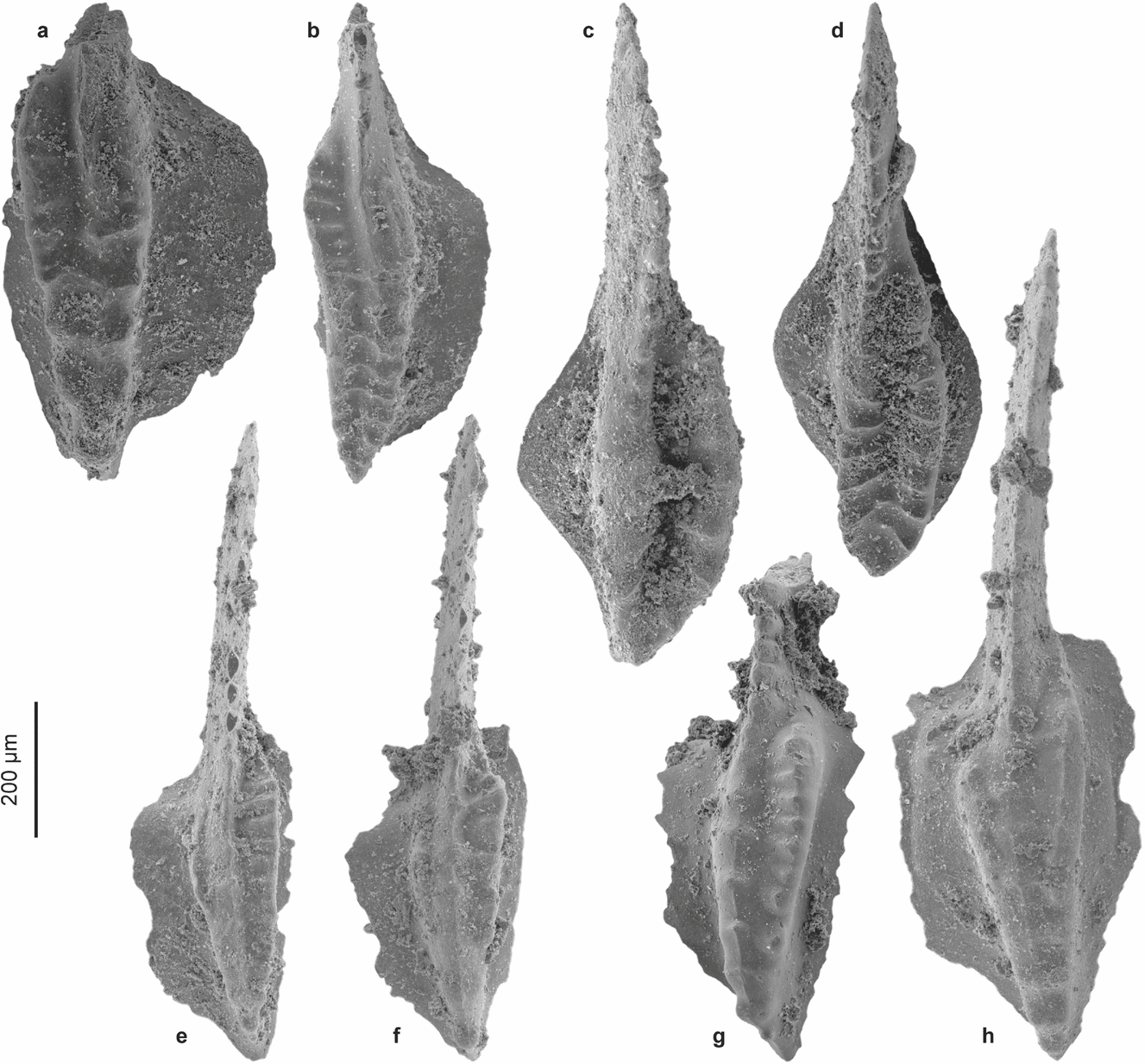
Oral views of selected P1 conodont elements from the Clare Shale Formation at Inishcorker, Killadysert, Co. Clare, Ireland. (a, b) Declinognathodus noduliferus inaequalis (Higgins, Reference Higgins1975), (a) sample C10 N4, cat. no. JMM.PF6.D6, (b) sample C12 N2, cat. no. JMM.PF8.C3; (c, d) Rhachistognathus minutus (Higgins & Bouckaert, Reference Higgins and Bouckaert1968), (c) sample C10 N3, cat. no. JMM.PF6.C2, (d) sample C10 N4, cat. no. JMM.PF6.D4; (e) Gnathodus girtyi girtyi Hass, Reference Hass1953, sample C1 N2, cat. no. JMM.PF8.A4; (f) Gnathodus girtyi rhodesi Higgins, Reference Higgins1975, sample C1 N2, cat. no. JMM.PF8.A9; (g) Gnathodus girtyi simplex Dunn, Reference Dunn1966, sample C1 N2, cat. no. JMM.PF7.A1; (h) Gnathodus girtyi intermedius Globensky, Reference Globensky1967, sample C1 N2, cat. no. JMM.PF8.A19.

Three conodont genera are present in the Inishcorker section: Declinognathodus, Gnathodus and Rhachistognathus. A total of six conodont species/subspecies are identified and two Conodont Biozones are recognized in this section: the Kladognathus–Gnathodus girtyi simplex Biozone in the Serpukhovian deposits and the Declinognathodus noduliferus Biozone in the Bashkirian deposits (Fig. 8).
The lower part of the studied section at Inishcorker belongs to the Kladognathus–G. g. simplex Biozone. The lower limit of this biozone could not be constrained within this section as the precise location of the FOD of G. g. simplex could not be determined. Only four elements of G. g. simplex were recovered from a single sample (C1 N2; Fig. 9g) taken from the base of the measured section (Fig. 8), which correlates to the E1b Ammonoid Biozone as determined by Hodson & Lewarne (Reference Hodson and Lewarne1961). This corresponds to the generally accepted range of this conodont biozone between the bases of the E1a and E2a Ammonoid Biozones. Without material below and above this horizon, however, a more definitive statement on the full stratigraphic extent of this biozone cannot be made. No specimens of G. b. bollandensis have been recovered from this section and the upper limit of the Kladognathus–G. g. simplex Biozone could therefore not be constrained at Inishcorker.
In the Inishcorker section the base of the D. noduliferus Biozone, and therefore the mid-Carboniferous boundary, is marked by the FOD of D. n. inaequalis in sample C10 N4 (c. 149.2 m ABS) (one P1 element; see Fig. 9b), within the H1a Ammonoid Biozone as determined by Hodson & Lewarne (Reference Hodson and Lewarne1961). This horizon lies c. 1.9 m stratigraphically above sample C10 N3, which is the lowest Isohomoceras subglobosum goniatite band (the Arnsbergian–Chokierian regional substage boundary) recorded by Hodson & Lewarne (Reference Hodson and Lewarne1961). The Arnsbergian–Chokierian boundary identified using ammonoids, and the mid-Carboniferous boundary identified on the basis of conodont elements, are therefore apparently not coincident in this section. D. n. inaequalis extends up to sample C12 N5 (c. 162.4 m ABS), which possibly corresponds to the horizon where Hodson & Lewarne (Reference Hodson and Lewarne1961) recorded Homoceras beyrichianum. The D. noduliferus Biozone may therefore extend to be the base of the H1b Ammonoid Biozone at Inishcorker (Fig. 8); however, as no specimens of Idiognathoides corrugatus have been recovered, the upper limit of the former conodont biozone could not be constrained.
4. Discussion
4.a. The mid-Carboniferous boundary in Western Ireland
At Ballybunion, the FOD of D. n. inaequalis (Fig. 7b; sample BBN N12) occurs at the lowest I. subglobosum goniatite band identified by Kelk (unpub. Ph.D. thesis, University of Reading, 1960; see Fig. 6). The Arnsbergian–Chokierian boundary (on the evidence of ammonoid faunas) and the mid-Carboniferous boundary (as determined using conodont elements) are therefore apparently coincident within the Ballybunion section. In contrast, at Inishcorker the first occurrence of D. n. inaequalis in sample C10 N4 lies c. 1.9 m stratigraphically above the lowest I. subglobosum goniatite band recorded by Hodson & Lewarne (Reference Hodson and Lewarne1961). The Arnsbergian–Chokierian boundary and the mid-Carboniferous boundary are therefore apparently not coincident in this section. This is broadly similar to the placement of the mid-Carboniferous boundary at Stonehead Beck, England (the location of the Arnsbergian–Chokierian boundary Stratotype), where the first occurrence of D. n. inaequalis is recorded 9.4 m above the Arnsbergian–Chokierian boundary and 0.4 m beneath the second I. subglobosum (H1a2) goniatite band (Riley et al. Reference Riley, Varker, Owens, Higgins, Ramsbottom, Brenckle, Lane and Manger1987; Varker et al. Reference Varker, Owens and Riley1990; Varker, Reference Varker1994).
Rhachistognathus minutus first appears in the Inishcorker section coincident with the lowest I. subglobosum goniatite band of Hodson & Lewarne (Reference Hodson and Lewarne1961) and extends to the first occurrence of D. n. inaequalis. This is also broadly in agreement with the biostratigraphic distributions observed at Stonehead Beck, where the first occurrence of R. minutus is recorded towards the top of the E2c Ammonoid Biozone and extends past the first occurrence of D. n. inaequalis to the base of the H1a3 Ammonoid Biozone (Varker et al. Reference Varker, Owens and Riley1990; Varker, Reference Varker1994).
There is, however, some uncertainty as to the identification of the bases of the ammonoid and conodont biozones at both Ballybunion and Inishcorker, and indeed at Stonehead Beck. Correlation of the mid-Carboniferous boundary with the lower I. subglobosum horizon at Ballybunion and 1.9 m above this biostratigraphic datum at Inishcorker implies a diachronous base for the Chokierian substage, which is by definition impossible. Once a GSSP has been ratified, correlation to it should be made using any available tool, irrespective of the precise biostratigraphical tool originally used to establish the GSSP. It should also be imperative that the mid-Carboniferous boundary be identified at the same horizon in two sections from a single basin. The number of conodonts recovered from the lower I. subglobosum horizon (sample C10 N3) at Inishcorker is such that the probability of finding Declinognathodus (based on numbers from the sample C10 N4) is low. The presence of unsuitable lithologies for conodont element processing below the FOD of D. n. inaequalis at Inishcorker and Stonehead Beck, and also the limited numbers of conodont elements recovered from nodule sample C10 N3, could therefore have produced an artificial offset of the two boundaries. D. n. inaequalis, and therefore the mid-Carboniferous boundary, may indeed occur in the earliest I. subglobosum horizon at Inishcorker; however, with the limited data available and no additional calcareous nodules available to process, this hypothesis remains difficult to test.
Alternatively, it is possible that I. subglobosum occurs earlier at Ballybunion than the biostratigraphic level determined by Kelk (unpub. Ph.D. thesis, University of Reading, 1960), which would therefore reproduce the offset between the Arnsbergian–Chokierian and mid-Carboniferous boundaries. A careful reassessment of the ammonoid biostratigraphy at Ballybunion, which is outside the scope of the present study, is necessary to either prove or dismiss this contention.
4.b. The nature of the Gnathodus–Declinognathodus transition
Grayson et al. (Reference Grayson, Merrill and Lambert1990) demonstrated that non-P1 elements, specifically P2 elements, can prove useful in the assessment of hypotheses of conodont phylogeny and thereby advocated the derivation of D. noduliferus from the G. bilineatus clade. In the course of this investigation in the Shannon Basin region, only five poorly preserved P2 elements could be tentatively assigned to the genus Gnathodus while those belonging to Declinognathodus were not encountered. The general paucity of non-P1 elements, resulting in a lack of ‘expected’ multi-element ratios, is an interesting finding as the Clare Shale Formation is characterized by uniformly very fine-grained sediment. This would suggest extremely low bottom current activity, with the sediment typically interpreted as having been deposited in anoxic conditions (which would limit bioturbation). Both of these factors should have acted to limit post-mortem disturbance and sorting of dissociated conodont elements, but clearly this is not the case. Biostratinomic considerations aside, the low number of non-P1 elements recovered may be a sample processing artefact. Given the relatively low carbonate content of some of the nodules, it could be that the thinner, more delicate conodont elements simply did not survive the etching process. It should be noted, however, that signs of acid etching was generally not observed on recovered P1 elements. Instead, poor preservation was commonly attributable to either residual surficial encrustation with rock matrix or physical breakage of elements.
P1 elements belonging to G. girtyi, including G. g. simplex (Fig. 9g), were recovered from the lowermost Serpukhovian deposits (E1b Ammonoid Biozone: Pendleian) at Inishcorker (Figs 8, 9e–h; see also supplementary Table S6, available at http://journals.cambridge.org/geo). The last occurrence of this species could not be constrained within this section because of a large stratigraphic interval devoid of calcareous nodules (see Fig. 8). The complete lack of P1 elements belonging to G. girtyi at Ballybunion (Fig. 6) however suggests that the last occurrence of this species was prior to E2b times in the Shannon Basin region. Unless D. noduliferus developed from G. girtyi stock in a completely separate geographic location and subsequently migrated back into the basin, coincident with the base of the Bashkirian, this evolutionary pathway therefore seems unlikely.
In contrast, a relatively large number of G. b. bollandensis P1 elements were recovered and extend to over halfway through the E2c Ammonoid Biozone (Arnsbergian) at Ballybunion, almost to the FOD of D. n. inaequalis. This supports the hypothesis that the former species was ancestral to the latter. A similar conclusion was reached by Varker (Reference Varker1994), who also found G. g. simplex to be absent from all sampled horizons at Stonehead Beck.
Only one P1 element of G. postbilineatus (Fig. 7g) was recorded from the E2b Ammonoid Biozone at Ballybunion and none belonging to D. praenoduliferus were recovered. Riley et al. (Reference Riley, Claoué-Long, Higgins, Owens, Spears, Taylor and Varker1994) also noted a lack of D. praenoduliferus at Stonehead Beck, which these authors attribute to a c. 11.7-m-interval impoverished in conodont elements, occurring between the highest recorded specimens of G. bilineatus and G. postbilineatus and the FOD of D. n. inaequalis. The lack of biostratigraphic data from both the Irish and British sections makes testing the proposed evolutionary hypothesis of Nemirovskaya & Nigmadganov (Reference Nemirovskaya and Nigmadganov1994) very difficult; however, if it is valid then the G. b. bollandensis – G. postbilineatus transition must have occurred by the E2b Biozone (at the latest), followed by the G. postbilineatus – D. praenoduliferus transition at some time prior to the D. praenoduliferus – D. noduliferus transition at the mid-Carboniferous Boundary.
Sanz-López & Blanco-Ferrera (Reference Sanz-López and Blanco-Ferrera2013) have suggested that the presence of D. bernesgae in the upper Arnsbergian (Serpukhovian) deposits within the Barcaliente Formation in the Cantabrian Mountains, NW Spain, marks the first appearance of the D. noduliferus group after its evolution from G. postbilineatus. No P1 elements of D. bernesgae were retrieved during this current study. The D. noduliferus group therefore first appeared in the Shannon Basin region in Western Ireland with the FOD of D. n. inaequalis in the lowermost Bashkirian deposits.
5. Conclusions
The biostratigraphic ranges of conodont elements from two sections through the Clare Shale Formation, spanning the mid-Carboniferous boundary in the Shannon Basin in Western Ireland, have been presented here for the first time. At Inishcorker, the mid-Carboniferous and Arnsbergian–Chokierian boundaries (as identified by conodont elements and ammonoids, respectively) are apparently offset. A similar offset has also been reported by previous workers at Stonehead Beck; these two boundaries are however coincident at Ballybunion, suggesting that the offset observed elsewhere may possibly be an artefact produced by sampling limitations.
In the Shannon Basin, elements assigned to G. girtyi are found to be apparently restricted to the lowermost Serpukhovian deposits, while those belonging to G. b. bollandensis extend much higher, almost to the first occurrence of D. noduliferus s.l. The inference that D. noduliferus s.l. was ultimately derived from G. b. bollandensis therefore appears to be the most parsimonious interpretation. This shift was possibly initially achieved through an intermediary evolutionary transition to G. postbilineatus and then D. praenoduliferus; however, further studies are necessary to establish the full and precise stratigraphic ranges of these two species in this part of Western Europe. Further consideration of the phylogeny and biostratigraphic ranges of all of these important conodont genera and species would be greatly enhanced by establishing the entire multi-element composition of their apparatuses.
The correlation of the mid-Carboniferous boundary worldwide has been stated to depend on identification of the first appearance of D. noduliferus s.l. in an evolutionary transition from G. g. simplex, an evolutionary history which this and other studies suggest is not applicable to Europe. This report therefore agrees with Sanz-López et al. (Reference Sanz-López, Blanco-Ferrera, García-López and Sánchez de Posada2006) that the mid-Carboniferous Boundary definition as currently recognized is not appropriate for the recognition of this important subsystem boundary both regionally and, indeed, globally. The suitability of the Arrow Canyon section as a Global Boundary Stratotype Section and Point for the mid-Carboniferous may therefore need to be reassessed in the future.
Acknowledgements
The authors acknowledge the facilities and scientific and technical assistance of Pierce Lalor of the Centre for Microscopy & Imaging at the National University of Ireland, Galway (www.imaging.nuigalway.ie), a facility that is funded by NUIG and the Irish Government's Programme for Research in Third Level Institutions, Cycles 4 and 5, National Development Plan 2007–2013. This research was supported by an NUI Galway College of Science Postgraduate Research Scholarship, the NUI Galway Thomas Crawford Hayes Trust Fund Scheme and the IGA-CRH Postgraduate Travel & Research Grant. Finally, we wish to thank George Sevastopulo and an anonymous reviewer for very useful comments, which greatly improved this manuscript.
Supplementary material
To view supplementary material for this article, please visit http://dx.doi.org/10.1017/S0016756815000072