Introduction
While illuminating and justifying the contemporary appreciation of Edward Bulwer's early novels, Richard Henry Dana discerns in his Harvard thesis of 1837 a Bulwerian strategy that he would employ himself in Two Years Before the Mast. Both the undergraduate thesis and Two Years derive from the experiences of Dana's famous voyage, which have led him to recognise the power of literature to exercise a moral force. In the practice of Bulwer, which Dana would seek to emulate, literature becomes a means for liberating voices that the predominating social forces have been hitherto suppressing.
In embarking on his voyage in 1834, Dana did not expect his adventures to produce a book or indeed to involve any literary component. He was dropping out from his undergraduate course of study at Harvard because he was sick of books and of civilization more generally and suffering from a psychosomatic visual ailment that made reading painful. No books accompanied him, and he looked forward to regaining health during a prolonged period of purely physical activity. The climate of ship-board life under the command of a tyrannical captain worsened, however, until at a moment of crisis the captain unfairly and cruelly flogged two of Dana's shipmates. In revulsion against the revelation of the bestiality lurking within human nature, Dana began to long for the civilization that he had left behind in Boston. Whereas he had up till now wished to prove himself simply the accomplished sailor, a nostalgia for the repressed identity of the Harvard scholar asserted itself ever more fervently. A metaphorical “thirst,” as he calls it in Two Years, for books unexpectedly assailed him, and he began to ask sailors on his and other ships for books that he could borrow and read. A principal activity became the reading of books, both to himself and aloud to his shipmates, and the memorizing of long passages that could be recalled when standing watch.
The literary dimension compensated for the misery of much of his nautical experience, and among the works that offered particular pleasure were novels by Sir Walter Scott and William Godwin. The most joyful moment of the entire two-year voyage occurred, however, with the discovery at the half-way point in September 1835 of a novel by another author. In characteristic need of fresh reading material, he had “overhauled the chests of the crew.” Nothing had quite suited him until one of the men mentioned his possession of “a book which ‘told about a great highwayman,’ at the bottom of his chest”:
I found, to my surprise and joy, that it was nothing else than Bulwer's Paul Clifford. This, I seized immediately, and going to my hammock, lay there, swinging and reading, until the watch was out. The between-decks were clear, the hatchways open, and a cool breeze blowing through them, the ship under easy way, and everything comfortable. I had just got well into the story, when eight bells were struck, and we were all ordered to dinner. After dinner came our watch on deck for four hours, and, at four o'clock, I went below again, turned into my hammock, and read until the dog watch. As no lights were allowed after eight o'clock, there was no reading in the night watch. Having light winds and calms, we were three days on the passage, and each watch below, during the daytime, I spent in the same manner, until I had finished my book. I shall never forget the enjoyment I derived from it. To come across anything with the slightest claims to literary merit, was so unusual, that this was a perfect feast to me. The brilliancy of the book, the succession of capital hits, lively and characteristic sketches, kept me in a constant state of pleasing sensations. It was far too good for a sailor. I could not expect such fine times to last long. (Dana, Two Years 188–89)
The description indicates his development of a critical capacity to appreciate “literary merit,” and after returning home a year later, he eagerly read other books that were “far too good for a sailor.” His undergraduate career at Harvard culminated with a brilliant last year devoted primarily to literary studies and with graduation at the head of his class. Inspired by the discovery aboard ship of Paul Clifford, the topic chosen for his senior honours thesis was “The moral & literary character of Bulwer's novels.” The academic exercise, which earned the Bowdoin prize for “dissertations in English” at Harvard in 1837, may be considered the first literary product of Dana's voyage. It prefigured in preparatory respects the literary masterpiece, Two Years Before the Mast, on which he would soon thereafter begin to work.
Apart from its relevance to Two Years, to which I shall return, the thesis naturally interests us as a revelatory specimen of contemporary academic practice at Harvard. We observe the absence of any scholarly apparatus – notes and bibliography. Quotations are often imprecise, and the text contains inconsistently used abbreviations and many crossed out words and passages. The paragraphing appears uncertain. Dana sometimes begins sentences on a new line without any indentation as if he were creating bodies of text that are to be considered units but not complete paragraphs in their own right.
Yet the argument advances in terms of a clear organisation, and it contains astute observations with many telling quotations from Bulwer's works. The observations sometimes arrive unexpectedly in their references to particular details that we have probably overlooked or forgotten. They are less random than may at first appear, for they serve Dana's purpose of illustrating certain very specific and admirable qualities of Bulwer's style. In differing from our reading of Bulwer, Dana's certainly valid approach may indeed challenge and stimulate us. Historical in his treatment of the current “novel writing age,” Dana defines the significance of Bulwer for readers during the interregnum of 1832–1837, between the death of Scott and the first novels of Charles Dickens. Although the thesis cannot of course take account of Dickens, whose novels Dana would later value highly, it does devote initial attention to the works of Scott.
Dana appreciates Bulwer, as his title suggests, for both his moral and his literary qualities. To comment first on the discussion of literary merits, even though Dana considers them last, I would point out Dana's subtly qualified praise. Bulwer's insight into human nature “arouses our wonder,” for it enables him to draw highly individualised and complex characters, no two of which are alike. Events also occur in physical surroundings that are entirely particularised and memorable in their felt concreteness. The narrative pace carries the reader steadily and exhilaratingly forward in a movement that Dana compares wittily to that of Lord Mauleverer's coach horses in Paul Clifford. Even more impressive for Dana is the sense of a brilliant and restless intelligence that continually throws out clever remarks: “There are few men living who have said a greater number of clever things than Bulwer.” That the “brilliant” manner is often “careless” may provoke an uneasiness, which does not, however, cancel Dana's admiration: “there is something so brilliant, so vigorous, so spirit stirring, & to use a word wh he uses rather too often, so racy, in his style, that, although it may be an unsafe model for imitation, yet it cannot but be a worthy subject of admiration.” To Paul Clifford, which possesses “exceeding cleverness” but not “a high order of genius,” Dana nevertheless prefers Eugene Aram, which lacks the cleverness but exemplifies the “highest order of genius.” The genius may relate, however, more to the moral than to the literary dimension.
The moral climate of the times, Dana believes, has been characterised by hypocritical “complacency.” As a reflection of this climate in literature, the novels of Maria Edgeworth in particular have conveyed “the still industry of the school room, & the quiet tones of those who would represent the world as being all that it should be”: “Miss Edgeworth, with all the quiet industry of a spinster with her wheel, sitting by the domestic fire side, has woven a veil wh. has been spread before the eyes of the rising generation. They have been taught to believe that the whole world lieth in light.” The novels of Bulwer have served then to “lift” a “veil wh ought to be lifted” and to show the darkness. Bulwer “has made a disclosure, he has recalled the world to a sense of what sin & misery there is in the very midst of it.” The historical greatness of Bulwer's literary breakthrough derives from his having pursued the task in solitude, as the first artist to dare as much. Treading his path “nearly alone,”
[h]e has carried us into the haunts of the low & abandoned poor, who live in a midnight darkness in the midst of the great literary & intellectual metropolis of Christendom. He is the first, we believe, who has introduced these characters with their shocking & revolting habits, & peculiar dialect, into the literary world. It is like a glimpse at the infernal regions.
Although Dana also mentions Bulwer's exploration of another moral wasteland in fashionable high-life, the descent into the “infernal” underworld of poverty and crime fascinates him far more. Contradicting an often expressed (and mistaken) opinion about Bulwer's pandering to popular tastes, Dana emphasises that Bulwer gives his readers a salutary shock by making them see what they have not wanted to see. Modern readers who may be inured to the horror of such glimpses of hell have usually ascribed the originality of Paul Clifford to its being “the first important Tendenzroman [novel of purpose] in Britain” (Christensen, Bulwer 225). Dana's reaction offers instead a valuable indication of the utter dismay, albeit tempered by aesthetic delight, that Bulwer's revelations provoked in many of his first readers.
Another instructive and possibly surprising aspect of Dana's commentary is the notion that no particular moral purpose motivated Bulwer's horrifying disclosures. Bulwer did not himself possess strong moral principles and seems rather to have enjoyed his experiences in the underworld in a relationship of complicity with criminals. So his disclosures are given cynically “with an hardened & scoffing spirit” because it amuses him to act as “an accomplice who has turned State's evidence.” Despite the lack of moral intention, however, Bulwer's disclosures have produced profoundly moral results: they have “conduced to the great ends of truth & justice.” Like Byron, he has sometimes been in league with the devil but has also exposed, implacably, the devil's deformities. Bulwer has simultaneously attacked or betrayed, therefore, both the devil of the underworld and the complacent denizens of polite society that have wished to avoid confronting the devil, who is also within themselves. In observing this double nature of Bulwer's attack, Dana has also anticipated Jonathan Grossman's recent argument that Paul Clifford offers its readers “an epiphany in perspective”: instead of seeing a moral opposition between the worlds and between the figures of “criminal and judge,” readers “see analogues, likeness not only of external qualities but of internal ones” (71).
Besides serving the “ends of truth & justice,” Bulwer's works perform a moral function by awakening the reader's “feeling of his higher nature.” The “higher nature” is not synonymous with the morally virtuous self. Individuals whose minds entertain “lawless & irreverend [sic]” thoughts and whose “conduct” is “far from moral rectitude” may “yet seem more conscious of their higher nature than others.” The darker energies and longings at work in that nature “stir up the great elements of our being” and arouse impressions of “infinity & eternity.” The reader recognises his own psychic heights or depths particularly in confrontations with criminal passions. In showing the “grand, mysterious, & lofty character” of the criminal, Eugene Aram is not, in Dana's reference to the current controversy about the novel, a “dangerous” work. It stirs the reader to “profitable reflection” and lifts him out of the trite world of easy and complacent moralising.
Dana may have been the first reader to discern, with remarkable keenness, the moral truth about Bulwer's artistry that Bulwer would later claim for himself. Although Dana's notion about Bulwer's lack of moral principles may not have pleased the novelist, he would have approved Dana's observations about how his novels did after all exercise a moral function. In the 1845 Preface to Night and Morning [Reference Bulwer1841], Bulwer too would describe his novels as exploring “rarely trodden” regions, lying “beyond that range of conventional morality in which novelist after novelist had entrenched himself.” Similarly to Dana's reference to lifting the veil, Bulwer maintains, “I have sought to lift the mask from the timid selfishness which too often with us bears the name of respectability.” In the unmasking, the confrontation with criminality achieves, according to the Epilogue to Part II of Lucretia [Reference Bulwer1846], the grandest moral effects: “It is well to be awakened at times from the easy commonplace that surrounds our habitual life – to cast broad and steady and patient light on the darker secrets of the heart – on the vaults and caverns of the social state over which we build the marketplace and the palace.”
Night and Morning and Lucretia were published during the decade that succeeded Dana's thesis, but in fact the first nine of Bulwer's novels would have been available to Dana in 1837. We may wonder then why he limited his discussion to just three works – Pelham [Reference Bulwer1828], Paul Clifford [Reference Bulwer1830] and Eugene Aram [Reference Bulwer1832] – with a brief reference to The Disowned [1828]. The reasons are probably a limitation upon the length of undergraduate theses and the nature of Dana's argument. For while Dana's argument applies to all of Bulwer's works, the three novels chosen do serve to illustrate the points more explicitly than novels like The Last Days of Pompeii [1834] or Rienzi [1835] would have done.
To return finally to the sense in which Dana's thesis prepares the way for Two Years Before the Mast, I suggest that Bulwer's “disclosures” and lifting of the veil resemble the action of Dana's book. Dana considered himself to be, like Bulwer, a pioneer in displaying to public view what I have called elsewhere a region “up till now hidden from . . . polite society”: “In the italicised phrase of the preface that serves as subtitle for many editions, [Two Years] makes heard for the first time in print, Dana believes, ‘a voice from the forecastle’” (Christensen, “Textual Voyages” 283). Just like the underworlds of Bulwer, the degraded environment in which merchant-seamen suffer exploitation and violence is an inferno, the existence of which the readers of Miss Edgeworth have wished to ignore. The novels of Bulwer have thus provided Dana with a model for a literary narrative that could courageously reveal and liberate energies subversive of hypocritical respectability. And Dana's book has provided in its turn a model for the continuation of the noble endeavour in the works of Herman Melville and Joseph Conrad.
Besides its subversive disclosures, Two Years narrates the discovery or the stirring into being of Dana's own “higher nature,” which he also terms “my better nature.” The ghastly episodes of brutality and violence and the reflections upon mortality, as when he meditates at the lonely grave of a ship's captain, a suicide, induce a heightened awareness of his human value: “My better nature returned strong upon me. . . . I experienced a glow of pleasure at finding that what of poetry and romance I ever had in me, had not been entirely deadened by the laborious and frittering life I had led” (Two Years 144). To such an awareness of the non-“deadened” “poetry and romance” within himself the work of Bulwer has also made its precious contribution.
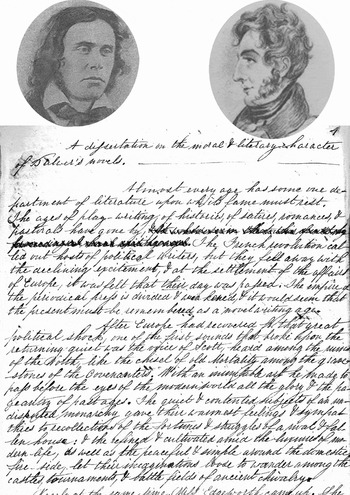
In the transcription that follows of Dana's thesis, I have attempted to reproduce to the extent feasible and with only occasional editorial corrections, in brackets, the features of the handwritten manuscript (See Figure 37). An exception to this practice, however, is my silent correction of the spelling of Bulwer's name, which Dana consistently misspells, except in the title itself, as “Bullwer.” I have not, except in one instance, indicated the occurrences of crossed out words and phrases. In most cases it proves difficult to decipher what has been crossed out. This edition of the thesis is published with the permission of the Massachusetts Historical Society, Boston, in whose archives the papers of the Dana family are deposited.
Digital photo-collage by Allan C. Christensen and Philip Rand. On the left: Portrait of Richard Henry Dana, Jr., from Charles Francis Adams, Richard Henry Dana: A Biography (Boston: Houghton, Mifflin, 1890), frontispiece. On the right: Emery Walker, photograph of Robert M. Sully's portrait of Edward Bulwer, circa 1828, from Victor Alexander, Earl of Lytton, The Life of Edward Bulwer, First Lord Lytton, Vol. 1 (London: Macmillan, 1913), 254. Below: Manuscript page, “Moral & Literary Character of Bulwer's Novels” by Richard Henry Dana, Jr., from the Dana Family Papers, with permission of the Massachusetts Historical Society.

A dissertation on the moral & literary character of Bulwer's novels
Almost every age has some one department of literature upon which its fame must rest. The ages of play-writing, of histories, of satire, romances, & pastorals have gone by. The French revolution called out hosts of political writers, but they fell away with the declining excitement, & at the settlement of the affairs of Europe, it was felt that their day was passed. The empire of the periodical press is divided & weakened, & it would seem that the present must be remembered as a novel writing age.
After Europe had recovered fr. that great political shock, one of the first sounds that broke upon the returning quiet was the voice of Scott, heard among the ruins of the North, like the child of old Mortality among the gravestones of the Covenanters. With an inimitable art he made to pass before the eyes of the modern world all the glory & the pageantry of past ages. The quiet & contented subjects of an undisputed monarchy gave their warmest feelings & sympathies to recollections of the fortunes & struggles of a rival & fallen house: & the refined & cultivated amid the luxuries of modern life, as well as the peaceful & simple around the domestic fire-side, let their imaginations loose to wander among the castles, tournaments, & battle fields of ancient chivalry.
Nearly at the same time, Miss Edgeworth came up. She describes modern life entirely. For her events she goes no farther than her own age; for her characters, no farther than her own clime; &, some will say, for her morality, no farther than her own idea of policy. Without either the sentiment or the imagination of Scott, she has yet a masterly power in delineating & dissecting character & motives, & is wonderful in conversation, & in all the machinery of fashionable life. Yet the world was not satisfied with this. The intense excitement produced by the infidel & radical doctrines of the French revolution had subsided, & the age was willingly held bound for a time by the “Wizard of the North[”], & built castles, & fought battles in the air; & for a time they were held fast to the apron-string, & taught that honesty is the best policy, & that the world is a great school-room, & every man his own teacher. But this could not satisfy them. It was felt that that quiet & every day morality wh. was composed of detached motives & duties whose very essence was continuity; & wh was to be obtained & practised independently of God or religion, would not stand when the rains descended & the floods came; & that even in the common course of life, sin, selfishness, corruption, & violence, were reigning over the minds of thousands. It was felt that the world was not that flower garden in wh we had nothing to do but to prune the defects & rear up & train the virtues; but that there were deserts, & forests with their beast of prey – that birds of prey were in the air, & that every green thing might be the covert of a venomous reptile.
At this time Bulwer appeared with his first novels, whose scenes are laid in the extremes of high & low life. That he is a man without principle appears upon the face of his writings, yet his disclosures are like the confessions of an accomplice who has turned State's evidence. It may have been better for the reputation of all parties concerned, &, as some would say, better for the audience that the evil should have been kept out of sight; yet although the testimony itself may have removed no evil & provided no remedy, & may have been given with no such intention, but even with an hardened & scoffing spirit; yet it conduced to the great ends of truth & justice. He has made a disclosure, he has recalled the world to a sense of what sin & misery there is in the very midst of it. ——
In Pelham we have the heartless trifling, the glittering vanity, & the ornamented viciousness of high life. In Tyrrel, the abandoned & profligate gambler & debauchee; & in Reginald Glanville, the man of intellect & refinement, but the victim of ungoverned passion. A man who had made a hell of his own bosom, & whose mind was like the troubled sea wh cannot rest. But it is not merely in high life that he has given powerful exhibitions of character; there is another walk in life wh. he has trodden nearly alone. He has carried us into the haunts of the low & abandoned poor, who live in a midnight darkness in the midst of the great literary & intellectual metropolis of Christendom. He is the first, we believe, who has introduced these characters with their shocking & revolting habits, & peculiar dialect, into the literary world. It is like a glimpse at the infernal regions. The visit of Pelham to the haunt of the thieves & highwaymen, the house of “Brimstone Bess”, besides being one of the best scenes in modern novels, has a peculiar, a solemn, &, I believe, a moral effect. The low cunning of Job Johnson,Footnote 1 the drunken & beastly fury of Brimstone Bess, & the sufferings of the poor wretch whom disease, want, & the agony of an awakened conscience had reduced to partial insanity, tell a fearful tale of human life. It breaks in upon the still industry of the school room, & the quiet tones of those who would represent the world as being all that it should be, & who teach the all-sufficiency of human reason, like the sound of distant thunder. We feel that a veil has been lifted fr before our eyes; & a veil wh ought to be lifted. Miss Edgeworth, with all the quiet industry of a spinster with her wheel, sitting by the domestic fire side, has woven a veil wh. has been spread before the eyes of the rising generation. They have been taught to believe that the whole world lieth in light, that it hath nothing to do but to inform itself, & to make the best use of its time & opportunities; all wh. will be an easy & a delightful task. ——
As it is better to go to the house of mourning than to the house of feasting; so a book wh shall show us the vanity & corruption of the high, & the degradation & misery of the low – wh shall convince us that the world is full of sin & suffering, wh is near us, even at our doors; may do more to give us a right knowledge of human nature & to make us truly wise, than one wh shall please & instruct, but leave us satisfied & complacent.
There are some minds wh, though far fr virtue, yet seem more conscious of their higher nature than others. Although they may be far fr moral rectitude in their conduct, & their thoughts may often be lawless & irreverend [sic], yet no one can read them without being reminded that he has an immortal nature, & that there are such things as infinity & eternity. Though fallen themselves yet
They stir up the great elements of our being, & he who in the multitude of his thoughts within him, does not find something to make him a more humble, if not a more virtuous man, must be hardened indeed. But those who are called the moral writers of the age (because they do not advocate immorality) would, most of them, hardly lead you to suspect that there was anything beyond this world. Scott sometimes alludes to religion; but it is always in its outward relations; when it is connected with any imposing ceremony of worship, or when it adds beauty & refinement to the female character; & Miss Edgeworth, if I mistake not, hardly alludes to it at all; & even the name of the Supreme Being is scarcely to be found in those tales wh are used as text books of education. Scott is even much of a latitudinarian & exceedingly good humoured whenever he falls in with evil. ——
It may be said that although this may be all true of the writers whom we have mentioned, yet we have only endeavoured to excuse Bulwer of one fault, by convicting his cotemporaries of another. We admit that this is partially true. Bulwer possesses, at best, but a comparative morality; yet this is the very point upon wh there seems to be the greatest dispute, & about wh, as we humbly believe, there has been much mistake. There is no novel writer of the present day who is a thorough & conscientious supporter of virtue & opposer of evil. Scott is very polite to the devil whenever he meets him, & Miss Edgeworth, like a good Quakeress, preserves an inoffensive neutrality, & keeps him well out of sight & out of mind; but Bulwer, like Byron, though he sometimes appears to be almost in league with him, yet at others, he exposes him in all his deformity.
We have nothing more to say upon the moral character of Bulwer's novels, except as we may do it incidentally, when speaking of their literary merit. Of this we presume there can be little doubt. There are indeed some who have formed their tastes upon the simple & even purity of writers of Queen Anne's time, who are agitated & offended by something which strikes them as exaggerated & ambitious – & he has these faults. Yet there is something so brilliant, so vigorous, so spirit stirring, & to use a word wh he uses rather too often, so racy, in his style, that, although it may be an unsafe model for imitation, yet it cannot but be a worthy subject of admiration. No man has ever drawn the complete dandy better than he, & he is equally successful in every kind of fashionable scene & dialogue. We have spoken before of his power in describing the characters, language, & habitations of the abandoned poor. Beside the character of Job Johnson & his confederates, & the scene at the house of Brimstone Bess, spirited as they are; the opening chapters of Paul Clifford are inimitable. The wret[c]hes who inhabit the presincts [sic] of Thames Court are given with a truth & minuteness wh. would seem to have come fr. personal inspection. They are not all alike ruffians, rogues, or brutes, but there is every variety & every nice shade of character. He never carries you into a room of wh, when you leave it you have not a distinct recollection. The common sitting room of the “Mug” with its low & smoke-dried walls, & the blanket hitched up for a screen, are as distinct to us as realities. Also the scraps of highwaymen's song & legends stuck up against the walls, & the ballad of “Sally” who
“loved a sailor lad,
“as sailed with famous Shovel”;Footnote 3 the print of the enormous ox raised by Mr. Fattem, grazier; & the wonderful account of the sudden & mysterious death of John Stiles who was struck dead by lightning while swearing a horrible oath, & who, when they came to examine him, had “swear not at all” stamped on the tail of his shirt. ——
Bulwer has an insight into the human character wh is intuitive, ready, & often calls out a feeling of wonder. Every person whom he describes is individual, consistent with himself, &, in surprisingly frequent instances, entirely new. There are few if any of his characters of whom any one can say “I think I have seen you before”. Tomlinson & Pepper, who are a couple of inimitables, & Lord Mauleverer in Paul Clifford; & even the incidental characters, like the hostler at the highwaymen's inn who gave Clifford his horse, & Mr. John Briggs, grocer, whom Pelham found sitting in the cool of the evening, in a blue coat & buff waistcoat, at the front of his snug little house, in the midst of his snug little property, contemplating the importance of John Briggs to the borough of B[u]yemall, & of the borough of B[u]yemall to the Kingdom at large.Footnote 4 These as well as scores of others are so many testimonies to the brilliancy, sagacity, & ready mother wit of the author. —— Footnote 5
What in the way of an incidental description can be better than the following – “Nothing, perhaps, could convey a more fitting picture of an aristocrat than a sight of Lord Mauleverer's thin fastidious features peering forth through the closed windows of his luxurious travelling chariot; the rest of the outer man being carefully enveloped in furs, half a dozen novels strewing the seat of the carriage, & a lean French dog, exceedingly like his master, sniffling in vain for the fresh air, wh. to the imagination of Mauleverer, was peopled with all sorts of asthmas & catarrhs! It was a fitting picture of an aristocrat for these reasons; it conveyed an expression of indolence, of unwholesomeness, of luxury, of pride, & of ridicule! . . . It was a frosty & a tolerably clear night. The dew of the twilight had melted away beneath the moon wh had just risen. On went the horses, briskly, their breath steaming against the fresh air, & their hoofs sounding cheerily on the hard ground. The rapid motion of the carriage – the bracing coolness of the night air – & the excitement occasioned by the anxiety & the forecast of danger, all conspired to stir the languid blood of Lord Maulever[er] into a vigorous & exhilarated sensation, natural in youth to his character, but utterly contrary to the nature he had imbibed fr. the customs of his manhood.” Lord Maulever[er] is a portrait throughout – even to his death, & in that there is something almost melancholy – Something wh, by a suppressed & almost imperceptable [sic] touch, reminds us of the vanity of worldly show. “Lord Mauleverer finally resolving upon a single life passed the remainder of his days in indolent tranquility. When he died the newspapers asserted that his Majesty was deeply affected by the death of so old & so valued a friend. His furniture & his wines sold remarkably well; & a great man, his particular intimate, who purchased his books, startled to find by pencil marks that the noble deceased had read [some] of them, exclaimed, not without truth, ‘Ah! Maulever[er] might have been a deuced clever fellow – if he had likedit !’”Footnote 6 ——
Paul Clifford is not a work of a high order of genius: its distinguishing mark is an exceeding cleverness. It moves forward like Lord Mauleverer's coach horses, & would stir the languid blood in the veins of any man. It abounds in happy hits, in characteristic descriptions, & has not a little that is even profound, though expressed in a brilliant, careless manner. There are few men living who have said a greater number of clever things than Bulwer.
The last novel in the series, &, though perhaps not the most brilliant, yet the best, is Eugene Aram. It is of the very highest order of genius. It has been said of Bulwer that he must always be in extremes – That he must have either the zest wh violence, lawlessness, & vice give to a picture, or the brilliancy & glitter of the other extreme of life – That he is an ignis fatuus wh shines only in a bad atmosphere: but this story gives the lie to all such assertions. Its scenes & characters are those of the middle & quiet walks of life. It is a grand conception, & the execution shews the author fully equal to it. The love of Madeline Lester, too, is of the highest order. It is not of the stuff of wh common love is made. It is full of soul. It was happy, confident, & all-engrossing, when all was happy & cheering about her – it supported in her sudden & hopeless fall, & grew more pure & more elevated as her hold upon life grew weaker & weaker. Her whole heart seems layed [sic] open to you, yet she is almost the only instance of a heroine in love who has not something wh might offend the most refined & fastidious.
In this work he has also some inimitable touches wh show his knowledge of life. The character & sayings of Corporal Bunting must be familiar to every one, yet I will give one extract for the sake of its deep satire upon human nature. “Knowledge of the world consists in knowing how to butter bread, & a man of the world knows wh side his bread's buttered. When I sees a man laying on the butter – knife steady – butter thick – hungry fellows standing by a licking chops – mothers saying to their brats – ‘see there child a respectable man! how thick his bread's buttered! take of[f] your hat to him!’ When I sees this my heart warms – there's a true man of the world.”Footnote 7 ——
Yet this is not carried too far. The Corporal's knowledge of the world, wh consisted of selfishness & suspicion, was sometimes at fault; as in the scene upon the road to Knaresboro’. Walter, with the Corporal for his servant, was travelling toward the town after dark, & was overtaken by Houseman, whom they both knew for a highwayman & an abandoned wretch, & asked to lend him his horse. Walter doubted, & Houseman continued riding at their side, beating & cursing the jaded beast that he rode upon, & saying that he had an only child – a daughter – lying at Knaresboro’ at the point of death. There was something in the countenance & tones of voice of the man wh. gave Walter an impression of his sincerity, & [he] dismounted & gave him his horse. The man uttered one word of thanks, promised to leave him at the inn, & plunging his spurs into his sides was out of sight in a moment. This was too much for the Corporal. He cursed the folly of his master, said it was “all sham”, & rode on to Knaresboro’ expecting to have his throat cut at every turn. On arriving at the inn, they found the horse there, & learned that the man had actually a child at the point of death. The Corporal knew the world, but he did not know human nature.
Bulwer is also very good in setting off natural grief against a hardened character. Houseman had placed his daughter under the care of the only relation of respectability wh. he had, & his only wish for her seemed to be that she might not turn out as he had – that she might be good & happy. When she died his grief turned to fury & he drove the women out of the house before him, saying that they had murdered her. He would not have them about him – “It is the prying, gossipping [sic] devil within ye that makes ye love to flock, & gape, & chatter while a poor man suffers.”Footnote 8 At length, seeing Walter & the clergyman he stopped short, & said – “If you are a clergyman, Sir; (& I think I remember your face, & Jane said you had been good to her). I wish you would go in & say a few words over her. And, harkee, Sir, don't bring in my name – it will do no good – & I don't want God to remember that there is such a man living”. ——
How characteristic is this of a man who is both afraid & ashamed of grief! “Why should death make such fools of us all? give me my hat & stick, woman! I'll take a walk. It's a fine day, Sir, don't you think it is – we shall have a late winter. Curse the woman, how long she is! I told her where they were. But when grief comes into a house, it puts all things into confusion. Don't you find it so, Sir?”Footnote 9
Whatever doubts & disputes there may have been about Aram himself, it is yet a grand, mysterious, & lofty character. There has been a great deal of censure upon the philosophising by wh he attempts to account for the commission of murder. It is certainly false philosophy, but I am not willing to say with some, that it is weak, or with a still greater number, that it is dangerous. The same censure has been passed upon a scene in the “Disowned”, where a man of character & education, reduced to beggary, with a wife dying fr. want – walking at night through the streets of that great city – hunger preying upon his body, & want coming upon him like an armed man, while thousands are about him with plenty & even luxury – attempts to convince himself that he may take relief by force. ——
There is one distinction wh. ought to be made here – viz. that the philosophy is no doubt false but the philosophising is true to nature. When the ignorant poor are turned fr their employ & are suffering, we are all prepared for violence & robbery. They feel their want & transgress at once, fr. impulse; while the intellectual man sins by a course of reasoning. The cause, the object, & the crime are the same in each case: the process only is different. These passages & numerous others in Bulwer's novels in wh. intellectual men are made to support fallacies to satisfy themselves in crime, are all proofs of the utter folly of depending upon theFootnote 10 intellectual without the religious cultivation. It is the theory of those who are called the moral writers of the day, only applied to men of strong passions, & in times of terrible temptation. The reasonings are false, it is true; but they are not weak, for they are true to human nature; & they are not dangerous, for their evident falsity would prevent any man fr. being deceived by them, & to the contemplative man, they are food for profitable reflection.
We have nothing more to say upon the moral & literary character of Bulwer's novels. As to their literary merit, we presume there are few who will not approve of what we have said upon that point; & as to their moral effect, we repeat that we do not think him a man of principle, but would simply ask any reflective man, who is a reader of Scott, Miss Edgeworth, & other popular writers, if he can come fr. Bulwer without having had at times awakened in him a feeling of his higher nature, at times a sense of the vanity of worldly things, & a lasting conviction of the weakness of human reason unsupported by a religious & moral cultivation.