Introduction
Cholesterol granuloma is an intractable ear disease. Many studies of this condition have been published since the first report by Manasse in 1917.Reference Manasse1 However, the pathogenesis of the condition is still unclear.
This study evaluated the treatment of middle-ear cholesterol granuloma.
Patients and methods
This study examined 16 cases of cholesterol granuloma which were treated surgically at the Kurume University department of otolaryngology and head and neck surgery between 1990 and 2006. We excluded patients with cholesterol granuloma complicated by chronic otitis media, and also those with cholesteatoma of the middle ear. All of included patients had cholesterol granuloma as the main lesion, and all of them undergone either mastoidectomy or tympanoplasty under hospitalization. Patients whose cholesterol granuloma had resolved after only tube insertion were excluded from the study. Patients comprised nine males and seven females, with ages ranging from nine to 78 years (mean age 36 years). The mean post-operative observation period was 825 days.
Patients' post-operative hearing test results were compared with their pre-operative tympanic membrane findings, surgical procedure and post-operative course. Patients' pre-operative tympanic membrane findings were classified as either swelling or retraction. Their post-operative hearing results were categorised based on the system of the Japanese Otological Society term committee;Reference Shambaugh2 a successful hearing outcome was defined as: (1) air–bone gap within 15 dB; (2) hearing gain more than 15 dB; and (3) hearing level less than 30 dB. The success rate was calculated from the number of the case who acquired success hearing/all cases.
Patients' hearing was evaluated pre-operatively, and their hearing success rates were evaluated at two weeks and one, three and six months post-operatively. When a tympanic membrane effusion was found post-operatively, the need for further treatment (e.g. myringotomy or tube insertion) was evaluated. Patients' pre-operative tympanic membrane findings and selected therapy were examined with regard to their post-operative course (classified as poor or good) and prognosis. A poor post-operative course was defined as one involving continuous otorrhoea from the ventilation tube, expulsion of the ventilation tube, or the need for more than two myringotomies.
Welch's t-test was used for statistical analysis. A value of p < 0.05 was considered to be significant.
Results
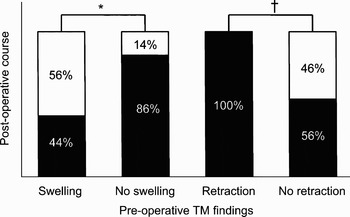
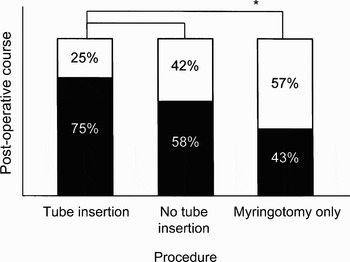
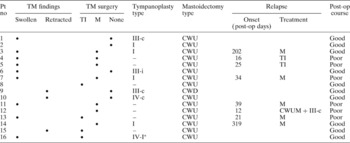
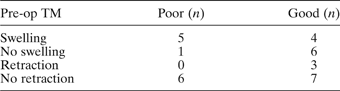
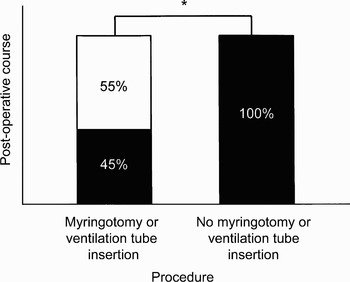
Patients' pre-operative tympanic membrane findings, surgical treatment and post-operative course are shown in Table I. Patients with a swollen tympanic membrane had a significantly poorer post-operative course, compared with those without swelling (p < 0.05; Figure 1 and Table II). On the other hand, patients with a retracted tympanic membrane had a significantly better post-operative course, compared with those without retraction (p < 0.01; Figure 1 and Table II). Only one of the patients experiencing a poor post-operative course had undergone tube insertion with mastoidectomy at the same time. There was no significant difference between the post-operative courses of patients with and without tube insertion. There were more poor outcomes among those patients undergoing only myringotomy, compared with patients undergoing tube insertion, but this difference was not statistically significant (Figure 3).
Relation between pre-operative tympanic membrane (TM) findings and post-operative course (white bar = poor; black bar = good). *p < 0.05; †p < 0.01.

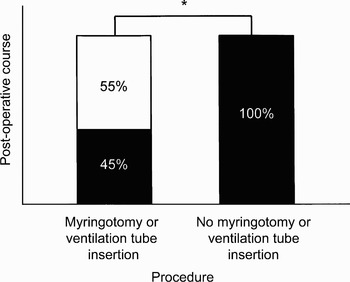
Relation between myringtomy or ventilation tube insertion, or neither, and post-operative course (white bar = poor; black bar = good). Of patients undergoing either a myringotomy or ventilation tube insertion, the post-operative course was poor in six and good in five. Of patient undergoing neither procedure, the post-operative course was good in all. *p < 0.01.
Relation between tympanic membrane procedure and post-operative course (white bar = poor; black bar = good). Patients undergoing the various procedures had the following respective post-operative courses: tube insertion: poor n = 1; good 3; no tube insertion: poor 5, good 7; myringotomy only, poor 4, good 3. *p = not significant, for both of tube insertion vs no tube insertion, and tube insertion vs myringotomy only.

Patients' clinical course
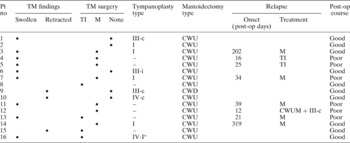
*Staged. No = number; TM = tympanic membrane; TI = tube insertion; M = myringotomy; post-op = post-operative; CWU = canal wall up
Patients' post-operative course by pre-operative TM findings
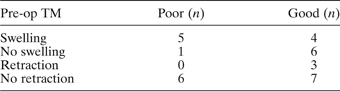
Pre-op = pre-operative; TM = tympanic membrane
All patients who did not undergo tympanic membrane surgery had a good post-operative course; these patients included four who underwent ossicular chain reconstruction. There was a significant difference in the post-operative course, of patients requiring tympanic membrane surgery, compared with those who did not (p < 0.01; Figure 3).
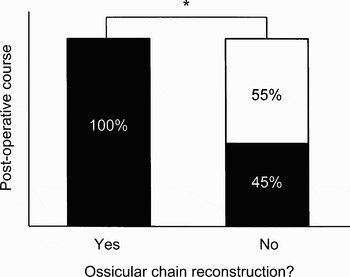
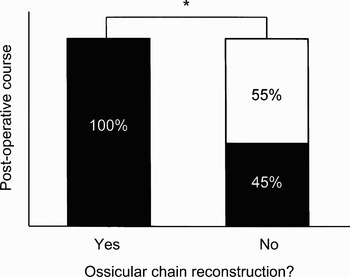
Five patients required reconstruction of the ossicular chain; four of these five required no tympanic membrane surgery. The remaining patient was treated with staged surgery, with tympanic tube insertion performed at the first stage; however, the tube was expelled in the early post-operative period. Despite this, there was no relapse of the cholesterol granuloma, and only a small amount of fluid was observed in the tympanic cavity at the second procedure. Patients who underwent ossicular chain reconstruction experienced a significantly better post-operative course compared with those who did not (p < 0.01; Figure 4).
Relation between ossicular chain reconstruction and post-operative course (white bar = poor; black bar = good). Patients had the following respective post-operative courses: ossicular chain reconstruction: poor n = 0, good 5; no ossicular chain reconstruction: poor 6, good 5. *p < 0.01.
Eight patients experienced tympanic fluid collection or relapse, and two of them at six months post-operatively. These two patients had a good post-operative course after a single myringotomy, but the other six cases experienced a relapse within 40 post-operative days and their overall post-operative course was poor.
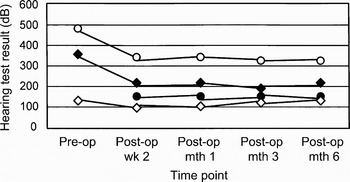
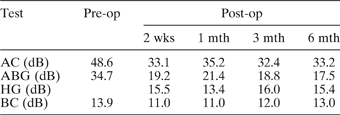
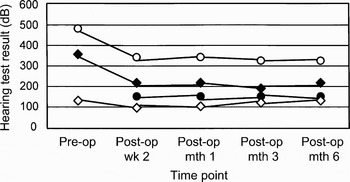
Patients' hearing test results are shown in Figure 5 and Table III. In all cases, a significant improvement in air conduction and bone conduction was observed two weeks post-operatively (p < 0.01) in all patients, but only a slight subsequent change was observed at one, three and six months post-operatively.
Patients' pre- and post-operative hearing test results, for air conduction (white circle), air–bone gap (black diamond), hearing gain (black circle) and bone conduction (white diamond). Pre-op = pre-operative, post-op = post-operative; wk = week; mth = month
Patients' pre- and post-operative hearing test results
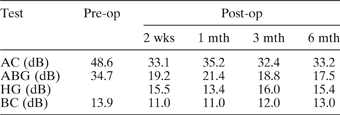
Pre-op = pre-operative, post-op = post-operative; wks = weeks; mths = months; AC = air conduction; ABG = air–bone gap; HG = hearing gain; BC = bone conduction
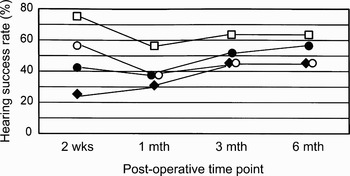
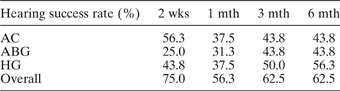
Patients' hearing success rates, calculated from their hearing test results, are shown in Figure 6 and Table IV. No statistically significant differences in hearing success rate were observed, comparing different post-operative examination times. The overall hearing success rate for all patients was 75 per cent at two weeks post-operatively, but this decreased to 62.5 per cent at one month post-operatively, with little subsequent change. Similarly, beyond one month post-operatively, little further change was seen in the air conduction hearing success rate. On the other hand, the air–bone gap hearing success rate was observed to be elevated at three months post-operatively. Similarly, the hearing gain hearing success rate was elevated at six months post-operatively.
Patients' post-operative hearing success rates, for air conduction (white circle), air–bone gap (black diamond), hearing gain (black circle) and overall (white square). Wks = weeks; mths = months

Patients' post-operative hearing success rates
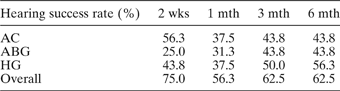
Wks = weeks; mths = months; AC = air conduction; ABG = air–bone gap; HG = hearing gain
In addition, although not noted in Table IV, four cases showed no improvement after two weeks postoperatively, and they had no improvement subsequently. No connection was seen between post-operative hearing test results and post-operative course.
Discussion
The term ‘cholesterol granuloma’ originally denoted a histological diagnosis, and there have been problems in establishing it as a clinical diagnosis. Therefore, general concepts regarding this condition became vague, and its diagnostic criteria differed between institutions.
The clinical pathogenesis of cholesterol granuloma is still unclear. The condition is characterised by negative pressure which develops in response to a blockage in the middle ear. Cholesterol in the blood separates and granulates, causing a foreign body reaction which results in progressive ventilatory impairment of the middle ear. Furthermore, with hypersecretion or hyperplasia of the granulation, pressure in the middle ear becomes positive, and this can cause persistent otorrhoea and expulsion of ventilation tubes. (Both these conditions are associated with changes in middle-ear pressure.)
Previous reportsReference Shambaugh2–Reference Sheehy, Linthicum and Greenfield4 have observed that a change in middle-ear pressure, indicating eustachian tube dysfunction, is associated with the development of cholesterol granuloma, but that otitis media (also associated with eustachian tube dysfunction) rarely progresses to cholesterol granuloma formation. FriedmannReference Friedmann5 reported that when a cholesterol crystal was injected alone into a marmot tympanic cavity no cholesterol granuloma was formed, but that injection of cholesterol crystals plus alcohol did result in cholesterol granuloma formation. Urano et al. Reference Urano, Nakano and Ikarashi6 examined the tympanic cavity mucosa and observed that, although it appeared macroscopically normal, electron microscopy revealed pathology such as secretion, indicating inflammation. Canal wall up mastoidectomy has been used as treatment for various middle-ear conditions, including granulation.
The present study examined tympanic membrane parameters reflecting the middle-ear pressure, as well as the appropriateness of mastoidectomy as treatment, in patients with cholesterol granuloma.
The post-operative course of patients with a retracted tympanic membrane was significantly good and, those with a swollen tympanic membrane had a significantly poorer post-operative course. It is necessary for the pressure of tympanic cavity to be elevated in order to present with swelling. This may be caused by hypersecretion and hyperplasia of the granulation in the middle ear. It may be necessary to completely remove the granulation and adjacent mucosa, but it is impossible to completely open all air cells. When the patient with cholesterol granuloma does not require myringoplasty or ossicular chain reconstruction, a myringotomy or ventilation tube insertion is undertaken, together with a mastoidectomy performed either contemporaneously or at a later stage (when effusion is seen in the tympanic cavity in the course of follow up). Therefore, tympanic membrane surgery is performed in all cases in which persistent otorrhoea suggests infection of the middle ear.
There have been various reports concerning the need to treat the mastoid air cells, and the methods of mastoidectomy, in patients with cholesterol granuloma. Some authorsReference Ikeda, Watanabe, Katsura, Eguchi, Sakamoto and Yorita7, Reference Ikeda and Watanabe8 have reported that tube insertion is not needed for new cases, and othersReference Farrior, Kampsen and Farrior9, Reference Plester and Cholesterol10 have recommended conservative treatment. However, there is consensus amongst Japan authors that a mastoidectomy or tympanic tube insertion alone is insufficient to control cholesterol granuloma, and that both procedures are needed to control the disease.Reference Sheehy, Linthicum and Greenfield4, Reference Inagi, Shitara, Okamoto and Sano11–Reference Okamoto, Matsuoka, Inagi, Sano and Shitara15 There are many cases uncontrolled by either tube insertion or myringotomy which require further treatment. Kudoh and ShibuyaReference Kudoh and Shibuya16 observed cholesterol crystals in the effusions of patients with uncontrolled secretory otitis media. Other authors have reported that the shadow in the antrum seen on computed tomography (CT) disappears after tympanic tube insertion.Reference Yoshida and Tomita17, Reference Tokio18 However, it is impossible to differentiate effusion from granulation on CT. A cholesterol-rich effusion is detected as an area of high intensity on both T1- and T2-weighted images. Therefore, definitive diagnosis of a cholesterol granuloma is impossible without a mastoidectomy.
In some cases, otorrhoea stops only after tube insertion, and it is possible that a cholesterol-rich effusion could progress to a cholesterol granulomaReference Kudoh and Shibuya16 or already includes a granuloma. Therefore, a mastoidectomy should be performed, if a shadow remains in the middle ear on CT after tympanic tube insertion.Reference Yoshida and Tomita17
In this study, there were more poor post-operative outcomes amongst patients treated only with mastoidectomy, compared with those receiving tympanic tube insertion plus mastoidectomy at the same time; this result suggests that tympanic tube insertion should be performed with a contemporaneous mastoidectomy. However, even after post-operative tube insertion, tube expulsion or obstruction can easily occur.
The efficacy of mastoidectomy alone must therefore be questioned. There are many cases of cholesterol granuloma with well pneumatised mastoid air cells in which a complete mastoidectomy is impossible. In such circumstances, it is thought that the re-growth of the granulation in the remaining cells may cause hypersecretion, fluid collection, persistent otorrhoea or tube expulsion. This is caused by an obstruction in the auditory tube, which cannot be affected by mastoidectomy. There is a report of a canal wall down mastoidectomy or obliteration was performed for the purpose of decreasing a ventilation alveus and the source of the secreting fluid,Reference Okamoto, Matsuoka, Inagi, Sano and Shitara15 but we have insufficient experience with these methods and we cannot evaluate them. The goal of the current treatment strategy was to achieve re-aeration of the mastoid cavity, because well pneumatised air cells are not suitable for obliteration or a canal wall down mastoidectomy. When a mastoidectomy is performed, we preserve the normal mucosa. Ikeda et al. Reference Ikeda and Watanabe8 described the same criteria.
A good post-operative course was difficult to achieve in patients with a swollen tympanic membrane. In the four such cases which did have a good post-operative course, three underwent ossicular chain reconstruction. No tympanic tube insertion was required in five patients. These five included four patients who underwent ossicular chain reconstruction at the same time as mastoidectomy, and one patient who underwent staged surgery.
A patient with extensive ossicular destruction requiring ossicular chain reconstruction may have granulation mainly in the attic, and removal of the head of the malleus and the incus plus posterior tympanotomy would be required to promote good ventilation of the attic or antrum. MorimitsuReference Morimitsu14 reported control of a tympanum partition type cholesterol granuloma with an anterior tympanotomy. Treatment via the anterior ventilation path may be necessary in order to control the posterior ventilation path in such cases.
On the other hand, the post-operative course was good in patients with a retracted tympanic membrane. In such cases, the primary clinical condition is ventilatory failure of the middle ear, and no hypersecretion occurs. NakanoReference Nakano and Cholesterol12 reported that mastoid obliteration to decrease the ventilation in the alveus provides a good passage for with a patient with a retracted TM. Ventilation tube insertion or improving the ventilation of the tympanic isthmus can also control the disease.
Takahashi et al. Reference Takahashi, Honjo, Kurata and Fujita19, Reference Takahashi, Honjo, Kurata, Sugimaru, Lim, Bluestone and Casselbrant20 administered a decreasing steroid dose followed by tympanic membrane tube insertion, as treatment of cholesterol granuloma. Mastoidectomy may reveal widely expanded granulation; in such cases, granulation may decrease with the administration of steroids. Thus, steroid therapy should be considered after surgery, for uncontrolled lesions.
Few reports have examined the hearing prognosis for cholesterol granuloma patients treated with surgery. Inagi et al. Reference Inagi, Shitara, Okamoto and Sano21 reported that the hearing results of patients with primary cholesterol granuloma were poorer than those of patients with secondary cholesterol granuloma cholesteatoma. Mori et al. Reference Mori, Iwanaga, Nakamura, Yui and Ishida22 stated that the pre-operative conductive disturbance seen in cholesterol granuloma patients was a friction curve and that their patients' post-operative hearing gain was poor in the middle to low frequency range. Yoshida and TomitaReference Yoshida and Tomita17 examined 122 cases of cholesterol granuloma, and reported worsened hearing in 40 and the onset of deafness in nine. These reports indicate that the hearing prognosis for patients with cholesterol granuloma is poor. In the current study, fortunately, no patient experienced further hearing loss following surgery. Inagi et al. Reference Inagi, Shitara, Okamoto, Sano and Matsuoka23 believed the following factors to be associated with poor post-operative hearing results in cholesterol granuloma patients: (1) age of 35 years or older; (1) symptoms for more than 15 years; (3) pre-operative otorrhoea within one month of pre-operation; (4) tympanic membrane perforation; and (5) granulations around the ossicles.
In the current study, relatively good hearing results were obtained two weeks after surgery (an overall hearing success rate of 75 per cent was observed). However, some patients' hearing worsened post-operatively. Two patients showed a deterioration in hearing two weeks post-operatively. One patient had extensive ossicular destruction and underwent a type IV-c tympanoplasty, so their poor hearing ability was due to ossicular chain reconstruction and was unrelated to cholesterol granuloma control. In the other patient, two week post-operative audiometry showed an air conduction of 26.7 dB, air–bone gap of 15.1 dB and hearing gain of 18.3 dB. This patient underwent a single myringotomy, based on a diagnosis of secretory otitis media after one year of surgery, and no effusion or relapse of granulation was seen in the tympanum at any follow-up consultation. This patient's air conduction hearing was 30 dB at their last follow-up consultation; however, this patient's hearing may improve with tube insertion to improve tympanic compliance.
In addition, four other patients showed poor hearing results two weeks post-operatively, with no subsequent improvement. When tympanoplasty is administered to treat chronic otitis media or cholesteatoma of the middle ear, there is little resulting improvement in patients' hearing. In such cases, aeration of the middle ear is maintained. On the other hand, in patients with cholesterol granuloma, the middle ear alveus is obstructed with effusion or granulation, and this obstruction causes severe conduction disturbance. In such patients, if tympanic compliance is improved by surgery, improved hearing would be expected during the early post-operative period.
In the other patients in the series, no large change was observed in hearing (assessed by mean air conduction and air–bone gap) throughout the post-operative course.
Inagi et al. Reference Inagi, Shitara, Okamoto, Sano and Matsuoka23 reported that bone conduction worsened from 25.6 to 42.3 dB during the early post-operative period in cholesterol granuloma patients with post-operative follow up of one year and more. In the current study, bone conduction was observed to increase by 1 dB at each post-operative monthly assessment point. This change was not statistically significant, but it seemed that it was necessary for the longer-term observation. However, patients' hearing prognosis is determined during the first two post-operative weeks. Patients with poor hearing ability at this stage should be informed that no subsequent hearing improvement can be expected.
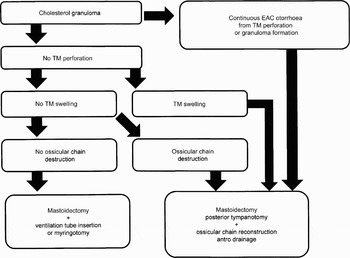
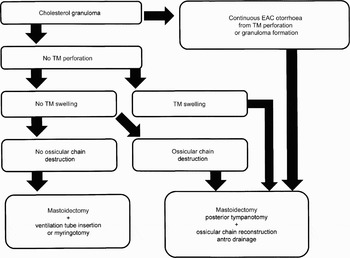
On the basis of the above analysis, a strategy for the treatment of cholesterol granuloma is shown in Figure 7.
Proposed strategy for cholesterol granuloma treatment. TM = tympanic membrane; EAC = external auditory canal; antro drainage = drainage of the mastoid antrum
Conclusion
This study examined 16 cases of cholesterol granuloma treated surgically at Kurume University department of otolaryngology and head and neck surgery between 1990 and 2006. The post-operative course tended to be significantly worse in patients presenting with tympanic membrane swelling. The post-operative course tended to be significantly better in patients presenting with a retracted tympanic membrane. A poorer post-operative course was observed in patients experiencing a relapse of effusion or granulation within 40 days of surgery. Patients who underwent ossicular chain reconstruction had a good post-operative course, and tympanic tube insertion may be unnecessary in these patients. Among patients presenting with a swollen tympanic membrane, those undergoing ossicular chain reconstruction had a better post-operative course. Patients' post-operative hearing ability showed little change after the first two post-operative weeks.