Reducing the potential for excess deaths due to earthquake-related risks in the first 12 months, estimated here at 90 000, is the immediate public health priority for Haiti. Most importantly, this will involve follow-up for wound care, provision of immunizations and nutritional monitoring, and the reduction of transmission of mosquito-borne diseases. Also, the reestablishment of care for existing TB and HIV patients, and the establishment of effective primary care for diarrheal and respiratory diseases, are critically important.
At the same time, we must strengthen priority activities in the health system to reduce the preexisting levels of excess mortality, estimated here at around 40 000 a year. Haiti's current public health threats, with the exception of wound care, do not deviate significantly from those prior to the earthquake. In the long run, reducing Haiti's high underlying mortality burden will account for the greatest potential to save lives. The success of both efforts will depend on the international community supporting Haiti as it trains and employs a competent workforce that can establish and operate a robust public health system.
EXCESS DEATH DUE TO EARTHQUAKE
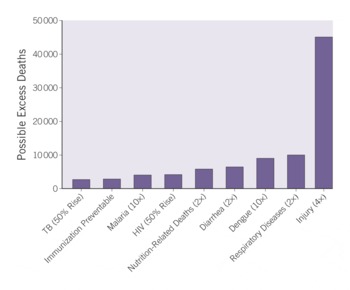
Approximately 140 people have been pulled alive from the earthquake rubble in Haiti. More than a thousand people have had limbs amputated. In the short run, actions to reduce the risks of elevated mortality from injuries, homelessness, and displacement are needed, and these efforts get most of the public and media attention. If mortality due to diarrhea and respiratory diseases each double in Haiti in the 12 months post earthquake, this will result in approximately 6400 and 10 000 excess deaths, respectively. A doubling of nutrition-related deaths would result in 5900 additional deaths. If injury deaths rise four-fold, 45 000 additional deaths would occur. If mortality rises by 50% due to loss of access to medication for HIV and TB, an additional 6850 deaths would result. If malaria and dengue deaths rise ten-fold, this would constitute an additional 13 000 deaths. If immunization-preventable disease deaths double, an additional 2800 deaths will occur. Together, these represent a total of 90 000 possible excess deaths in Haiti in the first year after the earthquake (Figure 1).
Projected risk of excess deaths during first post-earthquake year.

HAITI'S UNDERLYING MORTALITY BURDEN AND OPPORTUNITIES
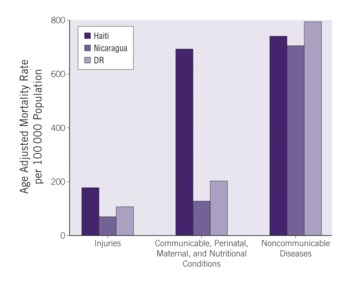
Despite declines of more than 40% in infant mortality and malaria in the last 10 years, overall health conditions in Haiti remain poor. The total deaths in Haiti per 100 000 population as estimated by the Global Burden of Disease project for 2004 was 1611.1 This was 78% higher than Nicaragua and 46% higher than the Dominican Republic. Haiti's injury deaths were nearly double those in Nicaragua and the Dominican Republic. Haiti's deaths due to communicable, perinatal, maternal, and nutrition-related diseases were 3 to 5 times higher than in Nicaragua and the Dominican Republic (Figure 2). Deaths due to noncommunicable diseases constitute nearly half of all deaths, but are not notably higher than in the other two countries.
Mortality rates by category, 2004.

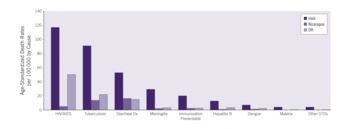
Most injury deaths and most excess injury deaths result from unintentional injuries. Among infectious and parasitic conditions, the biggest killers in Haiti are HIV, TB, respiratory infections, and diarrheal diseases. These are also the conditions with the largest level of excess deaths, in comparison to rates in Nicaragua and the Dominican Republic. Deaths due to meningitis, vaccine preventable diseases, hepatitis, dengue, malaria, and STDs other than HIV are each more than three times higher in Haiti (Figure 3).
Infectious and parasitic mortality rates, 2004.

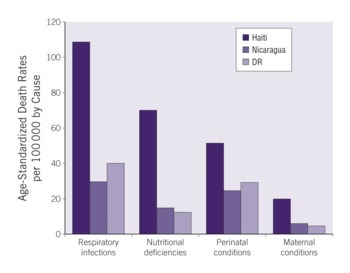
Deaths due to respiratory disease, nutritional conditions, perinatal or maternal disease were all more than twice as high in Haiti. Of all these conditions, respiratory infections are responsible for the greatest number of deaths at an estimated 10 000 per year. Other conditions accounting for more than 5000 deaths include injuries, nutritional deficiencies, HIV/AIDS, diarrheal diseases, tuberculosis, and perinatal conditions Haiti (Figure 4).
Respiratory, nutritional, perinatal, and maternal disease death rates, 2004.

Haiti has an average per capita annual income of approximately $550 USD and a purchasing power equivalent of $1200 USD. Average income is thus just under $2 a day, a level of extreme poverty. However, some other countries with very low income levels, including Nepal, Eritrea, and Bangladesh, have lower overall mortality rates. These are poor, predominantly rural countries with relatively good primary care, strong community organization, or both. Haitians can now aspire to considerable improvements in health conditions and outcomes if recovery program priorities and implementation are sound. Neighboring Dominican Republic has a per capita income (ppp, atlas method) six times greater than Haiti. Nicaragua, the second poorest country in the Americas, has a per capita income double that of Haiti. These two countries have broadly similar mortality levels, which can serve as a benchmark to highlight opportunities to reduce mortality in Haiti.
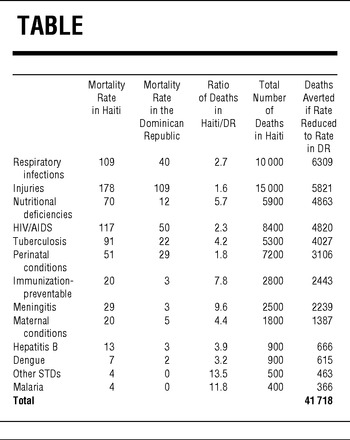
Reducing the risk of dying in Haiti to the level of neighboring Dominican Republic or the next-poorest country in Latin America, Nicaragua, would reduce deaths by more than 40 000 a year. Over a 5-year period, this would represent more than 200 000 deaths averted (Table).
Table

The top avertable causes of death are respiratory infection and injuries. Also high are HIV/AIDS, diarrheal disease, and tuberculosis. In addition, more advanced medical care for perinatal and maternal conditions are key to reducing mortality. If Haiti were to eliminate malaria, an estimated 400 deaths per year would be averted. If Haiti reduced its malaria burden to a level similar to that in the Dominican Republic, it would avert 366 deaths. Vaccine preventable diseases are responsible for far more deaths, estimated at 2800 a year. Overall immunization coverage in Haiti is about 50%. If coverage were raised to around 85%, immunization preventable diseases would drop to levels in the Dominican Republic and 2400 deaths would be averted. This represents far more deathsaverted than would result from the elimination of malaria. Even these 2400 deaths averted are small compared to the number of deaths averted if Haiti were to reach the Dominican Republic's level of mortality from the main causes of excess death.
UNLOCKING HAITI'S POTENTIAL
Underinvestment in social capital and overdependency on donors represent profound constraints on Haiti's social and health potential. During the 1990s, the Haitian government devoted only about 10% of its budget—about 1% of GNP—to education, and even less to health. More than three-quarters of all schools and health facilities were private. Despite high levels of external assistance, utilization of these resources has been suboptimal. For instance, from 1990 to 1998, calories produced per Haitian fell from 2010 in 1990 to 1620 in 1998. The main response has been to provide food aid. But providing short-term aid without building capacities among the recipients further discouraged domestic production. This is one factor contributing to the minimal improvements in average per capita income over the last 2 decades.
Haiti does not suffer from most of the structural traps that keep countries poor, such as being at war or being bordered by unstable countries, being landlocked, and having valuable extractable resources. In fact, among the “poverty traps” affecting the world's poorest countries, Haiti only has only two: poor and unstable governance and widespread environmental degradation. Nevertheless, for most of its 200 years of independence, Haiti has tottered on the brink of being a failed state.
Despite these challenges, Haiti has important assets for rebuilding. Large numbers of Haitians have emigrated, gained skills, and provide a stable and large amount of capital via remittances to their family members. Haiti attracts many social and religious foreign missions that provide health and education services throughout the country. Haiti has important potential economic resources in the cultivation of high-value tropical products, preferred trading status for export manufacture industries, and tourism. Educational levels have risen a great deal in the last decade, although adult literacy is still only 62% (UNICEF).2 Haiti has generated a notable cadre of teachers, nurses, and doctors, but the majority of them are outside the country. Relations with the Dominican Republic have seldom been better, with the DR providing sizable relief assistance and free passage for others via Santo Domingo. On top of these factors, the large-scale, multiyear recovery and development program taking shape post earthquake, and the extended commitment of peace-keeping troops, present an unprecedented development opportunity for reconstruction of the country.
This is why engagement and investment in Haiti now must occur in consultation with Haitians in a way that builds administrative capacity and a national consensus to contribute more to Haiti's long term development. Despite worsening economic conditions and unstable governance, Haitians have managed to send their children to primary school and get them immunized at ever-increasing rates since 1990. Improving coverage and quality of these and other basic services can help transform collective despair into hope.
What Haiti most lacks is a capable civil service and a stable, effective government. Development of a public health infrastructure for laboratory science, disease surveillance and reporting, training, and targeted disease control and elimination programs will go a long way towards creating that civil service. There has been much discussion about reconstruction being led by Haitians. In fact, unless programmatic activities focus on training people in an effective manner and employing them in systems with adequate working conditions, this principle will prove to be little more than lip service.