Phonological awareness is one of the most important predictors of successful reading development (Gottardo, Stanovich, & Siegel, Reference Gottardo, Stanovich and Siegel1996; Lyon, Reference Lyon1995; Mann, Reference Mann and Wong1998; Muter & Snowling, Reference Muter and Snowling1998; Stanovich, Reference Stanovich1994). Its ontogeny appears to be influenced by several factors, key among them being the status of phonological development and the extent of exposure to alphabetic instruction (for reviews, see Anthony & Francis, Reference Anthony and Francis2005; Foy & Mann, Reference Foy and Mann2001; Mann & Foy, Reference Mann and Foy2003). Obviously, a certain level of phonological processing skill is a prerequisite for phonological awareness, and it should come as no surprise that children's phonological awareness is linked with their effective and efficient perceptual and productive control of the sounds of their language (Elbro, Bostrom, & Petersen, Reference Elbro, Borstrom and Petersen1998; Foy & Mann, Reference Foy and Mann2001; Mann & Foy, Reference Mann and Foy2003, Reference Mann and Foy2007). But research suggests that something specific can be required for the attainment of phoneme awareness. Foremost among these specific factors is exposure to the alphabetic principle (i.e., learning that letter sequences are associated with specific sounds; Mann & Wimmer, Reference Mann and Wimmer2002; Morais, Cary, Alegria, & Bertelson, Reference Morais, Cary, Alegria and Bertelson1979; Read, Zhang, Nie, & Ding, Reference Read, Zhang, Nie and Ding1986).
In this paper we pursue an aspect of lexical processing that has been offered as an explanation of the emergence of phoneme awareness. Metsala and Walley (e.g., Reference Metsala, Walley, Metsala and Ehri1998) have suggested that, about the time that they begin to learn to read, children's lexicons undergo significant restructuring from holistic representations towards phoneme-sized units (lexical restructuring theory). They view this as a result of such factors as vocabulary expansion (e.g., Walley, Reference Walley1993), but others note that it could arise from a changing focus from meaning to sound (Byrne & Liberman, Reference Byrne, Liberman, Oakhill and Beard1999) and the learning of letter sound associations (Barron, Reference Barron, Hulme and Joshi1998; Foy & Mann, Reference Foy and Mann2006; Treiman & Bourassa, Reference Treiman and Bourassa2000; Vihman, Reference Vihman1981, Reference Vihman1996). According to Metsala and Walley, lexical restructuring is an impetus for phonological awareness, and it emerges as a consequence of spoken vocabulary growth: as children acquire more vocabulary items, their initially holistic lexical representations (e.g., “cut”) come to be represented in an increasingly segmental way (i.e., “c” “u” “t”). The addition of vocabulary items to the lexicon presumably involves increasing numbers of “high neighborhood density” words, words that are highly similar in phonological structure (Metsala & Walley, Reference Metsala, Walley, Metsala and Ehri1998). This dense similarity among words presumably forces a change from holistic representation of entire words to segmental representation of such sublexical units as phonemes. When lexical representations become more segmental, this presumably makes vocabulary growth and lexical access more efficient because words can be stored and retrieved on the basis of their shared segments, instead of as indivisible wholes. At the same time, more segmental representations can be seen as a prerequisite for children's realization that words consist of separate phonemes. Thus, in the view of Walley, Metsala, and their colleagues, phoneme awareness follows from lexical restructuring because that restructuring provides the phoneme representations that are mapped onto alphabetic representations.
Coady and Aslin (Reference Coady and Aslin2004) recently demonstrated that very young children (2.5–3.5 years) showed sensitivity to segmental aspects of nonwords in a repetition task varying phonotactic probability. Evidence of lexical restructuring, according to its proponents, is seen in certain differential effects of neighborhood density on the performance of preschool children compared to older children and adults. For example, in speech gating tasks (e.g., Walley, Reference Walley1993), where increasingly larger segments of speech are added on successive trials, preliterate children responded to words from dense neighborhoods more segmentally than they did to words from shallow neighborhoods (Garlock, Walley, & Metsala, Reference Garlock, Walley and Metsala2001), whereas adults responded to all words segmentally. The fact that density effects on speech processing depend on age, age of acquisition (Garlock et al., Reference Garlock, Walley and Metsala2001), task (Metsala, Reference Metsala1999; Vitevitch & Sommers, Reference Vitevitch and Sommers2003), and vocabulary size (De Cara & Goswami, Reference De Cara and Goswami2003) has been a primary basis of support for the lexical restructuring theory. For example, using a word repetition task, Garlock et al. (Reference Garlock, Walley and Metsala2001) found dense neighborhoods associated with poorer performance in preschoolers, but only for early-acquired words. In contrast, for both early- and late-acquired words elementary school-aged children (first and second graders) and adults showed poorer performance on words from dense neighborhoods. These findings were taken to suggest that for very young children, with presumably small vocabularies, neighborhood density facilitates segmental effects in speech-processing performance.
We note that a link between vocabulary size and density effects echoes findings of a link between vocabulary size, reading ability, and such prereading skills as phonological awareness in young children (e.g., Bowers & Wolf, Reference Bowers and Wolf1993; Foy & Mann, Reference Foy and Mann2001, Reference Foy and Mann2003; Mann & Foy, Reference Mann and Foy2003; Wolf, Reference Wolf1999). Our interest in neighborhood density effects and in the lexical restructuring theory concerns their ability to explain why young children do poorly on phoneme awareness tasks. A few studies have explicitly examined effects of neighborhood density on phonological awareness. They illustrate a mixed pattern of results. For example, one study shows facilitative effects of neighborhood density on the phoneme blending performance of 3- to 4-year-old children but no effect in an onset-rime blending task (Metsala, Reference Metsala1999). Density has also been reported to facilitate rhyme awareness in a study of 5-year-olds (De Cara & Goswami, Reference De Cara and Goswami2003); children with large vocabularies had more accurate responses in a rhyme oddity task for words from dense neighborhoods than for words from sparse neighborhoods.
In the experiment reported below, we have continued to study the effects of neighborhood density on phonological awareness. However, rather than using overall neighborhood density, we have adapted a set of materials from Vitevitch (Vitevitch, Reference Vitevitch2002a; Vitevitch, Armbruster, & Chu, Reference Vitevitch, Armbruster and Chu2004), who manipulated the relative onset density of words from highly dense neighborhoods. By showing performance differences between words from neighborhoods that share the initial consonant (e.g., the onset) and those whose neighborhoods involve a diversity of initial consonants, these researchers provide evidence of sublexical (e.g., segmental) processes in lexical decision and repetition. Our reasoning was that (a) if the lexical representations of preschool children are predominantly holistic, then we should find less evidence of sublexical processes in their processing of spoken words, especially when the children are unable to perform phonological awareness tasks, and (b) if phoneme awareness follows from a shift to segmental representation, then we would observe a contrast between onset density effects on the speech processing performance of children who demonstrate phoneme awareness and those who do not.
The concept of “neighborhood” has become increasingly important to models of the lexicon. A word's neighborhood is the set of words that share the majority of phonemes and their sequence. Members of a consonant–vowel–consonant (CVC) word's neighborhood, for example, can be produced by systematically changing one phoneme in the word (by adding, substituting, or deleting a phoneme) and then noting whether the item that results is also a word. For example, “mad” is in the neighborhood of “bad” (“b” changed to “m”) and “mud” (“u” changed to “a”). Neighborhood density, as calculated in the present study, refers to the number of words that can be so derived for a target word (Coltheart, Davelaar, Jonasson, & Besner, Reference Coltheart, Davelaar, Jonasson, Besner and Dornic1977).
Words that have many neighbors share a highly similar phonological structure with many other words, and are said to “reside” in “dense neighborhoods” (Logan, Reference Logan1992; Luce, Reference Luce1986; Metsala & Walley, Reference Metsala, Walley, Metsala and Ehri1998). Most typically, in lexical recognition studies, density shows a competition effect: words from dense neighborhoods evoke longer response times than words from sparse neighborhoods (Garlock et al., Reference Garlock, Walley and Metsala2001; Luce & Pisoni, Reference Luce and Pisoni1998; Motley & Baars, Reference Motley and Baars1975; Vitevitch, Reference Vitevitch2002a, Reference Vitevitch2002b; Vitevitch et al., Reference Vitevitch, Armbruster and Chu2004; Vitevitch & Luce, Reference Vitevitch and Luce1998, Reference Vitevitch and Luce1999; Vitevitch, Luce, Charles-Luce, & Kemmerer, Reference Vitevitch, Luce, Charles-Luce and Kemmerer1997).
Vitevitch and colleagues (Vitevitch, Reference Vitevitch2002a; Vitevitch et al., Reference Vitevitch, Armbruster and Chu2004) used a refinement of neighborhood density, namely, onset density to provide a more direct form of evidence about sublexical processes in speech perception and production. When words from equally “dense” neighborhoods were ranked in terms of the density of shared onset (e.g., the number of neighbors that shared the initial consonant), the reaction time (RT) increased as onset density increased (Vitevitch, Reference Vitevitch2002a; Vitevitch et al., Reference Vitevitch, Armbruster and Chu2004), and Vitevitch and colleagues attributed the penalizing effect of onset density to interactive processes between words and phonemes. In their view, if a word contains phonemes that occur in the same position in many other words then it receives additional activation because of reverberation between the words and the phonemes. High onset density words like “mass” activate relatively many neighbors that share the same initial phoneme “m” but differ in medial or final segments. This activation of words that start with “m” leads to competition for the medial and final phonemes of the target word (e.g., neighbors like “mad” and “miss” compete with the target word “mass”), a slowing of response time in lexical decision and a loss of accuracy in picture naming. Low onset density words like “sad” activate relatively few words that start with “s,” as fewer such words exist, but there are relatively more words that share medial and/or final phonemes (e.g., “bad,” “mad”), so the spreading activation occurs at a later point in word processing and thus causes less competition.
Vitevitch et al.'s primary interest is in distinguishing between lexical and sublexical levels of speech representation (for a review, see Vitevitch et al., Reference Vitevitch, Armbruster and Chu2004) and in contrasting the merits of interactive versus feedforward models of speech processing. For our purposes, their research can provide an important tool for studying any developmental changes in sublexical, segmental representation. If onset density effects imply an interaction between sublexical and lexical units, then their existence presumes that units such as onsets and rimes or phonemes are an active part of lexical representation. Children who show onset density can be presumed to be representing words segmentally.
In the present experiment, our strategy is to explore onset density effects on phoneme awareness and on speech processing. Vitevitch and colleagues have observed competition effects of onset density on shadowing, lexical decision, and naming tasks in the case of literate adults, and they have used this as evidence for the role of phonemic levels of representation in speech processing. We now ask if there are parallel effects of onset density on phoneme awareness tasks among preschool-aged children, and we ask if onset density effects among preschool children are limited to children who have attained phoneme awareness.
According to the lexical restructuring account, effects of a reduced vocabulary size should be limited to children close to the level at which holistic representation gives way to segmental representation. In the Vitevitch account, however, vocabulary size could relate to the effects of onset density, as larger vocabularies could associate with greater activation and a greater number of competing responses.
Extrapolating from the lexical restructuring hypothesis, we hypothesized the following: (a) for children who are aware of phonemes, we should see effects of onset density in both phoneme awareness and in word repetition, consistent with the operation of sublexical processes; (b) the effects of onset density on the word repetition of children who lack phoneme awareness should contrast with that of children who demonstrate phoneme awareness, if lexical restructuring is the impetus for attainment of phoneme awareness; and (c) onset density effects should be stronger in children with large vocabularies than in children with smaller vocabularies if vocabulary size is the primary impetus for lexical restructuring.
Children received a phonological awareness screening, the onset density phonological awareness tasks, and a subset of the items from Vitevitch's study of onset density effects on repetition. We also included vocabulary measures and a nonsense word repetition task and a test of working memory test. These choices were driven by the work of Gathercole and colleagues (Adams & Gathercole, Reference Adams and Gathercole1995; Gathercole, Willis, Emslie, & Baddeley, Reference Gathercole, Willis, Emslie and Baddeley1992), who have consistently shown that vocabulary and working memory are interrelated.
To test these predictions regarding onset density and phonological awareness requires that we can, in principle, obtain onset density effects in phonological awareness. Prior to conducting our experiment we used a subset of Vitevitch et al.'s materials to examine the effects of onset density on the phonological awareness of a group of adult subjects. We found that adults were significantly faster and more accurate in rhyme production, phoneme deletion, and phoneme substitution for words from sparse onset neighborhoods compared to words from dense onset neighborhoods. This is consistent with our previous findings of competition effects in adults with nonwords (Foy & Mann, Reference Foy and Mann2004). This effect of onset density on phonological awareness was stronger among participants with larger receptive vocabularies, as would be expected from Vitevitch et al.'s account of onset density effects (Vitevitch, Reference Vitevitch2002a; Vitevitch et al., Reference Vitevitch, Armbruster and Chu2004) as the reflection of sublexical processes and response competition. It was also stronger among those with greater working memory performance, consistent with Gathercole and Baddeley's model of the connection between vocabulary and working memory (see the Appendix A for details of the adult data).
METHOD
Participants
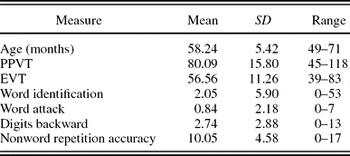
Native English speakers (N = 37) aged between 49 and 71 months (M = 58.24, SD = 5.42) were recruited from local preschool daycare programs. None of the participants had a history of speech, hearing, reading, or neurological problems, as reported by the parents. Three of the children were able to read at least one nonword on the Woodcock reading mastery word attack subtest (Woodcock, Reference Woodcock1987). Although race and socioeconomic class data were not collected systematically, the majority of the participants were White and from middle to upper socioeconomic backgrounds. In addition to parental consent, verbal assent was obtained from the children. The performance of the sample is summarized in Table 1.
Performance summary for child sample (N = 37)

Materials
Phonological screening task. Phonological awareness skills were screened using a shortened version of our Phonological Awareness Test, used in several previous studies. Instructions for these tasks were the same as in our Phonological Awareness Test as we have previously described for children (Foy & Mann, Reference Foy and Mann2001, Reference Foy and Mann2004; Mann & Foy, Reference Mann and Foy2003). We administered five items from each of the rhyme, deletion, and substitution tasks. The criterion for passing was set at one item correct in the respective subtest. A composite “phonological awareness” score was used as a measure of the degree of phoneme awareness. It consisted of the total number of correct responses on the five items from each task (e.g., max = 15, min = 0). The children defined as having no phoneme awareness did not achieve criterion on any of the three tasks. Unless otherwise specified, “phoneme awareness ability” groups consisted of children who had some phoneme awareness or did not have phoneme awareness, as operationally defined above.
Phonological awareness measures
Phonological awareness stimuli. Ninety CVC words from Vitevitch (Reference Vitevitch2002a) were used as stimuli in the experiment and pretested with adults (see Appendix A). As reported by Vitevitch (Reference Vitevitch2002a), the words varied significantly in onset density. Words in the “dense onset set” shared their initial phoneme with at least 50% of their neighbors (M = 75.3%), whereas those in the “sparse onset set” shared their same initial phoneme with less than 50% of their lexical neighbors (M = 42.0%). Words in the two sets were equivalent in word familiarity, word frequency, number of neighbors, neighborhood frequency, and recognition point, and phonological-P, a measure of phonotactic probability (Vitevitch, Reference Vitevitch2002a). The two sets contained equal numbers of words with the following phonemes in the initial position: /p, d, t, k, f, l, w, r, s/.
The stimuli consisted of words that were spoken in isolation at 70 db SPL and recorded by a trained speech scientist in a sound-attenuated booth with a high-quality microphone. The stimuli were low-pass filtered at 10.4 kHz and digitized at a sampling rate of 20 kHz with a 16-bit analog-to-digital converter. All words were edited into individual digital files.
Phonological awareness tasks. The words from the two sets were equally and randomly divided into three groups. These words served as the stimuli for three different phonological awareness tasks (phoneme deletion, phoneme substitution, and rhyme production), and were counterbalanced such that each participant saw each word only once, and in one task only. Each task had 15 words for the dense onset and 15 for the sparse onset (30 words per task). The tasks were administered in random order. The phoneme awareness tasks were standardized, and are derived from tasks we have used in several previous studies (e.g., Foy & Mann, Reference Foy and Mann2001, Reference Foy and Mann2003; Mann & Foy, Reference Mann and Foy2003). In the phoneme deletion tasks, participants were asked to say the stimulus word without its first sound. In the substitution task, the participants were asked to substitute the first sound in the stimulus word with the /g/ sound. Participants were asked to provide a rhyming word or nonword to the stimulus word in the rhyme task.
Word repetition stimuli. The word repetition task consisted of 30 items (15 dense, 15 sparse) randomly chosen from the items used for the phonological awareness as described above. Participants were asked to repeat the word that they heard. Responses were recorded as for the phoneme awareness tasks. This task was administered on a different day than the phonological awareness tasks, usually 1 week apart.
Vocabulary measures. Two standardized measures of vocabulary were used to estimate vocabulary size. A measure of receptive vocabulary was obtained using the Peabody Picture Vocabulary Test, Third Edition (Dunn & Dunn, Reference Dunn and Dunn1997). This untimed, individually administered test is normed for administration to children and adults (90 years+) and has well-established reliability and validity (r > .90). There are 17 sets of 12 items each, and the sets increase in difficulty. Expressive vocabulary was measured with the Expressive Vocabulary Test (Williams, Reference Williams1997), which was conormed with the Peabody Picture Vocabulary Test; it also has high reliability and validity. The examiner asks the participant to label pictures and to generate synonyms for test words that are presented as a written word accompanied by a picture.
Working memory. We used two measures of working memory, as detailed below: nonword repetition accuracy and backward recall of digits.
Nonword repetition. The modified Children's Test of Nonword Repetition (Gathercole, Willis, Baddeley, & Emslie, Reference Gathercole, Willis, Baddeley and Emslie1994) was used to assess nonword repetition ability. To shorten the task, only the first five nonwords from two-syllable, three-syllable, and four-syllable nonwords were administered to the participants. According to Gathercole and colleagues (Reference Gathercole, Willis, Baddeley and Emslie1994) the phoneme sequences in each stimulus nonword conformed to the phonotactic rules of English and within each number of syllables the items were constructed to correspond to the dominant syllable stress patterns in English for words of that length (SW for two-syllable nonwords, and SWW for the three-syllable nonwords, and variable stress patterns for four-syllable words). The phoneme sequences for the nonwords thus are phonotactically and prosodically legal. Test–retest reliability was reported at r = .77. Pronunciation was modified for the American sample according to pronunciation by 10 normally reading adults (Foy & Mann, Reference Foy and Mann2001). On-line scoring has been previously reported at agreement on 97% of the items. Deletions, substitutions, and additions were all scored as errors. Number of correct words was calculated.
Digits backward. The forward and backward digit span subtests of the Wechsler Intelligence Scale for Children (Wechsler, Reference Wechsler1997) were administered to assess verbal short-term memory. In this standardized, reliable, and valid test, the examiner says single digits at the rate of one per second, and asks the participants to repeat them forward and backward. We used the backward subtest score as a measure of working memory, consistent with views that this is a more reliable measure of working memory than digits forward (Carroll, Snowling, Julme, & Stevenson, Reference Carroll, Snowling, Hulme and Stevenson2003).
Procedure
Participants were tested individually in a quiet room equipped with a laptop computer, a pair of earphones, and a high-quality microphone interfaced with a Cedrus voice-activated response key. Presentation of stimuli and response collection for the nonword repetition and phonological awareness tasks was controlled by Superlab 2.02 on a Dell Latitude computer.
For the phonological awareness, word repetition, and nonword repetition tasks, participants heard the stimuli presented over the headphones (randomly presented for the phonological awareness task). RTs were measured from the onset of the stimulus to the onset of the participant's vocal response (Vitevitch, Reference Vitevitch2002a, Reference Vitevitch2002b; Vitevitch et al., Reference Vitevitch, Armbruster and Chu2004). All responses were transcribed on-line by the research assistant and also recorded on a high-quality audiotape for later accuracy analysis. Accuracy was assessed by listening to the participants' responses on the audiotape and, together with the written transcription of the responses, comparing them with a written transcription of the target responses. For responses in the rhyme task, a judgment was made by the raters as to whether the response rhymed with the target stimulus. In the three phoneme awareness tasks, the response was recorded as correct only if all phonemes of the response were correct. Only correct responses were included in the RT analyses. Errors that were also excluded from the RT analyses (but not the accuracy analyses) included responses in which the participant triggered the voice key inappropriately (e.g., cough, “uh”) or failed to trigger the voice key (e.g., speaking too softly). Accuracy was recorded as the number of incorrect responses. The children were tested in two sessions usually separated by 1 week.
RESULTS
To correct for positive skewness in several of our measures for the children's data, we used nonparametric statistics (Wilcoxon signed rank tests) to analyze the data. Unless otherwise stated, the nonparametric statistics corroborated the parametric results.
Phonological awareness tasks
These tasks were administered to the children who passed the respective screening tests. Thirty children passed the rhyme screening subtest, compared with 18 for the substitution and 11 for the deletion task.
Accuracy. A 3 (Task: Deletion, Substitution, and Rhyme) × 2 (Onset Density: Dense and Sparse) repeated-measures analysis of variance (ANOVA) for the subgroup of children (n = 11) who passed all of the phonological awareness screening tasks revealed no significant main effects of onset density or task, or interactions between them, on accuracy.
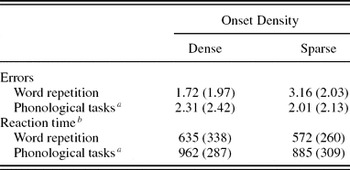
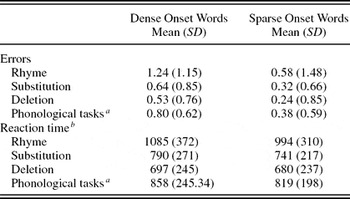
Reaction time (RT). A 3 (Task: Deletion, Substitution, and Rhyme) × 2 (Onset Density: Dense Vs. Sparse) repeated-measures ANOVA revealed a significant main effect of onset density on RT, F (2, 8) = 5.737, MSE = 200080.88, p = .043, ηp2 = .418, but not task, and no significant task by onset density interaction. As there were no significant differences between the phonological awareness tasks we computed a composite (average) score for phonological awareness and then used this mean score in an investigation of the main effect of onset density. For children who completed more than one phonological awareness task, we computed an average based on the tasks they did complete. A Wilcoxon signed ranks test revealed a significant main effect of onset density on RT in the full preschool sample (N = 30), z = −2.37, p = .018. RTs were slower for words from dense onset neighborhoods (M = 890, SD = 299) than for words from sparse onset neighborhoods (M = 740, SD = 183), replicating the effects we had observed with the adults.
Word repetition
Accuracy. A paired samples t test revealed a significant facilitative effect of onset density on accuracy in the word repetition task, t (24) = 4.15, p = .0001. Participants made fewer errors in repeating words from dense onset neighborhoods (M = 1.72, SD = 1.97) than in repeating words from sparse onset neighborhoods (M = 3.16, SD = 2.03).
RT. Paired samples t and nonparametric statistics tests failed to reveal a significant effect of onset density on RT.
Summary of onset density effects. For children who passed the phonological awareness screening subtests, there was a penalizing effect of onset density (i.e., longer RTs for words with dense onsets than for words with sparse onsets) in phonological awareness tasks (see Table 2). This was as we had seen in adult participants. There was also a facilitating effect of onset density on word repetition accuracy: participants were more accurate repeating words with dense onsets than words with sparse onsets.
Number of errors (max. = 15) and reaction time (ms) for children as a function of onset density and task

aThe mean of completed phonological tasks.
bFor correct responses only.
Group analyses
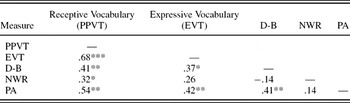
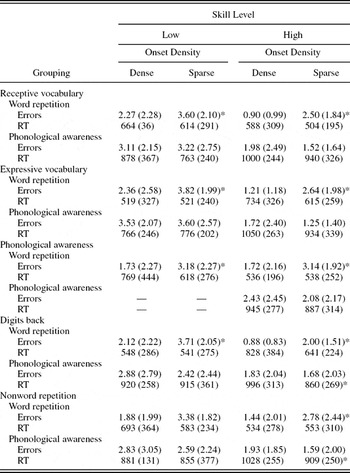
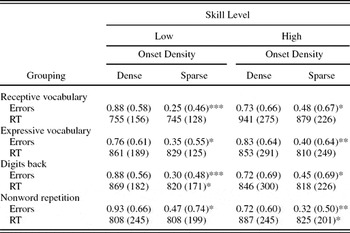
The next series of analyses were motivated by our desire to examine whether there might be different effects of onset density as a function of phonological awareness and as a function of our predictor measures (receptive and expressive vocabulary and working memory). The intercorrelations between the predictor variables are shown in Table 3. We studied groups of children who showed or did not show evidence of phonological awareness, and also created groups with high and low skills by means of median splits for receptive vocabulary (Mdn = 80), expressive vocabulary (Mdn = 54), and working memory (Mdn = 2) skills. The results of these analyses are described in detail below and summarized in Table 4.
Correlations between predictors for child sample

Note: PPVT, Peabody Picture Vocabulary Test (Dunn & Dunn, Reference Dunn and Dunn1997); EVT, Expressive Vocabulary Test (Williams, Reference Williams1997); D-B, digits back; NWR, nonword repetition; PA, phoneme awareness.
*p < .05. **p < .01. ***p < .001.
Onset density effects by group for errors and reaction time (ms) for the word repetition and phonological awareness tasks in the children

Note: RT, reaction time.
*The dense versus sparse comparison is statistically significant at p < .05.
Effects of predictor variables on onset density
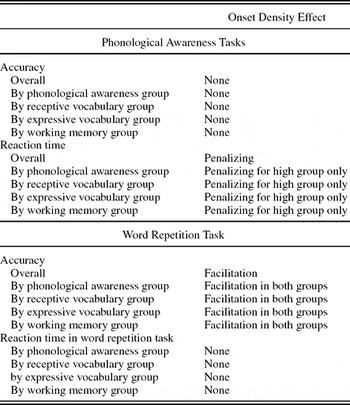
Phonological awareness tasks. Nonparametric statistics (Wilcoxon signed ranks test) revealed the penalizing effects of onset density on RT in the phonological awareness tasks only in the group of children with high skills in phonological awareness, z = −2.68, p = .007, receptive vocabulary, z = −2.20, p = .028, expressive vocabulary, z = −2.69, p = .007, and working memory, z = −2.38, p = .017.
Word repetition task. Wilcoxon signed ranks tests confirmed the facilitatory effects of onset density on accuracy in the word repetition task in both the low and high groups whether the split was according to phonological awareness (children who scored 0 on the phonological screening measure vs. those who did not), z = −2.55, p = .011 and z = −2.20, p = .028, receptive vocabulary, z = −2.30, p = .02 and z = −2.41, p = .02, expressive vocabulary, z = −2.00, p = .02 and z = −2.69, p = .007, and working memory, z = −2.67, p = .008 and z = −2.04, p = .04, respectively.
Summary of the group analyses. On average, children showed facilitative effects of onset density on repetition accuracy and penalizing effects on phoneme awareness RT (see Table 5). The facilitative effects on word repetition accuracy were not related to the level of children's phoneme awareness, vocabulary, or working memory performance, although these skills did relate to the penalizing effects of density on phonological awareness. Thus, effects on phonological awareness dissociated from effects on repetition.
Summary of onset density results for the children

DISCUSSION
In our pretest and in our experiment, we have sought evidence as to whether sensitivity to onset density might be a factor in phonological awareness tasks. To our knowledge, the present study is the first to demonstrate onset density effects on phonological awareness. Prior studies have concerned more tacit language processing tasks such as repetition, lexical decision, and naming. Paralleling the results of those studies (e.g., Vitevitch, Reference Vitevitch2002a; Vitevitch et al., Reference Vitevitch, Armbruster and Chu2004), we have found that onset density penalizes performance on rhyme production, phoneme deletion, and phoneme substitution. Moreover, we find penalizing effects for preschool children and adults, alike (e.g., the pretest and Foy & Mann, Reference Foy and Mann2004). As long as the children are able to do the task, their rhyme, phoneme deletion, and substitution responses are slower when the target word shares its onset with many lexical words neighbors.
We further discovered that participants were differentially susceptible to onset density. However, rather than finding that adults were susceptible and children less so (as was reported in Garlock et al., Reference Garlock, Walley and Metsala2001, for example), we find that susceptibility to density effects was present within each population but associated with vocabulary and to a lesser extent with working memory skills. Penalizing effects of onset density have previously been found for adults performing repetition and lexical decision tasks (Vitevitch, Reference Vitevitch2002a; Vitevitch et al., Reference Vitevitch, Armbruster and Chu2004). These effects appear to be most apparent in tasks where stimulus items are processed with reference to the mental lexicon (Vitevitch & Luce, Reference Vitevitch and Luce1998, Reference Vitevitch and Luce1999; Walley, Stavrinos, & Imai, Reference Walley, Stavrinos and Imai2005) and when the lexical representations have been firmly established (Garlock et al., Reference Garlock, Walley and Metsala2001; Walley, Metsala, & Garlock, Reference Walley, Metsala and Garlock2003). In the context of Vitevitch et al.'s research, our findings of onset density effects in phonological awareness tasks imply the operation of the lexicon in phonological awareness tasks. It is consistent with this lexical involvement that onset density effects associated with strong vocabulary and the association with stronger working memory skills accords with some other evidence (Adams & Gathercole, Reference Adams and Gathercole1995; Gathercole et al., Reference Gathercole, Willis, Emslie and Baddeley1992) that vocabulary and working memory are interrelated.
What we find significant is that the effects of vocabulary and working memory hold for children and adults alike. Within each population there appear to be individual differences in the involvement of sublexical representation in speech processing and these relate to vocabulary size and efficiency of working memory. We do not find that individual differences are limited to children, as would seem to follow from a view that segmentation is an all or nothing achievement promoted by vocabulary growth in the preschool years.
As a more explicit test of the possibility that lexical restructuring from holistic to sublexical units is a condition for phonological awareness, our experiment also examined onset density effects in a word repetition task. Our reasoning was that if children selectively respond to manipulations involving the onset density of a word, then they are arguably demonstrating sensitivity to a common initial phoneme and thus giving evidence of sublexical, segmental representations. We found that preschool children show reliable, facilitatory effects of onset density on the accuracy of word repetition, and that this was true regardless of their ability to perform phonological awareness tasks. Among the children we tested, susceptibility to onset density effects in word repetition was, for the most part, unrelated to performance on vocabulary and working memory measures, the only exception being a tendency for children with high expressive vocabularies to show significantly slower RTs for words from dense neighborhoods.
Vocabulary effects aside, our study of word repetition accuracy indicates that all of the preschoolers in our study show some evidence of sublexical representation, and that this did not appear to be related to phonological awareness. At this point a safe conclusion is that at the age we have tested, children who cannot do phoneme awareness tasks may nonetheless show other forms of evidence that they are capable of sublexical representation. Thus, sublexical representation may be a necessary condition for phonological awareness but it is not sufficient. Evidence that sublexical representation is necessary for phoneme awareness would involve finding some cases where it is not evident: alphabet-illiterate adults, for example. It remains to be seen whether younger children will continue to show onset density effects when given the word repetition task that we employed.
It also remains to be seen whether, in the case of density effects, segmental representation can be separated from onset-rime awareness. In this study and many like it, the phoneme awareness tasks could be solved by onset-rime awareness as opposed to true phoneme awareness. Vitevitch's materials, as used in our present study, did not involve manipulating phonemes that are part of consonant clusters (the “b” in “black”) or final consonants (the “b” in “tub”), so our results must remain ambiguous as to whether phonemes or onsets are being represented and manipulated. In the end, we suspect that segmental (vis-à-vis Walley et al.) or sublexical effects (vis-à-vis Vitevitch et al.), onset-rime effects and phonological effects may follow some kind of gradient; they will be stronger for some individuals and stronger for some tasks.Footnote 1 The literature, for example, has ample evidence that there are age-related differences between rhyme judgment and phoneme manipulations, but also differences in the cognitive skills that they accompany (for a review, see Foy & Mann, Reference Foy and Mann2001). With sufficiently sensitive measures of segmentation, researchers have begun to find evidence of segmental awareness much earlier in childhood (Coady & Aslin, Reference Coady and Aslin2004; Dehaene-Lambertz & Gliga, Reference Dehaene-Lambertz and Gliga2004; Mattys, Jusczyk, & Luce, Reference Mattys, Jusczyk and Luce1999) than had been previously thought. More sensitive indicators also appear to show that gradients of phonological awareness are found in adults (Lehtonen & Treiman, Reference Lehtonen and Treiman2007). Perhaps more refined manipulations of onset density in the context of such measures can offer an even earlier test of the role of lexical restructuring.
Our finding of a facilitative effect of onset-density on children's repetition accuracy is intriguing, especially given that we obtained competitive effects for the same pool of words in phonological awareness RT. Walley (Reference Walley, Pisoni and Remez2005) has recently proposed that the direction of the effect of neighborhood density follows from the degree to which a task invokes a lexical level of processing. She has proposed that facilitative effects will be induced when lexical processing is not invoked, as when nonwords are used, and that competitive effects will be induced when words are used. We do not find consistent support for this possibility. In our study, competition was seen in all three phonological awareness tasks, despite lexical responses predominating for the phonological awareness tasks (although nonword responses were sometimes correct). Onset density facilitated the accuracy of word repetition but we find no compelling reason to believe that this was not a lexically mediated task.
Our results suggest that whether we see facilitative or competitive effects of onset density may depend on whether the task involves repetition or phoneme awareness and not upon whether it involves real words or nonwords as items. Vitevitch et al.'s (Reference Vitevitch, Armbruster and Chu2004) notion of levels of processing and different patterns of interaction between activated levels in speech production tasks may provide some insight into why this result obtains. We see facilitative effects of onset density on repetition accuracy, just as Vitevitch et al. (Reference Vitevitch, Armbruster and Chu2004) saw facilitation in their picture-naming tasks. Vitevitch and colleagues (Reference Vitevitch, Armbruster and Chu2004) explain the facilitation with the view that in speech production tasks, when children retrieve and produce words that contain dense onsets, activation from those words may spread to the phonological system, to activate corresponding phonemes. This phoneme activation then spreads back to the lexical system, thereby activating more lexical members for words with dense onsets than those with sparse onsets. When the task shifts to phoneme judgment or manipulation phonemic levels of processing become dominant as all responses are strings of phonemes that may or may not be real words.
What we find most important, in the end, is the fact that onset density has a consistent effect on preschool children's repetition of words, as well as a consistent effect on both adults and preschool children's performance on phonological awareness tasks. It is not the direction of these effects so much as their existence that provides an indication that all of our subjects' representations of words are segmental. Where there are select consequences of manipulating the onset of a word it indicates some level of sublexical representation, some level of segmentation. Of importance, all of the children showed an effect of onset density on repetition accuracy whether or not they were able to perform our phonological awareness tasks, and regardless of their vocabulary and working memory abilities. Thus, phoneme awareness in this preschool population appears to be independent of segmentation at other levels of speech processing.
Walley and colleagues (Reference Walley, Metsala and Garlock2003) have suggested that lexical restructuring occurs as a result of vocabulary growth, and may predict development of phonological awareness. A relation between vocabulary and segmental representation is seen in our study, even though we do not find dissociation between children's explicit phoneme awareness and the presence of onset density effects in repetition. Rather, the relation we observe is not age dependent. In both our adult and child samples, individuals with superior vocabulary skills showed greater susceptibility to onset density. In addition to being related to vocabulary skills, onset density effects were also somewhat related to working memory skill in both the adults and children in our study. Consistent with the models proposed by Metsala (Reference Metsala1999) and others (Gathercole, Alloway, Willis, & Adams, Reference Gathercole, Alloway, Willis and Adams2006; Gathercole & Baddeley, Reference Gathercole and Baddeley1993), working memory capacity, vocabulary development, and phonological processing appear to be linked. Memory span for phonological units (i.e., phonemes) may be a key requirement for the development of phonological awareness and for the development of vocabulary (Gathercole & Baddeley, Reference Gathercole and Baddeley1990, Reference Gathercole and Baddeley1993; Gathercole et al., Reference Gathercole, Willis, Emslie and Baddeley1992, Reference Gathercole, Alloway, Willis and Adams2006). Larger working memory capacity may allow for more units, at any level of segmentation, to be activated, and to have competitive effects, possibly explaining why the onset density effects were most apparent in participants with larger working memory capacities. However, these interactions between vocabulary, working memory, and phonological awareness are present in both childhood and adulthood, which calls for an explanation cast in different terms than an age-related change in segmental representation.
What prior studies have shown is that vocabulary differences matter for children's susceptibility to effects that imply segmental representation. What we now demonstrate is that both adults and children show vocabulary- and working memory-related differences in onset density effects on phoneme awareness tasks. In light of this we propose adjustments to the emergent theorists' view as to how vocabulary plays a role in the development of phonological awareness. We appear to find some onset density effects wherever we look, whether it be among adults or children, in phonological awareness tasks, or in repetition accuracy, as long as the subjects can perform the task. Thus, we suggest that the sublexical representation of speech begins earlier than the late preschool years. We find that our data give no evidence of the discontinuity that would indicate a restructuring of the lexicon driven by preschool children's expanding vocabulary. Beginning to read involves growth in vocabulary, and it exercises children's expanding working memory capacity. It also involves explicit segmental analyses of words and of how phonological segments associate with orthographic representations. All of this may well result in improved phoneme awareness but not necessarily as a consequence of a restructuring of the lexicon. Our findings of penalizing effects of onset density for phonological awareness tasks and facilitating effects for word repetition tasks using the same pool of words in our preschool sample suggest that what may change with age, vocabulary, and memory development is the ability to explicitly use segmental processing when appropriate for the given task, but not the segmentation itself.
APPENDIX A
SUMMARY OF PRETEST RESULTS
Adults in the pretest sample (N = 38) were studied using the phonological awareness materials adapted from Vitevitch et al. Separate analyses were conducted for RT and accuracy, with an alpha level of .05 for all statistical tests. Descriptive statistics for the accuracy and RTs, as a function of onset density and task are provided in Tables A.1 and A.2. The adults showed strong penalizing effects of onset density on both the accuracy and the RT measures on all tasks. Participants tended to be more vulnerable to penalizing effects of onset density when they had larger receptive vocabularies. There was no such relation between density effects and expressive vocabulary, and there was a weak indication that greater working memory spans were also linked to greater vulnerability to density effects.
Number of errors (max. = 15) and reaction time (ms) in the phonological awareness tasks by onset density and task (rhyme, substitution, deletion) for the 38 adults in the pretest sample

aMean combined phonological awareness task scores.
bFor correct responses only.
Onset density effects for adults by group for errors and reaction time (ms)

Note: RT, reaction time.
*p < .05. **p < . 01. ***p < .001.
ANALYSES OF PRETEST DATA
Onset density effects on phonological awareness
Accuracy. A 3 (Task: Deletion, Substitution, and Rhyme) × 2 (Onset Density: Dense and Sparse) repeated-measures ANOVA revealed significant main effects of task, F (2, 37) = 4.81, MSE = 1.40, p = .01, ηp2 = .12, and onset density on accuracy, F (2, 37) = 23.52, MSE = 0.43, p = .0001, ηp2 = .39. The participants made fewer errors in the deletion (M = 0.38, SE = 0.11) and the substitution (M = 0.47, SE = 0.10) tasks than on the rhyme tasks (M = 0.91, SE = 0.19). The results of post hoc least significant difference tests with p = .05 revealed that responses to words with sparse onsets were more accurate (M = .38, SE = .10) than words with dense onsets (M = 0.80, SE = 0.10).
RT. A 3 (Task: Deletion, Substitution, and Rhyme) × 2 (Onset Density: Dense and Sparse) repeated-measures ANOVA revealed statistically significant main effects of task, F (2, 37) = 47.57, MSE = 54357.97, p = .0001, ηp2 = .56, and onset density, F (2, 37) = 8.45, MSE = 18704.09, p = .01, ηp2 = .19, on RT. Post hoc comparisons using Fisher's least significant difference test showed that the participants made faster responses in the deletion (M = 684.77, SE = 34.92) than in the substitution (M = 763.71, SE = 35.67) and rhyme tasks (M = 1032.82, SE = 45.55), which were also significantly different. Participants made faster (M = 801.76, SE = 31.63) phonological awareness responses to words from the sparse onset set than to words in the dense onset set (M = 852.44, SE = 40.00; M = 0.80, SE = 0.10, respectively). There were no statistically significant interactions.
Effects of other measures of language performance
To examine whether the onset density effects we reported above would differ as a function of vocabulary and memory skills, we divided the sample into two groups by vocabulary and into two groups by working memory using separate median splits. We then conducted separate mixed ANOVAs with task and onset density as within-subjects and group as between-subjects independent variables. The results are summarized in Table A.2. As the task and onset results do not differ from those reported above, we report here only results of the main effect and interaction analyses involving the relevant between-groups variable (i.e., receptive vocabulary, expressive vocabulary, and working memory).
Effects of receptive vocabulary
Accuracy. There was no significant main effect involving receptive vocabulary group on accuracy, although there was a significant interaction between vocabulary group and onset density on accuracy, F (1, 36) = 4.75, MSE = 0.39, p = .036, ηp2 = .117. The advantage for sparse onset density words over high-density onsets was greater for the low vocabulary group than for the high group, t (36) = 2.25, p = .03.
RT. A 2 (Onset Density: Sparse Vs. Dense) × 3 (Task: Rhyme, Substitution, Deletion) × 2 (Receptive Vocabulary: High Vs. Low) ANOVA revealed significant main effects of task and onset density on RT and accuracy, as reported above. In addition, the ANOVA revealed a significant main effect of receptive vocabulary group on RT, F (1, 36) = 7.77, MSE = 244078.28, p = .008, ηp2 = .177, as well as interactions between receptive vocabulary group and task, F (1, 36) = 5.21, MSE = 66792.91, p = .028, ηp2 = .126, and receptive vocabulary group and onset density, F (1, 36) = 4.71, MSE = 16998341, p = .037, ηp2 = .116. Participants with higher vocabularies were slower overall, and onset density had a significant penalizing effect on RT in the high receptive vocabulary group, t (19) = 3.505, p = .002, but not on RT in the low receptive vocabulary group.
Effects of expressive vocabulary
Accuracy. The ANOVAs failed to reveal a significant main effect of expressive vocabulary group, or interactions between expressive vocabulary group and onset density and task.
RT. The ANOVAs failed to reveal a significant main effect of expressive vocabulary group, or interactions between expressive vocabulary group and onset density and task.
Digits backward
Accuracy. The ANOVAs failed to reveal a significant main effect of grouping by digits backward performance, or interactions between digits backward and onset density and task on accuracy.
RT. The ANOVAs failed to reveal a significant main effect or interactions between digits backward and onset density and task on RT.
Nonword repetition accuracy
Accuracy. A 2 (Onset Density: Sparse Vs. Dense) × 3 (Task: Rhyme, Substitution, Deletion) × 2 (Nonword Repetition Accuracy Group: High Vs. Low) ANOVA revealed no significant main effect of group or interaction involving group for accuracy.
RT. A 2 (Onset Density: Sparse Vs. Dense) × 3 (Task: Rhyme, Substitution, Deletion) × 2 (Nonword Repetition Accuracy Group: High Vs. Low) ANOVA revealed significant interactions between task and nonword repetition accuracy group, F (2, 36) = 4.28, MSE = 51094.02, p = .04, ηp2 = .11, as well as a significant interaction between onset density, task, and nonword repetition accuracy group, F (2, 72) = 5.40, MSE = 24983.74, p = .028, ηp2 = .13. Participants in the low memory group had significantly faster RTs for the rhyme task and had significant competition effects for the substitution task, t (13) = 2.17, p = .049. In the high memory group, participants had significant competition effects for the rhyme task, t (23) = 2.75, p = .011.
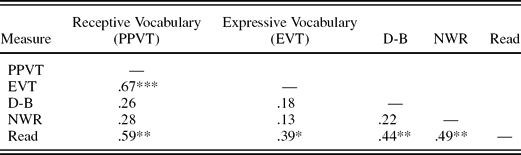
Correlations between the predictor variables
As shown in Table A.3, the predictor variables were highly intercorrelated.
Correlations (zero-order) between predictor measures for the adult sample
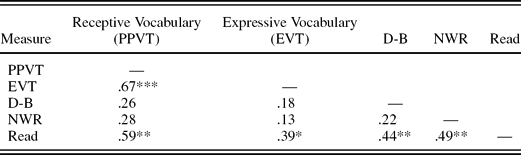
Note: PPVT, Peabody Picture Vocabulary Test (Dunn & Dunn, Reference Dunn and Dunn1997); EVT, Expressive Vocabulary Test (Williams, Reference Williams1997); D-B, digits back; NWR, nonword repetition; Read, reading.
*p < .05. **p < .01. ***p < .001.
ACKNOWLEDGMENTS
The authors gratefully acknowledge the assistance of the following Loyola Marymount University students in data collection and scoring for this study: Aqila Blakey, Marissa Feldman, Jessica Magenheimer, Ana Ceci Mel, and Alysha Thompson.