Introduction
Nutrition has an important effect on health during prenatal and postnatal life and, consequently, several studies have been performed about this issue (Jazwiec and Sloboda, Reference Jazwiec and Sloboda2019). The availability of nutrients associated with energy expenditure can affect hormonal profiles and fertility (Fontana and Torre, Reference Fontana and Torre2016). During early pregnancy, nutrition can affect placental physiology, which has been associated with adverse pregnancy outcomes (Ramakrishnan et al., Reference Ramakrishnan, Grant, Goldenberg, Zongrone and Martorell2012). Castañeda-Gutiérrez et al. (Reference Castañeda-Gutiérrez, Benefield, de Veth, Santos, Gilbert, Butler and Bauman2007) described that, in dairy cows, supplementation with conjugated linoleic acid (CLA) trans-10 cis-12 increased the levels of estradiol, androstenedione, and IGF-I. De Veth et al. (Reference de Veth, Bauman, Koch, Mann, Pfeiffer and Butler2009) showed that bovine supplementation with CLA reduced the pregnancy time, while Csillik et al. (Reference Csillik, Faigl, Keresztes, Galamb, Hammon, Tröscher and Butler2017) showed that this treatment increased the levels of P4 (postovulatory), IGF-1, and leptin and consequently an increment in their fertility, higher fertility with a reduction in the period from calving to conception, however due the physiological differences it is hard to compare murine and bovine outcomes.
The composition of unsaturated fatty acids affects several cell signalling pathways (Khajeh et al., Reference Khajeh, Rahbarghazi, Nouri and Darabi2017). Particularly, CLA is a class of isomers produced by ruminal bacteria and found in ruminants beef and milk (Kim et al., Reference Kim, Kim, Kim and Park2016). CLA isomers have shown some anticancer effects, trans-10 cis-12 inhibits cellular proliferation in colon tumours, while cis-9 trans-11 stimulates apoptosis and acts as an angiogenic inhibitor in cancer cells (Basak and Duttaroy, Reference Basak and Duttaroy2020). Recently, Zeng et al. (Reference Zeng, Liu, Yang, Li, Li, Guo, Meng and Liu2020) showed a reduction in breast tumour weight in women supplemented with the cis-9 trans-11 isomer. CLA is important for the growth and reproduction of non-ruminants and is a supplement that would impact energy balance, postpartum, and subsequent fertility (NRC 1995; Butler, Reference Butler2000). Additionally, some studies have demonstrated that CLA would modulate lipid synthesis in germ and embryonic cells, influencing their developmental potential (Batista et al., Reference Batista, Raposo, Campos-Junior, Pereira, Camargo, Gama and Viana2014) and also would prevent premature births and cervical incompetence (Harris et al., Reference Harris, Hansen, Vidsudhiphan, Koslo, Thomas, Watkins and Allen2001).
Mammalian oogenesis takes place in the ovaries, maintaining intimate contact with the somatic cells constituting the ovarian follicle formed during embryogenesis (Zhai et al., Reference Zhai, Ma, Yan, Qiao, Leung and Qiao2019). The development of these gametes is known as folliculogenesis, and occurs through follicle activation and growth, from the primordial follicles to ovulation. Some studies have shown that changes in the nutritional plan are able to alter ovarian follicular dynamics (Fouladi-Nashta et al., Reference Fouladi-Nashta, Gutierrez, Gong, Garnsworthy and Webb2007) and reproductive performance. Mostafa et al. (Reference Mostafa, Samir and Nagib2018) showed that the inclusion of polyunsaturated fatty acids in the diet of female rats increased the number of growing follicles (Butler, Reference Butler2000). As fish oil diet supplementation has some oestructural similarities with CLA (Pires and Grummer, Reference Pires and Grummer2008) and was associated with some negative effects on ovulation rate, and litter size (Yi et al., Reference Yi, Zeng and Guo2012), the effects of CLA treatment in ovarian follicle endowment and female fertility is a field that requires further investigation. Moreover, due to the wide application of CLA in several parameters of human and animal health, it is extremely important to evaluate the potential side effects of this supplementation in reproductive parameters. Therefore, the aim of this study was to evaluate the effects of CLA gastric administration, during the pregestational and gestational period, in biometric parameters and ovarian morphophysiology, and also its effects on their progeny prolificity in mice.
Materials and methods
Animals, facilities and experimental design
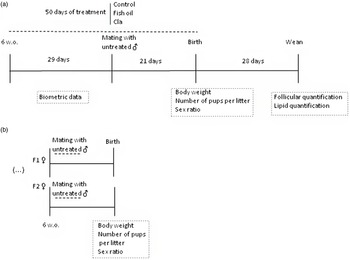
Female (n = 30) and male (n = 15) mice C57BL/6 were obtained from the Núcleo de Criação de Animais de Laboratório and maintained in an environment with a controlled temperature of 22 ± 2°C and with artificial light cycles (12 h:12 h). The 6-week-old females were selected at random and distributed into three groups: (1) control (n = 10), (2) fish oil (n = 10), and (3) CLA (n = 10), that daily received by gavage 35 µl of phosphate-buffered saline (PBS), fish oil (Mundo dos Óleos®, Brasilia, DF, Brazil), synthetic CLA (Tonalin TG80 Basf®, São Paulo, SP, Brazil; 80% C18:2 conjugated, 39.2% C18:2 cis-9, trans-11 and 38.4% C18:2 trans-10, cis-12), respectively. The administration of fish oil was used as a positive control, and the structural and functional similarities (Pires and Grummer, Reference Pires and Grummer2008) with the fatty acid CLA profile is well established; there is a report about its effects on ovulation rate, and litter size in mice (Yi et al., Reference Yi, Zeng and Guo2012). These treatments were performed over 50 days (before mating, mating and pregnancy) (Figure 1a,b). These females were crossbred with 10-week-old males (1:2, male:female) with proven fertility for a period of 2 weeks. After delivery, females were euthanized by CO2 asphyxia and their ovaries were collected. All experiments were conducted according to the principles and procedures described by the Brazilian College of Animal Experimentation (COBEA) and were approved by the Institutional Ethics Committee of the Federal University of São João del-Rei (Protocol 013/2018).
Experimental design. (a) PBS (control), fish oil and conjugated linoleic acid (CLA) were gastric administered during 50 days on 6 weeks old (w.o.) female C57BL6 mice that were mated with untreated males with proven fertility. Biometric data were evaluated weekly before mating. At the day after delivery the treatments were interrupted and the body weight, number of pups per litter and sex ratio of parental offspring were assessed. After weaning, the ovaries of the treated mothers (control, fish oil and CLA) were harvested and used for follicle and oocyte lipid quantification. (b) Body weight, number of pups per litter, and sex ratio were also analyzed in litters obtained from F1 and F2 females mated with untreated males with proven fertility.

Biometric data
The animals were weighed weekly on a commercial scale (SF-400®, São Paulo, SP, Brazil), and nasoanal length also was measured. The Lee index (obesity indicator) was calculated as previously described by Bernardis (Reference Bernardis1970).
The number of pups per litter, as well as their sex and weight, were obtained shortly after birth (postnatal day 1) in parental and F1 and F2 generations. The sex of the pups was identified by visual evaluation, while their weights were also obtained. In F1 and F2 evaluations, these females were crossbred at 6 weeks old with 10-week-old males (1:2, male:female) with proven fertility for a period of 2 weeks.
Ovarian follicular quantification
All ovaries were fixed in PFA (Sigma-Aldrich, St. Louis, MO, USA) solution. Paraffin-embedded ovaries were serially sectioned (5 μm) and stained with haematoxylin and eosin solution. In every 50 sections, the number of primordial, primary, secondary, antral, and atretic follicles were quantified, estimating the total number of follicles per ovary. Follicles were classified and counted (Campos-Junior et al., Reference Campos-Junior, Marinho Assuncao, Carvalho, Batista, Garcia and Viana2012) and follicles (from primordial to antral) showing morphological signs of death such as pyknosis, cellular fragmentation, and disintegration were classified as atretic (Campos-Junior et al., Reference Campos-Junior, Marinho Assuncao, Carvalho, Batista, Garcia and Viana2012). Only follicles containing an oocyte with a visible nucleus were considered to avoid double counting. Results are shown as the number of counted follicles per animal. Atresia rate (%) was determined as the number of atretic follicles/total number of follicles × 100; and activation rate (%) as the number of growing follicles/total number of follicles × 100 (Campos-Junior et al., Reference Campos-Junior, Marinho Assuncao, Carvalho, Batista, Garcia and Viana2012).
Oocyte lipid quantification
Paraffin-embedded ovaries were also serially sectioned (5 μm) and stained with Sudan red dye, as described by Sudano et al. (Reference Sudano, Santos, Tata, Ferreira, Paschoal, Machado and Landim-Alvarenga2012). The Sudan red dye solution was prepared with 3% Sudan IV in 70% ethanol. To estimate the relative amount of lipid droplets per oocyte, images of antral follicles (12 oocytes per animal; six animals per group) were captured in ×40 objectives. All photographs were converted to black and white (32 bt), and the oocytes included in antral follicles were delimited and analyzed using the area of integrated density compared. This evaluation was performed in ImageJ® software according to Leite et al. (Reference Leite, Andrade, Silva and Borges2017).
Statistical analysis
Statistical analysis was carried out using statistical software (GraphPad Prism 8.0, Graph Prism Inc., San Diego, CA). A completely randomized design (DIC) was carried out using the following mathematical model:
 ${Y_{ij}} = \mu + {x_i} + {e_{ij}}$
where Y ij = bodyweight, nasoanal length, Lee index, primordial, primary, secondary, antral, total and atretic follicles, atresia and activation rate; μ = constant; x i = supplementation (control, fish oil, CLA); e ij = random error.
For the characteristics bodyweight, nasoanal length and Lee index, a comparison of intercepts and the slope of the line were analysed using a simple linear regression analysis for the 4 weeks of evaluation. For the variables number of primordial, primary, secondary, antral, total and atretic follicles, atresia and activation rate, a D’Agostino–Pearson normality test was conducted to test the null hypothesis that the data are sampled from a Gaussian distribution. When the data did not deviate from Gaussian distribution (P > 0.05) they were analyzed using one-way analysis of variance (ANOVA) with Newman–Keuls for multiple comparisons test. Alternatively, a Kruskal–Wallis test was done. Student’s t-test was applied to body weight, nasoanal (NA) length and Lee index in two-group comparisons. All tests were performed at a level of significance of 0.05.
Results
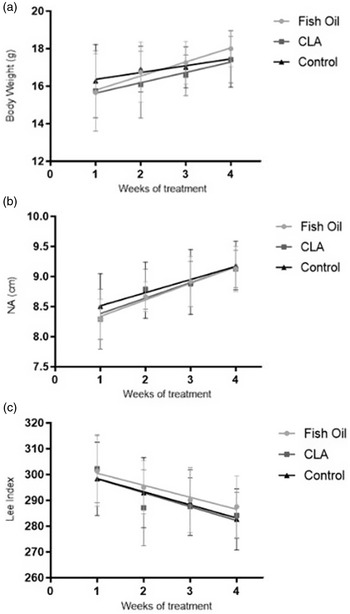
There was no significant (P > 0.05) difference among control, fish oil, and CLA groups in relation to the bodyweight (Figure 2a), nasoanal length (Figure 2b) and Lee index (Figure 2c) at 1, 2, 3 and 4 weeks of treatment. However, some punctual differences were observed in the comparisons between 2 weeks consecutively in the same group by t-test. At the second week of treatment, there was an increment in nasoanal length compared with the previous week, in animals treated with fish oil (P = 0.049) and CLA (P = 0.008). However, this parameter stabilized (P > 0.05) after the third week (Figure 2b). In relation to the Lee index, a significant difference (P = 0.015) was observed in CLA-treated animals in the first and second week comparison (Figure 3c).
The effects of conjugated linoleic acid (CLA) gastric administration during the pregestational period on biometric parameters. (a) Bodyweight, (b) nasoanal length, and (c) Lee index were compared among groups (control, fish oil and conjugated linoleic acid) by linear regression in the first 4 weeks and no differences were noticed (P > 0.05). In relation to the comparisons, by t-test, between 2 weeks consecutively in each treatment, there was no difference in bodyweight, whereas the nasoanal length increased with subsequent stabilization in fish oil- and CLA-treated animals (P = 0.049 and P = 0.008, respectively). In relation to the Lee index, the unique statistical difference observed was in the CLA group, between the first and second weeks (P = 0.015).

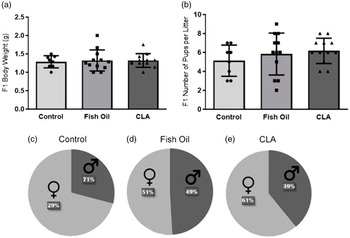
CLA gastric administration during the pregestational and gestational periods does not alter some biometric and reproductive parameters. There was no difference in the (a) bodyweight of the pups (b) in the number of pups per litter (c–e) as well as in the offspring percentage of male and female among the groups (control, fish oil, and CLA; P > 0.05).

The bodyweight (g; Figure 3a) of pups delivered from control, fish oil, and CLA-treated females was similar (P > 0.05). Also, there was no effect of these treatments on the number of pups per litter (P > 0.05; Figure 3b), as well as in the percentage of males and females (P > 0.05; Figure 3c).
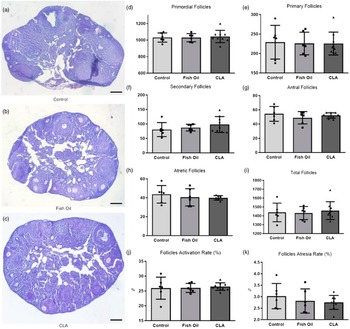
All classes of follicles were observed qualitatively in the ovaries of control, fish oil, and CLA-treated animals and, clearly, no morphological alterations were caused by these treatments (Figure 4).
CLA gastric administration during the pregestational and gestational periods did not alter ovarian follicle endowment and mobilization. Apparently (a–c) the ovarian morphology of treated mothers were not altered, and all classes of follicles were observed. There was no effect of fish oil and CLA administration on the number of (d) primordial (e) primary (f) secondary (g) antral (h) atretic, and (i) total follicles (P > 0.05). (j) Follicle activation and (k) follicle atresia rates (%) were also unaltered by treatments (P > 0.05). Bars, 70 µm.

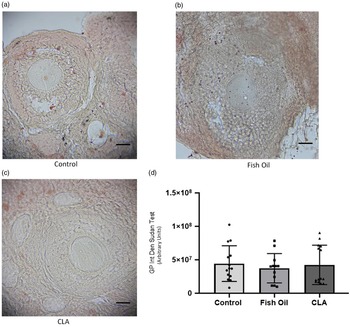
In relation to the morpho-quantitative analyses, there was no difference (P > 0.05) in the number of primordial, primary, secondary, antral, atretic, and total follicles per ovary on control, fish oil, and CLA-treated animals (Figure 4d–i). The follicle activation (Figure 6a) and atresia rates (Figure 6b) were not altered (P > 0.05). Additionally, there was no effect of the treatments (fish oil and CLA; P > 0.05) in the integrated density of lipid content of oocytes included in antral follicles (Figure 5).
CLA gastric administration during the pregestational and gestational periods does not alter lipid accumulation on oocytes included in antral follicles. (a–c) Representative pictures of antral follicles stained with Sudan IV depicting an apparent similar staining intensity. Quantitatively, there was no difference in the (d) integrated density of lipid content (arbitrary units) of oocytes included in antral follicles among control, fish oil, and CLA groups (P > 0.05). Bars, 25 µm.

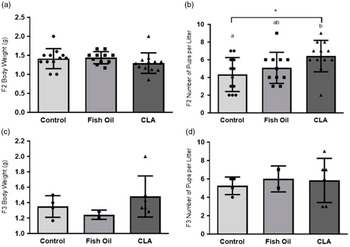
CLA gastric administration during the pregestational and gestational period altered the number of pups per litter on F2. The (a) bodyweight of F2 pups was not different among control, fish oil, and CLA groups (P > 0.05). However (b) an increment in the number of F2 pups per litter was observed in CLA-treated animals compared with the control (P = 0.028), whereas the fish oil group was not significantly different from the control and CLA for this parameter. Finally, in relation to F3 mice, their (c) bodyweight, and (d) number of pups per litter were not altered by treatments (P > 0.05).

After crossing, the bodyweight of F2 pups was not different among groups (P > 0.05; Figure 6a), however, the number of pups per litter was higher in those mothers supplemented with CLA (P = 0, 028; Figure 6b). Finally, there was no difference in the bodyweight of F3 (P > 0.05; Figure 6c), as well as in their litter size (P > 0.05; Figure 6d).
Discussion
Several studies have been carried out to investigate the nutrigenomic effects of CLA on antiobesity, immunological, cardiovascular, and anticarcinogenic functions (Den Hartigh, Reference Den Hartigh2019; Basak and Duttaroy, Reference Basak and Duttaroy2020). Ávila et al. (Reference Ávila, Catozzi, Pravettoni, Sala, Martino, Meroni, Lecchi and Ceciliani2020) demonstrated that a mixture of CLA isomers had immunomodulatory effects. In lactating sheep, it has been shown that the expression of lipogenic genes was related to the amount of trans-10 cis-12 CLA per unit of metabolic weight (Oliveira et al., Reference Oliveira, Urio and Sandri2018). Consequently, some studies have demonstrated that CLA diet supplementation can reduce the concentration of lipid in milk (Ticiani et al., Reference Ticiani, Urio, Ferreira, Harvatine and De Oliveira2016; Sandri et al., Reference Sandri, Camêra, Sandri, Harvatine and De Oliveira2018) and also would increase milk production by dairy cows (Medeiros et al., Reference Medeiros, Oliveira, Aroeira, McGuire, Bauman and Lanna2010). However, studies about its effects on female fertility are still ongoing, mainly in mice. Therefore, our data describes for the first time in the literature that, at least in mice, the gastric administration of CLA during pregestational and gestational periods did not affect maternal biometric parameters and ovarian follicle mobilization. However, there was a significant increase in the number of pups per litter produced by their F1 progeny. Is also important to consider that, to the best of our knowledge, this study is the first to use gavage as a route for the administration of CLA to evaluate female mice reproductive parameters. Accordingly, our data must be carefully compared with other reports in the current literature.
CLA supplementation affects the development of adipose and muscle tissues, altering body growth and composition. Its effects are time and sex influenced (Poulos et al., Reference Poulos, Sisk, Hausman, Azain and Hausman2001), and also in nonpregnant women, it has been already demonstrated as an immunomodulatory agent (Penedo et al., Reference Penedo, Nunes, Gama, Leite, Quirico-Santos and Torres2013). In the current study, CLA administration did not affect body weight and the obesity index, corroborating reports in the literature (Cordoba-Chacon et al., Reference Cordoba-Chacon, Sugasini, Poorna, Apoorva, Zachary, White and Subbaiah2020). Cordoba-Chacon et al. (Reference Cordoba-Chacon, Sugasini, Poorna, Apoorva, Zachary, White and Subbaiah2020) also demonstrated that, in mice, the effects of the trans-10 cis-12 CLA isomer on adipose tissue would be secondary and a fat mass reduction in the first week of supplementation. In contrast, Yeganeh et al. (Reference Yeganeh, Zahradka and Taylor2017) showed that a 4-week 0.4% cis-9 trans-11 CLA diet administration did not reduce fat mass or bodyweight in mice. The negative effects of obesity on the health of mothers and on their progeny have been well described in the literature (Reynolds et al., Reference Reynolds, Vickers, Harrison, Segovia and Gray2014). CLA supplementation in healthy men affects adiposity (Taylor et al., Reference Taylor, Williams, Rhys, James and Frenneaux2006), and it has been also demonstrated that CLA can contribute to weight loss in healthy men and women (Gaullier et al., Reference Gaullier, Halse, Høye, Kristiansen, Fagertun, Vik and Gudmundsen2004). Additionally, Bauman et al. (Reference Bauman, Perfield, Harvatine and Baumgard2008) and Castañeda-Gutiérrez et al. (Reference Castañeda-Gutiérrez, Benefield, de Veth, Santos, Gilbert, Butler and Bauman2007) observed that the trans-10 cis-12 isomer inhibits the accumulation of body fat in dairy cows, however the mechanism of action of CLA in adipogenesis demands further investigation, and comparisons between mice and cows are difficult to perform.
Nasoanal length is a functional indicator of rodent obesity (Uti et al., Reference Uti, Atangwho, Eyong, Umoru, Egbung, Nna and Udeozor2020), it is assumed that the shortening of this parameter is due to the accumulation of fat in the abdominal region, increasing bodyweight, without a corresponding increment in body length (Novelli et al., Reference Novelli, Diniz, Galhardi, Ebaid, Rodrigues, Mani, Fernandes, Cicogna and Novelli Filho2007). Although some studies have associated CLA with obesity reduction (Park et al., Reference Park, Albright, Storkson, Cook and Pariza1997; Den Hartigh, Reference Den Hartigh2019), our biometric findings corroborated those of Reynolds et al. (Reference Reynolds, Vickers, Harrison, Segovia and Gray2014), once there were no beneficial effects of CLA administration on fat accumulation. In contrast, Azain et al. (Reference Azain, Hausman, Sisk, Flatt and Jewell2000) showed that the inclusion of 0.5% CLA in the diet of male rats for 7 days caused a drastic reduction in subcutaneous fat. These contrasting findings indicated that, maybe, CLA effects on this parameter could be species, sex, time, route and dose specific, demanding more investigations, especially if we consider its potential clinical and zootechnical application.
Oogenesis is established during embryonic development, involves the differentiation of cells that generate functional oocytes and depends on intra-ovarian and external factors, crucial for normal embryo development (Zhai et al., Reference Zhai, Ma, Yan, Qiao, Leung and Qiao2019). Several factors can influence ovarian follicle endowment, mobilization and quality such as inbreeding (Campos-Junior et al., Reference Campos-Junior, Marinho Assuncao, Carvalho, Batista, Garcia and Viana2012), as well as nutritional and metabolic modifications (Lapa et al., Reference Lapa, Marques, Alves, Vasques, Baptista, Carvalhais and Pereira2011). Additionally, Yi et al. (Reference Yi, Zeng and Guo2012) clearly showed that the number of ovulated oocytes in mice fed with fish oil was reduced compared with CLA. In the present study, a different route of administration was used, and there are no data on the ovulatory rate, making the comparisons with Yi et al. (Reference Yi, Zeng and Guo2012) difficult. However, our findings strongly suggested that fish oil and CLA gastric administration during pregnancy and lactation (at least in this dosage) were not able to alter ovarian follicle endowment and mobilization. This is a very exciting finding that indicates that this treatment can be safely used for different therapeutic purposes such as obesity (Dahiya and Puniya, Reference Dahiya and Puniya2018), cryopreservation (Freitas et al., Reference Freitas, Lopes, Nascimento, Pereira, Batista and Campos-Junior2020), and anticancer (Zeng et al., Reference Zeng, Liu, Yang, Li, Li, Guo, Meng and Liu2020) with no side effects on ovarian morphophysiology.
Some investigations have demonstrated that the inclusion of CLA on oocyte in vitro maturation medium and embryo culture medium is able to modulate a lipogenesis increase in their developmental competence (Abazarikia et al., Reference Abazarikia, Zhandi, Shakeri, Towhidi and Yousefi2020). During follicle growth and oocyte maturation, lipids play a fundamental role in energy production (Lapa et al., Reference Lapa, Marques, Baptista, Vasques, Horta, Portugal and Pereira2005; Prates et al., Reference Prates, Marques, Baptista, Vasques, Carolino, Horta, Charneca, Nunes and Pereira2013). According to Prates et al. (Reference Prates, Marques, Baptista, Vasques, Carolino, Horta, Charneca, Nunes and Pereira2013), the mechanism by which CLA acts on lipid droplets in oocytes has not been completely elucidated. González-Serrano et al. (Reference González-Serrano, Ferreira, Pirro, Lucas-Hahn, Heinzmann, Hadeler, Baulain, Aldag, Meyer, Piechotta, Jahreis, Dänicke, Cooks and Niemann2015) reported that cows fed CLA protected in the rumen showed an increased concentration of CLA in follicular fluid and oocytes. Therefore, we evaluated if our treatments would alter the relative amounts of lipids on oocytes included in antral follicles. Again, no differences were noticed, suggesting that the treatment used in this study did not alter lipid accumulation in non-ovulated oocytes. Compared with the literature, our findings led us to hypothesize that probably lipid modulatory actions of CLA on oocytes (Prates et al., Reference Prates, Marques, Baptista, Vasques, Carolino, Horta, Charneca, Nunes and Pereira2013) would be restricted to the ovulated ones and also to the in vitro environment. However, further studies using gene expression, and transmission electron and confocal microscopy are required to investigate this aspect.
Adipogenesis occurs during fetal life and can be modulated during development by hormones, glucocorticoids, growth factors, transcription of genes, and dietary manipulation (Poulos et al., Reference Poulos, Sisk, Hausman, Azain and Hausman2001). According to Peng et al. (Reference Peng, Ren, Yin, Fang, Li and Li2010), trans-10 cis-12 isomers can pass through the umbilical cord from mother to their progeny. Therefore, these effects can be long-lasting in terms of obesity. Rats with a small litter or high milk production do not show an energy deficit, because the progeny can compensate for the low milk energy with a higher consumption per pups (Chin et al., Reference Chin, Storkson, Albright, Cook and Pariza1994). Bee (Reference Bee2000) evaluated the inclusion of CLA in the diet of sows during pregnancy and lactation, and corroborating our data that showed that there was no difference in the weight gain of their offspring. Additionally supporting our findings, Yi et al. (Reference Yi, Zeng and Guo2012) demonstrated that the inclusion of CLA did not affect the litter size; however, in the next generations, differences were observed that led to the hypothesis that long-term administration would generate changes in F2 reproductive parameters. Actually, this is an intriguing finding that suggests that CLA may present an epigenetic effect, demanding further investigation and opening new perspectives for this application in animal production and human medicine.
CLA gastric administration during the pregestational and gestational period did not affect murine biometric parameters, F1 number of pups per litter, ovarian follicle endowment and mobilization, as well as oocyte lipid accumulation, demonstrating that these supplementation protocols can be used without apparent prejudice to mice female reproductive health and taking advantage of the other benefits already described in the literature. Intriguingly, this supplementation increased the mice F2 prolificity, suggesting a potential transgenerational effect in this species.
Acknowledgements
This work was supported by the National Council for Scientific and Technological Development (CNPq, Brazil) and Minas Gerais State Research Foundation (FAPEMIG, Brazil). DFS, GAGL, BNR and BAM received a scholarship from CNPq and CAPES.
Conflict of interest
The authors declare that there are no known conflicts of interest associated with this publication and there has been no significant financial support for this work that could have influenced its outcome.