Introduction
Tropical coastal zones are recognized for their high biodiversity and, in contrast, they have highly threatened environments being vulnerable to anthropogenic pressures (Gray, Reference Gray1997; Luypaert et al., Reference Luypaert, Hagan and McCarthy2020). Changes in the components of biological diversity in these marine ecosystems are directly related to overexploitation (Crain et al., Reference Crain, Kroeker and Halpern2008), pollution (Gall and Thompson, Reference Gall and Thompson2015; Villarrubia-Gómez et al., Reference Villarrubia-Gómez, Cornell and Fabres2018), habitat destruction and/or modification (Lotze et al., Reference Lotze, Lenihan, Bourque, Bradbury, Cooke, Kay, Kidwell, Kirby, Peterson and Jackson2006), climate change (Rosenzweig et al., Reference Rosenzweig, Karoly, Vicarelli and Imeson2008), and biological invasions (Laeseke et al., Reference Laeseke, Schiller and Letschert2020; Worm et al., Reference Worm, Barbier, Beaumont, Duffy, Folke, Halpern and Watson2006).
Bioinvasion events can increase these threats when modifying the structure of invaded communities since the establishment of non-native species can affect local species’ distribution and population dynamics (Gurevitch and Padilla, Reference Gurevitch and Padilla2004; Thomsen et al., Reference Thomsen, Byers, Schiel, Bruno, Olden, Wernberg and Silliman2014). In addition to the damage to biodiversity, bioinvasive organisms also represent economic and public health risks (Boltovskoy et al., Reference Boltovskoy, Guiaşu, Burlakova, Karatayev, Schlaepfer and Correa2022).
One of the most notable coastal bays in Brazil, Todos-os-Santos Bay (TSB) has ecosystems of high biodiversity, endemism, and productivity, such as estuaries, mangroves, and coral reefs (Alves et al., Reference Alves, Manso, Absalão and Paiva2006; Barros et al., Reference Barros, Costa, Cruz, Mariano and Miranda2012). Exposed to different environmental pressures, and susceptible to bioinvasion events, the bay has a traditional history of exploitation of its natural resources and impacts related to urban and industrial development (Santos et al., Reference Santos, Miranda, Hatje, Albergaria-Barbosa and Leonel2020). Intense ship activity may contribute to the introduction of non-indigenous organisms in the TSB (e.g., biofouling and ballast water), including all nautical logistics such as docks, shipyards, and large ports, which are likely to offer further substrates for the establishment of exotic sessile invertebrates.
In recent years, new records of exotic invertebrate species in the TSB have increased substantially, including the first records of the corals Tubastraea spp. on the Brazilian Northeastern Coast (Almeida et al., Reference Almeida, Souza, Gordon and Vieira2015; Klautau et al., Reference Klautau, Cóndor-Luján, Azevedo, Leocorny, Brandão and Cavalcanti2020; Menezes et al., Reference Menezes, McFadden, Miranda, Jacc, Lolis, Barros, Sampaio and Pinto2021; Pedro et al., Reference Pedro, Salvador and Simone2023; Sampaio and Rosa, Reference Sampaio and Rosa2006). Corals of the genus Tubastraea are popularly known as sun corals due to the vibrant colour of their polyps, which have orange tissue and yellow tentacles when extended (Bastos et al., Reference Bastos, Calazans, Altvater, Neves, Trujillo, Sharp, Hoffman and Coutinho2022). These azooxanthellate corals, which are considered non-reef-forming (ahermatypic) since they do not depend on light to survive, have a wide bathymetric distribution, occurring from shallow waters to depths of 110 m (Cairns, Reference Cairns2001). However, sun corals are recognized as invasive species in different regions of the world (Bastos et al., Reference Bastos, Poubel and Coutinho2024; Costa et al., Reference Costa, Pinheiro, Teixeira, Mazzei, Bueno, Hora, Joyeux, Carvalho-Filho, Amado-Filho, Sampaio and Rocha2014; López et al., Reference López, Clemente, Moreno, Ocaña, Herrera, Moro, Monterroso, Rodríguez and Brito2019) due to their broad ecological tolerance and superior competitive strategies, such as accelerated growth, early maturity, and ability to adapt to diverse substrates (de Paula et al., Reference de Paula, de Oliveira Pires and Creed2014). These characteristics make them efficient colonizers in new habitats. First recorded in the TSB in 2008, sun corals currently occur in more than 18 localities, predominantly colonizing artificial substrates, such as shipwrecks (e.g., Cavo Artemidi and Blackadder), piers, columns, decks (floating and fixed), nautical signalling structures, and breakwater barriers. Although less frequent, they have also been documented in natural environments, such as coral reefs (Cascos) and rocky reefs (Miranda et al., Reference Miranda, Tagliafico, Kelaher, Mariano-Neto and Barros2018).
Although the introduction of Tubastraea into the bay dates from nearly two decades ago (2008, in Sampaio et al., Reference Sampaio, Miranda, Maia-Nogueira and de Anchieta Cc2012), given the lack of baseline information characterizing the original biofouling communities, surveys approaching the malacofauna under the influence of sun corals are essential to the knowledge of local biodiversity and future losses due to possible changes in the environment.
Molluscs are a diverse and abundant component of the benthic communities in artificial marine environments, comprising up to 25% of the species in the marine benthos (Appeltans et al., Reference Appeltans, Ahyong, Anderson, Angel, Artois, Bailly and Costello2012; Guerra-García et al., Reference Guerra-García, Martínez-Pita, García-García and Moreira2021; Ortega-Jimenez et al., Reference Ortega-Jimenez, Sedano and Espinosa2022; Rueda et al., Reference Rueda, Gofas, Urra and Salas2009). Because of the highly diverse morphological patterns, different feeding strategies, and ways of life, Mollusca reached great evolutionary success and diversification (Ponder et al., Reference Ponder, Lindberg and Ponder2019).
Mollusca is the second-largest animal phylum on Earth, with 47,000 described species exclusively in marine ecosystems, second only to Arthropoda. Furthermore, this number is underestimated because most taxonomic inventories and ecological studies neglect the species of small size scales (sometimes less than 1.0 mm) (Costello and Chaudhary, Reference Costello and Chaudhary2017; Geiger et al., Reference Geiger, Marshall, Ponder, Sasaki and Warén2007; Sasaki, Reference Sasaki2008).
A group of taxonomists has recently provided a wide survey on Mollusca biodiversity from Brazil, including marine, limnic, and terrestrial (Machado et al., Reference Machado, Miranda, Salvador and Simone2023). They list 2,525 marine molluscs distributed in 1,181 genera and 337 species, also estimating that 680 of the species remain unknown to science.
Due to the increasing worldwide concern about the composition of faunal communities in the face of the Anthropocenic scenario, taxonomic inventories are fundamental to environmental studies, and for conservation and management policies as well (Bouchet, Reference Bouchet1997; Gofas et al., Reference Gofas, Luque, Templado and Salas2017). Indeed, these inventories from different geographic areas containing data on species composition, ecology, and biogeography are expected to facilitate communication and partnership between researchers, such as taxonomists, ecologists, museum curators, and conservationists (Lydeard et al., Reference Lydeard, Cowie, Ponder and Thompson2004; Régnier et al., Reference Régnier, Fontaine and Bouchet2009).
Therefore, this study aimed to characterize the composition of the mollusc assemblages in artificial environments in the TSB with the establishment of exotic Tubastraea corals. In addition, data on the ecology and geographic distribution of all the taxa here identified are provided.
Material and methods
Study area and sampling
TSB (Bahia State, Northeastern Brazil) is the second largest bay in the country, 1,233 km2 of area, with humid tropical climate features (Lessa and Dias, Reference Lessa and Dias2009). Despite the three major estuaries (Jaguaripe, Paraguaçu, and Subae rivers), the bay has a low supply of fresh water, being predominantly marine, with a salinity average of 35 and a superficial temperature of above 20° C (Cirano and Lessa, Reference Cirano and Lessa2007). The area has a semi-diurnal tidal regime, and the currents inside the bay are bidirectional, driven by the tides (Andrade et al., Reference Andrade, Hatje, Masqué, Zurbrick, Boyle and Santos2017).
Between August 2019 and December 2023, we selected 10 sampling stations with artificial substrates in the TSB interior (Figure 1; Table 1). At these sites, the hard substrate was characterized by concrete columns in marinas and boatyards, as well as floating piers made of wood or polymer in a negative or vertical orientation at depths ranging from 0.0 to 10.0 m. We based the selection of sampling sites on sun coral cover, classified as ‘absent’, ‘low’, ‘medium’, and ‘high’. To quantify the cover, we used PVC squares (50 × 50 cm) divided into 25 smaller squares of equal size. Coverage was classified by counting how many of the smaller squares contained coral colonies. We defined the coverage levels as follows: ‘low coverage’ corresponds to up to 5 squares with sun coral colonies, ‘medium coverage’ covers between 10 and 15 squares, and ‘high coverage’ refers to more than 20 squares with colonies. We also collected squares with no corals present, representing the ‘absent coral cover’ condition. Each coverage level was sampled in triplicate, totalling 109 samples. After selecting and delimiting the area for sampling, we photographed the entire quadrant. Using a hammer and chisel, we individually removed all the coral colonies from the sun, packing them in bags to avoid losing the associated fauna. After removing the colonies, we scraped the entire area delimited by the quadrant with a spatula. In the field, we filtered the scraped material through a 100-µm mesh, labelled the samples, and fixed them in 4% formaldehyde for later laboratory analysis.
Sampling sites in the Todos-os-Santos Bay, Bahia, Brazil. BIM: Bimbarras Island; BJP: Bom Jesus dos Passos Island; BRP: Barra do Paraguaçú Island; ITA: Marina de Itaparica; MDD: Madre de Deus Island; MMS: Magnetic Measurement Station, itaparica Island; MAR: Private shipyard, Maragogipe; TPA: Terminal dos Passos; SAL: Salinas das Margaridas; SSA: Private Terminal, Salvador.

Sampling sites, date of collection, and artificial structure were sampled

Laboratory procedures and data analysis
In the laboratory, we washed the samples in a 100-µm mesh, covering various sizes of shells, including macro- and micromolluscs. The samples were separated under a stereomicroscope (Zeiss Discovery V8 model) and then preserved in 70% alcohol for identification.
The taxonomic identification of the molluscs was supported by identification keys available in the specialized literature and databases, including the World Register of Marine Species (WoRMS Editorial Board, 2024) and MALACOLOG 4.1.1 (Rosenberg, Reference Rosenberg2009) (Amaral, Reference Amaral2006; Mikkelsen and Bieler, Reference Mikkelsen and Bieler2021; Redfern, Reference Redfern2013; Rios EC, 2009). The corals and molluscs were registered and deposited in the collections of the Museu de Zoologia da UFBA, the Museu Nacional, and the MZUSP.
We captured images of the specimens with an Axiocam 305 camera coupled to a stereoscopic microscope (Zeiss, Discovery V20 model) using Zen 2 Blue software. We obtained the microphotographs using a scanning electron microscope (SEM). For the SEM, we mounted the shell on aluminium pins, previously covered with double-sided adhesive tape, sputter-coated with 35 nm of gold in a Denton Vacuum Desk IV ion coater, and examined through a Jeol JSM-6390LV, located at the Oswaldo Cruz Foundation (FIOCRUZ-BA).
We attribute four functional characteristics to all mollusc species: body size, trophic group, way of life, and mobility – information based on specialized literature and database MolluscaBase (Barbosa et al., Reference Barbosa, Dias, Lopes, Duarte and Amaral2019; Duarte et al., Reference Duarte, Milesi and Dias2020; Rios EC, 2009; Rosenberg et al., Reference Rosenberg, Moretzsohn and García2009; Souza et al., Reference Souza, Matthews-Cascon and Couto2020; WoRMS Editorial Board, 2024).
Shell size limits adopted here were defined by Pimenta (Reference Pimenta2002), with micromolluscs up to 10.0 mm in length as adults and those larger than 10.0 mm classified as macromolluscs. Trophic groups followed Rosenberg et al. (Reference Rosenberg, Moretzsohn and García2009) and Rueda et al. (Reference Rueda, Gofas, Urra and Salas2009) are represented by five principal categories: carnivorous (Car), feeding exclusively on animals, including scavengers; herbivorous (Her), feeding exclusively on macroalgae or angiosperms; suspensivorous/filterers (S/F), with adaptations for feeding on suspended/particulated matter in the water column; grazers (Gra), scraping surfaces to obtain food, which can be microalgae and/or detritus deposited in the sediment; and finally, parasites (Par), with anatomical modifications adapted to the parasitic life habit. The way of life is described by the relationship between the mollusc and the substrate, whether non-organic or organic consolidated (epifauna), unconsolidated (infauna), or another organism (endolithics, ectoparasites). At least, based on mobility, the molluscs were distributed into two groups: the mobile per se, actively capable of displacement, including scavengers and crawlers, also comprising the sedentary (usually low mobile forms able to reposition themselves in response to environment disturbances), and sessile, fixed and/or cemented organisms, which may have a protein-derived byssus or can produce a carbonate cement.
To check the new records for the Brazilian coast, check the geographic distribution data for each species in the Global Biodiversity Information Facility (GBIF.org, Reference GBIF.org2023), Taxonomic Catalog of the Fauna of Brazil (CTFB, 2024), and Encyclopedia of Life (EoL, Reference EoL2024). For the new records, distribution maps were developed using QGIS© 3.12.1 software and the QGIS GBIF plugin (Noé, Reference Noé2019).
To create the species accumulation curve, we used the Jack1, Chao2, and Bootstrap estimators. The first two estimators are based on the distribution of species between samples, considering species present in one or two samples as ‘uniques’ and ‘duplicates’, respectively (Gotelli and Chao, Reference Gotelli and Chao2013; Magurran and McGill, Reference Magurran and McGill2011). The Bootstrap estimator uses data from all the species collected to estimate total richness, not restricting itself to rare species. The EstimateS 9.1 software was used for both analyses (Colwell, Reference Colwell2013), with 100 randomizations for constructing the accumulation curve and analysing the estimators.
Results
A total of 9,085 mollusc specimens were collected in artificial environments in the TSB with the presence of Tubastraea corals. A total of 81 taxa (genera and species) were distributed in 46 families belonging to Bivalvia, Gastropoda, and Polyplacophora (Table 2). Gastropoda was the most representative class regarding taxon richness, with 56 species representing 69.1% of the composition and 28 families. The Bivalvia accounted for 29.6% of the taxa found with 24 species and 17 families, while the Polyplacophora was represented by only one genus (1.2%).
List of mollusc species in Todos-os-Santos Bay and classification according to shell size, trophic groups, mode of life, and mobility

Mic: micromollusc; Mac: macromollusc; Car: carnivore; Par: parasite; S/F: suspensivorous/filter; Gra: grazer; Her: herbivore; Epi: epifauna; Inf: infauna; End: endolithic; Ecp: ectoparasite; Mob: mobile; Ses: sessile.
a Occurred in a single sample.
b Occurred in two samples.
The number of species per family varies from 1 to 13 species. In total, 34 families were represented by only one species. Among the richest families of gastropods, Cerithiopsidae was represented by 13 species, followed by Pyramidellidae with 7 species, and Collumbelidae with 5 species. Among the bivalves, the Ostreidae was the most representative family with 4 species, followed by Mytilidae and Arcidae, both with 3 species (Table 1).
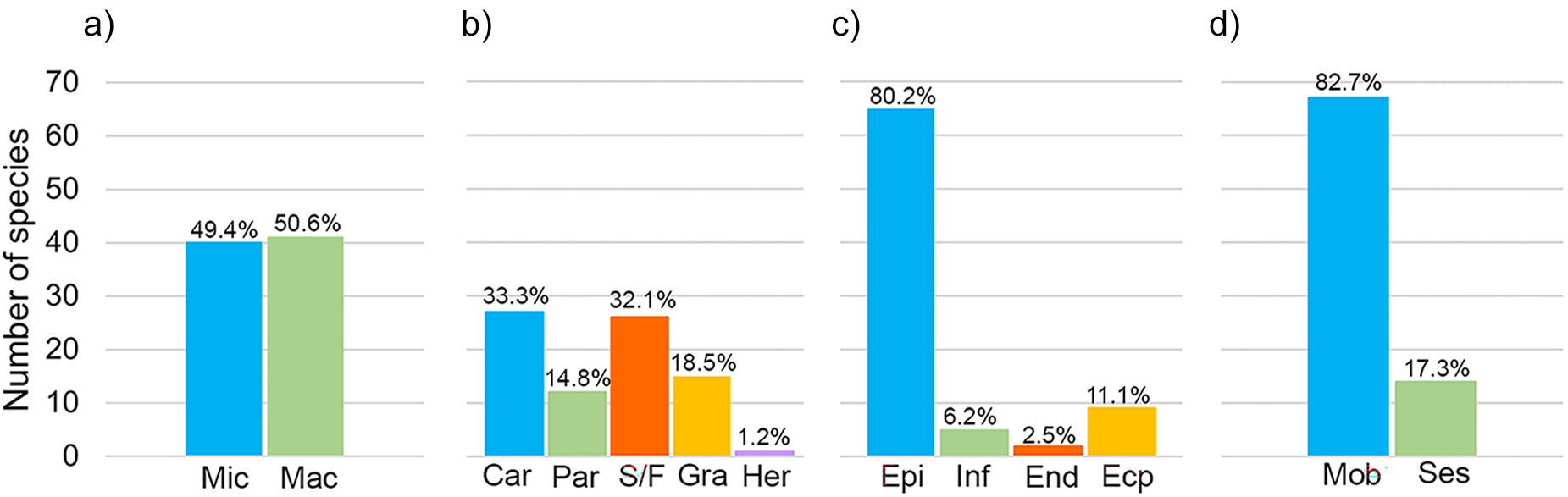
In the mollusc assemblages at the TSB, the richness of macromolluscs was slightly higher than that of micromolluscs, representing 50.6% and 49.4%, respectively (Figure 2a). The most common trophic group comprehends the carnivorous, 27 species (33.3%), exclusively a group of gastropods with a large contribution from the Cerithiopsidae and Collumbelidae families. Suspensivorous/filtering had the second highest richness (26 spp.), representing 32.1% of the mollusc species (Figure 2b), more specifically, all bivalve species and two gastropods, i.e., Eualetes tulipa and Bostrycapulus aculeatus. Grazers (15 spp.) and parasitic organisms (12 spp.) represented 18.5% and 14.8%, respectively. Finally, herbivores, with only one gastropod species, Astralium latispina, are equivalent to 1.2% of the total species found.
Classification of TSB molluscs species according to (a) shell size, (b) trophic groups, (c) mode of life, and (d) mobility. Mic: micromollusc; Mac: macromollusc; Car: carnivore; Par: parasite; S/F: suspensivorous/filter; Gra: grazer; Her: herbivore; Epi: epifauna; Inf: infauna; End: endolithic; Ecp: ectoparasite; Mob: mobile; Ses: sessile.

More than 80% of the mollusc species (65 spp.) were classified as epifauna, living on the surface of consolidated substrates, while 11.1% were classified as ectoparasites, living in association with their hosts (Figure 2c). We also found species with infaunal habits, with five species capable of burrowing into unconsolidated substrates and two species (42.5%) of endolithic bivalves that bore into other organisms and/or rocks, living inside them.
Concerning mobility, 67 species (82.7%) were classified as mobile, highly mobile, or sedentary (moving around only when necessary), while 14 taxa were sessile, either by cementation or fixed by the byssus (Figure 2d). All the mollusc species found in this study are illustrated in Figures 3–7.
Gastropods from artificial substrates with the presence of sun coral in Todos-os-Santos Bay: (a) Ischnochiton striolatus; (b) Bittiolum varium; (c) Caecum brasilicum; (d) Caecum ryssotitum; (e) Bostrycapulus aculeatus; (f) Cerithiopsis cf. altiusae; (g) Cerithiopsis cabritensis; (h) Cerithiopsis flava; (i) Cerithiopsis fusiformis; (j) Cerithiopsis gemmulosa; (k) Cerithiopsis io; (l) Cerithiopsis lata; (m) Cerithiopsis aff. perigaudae; (n) Cerithiopsis cf. recourti; (o) Cerithiopsis sp.; (p) Cerithiopsis cf. rabilleri; (q) Retilaskeya sp.; (r) Seila adamsii; (s) Marshallora nigrocincta; and (t) Epitonium sp. Scale bar: 1 mm, except (c) = 0.5 mm.

Microgastropods from artificial substrates with the presence of sun coral in Todos-os-Santos Bay: (a) Astyris lunata; (b) Costoanachis sparsa; (c) Falsuszafrona idalina; (d) Mokumea albovittata; (e) Parvanachis obesa; (f) Eulimidae sp.; (g) Vitreolina conica; (h) Littorina sp.; (i) Echinolittorina ziczac; (j) Stramonita brasiliensis; (k) Farvatia alveata; (l) Gemophos auritulus; (m) Granulina ovuliformis; (n) Parviturboides interruptus; (o) Crassispira sp.; (p) Pilsbryspira albocincta; (q) Teinostoma cocolitoris; (r) Eualates tulipa; and (s) Schwartziella catesbyana. Scale bars: 1 mm = (a, c–f, h, i); 0.5 mm = (b, g, m, n, q); and 1 cm = (j, k, l, r).

Gastropods from artificial substrates with the presence of sun coral in Todos-os-santos Bay: (a) Iselica globosas; (b) Ammonicera zelindae n.sp.; (c) Graphis underwoodae; (d) Retusa sp.; (e) Nudibranchia sp. (1 cm); (f) Boonea bisulturalis; (g) Boonea jadisi; (h) Fargoa bushiana; (i) Eulimastoma franklini (0.5 mm); (j) Turbonilla abrupta; (k) Turbonilla penistone; (l) Turbonilla pupoides; (m) Calliostoma cf. hassler; (n) Eulithidium affine; (o) Eulithidium bellum; (p) Rissoella caribaea (0.5 mm); (q) Astralium latispina; and (r) Vitta virginea. Scale bars: 1 mm = (a, b, c, f–l, n–p, r); 0.1 mm = (b, d); and 1 cm = (e, m, q).

Bivalves from artificial substrates with the presence of sun coral in Todos-os-Santos Bay: (a) Chama congregata; (b) isognomon bicolor; (c) Lamarcka imbricata; (d) Barbatia candida; (e) Carditamera plata; (f) Lamychaena hians; (g) Brachidontes exustus; (h) Musculus lateralis; (i) Leiosolenus bisulcatus; (j) Leptopecten bavayi; (k) caryocorbula contracta; (l) Diplodonta sp.; and (k) Sphenia fragilis. Scale bars: 1 mm: (f–h, j–m); 1 cm = (a–e, i).

Bivalves from artificial substrates with the presence of sun coral in Todos-os-Santos Bay: (a) Carditamera plata; Pododesmus rudis; (b) Crassostrea tulipa; (c) Ostrea puelchana; (d) Ostrea equestris; (e) Saccostrea cuccullata; (f) Pinctada imbricata; (g) Plicatula australis; and (e) Tellina sp. Scale bars: 0.1 mm = (a, b, k); 1 cm: (c–j).

All the richness estimators used estimated a higher number of species than observed, with Jackknife 1 estimating that there may be 93.9 species of molluscs in the region sampled (Figure 8), followed by Chao2 with 87 species, and Bootstrap, which estimated 88.4 species of molluscs for the area. Although our sample represents around 86.3% of the total estimated species, which we consider a satisfactory sample number, only the Chao 2 estimator has reached an asymptote. In contrast, the others still show an upward trend, indicating that there are still species to be discovered in the region. Moreover, 18 species were considered rare: 12 species occurred in a sample, while 6 other different species were recorded in two distinct samples.
Species accumulation curve (Sobs) and richness estimators (Bootstrap, Chao2, Jack1).

As an important result, three exotic species of molluscs are described for the TSB, the gastropod E. tulipa and the bivalves Isognomon bicolor and Saccostrea cuccullata.
A total of five gastropod species belonging to the Ceriothiopsis (Cerithiopsidae) were for the first time identified for the Brazilian Coast: Ceriothiopsis altiusae, C. cabritensis, C. aff. Perigaudae, C. cf. recourti, and C. cf. rabilleri. Finally, the bivalve Electroma vexillum also represents a new record for the TSB (Figure 9). And a specimen of Plicatula, very similar to P. australis, remains under analysis.
Distribution of the species Cerithiopsis cf. altiusae, Cerithiopsis cabritensis, Cerithiopsis cf. Rabilleri, Cerithiopsis cf. Recourti (blue dots), Cerithiopsis aff. perigaudae, and Electroma vexillum with the addition of a new record for the Brazilian coast (red dots).

Discussion
This is the first wide study approaching the malacofauna associated with invasive Tubastraea corals, comparing ecological aspects and life habits of the molluscs in artificial environments. The knowledge of biodiversity on variable scales, e.g., spatial and temporal, is essential for understanding the structure, composition, and processes of the benthic communities, including ecological interactions among the organisms (Gofas et al., Reference Gofas, Luque, Templado and Salas2017; Ponder et al., Reference Ponder, Lindberg and Ponder2019). Although this study has no temporal components, the diversity of molluscs is likely to be related to the characteristics spatially determined by biotic and abiotic parameters of the biofouling studied.
Indeed, information on molluscs from artificial environments around the world is scarce, with few studies providing species checklists, and mainly focusing on invasive bivalves and vermetid gastropods (Bezerra et al., Reference Bezerra, Franklin Junior, Spotorno and Rocha-Barreira2022; Bieler et al., Reference Bieler, Granados-Cifuentes, Rawlings, Sierwald and Collins2017; Guerra-García et al., Reference Guerra-García, Martínez-Pita, García-García and Moreira2021; Tempesti et al., Reference Tempesti, Langeneck, Maltagliati and Castelli2020). Surprisingly, inventories of the mollusc species from any locality in the TSB are not available in the literature, although the bay is a protected environmental area (State Decree No. 7.595, 5 June 1999) with pristine marine ecosystems, including coral reefs.
Regarding studies of malacofauna in artificial environments, Guerra-García et al. (Reference Guerra-García, Martínez-Pita, García-García and Moreira2021) investigated the malacofauna in several marinas in a large geographic area, covering the Iberian Peninsula and North Africa, finding only 48 species of macromolluscs (using 500 µm mesh). In contrast, the present study, conducted on a regional scale and including micromolluscs, was supported by a more robust inventory, with 81 species.
Nevertheless, the mollusc richness found in the sun coral communities from the TSB may be considered lower than that of true reef systems (Costa and Pires-Vanin, Reference Costa and Pires-Vanin2021; Lima et al., Reference Lima, Lima, Abreu, Oliveria, Lucena, Mendonça, Prata and Souza2019). From the Southern Bahia littoral, specifically in the Abrolhos reef complex (17–18°S), data on mollusc richness are strictly attributed to unconsolidated substrates: Absalão (Reference Absalão2005) identified 293 species from 39 sampling stations using a core, while Costa and Pires-Vanin (Reference Costa and Pires-Vanin2021) identified 100 species from 9 sampling stations using a dredge. Northwards, Lima et al. (Reference Lima, Lima, Abreu, Oliveria, Lucena, Mendonça, Prata and Souza2019) identified only the macromolluscs from the Tinharé and Boipeba Is. (13°S) and found 99 species, all collected during 5 days (3 h per day). However, regarding species richness, these works provide different methodological protocols based on very variable spatial and temporal scales – which may bias all attempts of comparison (González‐Megías et al., Reference González‐Megías, María Gómez and Sánchez‐Piñero2007).
Indeed, many factors can explain the lower richness of organisms in artificial substrates compared to natural environments. The physical and chemical properties of the biofilm, light, and sedimentation conditions, hydrodynamic regime, availability of space, and complexity of the substrate are among the most relevant aspects for the establishment and survival of species in artificial environments (Bonnici et al., Reference Bonnici, Borg, Evans, Lanfranco and Schembri2018; Firth et al., Reference Firth, Browne, Knights, Hawkins and Nash2016).
The degree of substrate slope can also influence the composition of the biofouling community since, according to settlement preferences, larvae can actively select negative (e.g., pier decks) and/or vertical (e.g., pier columns) surfaces (Bonnici et al., Reference Bonnici, Borg, Evans, Lanfranco and Schembri2018). In this study, due to the physical characteristics of the artificial structures sampled (pier, deck, and columns), the molluscs were not sampled in a positive orientation, which may limit the occurrence of some species that need this condition for feeding and locomotion.
In addition, the age of the structures plays a determining role in species richness since older structures support biological communities in more advanced stages of ecological succession, resulting in greater diversity (Sferra et al., Reference Sferra, Hart and Howeth2017). According to the literature, over 5–20 years, these communities can reach a climax (Ortega-Jimenez et al., Reference Ortega-Jimenez, Sedano and Espinosa2022). We know that the age of the piers and marinas where the sampling was conducted varies, as we observed different successional stages of biofouling development. Although comparing the successional stages of the sampling sites was not the focus of this study, it was possible to observe differences in species diversity between the areas studied – with impressive richness in older structures (e.g., the Magnetic Measuring Station on Itaparica Island). However, it is worth considering that several other factors may control the species richness in such environments, and one condition may particularly impact the local biodiversity: the pollution by polycyclic aromatic hydrocarbons (PAHs) from motor oil spills and oil exploration activities as well (Martins et al., Reference Martins, Assis, Cardoso Filho, Hatje, Moreira and Albergaria-Barbosa2020). Indeed, levels of chemical pollution may play a role in the composition of biofouling communities in the TSB. As demonstrated by Souza et al. (Reference Souza, Júnior, Neumann-Leitão, Farias, Johnsson and Neves2024), abnormal tissue protrusions in copepods due to water contamination with PAHs are occurring in the TSB. On the other hand, Martins et al. (Reference Martins, Assis, Cardoso Filho, Hatje, Moreira and Albergaria-Barbosa2020) attested to the contamination of commercial oysters from the TSB by PAHs, particularly in Madre Deus I. (12°S) and neighbourhood, also alerting for risks to human health. This scenario is very concerning, and further studies are necessary to bring to light the influence of pollution on the ecology and diversity of the malacofauna in the TSB.
Many species identified in this study have been associated with macroalgae (Barbosa et al., Reference Barbosa, Dias, Lopes, Duarte and Amaral2019; Duarte et al., Reference Duarte, Milesi and Dias2020; Queiroz and Dias, Reference Queiroz and Dias2014), but in the artificial structures studied, major coverage is represented by other sessile invertebrates. The scraped sampling areas were composed, in general, of sponges, bryozoans, ascidians, and particularly Carijoa riisei (octocoral), and because the protocol was not selective, we were unable to define from which ‘host’ the molluscs came from. It draws attention to the fact that a great mollusc richness was observed in the sampling sites with more complex organisms, such as C. riisei and branching bryozoans. Surprisingly, only a few studies analyse the macrofauna associated with this exotic octocoral species, and none are dedicated exclusively to the malacofauna.
The most representative families, Cerithiopsidae and Pyramidellidae, are included in the ‘Big Five’ (sensu Albano et al., Reference Albano, Sabelli and Bouchet2011, also comprising the Triphoridae, Turridae, and Eulimidae) – being represented by a megadiverse group of gastropods, expected to contribute significantly to the environmental richness. In the benthic communities, the molluscs have a vast functional contribution. And the artificial structures with sun corals have revealed an impressive malacofauna that is likely to sustain a complex system. The balance in the richness of macro- and micromolluscs reveals that these two groups have similar ecological relevance in artificial environments, highlighting the need for studies approaching the microfauna (and smaller molluscs) – which were excluded due to mesh sizes bigger than 0.5 mm (Albano et al., Reference Albano, Sabelli and Bouchet2011; Bouchet, Reference Régnier, Fontaine and Bouchet2009).
Here, the gastropods present more diversified feeding habits, in contrast with a large number of suspensivores/filterers – being the latter majorly represented by the bivalves. The dominance of carnivorous gastropods may be attributed to the richness of the Cerithiopsidae and Columbellidae. Cerithiopsids are commonly found in sponge-dominated environments, as they preferentially feed on the tissues of the Demospongiae (Nützel, Reference Nützel, De Baets and Huntley2021). The artificial environments in the TSB have a high diversity of sponges (48 species of Demospongiae), supporting the occurrence of specialized predators (Macola, Reference Macola2023).
Regarding the parasite molluscs, mainly the Pyramidellidae, Eulimidae, and Epitoniidae, these families have an ectoparasitic habit, living attached to their hosts by the proboscis or mucous threads. Eulimids parasite echinoderms, epitoniids feed on cnidarians and have even been recorded preying on Tubastraea coccinea (Rodríguez-Villalobos et al., Reference Rodríguez-Villalobos, Ayala-Bocos and Hernández2016), while pyramidellids are more generalists feeding on the body fluids of various invertebrates (Nützel, Reference Nützel, De Baets and Huntley2021). In this study, only one species was identified for Cimidae and Amanthinidae, both families have also been mentioned as parasites, but there is no data in the literature on their hosts.
The predominance of epifaunal organisms was expected since artificial structures are hard substrates with varied physical characteristics, and few of the species found have excavating mechanisms to enter the substrate, such as the bivalve Leiosolenus bisulcatus (Bagur et al., Reference Bagur, Richardson, Gutiérrez, Arribas, Doldan and Palomo2013). In addition, a high number of small and mobile species that live in association with other invertebrates was recorded – contrasting with the sessile molluscs (e.g., vermetids) that have their settling space reduced due to competition with other groups of sessile invertebrates (Antoniadou et al., Reference Antoniadou, Voultsiadou and Chintiroglou2011; Oricchio and Muniz Dias, Reference Oricchio and Muniz Dias2020).
Although the estimators indicate that several species remain unsampled, we concluded that our sampling covered, satisfactorily, 80% of the expected diversity for the species at the sites sampled. Relying on the great diversity of habitats, and different environmental conditions found in the TSB, we agree that many molluscs are still unknown to science, and our study is an important starting point.
The Northeastern Brazilian Coast is under the influence of the warm waters of the Brazilian Current, being a centre of great diversity of marine invertebrates in the entire Southwestern Atlantic. Moreover, because of commercial activities and tourism, the TSB is at continuous risk of the introduction of exotic species. Three exotic species were reported for the first time in the TSB: the bivalves I. bicolor and S. cuccullata (Brahim et al., Reference Brahim, Amaral, Johnsson and Neves2024) and the gastropod E. tulipa (Alves et al., Reference Alves, Serra, Johnsson and Neves2024). In addition, a total of seven species were identified for the first time in Brazil: five species of Cerithiopsis (C. altiusae, C. cabritensis, C. aff. perigaudae, C. cf. recourti, and C. cf. rabilleri), Plicatula sp., and the Indo-Pacific E. vexillum. The genus Electroma has been considered introduced into the Caribbean Sea, with significant impacts on the monopolization of spaces, also affecting the availability of plankton (Borrero and Díaz, Reference Borrero and Díaz1998). Electroma vexillum became invasive in the Mediterranean Sea (see Çevik et al., Reference Çevik, Dogan, Önen and Zenetos2008), and there is a substantial risk of dispersing along the Brazilian Coast. Monitoring and biological studies are needed for the management of invaded areas and a better approach to conservation policies.
Finally, supporting complex and diverse assemblages of molluscs, our results represent an unprecedented contribution to the knowledge of the malacofauna associated with benthic communities from artificial environments.
In this study, we present the high diversity of malacofauna in artificial structures with the presence of an invasive coral, including information on the expansion of the geographical distribution of some species and the occurrence of exotic organisms in the area. With a methodological approach that includes everything from small molluscs, the richness recorded in the TSB was higher than in many artificial structures worldwide, highlighting the importance of conserving the site. Although we do not have a baseline for comparing biological diversity prior to the establishment of the sun coral in the communities studied, the inventory of molluscs with taxonomic and ecological information contributes to the knowledge of local biodiversity and is extremely valuable for future studies.
Acknowledgements
The authors thank to the LABIMAR team for their support in sampling and laboratory procedures for data acquisition and to the researchers PhD Alexandre D. Pimenta and PhD Vanessa S. Amaral for their assistance in identifying the organisms.
Author contributions
Sabrina Brahim: Writing – original draft, Writing – review & editing, Methodology, Investigation, Formal analysis. Rodrigo Johsson: Writing – review & editing, Project administration, Funding acquisition. Elizabeth G. Neves: Writing – review & editing; Project administration, Funding acquisition, Conceptualization, Supervision, Resources.
Funding
This study is part of the project ‘Assessment and research of sun coral in Todos os Santos Bay’, a cooperation agreement between UFBA and PETROBRAS (No. 5850.0107361.18.9) regulated by RD&I investments clauses of the Brazilian Agency of Petroleum, Natural Gas and Biofuels (ANP Resolution 05/2015).
Competing interests
The authors declare none.
Dada availability statement
The datasets generated during and/or analysed during the current study are available from the corresponding author on reasonable request.