INTRODUCTION
Terebellids are tubicolous polychaetes found worldwide from tidal to abyssal depths and from the North Pole to the Antarctic. However, as usually happens with polychaetes, when the number of genera becomes close to 100, definitions of genera have become confusing. Since publication of the ‘pink book’ (Fauchald, Reference Fauchald1977), there has been no published key to all genera or discussion of the taxonomic value of different characters at the genus level. Holthe (Reference Holthe1986b) published the most recent review of the family and proposed six taxa at the ‘Tribus’ level (a level not usually used in Polychaeta). Several authors (Garraffoni & Lana, Reference Garraffoni and Lana2008, Reference Garraffoni and Lana2010; Nogueira et al., Reference Nogueira, Fitzhugh and Hutchings2013) have carried out phylogenetic analyses but they came to different conclusions, even at the family group level. At genus level, their results are not satisfactory (see below), probably because generic revision was not their goal. We have tried to address this question: to clarify the taxonomic definitions of genera. As the first step, we chose genera with large lateral lobes. The largest genus of this group, Pista, is also the largest genus of Terebellidae sensu lato. According to Gil et al. (Reference Gil, Read and Bellan2016a, Reference Gil, Read and Bellanb, Reference Gil, Read and Bellan2017) the genus Pista sensu Jirkov et al. (Reference Jirkov, Saphronova, Leontovitch and Jirkov2001), including Axionice and Pistella, includes 95 valid species and subspecies, i.e. more than 10% of the family. The total number of valid species with large lateral lobes included in Betapista Banse, Reference Banse1980, Eupistella Chamberlin, Reference Chamberlin1919, Lanice Malmgren, Reference Malmgren1866, Lanicides Hessle, Reference Hessle1917, Lanicola Hartmann-Schröder, Reference Hartmann-Schröder, Hartmann-Schröder and Hartmann1986, Loimia Malmgren, Reference Malmgren1866, Paraxionice Fauchald, Reference Fauchald1972, and Scionella Moore, Reference Moore1903 is 130, or 20% of the family (Read, Reference Read2011a, Reference Readb; Read & Bellan, Reference Read and Bellan2011a, Reference Read and Bellanb; Gil & Read, Reference Gil and Read2016a, Reference Gil and Readb, Reference Gil and Read2017; Read & Bellan, Reference Read and Bellan2016). The group has a worldwide distribution and many varying diagnoses have been published. The taxonomic definitions and diagnoses of genera in this group also vary between authors, to different extents.
The goal of our review is to answer two questions:
-
(1) How is the type species of the genus Pista (Amphitrite cristata Müller, Reference Müller1776) defined?
-
(2) How many genera have large lateral lobes and what are their definitions?
Abbreviations
Morphology: S, segment; C, chaetiger; TC, thoracic chaetiger; TU, thoracic unciniger (segment with uncini).
Combinations of abbreviations and numbers define the segment (e.g. TU1 is the first thoracic unciniger).
Collections: APEM, APEM Ltd., UK; BCPM, British Columbia Provincial Museum, Canada; HZMI, University of Hamburg; Zoological Institute und Zoological Museum, Germany; IORAN, P.P. Shirshov Institute of Oceanology, Russia; KGB, Department of Hydrobiology Moscow State University, Russia; MNCN, Museo Nacional de Ciencias Naturales, Madrid, Spain; NHM, Natural History Museum, UK; NMC, National Museums of Canada; USNM, United States National Museum, USA; ZMMU, Zoological Museum of Moscow State University, Russia.
MATERIALS AND METHODS
Our focus is on Terebellidae with large lateral lobes (also called lappets). Although small and large are, in a biological sense, rather vague terms, there is general consensus in applying them (or similar terms) to terebellid genera. For example, Fauchald (Reference Fauchald1977) specified ‘large lateral lappets’ as characterizing Lanice (p. 130) and Pista (p. 132), in contrast to ‘small lateral lappets’, applied to Eupolymnia Verrill, Reference Verrill1900 (p. 130). Similarly, the terms ‘largest’, ‘large’ and ‘small’ in the diagnosis of Pista and its species have been used by Hessle (Reference Hessle1917, p. 153): ‘Die vorderen Segmente sind mit oft sehr kraftigen Seitenlappen versehen’, Fauvel (Reference Fauvel1927, p. 262): ‚Souvent des lobes latéraux très développés aux premiers segments’, Uschakov (Reference Uschakov1955, p. 385): ‘well-developed lobes’ and many others (Monro, Reference Monro1936; Hartman, Reference Hartman1966, Reference Hartman1969; Day, Reference Day1967; Hilbig, Reference Hilbig, Blake, Hilbig and Scott2000).
Malmgren (Reference Malmgren1866) described five genera with large lateral lobes: Axionice, Lanice, Loimia, Pista and Scione. According to his key (p. 373), these genera differ in the number of branchiae and thoracic segments. However, neither of these characters can be currently accepted as a valid criterion for the separation of genera.
Hessle (Reference Hessle1917) included Axionice and Scione in Pista and added ‘lateral lobes on anterior segments’ to Malmgren's characters: ‘Die vorderen Segmente sind mit oft sehr kräftigen Seitenlappen versehen’; this was accepted by all authorities. He also used the structure of the nephridial system as a characteristic but few authors, with the exception of Smith (Reference Smith1992), have since included nephridial structure in their species descriptions. Smith (Reference Smith1992) showed that the nephridial system is much more complicated than Hessle (Reference Hessle1917) had supposed and probably not suitable for generic diagnoses. In any case, much more information is necessary to make final decisions about the taxonomic value of the nephridial system.
Although Hessle (Reference Hessle1917) included the presence of a manubrium in his description of Pista (‘Die Hakenborsten im Vorderkorper sind langschäftig’), it is clear that he did not consider it to be strictly diagnostic. This is shown by his inclusion of two genera (Axionice and Scione) in Pista whose type species have uncini without manubria and his description of Pista macrolobata, which has uncini without manubria. Fauvel (Reference Fauvel1927), Day (Reference Day1967), Hartmann-Schröder (Reference Hartmann-Schröder1971) and Hilbig (Reference Hilbig, Blake, Hilbig and Scott2000) also included in Pista species with uncini both with and without manubria.
Other contemporary authors, however, treated Pista as characterized by the presence of long-handled uncini in TU1. For species with large lateral lobes on anterior segments and uncini in TU1 without manubria, they used other genera: Axionice (Caullery, Reference Caullery1915; Chamberlin, Reference Chamberlin1919; Monro, Reference Monro1936; Hartman, Reference Hartman1969, Reference Hartman1971; Fauchald, Reference Fauchald1972, Reference Fauchald1977; Hartmann-Schröder, Reference Hartmann-Schröder1996; Holthe, Reference Holthe1986a), Scione (Benham, Reference Benham1916; Caullery, Reference Caullery1944), Pistella (Londoño-Mesa, Reference Londoño-Mesa, de León-González, Bastida-Zavala, Carrera-Parra, García-Garza, Peña-Rivera, Salazar-Vallejo and Solís-Weiss2009), combinations of these genera: Axionice and Scionella Holthe (Reference Holthe1986a, Reference Holtheb), Axionice and Pistella (Hartmann-Schröder, Reference Hartmann-Schröder1996), or various other genera (Nogueira et al., Reference Nogueira, Hutchings and Carrerette2015).
Several other genera have been described as having large lateral lobes (numbers in parentheses are numbers of species and they were included in our analysis: Betapista Banse, Reference Banse1980 (1) (Read, Reference Read2011a, Reference Readb); Eupista McIntosh, Reference McIntosh1885, replaced by Eupistella Chamberlin, Reference Chamberlin1919 (4) (Read & Bellan, Reference Read and Bellan2011a, Reference Read and Bellanb); Lanicides Hessle, Reference Hessle1917 (10) (Gil & Read, Reference Gil and Read2016a, Reference Gil and Readb); Lanicola Hartmann-Schröder, Reference Hartmann-Schröder, Hartmann-Schröder and Hartmann1986 (7) (Gil & Read, Reference Gil and Read2016a, Reference Gil and Readb); Paraxionice Fauchald, Reference Fauchald1972 (1) (Gil & Read, Reference Gil and Read2017); Scione Malmgren, Reference Malmgren1866, replaced by Euscione Chamberlin, Reference Chamberlin1919; and Scionella Moore, Reference Moore1903 (2) (Read, Reference Read2011a, Reference Readb). The status of some of them is complex and the need for revision has been recognized by many authors (Londoño-Mesa, Reference Londoño-Mesa, de León-González, Bastida-Zavala, Carrera-Parra, García-Garza, Peña-Rivera, Salazar-Vallejo and Solís-Weiss2009; Nogueira et al., Reference Nogueira, Hutchings and Carrerette2015). We have also included Amphitrite lobocephala Hsieh, Reference Hsieh1994 as it obviously belongs to this group. Some other genera seem to have large lobes but their descriptions are unsatisfactory, so we have excluded them from our analysis: Colymmatops Peters, Reference Peters1854, Opisthopista Caullery, Reference Caullery1944 and Parascione Caullery, Reference Caullery1944.
We excluded from our analysis several genera sometimes reported as having large lateral lobes because most authors did not describe them with large lateral lobes. These include Eupolymnia, as its type species (Amphitrite nesidensis Delle Chiaje, Reference delle Chiaje1828) has much smaller lobes than the genera included here, according to the re-description by Holthe (Reference Holthe1986a) and our observations (Jirkov et al., Reference Jirkov, Saphronova, Leontovitch and Jirkov2001); Fauchald (Reference Fauchald1977) also used the term ‘small lateral lappets’ to separate Eupolymnia from Lanice in his key (the latter having ‘large lateral lappets’). The same is true for Longicarpus Hutchings & Murray, Reference Hutchings and Murray1984 (‘lateral lobes poorly developed’ – Hutchings & Murray, Reference Hutchings and Murray1984, p. 97), Lizardia Nogueira, Hutchings & Carrerette, 2015 (‘low ventral lobes’ – Nogueira et al., Reference Nogueira, Hutchings and Carrerette2015, p. 527) and Reteterebella Hartman, Reference Hartman1963 (‘lobes on anterior segments… low’ – Nogueira et al., Reference Nogueira, Hutchings and Carrerette2015, p. 502).
Thus, the genera included in our analysis (Axionice, Betapista, Eupistella, Lanice, Lanicides, Loimia, Paraxionice, Pista, Pistella and Scionella) are more or less equivalent to Lanicini Holthe, Reference Holthe1986 Reference Holtheb plus Pistini Holthe, Reference Holthe1986 Reference Holtheb. We have tried to include all of the species listed for these genera in WoRMS (Read, Reference Gil and Read2011a, Reference Readb; Read & Bellan, Reference Read and Bellan2011a, Reference Read and Bellanb, Reference Read and Bellan2016; Costello et al., Reference Costello, Bouchet, Boxshall, Fauchald, Gordon, Hoeksema, Poore, van Soest, Stöhr, Walter, Vanhoorne, Decock and Appeltans2013; Gil & Read, Reference Gil and Read2016a, Reference Gil and Readb, Reference Gil and Read2017; Gil et al., Reference Gil, Read and Bellan2016a, Reference Gil, Read and Bellanb, Reference Gil, Read and Bellan2017) but some have not been described in enough detail for inclusion. Also, several species have been included in the analysis that have not yet been formally described or are included in other genera but definitely belong to the group under study. We have tried to illustrate as many species as possible but, unfortunately, have not seen all of the species in the group and specimens of the investigated species were sometimes in a condition too poor for reasonable photographs.
We excluded Pista indica Fauvel, Reference Fauvel1940; Scione abyssorum Caullery, Reference Caullery1944; Pista pectinata Hutchings, Reference Hutchings1977 and Pista trina Hutchings, Reference Hutchings1977 from our analysis for the following reasons.
Pista indica, according to Fauvel (Reference Fauvel1953: 423), has ‘the first four uncinigerous tori short, with a transverse row of big, long, brown hooks with smooth tips. On the two following tori, a single row of small avicular uncini; next, the succeeding thoracic and abdominal segments bear two alternating rows’. All other species included in the analysis have abdominal neuropodia with a single row of uncini. Hutchings (Reference Hutchings1977) also suggested that this species should be removed from Pista.
In our opinion, Scione abyssorum, Pista pectinata and Pista trina have arrangements of lobes and branchiae that are very different from other species in the Axionice/Pista group and also from the wider group of species with large lateral lobes. Their position must be clarified by examination of type material. We have had the opportunity to study only the paratype of P. pectinata (NHM 1975.139) but it is, unfortunately, so poorly preserved that even identification to family level is difficult.
We consider the generic position of these four species to be unclear. Generic assignment would require a full revision of the Terebellini and the validity of some genera is questionable. The vagueness of generic diagnoses has become a threat to our understanding of relationships within the group.
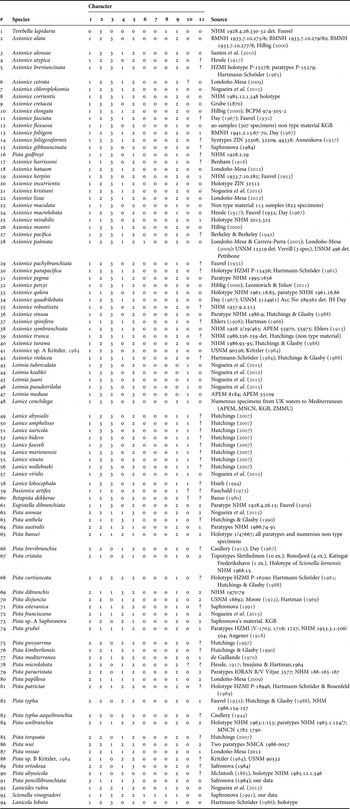
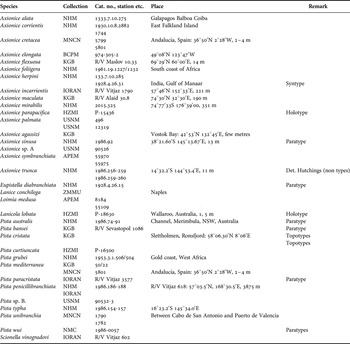
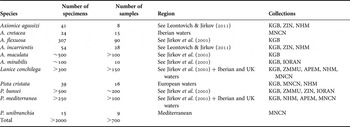
Whenever possible, type material has been investigated; non-type specimens were examined where necessary. Material was reviewed from the collections of APEM, BCPM, HZMI, IORAN, KGB, MNCN, NHM, NMC, USNM and ZMMU. We also used original descriptions and later re-descriptions of type material. A total of 93 species was included (or 85% of the total number of species in the group – 108); the remaining species are either so poorly described that, without examination of type material too few characters can be determined, or seem to belong to other genera (Table 1). Of the included species, we had no information about the arrangement of uncini in double rows for three species and we had information on ventral pads for 55 species only, so we needed three separate calculations. As an out-group, we selected the type species of the type genus of Terebellinae – Terebella lapidaria Linnaeus, Reference Linnaeus1767. Intraspecific variation was reviewed for several species, using the IORAN, KGB and MNCN collections (Table 3).
Character coding.

?, absence of data.
Specimens were studied using several different stereo- and compound microscopes (available in places of location of material). Photographs were taken under microscopes using different digital cameras. The specimens were held in position with entomological needles and photographed in a Petri dish. In order to increase contrast, specimens were stained with methylene blue (in water solution), which gives the best results, or sometimes methyl blue. Unless otherwise stated, neuropodia were removed from TU1, mounted on slides with 3C Polyvinylactophenol, examined and photographed, using compound microscopes. Images were produced and edited manually with CorelDRAW! software. For detailed information on the illustrated specimens, see Table 2.
Illustrated worms.

Characters and character coding (Table 1)
-
1. Branchial type: 0. cirriform; 1. arborescent; 2. pompom-like (=bottle-brush, club-shaped, plumose, branching filaments in a spiral arrangement); 3. all branching filaments at the top.
-
2. Branchial number: 1. one pair (including examples where only a single branchia is typically present); 2. two pairs; 3. three pairs.
-
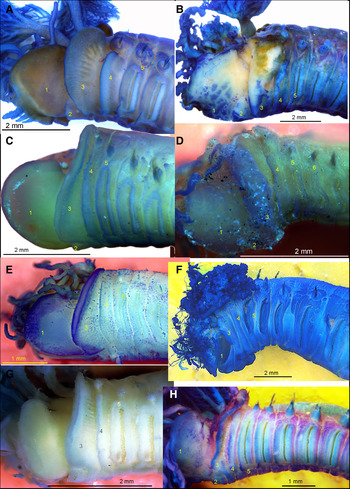
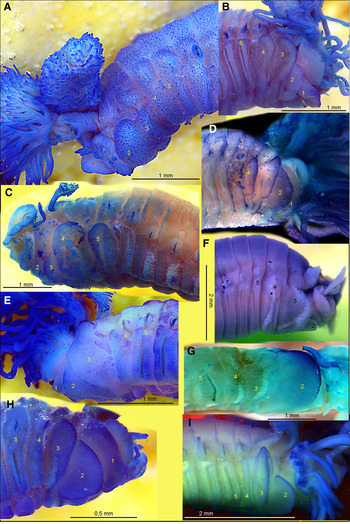
3. Lateral lobes of S1: 0. absent; 1. small; 2. large, but not the largest; 3. the largest (Figures 2–5).
-
4. Lateral lobes of S2: 0. absent; 1. small; 2. large; 3. the largest.
-
5. Lateral lobes of S3: 0. absent; 1. small; 2. large; 3. the largest.
-
6. Dorsal crest: 0. absent; 1. present (Figure 5).
-
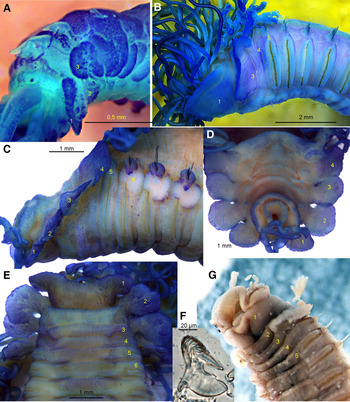
7. Festoon-like arrangement of lobes of the first four segments (Figure 5): 0. absent; 1. present.
-
8. Notochaetae: 0. smooth; 1. serrated.
-
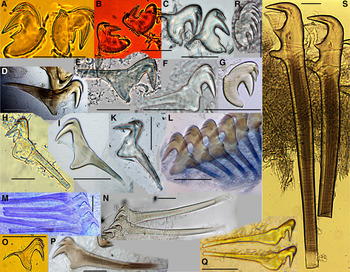
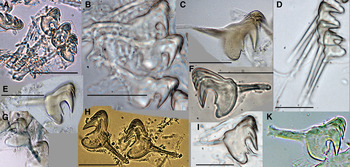
9. Shape of uncini (Figures 6 & 7): 0. pectinate (=monopectinate sensu Holthe, Reference Holthe1986b), first type sensu Leontovich & Jirkov, Reference Leontovich and Jirkov2011; 1. avicular (=breviavicular sensu Holthe, Reference Holthe1986b); second type sensu Leontovich & Jirkov, Reference Leontovich and Jirkov2011; 2. with manubrium at least in S5 (=opisthavicular sensu Holthe, Reference Holthe1986b); this type is a derivative of avicular but, as shown below, in at least two different ways.
-
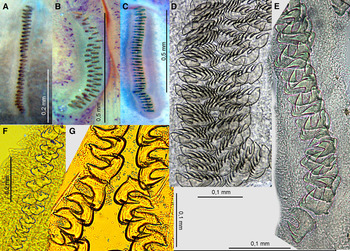
10. Uncini in double rows: 0. face-to face; 1. back-to-back (Figure 8). Although we demonstrate below that this subdivision is not absolute and that there are transitional states, current literature data do not allow us to propose another coding system.
-
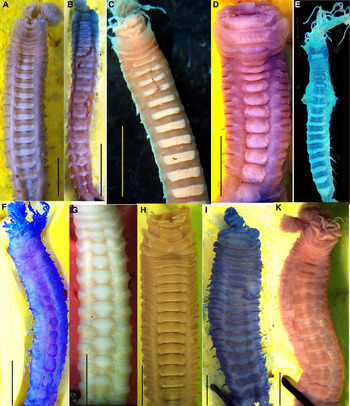
11. Ventral pads (Figures 9 & 10): 0. colouration uniform; 1. posterior margin and lateral sides of pad whitish and granulated; 2. posterior part white. This character may be difficult to see in poorly preserved specimens.
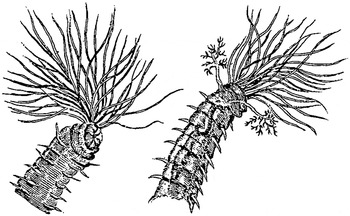
Müller (Reference Müller1780) original drawings of Amphitrite cristata.

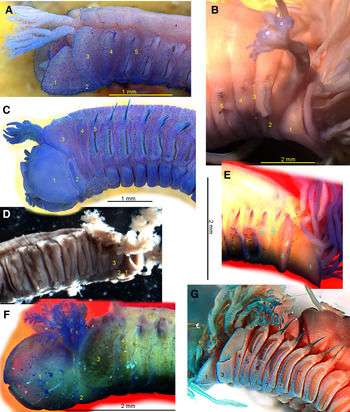
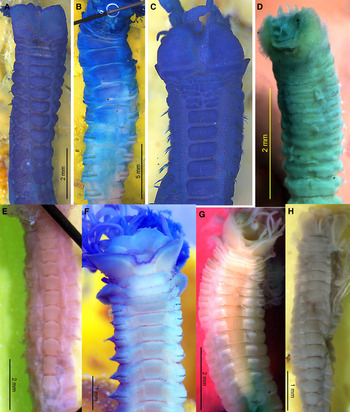
Lateral lobes of some species of Axionice group. (A) A. flexuosa KGB R/V Maslov 10.33; (B) A. mirabilis NHM 2015.325; (C) A. maculata KGB R/V Alaid 30.8; (D) A. parapacifica HZMI holotype; (E) A. herpini NHM 133.7.10.285; (F) A. trunca NHM 1986_259-260; (G) A. cretacea MNCN 5799. Here and below numbers refer to segments. Detailed information on pictured specimens see Table 2.

Lateral lobes of some species of Axionice. (A) A. agassizi KGB; (B) A. incarrientis IO RAN R/V Vitjaz 1790; (C) A. alata NHM 1333.7.10.275; (D) A. sinusa NHM paratype; (E) A. symbranchiata APEM 55975; (F) A. elongata BCPM 974-305-2; (G) A. corrientis NHM 1930.10.8.2882; (H) A. palmata USNM 12319.

Lateral lobes of some Pista species. (A) P. cristata KGB Slettholmen; (B) P. wui NMC 1986-0057; (C) P. paracristata IORAN R/V Vitjaz 3577; (D) P. curtiuncata HZMI; (E) P. mediterranea KGB 50/22; (F) P. grubei NHM 1953.3.1.506/504; (G) P.unibranchia MNCN 1790; (H) P. bansei KGB R/V Sevastopol 1086; (I) P. typha NHM 1986.154-157.

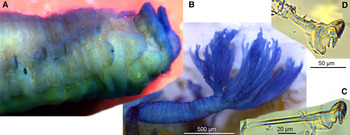
Morphology of some genera with large lateral lobes (valid on 1 April 2017). (A) Loimia medusa APEM 8184; (B) Lanice conchilega ZMMU Neaples; (C–F) Scionella vinogradovi; (G) Laonicola lobata HZMI. (A) antero-frontal view, (B, C) lateral view, (D) antero-dorsal view, (E) ventral view; (F) uncinus TU1; (G) ventro-lateral view.

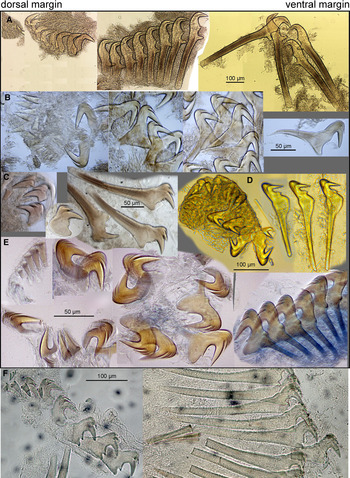
Uncini of different Axionice species. (A) A. flexuosa KGB R/V Maslov 10.33; (B) A. maculata KGB R/V Alaid 30.8; (C) A. sp A USNM 90526; (D) A. alata NHM 1333.7.10.275; (E) A. corrientis NHM 1930 TU1; (F) A. symbranchiata APEM 55970; (G) A. trunca NHM 1986.256-259; (H) A. agassizi KGB Vostok; (I) A. herpini NHM 133.7.10.285; (K) A. palmata USNM 496; (L) A. sinusa NHM paratype; (M) A. mirabilis NHM 2015.325; (N) A. cretacea MNCN 1744; (O) A. conchilega (formerly Lanice conchilega) ZMMU Naples; (P) A. foliigera NHM 1961.19.1227/1232; (Q) A. incarrientis IORAN Vitjaz 1790; (R) A. medusa (formerly Loimia medusa) APEM 8184; (S) A. elongata BCPM 974-305-2. All uncini from TU1. All scale bars 50 µm.

Uncini of different Pista species. (A) P. cristata KGB Slettholmen; (B) P. bansei KGB R/V Sevastopol 1086; (C) P. grubei NHM 1953.3.1.506/504; (D) P. paracristata IORAN R/V Vitjaz 3577; (E) P. typha NHM1986.154-157; (F) P. sp B. USNM 90532-3; (G) P. australis NHM 1986.74-91; (H) P. mediterranea KGB 50/22; (I) P. wui NMC 1986-0057; (K) P. unibranchia MNCN 1782. All uncini from TU1. All scale bars 50 µm.

Double rows uncini of Axionice and Pista and TU1 uncini of Scionella vinogradovi and type species of Loimia and Lanice. (A) Pista cristata TU8 KGB Ronsfjord; (B) Axionice maculata KGB R/V Alaid 30.8; (C) Pista mediterranea MNCN5801; (D) Axionice medusa (formerly Loimia medusa) APEM 55109 TU11; (E) Axionice cretacea TU7 MNCN1744; (F) Axionice flexuosa uncini TU11 Maslov_33; (G) Axionice conchilega (formerly Lanice conchilega) TU7 Neaples H – TU7.

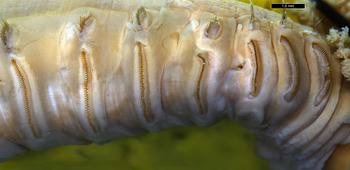
Ventral pads of Axionice. (A) A. flexuosa KGB R/V Maslov 10.33; (B) A. elongata BCPM 974-305-2; (C) A. maculata KGB R/V Alaid 30.8; (D) A. diabranchiata (formerly Eupistella diabranchiata) NHM 1928.4.26.15; (E) A. sinusa NHM 1986.92; (F) A. palmata USNM 496; (G, H) A. herpini NHM 133.7.10.285 and 1928.4.26.31.

Ventral pads of Pista. (A) P. cristata KGB Slettholmen; (B) P. bansei KGB R/V Sevastopol 1086; (C) P. unibranchia MNCN 1782; (D) P. paracristata IORAN R/V Vitjaz 3577; (E) P. papillosa after Londoño-Mesa (Reference Londoño-Mesa, de León-González, Bastida-Zavala, Carrera-Parra, García-Garza, Peña-Rivera, Salazar-Vallejo and Solís-Weiss2009); (F) P. mediterranea KGB 50/22; (G) P. typha NHM 1986.154-157; (H) P. grubei NHM 1953.3.1.506/504; (I) P. wui NMC 1986-0057; (K) P. australis NHM 1986.74-91. All scale bars 2 mm.

We compared the size of the lateral lobes (characters 3–5) between those segments with lateral lobes (S1–S3).
Observations of variation between individuals of over 2000 specimens of 12 species (Axionice agassizi, A. cretacea, A. elongata, A. flexuosa, A. incarrientis, A. maculata, A. mirabilis, Lanice conchilega, Pista cristata, P. bansei, P. mediterranea, P. unibranchia) (Table 3) showed that the relative size of the lobes does not correlate with the size of the worm.
Material for investigation of individual variation.

The number of characters that we used is lower than used by others (Garraffoni & Lana, Reference Garraffoni and Lana2008; Nogueira et al., Reference Nogueira, Fitzhugh and Hutchings2013). We do not think that increasing the number of characters coded by itself increases the precision of the results unless all characters can be assumed to have equal value. For example, although Garraffoni & Lana (Reference Garraffoni and Lana2008) used 81 characters, their results were either already known and long accepted (such as their separation of Terebellinae and Trichobranchinae), or confusing (Polycirrinae was included in Thelepinae). Nogueira et al. (Reference Nogueira, Fitzhugh and Hutchings2013) used 118 characters and got reasonable results at the subfamily level; in particular, we agree that Telothelepodidae is a quite separate taxon (not higher than subfamily in our opinion). However, use of over 100 characters did not prevent them from making some serious mistakes; for example: (1) Pista cristata (actually P. mediterranea) is shown far from Pistella lornensis (actually P. cristata) despite these species being members of the same genus and very close to Scionella japonica, although they are very different in appearance (compare Figures 4A & 5C–E, G); (2) a similar error was made in the case of Amphitrite cirrata and A. affinis, which were shown far away from each other, despite being members of the same genus. In our opinion, the reason for these anomalous results is in the different values of the characters used. Some characters provide taxonomic information, while others instead produce noise, which prevents meaningful results from being obtained. The only way to avoid noise in an analysis is to use only characters for which the taxonomic information content has been shown by practice to be diagnostic.
Also, we have avoided taxonomic characters that are used only for the separation of species, not genera. These include the number of TC, presence/absence of eyespots, lateral lobes on S4 and later segments, number of segments with long-handled uncini and species-specific structures, such as dorsal lobes and crests. Ventral lobes are also excluded from our analysis, as they are very different in closely related species, such that the character is suitable for the separation of species, but not genera.
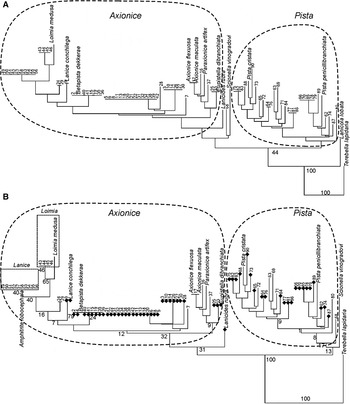
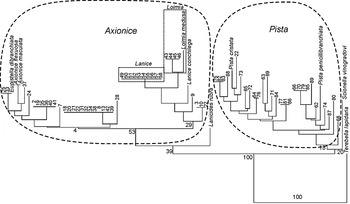
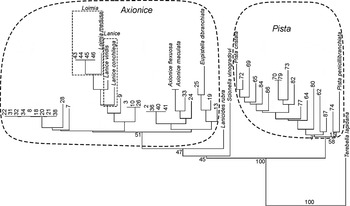
We used Neighbour-Joining multivariate cluster analysis (Saitou & Nei, Reference Saitou and Nei1987), with Euclidean distance as a measure. Calculations were carried out using Past3 (Hammer, Reference Hammer2015). As details of the structure of ventral pads are usually absent from descriptions, we needed separate calculations for characters 1–9 (Figure 11), characters 1–10 (Figure 12) and all characters (Figure 13).
Cluster tree, characters 1–9. (A) with Lanicola lobata; (B) without. Black rhombus – species with long-handled uncini on TU1. Used binomens valid on 1 April 2017. Horizontal number – bootstrap, vertical – number of species (Table 1).

Cluster tree, characters 1–10. Used binomens valid on 1 April 2017. Horizontal number – bootstrap, vertical – number of species (Table 1).

Cluster tree, characters 1–11. Used binomens valid on 1 April 2017. Horizontal number – bootstrap, vertical – number of species (Table 1).

HOW IS THE TYPE SPECIES OF THE GENUS PISTA DEFINED?
The type species of Pista by monotypy is Amphitrite cristata Müller, Reference Müller1776. The type material is ‘probably lost or never designated’ (Holthe, Reference Holthe1986a: 112). The first stage in the definition of Amphitrite cristata Müller, Reference Müller1776 (p. 216) is to review the original description; however, it is too short to adequately define the species: ‘corniculis ramosis binis’ (two arborescent horns). On the same page, Müller described three other Terebellidae: Amphitrite cirrata (‘cincinnis utrinque tribus’, three curls on both sides – an obvious reference to the branchiae), A. cornuta (‘corniculis simplicibus horizontalibus’, horns simple horizontal) and A. pennacea (‘penicillis frontis quatuor; intermediis majoribus’, four anterior brushes, intermediate origins). It becomes clear through comparison of these four ‘descriptions’, that ‘horns’ are branchiae and thus Amphitrite cristata has only one pair of branchiae. In 1779 (p. 87), Müller gave a much more complete description but did not describe the uncini and gave no figures, despite directly stating that he had. Although the figures eventually published in 1780 (Müller, Reference Müller1780) are not very informative, it is clear that only one pair of branchiae is depicted (Figure 1). The figured branchiae appear to be arborescent but, considering that late 18th century figures were often inadequate, we do not consider this to be important. Also: (1) other species with a single pair of arborescent branchiae found in Norway have either 16 TC (Axionice maculata) or 15 TC (Axionice flexuosa), whilst the original description clearly states ‘Segmenta septendecim anteriora’ (17 anterior thoracic segments); (2) clear lobes are shown on the branchiferous segment and no lobes on S1, whilst both other species with a single pair of branchiae have large lobes on S1 and small to absent lobes in S2. The first details of the uncini come from Malmgren's re-description: ‘uncini in sex segmentis anticis uncinigeris processu inferiori elongato’. However, almost half of a century ago, Banse (Reference Banse1980) showed that Malmgren had two species in his hands: one with two pairs of branchiae and TU1 with long-handled uncini and another with a single pair of branchiae and TU1 without a manubrium on the uncini. According to Müller (Reference Müller1779), A. cristata was collected in Christianfjord (58°06′N 8°00′E). Since then, studies of European Terebellidae have described five morphologically different species with pompom-like branchiae from the region between the Barents and Mediterranean Seas (Hartmann-Schröder, Reference Hartmann-Schröder1971, Reference Hartmann-Schröder1996; Holthe, Reference Holthe1986a; Jirkov et al., Reference Jirkov, Saphronova, Leontovitch and Jirkov2001; Jirkov & Leontovich, Reference Jirkov and Leontovitch2013; Londoño-Mesa et al., Reference Londoño-Mesa, Nygren and Kongsrud2016): Pista bansei Saphronova, 1988; Pista mediterranea de Gaillande, Reference de Gaillande1970; Pista unibranchia Day, Reference Day1963; Pista wui Saphronova, 1988; and Pistella lornensis (Pearson, Reference Pearson1969). As no other species have been discovered in the area for two and a half centuries, one of them is almost certainly a junior synonym of A. cristata; but which one?
Pista unibranchia has only a single branchia (not a pair!). Its range does not include the North Sea (much more southern), so it cannot be Müller's species.
Pista bansei has one pair of branchiae, but it inhabits greater depths than the source of Müller's material, so we consider it unlikely to be his species.
Pista mediterranea has a range that includes southern Norway but it has two pairs of branchiae. As it has long-handled uncini in TU1, we consider this to be the species described as Pista cristata by Malmgren and currently accepted as such by most authors despite its obvious differences from the original description. It is interesting that Pista cristata sensu Malmgren has probably also been described by Müller, as A. pennacea. Hartman (Reference Hartman1959) incorrectly gave the author of A. pennacea as Bosc (Reference Bosc1802) and treated it as a nomen nudum; Holthe (Reference Holthe1986b) made the same mistake. According to the glossary of the International Code of Zoological Nomenclature, nomen nudum refers to ‘a name that, if published before 1931, fails to conform to Article 12’; Article 12.1 says: ‘To be available, every new name published before 1931 must satisfy the provisions of Article 11 and must be accompanied by a description or a definition of the taxon that it denotes’. Müller's (Reference Müller1776) description of A. pennacea meets both conditions but, as it was not described satisfactorily and is in reality indeterminable, it is better to accept A. pennacea as a nomen dubium (glossary of Code: ‘a name of unknown or doubtful application’) and to disregard it. Pista mediterranea has also been described by us (Jirkov et al., Reference Jirkov, Saphronova, Leontovitch and Jirkov2001) as Pista malmgreni but comparison of our type material with topotypes of P. mediterranea shows that it is the same species.
Pista wui has been reported from Norway only once (Londoño-Mesa et al., Reference Londoño-Mesa, Nygren and Kongsrud2016) without any morphological data. We doubt that this species, previously known only from Pacific coasts of the USA, really inhabits Norwegian waters. It has two pairs of branchiae and uncini of TU1 with a manubrium.
Pistella lornensis has a range that includes southern Norway and it has one pair of branchiae. It is the only species listed above that fits the description and thus should be synonymized with P. cristata s.str. Remarkably, it lacks long-handled uncini in TU1. It was originally described as Scionella lornensis Pearson, Reference Pearson1969 and was later transferred to its own genus: Pistella Hartmann-Schröder, Reference Hartmann-Schröder1996. As the type species of Pistella (S. lornensis) is a junior synonym of the type species of Pista (Amphitrite cristata), Pistella should be considered a junior synonym of Pista. According to Londoño-Mesa et al. (Reference Londoño-Mesa, Nygren and Kongsrud2016), Pista cristata (named P. lornensis in their publication) is genetically homogenous in Norwegian waters (type locality of P. cristata and close to Scotland, the type locality of P. lornensis).
We published these findings 15 years ago (Jirkov et al., Reference Jirkov, Saphronova, Leontovitch and Jirkov2001) in Russian. Probably due to the linguistic barrier, Nogueira et al. (Reference Nogueira, Hutchings and Carrerette2015) did not accept our conclusions and wrote ‘that synonymy, however, requires that all species currently assigned to Pista should be transferred to a new, still undescribed genus, due to the presence of long-handled uncini on anterior segments, which are absent in P. cristata’. However, restoration of the original taxonomic meaning of Amphitrite cristata Müller, Reference Müller1776 does not require the description of a new genus. At the generic level, re-description can be limited to amendment of the diagnosis of Pista (i.e. removal of the requirement for the presence of long-handled uncini). This diagnosis of Pista was and is accepted by many authors (see above).
RESULTS AND DISCUSSION
The first calculation (Figure 11A) shows that the type species of Lanicola – L. lobata is outside the investigated group, so it is excluded from further discussion.
All calculations give almost the same results, showing two well-defined groups (bootstrap = 100). The positions of Scionella and Lanicides vary; they are sometimes included in one group, sometimes in the other, but in all cases they are somewhat apart. We think that these two genera should be accepted as distinct. As for the large groups, one includes the type species of Pista (Amphitrite cristata), the other includes the type species of Axionice (Terebella flexuosa); Betapista Banse, Reference Banse1980 (Betapista dekkerae Banse, Reference Banse1980); Eupistella Chamberlin, Reference Chamberlin1919 (Eupista darwini McIntosh, Reference McIntosh1885); Lanice Malmgren, Reference Malmgren1866 (Nereis conchilega Pallas, Reference Pallas1766); Loimia Malmgren, Reference Malmgren1866 (Terebella medusa Savigny in de Lamarck, Reference de Lamarck1818); and Paraxionice Fauchald, Reference Fauchald1972 (P. artifex Fauchald, Reference Fauchald1972). We consider this group to be a single genus and the other names as its junior synonyms. The oldest genera are Axionice, Lanice and Loimia; they were erected in one paper, so they have equal taxonomic status. We prefer to use Axionice because in the usual sense in which the genus is used is clearer and we will avoid confusion with previously used binomens. Some comments on genera synonymized with Axionice are given below to support our opinion. Updated diagnoses for all the genera we consider to be valid are also given below.
Holthe (Reference Holthe1986b) placed both Pista and Axionice in one tribe: Pistini. This cannot be accepted, due to significant differences between them.
Species with and without manubria are scattered between the Axionice and Pista (Figure 11B), so this character cannot be used for separation of genera; this opinion has been accepted by many authors (see above). So the diagnoses of Axionice and Pista do not require the obligatory presence or absence of an uncinal manubrium: it may be present or absent; but, if a manubrium is present, its origin is different between Axionice and Pista. The manubrium of Axionice develops as an extension of the uncinus. Figure 15 presents different stages of this development from the single neuropodium of several Axionice species. The manubrium develops either as prolongation of the base of the uncinus (A. elongata Figure 15A) or as prolongation behind it (most other Axionice Figure 15B–F). Its development starts in a special sac under the body surface, above the dorsal margin of the uncinal row. Figure 16 shows prepared TU1 neuropodia of A. alata showing the sac where uncini form. If the manubrium is broken, the break may occur at any point along the manubrium, usually far from the uncinal body (Figure 15F). This kind of development agrees perfectly with hypotheses about the possible origin of the manubrium in Terebellinae (Garraffoni & Lana, Reference Garraffoni and Lana2010). The manubrium of Pista originates quite differently: as a more or less chitinized tendon. The point of attachment is obvious and, if the manubrium is broken, it almost always happens at this point.
Morphology of Pista penicillibranchiata. (A) lateral view; (B) tip of branchia; (C) uncinus TU1; (D) uncinus TU16. (A) NHM, (B–D) IORAN. All from the same station RV ‘Vitjaz 618'.

Development of uncini in different Axionice species. (A) A. elongata BCPM 974-305-2; (B) A. alata NHM; (C) A. foliigera NHM 1961.19.1227/1232; (D) A. incarrientis IORAN RV ‘Vitjaz 1790'; (E) A. sinusa NHM 1986.92; (F) A. cretacea MNCN5801. All uncini from TU1 except (F), which are from TU3.

Row of uncini of TU1 of Axionice alata. Sac with juvenile uncini is arrowed.

Obviously, the plesiomorphic shape of the uncini in Axionice and Pista and closely related genera is avicular uncini without a manubrium, as in Axionice flexuosa (Figure 6A) and Pista cristata (Figure 7A). The uncinus goes through this stage during development (see Figure 15C). So, the manubria of Axionice and Pista are homoplasies. Manubria probably have independent origins even within Axionice, but this requires further investigation.
The plesiomorphic state of lateral lobes is poorly developed lobes or absence of lobes. The apomorphic state of lobes in Axionice is very large lobes on S1, and it is a synapomorphy for the group. Other segments may or may not have lobes; S3 has well-developed lobes, while S2 usually has no lobes at all, but they are sometimes present or even well-developed. In contrast, Pista has poorly developed lobes on S1. Scionella has a quite different structure on anterior segments, which should be treated as an apomorphy.
The synapomorphy of Pista is pompom-like branchiae.
SYSTEMATICS
Order terebellomorpha Hatschek, Reference Hatschek1893
Family terebellidae Johnston, Reference Johnston1846
Genus Pista Malmgren, Reference Malmgren1866
Type species Amphitrite cristata Müller, Reference Müller1776
WoRMS: 129708. Lobes of S1 not the largest, usually the smallest or absent; other lobes of various sizes and shapes, some large; largest lobes on S2 or S3. Branchiae pompom-like (bottle-brush, club-shaped, plumose – branching filaments in a spiral arrangement); sometimes the whole plume is in an apical position like a brush. Dorsal crest absent. Ventral pads divided into posterior and anterior parts, with different colours. Uncinal manubrium, if present, always develops from the uncinal tendon. Uncini in double rows arranged face-to-face. Notochaetae laterally smooth.
The genus, as defined above, includes 29 species (Appendix 1).
We have some doubt concerning the position of P. penicillibranchiata. In contrast to all other known species of the Axionice/Pista group, its ventral pads are not subdivided and, whilst its branchiae are definitely not arborescent, their pompom-like structure is reduced to a Penicillus-like tuft (Figure 14); however, all calculations place this species within Pista.
Pista cristata (Müller, Reference Müller1776)
Figures 4A, 7A, 8A & 10A
Amphitrite cristata Müller, Reference Müller1776: 216; type locality Christianfjord, Norway ≈ 58°06′N 8°00′E, type material ‘probably lost or never designated’ (Holthe, Reference Holthe1986a: 112).
Pista cristata – Malmgren, Reference Malmgren1866: 382–383 (partim), non Tab. XXII f. 59 (P. mediterranea); Jirkov, Leontovich & Saphronova, Reference Jirkov, Saphronova, Leontovitch and Jirkov2001: 521–522, textfig – non auctuorum.
Scionella lornensis Pearson, Reference Pearson1969: 509–513, fig. 1, 2, type locality Loch Linnhe, Loch Creran and Firth of Lorne, Scotland, holotype BMNH ZB 1968 15; Holthe, Reference Holthe1986a: 114–115, fig. 50;
Pistella lornensis – Hartmann-Schröder, Reference Hartmann-Schröder1996: 520.
Pista lornensis – Saphronova, 1988: 890–891, fig. a, b.
Pista sp. II – Banse, Reference Banse1980: 31, fig. 4j–k.
WoRMS: 131516
MATERIAL EXAMINED
Slettholmen 12.09.1979 (10 ex., det. as Scionella lornensis by E. Oug), Ronsfjord, 58°06′30″N 8°06′E (very close to the type locality); 25.08.1979 (4 ex., det. as Scionella lornensis by E.Oug); Kattegat Frederikshavn Hirsholm, 25–30 m 21.06.1960 57°29′30″N 10°37′30″E (1 ex., det. as Scionella lornensis by M. Petersen) collection of ZMMGU; 15 ex. Islas Chafarinas, between Cabo de San Antonio and Puerto de Valencia, Cala Uruguay MNCM; type of Scionella lornensis BMNH ZB 1968 15.
DIAGNOSIS
Length up to 60 mm, width 3 mm. Upper lip small. S1 reduced, without lobes. S2 with large semi-rounded ventro-lateral lobes, covering S1, their upper margin on the level of the upper end of the uncinal row of S5, maximum length of lobes at their centre, lobes poorly developed ventrally, S1 visible through broad incision. Lobes of S3, if present, distinctly smaller, their upper margin lower than upper margin of the lobes of S2, ventrally not developed. S4 without lobes or small variably developed thickening below notopodia. One pair of branchiae on transverse fold, branchiae pompom-like, usually left and right of different sizes. Notopodia start from S4, extending for 17 S (17TS), short, cylindrical, 1st pair on the same level as others, or slightly higher. Neuropodia start from S5, uncini in double rows arranged face-to-face on S11–S20 (up to the end of the thorax). All thoracic neuropodia are tori, all abdominal neuropodia are pinnuli, about 50 AU. Rows of thoracic uncini of similar length, those of abdominal region 2 to 3 times shorter. Nephridial papillae on S6 and S7, usually invisible. Ventral pads start from S4–S6, not developed on preceding segments, at first semicircular, then as transverse rectangles, absent on last 1–2 TU, middle pads are the largest. Ventral pads divided into posterior and anterior parts, with different colours: anterior parts of the same colour as other parts of the body, posterior half white. All uncini avicular, in double rows, neuropodia face-to-face, flexible tendon attached to the back of uncini, tendons easily separated from uncini while preparing slides. Tube of dense detritus, with inlaid shells and their fragments, oriented transversely.
Species range. Records almost worldwide, but all reports refer to Pista with two pairs of branchiae, i.e. to different species. Confirmed distribution from the North and Mediterranean Seas.
Biology. Shallow water, not deeper than 25 m.
Genus Axionice Malmgren, Reference Malmgren1866
Type species Terebella flexuosa Grube, 1860
WoRMS: 129689. Lobes of S1 are the largest, usually at least twice as large as the largest lobes of other segments, directed anteriorly and covering the upper lip; lobes of S3 smaller, but still large; lobes of other segments much smaller or absent; a usual trait is small or absent lobes on S2. Branchiae arborescent. Dorsal crest absent. Ventral pads not subdivided. Uncinal manubrium, if present, develops as an extension of the uncinus. Uncini in double rows arranged face-to-face. Notochaetae laterally smooth.
Axionice in sense proposed here includes 94 species (Appendix 1). It is interesting that all of them have been described outside Axionice. The re-description of the type species is given below.
Taxonomic remarks on generic synonymy.
Betapista Banse, Reference Banse1980. WoRMS: 325246. Banse (Reference Banse1980) stated that the main reason for establishing the new genus was branchiae starting from S3 instead of S2. However, he noticed that counting segments is difficult and that the genus could be based on several other characters that seemed stable. He defined the first of these characters as: double rows of uncini beginning on segment 11, a diagnostic character at the subfamily level (see Hessle, Reference Hessle1917: 145; Caullery, Reference Caullery1944). While it is true that double rows of uncini usually start from TU7 (=TC8=S11), the character is not as stable as the authors supposed. We have found Axionice elongata with double rows of uncini starting two segments earlier: from TU5 (=TC8=S9) (Figure 17). We consider the difference to be only individual variation as, in all other characters, this worm did not differ from other Axionice; it showed, however, that the starting point of double rows of neuropodial uncini is a variable character (though not commonly so) and not a real basis for the accepting Betapista as valid, at least not before variation within a species has been investigated.
Double rows start in Axionice elongate. BCPM 974-305-2.

Euscione Chamberlin, Reference Chamberlin1919. WoRMS: 882063. Chamberlin (Reference Chamberlin1919) proposed Euscione as a replacement for the junior homonym Scione Malmgren. The type species of Scione (Scione lobata), presently accepted as Axionice maculata is so similar to Axionice flexuosa (Figures 2A, C, 6A, B & 9A, C), that there is no doubt that Euscione should be accepted as a junior synonym of Axionice.
Eupistella Chamberlin, Reference Chamberlin1919. WoRMS: 129692. Unfortunately only the type of E. dibranchiata was available. Contrary to the original description, branchiae are clearly dichotomous. So, at least this species should be transferred to Axionice. The validity of the genus should be clarified after investigation of McIntosh's species types; unfortunately, they were not available during the course of our study. However, the presence of cirriform instead of arborescent branchiae is not accepted as enough to differentiate genera in Terebellidae; for example, within Amphitrite, the type species has cirriform branchiae, while most others have more or less branched branchiae (some of them are sometimes transfered to Neoamphitrite).
Lanice Malmgren, Reference Malmgren1866. WoRMS: 129697. There is remarkable similarity in the development of lateral lobes (compare Figures 2 and 3 with Figure 5B) and uncini of TU1 (Figure 6) between Lanice and Axionice. The only difference between them is that the uncini in double rows are arranged back-to-back (Figure 8G), rather than face-to-face (Figure 8B, F). However this difference can appear if two rows are well separated or at least not completely ‘zipped’. However it is not always the case: in some species, such as Pista mediterranea (Figure 8C) and Axionice cretacea (Figure 8E), uncini of different orientations form a single row and they cannot be named either back-to-back, or face-to-face, but only side-to-side. The existence of such species makes the difference between Lanice and Axionice insignificant or, at least, cannot be enough to accept the feature as valid for the separation of genera. Also, it is necessary to mention that the type species of Lanice (L. conchilega), contrary to previous descriptions, differs from other members of the genus in that it has a short but distinct manubrium. This manubrium seems to have an origin similar to that of Axionice (Figure 15). Also, the tube with a branched, fine-meshed fan attached to the opening is not characteristic for the genus: we have seen very similar tubes built by Thelepus.
Loimia Malmgren, Reference Malmgren1866 (Figure 8). WoRMS: 129700. As in Lanice, the lateral lobes of Loimia are remarkably similar to those of Axionice (compare Figures 2 and 3 with Figure 5A). Loimia is defined by a unique generic character: adults with pectinate uncini, but juveniles of some species have the usual avicular uncini in the posterior abdomen (Wilson, Reference Wilson1928; Hutchings & Glasby, Reference Hutchings and Glasby1988). This seems to be an apomorphy and the group seems to be monophyletic. However, there is great variation in uncini within Axionice and the difference between, for example, A. elongata (Figure 6C) and the type species A. flexuosa (Figure 6A) is much greater than between A. flexuosa and Loimia (Figure 6R). Probably, detailed investigation of Axionice s. lato will show that there are several groups of species, but an evaluation of such a group is beyond the goal of the present investigation. It would require much deeper investigation of their morphology than is currently possible and cannot be completed using literature data alone. Also, Loimia differs from all other genera of the investigated group except for Lanice in that the uncini are arranged in a back-to-back position, but we already considered that this is not enough for accepting a genus as valid.
Paraxionice Fauchald, Reference Fauchald1972. WoRMS: 325264. The original description states: ‘It has sixteen thoracic setigers and a single pair of branchiae; both the other genera mentioned [Axionice and Pista IJ] have seventeen thoracic setigers and two or three pairs of branchiae’ (p. 319). However, this is not true: the type species of Axionice has only 15 thoracic chaetigers and one pair of branchiae (see re-description above). The number of TC in Pista and Axionice varies from 15 to 20 and the number of branchiae varies from one to three. So, Fauchald's reasons for establishing the new genus are not valid and Paraxionice should be accepted as a junior synonym of Axionice. This was also indicated by our calculations.
Axionice flexuosa (Grube, 1860)
Figures 2A, 6A, 8F & 9A
Axionice flexuosa – Holthe, Reference Holthe1986a: 118–120, fig. 52, map 51.
Pista flexuosa – Uschakov, Reference Uschakov1955: 386; Jirkov, Leontovich & Saphronova, Reference Jirkov, Saphronova, Leontovitch and Jirkov2001: 522, textfig.
WoRMS: 131483
MATERIAL EXAMINED
Ninety samples (307 specimens) from collections KGB, IORAN and ZIN, 9–263 m from the Barents Sea to the northern parts of the Sea of Japan.
DIAGNOSIS
Length up to 60 mm. Eyespots absent. Lobes S1 are the largest, ventro-lateral, ventrally fused and cover prostomium. Lobes absent from S2. Lobes on S3 large, lateral, covering S2 completely and partly covering S1. One pair of arborescent branchiae on S2. Notopodia from S4 extending for 15 S. Neuropodia start from S5, uncini in double rows arranged face-to-face on S11–S16, thus uncini are single rows on neuropodia of last two thoracic segments. All thoracic neuropodia (including last single row) are tori, all abdominal neuropodia are pinnuli. Ventral pads uniform. Uncini avicular, without manubrium. Notochaetae laterally smooth. Tube distinctive and peculiar to this species: flat and undulating, sandy.
Species range. From the Barents Sea to the northern parts of the Sea of Japan.
Biology. Shallow water, mainly shallower than 100 m.
Remark. Although we have not investigated type material, all characters perfectly fit Holthe's (Reference Holthe1986a) re-description with one exception: Holthe reported this species as having double-rows of neuropodia up to the end of the thorax. In reality, although all thoracic neuropodia are tori and all neuropodia starting from AU1 are pinnuli, the last two TU have neuropodia with uncini in single rows. As far as we know, all other Terebellinae have neuropodia with uncini in double rows at least to the end of the thorax and often on some (occasionally numerous) abdominal neuropodia. Nevertheless, as there are no similar species in the Arctic that can be confused with A. flexuosa, we suppose that Holthe's description is partly inaccurate.
Genus Scionella Moore, Reference Moore1903
(Figure 5C–F)
Type species Scionella japonica Moore, Reference Moore1903
WoRMS: 147148.
Lobes of S1–S4 well developed, equal in size. Branchiae spirally wound arising from a transverse dorsal fold on S4. Ventral pads not subdivided. Uncinal manubrium absent. Uncini in double rows arranged face-to-face. Notochaetae with serrated tips.
Saphronova (Reference Saphronova1991) considered this genus to be distinctive in its dorsal crest and the arrangement of its lateral lobes, not by the absence of a manubrium, as thought by Pearson (Reference Pearson1969); we agree with her conclusions.
Genus Lanicides Hessle, Reference Hessle1917 sensu Nogueira et al. (Reference Nogueira, Hutchings and Carrerette2015)
Type species Terebella (Phyzelia) bilobata Grube, 1878 according to Nogueira et al. (Reference Nogueira, Hutchings and Carrerette2015).
WoRMS: 174905.
S1 reduced, S2 and S3 with lobes of variable size. Branchiae arborescent or plumose. Serrated notochaetae present. Uncini avicular; manubrium in some anterior segments.
Remark. We have not investigated any species of this genus; data in Table 1 based on the best description of the species of the genus given by Nogueira et al. (Reference Nogueira, Hutchings and Carrerette2015) – Lanicides rubra.
ACKNOWLEDGEMENTS
The authors thank Dr A. Sazhin for the use of equipment for preparing photographs. We thank Dr A. Glover and E. Sherlock for their help with examination of the NHM collection, Mr D.J. Hall and Dr T.M. Worsfold (APEM Limited UK) for the loan of specimens and access to the collection at APEM, Dr Marián Ramos, Principal Researcher of the ‘Fauna Ibérica X’ project and Dr Javier Sánchez Almazán, Collection Manager at the Museo Nacional de Ciencias Naturales (MNCN, Madrid) for facilities and help with the study of the MNCN collection. Dr T.M. Worsfold made edits to the English. We also thank Dr João Miguel de Matos Nogueira for fruitful discussion at IPC12 and two anonymous reviewers for their valuable comments.
FINANCIAL SUPPORT
This work was supported by the Russian Science Foundation (grant number 14-50-00029) for investigation within the Russian border and Fauna Ibérica XI – Polychaeta VI (Reference: MICINN CGL2010-22267-C07-01) outside.
APPENDIX 1
Proposed taxonomic status of species of the genera Axionice, Betapista, Eupistella, Lanice, Lanicides, Loimia, Paraxionice, Pista and Pistella
Axionice agassizi (Hilbig, Reference Hilbig, Blake, Hilbig and Scott2000) as Pista
Axionice alata (Moore, 1910) as Pista
Axionice alonsae (Santos et al., Reference Santos, Nogueira, Fukuda and Christoffersen2010) as Pista
Axionice amphelisso (Hutchings, Reference Hutchings2007) as Lanice
Axionice annulifilis (Grube, 1872) as Terebella
Axionice arakani (Hissmann, 2000) as Lanice
Axionice arborea (Moore, Reference Moore1903) as Loimia
Axionice armata (Carrerette & Nogueira, 2015) as Loimia
Axionice artifex (Fauchald, Reference Fauchald1972) as Paraxionice
Axionice atypica (Hessle, Reference Hessle1917) as Pista
Axionice auricula (Hutchings, 1990) as Lanice
Axionice bandera (Hutchings, 1990) as Loimia
Axionice batilla (Hutchings & Glasby, Reference Hutchings and Glasby1988) as Loimia
Axionice bermudensis (Verrill, Reference Verrill1900) as Loimia
Axionice bidewa as (Hutchings & Glasby, Reference Hutchings and Glasby1988) Lanice
Axionice brasiliensis (Carrerette & Nogueira, 2015) as Loimia
Axionice breviuncinata (Hartmann-Schröder, Reference Hartmann-Schröder, Hartmann-Schröder and Hartmann1965) as Pista
Axionice caulleryi (Holthe, Reference Holthe1986a, Reference Holtheb) as Lanice
Axionice cetrata (Ehlers, 1887) as Terebella
Axionice chloroplokamia (Nogueira et al., Reference Nogueira, Hutchings and Carrerette2015) as Pista
Axionice conchilega (Pallas, Reference Pallas1766) as Nereis
Axionice contorta (Ehlers, Reference Ehlers and Chun1908) as Terebella (Loimia)
Axionice corrientis (McIntosh, Reference McIntosh1885) as Pista
Axionice crassifilis (Grube, 1878) as Terebella
Axionice cretacea (Grube, 1860) as Terebella
Axionice darwini (McIntosh, Reference McIntosh1885) as Eupista
Axionice decora (Pillai, 1961) as Loimia
Axionice dekkerae (Banse, Reference Banse1980) as Betapista
Axionice dibranchiata (Fauvel, Reference Fauvel1909) as Eupista
Axionice digitibranchia (Caullery, Reference Caullery1944) as Eupista
Axionice elongata (Moore, 1909) as Pista
Axionice expansa (Treadwell, 1906) as Lanice
Axionice fasciata (Grube, 1870) as Dendrophora
Axionice fauveli (Day, 1934) as Lanice
Axionice flabellum (Baird, 1865) as Terebella
Axionice flexuosa (Grube, 1860) as Terebella
Axionice foliigera (Caullery, Reference Caullery1915) as Pista
Axionice foliigeraformis (Annenkova, Reference Annenkova1937) as Pista
Axionice gibbauncinata (Saphronova, 1984) as Pista
Axionice godfroyi (Gravier, 1911) as Scione
Axionice grubei (Holthe, Reference Holthe1986a, Reference Holtheb) as Loimia
Axionice grubei (McIntosh, Reference McIntosh1885) as Eupista
Axionice haitiana (Augener, 1922) as Lanice
Axionice harrissoni (Benham, Reference Benham1916) as Scione
Axionice hataam (Londoño-Mesa, Reference Londoño-Mesa2012) as Pista
Axionice herpini (Fauvel, 1928) as Pista
Axionice incarrientis (Annenkova, 1925) as Pista
Axionice ingens (Grube, 1878) as Terebella
Axionice juani (Nogueira, Hutchings & Carrerette, Reference Nogueira, Hutchings and Carrerette2015) as Loimia
Axionice keablei (Nogueira, Hutchings & Carrerette, Reference Nogueira, Hutchings and Carrerette2015) as Loimia
Axionice kristiani (Nogueira et al., Reference Nogueira, Hutchings and Carrerette2015) as Pista
Axionice lizae (Londoño-Mesa, Reference Londoño-Mesa2012) as Pista
Axionice macrolobata (Hessle, Reference Hessle1917) as Terebella
Axionice maculata Dalyell, 1853 as Scione
Axionice marionensis (Branch, 1998) as Lanice
Axionice medusa (Savigny in de Lamarck, Reference de Lamarck1818) as Terebella
Axionice medusa angustescutata (Willey, 1905) as Loimia
Axionice megaoculata (Carrerette & Nogueira, 2015) as Loimia
Axionice minuta (Treadwell, 1929) as Loimia
Axionice mirabilis (McIntosh, Reference McIntosh1885) as Pista
Axionice montagui (Grube, 1878) as Terebella (nomen dubium)
Axionice moorei (Berkeley & Berkeley, Reference Berkeley and Berkeley1942) as Pista
Axionice nigrifilis (Caullery, Reference Caullery1944) as Loimia
Axionice ochracea (Grube, 1878) as Terebella (Loimia)
Axionice pachybranchiata (Fauvel, Reference Fauvel1932) as Pista
Axionice pacifica (Berkeley & Berkeley, Reference Berkeley and Berkeley1942) as Pista
Axionice palmata (Verrill, 1873) as Scionopsis
Axionice parapacifica (Hartmann-Schröder, Reference Hartmann-Schröder, Hartmann-Schröder and Hartmann1965) as Pista
Axionice pegma (Hutchings & Smith, 1997) as Pista
Axionice pseudotriloba (Nogueira, Hutchings & Carrerette, Reference Nogueira, Hutchings and Carrerette2015) as Loimia
Axionice qolora (Day, 1955) as Pista
Axionice quadrilobata (Augener, Reference Augener1918) as Nicolea
Axionice robustiseta (Caullery, Reference Caullery1915) as Pista
Axionice salazari (Londoño-Mesa & Carrera-Parra, Reference Londoño-Mesa and Carrera-Parra2005) as Loimia
Axionice savignyi (McIntosh, Reference McIntosh1885) as Loimia
Axionice savignyi trussanica (Annenkova, 1925) as Loimia
Axionice seticornis (McIntosh, Reference McIntosh1885) as Terebella (Lanice)
Axionice sinata (Hutchings & Glasby, Reference Hutchings, Glasby, Wells, Walker, Kirkman and Lethbridge1990) as Lanice
Axionice sinusa (Hutchings & Glasby, Reference Hutchings and Glasby1988) as Pista
Axionice socialis (Willey, 1905) as Polymnia
Axionice sp. A Kritzler, Reference Kritzler1984 as Pista
Axionice spinifera (Ehlers, Reference Ehlers and Chun1908) as Scione
Axionice symbranchiata (Ehlers, Reference Ehlers1913) as Nicolea
Axionice triloba (Hutchings & Glasby, Reference Hutchings and Glasby1988) as Loimia
Axionice trunca (Hutchings, Reference Hutchings1977) as Pista
Axionice tuberculata (Nogueira, Hutchings & Carrerette, Reference Nogueira, Hutchings and Carrerette2015) as Loimia
Axionice turawa (Hutchings & Glasby, Reference Hutchings and Glasby1988) as Pista
Axionice turgida (Andrews, 1891) as Loimia
Axionice variegata (Grube, 1870) as Terebella
Axionice verrucosa (Caullery, Reference Caullery1944) as Loimia
Axionice violacea (Hartmann-Schröder, Reference Hartmann-Schröder, Hartmann-Schröder and Hartmann1984) as Pista
Axionice viridis (Moore, Reference Moore1903) as Loimia
Axionice viridis (Nogueira, Hutchings & Carrerette, Reference Nogueira, Hutchings and Carrerette2015) as Lanice HOMONYM
Axionice wollebaeki (Caullery, Reference Caullery1944) as Lanice
Pista abyssicola McIntosh, Reference McIntosh1885
Pista anneae Nogueira et al., Reference Nogueira, Hutchings and Carrerette2015
Pista anthela Hutchings & Glasby, Reference Hutchings, Glasby, Wells, Walker, Kirkman and Lethbridge1990
Pista australis Hutchings & Glasby, Reference Hutchings and Glasby1988
Pista bansei Saphronova, 1988
Pista brevibranchia Caullery, Reference Caullery1915
Pista cristata (Müller, Reference Müller1776) as Amphitrite
Pista curtiuncata Hartmann-Schröder, Reference Hartmann-Schröder1981
Pista dibranchis Gibbs, 1971
Pista disjuncta Moore, Reference Moore1923
Pista estevanica (Berkeley & Berkeley, Reference Berkeley and Berkeley1942) as Scionella
Pista franciscana (Nogueira et al., Reference Nogueira, Hutchings and Carrerette2015) as Pistella
Pista grubei Augener, Reference Augener1918
Pista gwoyarrma Hutchings, Reference Hutchings, Hanley, Caswell, Megirian and Larson1997
Pista kimberliensis Hutchings & Glasby, Reference Hutchings, Glasby, Wells, Walker, Kirkman and Lethbridge1990
Pista microlobata Hessle, Reference Hessle1917
Pista mediterranea de Gaillande, Reference de Gaillande1970
Pista ortodoxa Saphronova, 1984
Pista papillosa Tourtellotte & Kritzler, 1988
Pista paracristata Safronova, Reference Safronova1988
Pista patriciae Hartmann-Schröder & Rosenfeldt, Reference Hartmann-Schröder and Rosenfeldt1989
Pista pencillibranchiata Saphronova, 1984
Pista sp. B Kritzler, Reference Kritzler1984
Pista torquata Hutchings, Reference Hutchings2007
Pista typha aequibranchia Caullery, Reference Caullery1944
Pista typha Grube, 1878
Pista unibranchia Day, Reference Day1963
Pista vossae Londoño-Mesa, Reference Londoño-Mesa2012
Pista wui Saphronova, 1988
Pista percyi Hilbig, Reference Hilbig, Blake, Hilbig and Scott2000. Original description does not allow differentiation of this species from Axionice incarrientis.
Pista brevibranchiata Moore, Reference Moore1923. Never described, see Hilbig (Reference Hilbig, Blake, Hilbig and Scott2000) for taxonomic explanation = Axionice agassizi.
Pista zachsi Annenkova, 1925. Indeterminable, fide Leontovich, Jirkov (Reference Leontovich and Jirkov2011).
Pista shizugawaensis Nishi & Tanaka, 2006 = Axionice agassizi fide Leontovich & Jirkov (Reference Leontovich and Jirkov2011).
Scionella lornensis Pearson, Reference Pearson1969 = Pista cristata s. str. fide Jirkov, Saphronova & Leontovich (Reference Jirkov, Saphronova, Leontovitch and Jirkov2001).
1. Pista shizugawaensis. This species has been considered as a junior synonym of A. brevibranchiata by Leontovich & Jirkov (Reference Leontovich and Jirkov2011) based on re-investigation of paratypes. Choi et al. (Reference Choi, Jung and Yoon2015) did not agree and wrote: ‘P. shizugawaensis differs from P. brevibranchiata referred by Leontovich and Jirkov (Reference Leontovich and Jirkov2011) in terms of the detailed shape of notosetae. P. shizugawaensis has broadly or narrowly winged capillary notosetae, while P. brevibranchiata has capillary notosetae bearing only small denticles on the surface. Also, P. shizugawaensis lacks shafts or has short-handled shafts that appear additionally in the uncini on the posterior thoracic segments, but P. brevibranchiata has only long handled shafts (Leontovich & Jirkov, Reference Leontovich and Jirkov2011)’ (p. 156). The differences described by Choi et al. (Reference Choi, Jung and Yoon2015) in the notochaetae between their specimens and ours is no more than the difference seen through the compound microscope used by them and seen in the SEM used by us. Uncini without a manubrium in Axionice are normally present as a stage of development (see above), so the uncini without a manubrium reported by Choi et al. (Reference Choi, Jung and Yoon2015) are either juvenile uncini or, more probably, uncini with broken manubria (it happens often and is not easily distinguishable). So we propose that Pista shizugawaensis should be accepted as a junior synonym of A. brevibranchiata or, more correctly, of A. agassizi (Hilbig, Reference Hilbig, Blake, Hilbig and Scott2000), as A. brevibranchiata has never been described as required by the Code (see Hilbig, Reference Hilbig, Blake, Hilbig and Scott2000 for taxonomic discussion).
2. Amphitrite lobocephala Hsieh, Reference Hsieh1994. According to characters mentioned in the original description (shape of branchiae, arrangement of lateral lobes, uncini arranged back-to-back and others, see Table 1), this species agrees well with species formerly belonging to Lanice; we do not understand why it was described as Amphitrite. Our calculations (Figures 11 & 12) show that it should be transferred to Axionice as we consider that Lanice should be accepted as its junior synonym. Nogueira et al. (Reference Nogueira, Fitzhugh and Hutchings2013) came to the same conclusion, but did not make the necessary taxonomic amendments.