Implication
A wide spread of hatching in the incubator results in an equally wide variety of holding period durations for the newly hatched chicks, which impairs post-hatch performance. Therefore, it is important to identify the relationship between the length of holding period and the physical or physiological status of the broiler chick at pulling. Our results recommend the shortening of the hatch window, thereby decreasing the negative effects caused by long holding period duration, which should result in greater uniformity and growth of chicks.
Introduction
At the end of an ∼21-day incubation period, chicks hatch over a 24 to 48 h period in a commercial hatchery and hatch window is defined as the time between the hatching of the first and last chick (Careghi et al., Reference Careghi, Tona, Onagbesan, Buyse, Decuypere and Bruggeman2005). The early hatch chicks are held in the incubator until the majority of the chicks in the entire batch hatch, rather than being removed immediately upon hatching. This ‘spread of hatch’ causes considerable variation in the holding period experienced by individual chicks before the whole batch is removed from the incubator at the end of the incubation (pulling). Moreover, the chicks subsequently undergo processing and are then transported to the broiler farm. Thus, chicks can be deprived of feed and water for up to 72 h (Willemsen et al., Reference Willemsen, Debonne, Swennen, Everaert, Careghi, Han, Bruggeman, Tona and Decuypere2010). It has been shown that feed and water deprivation after hatch leads to dehydration (van de Ven et al., Reference van de Ven, van Wagenberg, PWGG, Kemp and van den Brand2009) and impairs welfare and post-hatch performance with respect to growth, immune system activation, digestive enzyme stimulation and organ development (Gonzales et al., Reference Gonzales, Kondo, Saldanha, Loddy, Careghi and Decuypere2003; Willemsen et al., Reference Willemsen, Debonne, Swennen, Everaert, Careghi, Han, Bruggeman, Tona and Decuypere2010). Therefore, the start of feed and water deprivation should be considered from the individual time of hatch and not from the end of incubation (Careghi et al., Reference Careghi, Tona, Onagbesan, Buyse, Decuypere and Bruggeman2005) in order to reduce welfare issues and maintain health, as the day-old chick is the starting material to realise a high-quality broiler flock at slaughter age (Tona et al., Reference Tona, Bamelis, De Ketelaere, Bruggeman, Moraes, Buyse, Onagbesan and Decuypere2003). High-quality day-old chicks ensure greater survivability and better growth potential during the early post-hatch stages (Christensen, Reference Christensen2009). There have been previous studies investigating the physiological status of chicks shortly after hatch and these show no difference in chick weights relative to the time of hatch (Careghi et al., Reference Careghi, Tona, Onagbesan, Buyse, Decuypere and Bruggeman2005; van de Ven et al., Reference van de Ven, van Wagenberg, Debonne, Decuypere, Kemp and van den Brand2013; Maatjens et al., Reference Maatjens, Reijrink, van den Anker, Molenaar, van der Pol, Kemp and van den Brand2014). However, there is no specific data to show how weight, chick quality or other physiological parameters at pulling are influenced by the precise duration of the holding period. This is highly relevant to industry, where chicks are left in the hatcher for varying lengths of time as opposed to being removed soon after hatch. We hypothesised that the different durations of holding period may affect the physiological status of chicks at pulling which consequently affects post hatch performance.
In this study, we identified the exact individual hatching time of focal eggs using eggshell temperature (EST) sensors (Romanini et al., Reference Romanini, Exadaktylos, Tong, McGonnel, Demmers, Bergoug, Eterradossi, Roulston, Garain, Bahr and Berckmans2013) and investigated the effects of holding period duration on the physical and physiological status of newly hatched broiler chicks at pulling. We have investigated a number of blood chemistry parameters combined with corticosterone levels, body weight (BW), organ weight and chick quality score to investigate the physiological status of each focal chick.
Material and methods
Animal experiments were performed with ethical approval from the Royal Veterinary College Animal Ethics Committee.
Eggs and incubation
In total, eight batches of fertile Ross 308 eggs (600 eggs per batch) were collected from breeders aged between 35 and 57 weeks (Henry Stewart & Co. Ltd, Lincolnshire, UK) and stored for 3 days under standard conditions. Eggs were incubated in the small custom-built ‘BioStreamer’ incubators (Petersime NV, Zulte, Belgium) under standard incubation conditions with an eggshell temperature of 37.8°C and a relative humidity around 60%. Eggs were candled at day 18 and those with evidence of a living embryo were transferred from the trays to the hatcher baskets. All incubations were stopped at 512 h (21 days and 8 h) and chicks were removed from the hatcher.
Hatching time and holding period
Focal eggs were individually labelled and weighed. During transfer to the hatcher basket, each focal egg was placed in a specially constructed area within the top basket (using 8×8×8 cm3 metallic mesh grid). The hatching time of individual focal eggs was determined using EST as previously described by Romanini et al. (Reference Romanini, Exadaktylos, Tong, McGonnel, Demmers, Bergoug, Eterradossi, Roulston, Garain, Bahr and Berckmans2013). The identification of hatching time is based on a registered EST drop (2°C to 5°C) when the chick emerges from the egg. A total of 111 focal eggs from eight batches were hatched. The hatching time of 109 individual focal chicks was successfully determined and recorded as the incubation time (hours). The duration of holding period was defined as the precise time between hatching of the chick and pulling from the hatcher. This was calculated by subtracting the individual hatching time from the total incubation time (512 h).
Chick scoring and measurement
At pulling, all hatched focal chicks were weighed and scored for quality assessment using a standard method (Tona et al., Reference Tona, Bamelis, De Ketelaere, Bruggeman, Moraes, Buyse, Onagbesan and Decuypere2003) that scores several physical conditions within a total scale of 100 according to their importance (activity, feather, eyes, legs, comb, navel area and remaining yolk). Immediately after scoring, 63 chicks were euthanised via cervical dislocation and blood samples were collected from the left ventricle into heparin-coated syringes and organs (heart, liver and stomach) were dissected and weighed. Relative BW was expressed as a function of egg weight, and relative heart weight, relative liver weight and relative stomach weight were expressed as a function of BW.
Blood values and corticosterone
Blood samples from 29 focal chicks were analysed for blood values and from 57 focal chicks for corticosterone. After collection, 200 µl whole blood was immediately presented to a Portable Blood Gas Electrolyte and Critical Care Analyser (Woodley Equipment Company Ltd., Bolton, UK) to measure the following blood parameters: pH, partial pressure of carbon dioxide (pCO2; mmHg), partial pressure of oxygen (pO2; mmHg), sodium (Na; mmol/l), potassium (K; mmol/l), ionised calcium (iCa; mmol/l), glucose (Glu; mmol/l), lactate (Lac; mmol/l), haematocrit (Hct;%), haemoglobin (Hb; g/dl), bicarbonate (HCO3 −; mmol/l), total carbon dioxide (TCO2; mmol/l) and base excess (BE; mmol/l). Sample collection and processing followed the analyser manufacturer instructions and results were available within 2 to 3 min. The remaining blood was centrifuged at 3000 r.p.m. for 10 min. The plasma was decanted into 1.5 ml tubes and frozen at −20°C for corticosterone analysis. Plasma corticosterone (CORT; ng/ml) was measured using a commercially available double antibody RIA kit (IDS Ltd, Boldon, England).
Statistical analysis
Data were analysed with IBM SPSS Statistics 20. All variables were tested for normal distribution using the Shapiro–Wilk analysis. Pearson’s correlation or Spearman’s correlation (only for chick quality score) was used to summarise the association between all the variables. Linear mixed effects model, taking into account the random batch effect, which also takes into account flock age variability, was adopted to investigate the association between outcome variables and the explanatory variables if the Pearson’s or Spearman’s correlations were significant at 5% level.
The outcome variables considered were hatching time, chick score, BW, organ weight, blood values or plasma CORT levels at pulling; the explanatory variables were egg weight at setting, BW at pulling or duration of holding period. For each of the blood values and plasma CORT, descriptive statistics including mean value, standard deviation, maximum values and minimum value were calculated.
Results
The spread of hatch and holding period
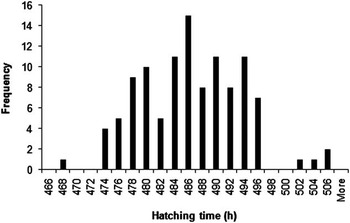
The hatching time of the 109 focal chicks ranged from 467.03 to 504.42 h and this was normally distributed (Figure 1). The calculated duration of holding period ranged from 7.58 to 44.97 h and more than 70% of chicks had to wait in the incubator for 20 to 35 h before pulling.
The distribution of hatching time as determined using eggshell temperature monitoring for 109 focal chicks. Hatching time is expressed as incubation time of the eggs in hours. The incubation was terminated after 512 h.

Blood parameters of broiler chicks
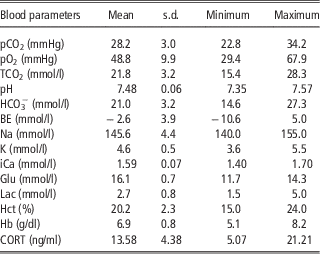
Values of blood parameters for Ross 308 chicks are presented in Table 1. Wide variations in blood gases, base excess and CORT levels were found in chicks at pulling. However, the remaining blood parameters fell within relatively narrow ranges.
Blood parameters data from 29 Ross 308 chicks at pulling

pCO2=partial pressure of carbon dioxide; pO2= partial pressure of oxygen; TCO2= total carbon dioxide; HCO3 −=bicarbonate; BE= base excess; Na=sodium; K=potassium; iCa=ionised calcium; Glu=glucose; Lac=lactate; Hct=haematocrit; Hb=haemoglobin; CORT= corticosterone.
Effects of egg weight and BW on hatching time and physical and physiological parameters at pulling
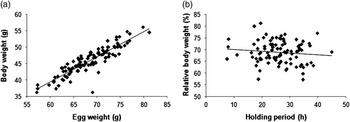
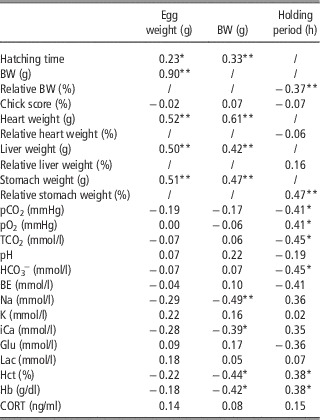
The range of egg weight was 57.1 to 81.2 g. The correlation coefficients between egg weight at setting or BW at pulling and all the measurements at pulling are shown in Table 2. Mixed effect model, after taking into account batch/flock age effect, showed a strong relationship between egg weight and BW (Figure 2a, r=0.90; P<0.001). In addition, egg weight also had impact on heart weight (P<0.001), liver weight (P=0.02) and stomach weight (P<0.001). BW influenced heart weight (P<0.001) and stomach weight (P<0.001), but it had no effect on liver weight (P=0.13). Therefore, relative BW and organ weights were used in subsequent analyses to calibrate the effect of BW. Furthermore, BW was negatively correlated with Na, Ca, Hct and Hb and the effects were significant (P<0.05). Hatching time appeared to have positive association with egg weight or BW. However, further analysed in the linear mixed effects model, egg weight and BW had no effect on hatching time (P=0.5 and P=0.6, respectively) when batch effect was considered. Chick score, other blood values and plasma CORT were all independent of egg weight and BW.
Relationship between BWs and egg weights (r=0.90, a) and relative BW and the duration of holding period (r=−0.37, b) in broiler chicks (n=111) at pulling.

The correlation coefficients of egg weight, chick BW or the duration of holding period with hatching time, organs weight, blood values or plasma corticosterone

pCO2=partial pressure of carbon dioxide; pO2=partial pressure of oxygen; TCO2=total carbon dioxide; HCO3 −=bicarbonate; BE=base excess; Na=sodium; K=potassium; iCa=ionised calcium; Glu=glucose; Lac=lactate; Hct=haematocrit; Hb=haemoglobin; CORT=corticosterone.
Hatching time and the duration of holding period (n=109); egg weight (n=111) was measured at setting; chick score (n=111), BW (n=111), organ weights (n=63), blood values (n=29) and plasma CORT (n=57) were measured at pulling.
*Significance level 0.05; **significance level 0.01.
Effect of the duration of holding period on BW, organ weight and chick quality
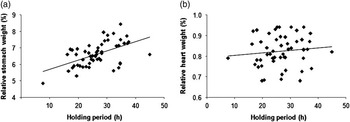
There was a negative linear relationship between relative BW and the duration of the holding period (Figure 2b). Mixed effect model, after taking into account batch/flock age effect, showed that the chicks lose weight equal to 0.13% of their initial egg weight with every additional 1-h holding period (P=0.002). In this study, this represents a loss of 0.99% to 5.85% of initial egg weight based upon the spread of hatch (7.58 to 44.97 h). The duration of holding period had significant positive effect on relative stomach weight (r=0.47; P<0.001; Figure 3a). Generally, early hatched chicks had heavier relative stomach weights at pulling. However, the duration of holding period did not affect relative heart (Figure 3b) or liver weights or chick score (Table 2). Relative heart and liver weights were highly consistent between individuals.
Relationship between relative stomach weight (r=0.47, a) or relative heart weight (r=−0.06, b) and the duration of holding period in broiler chicks (n=63) at pulling.

Effect of the duration of holding period on blood values and corticosterone
The general trend showed that as holding period increased, pO2, Hct and Hb increased, but pCO2, TCO2 and HCO3 − decreased (Figure 4). Furthermore, mixed effect model showed that the duration of holding period had significant impacts on pCO2 (P=0.03), TCO2 (P=0.01) and HCO3 − (P=0.02). But it had less impact on Hct and Hb because of the strong influence of BW on these parameters. The remaining blood values and plasma CORT showed no significant relationship with duration of holding period.
Relationship between blood gas values or blood chemistry and the duration of holding period in broiler chicks (n=29) at pulling.

Discussion
Previous studies have examined differences in physiological parameters of chicks that hatched within differing time windows during the hatching process. This was in order to determine if early v. late-hatching chicks differed in their physiological status at the time of hatching. In these studies, samples were collected during the hatch process, which disturbs the incubation process. In contrast, the aim of this study was to determine if the length of holding time (between the precise time of hatching and pulling at the end of the incubation process) has impact upon the chicks physiological status at pulling, as leaving the chicks in the incubator until pulling is standard practise in industry. A non-invasive method was used to detect the precise hatching time of individual chicks using temperature sensors, which does not interrupt or disturb the hatching process. Furthermore, chicks were only sampled at pulling and not sampled across a time window, which was the main method used in previous research. Therefore, it was possible to link the physiological variables (chick quality, blood values and corticosterone) of each chick at pulling to their exact duration of holding period without any interruptions and disturbances to hatch. One assumption is that the chicks are similar in physiological status at hatch, giving a baseline with which to compare the results obtained at pulling. While this is true for most physiological parameters including BW, some organ weights and hormone levels (Careghi et al., Reference Careghi, Tona, Onagbesan, Buyse, Decuypere and Bruggeman2005; van de Ven et al., Reference van de Ven, van Wagenberg, Debonne, Decuypere, Kemp and van den Brand2013; Maatjens et al., Reference Maatjens, Reijrink, van den Anker, Molenaar, van der Pol, Kemp and van den Brand2014), other parameters do differ slightly, such as glucose levels and heart weight, making it more difficult to compare these to chicks at pulling. Numerous factors influence hatching time and chick quality, such as breeder age, genetic strain and egg storage conditions. Earlier studies have shown that heavier eggs hatch later than lighter eggs (Yalçin et al., Reference Yalçin, Izzetoğlu and Aktaş2013) and hatching speed seems to be strongly determined by egg weight and maternal influences (Hassan and Nordskog, Reference Hassan and Nordskog1971). The positive correlation between egg weight and hatching time was also found in this study, but the association was very weak with a low correlation coefficient (r=0.23). Chick uniformity is difficult to evaluate at pulling time, but chick weight at pulling time has been traditionally employed as an important indicator of chick quality. Ricklefs and Starck (Reference Ricklefs and Starck1998) stated that egg weight and the length of the incubation period have the greatest impact on chick weight. In this study, chick BW measured at pulling was strongly correlated with initial egg weight. This is in agreement with previous reports on the positive effect of egg weight on chick weight (Wolanski et al., Reference Wolanski, Renema, Robinson, Carney and Fancher2007; Singh et al., Reference Singh, Singh, Kumar and Kumar2009). Chick BWs at hatch have been shown to be similar, but we found that the duration of holding period had a negative effect on the relative BW at pulling. In agreement with the findings of Hager and Beane (Reference Hager and Beane1983) and van de Ven et al. (Reference van de Ven, van Wagenberg, Debonne, Decuypere, Kemp and van den Brand2013), relative BW at pulling decreased with duration of holding period, indicating that chicks started to lose weight after hatch possibly due to dehydration or fasting. It has been reported that chicks and poults deprived of feed and water for 24 h post-hatch have a reduced BW through to 14 weeks of age, and that deprivation for 48 h or more post-hatch results in loss 10.7% of their initial post-hatch weight, and depressed growth and activity (Moran, Reference Moran1978; Pinchasov and Noy, Reference Pinchasov and Noy1993; Corless and Sell, Reference Corless and Sell1999). As found in this study, the chicks can lose up to 5.2% of their initial egg weights with a 40-h holding period. Moreover, there was a negative association between chick BW at pulling and blood Na or Ca. Blood Na of adult broilers has been found to increase steadily during 24 h of water deprivation, which may be used as a dehydration indicator for broiler chickens at slaughter (Vanderhasselt et al., Reference Vanderhasselt, Buijs, Sprenger, Goethals, Willemsen, Duchateau and Tuyttens2013). Maatjens et al. (Reference Maatjens, Reijrink, van den Anker, Molenaar, van der Pol, Kemp and van den Brand2014) reported that blood Ca of chicks was 1.08 mmol/l at hatch and increased to 1.10 mmol/l at 12 h after hatch, whereas the data presented here showed that blood Ca of chicks at pulling was 1.59 mmol/l. Together, this suggests that the elevated Na and Ca levels in blood may be due to either water loss or no water intake during the holding period.
We found that early hatched chicks had heavier relative stomach weight at pulling. This may be due to the yolk utilisation during the holding period. A mixed batch of early hatchers and late hatchers creates an uneven start for the flock since the early birds disproportionately exhaust their yolk sacs (energy reserve). Noy et al. (Reference Noy, Uni and Sklan1996) observed that the labelled materials from the yolk sac were transported through the intestines and blood and later have been found in the gizzard of post-hatch chicks. Heavier stomachs would indicate that early hatched chicks use more yolk. Daghir and Pellett (Reference Daghir and Pellett1967) reported that the correlation between BW and heart weight or liver weight was very low (r=0.29 and r=0.21, respectively) in day-old chicks, but higher in chickens at 1 week of age. We found much stronger association between BW and heart weight (r=0.60) for chicks at pulling. The organ-body ratios of day-old chicks are different among breeds due to the large weight variations, but become comparable when birds get older (Dunnington and Siegel, Reference Dunnington and Siegel1995). Heart weight tends to be more closely related to BW during growth than liver or spleen (Brody, Reference Brody1945). Holding time had no impact on relative heart and liver weight. However, as this study indicates, the longer the chicks are held, the more yolk they utilise and the chicks that hatch earlier may run out of yolk earlier before getting access to food and water.
There is limited information available for the blood chemistry and gas values for chicks at pulling. Without reference ranges, it is difficult or impossible to interpret the physiological status and the impact this has upon quality of birds. In this study, blood values at pulling were determined using chicks with holding times ranging from 8 to 45 h post-hatch. The majority of the selected blood parameters were independent of chick BW. While normal blood parameters may be affected by external management and nutrition, values for most blood parameters are very consistent among adult broiler breeders (Martin et al., Reference Martin, Wineland and Barnes2010), but we do not know if there is the same consistency in chicks at earlier, post-incubation, stages. For newly hatched chicks, the physiological status at hatch may be related to the environment that the embryo experience during the incubation or the hatching process itself (Molenaar et al., Reference Molenaar, van den Anker, Meijerhof, Kemp and van den Brand2011). Blood gases values and haematology parameters were found to vary among chicks at pulling in this study. The observed increase in pO2, along with reduced blood pCO2 and HCO3 − with longer holding periods may be the result of the significant increase in respiratory magnitude, which also acts to stabilise pH (Tazawa et al., Reference Tazawa, Visschedijk, Wittmann and Piiper1983; Mortola, Reference Mortola2009). Hct levels were increased by up to 24% in chicks that had experienced a longer holding period. This is similar to the values of chicks that were fasted for 24 or 48 h fasted after pulling, which were higher than that of chicks fed after pulling (Pires et al., Reference Pires, Malheiros and Boleli2007). Hb was also found to increase with decreased BW, which happened with longer duration of holding period. Carmi et al. (Reference Carmi, Pinshow and Horowitz1994) reported 8.2% increase in Hb with no change in Hct in dehydrated pigeons caused by higher ambient temperature plus water and food deprivation. When dehydrated, the body utilises internal fluids and causes a significant increase in Hct or Hb values (Zhou et al., Reference Zhou, Fujita and Yamamoto1999). The utilisation of internal fluids may also be an alternative explanation for weight loss during holding period. Therefore, BW loss and blood values (Hct, Hb, Na and Ca) found here likely reflect dehydration, due to the thermal experience during the holding period. Dehydration of newly hatched chicks has also been associated with increased early mortality and poor growth (Vieira and Moran, Reference Vieira and Moran1999; Peebles et al., Reference Peebles, Keirs, Bennett, Cummings, Whitmarsh and Gerard2004).
Glucocorticoids (cortisol and corticosterone) are stress hormones and reflect the activity of adrenal glands. It has been reported that there is no effect of hatching time on CORT at hatch (van de Ven et al., Reference van de Ven, van Wagenberg, Debonne, Decuypere, Kemp and van den Brand2013). There was also no direct relationship between the duration of holding period and CORT levels at pulling. However, a wide range of CORT levels (5.07 to 21.21 ng/ml) was obtained in this study, possibly due to such factors as fasting or thermal stress. The plasma CORT levels of chicks at hatch has previously been reported as ranging from 6.5 to11.5 ng/ml and there is no significant difference in the CORT levels of chicks hatching at various times up to 12 h after first emergence (Scott et al., Reference Scott, Johnson, Satterlee and Gildersleeve1981). The highest levels of CORT of broiler chicks are reported as 20 ng/ml after beak trimming and vaccination (stressful events), which is much higher than the top end of the normal range values reported by Scott et al. In our study, the CORT levels of some focal chicks reached this higher CORT level, indicating that chicks may experience significant levels of stress during the holding period. Newly hatched chicks are often subjected to numerous stressors (heat, dehydration, dust and deprivation of feed) in the first 24 h after hatching. This has been demonstrated that these adverse effects during the critical early hours following hatch can result in an increased percentage of early mortality. Furthermore, these early stressors also influence final performance, resulting in reduction in final BWs and increases in feed conversions. Therefore, identifying methods to reduce the duration of holding period may be beneficial in maintaining the physiological status of the chick, improve welfare and post hatch performance.
Acknowledgements
This research is a part of the BioBusiness Project (FP7-PEOPLE-ITN-2008), which is supported by the EU Commission and Marie Curie Initial Training Network. The authors are grateful to Dr Yumei Chang for statistical advice and the support of Biological Services Unit at the Royal Veterinary College (Hertfordshire, UK).