


Introduction
Social anxiety disorder (SAD) is a prevalent disorder characterized by anxiety in social and performance situations (American Psychiatric Association, 2013). Individuals with SAD attach a fundamental importance to receiving positive appraisal from others, yet are insecure about their social competence and thus worry about embarrassment during social encounters (Clark and Wells, Reference Clark, Wells, Heimberg, Liebowitz, Hope and Schneier1995). Cognitive models of SAD (e.g. Clark and Wells, Reference Clark, Wells, Heimberg, Liebowitz, Hope and Schneier1995; Rapee and Heimberg, Reference Rapee and Heimberg1997) have suggested factors that may maintain symptoms of social anxiety.
The present study focuses on post-event processing (PEP) that has been described by the aforementioned models as one of several contributors to the maintenance of the disorder. Clark and Wells (Reference Clark, Wells, Heimberg, Liebowitz, Hope and Schneier1995) defined PEP as a prolonged cognitive rumination that highlights negative aspects of one's behaviors following social interactions. As a result of this preoccupation, few cognitive resources are allocated towards any positive social feedback that may have otherwise disconfirmed negative beliefs (Brozovich and Heimberg, Reference Brozovich and Heimberg2008). If selectively brooding about negative aspects of one's social performance becomes a habit, socially anxious individuals may build an exaggerated repertoire of past perceived failures that ultimately works to fuel anticipatory anxiety prior to future social encounters. A number of empirical studies have demonstrated robust associations between social anxiety symptoms and the frequency of PEP following both self-reported and experimentally crafted social scenarios (Brozovich and Heimberg, Reference Brozovich and Heimberg2008). Studies using non-clinical samples have found significant correlations between PEP and social anxiety (Brozovich and Heimberg, Reference Brozovich and Heimberg2011; Dannahy and Stopa, Reference Dannahy and Stopa2007; Edwards, Rapee and Franklin, Reference Edwards, Rapee and Franklin2003; Kocovski and Rector, Reference Kocovski and Rector2007, Lundh and Sperling, Reference Lundh and Sperling2002; Mellings and Alden, Reference Mellings and Alden2000; Rachman, Gruter-Andrew and Shafran, Reference Rachman, Grüter-Andrew and Shafran2000) and several studies have demonstrated the relationship between PEP and anxiety among patients with SAD (Abbott and Rapee, Reference Abbott and Rapee2004; Kocovski and Rector, Reference Kocovski and Rector2008; Perini, Abbott and Rapee, Reference Perini, Abbott and Rapee2006).
Despite the significant relationship between social anxiety and PEP, little research has investigated the specificity of PEP to SAD. It is possible that many individuals with a variety of anxiety presentations ruminate about anxiety-provoking situations after the fact. In support of this idea, recent research found that measures of PEP, worry, and depressive rumination loaded onto a single factor, which was labelled repetitive negative thinking (McEvoy, Mahoney and Moulds, Reference McEvoy, Mahoney and Moulds2010). Also, individuals across multiple anxiety presentations showed elevated PEP after attending the first session of group CBT (Laposa, Collimore and Rector, Reference Laposa, Collimore and Rector2014). Perhaps PEP is just one form of repetitive negative thinking and should be considered transdiagnostic.
On the other hand, there is evidence that PEP may be specific to social anxiety. In a study by Fehm, Schneider and Hoyer (Reference Fehm, Schneider and Hoyer2007) using a non-clinical sample, participants were instructed to recall personally relevant phobic (e.g. heights) and social scenarios occurring within the past 6 months, and degree of PEP in relation to these anxiety provoking events was evaluated. Results suggested that social situations elicited significantly higher levels of PEP than did phobic ones. Social anxiety was shown to be a significant predictor of the amount of PEP after social, but not after phobic situations. Furthermore, Fehm et al. (Reference Fehm, Schneider and Hoyer2007) reported that PEP was not predicted by more global measures of anxiety and depression, inferring that PEP does not seem to be a general indicator of psychopathology. Given these results, it appears that PEP is more likely to occur after a social-evaluative trigger, and that it may be more relevant for people with elevated symptoms of social anxiety. Further research is necessary. Therefore, the first purpose of the current study is to examine the experience of PEP across multiple anxiety disorders after the first session of group cognitive behavioural therapy (CBT). The first session of group CBT represents an ecologically valid anxiety provoking stressor, irrespective of diagnosis. Building on Laposa et al.’s work where many participants had comorbid SAD but were not classified as such, we classified our sample based on presence or absence of principal and comorbid SAD. Based on results from Fehm et al. (Reference Fehm, Schneider and Hoyer2007) we hypothesize that individuals with a principal diagnosis of SAD will report the greatest PEP, followed by those with an anxiety disorder and a comorbid diagnosis of SAD, and then those with an anxiety disorder who do not have a diagnosis of SAD.
The current study also sought to further examine the association between trait anxiety, state anxiety, and PEP. Studies have found that state anxiety is more strongly and independently associated with PEP than social anxiety severity, after controlling for depression, anxiety, and stress (McEvoy and Kingsep, Reference McEvoy and Kingsep2006), after controlling for social anxiety severity (Kiko et al., Reference Kiko, Stevens, Mall, Steil, Bohus and Hermann2012; Laposa and Rector, Reference Laposa and Rector2011), and across anxiety diagnoses (Laposa et al., Reference Laposa, Collimore and Rector2014). On the contrary, Kocovski and Rector (Reference Kocovski and Rector2008) reported that greater baseline social anxiety was more strongly associated with PEP than state anxiety following an in-session exposure task. McEvoy and Kingsep (Reference McEvoy and Kingsep2006) noted that immediate and context-specific anxious arousal (state anxiety) may cause individuals with SAD to dwell upon a troubling social experience to a greater extent thereafter. It is possible that heightened state anxiety may cause PEP among individuals with other anxiety disorders. Therefore, it is important that we investigate the association between PEP and overall state anxiety in addition to trait social anxiety.
It is also important to include depressive symptom severity as a covariate in analyses of PEP. Some studies suggest that depressive symptoms are significantly associated with PEP (e.g. Kocovski, MacKenzie and Rector, Reference Kocovski, MacKenzie and Rector2011) and many studies control for depressive symptoms when examining predictors of PEP. Considering the high comorbidity between depressive and anxious symptoms and the conceptual overlap between rumination and PEP, it is important to control for depressive symptom severity when examining predictors of PEP.
Consistent with research regarding potential influence of state anxiety and depressive rumination on PEP, we hypothesize that state anxiety (vs. social anxiety severity) will emerge as the strongest predictor of PEP after controlling for depressive symptoms.
Method
Participants
Participants were recruited from the Anxiety Treatment and Research Clinic, an outpatient specialty anxiety disorders clinic. Inclusion criteria for participants were: (a) aged ≥ 18 years of age; (b) enrolled in group CBT for generalized anxiety disorder (GAD), SAD, obsessive compulsive disorder (OCD), or panic disorder with or without agoraphobia (PD/A); and (c) met DSM-IV criteria for a principal diagnosis of GAD, SAD, OCD, or PD/A. Patients with psychiatric or medical comorbidities were included, and there were no restrictions regarding patient use of medication. Participants were excluded if they had a principal disorder other than an anxiety disorder. The sample consisted of 86 patients [mean age of 37 years (SD = 13.2), 64% female]. Twenty-five patients had a principal diagnosis of SAD (Principal SAD), 18 patients had a principal diagnosis of another anxiety disorder (e.g. OCD, GAD, PD/A with comorbid SAD (Comorbid SAD), and 43 patients had a primary diagnosis of OCD, GAD, or PD/A with no comorbid SAD (No SAD). Ten additional participants had incomplete data and were excluded from the study. Therefore, 96 participants were recruited and consented, and 86 of these 96 individuals completed the primary measure (the Post-Event Processing Questionnaire) and comprised the total sample. Participants had a mean number of 1.69 comorbidities (SD = 1.39; range = 0–6). The most common comorbid diagnoses were GAD (11.5%) and SAD (11.5%) followed by OCD (6.3%), and Major Depressive Disorder (10.4%). Diagnoses were established using the Structured Clinical Interview for DSM-IV (SCID-IV; First, Spitzer, Gibbon and Williams, Reference First, Spitzer, Gibbon and Williams1996).
Ethics
This study was approved by the Hamilton Integrated Research Ethics Board (HIREB). Participants provided written informed consent before being enrolled.
Measures
Social anxiety symptoms
The severity of social anxiety symptoms was measured using the Social Phobia Inventory (SPIN; Connor et al., Reference Connor, Davidson, Churchill, Sherwood, Foa and Wesler2000), a 17-item measure designed to assess symptoms specific to SAD. Individuals are asked to answer questions regarding how much a particular symptom troubled them during the past week. The SPIN has demonstrated strong internal consistency, good test-retest reliability, convergent validity, discriminative validity, and construct validity (Antony, Coons, McCabe, Ashbaugh and Swinson, Reference Antony, Coons, McCabe, Ashbaugh and Swinson2006).
State anxiety ratings
Participants rated their subjective level of anxiety using the Subjective Units of Distress Scale (SUDS; Wolpe and Lazarus, 1996), a scale from 0 to 100.
Depressive symptoms
The severity of depressive symptoms was measured using the depression scale of the Depression Anxiety Stress Scales (DASS-depression; Lovibond and Lovibond, Reference Lovibond and Lovibond1995), a 7-item subscale used to measure symptoms of depression. The DASS subscales have strong psychometric properties (e.g. Brown, Chorpita, Korotitsch and Barlow, Reference Brown, Chorpita, Korotitsch and Barlow1997).
Post-event processing
The degree of PEP was measured using the revised version of the Post-Event Processing Questionnaire (PEPQ; Rachman et al., Reference Rachman, Grüter-Andrew and Shafran2000), the PEPQ-R (McEvoy and Kingsep, Reference McEvoy and Kingsep2006). We used 8 out of 9 items of the PEPQ-R, each answered using a 0 (not at all) to 100 (extremely) rating scale. The first item asking “How much anxiety did you experience (at the first CBT session)” was excluded to ensure that the final measure was indicative of cognitive processes reflecting PEP and not state arousal. The questions were slightly reworded to reflect that any PEP endured by the patients was specific to their experience at the first CBT session (e.g. “After the first group session did you find yourself thinking about it a lot?”).
Procedure
Participants in the study completed the SCID-IV as part of the standard assessment. All SCID interviews were conducted by experienced staff or advanced graduate students in clinical psychology who received extensive training in administration of the SCID. All SCID interviews in this study were discussed at a weekly team meeting chaired by a doctoral level psychologist with over 15 years of experience conducting SCID assessments. Any diagnostic questions and issues that arose were addressed at this meeting. Interrater reliability across two independent raters for principal diagnosis was ĸ = .89 for a subset of administrations of the SCID (N = 13) at our centre. Following completion of the assessment, participants were offered group CBT based on empirically supported protocols for their principal anxiety disorder diagnosis. At the start of the first group CBT session, participants rated state anxiety. At the second session of weekly group CBT, they completed the PEPQ-R. The first CBT session seems to be a good universal anxiety-provoking stressor. We chose to measure PEP one week following the first CBT session to allow for enough time for participants to experience PEP, but also to increase the likelihood that the content of any negative brooding is specific to the first session (vs. other difficult stressors that occur in people's lives) and to minimize the possibility of recall bias that could arise with longer follow-up periods. Furthermore, other studies (e.g. Laposa and Rector, Reference Laposa and Rector2011; Perini, Abbott and Rapee, Reference Perini, Abbott and Rapee2006) have opted to measure PEP one week after an anxiety provoking trigger.
Results
Demographics
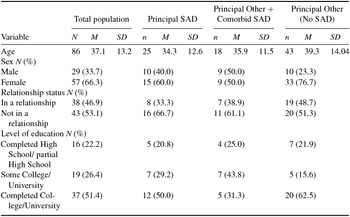
The three groups (Principal SAD, Comorbid SAD, No SAD) did not differ on any demographic variables including age [mean age of 37 years (SD = 13.2)], gender (64% female), marital status (43.8% in a relationship), level of education, or number of comorbid diagnoses (all ps > .05). The sample was primarily Caucasian. See Table 1.
Demographic information

Notes: Differences between groups were non-significant for sex, relationship status, and level of education using Chi-Square tests (all p’s> .05). Differences between groups were non-significant for age using a one-way between groups ANOVA (all p’s> .05)
Specificity of post event processing
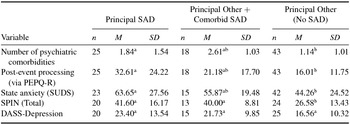
To determine whether greater degrees of PEP were reported by people with SAD as compared to other anxiety disorders, we compared the mean total score of the PEPQ-R across the three comparison groups. A one-way analysis of variance (ANOVA) revealed a significant difference between the self-reported mean total PEPQ-R score among the groups, F(2,83) = 7.19, p< 0.01.Group differences were examined using Tukey's HSD post-hoc test. The mean levels of PEP across the different groups are presented in Table 2. Tukey's HSD test revealed a significant difference in PEP levels between those with a Principal SAD diagnosis and those with No SAD (p = .001). The Comorbid SAD group reported intermediate levels of PEP, but was not statistically different from either those with principal SAD (p = .09) or those with no SAD (p = .54).
Descriptive statistics

Notes: PEPQ-R= Post-event processing questionnaire (revised); SUDS= Subjective Units of Distress Scale; SAD= Social Anxiety Disorder; Principal Other = one of obsessive-compulsive disorder, generalized anxiety disorder, or panic disorder. Different superscripts indicate significant differences across groups. PEPQ-R scores are presented as mean item scores.
Hierarchical linear regression assessing predictors of PEP

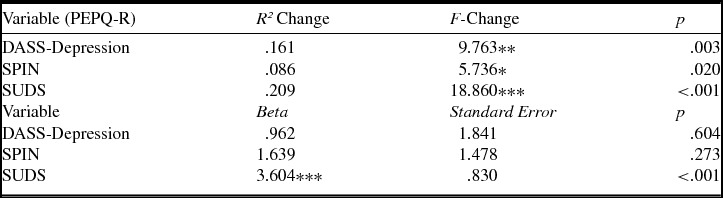
Notes: PEP= Post-Event Processing, PEPQ-R = Post-Event Processing Questionnaire Revised; SPIN= Social Phobia Inventory, DASS-Dep = Depression Anxiety Stress Scales (Depression); SUDS= Subjective Units of Distress Scale
* p < .05; **p < .01; *** p< .001
State anxiety
Mean levels of state anxiety are presented in Table 2. A one-way between subjects ANOVA revealed a significant difference between the groups, F(2,81)= 4.74, p < .05 on anxiety ratings. Tukey's HSD revealed a significant difference in anxiety levels between those with a principal SAD diagnosis and those with no SAD (p < .05). Mean ratings of state anxiety for the comorbid SAD group were not significantly different from the two other groups.
Social anxiety
Mean levels of social anxiety as assessed using the SPIN are presented in Table 2. A one-way between subjects ANOVA revealed a significant difference between the groups, F(2,54) = 7.78, p < .01 on total SPIN scores. Tukey's HSD revealed a significant difference in social anxiety levels between those with a principal SAD diagnosis and those with no SAD (p < .05). Mean ratings of social anxiety for the comorbid SAD group were significantly different from the group with no SAD (p < .05), but not from the group with a primary diagnosis of SAD (p = .942).
Depression
Mean levels of depression as assessed using the DASS (depression subscale) are presented in Table 2. Means for the SAD and Other+SAD groups fell into the severe range of depressive symptoms on the DASS and means for the no SAD group fell into the moderate range. A one-way between subjects ANOVA revealed no difference between the groups, F(2,57) = 2.20; p = .120 on depression scores.
Predictors of post-event processing
To determine the extent to which baseline social anxiety (SPIN) severity and state anxiety (SUDS) uniquely predict PEP following the first session of group CBT over and above severity of depressive symptoms, a hierarchical linear regression analysis was conducted. The data met the assumptions of homoscedasticity and multicollinearity, and a linear relationship was determined between the independent and dependent variables. The variables were determined to be normally distributed. A subset of the total patient population was used (n = 53) due to missing data. Six participants did not complete the SUDS during the study, 26 participants did not complete the DASS prior to beginning CBT, and another 29 did not complete the SPIN prior to commencing CBT. Thus, 53 of 86 patients had completed all four measures (PEP, SUDS, SPIN, and DASS) and comprised the sample used for regression analyses. The DASS-Depression total score was entered into the first block and was found to be a significantly associated with PEP, F Change (1,51) = 9.76, p < .01, R² Change = .16. SPIN total score was entered into the second block and was found to be a significant predictor of PEP, F Change (1,50) = 5.74, p < .05, R² Change = .086. With the addition of SPIN into the second block, DASS-Depression was no longer significantly associated with PEP. Lastly, the SUDS score was entered into the third block. SUDS was determined to be a significant predictor of PEP, F Change (1,49) = 18.86, p < .001, R² Change = .209. With the addition of SUDS into the regression, SPIN was no longer found to be a significant predictor of PEP, and SUDS prior to the first session of CBT was the only variable accounting for significant change in the third and final block, β = 3.604, p < .001.
Discussion
The present study investigated the extent to which PEP is unique to social anxiety by comparing PEP after the first session of group CBT in three groups of participants: those with a principal diagnosis of SAD, those with a principal other anxiety disorder and comorbid SAD, and those with a principal other anxiety disorder and no comorbid SAD. On average, all participants, irrespective of diagnosis, reported at least moderate levels of state anxiety at the beginning of the first session of CBT, suggesting that attending the first session of group CBT was indeed a trigger of anxiety. As hypothesized, individuals with a principal diagnosis of SAD experienced the greatest amount of PEP following the first session of CBT, followed by those with comorbid SAD, and finally by those with no comorbid SAD, with a significant difference between the principal SAD and no SAD groups. These results are in contrast with a recent study by Laposa et al. (Reference Laposa, Collimore and Rector2014) that found that PEP appeared to be a transdiagnostic factor. Our results suggest that PEP may be more relevant to those with SAD (even when SAD is a comorbid diagnosis) as compared to those with other anxiety presentations.
As a secondary objective, the present study sought to examine predictors of PEP. Previous research suggests that state anxiety is a strong predictor of PEP, though some studies suggest that social anxiety symptom severity (among other variables) may also predict PEP. Furthermore, considering that there is some conceptual overlap between depressive rumination and PEP in regards to negative and repetitive thinking, we decided to treat depressive symptom severity as a covariate when examining the association between social anxiety and state anxiety with PEP. In the present study, state anxiety was a unique predictor of PEP above and beyond that of social anxiety after controlling for depression. In the original description of PEP, Clark and Wells (Reference Clark, Wells, Heimberg, Liebowitz, Hope and Schneier1995) noted that negative introspective cues and physiological arousal (such as increased heart rate) associated with heightened state anxiety may fuel PEP, as an individual's awareness of his or her anxiety response becomes discomforting and heightens self-focused attention. Heightened state anxiety and self-focused attention, in turn, may allow people to “catch” the minor mishaps that naturally occur during social or performance situations, providing fodder for post-event rumination. While a predisposition to being socially anxious may make one more prone to engaging in PEP, elevated state anxiety in response to an anxiety-provoking social event may also be necessary to trigger a negatively biased post-mortem analysis of one's experience. Indeed, a recent study suggested that experimentally induced self-focused attention led to more negative PEP after a conversation task (Gaydukevych and Kocovski, Reference Gaydukevych and Kocovski2012), supporting the notion that any mechanism by which people pay more attention to their current state may encourage elevated PEP. Our results add further evidence that anxiety experienced in the moment is an important factor in understanding the degree to which someone might ruminate about social encounters.
Individuals with a principal diagnosis of SAD reported slightly higher mean levels of anxiety in the first session of CBT as compared to individuals with other anxiety disorders with no comorbid SAD. Taken together with our finding that state anxiety was the strongest predictor of self-reported PEP, our choice of task may have influenced results. It is likely that our participants with SAD reported more PEP in part because the stressful task was inherently more anxiety-provoking for people with social anxiety. It is difficult to find a task that is uniformly anxiety-provoking, that is not a social-evaluative task at all, and that has ecological validity. On the other hand, all participants, on average, reported moderate levels of anxiety about beginning group CBT, consistent with Laposa et al. (Reference Laposa, Collimore and Rector2014), suggesting that this task was fairly uniformly stressful. Also, our measure of PEP did not solely contain social-evaluative questions and was relevant to a broad range of negative, ruminative thinking, increasing our confidence that any type of post-event rumination was captured. It appears then that the higher degree of anxiety provoked by social-evaluative tasks for people with SAD may be the very reason that they experience more PEP than those with other anxiety presentations.
Considering the importance of state arousal in predicting PEP, it is important to consider the reciprocal relationship between state anxiety, exposure therapy, and PEP during a course of CBT for SAD. Clark and Wells (Reference Clark, Wells, Heimberg, Liebowitz, Hope and Schneier1995) suggest that PEP causes distress following a social event, but may also contribute to anticipatory anxiety before future social interactions. It is important to identify and intervene during the various stages of this cycle as treatment progresses. For example, early in therapy it would be most important to monitor and disrupt PEP after initial exposure therapy exercises or behavioural experiments. Initial behavioural interventions are inherently anxiety provoking, and thus will likely lead to enhanced PEP via elevated state anxiety. However, as state anxiety levels begin to plateau as treatment progresses, less energy may be needed to disrupt PEP as levels of PEP would be receiving less “fuel” and may naturally begin to remit. This conceptualization is consistent with studies that demonstrate reductions in PEP across CBT protocols (Abbott and Rapee, Reference Abbott and Rapee2004; McEvoy, Mahoney, Perini and Kingsep, Reference McEvoy, Mahoney, Perini and Kingsep2009; Price and Anderson, Reference Price and Anderson2011). One reason that PEP may reduce across treatment is because of corresponding reductions in state anxiety in social situations. Future studies could examine the effects of PEP on subsequent state anxiety during social encounters to further elucidate a potential mediatory role of state anxiety on the experience of PEP, including its role across treatment.
Depression scores were significantly associated with PEP only until social anxiety and state anxiety measures were entered into analyses. Our results suggest that PEP may be a type of RNT with more specificity to social anxiety and less overlap with depressive symptoms than expected by models of repetitive negative thinking (McEvoy et al., Reference McEvoy, Mahoney and Moulds2010; McEvoy, Watson, Watkins and Nathan, Reference McEvoy, Watson, Watkins and Nathan2013). However, it is important to keep in mind that the DASS-Depression questionnaire was used as a proxy for depressive rumination, and a more reliable indicator of a ruminative response style would provide clearer information.
Limitations
There are some limitations of the current study. Our comorbid SAD group was small, which may have limited power to detect differences between this group and the other two groups on anxiety and PEP levels. There was significant missing data for regression analyses examining predictors of PEP with a number of participants not completing the SPIN or DASS before starting their CBT group. Also, PEP was assessed in a post hoc fashion after one week as opposed to employing questionnaires on a daily basis. The large majority of PEP studies have been conducted over the span of a few days or weeks and future research should attempt to examine the long-term effects of PEP in maintaining social anxiety, perhaps by monitoring levels of PEP in patients across weeks or months in relation to several anxiety provoking events. The anxiety provoking trigger used to experimentally evoke PEP was attendance at the first session of group CBT. One may argue that individuals with social anxiety may have naturally felt more anxious in a novel group setting than those with other anxiety disorders. Future studies may choose to design diagnostic specific triggers (such as first exposure session) and administer the PEP in relation to a specific trigger that is troublesome to individuals with a particular anxiety disorder. Future research could also attempt to discern which aspects of current CBT methods contribute to the reduction of PEP, including the reciprocal role of state anxiety and PEP. Work that investigates potential interventions that can explicitly target this maladaptive process would be helpful, given that there is little explicit guidance for clinicians in how to tackle PEP.
In sum, the present study demonstrated increased levels of PEP in SAD as compared to other anxiety presentations. It appears that the nature and content of PEP is more prominent and relevant to those expressing more prominent social anxiety, even when social anxiety is not the principal clinical concern. These results stress the necessity of assessing PEP in people with SAD, but also of querying its presence for people with comorbid SAD when in social evaluative situations.
Acknowledgements
Financial support: This research received no specific grant from any funding agency, commercial or not-for-profit sectors.
Ethical standards: The authors assert that all procedures contributing to this work comply with the ethical standards of the relevant national and institutional committees on human experimentation and with the Helsinki Declaration of 1975, as revised in 2008.
Conflict of Interest: The authors have no conflicts of interest with respect to this publication.



Comments
No Comments have been published for this article.