A judge’s decision to publicly dissent and the emergence of conflict on a high court are politically important phenomena, both for high courts, their members, other political actors, and the public. When high courts review laws, they must directly confront disagreements inherent in the legislative process – a process requiring compromise among legislators to produce laws over which society may itself be deeply divided. In exercising judicial review, judges confront the same issues dividing legislators and their constituents. Although this may translate into disagreement among the judges that review these laws, it does not always translate into dissenting opinions. Indeed, in many nations, dissents against the majority opinion are not made public and even in those which publicize dissent, norms of consensus may make formalization of conflicting opinions infrequent (Laffranque, Reference Laffranque2003; Keleman, Reference Kelemen2013).
Dissent or disagreement may significantly impact the outcome and enforcement of case decisions regarding the constitutionality of laws. In cases where opinions are fairly evenly split between judges voting for the majority and those dissenting, just one judge’s change in opinion could change the law’s viability. Likewise, a single judge’s dissent may form the basis for a majority opinion in the future. Scholars also suggest that non-unanimous decisions upholding a law may ultimately undermine that law’s legitimacy and the ability to enforce it. Thus, understanding judges’ disagreements is important because the disagreements themselves have significant implications regarding the content and enforcement of a country’s laws.
While much is known about the emergence of dissent on the US Supreme Court (Schmidhauser, 1945, Reference Schmidhauser1962; Pritchett, Reference Pritchett1948; Ulmer, Reference Ulmer1970; Danelski, Reference Danelski1986; Walker et al., Reference Walker, Epstein and Dixon1988; Epstein and Knight, Reference Epstein and Knight1998; Epstein et al., Reference Epstein, Segal and Spaeth2001a, b, Reference Epstein, Landes and Posner2011), few studies have analyzed judicial dissent outside the United States.Footnote 1 Yet, these environments can provide considerable opportunity to obtain insight into theoretical concerns of the literature (Dyevre, Reference Dyevre2010). The paper focuses on the structure and change in the Chilean Constitutional Tribunal to examine the political determinants of judicial dissent. The Chilean Tribunal provides scholars with an opportunity to analyze the evolution of dissent patterns on a court with broad constitutional review powers in which judges are selected by a mixed appointment mechanismFootnote 2 during a period of rapid political change. The study compares the behavior across Tribunal membership and across time with particular focus on constitutional reforms enacted in 2005, which gave the Tribunal additional powers and increased the number of judges appointed by political actors with their own distinctive origins. Using this context, this study examines to what extent judges’ dissents are attributable to their political affiliations or divergent political preferences.
The paper proceeds with an overview of the extant literature dealing with the determinants of dissent. After describing the Tribunal’s structure and changes related to the 2005 reforms, the paper outlines the empirical expectations consistent with these reforms and judges’ political origins and judicial dissent. Both the changes in the case-level patterns of conflict before and after the reform and individual judges’ dissents are examined. Analyzing cases from 1990 to 2010, the results show that the overall rate of dissent has grown considerably since reforms that led to an increased influence of partisan actors on the appointment process. Dissenting opinions are more common in the post reform era when non-partisan judges (defined as those not associated with political parties) comprise a smaller proportion of the Tribunal and politically affiliated judges a larger proportion. Looking at judges’ individual dissenting votes, dissent tends to be associated with partisan backgrounds – especially those from the parties of the center-left.
Judicial consensus and conflict
A significant amount of research in judicial politics has focused on understanding why norms of consensus are developed on high courts and when they give way to overt displays of disagreement. Some work emphasizes that dissent may arise due to ideological and partisan differences among judges in certain circumstances (Pritchett, Reference Pritchett1948; Nagel, Reference Nagel1964; Schmidhauser, Reference Schmidhauser1962; Rohde and Spaeth, Reference Rohde and Spaeth1976; Brace and Hall, Reference Brace and Hall1993; Segal and Spaeth, Reference Segal and Spaeth1993, Reference Segal and Spaeth2002). However, ideological differences may be constrained by strategic concerns ranging from job security and collegiality to a desire to reinforce the legitimacy of the court itself (Epstein and Knight, Reference Epstein and Knight1998; Couso, Reference Couso2004; Garoupa and Ginsburg, Reference Garoupa and Ginsburg2010; Epstein et al., Reference Epstein, Landes and Posner2011).
Unanimous rulings are thought to be stronger in terms of their influence on lower courts and the public’s support (Pritchett, Reference Pritchett1948; Danelski, Reference Danelski1960; Swisher, 1935; Frank, Reference Frank1968; Burns, Reference Burns2010). Both American and comparative scholars have suggested that unanimous rulings may bolster the legitimacy of a court’s rulings and stature, especially when a court is relatively young (Swisher, Reference Swisher1935; Pritchett, Reference Pritchett1948; Danelski, Reference Danelski1960; Frank, Reference Frank1968; Couso, Reference Couso2004; Baum, Reference Baum2006; Sadurski, Reference Sadurski2008; Garoupa and Ginsburg, Reference Garoupa and Ginsburg2010; Keleman, Reference Kelemen2013, but see Salamone, Reference Salamone2014).Footnote 3 O’Brien (Reference O’Brien2011) notes that with the institutionalization of separate opinion writing by New Deal era judges on the US Supreme Court, disagreement over decisions invited ‘uncertainty and confusion about the Court’s rulings, interpretation of law, and policy making’ (p. 311). In general, dissents are thought to signal that there is not a single clear legal position that can be upheld (Garoupa and Ginsburg, 2006), which may be detrimental to the effectiveness and enforcementFootnote 4 of the decisions of these high courts and the underlying law (e.g. Milner, Reference Milner1971; Brenner and Spaeth, Reference Brenner and Spaeth1988; Gibson et al., Reference Gibson, Calderia and Baird1998; Gibson and Caldiera, Reference Gibson and Caldeira2009).
Others have argued that public disagreement among judges is an important part of representing minority views in democratic decision making (Morgan, Reference Morgan1954) and is in line with the ideals of deliberative democracy (Guttman and Thompson, Reference Gutmann and Thompson1996; Hicks, Reference Hicks2002). These minority viewpoints in the judicial process may be highly influential at a later date (Douglas, Reference Douglas1948; Peterson, Reference Peterson1981; Schwartz, Reference Schwartz2000). As stated by former Chief Justice Hughes of the US Supreme Court, ‘A dissent in a court of last resort is an appeal to the brooding spirit of the law, to the intelligence of a future day, when a later decision may possibly correct the error into which the dissenting judge believes the court to have been betrayed’ (Douglas, Reference Douglas1948: 153).
Empirically, dissent rates vary widely. On the US Supreme Court, dissent was relatively rare until the 1930s when New Deal-era judges began to do so frequently (Pritchett, Reference Pritchett1948), recently reaching more than 65% among cases decided on the merits (Epstein et al., Reference Epstein, Landes and Posner2011). Songer and Siripurapu (Reference Songer and Siripurapu2009) show that dissent on the Canadian Supreme Court is much less frequent at 20–30% of cases. Garoupa (Reference Garoupa2010) shows that dissent occurs in about 33% of cases in the Spanish Constitutional Court and 65% in the Portuguese Supreme Court.Footnote 5 Finally, Garoupa et al. (Reference Carp, Stidham and Manning2011) show that dissent rates of the Taiwanese Constitutional Court fluctuated between 20 and 50%, depending on the longevity of the country’s democracy.
Where allowed to do so publicly, the emergence of dissent at any frequency, at minimum, requires that judges are willing to voice their individual disagreements within a case opinion. Many arguments from the American courts literature emphasize that such dissent arises due to ideology and partisan differences (Nagel, Reference Nagel1964; Schmidhauser, Reference Schmidhauser1962). From this perspective, dissent is seen as ‘the product of ideological disagreement among justices’ (Brace and Hall, Reference Brace and Hall1993: 918) and is therefore exacerbated by the degree or amount of political polarization within the court (Epstein et al., Reference Epstein, Landes and Posner2011). In this literature, judges’ dissents are driven not only by their individual political preferences, but the fact that the court is composed of judges with policy preferences that differ from one another (Pritchett, Reference Pritchett1948; Segal and Spaeth, Reference Segal and Spaeth1993, Reference Segal and Spaeth2002). These arguments have been applied both to the US Supreme Court (Pritchett, Reference Pritchett1948; Segal and Spaeth, Reference Segal and Spaeth1993, Reference Segal and Spaeth2002) and to the US courts of appeals (Van Winkle, Reference Van Winkle1997; Cross and Tiller, Reference Cross and Tiller1998; Hettinger et al., Reference Hettinger, Lindquist and Martinek2004). Hurwitz and Lanier (Reference Hurwitz and Lanier2004: 429) argue that with regard to the US Supreme Court there is a ‘systematic interrelation between the justices’ policy preferences and their issuance of nonconsensual opinions’.Footnote 6 Reinforcing this interpretation, where dissents are common (as in the US Supreme Court), the voting differences themselves are even interpreted as a proxy for ideology (Segal and Cover, Reference Segal and Cover1989; Segal and Spaeth, Reference Segal and Spaeth1993, Reference Segal and Spaeth2002; Giles et al., Reference Giles, Hettinger and Peppers2001; Martin and Quinn, Reference Martin and Quinn2002).
While diversity of judges’ interests on a court may encourage disagreement or dissent, judges’ association with politics per se may encourage individual judges to voice separate opinions through dissent. As a result, the political origins of a court’s members are key to understanding dissent. For example, the overtly political background of elected judges in the United States has been found to encourage dissenting opinions because of the incentives to maintain allegiance to partisan positions (Brace and Hall, Reference Brace and Hall1993). A similar phenomenon is noted with regard to higher rates of dissent for Spanish Constitutional Court judges with strong party ties (Garoupa et al., Reference Garoupa, Gomez-Pomar and Grembi2011) and judges with party allegiances on Portugal’s Constitutional Court (Amaral-Garcia et al., Reference Amaral-Garcia, Garoupa and Veronica2009). An extension of this literature, as yet only applied in the American state context, suggests that elected state judges dissent more than appointed judges and that they even disagree substantially with other judges from their own party (Choi et al., Reference Choi, Gulati and Posner2010). Elected judges are thought to dissent more because they have more experience in acting in political contexts where independent opinions are valued. In essence, dissent provides political opportunities for judges whose connection with the electorate is paramount for their survival. Further, for non-elected judiciaries in which judges are appointed through a mixed system and some judges have more distinct political backgrounds than others, politically affiliated judges may dissent more as they view their dissent as a political opportunity to demonstrate loyalty or to build their reputations.
In sum, previous literature on judicial behavior on high courts suggests that judicial dissent, while constrained by many potential collective and individual costs, is often associated with either the diversity of individual judges’ preferences on the same court or due to some judges’ strong links to party politics more generally. Therefore, dissent should arise more frequently when judges have ideological preferences or when a court is composed of judges whose ideological preferences in fact differ substantially over policy outcomes. Footnote 7
The Chilean Constitutional Tribunal: context
Political context of the Tribunal
This analysis reviews the work of Chile’s Constitutional Tribunal for the period after Chile’s return to democracy in 1990 until 2010. Prior to this, authoritarian leader General Augusto Pinochet staged a violent coup against elected Socialist president Salvador Allende in 1973. After the return to democracy in 1990, Chile’s political landscape was roughly divided between two coalitions of parties, the Concertación made up of several parties of the center left including Christian Democrats and Socialists and the Center Right or Allianza consisting of the National Renewal and Independent Democratic Union parties. The Concertación held power in the country continuously from 1990 through 2010. The first president in the democratic era, President Patricio Aylwin, created the Commission for Truth and Reconciliation or the Rettig Commission to investigate human rights abuses under Pinochet. Besides exposing gross human rights abuses, the Commission was especially critical of Chile’s judicial system, particularly holding Chile’s Supreme Court responsible for these abuses due to its extreme deference to those in power. While Aylwin was unsuccessful in pushing through many judicial reforms, his Concertación successor, President Eduardo Frei Ruiz-Tagle was more successful in his reforms, which mainly focused on the Supreme Court and criminal law reforms, but leaving reforms to the Constitutional Tribunal largely untouched.
Not until 2005 were major constitutional reforms enacted under President Ricardo Lagos (Socialist of the Concertación), which allowed for the removal of authoritarian elements from Chile’s constitutional order as well as substantial changes to the Tribunal itself (discussed more below). The 2005 constitutional reforms made sweeping changes to other political institutions, such as the Senate in which long-time life appointees were no longer able to participate. To many, the constitutional reforms represented the final phase of Chile’s transition to democracy, which had been stymied by remnants of the authoritarian era embedded in the constitution as well as the Center Right’s failure to agree to such reforms for over a decade after the resumption of elected government in 1990 (see Montes and Vial, Reference Montes and Vial2005; Heiss and Navia 2007 for an overview). Some scholars suggest that the 2005 reforms were only possible after the center left or Concertación acknowledged that it would soon lose power to Chile’s Center Right, which it did in 2010, for the first time since Chile’s return to democracy. In this year, Chile elected its first Center Right president since 1990, Sebastian Piñera.
Description of Chile’s Constitutional Tribunal
While Chile’s Constitutional Tribunal operated for only a short period in 1973 prior to the coup, it is unusual in that it was recreated under an authoritarian regime in 1980 (see Barros, Reference Barros2002 for a description of the Tribunal’s work during this period). In the democratic period, beginning from 1990 onward, the Tribunal had two distinct periods which are the subject of this analysis and are divided by the Constitutional reforms in 2005, which came into effect in 2006.
Judicial selection prior to the reforms: Unlike Chile’s Supreme Court,Footnote 8 Chile’s Constitutional Tribunal employs a mixed appointment system for selecting judges. Such a selection system allows several different political and non-political actors to select different Tribunal judges, which in turn provides an additional means by which diverse preferences can arise within the same court and ultimately influence the lawmaking process.Footnote 9 Prior to the reforms (under the 1980 Constitution), the Supreme Court selected three of the Tribunal’s members from among the ministers of the Supreme Court. Couso (Reference Couso2004) points out that these judges tended to be particularly apolitical ‘bring[ing] to the court the deferential habits of the regular judiciary’ (p. 87). The remaining four members were selected as follows: the president nominated one, the Senate (by absolute majority) selected one, and the military-dominated Consejo de Seguridad Nacional (CSN) selected two.Footnote 10 This pre-reform Tribunal largely consisted of judges who were associated in some way with the Supreme Court and thus non-partisan as well as several judges who were appointed during Pinochet’s authoritarianism and thus representative of those era’s preferences. Under this pre-reform selection method, only about 30% of Tribunal judges were appointed by elected politicians.
Tribunal powers prior to the reforms: The military regime’s 1980 Constitution gave the Constitutional Tribunal the power ‘to make absolute binding decisions on questions of constitutionality at any phase of the legislative process’ (Siavelis, Reference Siavelis2000: 38–39).Footnote 11 With this relatively broad power of abstract judicial review,Footnote 12 the Tribunal may find parts of proposed legislation to be unconstitutional and require the legislature to make modifications prior to enactment. The Tribunal automatically reviews all laws that involve a precept of the constitution, organic law, or treaty norms.Footnote 13 The Tribunal also reviews abstractly other laws that the President or either chamber (in its entirety or one-fourth of its members) refers for its review.Footnote 14 When exercising its abstract review powers, the Tribunal is generally reviewing whether laws of the government currently in power are constitutional or not. Further, as noted by Ríos-Figueroa (Reference Ríos-Figueroa2011), such abstract cases have erga omnes effects, which mean that the ‘effects [of the decision] are valid for everyone’ (p. 41).
Judicial selection after the reforms: After the reforms, elected politicians were given a much greater role in the appointment of Tribunal judges. With the constitutional reforms in 2005, the Supreme Court continued to select three individuals for membership, but these judges are now required to be from outside the judicial branch and primarily have academic backgrounds (see Pardow and Verdugo, 2013). Also under the reforms, the President now chooses three members, the Senate chooses two members (by a two-thirds majority), and the Chamber of Deputies with Senate approval chooses two members. The Tribunal’s size increased from seven to ten members and each now serves for a 9-year non-renewable term.Footnote 15 After the reform, 70% of the Tribunal is appointed by elected politicians, with three members directly representing the president’s preferences without the involvement of other actors.Footnote 16
Tribunal powers after the reform: The constitutional reforms of 2005 were designed to remake the Tribunal as an institution of the democratic period. While the Tribunal maintained its abstract review powers after the reform, it also was given the additional powers of concrete review for certain types of cases (recursos de inaplicabilidad) previously heard, although with a slightly different understanding, by the Supreme Court among its other cases. The movement of these cases to the Tribunal was due to the unwillingness of the Supreme Court to confront the state on important issues and to make constitutional interpretation more uniform by allowing only one court to monitor the constitutionality of laws (Pfeffer, Reference Pfeffer2005; Couso and Coddou, Reference Couso and Coddou2010: 394–395, fn 22). Concrete cases are heard by five judge panels rather than the full court.
For concrete cases, the Constitutional Tribunal decides whether the application of legislation to a particular case is contrary to the Constitution or not (see Couso and Coddou, Reference Couso and Coddou2010). According to legal scholars, the post-reform concrete cases required an actual case and controversy, which was not required when the Supreme Court heard these cases in the pre-reform era. According to Couso and Coddou (Reference Couso and Coddou2010) and Figueroa (Reference Figueroa2013), this difference caused quite a bit of confusion among the judges. Further, post-reform concrete cases could now be filed by parties to the law suit or a judge who adjudicated the case at a lower level. Couso et al. (Reference Couso, Parmo, Guiloff and Coddou2011) claim that because the concrete cases may now be brought by ordinary citizens, ‘[t]his increased accessibility and visibility strengthened the link between the citizenry and the Court while at the same time lowering the political cost of decision-making for the justices’ (p. 126).
More generally, in concrete cases, the Tribunal predominantly reviews the applicability of legislation of prior governments to a given case and controversy. Therefore, in these types of cases, the Tribunal may be reviewing laws enacted under the period prior to Pinochet, during Pinochet’s regime, and various other laws of the democratic period. Unlike abstract review cases, these cases of concrete review do not render the law unconstitutional, but simply state that it is inapplicable in a given case. Without a system of legal precedent (Couso et al., Reference Couso, Parmo, Guiloff and Coddou2011), the impact of individual rulings in the context of concrete review is more limited compared with abstract review.Footnote 17 In comparison with abstract cases, concrete cases have inter partes effects, which means the decision is ‘valid only for participants in the case’ (Ríos-Figueroa, Reference Ríos-Figueroa2011: 41). Both types of judicial review practiced by one or more high courts are common, especially in Latin America (see Ríos-Figueroa, Reference Ríos-Figueroa2011).
The reform also allowed for an additional new type of abstract reviewFootnote 18 allowing judges to find unconstitutional statutes already passed by the legislature.Footnote 19 These cases now have erga omnes or universal effects, but have occurred infrequently, only nine cases within the sample of cases analyzed. Although there has been some theorizing about the impact of the two different types of review or case types (i.e. abstract or concrete; see Sadurski, Reference Sadurski2008; Couso and Hilbink, 2011; Ríos-Figueroa, Reference Ríos-Figueroa2011), there has been little or no statistical testing of whether the type of judicial review results in differential judicial behavior.
The reform, providing the Tribunal with responsibility for abstract cases and concrete cases, in essence put all judicial review functions under the control of the Tribunal. While the Tribunal has decided on average less than 50 abstract cases per year before and after the reform, the addition of concrete review has added ∼150–200 cases to the Tribunal’s annual docket. Post reform, abstract cases constitute 17% of the Tribunal’s docket and concrete cases 83%.Footnote 20 All the Tribunal cases are publicly available on the Tribunal’s website.Footnote 21 Decisions are reached by a majority voting rule. Each case includes the majority opinion and reasoning as well as the identity of judges who cast votes in each case. The cases also indicate if anyone was absent from the vote. Judges’ separate or joint dissents, and the reason for the dissent, appear after the majority opinion. The dissents often provide lengthy reasons for disagreements with the majority opinion. Disagreements are over societal or political disputes such as the distribution of the morning after pill, or more mundane points of law, such as the jurisdiction of tax authorities (see Carroll and Tiede, Reference Carroll and Tiede2012 for a discussion of some of these disagreements). The following sections present implications and analysis for the emergence of dissent at both the case and vote level.
Testable implications for case-level patterns of dissent
Following the reforms of 2005, we may expect more dissent due to either an increase in the number of judges selected by elected politicians with partisan preferences or an increase in the diversity of judges with opposing political origins. Just as judges’ preferences are attributable to their appointers’ preferences in the American (Gottshall, 1986; Rowland and Carp, Reference Rowland and Carp1996; Cross and Tiller, Reference Cross and Tiller1998; Brudney et al., Reference Brudney, Schiavoni and Merrit1999; Brace et al., Reference Brace, Langer and Hall2000; George, Reference George2001; Carp et al., Reference Carp, Stidham and Manning2004, Reference Garoupa, Gomez-Pomar and Grembi2011) and comparative contexts (Domingo, Reference Domingo2000; Magaloni, Reference Magaloni2003; Garoupa et al., Reference Garoupa, Gomez-Pomar and Grembi2011), the preferences of judges on Chile’s Tribunal should likewise be related to their party affiliations. As a result, after the constitutional reforms, the Chilean Tribunal was made up of more judges with party influence on their appointments. This more politically diverse composition after the reform should lead to more disagreement among judges revealed through dissents, as more members of the Tribunal have stronger political preferences and possibly more divergent political preferences.Footnote 22 Without either strong preferences or strongly divergent preferences, the opportunities for public dissents should be infrequent even without resistance to public dissents per se. In Chile, the reform of 2005 created a nearly fully renovated court of judges with diverse political and professional backgrounds, along with greater institutional legitimacy, which should lead to higher dissent rates among cases.
The degree of controversy certainly varies across cases, but in particular would be likely to emerge in cases where the Tribunal’s majority has either found a proposed law (under abstract review) unconstitutional or found an enacted law (under concrete review) inapplicable. Therefore, at the case level, dissent on rulings of unconstitutionality in abstract cases may have two alternative interpretations. First, if judges are voting according to their political preferences, dissent signals disagreement over policy choices. Alternatively, if not voting based on political preferences than dissent on cases may signal disagreement over the action of overriding legislative deference to the current or current and past Congresses in the case of concrete review (see Goff, Reference Goff2005). This intuition is related to Peress’ (Reference Peress2009) finding that there are two dimensions of judicial conflict on another high court, the US Supreme Court. According to Peress, the first dimension is the traditional or political left/right dimension. A second dimension of conflict is based on a justice’s willingness to overturn laws or show ‘deference to legislative bodies’ (p. 11) or its antithesis ‘judicial activism’ (see also, Solum, Reference Solum2005). This second dimension may be especially important for judges trained in the civil law tradition, such as Chilean judges (Merryman and Pérez-Perdomo, Reference Merryman and Pérez-Perdomo2007). As a result, one would expect that there would be more dissent on cases where the ruling is for unconstitutionality or inapplicability because such outcomes highlight disagreements over the degree of legislative deference.
Individual variation in dissents
As discussed above, much of the literature suggests that conflict on constitutional courts should be more likely to emerge on older courts when their institutional legitimacy is solidified (Grimm, Reference Grimm1994; Couso, Reference Couso2004; Keleman, Reference Kelemen2013). Dissent may also occur due to two other circumstances involving individual judges. Dissent may emerge when there are judges on the court with opposing political ideologies or preferences (Brace and Hall, Reference Brace and Hall1993; Epstein et al., Reference Epstein, Landes and Posner2011) or when judges are more closely affiliated with politics and parties in general.
First, dissent by individual judges may be due to the fact that dissents allow them to express views in opposition to judges with different political preferences. For scholars such as Schmidhauser (Reference Schmidhauser1962), Nagel (Reference Nagel1964), Brace and Hall (Reference Brace and Hall1993), Segal and Spaeth (Reference Segal and Spaeth1993, Reference Segal and Spaeth2002), and Pritchett (Reference Pritchett1948), judges dissent not only because they have political preferences, but also because they are forced to make decisions with judges who have opposing preferences.
Second, to the extent that partisan origins indicate more consistent ideological preferences, judges may be more inclined to use dissents to represent their political viewpoint when analyzing the work of the legislature (Garoupa and Ginsburg, Reference Garoupa and Ginsburg2012). They also may be more inclined to use their votes to express allegiances to their parties. Choi et al. (Reference Choi, Gulati and Posner2010), in a study of American state judges, find that elected judges dissent more than appointed state judges because, by their very nature, they are more political and their ties to the electorate are stronger. According to Choi et al. (Reference Choi, Gulati and Posner2010) not only do elected judges dissent against judges from opposing parties, but they also dissent significantly against judges of their own party. These authors suggest that such behavior is due to elected judges’ views that dissents can be used as individual opportunities to express political allegiances or independent perspectives.
In the context of a court, which consists of all appointed judges, such as the Chilean Tribunal, judges who have more substantial ties to politics also may tend to act more politically especially when they have a veto in legislative policymaking. Dissent by judges affiliated with political parties may be done to signal loyalty to the appointer or the appointer’s party. This, in turn, could help build a judge’s reputation as a party loyalist, which could be helpful for judges’ careers after the Tribunal, which does not provide life tenure. More politically oriented judges, who had prior political careers, are more likely to seek similar careers after the bench and vocalizing individual opinions and preferences in dissent may help solidify their reputations (Garoupa and Ginsburg, Reference Garoupa and Ginsburg2012; see Magaloni, Reference Magaloni2003).
In contrast to partisan-affiliated judges, non-partisan judges on the Chilean Constitutional Tribunal may dissent less for several reasons. Non-partisan judges were selected generally from the Supreme Court (thought of as quite conservative and deferential) and the majority worked for the Supreme Court (except those selected post reform who practiced as attorneys prior to working on the Tribunal). As such, Supreme Court appointees are steeped in legal training under the civil law tradition, which Garoupa et al. (Reference Garoupa, Gomez-Pomar and Grembi2011) note, ‘favors consensus and dislikes dissent on the bench’ (p. 9) (see also, Merryman and Pérez-Perdomo (Reference Merryman and Pérez-Perdomo2007). Further, non-partisan judges, especially those affiliated with the Supreme Court, seem unlikely to seek positions in politics after the bench. It is more likely that they will return to the Supreme Court if they were former judges of this court or to lucrative attorney jobs if formerly attorneys.
In the context of the Tribunal, judicial appointments by the president have the clearest potential to represent partisan views on the Tribunal. However, judges affiliated with a political party from the Concertación or the democratic-era Right are just as likely to have identifiable political interests, even if they are not appointed by the president. In addition, those appointed by the authoritarian regime, before the democratic transition, might similarly differentiate from democratic era judges. The Chilean Tribunal also has a category of non-partisan judges, who are predominantly chosen by the Supreme Court and have expressed no overt inclinations towards, or work with, a specific political party. Among these different types of judges’ backgrounds, if such differences do not appear in the patterns of dissent, then these judges might be less concerned with exposing ideology and more concerned about the collegiality and/or legitimacy of the court, which could be enhanced by unanimous decision-making (Baum, Reference Baum2006). Together, appointment by political actors and the political background of judges provides an ideological basis for why certain judges would engage in dissent more than others. Compared with those with non-partisan backgrounds, there is an expectation that judges dissent more when they have backgrounds associated with political preferences. Ascertaining whether the dissent is due to divergence of political preferences, rather than just straight partisanship, would depend on the exact political and legal dispute faced by judges in each case, a question that is somewhat beyond the scope of this analysis, but has been analyzed to some degree in Carroll and Tiede (Reference Carroll and Tiede2012).
Data
The data consist of cases decided by Chile’s Constitutional Tribunal from its return to democracy in 1990 until March 2010 – from the democratic transition prior to the assumption of the presidency of Sebastian Piñera, the first President from the Right since the transition. The data do not include cases decided during the Piñera presidency as this allows a consideration of all abstract cases reviewed by the Tribunal as a review of legislation passed exclusively by the Concertación. Each case was reviewed and coded as to type of case (abstract or concrete), outcome, and the vote of each judge on the Tribunal. The analysis includes a review of a total of 933 cases – 476 individual abstract review cases and 457 individual concrete cases, where the unit of analysis is the case. The analysis also reviews 3136 individual judges’ votes in abstract cases and 3175 votes in concrete cases, where the unit of analysis is the vote.Footnote 23
The dependent variable at the case level is coded 1 if the case had at least one dissent and 0 if the case was decided unanimously. At the vote level, dissent is coded 1 if the individual judge dissented – voted against the majority – on each particular case (or in some abstract cases, separately reviewed paragraphs within the case).Footnote 24
The independent variables at the case level include: (1) whether the decisions occurred prior to or after the reform, (2) whether the case ruled a law or part of a law unconstitutional or inapplicable, (3) whether the reform interacted with case outcomes, and (4) whether the Tribunal was exercising its abstract or concrete review functions. First, Reform is used at the case level to test and to divide data samples at the individual vote level. Because the reform occurred in 2005, but was not effective until January 2006, Reform takes a 1 if the case occurred after 1 January 2006 and 0 otherwise. Case outcomes are measured as a variable indicating whether the majority finding was that the law or proposed law in question was unconstitutional, or in the case of concrete review, the law being applied was inapplicable to the case at hand (Unconstitutional Ruling). The interaction term (Reform×Unconstitutional) combines reform with the case outcome. This interaction term is used to determine whether the effect of unconstitutionality varies between the pre- and post-reform period. As to type of review, cases take a 1 if they involve concrete review and 0 if abstract review.
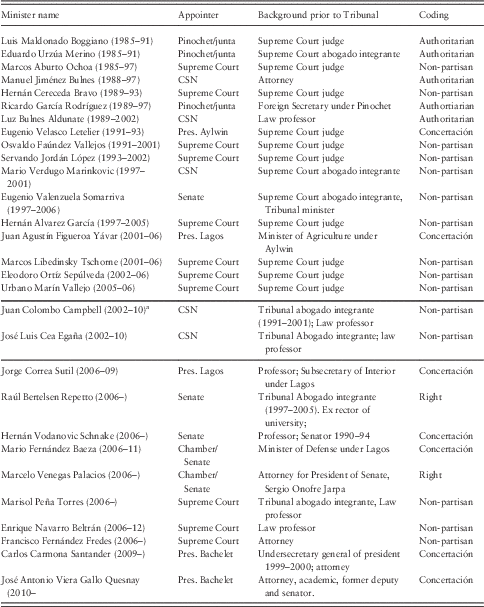
For the vote-level analysis, the judges’ partisan backgrounds are key variables. Concertación affiliation refers to all judges who are reported to be affiliates of a party within the governing center-left Concertación alliance (in practice, the Christian Democratic Party or the Socialist Party) or appointed directly by the three Concertación presidents: Aylwin, Lagos or Bachelet.Footnote 25 The variable Authoritarian appointee indicates that a judge was appointed prior to democratization in 1990 by either Pinochet, the military junta, or the military-dominated CSN. These judges exist on the Tribunal only in the pre-reform period and thus applicable only to the sample with those cases. Right affiliation refers to judges who are associated with Chile’s right-wing parties or Allianza – the National Renewal (RN) or the Independent Democratic Union (UDI) – who formed the opposition during this period. These judges exist on the Tribunal only during the post-reform period. Those judges with no direct political affiliation or not appointed by either a Concertación president, the authoritarian regime, or affiliated with the Right are considered non-partisan and are used as the reference category below. Generally, these non-partisan judges are associated with the Supreme Court due to their appointment by, or prior work with, the Supreme Court and are generally associated with a more conservative approach to the application of law (Hilbink, Reference Hilbink2007). Non-partisan does not refer to judges’ ideology, but rather the non-political nature of their appointment by the Supreme Court or non-elected politicians such as the CSN in the democratic period. Table A1 lists all of the judges, their appointers, background and coding as described above.Footnote 26 For the vote-level analysis, data is first pooled and includes not only the judges’ affiliations, but also independent variables for reform and type of review. This first analysis of pooled data examines subsamples based on case outcomes. In a second vote-level analysis, only the judges’ political affiliations are examined, but the data is divided into three samples by case type and reform period. Further discussion of these analyses is provided below.
Case-level analysis
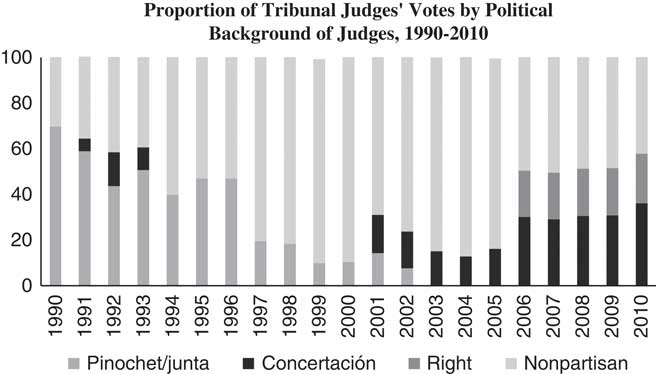
Figure 1 depicts the political composition of the Tribunal in two distinct time periods divided by the constitutional reforms. Figure 1 shows the proportion of the Tribunal’s votes coming from judges with political backgrounds: Pinochet/junta regime appointees and Concertación party affiliates in the pre-reform period and Center-right and Concertación affiliates in the post-reform period. The figure also depicts the proportion of votes coming from non-partisan judges, mostly appointed by the Supreme Court, with neither a direct connection to political parties nor the Pinochet regime. As seen in Figure 1, in the pre-reform era prior to 2006, the majority of votes in the Tribunal come from non-partisan judges. Votes from Pinochet/junta and Concertación appointees constitute a smaller portion of the votes on the Tribunal before the reform. It is noteworthy that the Concertación votes in this period come from just two judges who served in different years. As a result, the pre-reform Tribunal should not be very partisan. In the post-reform period, more votes come from judges with political affiliations, this time from judges affiliated with the Concertación and center Right. Votes from non-partisan judges now make up a much smaller portion of the decision-making process in the Tribunal.
Composition of Tribunal by judges’ votes. Note: The constitutional reforms were implemented at the beginning of 2006.

In accordance with expectations that political affiliation or polarization drives dissent, the dissent rate at the case level for the entire pre-reform period is quite low, just 17%. In the post-reform period, the dissent rate for the entire period has increased sharply to 44%, corresponding to a court which has judges from the major political forces in the nation – the Concertación or the Right. Non-partisan judges constitute a much lower percentage of the Tribunal’s composition as compared with the pre-reform period. A higher dissent rate observed after the reform coincides with a Tribunal with a higher proportion of justices with distinct political backgrounds and a smaller amount of judges who are designated as non-partisan.
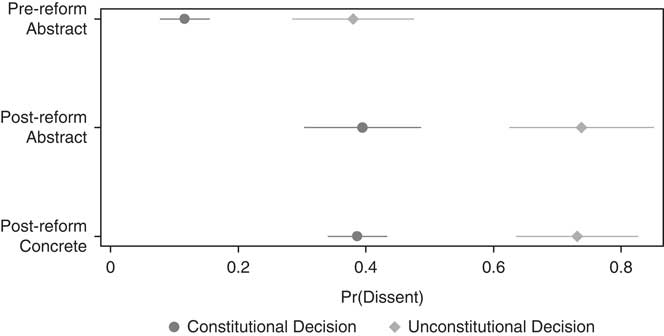
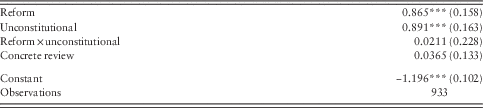
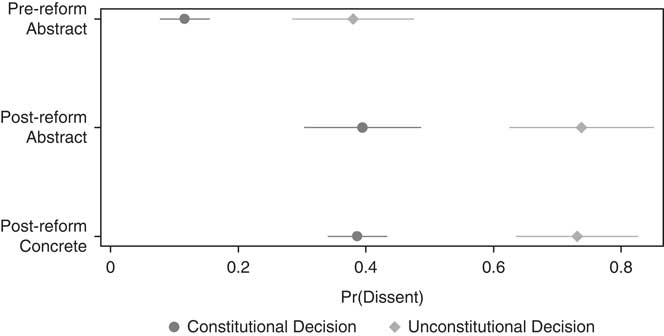
Figure 2 Footnote 27 compares the predicted probabilities from probit regressions of case-level conflict – a binary dependent variable indicating if a case has at least one dissenting vote – on a binary variable for post-reform rulings, a binary variable for unconstitutional or inapplicable rulings, an interaction term, and a variable for case type (i.e. a binary variable for ‘concrete review’). The specification is as follows:
 $$\eqalignno{ {\rm Probit}\,{\rm \{ Pr}\,(Y=1)\} = & B_{0} {\plus}B_{1} \,{\rm Reform}{\plus}B_{2} \,{\rm Unconstitutional} \cr & {\plus}B_{{\rm 3}} \,{\rm Reform}{\times}{\rm Unconstitutional}{\plus}B_{{\rm 4}} \,{\rm Concrete}\,{\rm review}{\plus}{\varepsilon} $$
The probit regression tests for whether the reform, the case outcome (constitutional or unconstitutional), and the type of review have statistically significant effects on the propensity of a case to involve disagreement. As seen in Figure 2, the growth in the average rate of cases with dissent after the reforms is striking. Pre-reform, abstract cases overall have a much lower predicted probability of dissent than post-reform cases. Case outcomes, however, also drive dissent with more dissent on cases in which the law is ruled unconstitutional or inapplicable in both the pre- and post-reform periods. In the pre-reform period, 38% of abstract cases that found proposed laws unconstitutional had dissent, whereas only 11.6% did where the proposed law was found constitutional in this period. Similarly, in the post-reform period, 72 and 73% of unconstitutional or inapplicable rulings for post-reform abstract and concrete cases have dissent, whereas only about 38% of both types of these cases had dissent when the outcome was constitutional/applicable.Footnote 28 It is noteworthy that the propensity to dissent is similar for both post-reform abstract and concrete cases, regardless of the case outcome, suggesting that the alleged lower risk of decision-making in concrete cases, as mentioned by Couso et al. (Reference Couso, Parmo, Guiloff and Coddou2011), does not affect the amount of cases with dissent. The overall patterns imply that the institutional changes in composition bringing a Tribunal with more politically affiliated judges and divergent interests coinciding with the reform were important. However, the above interpretation presumes that changes in the rates of conflict have occurred monotonically, yet more gradual changes to the makeup of the Tribunal occurred before the reform and affected the rates of dissent as well.
Predicted probabilities of rulings with conflict, by decision type, pre- and post-reform.
Vote-level analysis
The above analysis determined that cases are more likely to be non-unanimous for the post-reform period and for cases where the outcome changes the status quo with a ruling of unconstitutional or inapplicable. However, as stated from the outset, a further inquiry of this analysis focuses on whether the political affiliations of judges per se or the diversity of political opinions drives judges’ propensity to dissent. To test the predictions above regarding individual dissents, the data are disaggregated to the individual vote, which will allow an examination of both variation among judges and to distinguish those factors from the effects of other case-level variables. Because there is unmeasured case-level variation in the probability of dissent that influences the interdependent judge-level observations for each case, a probit model on individual dissents with random intercepts at the case-level is used.
For the first part of the analysis, all of the data for votes is pooled for the entire period from 1990 until March 2010. The regression specification for the pooled data is as follows:
 $$\eqalignno{ {\rm Probit}\,\{ {\rm Pr}\,(Y_{{ij}} ={\rm 1})\} = & { B}_{{\rm 0}} {_j} {\plus}{B}_{1} \,{\rm Concertaci} \'{\rm o} {\rm n}\,{\rm affiliation} \cr & {\plus}{B}_{2} \,{\rm Pinochet/junta}{\plus}{B}_{3} \,{\rm Right}\,{\rm affiliation} \cr & {\plus}B_{4} \,{\rm Concrete}\,{\rm review}{\plus}B_{{\rm 5}} \ {\rm Reform}{\plus}{\varepsilon} $$
The analysis of the pooled data not only includes judges’ political affiliations, but also variables regarding case review type and reform period previously tested in the case-level analysis. Three samples using the pooled data are evaluated. The first pooled sample analyzes all votes for all cases in the data base. The second pooled sample analyzes only votes in cases in which the majority found the law constitutional or applicable and the third pooled sample analyzes votes in cases in which the majority found the law unconstitutional or inapplicable.
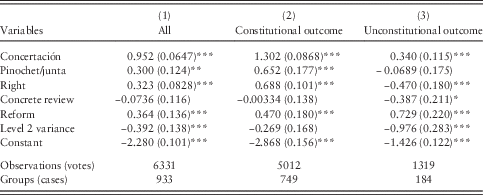
Overall, the results indicate that judges’ political affiliations have a strong effect on the propensity to dissent. In sample 1, which is depicted in Table 1, Column 1, all judges with political affiliations dissent more than non-partisan judges, and judges associated with the Concertación, dissent almost three times as frequently as judges associated with the junta or the Right. These results are similar in pattern to those in sample 2 (found in Column 2 of Table 1) for cases where the law is found constitutional or applicable. Only in sample 3, does divergence in dissent behavior by judges’ partisanship emerge. In this sample, when the law is found unconstitutional or inapplicable, Concertación-affiliated judges dissent more than non-partisan judges. In this sample of unconstitutional cases, judges associated with Pinochet/Junta or the Right dissent less than non-partisan judges, but only the coefficient for Right judges is significant. This final sample provides some evidence that judges’ dissents are linked to diversity of political preferences between judges associated with the center left and more conservative judges associated with the junta or the Right, at least in regard to unconstitutional or inapplicable laws, which are more controversial. The divergence may be based on the fact that the underlying laws reviewed are primarily laws passed by the Concertación (which is certainly the case for abstract laws) and Concertación affiliated judges have strong preferences against finding such laws unconstitutional. The results in all three samples also confirm that at the judge level, dissent is more likely after the reform as seen by the significant coefficient on this variable, but that the type of review (i.e. abstract or concrete) does not significantly alter individual judges’ propensity to dissent.
Partisan determinants of dissenting votes, pooled data

Standard errors in parentheses; ***P<0.01, **P<0.05, *P<0.1.
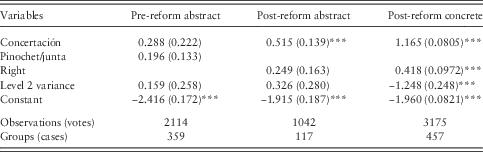
While these results are suggestive, the pooled data are unbalanced as neither Pinochet nor Right-affiliated judges occur in the entire sample period, nor are concrete cases before the Tribunal in the pre-reform period. In the second part of the analysis, three separate samples are used divided by time period and case type. The first sample includes all pre-reform abstract cases and the second all post-reform abstract cases. The final sample is for concrete review cases, which have existed only in the post-reform period. The regression specification is as follows:
 $$\eqalignno{ {\rm Probit}\,{\rm \{ Pr}\,(Y_{{ij}} ={\rm 1})\} = & { B}_{{\rm 0}} {_j} {\plus}{B}_{1} \,{\rm Concertaci} \'{\rm o} {\rm n}\,{\rm affiliation} \cr & {\plus}{B}_{2} \, \rm Pinochet/junta{\rm \ or}\ Right\,affiliation{\plus} {\rm \varepsilon}. $$
For the pre-reform period, judges’ political affiliations include Concertación and Pinochet/junta affiliates and for the post-reform period, judges’ political affiliations include Concertación and Right affiliates. As before, the base line affiliation for all samples is non-partisan.
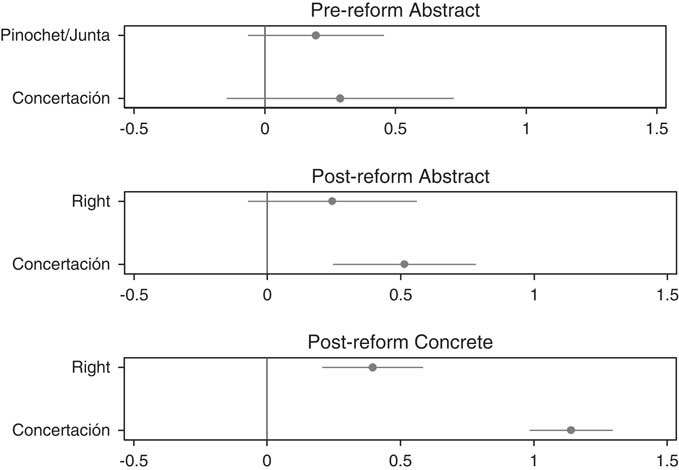
Figure 3 reports the marginal effects of partisanship for these regressions.Footnote 29 The plotted points represent the magnitude of change in the probability of a dissenting opinion relative to the non-partisan baseline group (i.e. the vertical line in each diagram).
Marginal effects of partisan judges on probability of dissent, by review type and time period. Note: For each square, the vertical line represents the category of non-partisan judges or the base group.
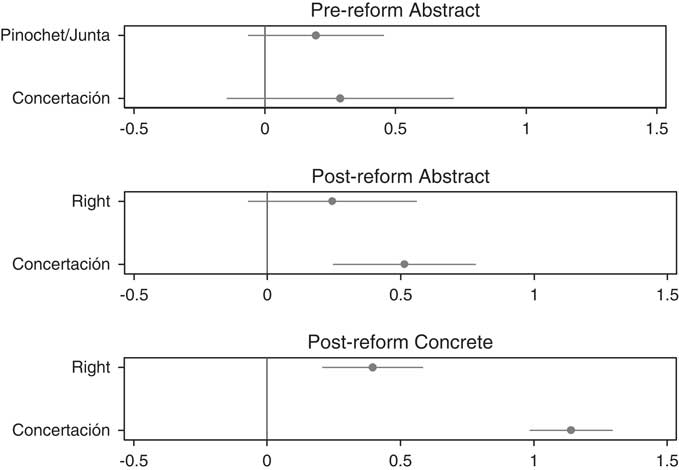
Overall, political affiliations consistently have a positive effect on judges’ decisions to dissent. Samples 1 and 2 represent abstract review cases pre- and post-reform. For the pre-reform abstract cases (sample 1), the results from the first model show that judges affiliated with the Concertación or the Authoritarian era dissent more in general, compared with the non-partisan judges, though the coefficients are not statistically significant at conventional levels. From the case-level analysis, one would not necessarily expect statistically significant differences here due to the fact that the Tribunal is not made up of a significant number of politically affiliated judges. For abstract cases in the post-reform period (sample 2), Concertación and Right affiliated appointees dissent more than non-partisan judges, though the difference is not statistically significant for Right judges.Footnote 30
Sample 3 includes cases of concrete review, which occur only after the reforms. These cases involve whether enacted legislation should be applied to a specific case and controversy. In other words, an inapplicable decision in these concrete cases means that the law should not be applied to an individual case even if the law itself is deemed constitutional. Such a finding does not affect the drafting or rewriting of legislation (at least immediately). For all concrete cases, dissent is more likely to come from judges affiliated with the Right or the Concertación political parties, with the latter being of striking magnitude.
The results overall indicate that judges with partisan origins dissent more. As stated above, this may be due to a variety of reasons including loyalty to the judge’s appointer or appointer’s party or due to potential opportunities in politics after the bench. An additional review of judges’ careers after their service on the Tribunal showed that the majority of judges affiliated with parties returned to politics after the bench compared with their non-partisan brethren. For example, Justice Correo Sutil, a Lagos appointee and former Subsecretary of the Interior under this same Concertación president, became the president of the Tribunal Supremo for the Democratic Christian political party after serving on the Tribunal. Likewise, after his time on the bench, Justice Fernando Baeza, a former minister of defense in Lagos’ cabinet, became associated with an independent government institution dealing with human rights created by Congress under President Lagos. In contrast, non-partisan judges, the majority whom were selected by the Supreme Court overwhelmingly returned to service on the Supreme Court or to academic careers. Future research will track whether the more recent Supreme Court appointees, chosen after the reform and who came from outside of the Supreme Court, will return to jobs as attorneys after serving on the Tribunal.
While the results indicate that politically affiliated judges dissent more than non-partisan judges and diversity of political affiliations may drive some dissent behavior when laws are found unconstitutional, the judge-level results, regarding patterns of dissent based on political origins, should not be overstated. While Figure 3 shows divisions in dissent based on political backgrounds of judges, the marginal effects are relatively small. Further, research beyond 2010 is warranted to determine whether these patterns persist and become substantively more meaningful.
Finally, the results do not indicate definitively whether the increase in dissent after the reform is due to the diversity of political preferences or opposing preferences on the Tribunal. However, in pooling the data, there is some indication that dissent is based on disagreements among politically affiliated judges at least in cases involving the unconstitutionality of laws. Much further research regarding judges’ underlying disagreements is warranted.
Conclusions
The literature on judicial behavior in American courts has emphasized the importance of judges’ political affiliations in explaining the occurrence of dissent on courts. Scholars know much less about dissent behavior in courts in other nations, where the norms of consensus and the influence of partisan appointments are less well documented. High courts around the globe provide an opportunity to examine these questions in contexts where the political role of the courts is rapidly changing. The Chilean Constitutional Tribunal, in particular, allows us to examine these propositions in an environment where both the degree of partisanship and political origins vary considerably.
Since its reforms, the structure of the Tribunal now favors the substantial involvement of elected politicians in the appointment of judges. For the continuing abstract review powers, changes in the makeup of the Tribunal appear to have coincided with a large increase in the overall probability of dissent on the Tribunal in the post-reform period compared with the pre-reform period, regardless of the outcome of the case. The period when the Tribunal was composed mostly of judges with no political background, which characterizes most of the pre-reform period, had the lowest percentage of cases with dissent. After the reform, the percentage of cases with dissent increased substantially. The post-reform patterns for abstract review are also similar to those of the Tribunal’s concrete review functions, which began along with the other reforms.
Generally, the empirical analysis finds that judges affiliated with politics are more likely than non-partisan judges to dissent in most situations. This is especially true of those connected to the political center left, though there is less support for this in the case of judges appointed by the Pinochet regime and judges associated with Chile’s right-wing parties. Importantly for the comparative study of judicial review, the analysis further suggests that this pattern of conflict may reflect a representation of political views on the Tribunal. The overall increase in conflict after the 2005 reforms is consistent with a Tribunal with more politically affiliated judges.
A greater tendency toward conflict post-reform may also suggest an institutionalization of the Tribunal’s role as a political actor in the policy-making process. In the context of the historical inertia of Chile’s judiciary, characterized by many scholars as politically detached, patterns of conflict on the Constitutional Tribunal would seem to reflect increasing political influence on the Tribunal, which in turn may have increased the possibility of politically oriented opinions and disagreement. Because the Constitutional Tribunal has extensive judicial review powers and has a legislative veto when deciding most abstract review cases, the political origins of dissent may have consequential policy implications. More comparative research is needed to explore whether the findings in Chile emerge in other political and institutional contexts and whether outcome and case type, as well as judicial attributes, drive dissenting opinions.
Acknowledgments
The author thanks Marina LaCalle for research assistance. The author also thanks Royce Carroll and Amanda Driscoll as well as anonymous reviewers for invaluable comments on prior drafts of this article.
Appendix 1: Tribunal Ministers Coding
Tribunal ministers 1990–2010 and coding

Appendix 2: Case-Level Probit Analysis
Case outcomes and types as determinants of dissent

Appendix 3: Vote-level Multi-level Probit Analysis, by review type and time period
Partisan determinants of dissenting votes