Implications
Applying high-grain (HG) diets to ruminants is a common practice in intensive production systems. However, quick, unwise shifts to these dietary regimens results in unfavourable rumen ecosystem imbalance. We studied the dynamics of change in the sheep rumen epimural bacteriome after a quick shift to continuous HG feeding episodes. Diversity indices decreased due to the shift and did not seem to recover. Prevotella spp. was the most abundant genus under this feeding regimen. The predicted relative abundance of carbohydrate metabolism genes was increased after the shift. This study provides a timewise description of the rumen fermentation parameters and epithelium-associated microbiome during this feeding situation.
Introduction
Throughout the past several years, applying HG diets to the ruminants’ production systems has been a common strategy to improve the animal performance (Liu et al., Reference Lin, Guo, Meng, Stevenson, Weimer and Schaefer2013; Gao and Oba, Reference Gao and Oba2014). Consequently, the challenge of maintaining a balanced rumen ecosystem rose due to the increased rates of volatile fatty acids (VFA) production and the reduced saliva secretion caused by the HG diets (Mertens, Reference Mertens1997). Accumulation of these organic acids leads to the reduction of ruminal pH which alters the ruminal microbiota community, and further, results in subacute rumen acidosis (SARA) (Kleen et al., Reference Kleen, Hooijer, Rehage and Noordhuizen2003). Subacute rumen acidosis is a predominant health issue particularly in animals that are usually susceptible to a swift exposure to HG diet like early lactation cows, feedlot ruminants and high producing dairy cattle, leading to significant economic losses to the livestock industry (Plaizier et al., Reference Plaizier, Krause, Gozho and McBride2008).
Previous studies on the duration and severity of SARA observed that occasional SARA conditions are stronger than continual SARA conditions, probably because the rumen microbiome has less time to adapt to diet fluctuation (Pourazad et al., Reference Pourazad, Khiaosa-Ard, Qumar, Wetzels, Klevenhusen, Metzler-Zebeli and Zebeli2016). Thus, the gradual adaptation of rumen microbiota to HG diets is recommended as a common feeding strategy in intensive ruminant production systems. However, in the modern ruminant production systems, ruminants, such as postpartum dairy cattle, are always exposed to rapid shifts to HG diets. Recently, Górka et al. (Reference Górka, Schurmann, Walpole, Błońska, Li, Plaizier, Kowalski and Penner2017) studied the time course of the forestomach and small intestine adaptation of calves in response to a rapid increase in the grain proportion of the consumed diet. Nonetheless, insufficient information is available on the adaptation of rumen microbiome to a rapid shift to HG diet.
Throughout a long period of continuously developing methodologies, rumen epithelium-associated (epimural) microbiota were proven to posses a critical importance in the rumen ecology in which they were found to account for 1% to 2% of the total bacterial population in the rumen (Russell et al., Reference Russell, Garner and Flint2002). They represent the first contact between the host cells and the rumen environment. Thus, investigating its behaviour and significant fluctuation under different feeding situations brings us closer to understand the host–microbe interaction mechanisms. Furthermore, it has been found that they play some crucial roles towards securing a stable rumen environment like urea hydrolysis (Jin et al., Reference Jin, Zhao, Zheng, Bu, Beckers, Denman, McSweeney and Wang2017), oxygen scavenging (Cheng and Costerton, Reference Cheng and Costerton1980; Mann et al., Reference Mann, Wetzels, Wagner, Zebeli and Schmitz-Esser2018), tissue recycling (McCowan et al., Reference McCowan, Cheng, Bailey and Costerton1978), starch (Mann et al., Reference Mann, Wetzels, Wagner, Zebeli and Schmitz-Esser2018) and amino acid metabolism (Mao et al., Reference Mao, Zhang, Liu and Zhu2015). However, further investigations is needed to elcucidate the rumen epimural microbiome composition and function especially in cases of the shift to HG diets. Here, we hypothesised that the composition of ruminal epithelium-associated microbiota would dynamically alter in response to a rapid transition to a HG diet. Therefore, the aim of this study was to explore the dynamic shifts in the composition and function of rumen epithelium-associated microbiota in sheep in response to a swift exposure to continuous HG feeding episodes.
Material and methods
Animals and experimental design
In this study, 20 Hu-breed male lambs (BW of 25.60 ± 0.41 kg, mean ± SD, ~180 days of age) were housed individually in pens (1.2 × 1.4 m). Before the commencement of the trial, all animals were fed a forage-based diet containing 96.4% hay plus 3.6% mineral and vitamin premix (Supplementary Table S1) for 4 weeks. Animals were divided randomly into four groups (n = 5 for each) based on age and BW. Subsequently, to ensure a constant rumen environment to the animals of the control group (CON) capable of ruling out the change in the HG groups, they were continued being fed the forage-based diet until slaughtering for sampling at the end of the experimental period. While, three groups (HG groups) were rapidly transited to an HG diet that contained 40% forage and 60% grain mix (Supplementary Table S1) and lasted for 7, 14 and 28 days in groups HG7, HG14 and HG28, respectively. The transition to HG diet took 4 days (HG diet was increased 15% by 3.50% of BW/day gradually) until fed by 60% grain mix which represent a rapid way of shifting to a HG diet. The HG diets (3.50% of BW/animal per day) were offered in equal amounts at 0830 and 1630 h daily. Throughout the experimental period, all animals were provided with clean drinking water ad libitum. Health, BW gain and dry matter intake (DMI) of the animals were continuously observed. Feed refusal was daily collected, weighed and analysed for chemical composition.
Sample collection
Feed ingredients sampling was performed at the set up and the end of the experimental episode. At the finishing time point of each feeding period, the sheep were slaughtered for sampling (4 h after the last feeding) in a local slaughterhouse. Sheep were stunned by captive bolt and slaughtered by exsanguinations according to animal protection laws of China. Rumen fermentation assessment is mentioned thoroughly in Supplementary Material S1 (section S1.1)
Extraction of microbial genomic DNA and amplification of 16S ribosomal RNA genes
The whole genomic DNA was extracted by applying the procedures of QIAamp Fast DNA Stool Mini Kit (Qiagen, Hilden, Germany). Tags of ~420 bp of V3 to V4 regions on 16S ribosomal RNA (rRNA) genes were amplified with forward primer 5′-ACTCCTRCGGGAGGCAGCAG-3′ and reverse primer 5′-GGACTACCVGGGTATCTAAT-3′ (Klindworth et al., Reference Klindworth, Pruesse, Schweer, Peplies, Quast, Horn and Glöckner2013). The PCR initial denaturation was at 95°C for 2 min, followed by 25 cycles of denaturation at 95°C for 30 s. Annealing was at 55°C for 30 s and 72°C for 30 s and final extension at 72°C for 5 min. More detailes are provided in Supplementary Material S1 (sections S1.2 and S1.3)
High throughput sequencing and metagenomic analysis
Illumina TruSeq DNA sample preparation Kit (Illumina, San Diego, CA, USA) was used to construct a sequencing library. Cluster generation, isothermal amplification, template hybridisation, linearisation, hybridisation, blocking and denaturisation was performed using Illumina TruSeq PE Cluster and Sequencing by Synthesis Kits. All sample depths were normalised to 29 341 sequences per sample. Phylogenetic investigation of communities by reconstruction of unobserved states (PICRUSt) analysis (http://picrust.github.io/picrust/) was used to predict the metabolic functions of each sample based on 16S rRNA data. Detailed procedures are in Supplementary Material S1 (sections S1.3 and S1.4)
Statistical analysis
Data of animal performance, fermentation parameters and diversity were analysed using the one way ANOVA followed by the polynomial post hoc test on SPSS software package (SPSS 23; SPSS Inc.).
For the relative abundance of the phyla, genera, operational taxonomic units (OTUs) and KEGGs, the R statistics npmv (Burchett et al., Reference Burchett, Ellis, Harrar and Bathke2017) package (https://www.r-project.org) was used to deduce the global variance in the relative abundance of the phyla, genera, OTUs and KEGGs. The Kruskal–Wallis test was used to test the null hypothesise of each phylum, genus and KEGG family, followed by a pair-wise comparison between groups’ means. Correlations between variables were tested by Pearson correlation test. Detailed procedures are provided in Supplementary Material S1 (section S1.5).
Results
Rumen fermentation parameters
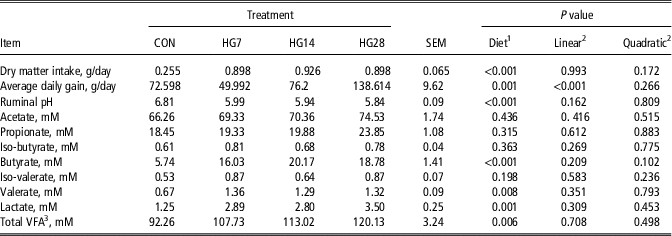
As shown in Table 1, ruminal pH decreased from 6.81 for CON group to 5.99, 5.94 and 5.84 for HG7, HG14 and HG28 groups (P <0.001), respectively. While, there was no significant effect between the HG groups that represent different time intervals on the linear or the quadratic term. The concentration of butyrate (P <0.001), valerate (P = 0.008), lacatate (P = 0.001) and total VFA (P = 0.006) showed a significant increase in the HG groups compared to their levels in the CON group. And similarly, no effect was found when excluding the CON group from the test.
Rumen fermentation and performance of sheep fed Hay (CON) or rapidly shifted to high-grain diet for 7 (HG7), 14 (HG14) or 28 (HG28) days

1 Control group was included in the test.
2 Control group was not included in the test.
3 Volatile fatty acids.
16S ribosomal RNA sequencing analysis, diversity indices and the global non-parametric multivariate inference
Results showed that number of OTUs, abundance-based coverage estimator and Chao estimates decreased due to the shift to the HG diet (Table 2). While, the duration of the HG feeding affected only the number of OTUs on the quadratic term (quadratic P = 0.045).
Diversity indices of ruminal epimural microbiome in sheep fed hay (CON) or rapidly shifted to high-grain diet for 7 (HG7), 14 (HG14) or 28 (HG28) days

OTU = operational taxonomic unit; ACE = abundance-based coverage estimator.
1 Control group was included in the test.
2 Control group was not included in the test.
3 Number of operational taxonomic units.
4 ACE and Chao species richeness estimators.
5 Shannon diversity index.
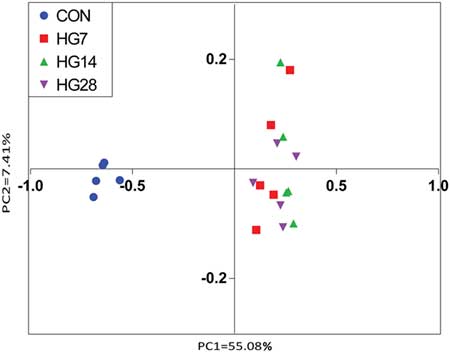
The results of unweighted UniFrac distance-based principal coordinates analysis (PCoA) revealed that the ruminal epithelium-associated bacterial communities of CON group clustered separately from all the HG groups (Figure 1). The unweighted distance-based analysis of molecular variance (AMOVA) (Supplementary Table S2) revealed statistically significant dissimilarities between CON group and all the HG groups with respect to bacterial diversity (Fs = 4.109, P <0.001) while the comparison among the four groups revealed that CON v. HG7, Fs = 6.667, P = 0.002; CON v. HG14, Fs = 8.535, P = 0.001; CON v. HG28, Fs = 6.759, P = 0.003; HG7 v. HG14, Fs = 1.299, P = 0.058; HG7 v. HG28, Fs = 1.440, P = 0.034; HG14 v. HG28, Fs = 1.356, P = 0.062).
(Colour online) Principal coordinates analysis of rumen epimural microbiome community of sheep fed hay (CON) or rapidly shifted to high-grain diet for 7 (HG7), 14 (HG14) or 28 (HG28) days. PC = percent variation explained by the axis.

Supplementary Table S3 illustrates the global permutation P-value of the non-parametric multivariate inference with or without including the control group in the test. Results shows that including the CON group in the test resulted in the presence of a significant difference between groups on the phyla (permutation P <0.001), genera (permutation P <0.001), OTU (permutation P <0.001) and predicted function (permutation P = 0.001). On the other hand, the absence of the CON group resulted in the absence of significance on the phyla (permutation P = 0.11) and predicted function (permutation P = 0.545), whereas the significance was on the genus level (permutation P = 0.001) and the OTU level (permutation P = 0.011) only.
Rumen epimural bacteria phylogenetic analysis
In the present study, 783 819 acceptable quality reads were obtained. The overall sequences were allocated into 20 phyla. Twenty phyla were assigned to CON group, 16 phyla were assigned to HG7 group, 18 phyla were assigned to HG14 and 19 phyla were assigned to HG28. At the genus level, it was found that CON group comprised 131 genera, HG7 group comprised 127 genera, HG14 group comprised 111 genera and HG28 group comprised 119 genera.
At the phylum level, most of sequences were assigned to Firmicutes, Bacteroidetes and Proteobacteria (Supplementary Table S4). These three phyla represented ~93% of the total relative abundance of phyla in the CON and HG14 group, whereas they represented 92% in HG7 and HG28 groups. The shift to the continuous HG feeding significantly altered the relative abundance of six phyla. Verrucomicrobia (P = 0.030), Chlorobi (P = 0.003), Cyanobacteria (P = 0.029), Lentisphaerae (P = 0.030), Proteobacteria (P = 0.042) and Candidate_division_SR1 (P = 0.010) showed a significant decrease due to the rapid shift to an HG diet, whereas they did not show any significant difference throughout the HG feeding episode. High-grain feeding duration did not cause any significant variation (P >0.05) to the relative abundances of any phylum except Spirochaetes which increased gradually from 2.85% in CON group to 7.14% in the HG14 group then started to recover to its levels in the CON group in the HG28 group.
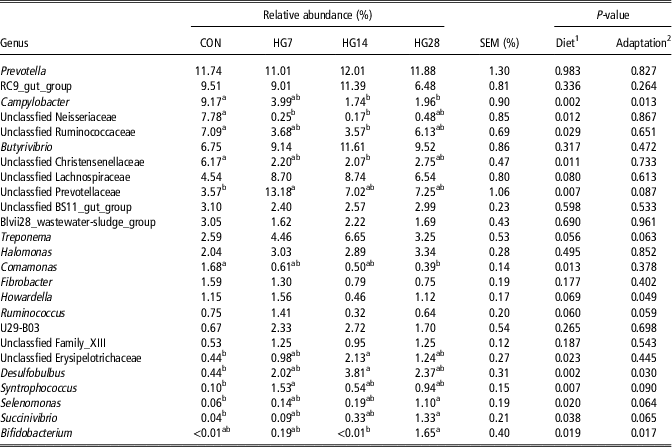
At the genus level, 26 genera were assigned to be predominant (with relative abundance ⩾1% in at least one group) (Table 3). The abundance of 12 genera was altered by the shift to HG feeding including unclassified Ruminococcaceae (P = 0.029), unclassified Prevotellaceae (P = 0.007), unclassified Christensenellaceae (P = 0.011), Selenomonas (P = 0.020), Succinivibrio (P = 0.038), Desulfobulbus (P = 0.002), Campylobacter (P = 0.002), unclassified Neisseriaceae (P = 0.012), Syntrophococcus (P = 0.007), unclassfied Erysipelotrichaceae (P = 0.023) and Bifidobacterium (P = 0.019). Some of these taxa were affected by the duration of the HG feeding period. In particular, Campylobacter (P = 0.013) showed a dramatic decrease at HG14 and HG28 groups; Howardella showed a decreased abundance in HG14 group compared to other HG groups (P = 0.049); Desulfobulbus showed a higher abundance in HG14 group compared to the other HG groups (P = 0.030). Bifidobacterium showed a higher abundance in HG28 groups compared to other groups (P = 0.017).
The relative abundance of bacterial taxa (relative abundance >1% at least in one group) in rumen epimural microbiome of sheep fed hay (CON) or rapidly shifted to high-grain diet for 7 (HG7), 14 (HG14) or 28 (HG28) days

a,b Mean values within a row with different superscript lower case letters are significantly different (P⩽0.05) in the analysis that comprised all the groups.
1 Control group is included in the test.
2 Control group is not included in the test.
While at the OTU level, 200 OTUs were assigned to be predominant (relative abundance ⩾0. 5% at least in one sample). In all, 21 of which has shown a significant difference among the three HG groups. These significantly affected OTUs were found to be mainly related to Firmicutes, Proteobacteria, Bacteroidetes and Fibrobacter (Supplementary Table S5).
Epimural microbiome metabolic capacity
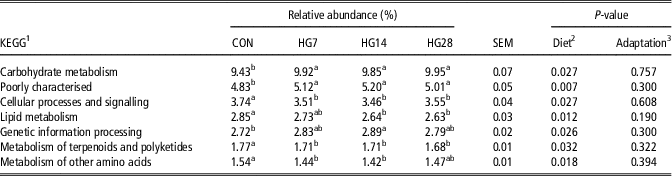
In the present study, PICRUSt was used to predict the metabolic potential of the rumen epimural microbiome (Supplementary Table S6). Generally, genes related to membrane transport, amino acid metabolism, carbohydrate metabolism, replication and repair, translation and energy metabolism were the most abundant in all groups. With progressing number of days of feeding the HG diet, the relative abundance of seven gene families showed significant variation among the four groups (Table 4). Genes related to carbohydrate metabolism were significantly higher in HG groups compared to CON group (P = 0.027). On the contrary, the abundance of genes families involved in lipid metabolism (P = 0.012), cellular processes and signalling (P = 0.027), genetic information processing (P = 0.026), metabolism of terpenoids and polyketides (P = 0.032), metabolism of other amino acids (P = 0.018) and poorly characterised (P = 0.007) were significantly higher in CON group compared to the HG feeding groups.
The relative abundance of significantly altered rumen epimural microbiome Kyoto Encyclopedia of Genes and Genomes (KEGGs) gene families of sheep fed hay (CON) or rapidly shifted to high-grain diet for 7 (HG7), 14 (HG14) or 28 (HG28) days

a,b Mean values within a row with different superscript lower case letters are significantly different (P⩽0.05) in the analysis that comprised all the groups.
1 Pathway name of KEGG.
2 Control group was included in the test.
3 Control group was not included in the test.
Correlation between the ruminal fermentation parameters and microbiota
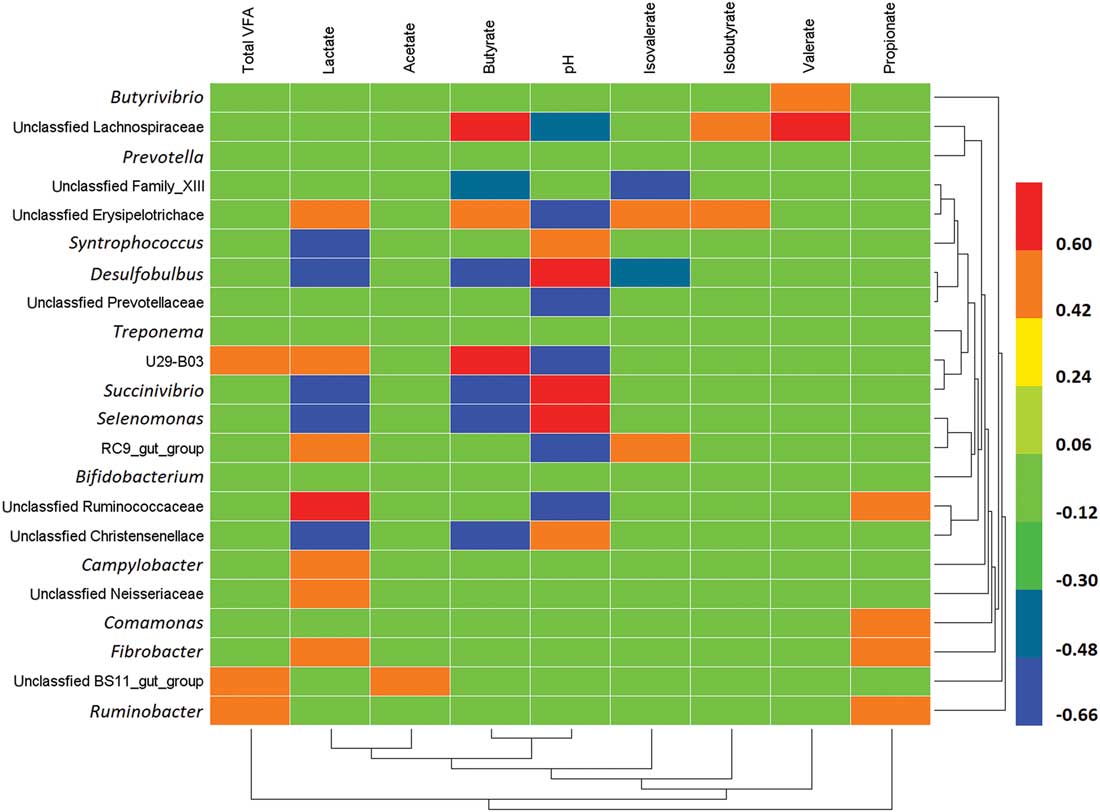
At the genus level, Figure 2 illustrates that the abundance of unclassified Neisseriaeae (P = 0.009, r = 0.568), unclassified Christensenellaceae (P = 0.005, r = 0.606), Campylobacter (P <0.001, r = 0.776), Fibrobacter (P = 0.047, r = 0.449) and Comamonas (P = 0.032, r = 0.737) showed a positive correlation with ruminal pH. In contrast, the abundance of unclassified Lacnospiraceae (P = 0.033, r = −0.456), Desulfobulbus (P = 0.001, r = −0.506) and Selenomonas (P = 0.004, r = −0.619) correlated negatively with the ruminal pH. Butyrivibrio correlated positively with valerate (P = 0.028, r = 0.490). Desulfobulbus correlated positively with butyrate (P<0.001, r = 0.721), lactate (P = 0.007, r = 0.585) and total VFA concentration (P = 0.012, r = 0.547).
(Colour online) Heat map of the correlation coefficient between dominant epimural taxa (with relative abundance ⩾1% at least in one treatment) and rumen fermentation parameters of sheep fed hay or rapidly shifted to high-grain diet for 7, 14 or 28 days. VFA = volatile fatty acids.

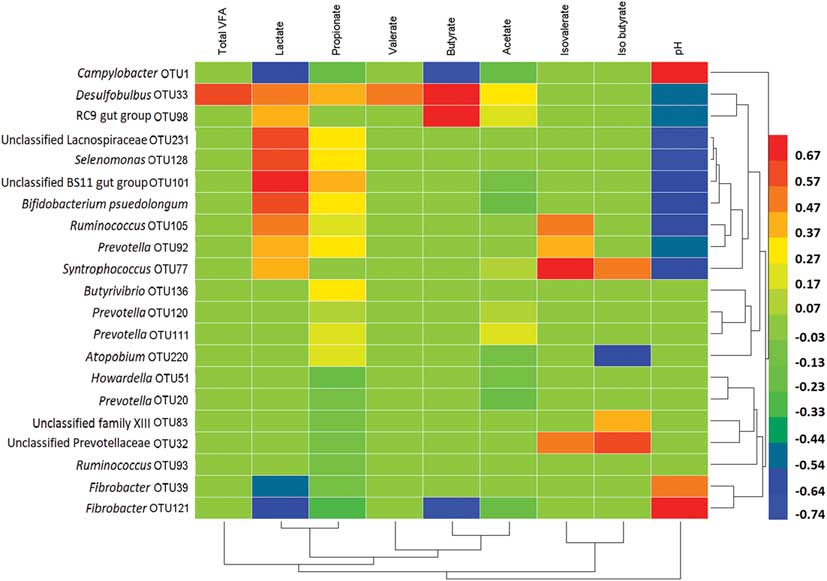
At the OTU level, rumen pH showed a positive correlation with Campylobacter OTU1 (P <0.001, r = 0.776) and Fibrobacter OTU121 (P <0.001, r = 0.768), while they showed a negative correlation with the concentration of butyrate and lactate. On the other hand, DMI was positively correlated with Desulfobulbus OTU33 (P = 0.004, r = 0.619) and Ruminococcus OTU105 (P = 0.007, r = 0.585). Lactate concentration showed a positive correlation with Bifidobacterium pseudolongum (P = 0.003, r = 0.631) and unclassified BS11 gut group OTU101 (P = 0.001, r = 0.683) (Figure 3). The taxonomic identifications of the significantly affected OTUs are illustrated in Supplementary Table S5.
(Colour online) Heat map of the correlation coefficient between significantly altered operational taxonomic units (OTUs) (P <0.05) and rumen fermentation parameters of sheep fed hay or rapidly shifted to high-grain diet for 7, 14 or 28 days. VFA = volatile fatty acids.

Discussion
The present study aimed to investigate the fluctuative change in the rumen epithelium-adherent microbiome in sheep after the exposure to a rapid shift to different continuous HG diet feeding episodes. Our data revealed that the bacterial diversity indices of rumen epimural bacteriome decreased dramatically due to the rapid shift. In addition, the results of unweighted UniFrac PCoA and AMOVA of ruminal epithelium-associated microbiome samples also revealed that significant differences is found between CON and the HG feeding groups that represented different durations, while there was no significant difference between any two consecutive sampling points (HG7 to HG14 or HG14 to HG28). Furthermore, the significance found in the non-parametric, multivariate test when including the control group at the phylum, genus, KEGGs and OTUs level deduces that the diet composition had the major effect on the rumen microbiome compared to the duration of its application.
In a study performed by Zhang et al. (Reference Zhang, Ye, Liu and Mao2017), it was found that HG diet significantly decreased the number of OTUs. Our data also indicates that the number of OTUs of rumen epithelium-associated microbiota was significantly changed by the time span of the HG feeding episode on the quadratic term. One possible explanation for these shifts in the ruminal epithelium-associated bacterial composition can be the increase in the rapidly fermentable carbohydrates that caused a dramatic decrease of ruminal pH and a dynamic change in butyrate, lactate and total short-chain fatty acids’ concentrations, as it is well known that the composition of rumen microbiota is affected by the changes in the rumen environment and the digestibility of the diet constituents (Liu et al., Reference Lin, Guo, Meng, Stevenson, Weimer and Schaefer2013). Based on this reported fact, we depended on the 28 days of the pre-experimental adaptation period to the hay-based diet that was applied to CON group animals, as well as other animals, to rule out the change that happened in the HG groups. As in this case the rumen of the CON animals is believed to be stable throughout the whole experimental period whithout any expectation of variation in the microbial consortium at the 7th or 14th day of the experimental period. Moreover, the polynomial contrasts (linear, quadratic and cubic) were performed accounting for the unequal spacing in the duration of time that lambs were offered the HG diet (Górka et al., Reference Górka, Schurmann, Walpole, Błońska, Li, Plaizier, Kowalski and Penner2017; Wang et al., Reference Wang, Xu, Liu, Zhu and Mao2017). However, frequent sampling of the rumen epithelium microbiome from identical regions may ensure a minimum time differences between sampling intervals that is common in gut microbiome studies. This necessitates the continuous development of rumen sampling techniques.
In accordance with the previous findings in cattle (Plaizier et al., Reference Plaizier, Li, Tun and Khafipour2017; Wetzels et al., Reference Wetzels, Mann, Pourazad, Qumar, Pinior, Metzler-Zebeli, Wagner, Schmitz-Esser and Zebeli2017) and goat (Ye et al., Reference Ye, Liu, Feng, Zhu and Mao2016; Zhang et al., Reference Zhang, Ye, Liu and Mao2017), the current study revealed that the phyla Firmicutes, Bacteroidetes and Proteobacteria dominated the epithelium-adherent microbiome in terms of abundance and function in sheep, indicating that the members of these phyla represent the major inhabitants of the community of rumen epithelium-associated microbiota.
Our data also showed that HG feeding significantly decreased the abundance of phyla Proteobacteria, Verrucomicrobia and Cyanobacteria despite not showing any significant difference throughout the HG feeding episode. These results give an indicator of their inability to adapt to a diet rich in grains or it can also be an indicator of their higher irresistibility to changes in the rumen environment caused by grain feeding as it continues to proceed with time. The current study also revealed that the relative abundance of Spirochaetes increased gradually from CON group to HG14 group then started to recover to its levels in the CON group in the HG28 group, the mechanism underlying the dynamic shift in the abundance of Spirochaetes is not clear and needs further investigation. However, regardless of a possible compounding time effect, shifts in the relatively less abundant phyla may be due to the change in the relative abundance of Firmicutes and Bacteroidetes which represent the highest most abundant phyla.
At the genus level, our results revealed that the abundance of 12 dominant taxa including unclassified Prevotellaceae, unclassified Ruminococcaceae, unclassified Christensenellaceae, unclassified Neisseriaceae, Selenomonas, Syntrophococcus, Succinivibrio, Campylobacter, Desulfobulbus, Comamonas, unclassfied family_XIII and Bifidobacterium was altered by the shift to HG feeding. Of these affected genera, unclassified Christensenellaceae has been reported to be an acetate and little butyrate producer (Morotomi et al., Reference Morotomi, Nagai and Watanabe2012). In the present study, despite a negative correlation with acidity parameters, this group showed an ability to increase their abundance after a dramatic decrease caused by HG feeding, which infers a proved capability of species that belong to this genus to grow under different diets. This was in line with results reported by Lima et al. (Reference Lima, Oikonomou, Lima, Bicalho, Ganda, de Oliveira Filho, Lorenzo, Trojacanec and Bicalho2015) where it was found to have a high significance in the discriminant analysis in cows that were transitioned from a high-fibre prepartum diet to a low-fibre postpartum diet. Bifidobacterium, an amylolytic species, is well established in the colon of human, swine and ruminants (Ze et al., Reference Ze, Duncan, Louis and Flint2012). Furthermore, it was noticed that its relative abundance increased with HG feeding in the colonic mucosa-associated bacteria of sheep (Wang et al., Reference Wang, Xu, Liu, Zhu and Mao2017). In the current study, our findings revealed that Bifidobacterium increased in abundance in the rumen epimural community with HG feeding especially in the HG28 group, which may suggest an adaptation ability possessed by this taxon to the percentage of the starch regularly flowing into the rumen. We also noticed an increased relative abundance of Succinivibrio genus in the HG28 group, and this is in consistence with the report by Petri et al. (Reference Petri, Schwaiger, Penner, Beauchemin, Forster, McKinnon and McAllister2013). Campylobacter genus has been proved to be found in a considerable relative abundance in the rumen epimural microbiome (Zhao et al., Reference Zhao, Wang and Bu2014; Mao et al., Reference Mao, Zhang, Liu and Zhu2015). In spite of its kinship to the roughage: concentrate ratio of the diet, this genus does not function as a carbohydrate fermenter (Indikova et al., Reference Indikova, Humphrey and Hilbert2015). Previous research linked them with the reduction of the dietary nitrate (Lin et al., Reference Lin, Guo, Meng, Stevenson, Weimer and Schaefer2013; Zhao et al., Reference Zhao, Meng, Ren, Liu, Zhang, Huo and Zhou2015) and others has regarded some of its species as non-pathogenic and highly abundant in the bovine epimural microbiome (Wetzels et al., Reference Wetzels, Mann, Metzler-Zebeli, Pourazad, Qumar, Klevenhusen, Pinior, Wagner, Zebeli and Schmitz-Esser2016). In the current study, the relative abundance of Campylobacter decreased in the HG feeding groups, which is in line with these reports. However, negative correlation was found between rumen pH, butyrate concentration and the abundance of Campylobacter, indicating that members of Campylobacter may be sensitive to the rumen environment and fermentation end products as well.
Ruminococcaceae members are known as celluloytic taxa (Stewart, Reference Stewart1977; Mao et al., Reference Mao, Zhang, Wang and Zhu2013), thus, it is not surprising that the relative abundance of unclassified Ruminococcaceae showed a dramatic decrease in HG7 and HG14 groups. Furthermore, it was proven by Kellermayer et al. (Reference Kellermayer, Dowd, Harris, Balasa, Schaible, Wolcott, Tatevian, Szigeti, Li, Versalovic and Smith2011) that this genus’s phenotypes can harmfully affect the mucosal barrier. Likewise, members of Syntrophococcus has been assigned as a signature of allergic diseases development in infancy (Ni et al., Reference Ni, Chua and Chou2015). Desulfobulbus has been shown to grow mixotrophically using H2 and an organic compound depending on the presence of sulfate in the media (Laanbroek et al., Reference Laanbroek, Abee and Voogd1982). In the present study, Desulfobulbus showed a positive correlation with rumen butyrate, lactate and total short-chain fatty acids concentration which was consistent with Jiao et al. (Reference Jiao, Huang, Zhou and Tan2015).
The ANOVAs among groups at the OTUs level provided more clues to explain the differences found on the genus and the phylum levels. The number of OTUs that showed a significant ability to increase in abundance was 21 out of 200 total predominant OTUs. This infer the drastic nature of the rumen microbiome adaptation to a persistent unfavourable condition like an unwise increase in the offered concentrate : roughage ratio. However, more research is needed to unravel the potential of these species to persist and reproduce under non-optimum conditions.
Interestingly, most of the significantly affected OTUs came into consistence with the effect of HG feeding on the relative abundance of their comprising genera which may provide a specific description of the particularly-affected species in each genus. However, most of these species were identified as uncultured rumen bacteria according to the reference database that we used except B. pseudolongum which was identified and showed an increased relative abundance after the shift to the HG diet. Kelly et al. (Reference Kelly, Cookson, Altermann, Lambie, Perry, Teh, Otter, Shapiro, Woyke and Leahy2016) analysed the genome of B. pseudolongum isolated from calf gut and showed that it can ferment starch as well as encoding several signal peptide-containing GH13 family glycoside hydrolases which may mediate the breakdown of dextran, pullulan, starch and other glucans. This can be a possible explanation to the significant increase of this species due to the increase in the dietary starch proportion where it found a favourable niche.
In the present study, we used PICRUSt as a prediction tool for the functional ability of the rumen epithelium-associated bacteriome. It is noticed that the gene family related to membrane transport was the highest in terms of abundance as well as amino acid metabolism, carbohydrate metabolism, replication and repair, cellular processes and signalling and energy metabolism. These metabolic functions are fundamental for the bacterial communities for growth and reproduction in the gastrointestinal tract (Lamendella et al., Reference Lamendella, Santo Domingo, Ghosh, Martinson and Oerther2011). Among the epimural microbiome KEGGs, carbohydrate metabolism genes were boosted in the HG feeding groups which indicates a boosted fermentation rate performed by the epimural microbiota as a result of HG feeding. However, the decrease in the lipid metabolism-related genes can be an indicator that HG feeding condition altered the rumen functionality towards using the carbohydrates as the main source of energy rather than lipids. These results came into consistency with Ye et al. (Reference Ye, Liu, Feng, Zhu and Mao2016). It is also clear that decreasing the percentage of roughage in the diet used in the current study had significantly altered the rumen bacterial consortia into a decreased abundance of terpenoids and polyketides metabolism genes.
Conclusion
Generally, the current study revealed that the quick exposure to HG feeding decreased the rumen pH and epimural microbiome diversity and drastically altered the composition and function of rumen epithelium-associated microbiota. Furthermore, these results point out that the diet composition has the major effect on the rumen epimural microbiome compared to the effect of its application period.
Acknowledgements
The authors are grateful to National Natural Science Foundation of China (No. 31572436) and the Key Technology R&D Program of Jiangsu Province, China (BE2016382) for funding this work.
Declaration of interest
The authors declare no conflict of interest.
Ethics statement
Experimental schemes of this study were authorised by the Animal Care and Use Committee of Nanjing Agricultural University (SYXK(Su)2015-0656), abiding the obligations of the Administration of Experimental Animals Affairs (The State Science and Technology Commission of P. R. of China, 1988).
Software and data repository resources
The 16S rRNA gene sequencing data for all the samples in this study were submitted to the National Centre for Biotechnology Information Sequence Read Archive under accession SRP127914, BioProject PRJNA428299.
Supplementary material
To view supplementary material for this article, please visit https://doi.org/10.1017/S1751731118003269