Background
The transition to formal schooling has been positioned as an ideal time to gather evidence of children's early development. This transition is often viewed as the culmination of a child's early learning and care experiences, which can irrevocably impact upon future academic, social, and economic life (Goldfeld, Sayers, Brinkman, Silburn, & Oberklaid, Reference Goldfeld, Sayers, Brinkman, Silburn and Oberklaid2009). Within early years literature, the transition to school is understood to be more than the first day of formal schooling, or the time between early learning and the first year of school. It is instead a concept with numerous interpretations that refer to the totality of young children's lives and experiences. As such, the transition to school includes the experiences of children and families within multiple structures (such as education and care services) and the connections between them (Bonhan-Baker & Little, Reference Bonhan-Baker and Little2004). While the importance of practices and processes to support children during the transition to school is undisputed in the literature, answers to the questions ‘what are effective transition practices?’ or ‘what does a successful transition look like?’ are less clear (Dockett & Perry, Reference Dockett and Perry2004a). This likely stems, in part, from the current and widely accepted view of transition as contextually bound and experienced by individuals in different ways (Dockett & Perry, Reference Dockett and Perry2004a, p.217). This conceptualisation builds on Bronfenbrenner's (Reference Bronfenbrenner1979) ecology systems model which has inspired ecological perspectives on the transition to school such as the Ecological and Dynamic Model of Transition (Kraft-Sayre & Pianta, Reference Kraft-Sayre and Pianta2000; Rimm-Kaufman & Pianta, Reference Rimm-Kaufman and Pianta2000). This view of children and their experiences acknowledges the interrelated nature and impact of family, childcare/early learning, community, and health services on children, and the need to support children and families in ways that recognise the totality and complexity of children's experiences (Crowley, Reference Crowley2001).
Despite no consistent definition of what the transition to school should look like, children and families experience very real change during this time and can require a variety of support mechanisms as they move through systems, providers, and environments. Programs and practices to support children and families during the transition to school are widely used in early childhood education and care settings, both in Australia and internationally (Einarsdottir, Perry, & Dockett, Reference Einarsdottir, Perry and Dockett2008). Due to a culmination of factors which converge during the transition to school, there is widespread acceptance in the literature that the first year of school is a useful point at which to collect data on young children and their previous learning and care experiences. As such, the time of children's transition to school is widely used to assess children's school readiness, or preparation for formal schooling. While school readiness is a heavily contested topic (see Graue, Reference Graue2010), it is generally understood as the assessment of children's development prior to and during the transition to school. School readiness has traditionally focused on children's cognitive skills such as reading, writing, and numeracy. However, the concept of school readiness continues to be expanded to incorporate a more varied understanding of child development including non-cognitive skills such as: adaptability, flexibility, independence, and cooperation in addition to cognitive skills (Janus & Duku, Reference Janus and Duku2010). Stemming from the continued interest and efforts in assessing child health and wellbeing using measures that go beyond indicators of children's basic survival, as is evidenced in the continued use and engagement with ‘State of the Child’ reports, (Ben-Arieh, Reference Ben-Arieh2012), child health and wellbeing has increasingly been included within the construct of school readiness, and is commonly assessed during children's transition to school. As the increasing focus on, and inclusion of, measures of health and wellbeing become a normalised part of the transition to school landscape, a review pertaining specifically to how health and wellbeing across school transition is being conceptualised, supported, assessed and understood is arguably both timely and necessary.
Recent research within early years literature points to a lack of communication and consensus between researchers, policy makers, and service providers about how to identify, assess and support young children's health and wellbeing (Ben-Arieh, Reference Ben-Arieh2012; Cronin de Chavez, Backett-Millburn, Parry, & Platt, Reference Cronin de Chavez, Backett-Millburn, Parry and Platt2005; Dodge, Daly, Huyton, & Sanders, Reference Dodge, Daly, Huyton and Sanders2012). While there is broad agreement on the definition of child health, the definition of wellbeing remains largely unresolved, and has resulted in ‘blurred and overly broad definitions’ (Foregeard, Jayawickreme, Kern, & Seligman, Reference Foregeard, Jayawickreme, Kern and Seligman2011, p. 81). Even within a single nation, such as Australia, conceptualisations of wellbeing in national reports and frameworks vary considerably. For example, despite having a shared focus on research to support the health of children and families, the Australian Research Alliance for Children and Youth (ARACY) and the Australian Institute of Family Studies (AIFS) define and understand wellbeing in very different ways. ARACY's view of wellbeing is expressed as ‘the good life’, which is defined by the successful obtainment of positive outcomes in the five key result areas: feeling loved and safe, being healthy, opportunities for learning, material basics, and community participation (ARACY, 2013). In contrast, the AIFS definition appraises wellbeing in terms of how children spend their time, stating that children's construction and use of time and participation in positive activities are indicators of health's positive development, particularly in the attainment and development of skills (AIFS, 2014, p.51). These two examples of current conceptualisations reflect the tension between the views of wellbeing as a holistic and lifelong state of being encompassing personal and social needs and opportunities, and a largely developmental view which situates child wellbeing as the building block for future development.
Moreover, constructions of wellbeing in research, policy, and practice in the early years are also highly discipline specific. For example, the Australian Early Years Learning Framework (EYLF), the national curriculum framework for early childhood educators working across the birth-to-five sector, encompasses many of the holistic understandings of wellbeing expressed in ARACY's definition, but also includes the concept of children's agency (Australian Government Department of Education, 2009).
Despite little consistency in definitions, however, as strong levels of wellbeing in the early years are correlated with academic achievement and lifelong health (Barblett & Maloney, Reference Barblett and Maloney2010), wellbeing has been increasingly operationalised as an indicator of optimal child development, even if it remains intangible, difficult to define and even harder to measure (Thomas, Reference Thomas2009). The continued lack of consensus in how to define and determine child health and wellbeing across the transition to school denotes the very real challenge in synthesising ‘what we know’ and ‘what needs further evidence or exploration’. In this context, the need for a systematic review of the literature pertaining to children's health and wellbeing across the transition to school was identified.
During preliminary searches, it also became evident that there was a very real gap in the literature addressing the dichotomy between education and health care in the early years. This gap speaks to the need for a systematic review that is able to cross distinct disciplinary and methodological boundaries. To this end, the aims of this review were threefold: (a) synthesise current research on child health and wellbeing during the transition to school (b) identify research interests, methodologies, assumptions, and theoretical perspectives being used by the range of disciplines working in this area, and (c) identify gaps in research to inform future policy and the development of services, practices, and partnerships that support the wellbeing of children and families.
Method
Scope
This review focuses on the Australian context, but also includes research across a range of OEDC countries and geographical/political entities such as the UK, Canada, the EU, and the USA. Australian policy reflects many of the early childhood policy directions championed by international bodies (such as the OEDC and the United Nations Children's Education Fund) and is based on the dual discourse of (i) starting strong and (ii) investing in the early years (Irvine & Farrell, Reference Irvine and Farrell2013, p.221). Therefore, the findings of this review are arguably of relevance to both an Australian and a wider international audience.
Systematic Review Framework
To complete a systematic review of this nature, a framework that could accommodate the complexity of this field of literature was sought. The CIS method offers an interpretive approach to systematic review which can be applied to a whole corpus of evidence, regardless of study type (Dixon-Woods et al., 2006, p. 2) – a necessary consideration when attempting to complete a review that crosses the diverse nature of early child research, practice, and policy perspectives. Designed by Mary Dixon-Woods et al. (Reference Dixon-Woods, Cavers, Agarwal, Annandale, Arthur, Harvey and Sutton2006), the CIS method allows for the production of a ‘mid-range’ theoretical account of the evidence and existing theory that is neither too abstract (so as to lack applicability) or too specific (that explanatory scope is limited). Within the context of the present review, the application of the CIS method is intended to produce a mid-range account of the current conceptualisations and operationalisations of child health and wellbeing during the transition to school.
Formulating the Review Question
In accordance with the CIS method, a preliminary research question was chosen to allow the systematic search to act as a ‘compass’, rather than an ‘anchor’(Dixon-Woods et al., Reference Dixon-Woods, Cavers, Agarwal, Annandale, Arthur, Harvey and Sutton2006). The preliminary research question was ‘How and in what ways do traditional (non-integrated) and integrated approaches to school transition impact upon early childhood health and wellbeing?’ Using the CIS method, the research question and criteria for inclusion/exclusion are iteratively developed throughout the review and investigation of the literature. During this process, the preliminary research question was developed into the final iteration used to guide the extraction, analysis and critique of data: ‘How can social indicators and socially critical ways of viewing health and education be used to inform understandings of health and wellbeing of children transitioning to school?’
Searching the Literature
This review undertook systematic searches of selected electronic databases. As per the CIS method, it also included a number of diverse strategies for locating relevant literature such as: website searching, reference list combing, contact with experts, and expertise from within the multi-disciplinary team of authors to identify the literature for inclusion.
The systematic database search included six databases, which returned a total of 6,445 records identified through keyword searches, which were subsequently screened by reading titles and abstracts to determine relevance to the preliminary research question (see figure 1). A complete record of the systematic database search (PRISMA diagrams) is available via the online supplementary material. From these search strategies, 109 papers were selected to undergo further screening.
Record of systematic database searching.

Sampling
Purposive sampling was used during the systematic database search to select papers that were highly relevant to the research question. Theoretical sampling was used during the iterative stage of the review to remove papers identified as no longer relevant, and add papers using the aforementioned searching strategy.
Determination of Quality
As per the CIS method, a two-pronged approach was used to determine the continued relevance of the papers to the research question and the quality of the included papers. After all papers were re-assessed to determine their relevance to the final research question, criteria were chosen for both quantitative and qualitative research studies to identify and exclude primary papers (empirical studies) of unsuitable quality to prevent distortion during the review (Dixon-Woods et al., Reference Dixon-Woods, Sutton, Shaw, Miller, Smith, Young and Jones2007). For quantitative studies, the Cochrane Collaboration's PICO(T) (Population, Intervention, Comparison, Outcome, and Type) framework was used to identify studies to be excluded due to fatal flaws (Higgins & Green, Reference Higgins and Green2011). For 11 qualitative studies, the model put forward by Tracy (Reference Tracy2010) identifying ‘eight “big-tent” criteria for excellent qualitative research’ (worthy topic, rich rigor, sincerity, credibility, resonance, significant contribution, ethical, meaningful coherence) was used to evaluate and exclude poor quality papers (for further discussion of exclusion criteria for qualitative research see Campbell et al., Reference Campbell, Pound, Pope, Britten, Pill, Morgan and Donovan2003). For mixed methods studies (eight papers), a combination of the two criteria was used according to the data being evaluated. Any paper that was found to be of insufficient quality or relevance to the finalised research question was excluded. Secondary papers were also screened by relevance to the research question.
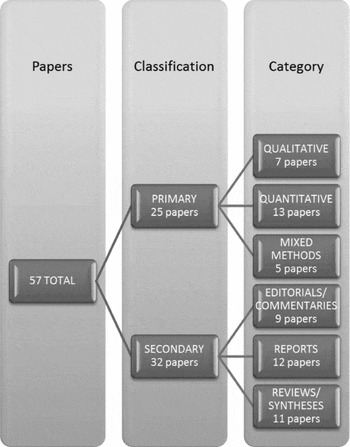
Following this process, all papers chosen for inclusion underwent further screening to determine their weighting in the review, based on whether the papers took the form of empirical research, re-analysis of research, commentary and editorial work, or reports and policy documents. The grading system proposed by Attree (Reference Attree2004) was used, a 4-point grading scale of A-D. Papers that would have been graded as D were excluded through the determination of quality screening. Papers that were secondary analyses or, while providing useful background evidence had only limited relevance to the research question, were graded C. Papers graded A or B were primary papers of rigorous quality that were used to identify main themes and concepts. The difference between A and B was determined by their relevance to the research question. The grading of papers facilitated the emergence of prominent themes during the iterative phase of the analysis. Of the 109 papers initially included, 54 were eventually excluded, resulting in 57 papers to be included in the review (see figure 2).
Categorisation of papers included in the systematic review.

Data Extraction
During the data extraction process, each paper went through a rigorous examination during which the aims, methods, frameworks, instruments, and key findings were identified and recorded. Alongside the extraction of data, as per the CIS method, a critical analysis of each paper was undertaken to investigate how the paper/report was presented, represented, or positioned within the literature. The full data extraction process for the 54 papers is available via the online supplementary material.
Conducting the Analysis
The distinctive characteristic of the CIS method is its movement beyond a summary of the data reported to a more fundamental critique which may involve questioning taken for granted assumptions (Dixon-Woods et al., Reference Dixon-Woods, Cavers, Agarwal, Annandale, Arthur, Harvey and Sutton2006, p.4). The CIS method allowed the critique of literature to be ‘dynamic, recursive and reflexive’ rather than a series of single, final steps. The iterative and interactive phase of the analysis uncovered a variety of potential themes and sub-themes. As these emerged they were identified and coded to document patterns, categories, and the frequency of each theme across the literature, while recursive and reflexive processes enabled early and emergent themes to be further developed. Ultimately many papers went through multiple inspections as they were compared against the themes and theoretical structures being developed throughout the analysis. From this process, seven prominent and distinct themes were identified, based on their frequency across the literature and the weighing given to the papers from which they emerged, and they correspond to the seven thematic categories presented in the findings below. As per the CIS method, each theme is discussed in regard to the way it is represented and positioned within the literature.
Findings
Conceptualisations of Health and Wellbeing for Young Children – Australia and Internationally
Discussion about social indicators, used to detect evolving norms, values, and changes in children's health and wellbeing status, was the most common theme found by this review. There was much discussion about the importance of social indicators and their potential value in responding to a range of needs and concerns relating to health and wellbeing such as: identification, monitoring, goal setting, and increased accountability (Moore, Brown, & Scarupa, Reference Moore, Brown and Scarupa2003; ARACY, 2013; Eldridge, Beneforti, & Macdonald, Reference Eldridge, Beneforti and Macdonald2011; Janus, Brinkman, & Duku, Reference Janus, Brinkman and Duku2011; Sayers et al., Reference Sayers, West, Lorains, Laidlaw, Moore and Robinson2012; Ure, Reference Ure2008). However, a significant challenge was the lack of consistency in the call for, use of, and/or application of social indicators to childhood health and wellbeing research. While child social indicators are meant to provide meaning for statistical data and empirical support for theories and models, they raised a host of validity and reliability challenges (Ben-Arieh, Reference Ben-Arieh2012), which the literature did not engage with or attempt to resolve.
While investigating the social indicators literature, the review found the terms ‘health’ and ‘wellbeing’ were used largely interchangeably and often without further definition. While it is to be expected that these concepts would have a variety of different definitions depending on epistemological or discipline specific views, health and wellbeing are different concepts (see Earls & Carlson, Reference Earls and Carlson2001). When health and wellbeing are used interchangeably or lumped together as synonymous terms, it becomes unclear what the research or report is suggesting should be valued, measured, or identified. This is a significant limitation for the current literature found in this review. Compounding this confusion was the conceptualisation of indicators to identify children's health and wellbeing. In its truest sense, wellbeing is the ‘right now’, or ‘this specific point in time’. In the case of children transitioning to school, indicators for wellbeing would focus on children's quality of life in the present (Fattore, Mason, & Watson, Reference Fattore, Mason and Watson2008), their current experiences of being and being well. Despite this, the vast majority of papers in actuality referred to children's future ability to lead happy and productive lives – their well-becoming. The literature's preoccupation with well-becoming, rather than wellbeing is also evinced by the intense focus on the design and implementation of programs, interventions, and supports for children that aim to positively support children with what they will need to be happy, healthy, and fully functioning adults. The confusion in the literature regarding whether the focus should be on wellbeing as opposed to well-becoming (which appears in actuality to be of greatest concern) was a rarely stated yet recurrent issue. If child social indicators are to be used to provide statistical data and empirical support for theories and models of child health and wellbeing, further discussion pertaining to the interchangeable use of health and wellbeing, and wellbeing and well-becoming is warranted.
The Measurement of Health and Wellbeing of Children Transitioning to School
School entry is widely regarded as a useful time to reflect on children's cumulative early childhood development experiences (Goldfeld et al., Reference Goldfeld, Sayers, Brinkman, Silburn and Oberklaid2009, p. 980–981) and there has been extensive investigation of how best to obtain data on the health and wellbeing of children in this age group. Despite established links between the quality of children's early life experiences [and] indicators of health, social wellbeing, and economic viability in adult years (Ure, Reference Ure2008, p.11), there is agreement that Australia, like some other OECD countries, currently lacks a valid data source on the social and emotional wellbeing of young children (ARACY, 2013; Eldridge et al., Reference Eldridge, Beneforti and Macdonald2011). As such, the literature refers to an array of assessments and instruments designed to gauge children's capabilities, competencies, and health and wellbeing status before, during, and after the transition to school. While the systematic search included only papers which reported on an assessment/measurement tool that covered at least one aspect of health and wellbeing, this review found 87 different instruments in recent and/or current use (AIFS, 2014; Corter, Patel, Pelletier, & Bertrand, Reference Corter, Patel, Pelletier and Bertrand2008; Curtis & Simons, Reference Curtis and Simons2008; Denham, Reference Denham2006; Edmunds & Stewart-Brown, Reference Edmunds and Stewart-Brown2002; Giallo, Kienhuis, Treyvaud, & Matthews, Reference Giallo, Kienhuis, Treyvaud and Matthews2008; Goldfeld et al., Reference Goldfeld, Sayers, Brinkman, Silburn and Oberklaid2009; Guhn, Janus, & Hertzman, Reference Guhn, Janus and Hertzman2007; Guhn, Zumbo, Janus, & Hertzman, Reference Guhn, Zumbo, Janus and Hertzman2001; Hymel, LeMare, & McKee, Reference Hymel, LeMare and McKee2011; Janus et al., Reference Janus, Brinkman and Duku2011; Janus & Duku, Reference Janus and Duku2010; McIntyre, Eckert, Fiese, DiGennaro, & Wildenger, Reference McIntyre, Eckert, Fiese, DiGennaro and Wildenger2007; Rural and Regional Health and Aged Care Services Division, 2003; Sayers et al., Reference Sayers, Coutts, Goldfeld, Oberklaid, Brinkman and Silburn2007; Sayers, Reference Sayers2008; Sayers et al., Reference Sayers, West, Lorains, Laidlaw, Moore and Robinson2012; valentine, Thomson, & Antcliff, Reference valentine, Thomson and Antcliff2009; Wildenger & McIntyre, Reference Wildenger and McIntyre2012).
The focus of these instruments varied considerably and, through the process of data extraction and analysis, they were categorised into eight groups: social and emotional competency focus (17), behaviour focus (18), teacher/educators perspective focus (13), academic skill focus (14), health assessment/diagnostic focus (10), parent/family perspective focus (8), transition to school focus (4), and learning/care environment focus (3). A full listing of the instruments and categorisation can be found via the online supplementary material. The differing foci of these instruments make it difficult to compare the instruments in terms of their validity/psychometric properties, or their ability to contribute to a holistic understanding (incorporating both cognitive and non-cognitive measures) of child health and wellbeing during the transition to school. These challenges are also exacerbated by the lack of agreement as to whether either positive indicators (such as happiness or self-esteem) or negative indicators (such as illness or deficits) are most useful in childhood health and wellbeing research (Pollard & Lee, Reference Pollard and Lee2003).
In regard to this review's focus on the child wellbeing and well-becoming during the transition to school, the instrument that was most cited/examined/used was the Early Development Instrument (EDI) or AEDI (the Australian adaptation of the EDI) – now referred to as the AEDC (Australian Early Development census). This instrument is a teacher-completed checklist which reports on children's prior to school development (see Janus et al., Reference Janus, Brinkman and Duku2011). There was strong evidence within the literature to support the use of this instrument by studies investigating its validity and ability to act as a comprehensive tool for gathering data to identify, at the community level, areas of vulnerability for children during their transition to school (Brinkman, Reference Brinkman2012; Goldfeld et al., Reference Goldfeld, Sayers, Brinkman, Silburn and Oberklaid2009; Guhn et al., Reference Guhn, Zumbo, Janus and Hertzman2001; Janus et al., Reference Janus, Brinkman and Duku2011; Sayers et al., Reference Sayers, Coutts, Goldfeld, Oberklaid, Brinkman and Silburn2007).
Widespread and international use of the EDI/AEDI/AEDC speaks to its utility for collecting meaningful community-level data on a range of social indicators for transition-to-school aged children. However, there are still questions and concerns raised in the literature as to whether the current design of this instrument, and others, have indeed moved beyond the narrow and highly contested view of school readiness, specifically in regard to children's health and wellbeing. While the general discriminant and convergent validity of the EDI/AEDI/AEDC has been evidenced by many of the included papers, the physical health and wellbeing domain was identified by Janus et al. (Reference Janus, Brinkman and Duku2011) as having the lowest internal consistency of the five domains. The work of Hymel et al. (Reference Hymel, LeMare and McKee2011) also called into question the discriminant validity of the physical health and wellbeing domain. This suggests that while the EDI/AEDI/AEDC has demonstrated its validity and efficacy as a tool for gathering data during the transition to school, there remain questions as to the ability of the EDI/AEDI/AEDC (and other reported tools/instruments) to accurately and comprehensively report on dimensions of health and wellbeing.
Parents and Families as Actors and Agents in Supporting the Transition to School
A significant amount of research was identified in the review characterising the transition to school as a process that families experience with their transitioning child, rather than as an event that happens to the child (Rimm-Kaufman & Pianta, Reference Rimm-Kaufman and Pianta2010; Sayers et al., Reference Sayers, West, Lorains, Laidlaw, Moore and Robinson2012). Indeed, there is strong agreement within the literature that families and parents are important actors within the transition process. This has likely been an important force behind the call from both policy makers, researchers, and practitioners for increased parental/family involvement in the transition to school.
The conceptualisation of the transition to school as an experience necessitating the involvement of families and parents was demonstrated by a variety of studies included in the review (Bonhan-Baker & Little, Reference Bonhan-Baker and Little2004; Dockett & Perry, Reference Dockett and Perry2004b; Giallo et al., Reference Giallo, Kienhuis, Treyvaud and Matthews2008; Giallo, Treyvaud, Matthews, & Kienhuis, Reference Giallo, Treyvaud, Matthews and Kienhuis2010; Janus, Kopechanski, Cameron, & Hughes, Reference Janus, Kopechanski, Cameron and Hughes2008; La Paro, Kraft-Sayre, & Pianta, Reference La Paro, Kraft-Sayre and Pianta2003; McIntyre et al., Reference McIntyre, Eckert, Fiese, DiGennaro and Wildenger2007; Sayers et al., Reference Sayers, West, Lorains, Laidlaw, Moore and Robinson2012; Wildenger, McIntrye, Fiese, & Eckert, Reference Wildenger, McIntrye, Fiese and Eckert2008). While the majority of these studies focused on the experiences of transition from both a parent and family perspective, there was also discussion about children's experiences and how these differed from those of parents and family. Dockett and Perry's (Reference Dockett and Perry2004b) findings articulated discernible differences between the experiences and perspectives of children and parents, and highlighted the important implications of this when creating partnerships between schools and families. Similar findings emerged in a study by Laverick (Reference Laverick2008), which emphasised the need to account for these differences within the transition process. Both in terms of policy and practice, the repositioning of the parents and families as active actors and agents during the transition process now sees family involvement increasingly recognised and called for in the development of transition programs (Bonhan-Baker & Little, Reference Bonhan-Baker and Little2004; Dockett, Reference Dockett2008; McInnes & Nichols, Reference McInnes and Nichols2011). In addition, partnerships between parents and family and other transition actors (schools, early learning and care, health, and community agencies) have received significant attention. Likewise, there has been broad interest in the experiences of parents and families, and how they relate to child health and wellbeing, with studies examining areas such as: parental efficacy (Giallo et al., Reference Giallo, Kienhuis, Treyvaud and Matthews2008), parenting intervention programs (La Paro et al., Reference La Paro, Kraft-Sayre and Pianta2003; Thompson, valentine, Mullan, Longden, & Harrison, Reference Thompson, valentine, Mullan, Longden and Harrison2010), and past and present experiences of parents and families during transition (Janus et al., Reference Janus, Kopechanski, Cameron and Hughes2008; McIntyre et al., Reference McIntyre, Eckert, Fiese, DiGennaro and Wildenger2007; Wildenger et al., Reference Wildenger, McIntrye, Fiese and Eckert2008).
While there was significant evidence to show that partnerships between parents/families and other transition actors are integral to successful transitions and the design/implementation of services, research has also highlighted that there can be impediments to this. In a recent study by Kaehne and Catherall (Reference Kaehne and Catherall2013), findings suggested that, despite efforts to include family/parents through service co-location and planning, the majority of parents were unaware or mistaken about changes to services and the impacts on transitions for their children. Parents’ lack of knowledge about organisational structures and professional practice within children's services, as well as their focus on the specific needs of their own child rather than on those of children more generally, were issues raised by the authors (Kaehne & Catherall, Reference Kaehne and Catherall2013). In another review of the literature and research study of partnerships between parents and early childhood service providers, McInnes and Nichols (Reference McInnes and Nichols2011) also identified a potential lack of congruence between the goals and needs of parents and service providers, arguing that partnerships among a variety of professionals and parents can be disempowering for parents, adding layers of complexity and introducing barriers to their ability to make decisions based on their child's needs.
While it is not reasonable to expect all parents to have high-level competencies in early childhood development and education, the specific knowledge they bring about their child and the child's needs remains an essential component of successful transitions, as identified in ecological models of transition. However, it does raise questions about what partnerships between parents and transition actors could or should look like. Several papers also cautioned against the assumption that a partnership model is necessarily ‘good’ or ‘best’ practice. Papers critical of the view that partnerships in and of themselves are the best solution point out that partnerships should be carefully constructed, facilitated and examined in order to maximise their efficacy (Kaehne & Catherall, Reference Kaehne and Catherall2013; Nichols & Jurvansuu, Reference Nichols and Jurvansuu2008; Wong, Sumsion, & Press, Reference Wong, Sumsion and Press2012).
Service Integration in Early Childhood Education and Care
Calls for further service integration in early childhood education and care sectors feature prominently in the literature, with service integration seen as a tool for supporting the health and wellbeing of children and families (AMA Taskforce on Indigenous Health, 2013; Atkinson, Doherty, & Kinder, Reference Atkinson, Doherty and Kinder2005; Eastman, Newton, Rajkovic, & valentine, Reference Eastman, Newton, Rajkovic and valentine2011; Mustard, Reference Mustard2008; Rural and Regional Health and Aged Care Services Division, 2003; Schmeid et al., Reference Schmeid, Donovan, Kruske, Kemp, Homer and Fowler2011; Sims, Reference Sims2011; The Centre for Community Child Health, 2008). While there are a variety of different definitions of service integration and what it entails, it is generally considered to constitute services that are connected in ways that create a comprehensive and cohesive system of support (Dockett et al., Reference Dockett, Einarsdottir and Perry2011, p.5). However, within the reviewed literature, service integration was often left undefined (see Wright, Reference Wright2005 for further discussion and examples of early years service integration in Australia).
Although papers sometimes mentioned the rationale for the integration or ‘joining-up’ of services (Wong & Press, Reference Wong and Press2012), several discussed the often ‘unspoken’ problems that come with service integration, such as difficulties working in multi-disciplinary teams and interprofessionally (Nichols & Jurvansuu, Reference Nichols and Jurvansuu2008; Rous, Myers, & Stricklin, Reference Rous, Myers and Stricklin2007). Wong, et al. (Reference Wong, Sumsion and Press2012) also argue that including educators and health practitioners in collaborative teams can become problematic due to existing hierarchical structures, which often devalue the work of those in the early education and care sector. Calls for increased service integration have been widely echoed in policy documents and reports in Australia, yet concerns remain about the almost complete lack of empirical evidence regarding the impacts of service integration on child and family outcomes (Wong & Sumsion, Reference Wong and Sumsion2013).
School Readiness and ‘Ready Schools’ within the Context of Health and Wellbeing
‘School readiness’ (or children's readiness for the transition to school) continues to be a highly contested concept evoking specific criticism within the literature (for further discussion see Graue, Reference Graue2010). While some papers claimed that current conceptualisations of school readiness have moved far beyond previously narrowly defined cognitive skills-based definitions (see Janus & Duku, Reference Janus and Duku2010), the utility of focusing on the child's ability to be ready for school as an important and necessary aim for early years education and care continues to be debated in the reviewed literature (Curtis & Simons, Reference Curtis and Simons2008; Dockett, Mason, & Perry, Reference Dockett, Mason and Perry2006; Goldfeld et al., Reference Goldfeld, Sayers, Brinkman, Silburn and Oberklaid2009; Guhn et al., Reference Guhn, Janus and Hertzman2007; La Paro et al., Reference La Paro, Kraft-Sayre and Pianta2003). There has also been some attempt to re-focus school readiness from children needing to be ready for school, to schools being ready to support the health and wellbeing of children (Clark & Zygmut-Fillwalk, Reference Clark and Zygmut-Fillwalk2008; Curtis & Simons, Reference Curtis and Simons2008). However, these ‘expanded’ views of readiness remain closely tied to cognitive measures of reading and math proficiency (Curtis & Simons, Reference Curtis and Simons2008; Janus & Duku, Reference Janus and Duku2010).
While some studies attempted to investigate health and wellbeing during the transition to school independently of academic variables, these studies were largely focused on socio-behavioural outcomes such as problem behaviour (Edmunds & Stewart-Brown, Reference Edmunds and Stewart-Brown2002; Rimm-Kaufman & Pianta, Reference Rimm-Kaufman and Pianta2010; Wildenger & McIntyre, Reference Wildenger and McIntyre2012), which, as this synthesis argues, is no more holistic in regard to health and wellbeing than the academic measures they seek to move away from. The literature clearly identifies the need to expand of the concept of ‘school readiness’, though there was no agreement as to how this might be redefined.
A Focus on those Most at Risk During Transition
Within the literature there was a subset of papers and reports that focused on specific populations identified as ‘at risk’, such as children with special needs and/or chronic health conditions, children and families from low socio-economic status backgrounds, children of immigrant and refugee families, and Indigenous children (AMA Taskforce on Indigenous Health, 2013; Dockett et al., Reference Dockett, Mason and Perry2006; Janus et al., Reference Janus, Kopechanski, Cameron and Hughes2008; Janus, Lefort, Cameron, & Kopechanski, Reference Janus, Lefort, Cameron and Kopechanski2007; Kaehne & Catherall, Reference Kaehne and Catherall2013; Rous et al., Reference Rous, Myers and Stricklin2007; Sayers et al., Reference Sayers, West, Lorains, Laidlaw, Moore and Robinson2012; Sims, Reference Sims2011). While this review has highlighted that child health policies frequently emphasised the need for a partnership approach to be combined with a mix of flexible integration strategies, this is particularly so where vulnerable and disadvantaged families are concerned (Schmeid et al., Reference Schmeid, Donovan, Kruske, Kemp, Homer and Fowler2011). Of these ‘at risk’ groups, Indigenous children and children with special needs attracted the most attention in the literature.
As this synthesis has already demonstrated, the measurement of health and wellbeing through validated assessment tools is a focus for much of the literature. However, as Sayers et al. (Reference Sayers, West, Lorains, Laidlaw, Moore and Robinson2012) indicate, the research regarding ‘at risk’ families is particularly focused on whether [identified] tools would be applicable and inclusive for all children; in particular, families with an Indigenous or culturally and linguistically diverse (CALD) background or who have a child with a disability (2012, p.48).
In Australia, research and policy documents concerning Indigenous children and families stressed the need for flexible and integrated strategies specific to Indigenous community needs in order to work towards reducing, and eventually eliminating, health disparities between Indigenous and non-Indigenous children (AMA Taskforce on Indigenous Health, 2013; Dockett et al., Reference Dockett, Mason and Perry2006; Sims, Reference Sims2011). In addition, Dockett and Mason (Reference Dockett, Mason and Perry2006) assert that assessment tools and school readiness checklists also need to be adapted for Indigenous children because what is valued in their culture is not what is generally assessed (2006, p.143). This is echoed by Sims’ findings (Reference Sims2011), which indicate that policy recommendations, planning, and practices to support Indigenous students are often based on assumptions that Indigenous early years support and programs can be modelled on programs for non-Indigenous children.
While it was encouraging to observe an increased interest in supporting Indigenous children's outcomes in the early years, this review also noted quite disparate approaches to supporting Indigenous health and wellbeing. For example, the report by the AMA Taskforce on Indigenous Health (2013), titled The Healthy Early Years – Getting The Right Start in Life, was largely written from a biomedical and individualistic standpoint, focusing heavily on risks and what Indigenous families and parents can (and should) do to prevent poor health outcomes for their children. While this report did highlight key issues and challenges for Indigenous families and the services that support them, it took little account of the social determinants of health and power relationships that are key factors in health disparities between Indigenous and non-indigenous Australians. In contrast, Growing up in Australia: The Longitudinal Study of Australian Children – Annual statistical report commissioned by the AIFS (Sims, Reference Sims2011) identified similar key issues, but instead took a strengths-based approach to the amelioration of health disparities faced by Indigenous children and families.
Children with special needs were identified as the other key ‘at risk’ group in this review. While there was a substantial amount of literature on transitions for children with special needs, there was very little literature relating to the transition to school, with only two papers explicitly concerned with this topic (Janus et al., Reference Janus, Kopechanski, Cameron and Hughes2008; Rous et al., Reference Rous, Myers and Stricklin2007). This finding echoes a review conducted over seven years ago by Janus et al. (Reference Janus, Lefort, Cameron and Kopechanski2007), demonstrating a continued gap in the field's knowledge base. There were, however, four other papers that, in some way, addressed related aspects of health and wellbeing for young children with special needs during transitions (Brinkman, Reference Brinkman2012; Edmunds & Stewart-Brown, Reference Edmunds and Stewart-Brown2002; Janus et al., Reference Janus, Lefort, Cameron and Kopechanski2007; Kaehne & Catherall, Reference Kaehne and Catherall2013).
While the literature generally differentiates between the specific needs of ‘high risk’ groups, it is important to note that high risk categories often overlap. For instance, Indigenous students are over-represented in special education (Graham, Reference Graham2012), and there is a correlation between children considered at risk due to low socio-economic status and those considered at risk due to special health care and education needs (Goldfeld, O'Connor, Sayers, Moore, & Oberklaid, Reference Goldfeld, O'Connor, Sayers, Moore and Oberklaid2012). This, taken with the findings of papers included in this review, suggests that there remains a dearth of knowledge and research addressing high risk child populations and their health and wellbeing as they transition to school.
The Voice of the Child in their Own Wellbeing
The last theme emerging from this synthesis is the role that children's voices can and/or should play in early childhood health and wellbeing research. A small number of papers were found to have addressed this theme (Dockett & Perry, Reference Dockett and Perry2004b; Goldfeld et al., Reference Goldfeld, O'Connor, Sayers, Moore and Oberklaid2012; Jones & Sumner, Reference Jones and Sumner2009; Stephenson, Reference Stephenson2012a). Of the four papers that explicitly covered an aspect of child voice, only one was specifically about child voice and children's understanding of their own wellbeing (Stephenson, Reference Stephenson2012a). Two other papers included some data from children (through surveys or focus groups) as part of their wider data collection (Dockett & Perry, Reference Dockett and Perry2004b; Goldfeld et al., Reference Goldfeld, O'Connor, Sayers, Moore and Oberklaid2012), and a fourth extolled the virtues of including child voice, yet lacked frameworks, methods, examples, or suggestions of how to incorporate or highlight child voice within research (Jones & Sumner, Reference Jones and Sumner2009). Stephenson's work (Reference Stephenson2012a), however, offered an example of a highly detailed study into child voice and child wellbeing by exploring the transition of a small cohort of students moving together from the same kindergarten (pre-school) to the same primary school, and drawing on children's capacity to participate in and inform research.
The lack of interest in capturing the child's voice as part of research into child health and wellbeing is interesting considering the wider interest in including or hearing children within other areas of early childhood education and care (see Clark, Reference Clark2005). It suggests there may be an opportunity to use this alternative approach to enhance our understanding of young children's health and wellbeing across the transition to school.
Discussion
The findings of this CIS indicate that, while there is great interest in the health and wellbeing of young children, there is little cohesion across the health and education sectors in regard to research, policy, and practice during children's transition to school. In the discussion that follows, areas of contestation and continued challenge concerning the health and wellbeing of transition-to-school aged children are explored in response to key themes that emerged.
Positioning ‘Readiness’ within Health, Wellbeing, and Well-becoming
Despite the recent and considered efforts to include health and wellbeing as part of the determination of school readiness, this review asks whether it is possible or appropriate to conceptualise wellbeing (or well-becoming) as a measurable outcome that can be assessed as part of general school readiness.
There is extensive literature on the definitions of and history behind the concept of school readiness by leading authors in the field (see Graue, Reference Graue1993, Reference Graue2010; Kagan, Reference Kagan1992; Meisels, Reference Meisels, Sameroff and Haith1996; Meisels, Reference Meisels1998, Reference Meisels and Cox1999; Pianta, Cox, & Snow, Reference Pianta, Cox and Snow2007), and it is broadly understood as an outcome of children's early development (Janus & Offord, Reference Janus and Offord2007). The present review seeks to extend this literature and current debates by questioning the positioning of health and wellbeing as merely another aspect of school readiness. The literature synthesised in this review is very clear that children's wellbeing and well-becoming (throughout childhood and later years in life) depends greatly on their physical, mental, social, emotional, cognitive, and spiritual health. When health and wellbeing are positioned as generalist indicators of an overall outcome of school readiness, holistic ideas of wellbeing and well-becoming become greatly over-simplified and expressed as ‘qualities’. An example of this simplification is found in research compiled by the US National Center for Education in Statistics in which teachers stated that physical health, being ‘well-rested’, curiosity, and enthusiasm were ‘essential qualities’ of ready children (1993, as cited in Hair, Halle, Terry-Humen, Lavelle, & Calkins, Reference Hair, Halle, Terry-Humen, Lavelle and Calkins2006). Similarly, despite being created nearly a decade later, the EDI/AEDI/AEDC uses similarly random parameters to determine a child's physical health and wellbeing such as school absences, hunger, tiredness levels, and coordination (Janus & Offord, Reference Janus and Offord2007).
Rather than reimagining health and wellbeing, studies tended to continue using health and wellbeing as generalist and problematic indicators of school readiness. A way forward would be to rethink the combination of indicators necessary to assess child health and wellbeing in more holistic ways. To this end, Meisels (Reference Meisels and Cox1999) offers an alternative approach to conceptualising readiness, termed the ‘interactionist approach’, which takes into account dimensions of children's biological, social, and environmental factors in its assessment of their readiness. Further thinking and consensus around holistic measures of child health and wellbeing, taking us beyond the observation of easily measured qualities and behaviours, would support the literature's aim to move away from narrowly defined conceptualisations of readiness. This would also promote further discussion and engagement with the question of what should be the actual focus of these measurements: health, wellbeing, or well-becoming? And what indicators might be chosen to meaningfully explore these.
Whose Voice is being Heard?
In the review's earlier discussion of instruments used to measure at least one facet of health and wellbeing, it was noted that the vast majority of instruments were completed by teachers, educators, or health practitioners. Out of the 87 instruments identified, only seven investigated family and or parental experiences of their child's health and wellbeing, and only four were completed by the parents/families themselves. While not wanting to suggest that parent/family perspectives should be the sole measure, there is a significant amount of research, grounded in Bronfenbrenner's ecological systems model (Reference Bronfenbrenner1979), which has indicated the benefits of including the voices of parents and family members to a great extent in transition-to-school literature, especially if the parental/family involvement has been carefully planned, scaffolded, and supported.
Another concern that several papers raised was the absence of the child's voice within existing research on child health and wellbeing, a concern shared across many disciplines that work explicitly with children. Until the late 20th century, research paid little close attention to the experiences of children and childhood, and what attention was paid to children was based on a behaviouristic view of child development that relegated children to a primarily passive role (Corsaro, Reference Corsaro2005, p.27). These developmental approaches still dominate today, framing children as developing and incomplete versions of adults (Danby & Farrell, Reference Danby and Farrell2004) or as in their very nature not grown up and thus not yet something rather than something (Waksler, Reference Waksler1991, p.63). Despite a large and continually growing body of research that shows children to be competent actors and participants in research, and advocates for the inclusion of their own voices, in practice their voices, especially those of young children, remain most often ‘silenced’ and excluded from decisions which shape their lives (Pascal & Bertram, Reference Pascal and Bertram2009, p.253). This exclusion continues even though a number of disciplines that contribute to early years research have long-standing traditions of including the voice and experiences of marginalised people in the research process. Disciplines such as education (see the work of Freire, Reference Freire and Ramos1972), public health, sociology, and the New Sociology of Childhood (Corsaro, Reference Corsaro2005; Prout, Reference Prout2011) all advocate for Participatory Action Research methods, which require those being researched to be active participants within the process (Baum, MacDougall, & Smith, Reference Baum, MacDougall and Smith2006). Given that the need to question the nature of knowledge and the extent to which knowledge can represent the interests of the powerful and serve to reinforce their positions in society (Habermas, 1971 as cited by Baum et al., Reference Baum, MacDougall and Smith2006, p. 854) has received widespread acceptance, there is a need to critically examine whose voice and interests are being heard and included in current conceptualisations of child health and wellbeing.
The results of this synthesis suggest that the lack of attention to the child's voice is indicative of broader disengagement with children's experiences. The majority of authors felt no need to acknowledge or justify their exclusion of children's experiences, or to draw on other related research that has incorporated understandings based on children's voices, and this is underscored by many authors’ reliance on methodologies that reflect the deficit view of children as ‘incomplete adults’. For example, Hymel et al. (Reference Hymel, LeMare and McKee2011), in their study of the convergent and discriminate validity of the EDI, claim that given young children's limited cognitive and language skills and attention spans, it is not surprising that many researchers rely on adult rating as an efficient way to evaluate child attributes (2011, p.270).
While it has been recognised for over two decades, in part as a result of the United Nations Convention on the Rights of the Child (Zhang, Reference Zhang2015), that children can be positioned as active participants in social research, only two papers included and/or focused on the voice of the child in understanding and conceptualising child health and wellbeing (Dockett & Perry, Reference Dockett and Perry2004b; Stephenson, Reference Stephenson2012a). By contrast, the increasing value and importance given to children's voices in other areas of early years research is reflected by a recent large-scale study children's views of their community, involving 350 young children, their families, and educators in South Australia (Harris & Manatakis, Reference Harris and Manatakis2013), and a previous study of early experiences of school by Briggs and Potter (Reference Briggs and Potter2003), involving 100 five-to-six year olds. As such, the question for researchers working in the early years is no longer why the voice of the child is important, but how can it be captured (Stephenson, Reference Stephenson and Gioia2012b). While there remains some debate about how best to authenticate and meaningfully incorporate children's voices into the research process (see Zhang, Reference Zhang2015), there is broad support for a number of research methods that allow researchers to ‘listen’ to children (Clark, Reference Clark2001; Dockett, Einarsdottir, & Perry, Reference Dockett, Einarsdottir and Perry2011; Lipponen, Rajala, Hilppö, & Paananen, Reference Lipponen, Rajala, Hilppö and Paananen2015). These include the Mosaic Approach (Clark, Reference Clark2001), the Jigsaw Approach (Stephenson, Reference Stephenson2012a), the Children's Voices Framework (Harris & Manatakis, Reference Harris and Manatakis2013), and visual and video observatory methods (Clark, Reference Clark2011; Pálmadóttir & Einarsdóttir, Reference Pálmadóttir and Einarsdóttir2015), which suggest future ways to capture children's understandings and experiences of their health and wellbeing, and challenge the nature of current knowledge.
Integration: What do we Need to Know?
As reported in the findings, service integration continues to be the main focus of Australian early years policy and research, a finding that can be attributed to the Starting Strong (2001) and Starting Strong II (2006) OECD reports which highlighted the need, through government action, to move towards the integration of early childhood education and care services (Cleveland & Colley, Reference Cleveland and Colley2013; Kaga, Bennett, & Moss, Reference Kaga, Bennett and Moss2010). These recommendations have informed policy internationally, with examples of service integration in early childhood education and care settings being programs such as Early Excellence and the Sure Start Centres in the UK, Head Start in the US, and Toronto First Duty in Canada (Cleveland & Colley, Reference Cleveland and Colley2013; Corter et al., Reference Corter, Patel, Pelletier and Bertrand2008; Kagan & Kauerz, Reference Kagan, Kauerz, Pianta, Cox and Snow2007). In their review of the literature on the integration of early years provision in Australia, Press et al. (Reference Press, Sumsion and Wong2010) note that annual state and national government reports, and the websites of the relevant departments, clearly reflect the widely held belief that further service integration is important and beneficial for Australia. This has been demonstrated by attempts to increase integration for national and state programs (for example, via National Partnerships in the early years through the Council of Australian Governments), as well as efforts to integrate service delivery for children and families across state government departments (Press et al., Reference Press, Sumsion and Wong2010, p. 3–4). Nevertheless, while there are a number of different models being used to improve service integration, this review has found there is a lack of empirical research to support that assumption that service integration, in and of itself, has beneficial impacts on child health and wellbeing, and this remains an area for further investigation.
Methodological Concerns Encountered
As is the case with any qualitative or partially qualitative analysis, presenting a fully transparent account of the methods and processes used in the creation of this synthesis is made difficult by the creative processes entailed by critical analysis. To address this concern and add to the review's rigor, a multi-disciplinary team of academics working across Early Childhood Education, Public Health, and Social and Policy Studies were involved in the triangulation of data during data extraction, and contributed to review's processes of analysis.
Future Pathways
Current conceptualisations of young children's health and wellbeing and the role of service integration in the early years clearly emerged from the findings of this review as two areas demanding further exploration and empirical research. The current literature evidently conceptualises young children's health and wellbeing in ways that are problematic, and the emerging challenges are compounded by the use of deficit-based child development models that have led to the exclusion of children's voices from existing research. While there is certainly a place for adult-led measures and assessment of child health and wellbeing, this review argues that the reliance on these methods comes at the expense of child-centred understandings of children's health and wellbeing. Clearly there is not only a lack of empirical research regarding child health and wellbeing, but also a lack of acknowledgement for and valuing of young children's ability and capacity to be active participants in childhood research, rather than passive recipients of service delivery.
In light of these findings, this review asserts that there are several key questions that could usefully guide future research. The first relates to whether health and wellbeing can be meaningfully positioned as outcomes within the transition to school. Can health and wellbeing be usefully defined in ways that move beyond narrow conceptualisations of school readiness, and, if so, what would the appropriate indicators of health and wellbeing be, and from whose perspective? Finally, in order to redress the lack of empirical evidence concerning the need for and impacts of service integration, future research must ask: What are the impacts of service integration on young children and their families? Does it deliver the benefits assumed by policy makers, and, if so, what models make service integration most effective as a way to support children during the transition to school?
Supplementary Material
To view supplementary material for this article, please visit http://dx.doi.org/10.1017/S1035077216000043.