

The Inca state resettlement program known by the term mitmaq was massive in scope. Early colonial sources indicate that entire Andean communities, often including hundreds of families, were uprooted and forced to move—sometimes enormous distances—to establish residence in foreign territories (D'Altroy Reference D'Altroy and Stein2005; Espinoza Soriano Reference Espinoza Soriano1969–1970, Reference Espinoza Soriano1973, Reference Espinoza Soriano1975, Reference Espinoza Soriano1975–1976; Murra Reference Murra1978; Pease Reference Pease, Collier, Rosaldo and Wirth1982; Wachtel Reference Wachtel, Collier, Rosaldo and Wirth1982). Colonies of mitmaqkuna seem to have been nearly ubiquitous at the time of the Spanish invasion. As Cobo (Reference Cobo1892 [1653]:225) noted, “People were so mixed and scrambled with those of other provinces, that there was scarcely a valley or village in all of Peru without an ayllo or parcialidad of mitimaes” (translation by authors; see also Guamán Poma de Ayala Reference Guamán Poma de Ayala1936 [1613]:340). According to the chroniclers, mitmaqkuna fulfilled many functions, including garrisoning frontiers, colonizing new lands, producing agricultural surplus for state stores, extracting valued resources, disseminating knowledge about citizenship and imperial expectations, and manufacturing state goods (Cieza de León Reference Cieza de León1986 [1553]:63‒67).Footnote 1
Mitmaqkuna were relocated throughout the provincial districts as well as to Cusco itself, creating what Rowe (Reference Rowe and Steward1946:270), echoing Cobo, once referred to as “a regular melting pot.” According to the chroniclers, the installation of mitmaqkuna was typically one of the first steps taken toward imperial integration, mentioned in the same sentence as the appointment of a provincial governor, the building of a temple to the sun, and the extension of the royal road (e.g., Cieza de León Reference Cieza de León1986 [1553]:155, 161‒163, 170‒179). How did the interactions between such involuntary state agents and local inhabitants of state-appropriated territories work? How did the ethnic communities forced together by imperial fiat engage with one another? What were the social, ideological, and technological effects of such disruptive state interventions? Would they have resulted in the homogenization of ethnic difference, as envisioned by Rowe (Reference Rowe and Steward1946:270), or would animosities and boundaries between groups have increased in intensity? Here we examine some of these questions through the lens of a communities of practice model that focuses on tool assemblages and the technological chaîne opératoire associated with ceramic manufacture.
Mitmaqkuna and the Production of State Goods
There are only a handful of references regarding the resettlement of craft specialists as part of the overall Inca program of relocation. The best known pertains to a settlement of mitmaqkuna found within the territory of the Lupaqa in the Lake Titicaca basin; it was initially brought to light by Murra (Reference Murra1978). Inspections undertaken by Spanish functionaries in 1567 and 1583 reported on the existence of colonies of artisans consisting of potters, feather workers, and weavers placed there by the Inca after the conquest of Collasuyu. Archaeological investigations conducted by Spurling (Reference Spurling1992) in this area at the site of Milliraya yielded evidence of imperial Inca ceramic production. Another example, published by Espinoza Soriano (Reference Espinoza Soriano1969–1970), refers to the movement of pottery-producing specialists from the Collique region of the north coast of Peru to the site of Shultín in the northern highlands near Cajamarca. In both cases, the evidence suggests that the relocated mitmaq potters produced both imperial Inca and local-style wares, likely using their own traditional techniques of manufacture (Hayashida Reference Hayashida1999; Ramón Reference Ramón2008a:103, Reference Ramón2016:32; Spurling Reference Spurling1992).
Early historic references indicate that enclaves of mitmaqkuna potters were also present in the Department of Ancash in the north-central highlands of Peru, which is the region of interest in this article (Ramón Reference Ramón2008a:110‒111). It was reported that the Inca had moved potters from the communities of Pararin and Pira (Ancash) to the southern extreme of Huaylas two generations before the Spanish invasion (Hernández Príncipe Reference Hernández Príncipe and Duviols2003 [1621]:763‒764, 776). Zuloaga (Reference Zuloaga2012:70) also noted the presence of mitmaqkuna in the southern sector of Ancash, among whom were potters. Those mitmaqkuna relocated to the administrative subdivision of Huaraz in Huaylas Province in Ancash were originally from Yauyos, near modern-day Lima (Álvarez Reference Álvarez1969 [1558]:17‒18). In the Conchucos region of Ancash farther to the north, a certificate of encomienda dated to 1542 notes the presence of “quitos, condesujos, and cañares”—presumed mitmaqkuna colonies—living in the Huari district, which lies in the south-central part of Conchucos (Chocano Reference Chocano2016:76; León Gómez Reference León Gómez2018:39n19). Interestingly, the town of Pomabamba, which is in this region, retains a sector called Cañari, suggesting the earlier presence of Inca mitmaqkuna. The surname Cañari is also present in Ancash (León Gómez Reference León Gómez2018:142).
In Tawantinsuyu, two of the most highly disrupted and widely dispersed ethnic populations were the Cañari and the Chachapoyas (Espinoza Soriano Reference Espinoza Soriano1975–1976:63). Both were known to have been fierce opponents of the Inca. The original territories of the Cañari and Chachapoyas were the southern Ecuadorian highlands and the montaña region of northeastern Peru, respectively. Yet the communities (ayllus) of Cañari and Chachapoyas appear in the earliest Spanish census records throughout the four quarters of the Inca Empire, from the northernmost frontier of the Pasto region to the southernmost realms of central Chile (Espinoza Soriano Reference Espinoza Soriano1975–1976; Salomon Reference Salomon1986:163). In addition to suffering territorial dislocation, men of both ethnic groups were regularly drafted into the personal guard of the later Inca kings Topa Inca and Huayna Capac (Ayavire y Velasco Reference Ayavire y Velasco2011 [1582]:48), perhaps as an Inca strategy to keep their enemies close.
Scope of Study
For all the early colonial references to Inca resettlement practices and the purportedly enormous scale on which they occurred, the archaeological identification of such communities has proven elusive (Hu Reference Hu2019:990). One obvious difficulty is that most such deportees were undoubtedly simple farmers and herders rather than artisans or craft specialists. In the relatively few archaeological studies geared toward the investigation of Inca mitmaqkuna, efforts to identify their settlements relied primarily on the presence of nonlocal ceramic styles, sometimes supported by comparative paste analyses (e.g., Lorandi Reference Lorandi1984; Makowski Reference Makowski2002; Spurling Reference Spurling1992; Williams and Cremonte Reference Williams, Cremonte and Lorandi1997). But as D'Altroy (Reference D'Altroy and Stein2005:283‒286) and others have noted, Inca-era sites suspected of having been populated by mitmaqkuna are more often than not found to contain Inca-style remains, rather than the material culture of the displaced ethnic subjects.
Given the various problems encountered by previous studies emphasizing markers of ethnic difference based on ceramic vessel shapes, decoration, and petrography, we propose a different approach for identifying mitmaqkuna that considers all the components of the chaîne opératoire (including toolkits) and pays particular attention to manufacturing techniques. Until recently, toolkits and chaînes opératoires were not an important focus of study for Andean archaeologists. But the artifacts involved in production provide critical insight into the manufacturing techniques used by different communities of practice. As such, they may be considered both cultural products and cultural markers. Andean potters do not learn their craft in the abstract but rather develop their skills in conjunction with specific toolkits and manufacturing techniques (Lara Reference Lara2020:109; Ramón Reference Ramón2008a; Ramón and Bell Reference Ramón and Bell2013).
The chaîne opératoire of pottery making involves six actions: acquiring and preparing raw materials, manufacturing, finishing, surface treatment, decoration, and firing (for Andean examples, see Bankes Reference Bankes, Saunders and Montmollin1988; Brazzero Reference Brazzero2011; Camino Reference Camino1982; Holm Reference Holm1967; Ravines Reference Ravines, Ravines and Villiger1989; Sabogal Wiesse Reference Sabogal Wiesse1982; Sjöman Reference Sjöman1992). Of particular interest here is manufacturing, which may be divided into two stages. The first one produces a roughout or “a hollow volume that does not present the final geometric characteristics of the recipient” (Roux Reference Roux2019:41). The second stage produces a preform: “a hollow volume with the geometric characteristics of the recipient without undergoing the finishing operations. It is obtained by shaping operations” (Roux Reference Roux2019:41). This secondary, shaping step is typically accomplished via the application of either percussion or pressure—the two main families of secondary forming techniques. Percussive methods include beating, which involves forming the vessel walls by simultaneously striking the internal and external surfaces of the vessel using a variety of artifact types. Striking or pounding the vessel walls may be carried out either when the paste is still wet or when the vessel is in a leather-hard state. The use of an external paddle, often made of wood, is one variant within the percussive-forming family. Other types of internal and external percussive instruments used in the production process include both stone and ceramic implements. In northwestern South America, the striking or percussive technique is a deeply rooted tradition, dating back to at least 100 BC in southern Ecuador (Idrovo Urigüen Reference Idrovo Urigüen1989:6; Lara Reference Lara2018:94) and to about AD 600 in northern Peru (Lara Reference Lara and Goepfert2019:37).
A review of the ethnographic literature on pottery production in these two regions finds different combinations of manufacturing processes and percussors relating to the use of the striking technique (e.g., Bankes Reference Bankes, Saunders and Montmollin1988:549; Camino Reference Camino1982:45, Christensen Reference Christensen1955:11; Druc Reference Druc1996:28, Reference Druc2005:75, Reference Druc2009:95; Echeandía Reference Echeandía1983:21; Lara Reference Lara2017:96; Ramón Reference Ramón2008a:137, Reference Ramón2013:78; Ravines Reference Ravines, Ravines and Villiger1989:93; Sabogal Wiesse Reference Sabogal Wiesse1982:1:46; Sjöman Reference Sjöman1992:47). From the point of view of ceramic production technologies, this panorama suggests the possibility of multiple diachronic and synchronous phenomena of migrations and technical loans. The juxtaposition of distinct communities of practice living in proximity or the documented cases of potters in geographically distant localities using similar production tools and techniques (such as found in the Department of La Libertad in Peru studied by Ramón Reference Ramón2008a:203n11) have yet to be more deeply analyzed or theorized from a regional and diachronic perspective.
In Peru today, potters in most villages in rural areas who use the percussive technique employ a wooden paddle that is beaten against the exterior wall with a small stone used as an anvil (yunque) held against the interior wall.Footnote 2 Most of these villages are on the north coast of Peru (e.g., Simbilá). However, in highland Ancash, there are some places where the percussive technique is used but the stone yunque is not. In this department, potters in 13 villages in the Conchucos and Huaylas regions employ a fired clay, mushroom-shaped percussor that is known by various names, including broquel/broquichu, cutana, tucllu, and choungo (Ramón Reference Ramón2008a:169, 187, 318, 364, 397, 406, Reference Ramón2013:79). This distinctive object consists of a plain, flat, or slightly convex ceramic disc with a simple nub handle (Figure 1c, d). It is not found elsewhere in Peru, but it is very similar to an object that is widely used in the eight most active communities of rural potters in the provinces of Cañar, Azuay, and Loja in southern Ecuador—a region that maps precisely onto the territory of the precontact Cañari population (Brazzero Reference Brazzero2011:3; Lara Reference Lara2017:96; Sjöman Reference Sjöman1991:158, Reference Sjöman1992:47). In Ecuador, these ceramic percussors, which are called huactanas or golpeadores, are used on both the internal and external sides of the container to shape and thin the vessel walls (Figure 1a, b).
Modern mushroom-shaped tools in Ecuador and Peru: (a) and (b) huactanas or golpeadores (Azuay, Ecuador; photo by Catherine Lara); (c) and (d) tucllus (Ancash, Peru; photo by Gabriel Ramón). (Color online)

Considering the uniqueness of this mushroom-shaped tool, we were interested in further comparing the chaînes opératoires of ceramic manufacture and associated implements in these two regions to determine whether additional similarities might exist and, if so, whether such distinctive islands of practice in north-central Peru might be linked to the deportation of Cañari mitmaqkuna to this region during the Inca era. For this study, we focused on pottery production in two locations, one in Ecuador around the town of Nabon and the other in Peru around the village of Conopa. We selected these two sites for more detailed comparison because the corresponding pottery-making chaînes opératoires in these geographically remote villages seem to be the most similar we observed in our studies to date. Nabon is in the province of Azuay in southern Ecuador, and the village of Conopa is in the province of Pomabamba in the department of Ancash in north-central Peru; Conopa is approximately 700 km south of Nabon (Figure 2).
Map of the main geographic locations cited in text (photos by Catherine Lara and Gabriel Ramón).

Technological Traditions and Chaînes Opératoires
As previously noted by Ramón (Reference Ramón2008b:478), focusing on the toolkits associated with ceramic production is an important way of bridging the ethnographic and archaeological divide. In addition, tools are closely linked with technologies of production, which can, in turn, provide significant insights into archaeological communities of practice or social groups (Ramón Reference Ramón2008b:479; see also Gosselain Reference Gosselain2010:687; Mayor Reference Mayor2010:663). As such, the methodological approach used here is based on the concept of a chaîne opératoire, which refers to “the series of operations which transform raw material into finished product” (Cresswell Reference Cresswell1996:43). The relevance of chaînes opératoires lies in their potential to reflect social groups and the cultural choices they make (Lemonnier Reference Lemonnier and Lemonnier1993:7). We construe the notion of social groups in a broad sense as being potentially determined by any number of criteria, including gender, religion, ethnicity, family, caste, faction, and class (Roux Reference Roux2019:5). Indeed, as shown by abundant ethnographic examples worldwide, technological boundaries tend to map onto social boundaries insofar as each social group often uses its own chaîne opératoire, with the method of manufacturing being the “hard core” of the technical sequence (e.g., Calvo Trías and García Reference Calvo Trías and Rosselló2014:10‒13; Delneuf Reference Delneuf1991:80; Mayor Reference Mayor2011:33; Ramón Reference Ramón2008a:35, Reference Ramón and Bell2013:104; Ramón and Bell Reference Ramón and Bell2013:597; Roux et al. Reference Roux, Bril, Cauliez, Goujon, Lara, Manen, de Saulieu and Zangato2017; Stark Reference Stark and Chilton1999:42). In the Bulandshar district of northwest India, for instance, Muslim potters and Hindu potters use completely different kinds of wheels and firing structures (Roux et al. Reference Roux, Bril, Cauliez, Goujon, Lara, Manen, de Saulieu and Zangato2017:330), whereas in Senegal, the Halpulaar create their pottery bases by modeling, in contrast to the Mandé, a neighboring ethnic group that produces them using molds (Gelbert Reference Gelbert2003:89).
This correspondence between technological traditions and social units is explained by social learning, which necessarily implies learning from a tutor, who is almost always associated with the learner's close social circle (see, for instance, Ramón and Bell Reference Ramón and Bell2013:597). The novice's learning is achieved within a community of practice, which is a group of people whose collective practice constantly produces and reinforces a common identity (Lave and Wenger Reference Lave and Wenger1991:98; Wendrich Reference Wendrich and Wendrich2012:5). In this context, chaînes opératoires end up constituting traditions (see Dietler and Herbich Reference Dietler, Herbich, Courtin and Binder1994:247) and are therefore potentially good markers of social boundaries. This is especially true with respect to manufacturing techniques, which are comparatively more resistant to change than attributes pertaining to vessel form or decoration that may respond more readily to situational factors leading to more rapid alteration (Arnold Reference Arnold and Shimada1994:486; Gosselain Reference Gosselain2000:190; Hernández Sánchez Reference Hernández Sánchez2012:208; Ramón Reference Ramón2008a:123; Stark et al. Reference Stark, Clark and Elson1995:217). Manufacturing techniques and chaînes opératoires may, however, change because of the dynamic historical scenarios within which they are embedded. Such changes can be caused by endogenous or exogenous factors affecting social groups and can occur both diachronically and synchronously (Manem Reference Manem2020; Roux Reference Roux2019:302).
Ethnographic Fieldwork
In Ecuador, ethnographic research was carried out over a two-month period (March 2014 and October 2015) in the community of Nabon where six potters still actively produce ceramic vessels (Lara Reference Lara2017:81).Footnote 3 The study focused most intensively on one husband-and-wife team, and another pair of potters served as secondary informants. In Peru, Ramón (Reference Ramón2008a) has been engaged in research on rural pottery-making communities since the early 1990s. Of primary interest to the present study is the research conducted at the site of Conopa, where he worked with 15 potters in 2005. As part of the ethnographic fieldwork undertaken in both areas, photographic records were made of each stage of the technological chaîne opératoire, including paste preparation, vessel construction, finishing, surface treatments, decorative applications, and firing. Standardized questionnaires were also used to enhance comparability and ensure that as many parameters as possible were observed and recorded (see Ramón Reference Ramón2008a:385‒391). Observations were made of apprenticeships and learning contexts, as well as idiosyncratic practices. Both researchers recorded information on the manufacture of various vessel types and viewed each stage of production multiple times and with different potters.
Nabon, Southern Ecuador
The canton of Nabon, which is home to approximately 9,500 people (Instituto Nacional de Estadísticas y Censos 2010), is in the southern sector of Azuay Province. Potters who still practice their craft are concentrated in the community of Las Nieves (2,532 m asl), which is located very near the principal town of the canton, Nabon proper. The first written reference to the “Catholic doctrine settlement” of Nabon dates to 1685. However, archaeological excavations within the nearby site of Dumapara indicate the presence of a much earlier precontact occupation (Brazzero Reference Brazzero2011:15). The average age of the potters living in Las Nieves is 60 years; none speak Quichua or have any memory of their parents or grandparents having spoken it.
In this area today, both men and women practice pottery manufacture. According to Sjöman (Reference Sjöman1992:82), however, it was traditionally a female activity, with men only becoming involved more recently due to economic pressures. This was the case for one potter from Las Nieves, who came to the craft after marriage and learned by watching his wife work. In the case of pottery-making couples, both may participate in the process of making a single pot, or each may focus on making a specific vessel type. For potters in Las Nieves, as well as in other communities in Azuay Province, making and selling ceramic vessels does not provide sufficient income to sustain a living. Pottery manufacture is therefore supplemented by subsistence agriculture centered on the cultivation of potatoes, corn, peas, beans, and lentils, as well as raising animals such as chickens, guinea pigs, and cows. Pottery making in Azuay typically begins at the end of the wet season in April or May. Potters work intensively during the first half of the dry season to create an inventory in advance of the Festival of the Virgin of Las Nieves, where they make the majority of their sales. During this period, they fire between 35 and 50 pots every eight days on average. The morphological repertoire of the Las Nieves potters includes ollas, tortilleros, casseroles, pitchers, jugs, cups, and basins.
Conopa, Northern Conchucos Region, Peru
The village of Conopa is located two hours walking distance from the city of Pomabamba. In 2005, most of the approximately 2,300 inhabitants, including the potters, lived in small, scattered hamlets comprising about six houses each, which were located uphill from the village center at elevations ranging up to 3,800 m asl. Pomabamba belongs to the quechua (or temple) ecological level, and in its lower reaches people cultivate corn, wheat, potato, and other vegetables most of the year. The potters live in the higher sections of Conopa that belong to the jallga zone, which is associated with the limits of the herding area. In this zone, agriculture is restricted to potato, oca, and olluco.
Around 20 potters were identified in Conopa, most from the hamlets of Shogopampa and Vado. The craft is transmitted from fathers to sons during childhood and occasionally from older men to younger relatives. Wives and daughters usually help with the grinding of raw materials and the painting, firing, and distribution of vessels. In May when summer starts, the fuel for the firing, as well as the raw materials for the craft, must be collected and stored. In May and June, potters usually make some vessels, but from late June to early July during the harvesting peak, most focus on their crops or those of their relatives. After this period, they continue with their pottery-making activities until the arrival of the rains in November. The daily average number of items produced varies widely according to the target of each potter, but they can work all day long if required and are able to produce up to a dozen medium-sized pots in a sitting.
The manka (the generic Quechua term for “pot”) is the most common vessel type manufactured by potters in this region. The variety produced in Conopa has a convex base and is known more specifically by the term tullpa manka after the type of stove on which it is used. Another form with a flat base is called chacas (referring to the type of pots made in the village of Chinlla, near the town of Chacas). Any type of food may be prepared in either vessel form. In Conopa, the function of the pots is decided on after they are fired: the way in which it is subsequently used will define the pot. In this sense, they may become apimanka for gruel made of corn, oat, wheat, or barley flour; dried potatoes or chuño; and generally nonsalty foods. Its opposite is the rojromanka, which is used for salty foods, generally soups such as takapi (broken wheat soup), tzotzoga (boiled dry-grinded corn soup), papa caski (potato soup), and olluco caski (ullucu soup). The pots are intended to contain liquids, the vessel height is typically greater than the vessel diameter, and the mouth of the vessel is usually somewhat smaller in diameter. Another common vessel in the local repertoire is the cántaro or puyñu, which is a type of pitcher used to ferment and contain chicha (corn beer).
In May, potters take their wares into the surrounding countryside to exchange for choclo (corn ear). In August, the frequency of trips increases as crops for trade like wheat or pea become more available. With grains, the method of exchange is referred to as rurinwan patzayanwan wiñaipa (“in the same pot, they give to fill it”). With larger items of produce, such as oranges, potatoes, and manioc, they double the quantity or sometimes use a different system. The distance the potters travel to trade their wares is reflected in differences in exchange rates, products bartered, and units of measure.
A Comparison of Chaînes Opératoires
Detailed information on the chaînes opératoires in each community is found in Supplemental Text 1 and Supplemental Figures 1 and 2 (see also Figures 3 and 4; Lara Reference Lara2017:89, 113; Ramón Reference Ramón2008a:413‒415, Reference Ramón2013:77). The information collected in Nabon and Conopa was adapted to the descriptive grid and vocabulary proposed by Roux (Reference Roux2019:41). In this, each action of the operational sequence is described in terms of method, gestures, procedure, and tools used. The description provided corresponds to the fabrication of cooking pots, the most common shape in both communities (Figure 5). In both villages, the chaînes opératoires associated with the other vessel forms produced by the potters in these communities do not vary significantly. Table 1 provides a comparative summary of the steps involved in the chaînes opératoires of ceramic vessel manufacture in Nabon and Conopa. It shows strong technological similarities in the chaînes opératoires documented in the pottery-making communities in Azuay and Ancash, especially in the process of manufacturing the container.
Pottery chaîne opératoire in Nabon: collection/transformation of clay material and manufacturing (photos by Catherine Lara). (Color online)

Pottery chaîne opératoire in Conopa: collection/transformation of clay material and manufacturing. The potter Artemio Silvestre appears in the clay source. Justiniano Bolo is manufacturing the vessel (Ramón Reference Ramón2008a:413–415; photos by Gabriel Ramón). (Color online)

Cooking pots from study area: (a) Nabon (olla; photo by Catherine Lara); (b) Conopa (tullpa Manka; photo by Gabriel Ramón). (Color online)

Comparison of Chaînes Opératoires in Nabon and Conopa.

Note: Bold type highlights the similarities between Nabon and Conopa.
These similarities begin with the first stage of the process (collection and transformation of clay materials), where the grinding of the clay material (percussion on anvil), the kind of tempers added (mineral), and the wedging procedure are the same. In both localities, the initial construction of the vessel's base and body involves first modeling and hammering, followed by the addition of coils. The neck is shaped by discontinuous pressures while the clay is still moist. The work of shaping the base and body involves the use of percussion instruments that are pounded against the interior and exterior walls of the vessel in a hammer-and-anvil fashion when it reaches a leather-hard state. The percussive component of the manufacturing process is essential to achieving the desired shape and final form of the container. In addition, the two communities share the same inner percussion tool: the clay mushroom-shaped object called huactana in Nabon and choungo in Conopa. In both communities, pots are decorated with red paint: the formal similarity of the ollas between both communities is quite striking. Lastly, the firing technique is the same (open firing).
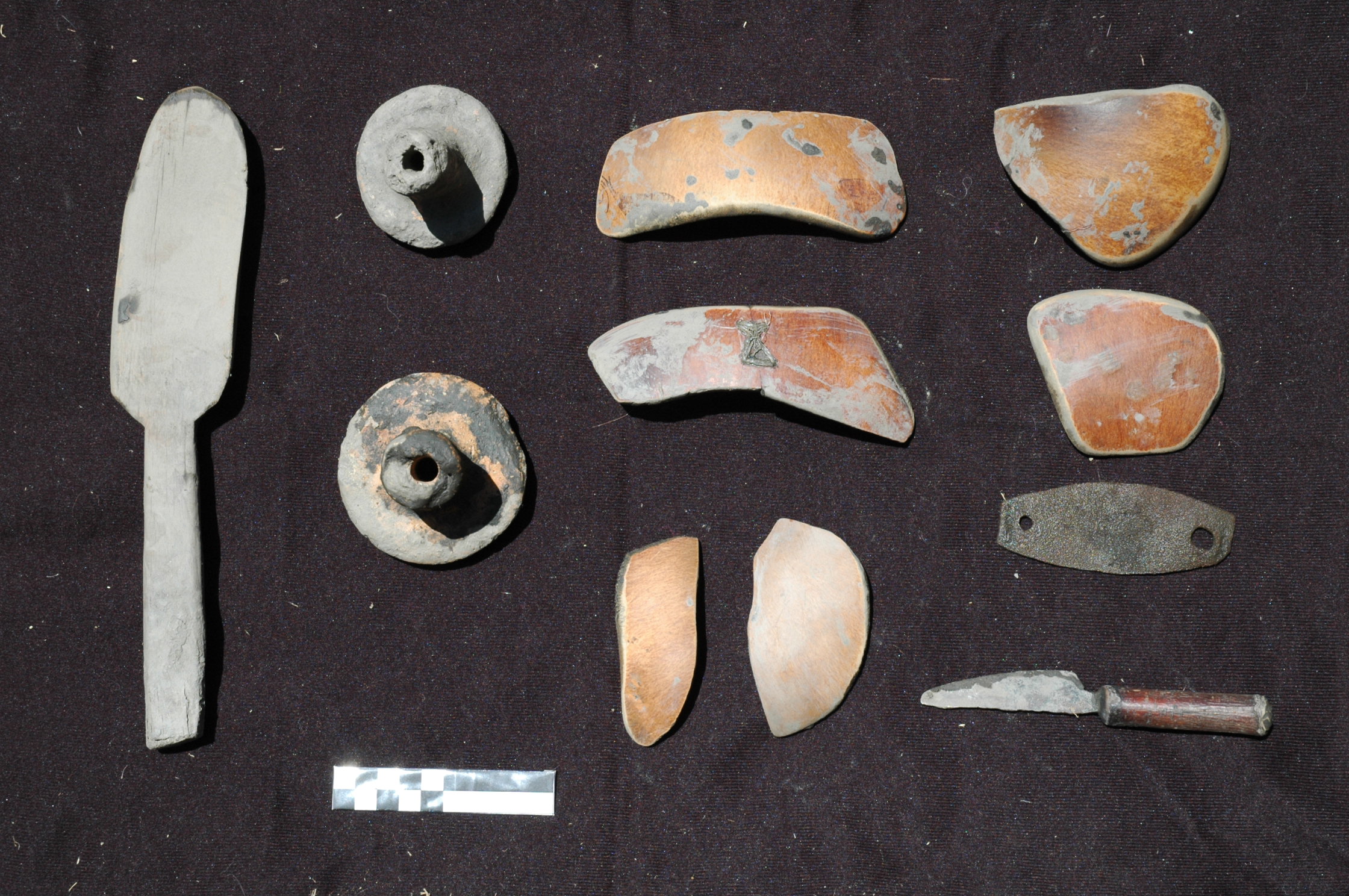
However, a few differences can be noted in the chaînes opératoires in the two villages. These differences are first related to the extraction strategy, the granulometric sorting and hydration techniques. In Conopa, neck shaping involves an additional step (continuous pressures). In Nabon, a slight scraping and beating of the humid clay of the base and body are also performed, along with a shaving of the base. Finishing operations are carried out at different moments in the manufacturing process in the two villages. Another significant difference involves the production toolkit, particularly the forming supports (a broken vessel neck in Nabon, a wooden plate in Conopa) and the outer percussion tool (the ceramic, mushroom-shaped object in Nabon and a small wooden paddle in Conopa). Pieces of leather and gourd are used in Conopa, whereas a knife is used in Nabon.
From a technological perspective, the similarities between Conopa and Nabon, especially in manufacturing operations and the shared usage of the distinctive mushroom-shaped percussors, could argue for some type of ancestral connection between the widely separated communities of practice in these two villages. The key question is how to explain these strong technological similarities.
Discussion
As noted earlier, the intent of this study was to determine whether an argument could be made for highlighting technologies of production as another way of identifying Inca mitmaqkuna. The merit of such an approach is bolstered by previous studies that found direct or indirect evidence for the maintenance of technological traditions in the form of paste recipes or toolkits discovered in the context of imperial Inca pottery-production locales (Hayashida Reference Hayashida1999; Spurling Reference Spurling1992; Williams and Cremonte Reference Williams, Cremonte and Lorandi1997). Here we suggest that the strong similarities documented in the chaînes opératoires followed by potters in Nabon and Conopa can be construed as evidence for some type of historical connection between these villages. Given the time depth of the distinctive ceramic production methods in Azuay inferred from the archaeological evidence (Lara Reference Lara2018:94), we believe that this production technology likely developed in Ecuador and was subsequently introduced in Peru. Although we cannot yet say when exactly this method of ceramic manufacture entered the Ancash region, we suggest that its association with Cañari mitmaqkuna deported to this zone by the Inca during the mid- to late fifteenth century is a viable hypothesis worthy of further investigation.
Our reasoning for the suggested north-to-south movement of this technology is based on two important observations. First, the percussion technique using an inner, mushroom-shaped tool on the interior of the vessel is found to occur earliest in Ecuador. Such objects (i.e., huactana) have been recorded in association with Tacalshapa I phase ceramics (about 100 BC–AD 1000) at several archaeological sites in Cañar and Azuay Provinces (Almeida et al. Reference Almeida, Barros, Mejía and Noboa2014:272; Idrovo Urigüen Reference Idrovo Urigüen1989:6; Sjöman Reference Sjöman1991:71; Valdez Reference Valdez1984:169). In addition, a study that compared macroscopic and microscopic traces on vessels produced by contemporary potters in southern Ecuador who use these tools with the traces observed on the Tacalshapa sherds (Figure 6a, c) offers further evidence that the archaeological materials were made using the same technique (Lara Reference Lara2017:205, Reference Lara2018:94).
Marks of beating on the inner walls of ceramics from Ecuador and Peru. Archaeological material: (a) about 100 BC–AD 1100 (Azuay, Ecuador); (b) about AD 700–1300 (Sechura, Peru). Modern ceramics: (c) Ecuador; (d) Peru (photos by Catherine Lara). (Color online)

In Peru, based on a relative chronology, Lanning (Reference Lanning1963:152) proposed that the percussive technique of pottery manufacture first came into use on the coast around AD 500. More recently, Goepfert and colleagues, excavating at the Huaca Grande site in the Sechura desert region, recovered pottery produced in this fashion in contexts dating between AD 635 and AD 675 (2σ calibration; Lara Reference Lara and Goepfert2019:37). The ceramics from the excavations at Huaca Grande are notable for the clear evidence of manufacture involving the use of an internal anvil element and for paddle-stamped decoration (Figure 6b, d). Finds of the actual percussive tools used in ceramic production in archaeological contexts in Peru are scarce, but the few noted finds consist of wooden paddles, rather than the mushroom-shaped huactana. To the best of our knowledge, the oldest find to date of a percussive pottery-manufacturing tool in northern Peru—consisting of a ceramic paddle—comes from the middle Lambayeque period site of Huaca la Pava (about AD 900‒1100; Fernández and Sánchez Reference Fernández, Sánchez, Fernández and Wester2014:322).
Second, we found no evidence for the use of percussive techniques in ceramic production in the Ancash region before the Inca period. Of course, archaeological studies oriented toward discerning chaînes opératoires and detailed analyses of manufacturing techniques are still scarce in the Andes in general, with discussion more often focused on ceramic pastes, designs, and shapes. Thus, the necessary comparative information pertaining to technologies of production is still limited. As Ibarra (Reference Ibarra and Ibarra2004:15) notes, the ceramics of the late periods in Ancash in general have been little studied: “most consist of plain fragments with little decoration, added to the fact that most settlements [in the region] are quite similar, which makes it difficult to associate [either architecture or pottery] with different ethnic groups.”
Somewhat more is known about the ceramic traditions from earlier time periods in Ancash. With respect to Recuay, for instance, which dates from approximately AD 1‒700, there appears to have been a strong preference for white-firing kaolin clays and an emphasis on the use of modeled and negative decoration (Amat Reference Amat and Ibarra2004:116). Production techniques associated with Recuay pottery involved the use of molds (Gero Reference Gero and Ibarra2013:413; Wegner Reference Wegner and Ibarra2004:134) and possibly modeling (Segura Reference Segura and Ibarra2016:104). During the Middle Horizon (about AD 700‒1000), the Recuay tradition is replaced by a plethora of local styles (see, for example, Burger Reference Burger and Ibarra2013:167; Diessl Reference Diessl and Ibarra2004:336; Lau Reference Lau and Ibarra2004:146; Terada Reference Terada and Ibarra2013:194). Inca pottery has also been recovered in the Conchucos region (Herrera Reference Herrera, Herrera, Orsini and Lane2006:9), although nothing is known about the production techniques or whether it is of local manufacture.
In sum, there are no real data currently available on ceramic manufacturing techniques during the late precontact period in Ancash; however, it is worth noting that neither are there any reports of percussive instruments (wooden or ceramic) potentially associated with pottery production in archaeological investigations in the area. This lack of data can be compared to the north coast, where the use of the paddle-and-anvil technique in pottery production (paleteado) is widely reported as beginning around AD 600, though again, little in the way of corroborating evidence, such as tools or technological studies, has been offered to support these claims. Although it is always risky to reason from negative data, it is nonetheless true that at present, there is no evidence for the use of percussive ceramic production technologies in the Ancash region before the late precontact era. New studies aimed at teasing out the chaînes opératoires involved in the manufacture of archaeological ceramics will either bolster or disprove this tentative claim. For the moment, it seems that if paddle-and-anvil techniques—which produce a distinctive patterning on vessel interiors—had been in use, this would have been noted in analyses of Ancash pottery or that the distinctive types of tools associated would have surfaced. This situation contrasts with what we find in southern Ecuador, where, as noted earlier, evidence of percussive production technologies date to around 100 BC.
From a chaîne opératoire perspective, similarities in techniques and the sequence of craft production are associated with the transfer of knowledge from a tutor to an apprentice within a specific community of practice. These similarities result from the learning mechanisms inherent in the transmission of all technical practice. Consequently, even though potters may not be living in their community of origin, they will likely continue to produce pottery using their own manufacturing technique. There are several examples of this phenomenon. In Peru, it has been reported among itinerant potters (golondrinos) who travel to different places to make pottery for local consumption, sometimes adapting shapes and designs to customer orders but always using their own manufacturing techniques. The golondrinos who ended up settling in places other than their villages of origin evidence the same pattern (Ramón Reference Ramón2013:14). At the archaeological level, Hayashida (Reference Hayashida1999) documents this phenomenon in the La Viña and Tambo Real workshops she excavated on the north coast, where ceramics with Inca shapes and designs were produced by non-Inca potters using their own techniques.
Cauliez and others (Reference Cauliez, Manen, Ard, Caro, Amara, Bocquet-Liénard and Bruxelles2017:37) report a similar situation with the Oromo ethnic group from the south of Ethiopia. Forty years ago, a group of Oromo migrated to the north of the country, yet they continue to use the same chaîne opératoire for producing pottery associated with their community of origin, despite being in regular contact with another ethnic group who employs a different chaîne opératoire. The “original” and “migrant” chaîne opératoires will eventually change with time. Such changes might be introduced through endogenous mechanisms such as “descent with modification” (Mesoudi Reference Mesoudi2011:57) or “copy and error” (Shennan Reference Shennan2011:1070). They can also be fostered by contact with other groups, through loans or horizontal transfers (for an example from the Sahelian area, see Huysecom Reference Huysecom1991–1992:88). Such mechanisms could explain the few differences noted between Conopa's and Nabon's chaînes opératoires.
It should also be mentioned that Conopa's chaîne opératoire is unique in Peru—not only in their potters’ use of the choungo but also in the combination of manufacturing techniques employed—that differ from other pottery-making communities in Peru that use the paddle-and-anvil technique. Moreover, Conopa is surrounded by hamlets where other techniques are used, which suggests that different communities of practice potentially settled there at different points in time.
Concluding Thoughts
After a detailed comparison of the manufacturing processes, the distinctive tools used, and the final products of two distant pottery-making villages in the Ecuadorian and Peruvian Andes, we tentatively propose that there may have been a historical connection between these two areas. Our current hypothesis is that the unique techniques of manufacture noted in the vicinity of Conopa in northern Ancash could have been introduced by Inca mitmaqkuna from the Cañari region. Many questions, of course, remain to be resolved, but this working hypothesis provides a direction for future archival and archaeological exploration.
To anticipate a few concerns with our hypothesis, we can consider the issue of the general distribution of the diagnostic, mushroom-shaped ceramic production tool in the Andes. If the Cañari were in fact resettled throughout Tawantinsuyu, why has their signature pottery-making tool not been found more broadly around the Inca Empire? One possibility is that Cañari pottery-making specialists were only relocated to specific regions, such as Ancash. Another is that the techniques and the toolkit introduced by Cañari potters may not have survived the disruptions of the early colonial period in different regions. Another potential issue concerns the internal distribution of the diagnostic, mushroom-shaped pottery-making tool within Ancash. We know that 13 villages in the Conchucos and Huaylas regions still today use this implement. It remains to be explored whether this tool and the associated chaîne opératoire of pottery manufacture could have been introduced by one hypothetical settlement of Cañari mitmaqkuna or whether the relocated population may have been dispersed more regionally. Finally, the hypothesized north-to-south directional movement of the specific pottery-making techniques described is a preliminary interpretation that may be further refined or modified with additional evidence.
Our investigation of potters and pottery manufacture in Conopa and Nabon has confirmed the utility of a comparative method centered on toolkits; our research involved first mapping the distribution of a unique implement, then focusing on diagnostic elements associated with its use, and comparing in detail the manufacturing techniques. As stated at the beginning of this article, this approach expands our heuristic resources, providing us with more points of comparison for exploring the past. It also highlights the need for detailed documentation of ethnographic manufacturing techniques not only to preserve knowledge of these traditions but also for the powerful insights they might lend to our interpretations of the archaeological record.
As demonstrated in previous studies, the association between social groups and chaînes opératoires in the contemporary Andes is quite clear (Calvo Trías and García Rosselló Reference Calvo Trías and Rosselló2014:10‒13; Druc Reference Druc2009:94; Holm Reference Holm1967; Lara Reference Lara2017:89; Ramón Reference Ramón2013:104; Sjöman Reference Sjöman1992). Combining a technological approach with specific attention to the associated tools of production, as we have done here, offers a roadmap for future archaeological research. The benefit of focusing attention on chaînes opératoires is that they can be reconstructed from the archaeological evidence, which can be compared with and interpreted in relation to present-day practices.
Based on our understanding of the way in which communities of practice operate, the endurance of technologies of production, and the archaeological evidence from the northern Andean region, we venture a tentative conclusion that the original chaîne opératoire involving the use of percussion and a specific set of tools for manufacturing vessels originated in southern Ecuador. We speculate that this technology may been carried to Ancash by Cañari mitmaqkuna, among whom we posit may have been craftspeople who included pottery makers. With the passage of time, the original Cañari tradition of pottery manufacture involving the use of internal and external percussors may have gradually changed based on any number of factors, including changes in consumption patterns, changing access to resources, shifting alliances, intercommunity marriage, and so on. Investigating this hypothesis further requires archaeological excavations in Ancash and more detailed analysis of the chaînes opératoires of pottery production through time in this region, as well as similar studies in other regions where Cañari were reported to have been relocated.
Acknowledgments
In Nabon, fieldwork was conducted by Catherine Lara, who thanks potters Julio and Rosa Ramón. In Conopa, fieldwork was conducted by Gabriel Ramón, José Luis Pino, and Elvis Crisóstomo in September 2005. We thank the schoolteacher Aquiles Laguna who lent us his room, as well as all the people in Conopa for their help, especially Jacinto Bermudez, Clara Bolo Moreno, Justiniano Bolo, María Huayta, Marcelino Martínez, Pablo Moreno, Artemio Silvestre, Faustino Vega, Rosa Vega, and Teodoro Vega. In 2010, G. R. returned with Martha Bell and Odolín Rodríguez Tinoco to confirm several details. Finally, we wish to thank the anonymous reviewers of our article for their helpful comments.
Funding Statement
In Nabon, fieldwork conducted by Catherine Lara was part of the ANR DIFFCERAM project directed by Valentine Roux (French National Research Center, grant ID ANR-12-CULT-0001-01). In Conopa, fieldwork conducted by Gabriel Ramón in 2005 was funded by the Robert Sainsbury Scholarship, University of East Anglia. G. R. also received support from PUCP DFI CAP 2019 grant ID 726.
Data Availability Statement
The data supporting the findings of this study are available within the article and its supplemental material. Additional information is available upon reasonable request.
Competing Interests
The authors declare none.
Supplemental Material
For supplemental material accompanying this article, visit https://doi.org/10.1017/laq.2023.39.
Supplemental Text 1. Detailed description of chaînes opératoires.
Supplemental Figure 1. Nabon toolkit (photo by Catherine Lara).
Supplemental Figure 2. Conopa toolkit plus the wooden dish that appears in the pictures of the manufacturing process (photo by Gabriel Ramón).