Introduction
In many equestrian disciplines, such as dressage and show-jumping, the aim is for the horse to be as balanced when being ridden around to the left as it is when being ridden to the right (Manroe, Reference Manroe1992). Being as balanced to the left as it is to the right increases performance of the horse, as balance is a requirement to perform well in these disciplines. A horse that is as balanced to the left as it is to the right should also then exhibit little or no motor bias, i.e. no increased ability to balance to the left compared to when worked to the right.
It is a long-held belief within riding circles that horses are biased towards one direction over the other, i.e. they are more balanced when performing in one direction than the other (Mairinger, Reference Mairinger1983; Sivewright, Reference Sivewright1986). Therefore it is common practice within riding disciplines that require symmetry of balance to work the horse to the left and to the right in equal amounts during training and riding (Sivewright, Reference Sivewright1986). This is despite a lack of compelling scientific research and thus evidence to support the idea that this kind of work actually reduces any motor bias in horses.
However, it is possible that equal riding to the left and right may reduce any inherent motor bias, as the relationship between asymmetrical brain function and motor asymmetries is similar across vertebrate species (Rogers and Andrew, Reference Rogers and Andrew2002), and in humans and mice, environmental factors such as motor training influenced motor preferences (Levy, Reference Levy1974; Collins, Reference Collins1975; Brackenridge, Reference Brackenridge1981).
Along with the lack of scientific research into whether the environmental factor of working horses equally to the left and right decreases motor bias in horses, there is contradictory scientific evidence as to whether horses are actually biased at all, either inherently or later in life. Some studies of young horses suggest that horses are born biased (Drevemo et al., Reference Drevemo, Fredricson and Hjertén1987), whereas others have shown young horses to be more unbiased compared to older horses (McGreevy and Rogers, Reference McGreevy and Rogers2005), suggesting bias is not an inherent trait. Although motor bias has been found to increase with age in those horses that were biased (McGreevy and Rogers, Reference McGreevy and Rogers2005), there were more ambidextrous horses than biased ones, and whether the training of these horses emphasised ambidexterity through equal work to the left and right is unclear.
To add to the controversy of whether horses are actually at all biased either inherently or when mature, there is contradictory evidence of the effects of breed and sex on motor bias in horses, in the few studies that have analysed their effect. Using grazing stance as the bias indicator, there was a difference found in one breed compared to the other two tested, and an increasing trend in left limb bias between all three breeds (Thoroughbred, Standardbred and Quarter Horse; McGreevy and Thomson, Reference McGreevy and Thomson2006). However, in a study that used gallop lead selection as the bias indictor, there was no difference in bias between the breeds tested (Thoroughbred, Arabian and Quarter Horse), and all were biased in the opposite direction to the grazing stance tests, by showing a right limb preference (Williams and Norris, Reference Williams and Norris2007). When testing bias using the foreleg that initiates movement, obstacle avoidance and rolling direction, differences in motor bias were found between males and females; however, no differences between males and females were found when the test of motor bias involved gallop lead preference (Williams and Norris, Reference Williams and Norris2007).
The most likely reason for this contradictory evidence of motor bias in horses is that there is no established method for measuring bias; thus different studies have employed different methods for testing bias. In humans, the species in which the most research into motor bias has been conducted, different tests of bias measure different characteristics of motor preference (Corballis, Reference Corballis1983), which means the motor preferences revealed differ between tests. The same difficulties in using varying tests of bias could be expected for horses due to the comparability between humans and other vertebrate species in terms of motor bias.
As the measures of motor bias used influences the results of bias gained, using tests that are similar to the challenges of bias that a horse faces during its work is likely to elicit the most relevant and useful results about bias. Therefore, horses that are ridden in disciplines that require symmetry of balance, such as dressage and show-jumping, could be tested for motor bias by challenging their balance and recording any differences in balance between the left and right directions, indicating a directional bias. Signs of balance that are commonly noted by riders include the length of time a horse maintains the canter gait (the more balanced horse canters longer; Moffett, Reference Moffett1999), the canter lead it selects (the more balanced horse selects the correct lead for the direction of travel more often; Davis, Reference Davis1998) and the amount of time the horse becomes disunited (cantering with incorrect footfalls; the more balanced horse becomes less disunited; Rees, Reference Rees1991).
This study tested the hypotheses that unridden horses will be biased due to inherent motor bias, and that ridden horses will be unbiased because of the environmental influence of the ambidextrous training they have received. This was achieved by analysing the differences in bias between ridden and unridden horses in a situation where balance was actively challenged, to determine the motor bias of the horses in a situation similar to their work: time spent in canter, selecting the correct lead and becoming disunited during lunging.
The hypothesis that different tests of motor bias results in different conclusions about bias was also tested. This hypothesis was tested by including a fourth indicator of motor bias where balance was not actively challenged (grazing stance), and comparing the responses of horses between tests where balance is challenged (lunging tests) and unchallenged (grazing stance test).
Material and methods
Horses
Two groups, each consisting of 15 horses of various riding breeds (60% Thoroughbred, 2% Arab, 28% Warmblood, 10% Riding Pony, across groups), were used. The ‘ridden’ group of horses (12 geldings, 3 mares) had at least 3 full years of ridden training, and thus were all over 5 years of age (range 5 to 20 years). All horses were used or intended for use in the Olympic disciplines; dressage, show-jumping, eventing or any combination of these. Verbal consent was gained from the owners who were present during the tests, and confirmed that they aimed to work the ‘ridden’ horses equally in both directions at all times. The ‘unridden’ group of horses (11 geldings, 4 fillies) had no ridden training and thus were all 3 years old and under (range 1.5 to 3 years).
It was clarified with the owner of each horse in both groups that their horse would not become stressed or anxious during lunging and thus influence results. Lunging is often a significant part of riding training as it mirrors the balance required when being ridden in circles, thus all ridden horses had experience at lunging, whereas each of the unridden horses had very little experience in comparison – all had been lunged at least once but less than five times.
Although the ridden horses were more likely to exhibit greater overall balance in the lunging tests due to increased practice at lunging, this was not an issue as the study was interested in the differences in balance between left and right rather than the difference in the level of overall balance between ridden and unridden horses.
Neither group was balanced for sex or breed because of the difficulties in obtaining the same numbers of animals for both variables, and also because of the lack of compelling evidence that either of these factors affects motor bias.
Location
All tests were conducted in the area surrounding Perth, Western Australia. The ridden horses were from a riding school in Wanneroo (n = 14) and a private livery yard in Brookdale (n = 1). The unridden horses were also from the same livery yard in Brookdale (n = 1), a training facility in the Swan Valley (n = 6), and private livery yards in Oldbury (n = 3) and Baldivis (n = 5). All horses were tested for bias in their own livery yards and tests were carried out in fine weather around midday. The horses’ daily routines were not affected by the testing for motor bias.
Indicators of motor bias when balance was challenged
All horses in both groups were tested by one author (AEDW) in lunge arenas on a lunge rein. All lunge arenas were about 20 m × 20 m with soft sand footing. The horses were warmed up in walk and trot for 2 min (1 min to the left, 1 min to the right), before one practice canter in the direction to be tested. The warm-up ensured physical safety of the horses through warming up their muscles, and also allowed us to check the owners’ assertion that the horse was not stressed by lunging.
The horse was then signalled to go from trot into canter either in the way in which it was familiar (by owner assertion), or if no signal was familiar, simply encouraged to go faster with the whip until it started canter. Once in canter, the whip followed passively, approximately 60 cm behind the horse at a steady height to the back of the horse until the horses broke into a trot, upon which the whip was lowered and the horse signalled to return to walk.
The transition from trot into canter was repeated 10 times in the left direction (i.e. left circle) and then replicated in the right direction on a different day. Only one direction was tested per day to ensure that fatigue did not have an effect on the responses of the horses to each indicator. During each of 20 canter transitions overall, the following three indicators of bias were recorded by a trained observer:
• Time in canter: The time that the horse continued cantering for was recorded during all 10 canters in each direction; the direction in which the horse cantered longer would suggest that the horse has a motor preference for that side (Moffett, Reference Moffett1999);
• Correct lead: The number of times the horse cantered on the correct or incorrect lead was recorded during all 10 canters in each direction; the correct lead was defined as when the left foreleg was leading in canter during left circle, and the incorrect lead was when the right foreleg was leading during a left circle, and vice versa for the right circle. The direction in which the horse had the correct lead more often indicated a motor preference for this side (Davis, Reference Davis1998); a score of 1 was given when the lead was correct during each of the 10 canters in each direction, and 0 if the lead was incorrect;
• Disunited: The number of times the horse became disunited during canter was recorded during all 10 canters in each direction; disuniting occurring when a horse began canter with the correct sequence of footfalls, but then started cantering with an incorrect sequence of footfalls (Rees, Reference Rees1991); the direction in which the horse became disunited less often would indicate a motor preference for this side; a score of 1 was given if the horse became disunited during each of the 10 canters in each direction.
Indicator of motor bias when balance was not challenged
Grazing stance was used to estimate motor bias in a situation where balance was not challenged, in a similar manner as that described by McGreevy and Rogers (Reference McGreevy and Rogers2005). Each horse was placed into its usual paddock with its usual companions (if any) and with ample grass and water, and left to settle for 10 min. The advanced foreleg when grazing was then recorded for 30 consecutive observations per horse. No recording was made if the horse was standing with forelimbs level. A recording was made only if the foreleg had been advanced for more than 10 s.
Data analysis
For each of the indicators obtained from the lunging test (time in canter, correct lead, disunited), an average score was calculated for each horse, for cantering to the left and for cantering to the right. The number of times in correct lead or disunited was expressed as a percentage.
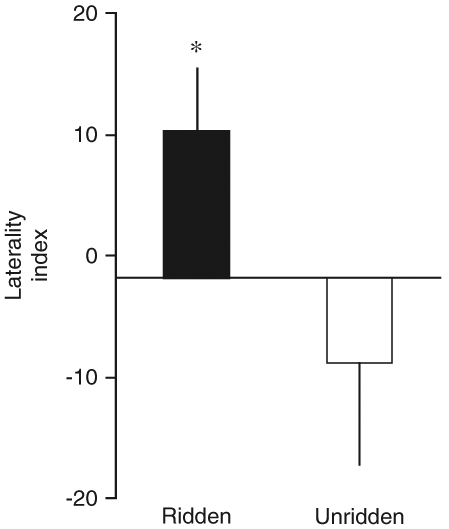
For the grazing stance test, the laterality quotient was calculated using the method commonly applied across vertebrate species (e.g. Corballis, Reference Corballis1983):

where L is left forelimb advanced and R is right forelimb advanced. Thus a negative laterality index indicated a left foreleg preference. Motor bias within each group of horses was assessed using a one-sample t-test with a hypothesised mean laterality index of zero. For the three lunging indicators, direction (left or right) was the independent factor within each group (ridden, unridden), and the data were analysed using analysis of variance (ANOVA) in Genstat (VSN International, Hemel Hempstead, UK). The full interaction between direction (left or right) and riding (ridden or unridden) was then analysed using ANOVA in Genstat. The correlations between the four indicators (balance challenged v. balance unchallenged) were tested using Pearson’s regression analysis in Excel.
Results
Time in canter
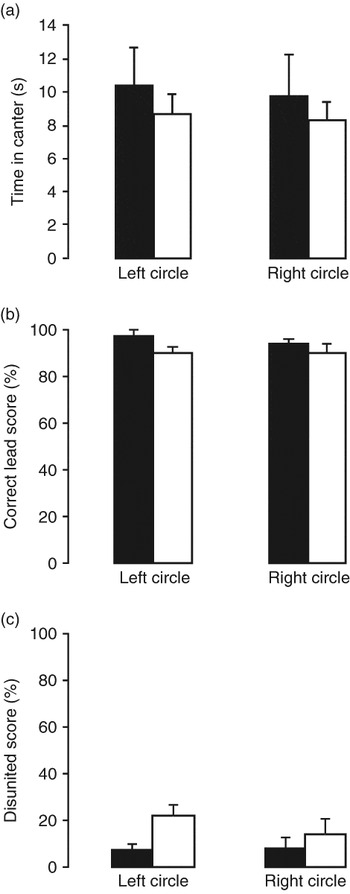
Time spent in canter to the left did not differ from time spent in canter when cantering to the right in either group (P = 0.68; Figure 1a). The ridden horses stayed in canter longer than the unridden horses (P = 0.036; Figure 1a) regardless of direction, which was expected due to their increased lunging experience. There was no interaction between direction and riding for time in canter (P = 0.66; Figure 1a).
Time spent in canter (a), correct lead score (b) and disunited score (c) in ridden horses (n = 15, close bars) and unridden horses (n = 15, open bars) during right or left circling during the lunge test. Mean ± s.e. NB: 10 observations to the left, 10 to the right, for all horses.

Correct lead
The number of times the horses got the correct lead was similar when cantering to the left and to the right in both groups (P = 0.44; Figure 1b). There was no difference between the ridden and unridden groups (P = 0.03; Figure 1b) and no interaction between riding and direction (P = 0.53; Figure 1b) for the correct lead score.
Disunited
The number of times the horses were disunited did not differ between cantering to the left and cantering to the right for either group (P = 0.98; Figure 1c). Unridden horses were disunited more often than the ridden horses, regardless of direction (P = 0.008; Figure 1c), which was expected due to ridden horses being more experienced in lunging. There was no interaction between riding and direction for the number of times the horses were disunited (P = 0.96; Figure 1c).
Grazing stance
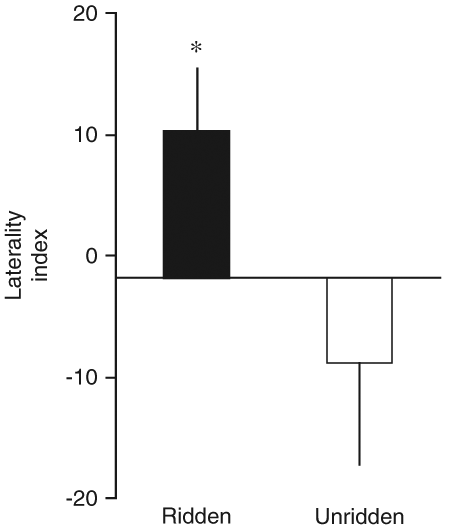
The unridden horses did not have a preference in advanced forelimb during grazing, whilst ridden horses exhibited right forelimb preference (P = 0.018; Figure 2).
Laterality index (mean ± s.e.) in ridden horses (closed bars) and unridden horses (open bars) calculated from observation obtained during grazing stance. *P < 0.02 compared by one-sample t-test to a hypothesised mean of zero (no motor laterality).
Correlations between balance challenged and balance unchallenged indicators
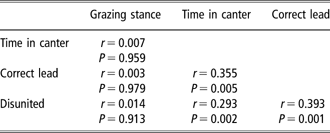
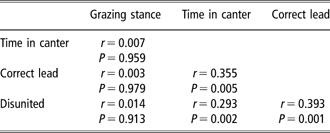
All the three indicators from the lunging test (time in canter, correct lead and disunited) correlated with each other (time in canter v. correct lead: r = 0.35, P = 0.005; time in canter v. disunited: r = 0.39, P = 0.0019; correct lead v. disunited: r = 0.43, P = 0.0006). This meant that horses that cantered for longer also selected the correct lead more often and became disunited less (all signs of balance), and that horses that cantered for less time also selected the incorrect lead more often and became disunited more often (all signs of imbalance). Grazing stance was not correlated to any of the three lunging indicators (Table 1).
Correlations between the scores obtained during grazing stance, time in canter, correct lead and disunited tests
Discussion
The lunging test results suggest that horses do not exhibit motor bias when their balance is challenged in canter, whether they have never been ridden (and therefore are younger than the ridden group), or have had extensive ridden training that aims for ambidexterity (and therefore are older than the unridden group). Therefore, whilst the hypothesis that ridden horses will be unbiased was supported by the lunging test results, it cannot be determined if this was a result of their ridden training, as young horses exhibited no bias in the first place. This result of no motor bias when balance is challenged is both supported by and in contrast to various bias studies in horses as well as in other vertebrates, including humans. We discuss how these results compare to previous evidence for and against motor bias in horses, and also propose possible reasons for these conflicting results in bias studies.
Motor bias in young horses – the inherent effect
Our results imply that horses are not inherently biased, which is supported by some studies into handedness in vertebrates. For example, in humans there is evidence that motor bias is not a totally inherent trait but rather develops during life (Corballis, Reference Corballis1983); such as more mixed motor preferences being found in younger people (under 10 years of age) in comparison to older people (Lennenberg, Reference Lennenberg1967; Levy, Reference Levy1974; Brackenridge, Reference Brackenridge1981). The relationship between asymmetrical brain function and motor asymmetries in humans is thought to be similar to that in non-human vertebrates (Rogers and Andrew, Reference Rogers and Andrew2002) and so it is possible that horses also are unbiased when born, as demonstrated in our findings that unridden horses exhibit no motor bias during balance challenge. However, there is also conflicting evidence that motor bias is largely inherent in vertebrates including horses. The prevalence of right-handedness in humans, described across many cultures for thousands of years, is suggested to be evidence of the inherent nature of motor bias (Wilson, Reference Wilson1885; Dennis, Reference Dennis1958; Uhrbrock, Reference Uhrbrock1973). Also, a study into young horses found they did exhibit motor bias in stride characteristics (Drevemo et al., Reference Drevemo, Fredricson and Hjertén1987), and minimally handled horses were found to exhibit bias in favoured foreleg to initiate movement, direction of obstacle avoidance and rolling (Murphy et al., Reference Murphy, Sutherland and Arkins2005).
Motor bias in older/ridden horses – the environmental effect
The results of our study indicate that horses ridden for ambidexterity are also unbiased when their balance is challenged. Although their ridden training cannot be attributed to the unbiased result due to the unridden horses also being unbiased, it is possible that this ambidextrous training has kept horses unbiased in limb preference, as environmental factors have been demonstrated to affect handedness in humans. Studies of human twins suggest that handedness is influenced by environment more than biology (Collins, Reference Collins1975), and the increase in proportions of people who are left-handers, from about 2% to over 10%, probably due to less social pressure to be right-handed (Levy, Reference Levy1974; Brackenridge, Reference Brackenridge1981) is also evidence of an environmental effect on handedness. Another example of motor bias being influenced by environment is that in humans, practice affects performance in various motor bias tests (Corballis, Reference Corballis1983).
The idea that motor bias can be influenced by practice and training is the basis for the common practice of riding horses in equal amounts to the left and to the right in disciplines that require equality of balance in each direction (Mairinger, Reference Mairinger1983). Despite this practice, along with rider contention that ridden horses are biased (Mairinger, Reference Mairinger1983; Sivewright, Reference Sivewright1986), there is also some scientific evidence that suggests older, ridden horses are biased; although no studies have clearly investigated horses that are worked with the aim of ambidexterity. Ridden horses showed increased motor bias in grazing stance, although there were more horses that were unbiased than that were biased (McGreevy and Rogers, Reference McGreevy and Rogers2005). Moreover, ridden racehorses were also found to exhibit bias in stride pattern preferences; however, this preference was to the right (Williams and Norris, Reference Williams and Norris2007) – the opposite direction to that found by McGreevy and Rogers (Reference McGreevy and Rogers2005) and McGreevy and Thomson (Reference McGreevy and Thomson2006). Bilateral asymmetry in gallop stride limb contact patterns of four Quarter Horse fillies has also been documented when being ridden; however, the left preference found differed again in direction to the right stride pattern preferences found by Williams and Norris (Reference Williams and Norris2007) (Deuel and Lawrence, Reference Deuel and Lawrence1987).
Possible reasons for the conflicting results of motor bias
Different tests measure different characteristics of motor bias
Our results are supported by some previous studies and are in contrast to others, which may be a reflection of the different tests of motor bias measuring different characteristics of bias. In humans, motor proficiency can be described using a wide range of unimanual tasks distributed over 10 distinct factors (Barnsley and Rabinovitch, Reference Barnsley and Rabinovitch1970). Therefore the use of different tests of motor bias will result in different skills being measured, and thus different conclusions about motor bias being made. Even with the extensive research of motor bias in humans, there are no clearly defined conventions for defining, testing or measuring handedness (Elliot and Roy, Reference Elliot and Roy1996), and a similar situation exists in the far fewer motor bias studies of horses. Some examples of the tests of motor bias used in past studies of horses include the advanced forelimb during grazing (McGreevy and Rogers, Reference McGreevy and Rogers2005; McGreevy and Thomson, Reference McGreevy and Thomson2006), lead stride pattern preference (Deuel and Lawrence, Reference Deuel and Lawrence1987; Williams and Norris, Reference Williams and Norris2007), trotting gait asymmetries (Drevemo et al., Reference Drevemo, Fredricson and Hjertén1987), and preferred foreleg to initiate movement at walk and trot, obstacle avoidance and rolling (Murphy et al., Reference Murphy, Sutherland and Arkins2005). It is likely that because these tests vary (some considerably) in ways of measuring bias, they measure different characteristics of motor bias and therefore will result in conflicting conclusions as to the existence, degree and/or direction of motor bias.
Our results support the idea that different tests of motor bias measure different characteristics of bias. The strong correlation found between the three lunging indicators (time spent in canter, correct lead selection and becoming disunited) suggests that these indicators were measuring similar characteristics of motor bias in the horses. Time spent in canter, selecting the correct lead and becoming disunited are all signs of balance (or lack thereof) in the horse (Rees, Reference Rees1991; Davis, Reference Davis1998; Moffett, Reference Moffett1999), so it is not surprising that they were found to all correlate with each other. In contrast, the grazing stance indicator and the three lunging indicators are likely to be measuring different characteristics because of the lack of correlation between those four indicators, and also because the ridden horses were unbiased when their balance was challenged, yet they were found to exhibit bias when their grazing stance was observed.
Unlike the lunging indicators that measured balance, it is not clear which characteristics of bias are measured when the advanced forelimb during grazing is used as the indicator of bias. The grazing stance method dictates that the advanced forelimb is the preferred limb; however, it may be more likely that the weight-bearing limb is stronger and thus preferred. The advanced forelimb does not necessarily bear more weight; it may in fact be the other supporting forelimb held under the horse that bears the majority of weight. By testing whether the leading limb is in fact bearing more weight could help determine the characteristics of bias measured during the grazing stance test.
Rider motor bias influences perceived motor bias in horses
The present study indicates that ridden horses trained for ambidexterity are not biased, but many riders believe otherwise despite such training (Mairinger, Reference Mairinger1983; Sivewright, Reference Sivewright1986). An explanation of this may be that, as humans tend to have strong motor preferences (Corballis, Reference Corballis1983), the riders could be biased in their capacity to direct the horses on a given side. If this is the case, riders could gain the impression that the horse is biased towards that same side. Most people are biased towards the right in both strength and fine motor skill (Woo and Pearson, Reference Woo and Pearson1927; Annett, Reference Annett1976), so a right-handed rider may be better able to get the horse to turn in a balanced manner with their right hand. This would make the horse appear more ‘balanced’ in turning to the right and more biased – in other words, biased riders may be influencing the performance of unbiased horses.
The influence of human motor bias on apparent motor bias in the horse should be considered in any tests that are designed to determine whether the motor bias of a horse is a perception or a reality. The study of this relationship between human motor bias and horse motor bias could be explored using a hand preference inventory of the rider (Corballis, Reference Corballis1983), determining the perceived horse bias by the rider, and then estimating the true bias of the horse using indicators such as those in our lunging test.
Conclusion
Although there is controversy on what constitutes an appropriate measure of motor bias in horses, measuring characteristics that are important to performance in a chosen discipline is likely to yield the most useful results about bias. The lunging test developed in the present study would be appropriate in studying motor bias in horses that are required to balance equally to the left and right (such as dressage and show-jumping), as the canter indicators used reveal the level of balance.
Acknowledgements
The authors would like to thank Dr Alison Harman for her help and advice, the owners of the horses and the staff and friends at Hillview Riding Centre, Coranda Estate, Equine Insight, and the other private facilities who made this study possible.