Introduction
Falls are common in older people with dementia with more than 60% falling annually (Taylor et al., Reference Taylor, Delbaere, Lord, Mikolaizak and Close2013). Older people with dementia are physically frailer than their cognitively intact peers (Taylor et al., Reference Taylor, Delbaere, Lord, Mikolaizak and Close2013) and falls in this group have a higher risk of mortality, morbidity, injury (including hip fracture), and placement in residential care (Gruber-Baldini et al., Reference Gruber-Baldini2003; Baker et al., Reference Baker, Cook, Arrighi and Bullock2011). In 2010, 36 million people worldwide had dementia and this is projected to increase to 115 million by 2050 (Prince et al., Reference Prince, Bryce, Albanese, Wimo, Ribeiro and Ferri2013). Thus, the monetary and societal costs of falls and disability in older people with dementia are substantial and will increase dramatically over the coming decades.
Balance and depressive symptoms have recently been identified as potentially modifiable independent predictors of falls in a large prospective study in community-dwelling older people with dementia (CDWD) (Taylor et al., Reference Taylor, Delbaere, Lord, Mikolaizak, Brodaty and Close2014). Exercise is a potential intervention strategy for both of these risk factors as there is strong evidence to indicate balance training can prevent falls in cognitively healthy older people (Sherrington et al., Reference Sherrington, Tiedemann, Fairhall, Close and Lord2011) and reduce depression in cognitively healthy older people with depressive symptoms (Bridle et al., Reference Bridle, Spanjers, Patel, Atherton and Lamb2012). Currently, however, there is limited literature examining the effect of exercise as a strategy for improving balance, mood, and falls in CDWD (Vreugdenhil et al., Reference Vreugdenhil, Cannell, Davies and Razay2012; Pitkäla et al., Reference Pitkäla2013a; Pitkälä et al., Reference Pitkälä, Savikko, Poysti, Strandberg and Laakkonen2013b; Suttanon et al., Reference Suttanon2013; Burton et al., Reference Burton2015; Forbes et al., Reference Forbes, Forbes, Blake, Thiessen and Forbes2015). Some studies have demonstrated significant positive changes in physical performance using group-based exercise in this population (Pitkälä et al., Reference Pitkälä, Savikko, Poysti, Strandberg and Laakkonen2013b). However, group-based activity is often not older people's preference for program delivery (Yardley et al., Reference Yardley, Kirby, Ben-Shlomo, Gilbert, Whitehead and Todd2008).
We have previously conducted a pilot feasibility randomized control trial (RCT) examining a home-based fall prevention program which included home hazard reduction and exercise components (Wesson et al., Reference Wesson2013). From this study, we determined that the intervention period needed to be longer. Three months did not provide adequate opportunity, in often sedentary individuals, to progress the exercise program to provide sufficiently challenging balance exercises.
Further research evaluating the effectiveness of home-based exercise programs in improving balance and reducing depressive symptoms (key risk factors for falls) in CDWD are needed to assist in the design of large RCTs powered for falls as the primary outcome measure. This uncontrolled study examined the effect of a six-month home-based, carer-enhanced, progressive, and individually tailored exercise program on balance (measured by sway on floor and foam) and affect (measured by the 15-item Geriatric Depression Scale (GDS)) in CDWD. We hypothesized that the six-month balance and strength training program would improve balance and mood (in those with clinically significant depressive symptoms) in this cohort of CDWD. Secondary outcome measures included concern about falling, physical activity, quality of life (QOL), hand reaction time, knee extension strength, and overall Physiological Profile Assessment (PPA) fall risk score. We also investigated the effect differing exercise program adherence levels had on physical outcome measures.
Methods
Participants
Participants comprised people aged 60+ years, living in the community with a clinical diagnosis of dementia (made by a geriatrician or psychogeriatrician) and either attending a specialty clinic (e.g. Cognitive Disorders Clinic, Memory Clinic, or Aged Care Clinic) or known to dementia services in the local community. Participants had an identifiable and consenting person responsible and/or carer who had a minimum of 3.5 hours a week of face-to-face contact with the participant for the purposes of intervention delivery and fall reporting. Exclusion criteria comprised Mini-Mental State Examination (MMSE) <12/30 (as it was considered people with significant dementia would be unlikely to engage with the intervention), residing in an aged care facility, presence of delirium, acute medical illness, severe psychiatric disorders, progressive neurological diseases (other than dementia), unable to speak English (without a readily available person to interpret), and/or blindness. A pool of 61 potential participants was assessed for eligibility. Of these, 19 were excluded 10 declined (six carer-related), six did not meet the inclusion criteria, one was deceased, and two were unable to be contacted. The study was approved by the South East Sydney Human Research Ethics Committee (HREC reference number 13/032) and consent was obtained from all participants and their person responsible prior to assessment.
Assessment
Participants and their person responsible were interviewed at home for demographic information, presence of medical conditions (specifically: stroke, transient ischaemic attack, heart disease, hypertension, diabetes, arthritis, osteoporosis, chronic lung disease, thyroid disorder, cancer, head injury, dementia, sleep apnoea, and depression), walking aid use, and carer- and participant-reported balance ability. One year history of falls was recorded at baseline.
Physical assessment and fall risk score
All physical assessment tasks were performed in the participants’ home at baseline and reassessment. Visual contrast sensitivity was assessed using the Melbourne Edge Test (MET) (Lord et al., Reference Lord, Menz and Tiedemann2003). Simple hand reaction time (ms) was measured using a visual stimulus and a finger-press response (score = average of 10 test trials) (Lord et al., Reference Lord, Menz and Tiedemann2003). Proprioception was measured using a lower limb matching task primarily involving the knee and ankle joints, while participants were seated with their eyes closed; average error in degrees was recorded for five trials (Lord et al., Reference Lord, Menz and Tiedemann2003). Maximal isometric knee extension strength was measured in the dominant leg in a seated position with the hip and knee joints at 90° using a spring guage dynamometer (best of three maximal voluntary contractions measured in kg force) (Lord et al., Reference Lord, Menz and Tiedemann2003).
Postural sway, a measure of standing balance, was assessed using a swaymeter that measures displacement of the body at waist level with participants standing on a firm surface (floor) and a foam rubber mat (15 cm thick) with eyes open for 30 s (Lord et al., Reference Lord, Menz and Tiedemann2003). Sway on floor and foam are expressed as path length in millimetres and have previously been demonstrated to be associated with falls in older people with and without cognitive impairment/dementia (Lord et al., Reference Lord, Menz and Tiedemann2003; Taylor et al., Reference Taylor, Lord, Delbaere, Mikolaizak and Close2012).
The coordinated stability test assesses controlled leaning balance and measures the ability of participants to adjust their body position in a steady and coordinated way. The participant navigated a pen on the end of a rod around a convoluted track placing them at or near the limits of their stability with a swaymeter secured to their waist (Lord et al., Reference Lord, Ward and Williams1996). The number of times the participant left the track (1 point) or failed to round a corner (5 points) was recorded and added to give the final error score.
Weighted contributions from five of the above tests (visual contrast sensitivity, hand reaction time, proprioception, knee extension strength, and sway on foam) provide the PPA composite fall risk score that has previously been demonstrated to predict multiple falls with up to 75% accuracy in cognitively intact community- and hostel-dwelling older people (Lord et al., Reference Lord, Menz and Tiedemann2003). Similar predictive accuracy has previously been demonstrated in community- and hostel-dwelling cognitively impaired older people (Taylor et al., Reference Taylor, Lord, Delbaere, Mikolaizak and Close2012).
Global cognition, depression, anxiety, concern about falling, the impact of caring for someone with dementia, physical activity, and quality of life
Global cognition was assessed with the Addenbrooke's Cognitive Examination – revised (ACE-R) (Mioshi et al., Reference Mioshi, Dawson, Mitchell, Arnold and Hodges2006) and the MMSE. The 15-item GDS (Jongenelis et al., Reference Jongenelis2005), Goldberg Anxiety Scale (GAS), and the short-form Iconographical Falls Efficacy Scale (iconFES) (Delbaere et al., Reference Delbaere, Close, Taylor, Wesson and Lord2013) were used to assess mood, anxiety, and concern about falling. The impact of supporting a person with dementia was measured using the Zarit Burden Interview (Bedard et al., Reference Bedard, Molloy, Squire, Dubois, Lever and O'donnell2001).
The Incidental and Planned Exercise Questionnaire (IPEQ-W) was administered with the assistance of carers to obtain information on total hours of physical activity, total hours of walking activity, total hours of incidental activity, and total hours of planned exercise over the past week (Delbaere et al., Reference Delbaere, Hauer and Lord2010). QOL of the participant was measured using the Alzheimer's Disease-Related Quality of Life Scale (QOL-AD) (score range 13–52) (Logsdon et al., Reference Logsdon, Gibbons, Mccurry and Teri1999). The ACE-R and MMSE were assessed only at baseline, while the remaining questionnaires and scales were administered at both baseline and reassessment.
Intervention
The intervention consisted of a home-based, carer-enhanced, progressive, and individually tailored exercise program delivered for six-months and designed to address deficits in physical performance identified during assessment, e.g. balance and strength. Over the six-month period there were ten visits from an experienced physiotherapist (Figure 1). The program allowed variation in the schedule based on the physical and cognitive abilities of the participant. Exercises were predominantly balance focused, but also included strength and/or combined strength-balance exercises, e.g. tandem stance, knee extensions +/− weights, sit-to-stand, step ups on a block, and sidestepping. Exercises were progressed by increasing the number, time, repetitions, weight and step block height; by reducing base of support, upper limb use, vision and chair height; and by changing the direction and surface (Table S1).
Intervention schedule.

Exercise program adherence and falls
Participants’ reported the number of prescribed exercise sessions they undertook in monthly diaries that were returned to the study site in reply-paid envelopes. Adherence was calculated as the percentage of exercise sessions the participant indicated they performed; i.e. (number of exercise sessions performed/number of exercise sessions presecribed) × 100. Falls were also recorded using diaries. The fall definition provided was, “In the past month, have you had any falls including a slip or a trip in which you lost your balance and landed on the floor or ground or lower level?” (Lamb et al., Reference Lamb, Jorstad-Stein, Hauer and Becker2005). If a participant/carer failed to return the calendar, a telephone call was made to obtain the participant's exercise and fall-related data.
Statistical analysis
The data were analyzed with SPSS version 22 (SPSS Inc., Chicago, IL). Participants who attempted but were physically unable to perform physical assessment tasks were allocated scores 3SD worse than the baseline mean and were included in the analyses. Participants who, after attempting the task were deemed by the assessing research assistant/physiotherapist as cognitively unable to comprehend and execute the requirements of a physical assessment task were given the mean baseline score for the study population. Independent samples t-tests for continuous data and Fisher's exact test for categorical data were used to compare characteristics of those who did and did not complete the reassessment. The McNemar's test for categorical data and the Wilcoxon signed rank test for continuous and ordinal data were used to compare baseline and reassessment scores as they were not normally distributed. Effect size was calculated using the following formula r = Z/√N (where N = number of observations) and based on Cohen's criteria/thresholds these can be interpreted as follows: r = 0.1 – small, r = 0.3 – medium, r = 0.5 – large. Generalized linear models (GLM) were used to determine the effect of adhering to ≥70% and <70% of the prescribed exercise sessions on reassessment performance of physical variables while controlling for baseline performance. Independent samples t-tests for normally distributed continuous data, Fisher's exact test for categorical data and Mann–Whitney U test for skewed data were used to compare adherence groups’ characteristics. Despite the multiple comparisons made, p-values were set at <0.05 and not adjusted to Bonferroni in this exploratory study because such adjustments may increase type II errors (Perneger, Reference Perneger1998).
Results
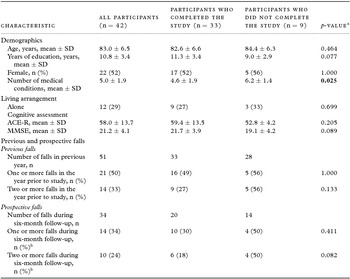
Forty-two older people with mild to moderate dementia were recruited with a mean ACE-R score of 58 ± 14. Twenty-two (52%) were female and the mean age was 83 ± 7 years (Table 1). Forty-one participants had follow-up falls data; 34% had one or more falls and 24% had two or more falls during the six-month follow-up (Table 1). Thirty-three participants (79%) completed the six-month reassessment (study completers; Figure S1). Of the nine who were not reassessed: one died, two were placed in residential care, four refused, one was unwell, and one withdrew from the study (Figure S1). The study completers were not significantly different to the study non-completers in relation to age (p = 0.464), gender (p =1.000), years of education (p = 0.077), cognitive performance (ACE-R: p = 0.208, MMSE: p = 0.089), previous falls (p = 1.000) or those who reported falls (p = 0.411), and multiple falls (p = 0.082) during the six-month follow-up. The non-completers did have significantly more medical conditions (p = 0.025) (Table 1).
Participant demographics/characteristics and; previous and prospective falls, and statistical comparison between study completers and non-completers

a p-value represents statistical comparison between completers and non-completers. bn = 1 insufficient follow-up.
ACE-R = Addenbrooke's Cognitive Examination–Revised; MMSE = Mini-Mental State Examination; SD = standard deviation.
Effect of the intervention
Primary outcomes – balance and mood
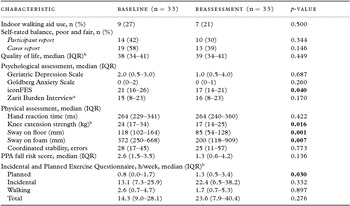
Participants significantly improved in the tests of sway on floor (Z = −3.350, p = 0.001, r = −0.412) and foam (Z = −2.679, p = 0.007, r = −0.330), but did not improve with respect to depressive symptoms measured with the GDS (Z = −0.402, p = 0.687, r = −0.049) (Table 2). Overall, there was a 28% and 20% improvement in sway on floor and foam from baseline, respectively. Of the six participants with clinically significant depressive symptoms (GDS scores ≥5), median scores decreased from 8.0 (IQR 5.0–8.5) at baseline to 6.5 (IQR 3.8–9.0) at reassessment (Z = −1.289, p = 0.197, r = −0.159).
Effect of the exercise intervention on outcome variables

h = hour; iconFES = iconographical–Falls Efficacy Scale; IQR = interquartile range; PPA = Physiological Profile Assessment; wk = week.
a n = 32.
b Higher values indicate better performance.
Secondary outcomes
Participants showed a significant reduction in concern about falling (iconFES) (Z = −2.049, p = 0.040, r = −0.252), a significant increase in planned physical activity measured by the IPEQ (Z = 2.176, p = 0.030, r = 0.268), and a significant reduction in knee extension strength at reassessment (Z = −2.413, p = 0.016, r = −0.297) (Table 2). There were no significant changes between baseline and reassessment for the remaining secondary outcome measures (Table 2).
Exercise program, progression, and adherence
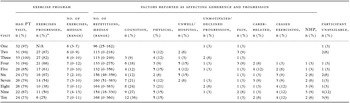
In study completers, there were a median of 10 (mean 8.4 ± 2.4, range 3–10) physiotherapy visits. The number of exercises and repetitions prescribed and record of when exercises were upgraded at the ten physiotherapy visits are displayed in Table 3. At visit one, a median of 6 (range 3–7) exercises and 96 (range 25–162) repetitions were prescribed (Table 3). By visit 10, a median of 7 (range 0–11) exercises and 168 (range 0–360) repetitions were prescribed (Table 3). At visit one, a median of 2.0 (IQR 1.0–3.0) balance exercises, 2.0 (IQR 0.3–3.0) strength, and 2.0 (IQR 1.0–2.0) combined strength-balance exercises were prescribed. At visit 5, a median of 3.0 (IQR 2.0–3.8) balance exercises, 2.0 (IQR 0.0–2.0) strength, and 2.0 (IQR 2.0–3.0) combined strength-balance exercises were prescribed. At visit 10, a median of 3.0 (IQR 2.0–3.0) balance exercises, 2.0 (IQR 1.0–3.0) strength, and 2.0 (IQR 2.0–3.0) combined strength-balance exercises were prescribed. The cognitive abilities of participants, as determined by the treating physiotherapist, was the most common reason for not progressing the exercise program (at visit 10, n = 12 (36%, or 50% of those who had the tenth physiotherapy visit)). Of the 33 study completers; three (9%) moved to a residential care facility and four (12%) discontinued exercising during the trial period (Table 3).
Visit schedule, exercise program and progression, and factors affecting adherence in study completers (n = 33)

a reported percentage was calculated using those participants that received the scheduled physiotherapy visit as the denominator.
Participant unavailable’ category description: participant away on holidays, participant cancelled appointment/s, participant staying with relative after illness, participant not home on therapists’ arrival.
No. = number; NHP = nursing home placement; PT = physiotherapy.
Study completers (n = 30, n = 3 were missing adherence data) undertook a mean of 45% of prescribed days of exercise and adherence decreased over the course of the intervention. During month one, a mean of 63% of the prescribed days of exercise were completed; this decreased to 47% and 34% for month three and six, respectively. At six-months, 22 (52%) of the study completers were still exercising, with only 10 exercising on ≥50% and 5 on ≥70% of prescribed days.
Effect of adherence on physical outcomes
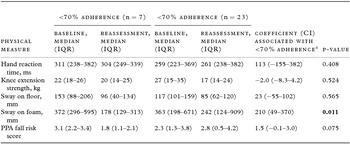
Table 4 displays the participants’ physical performance outcomes based on average adherence (≥70% and <70%). There was no significant difference between adherence groups with respect to age (p = 0.458), gender (p = 0.631), years of education (p = 0.344), number of medical conditions (p = 0.591), ACE-R (p = 0.905), or GDS (p = 0.811) scores. Participants who exercised ≥70% of prescribed days demonstrated significantly better balance (less sway on foam) at reassessment compared to those that adhered to <70% (p = 0.011, Table 4). There was also a trend for those who adhered ≥70% to have lower PPA fall risk scores at reassessment (p = 0.075, Table 4). Including participants (n = 3) who had missing adherence data to the low (<70%) adherence group did not significantly change the results.
Effect of average adherence (≥70%, <70% prescribed sessions) on physical outcomes in study completers

a Calculated using generalized linear models using reassessment score as the dependent variable and adherence (≥70%, <70%) as the factor; for each model baseline score was entered as a covariate.
CI = confidence interval; IQR = interquartile range; PPA = physiological profile assessment.
Discussion
In this cohort of CDWD, a six-month tailored home-based exercise intervention significantly improved balance, but not mood. The intervention also significantly improved two secondary outcome measures: concern for falls (iconFES) and planned physical activity (IPEQ).
The significant improvement with medium to large effect size in postural sway is encouraging as balance impairment has previously been identified as an important fall risk factor in CDWD (Taylor et al., Reference Taylor, Delbaere, Lord, Mikolaizak, Brodaty and Close2014). Two other RCTs of similar sample size have also demonstrated significant intervention effects in measures of balance (functional reach) with an exercise intervention in older people with Alzheimer's disease with either live-in spouses or daily caregivers when compared to controls (Vreugdenhil et al., Reference Vreugdenhil, Cannell, Davies and Razay2012; Suttanon et al., Reference Suttanon2013). Taken together, these findings suggest that although cerebral processing is affected by the disease process of dementia, exercise interventions are able to yield positive changes in balance (a sensorimotor function relying on central information processing as well as sensorimotor input) in people with mild to moderate dementia.
The exercise intervention did not significantly change GDS scores. Depressive symptoms were relatively low and this floor effect may have reduced our ability to demonstrate any significant improvements in mood. In the participants with clinically significant depressive symptoms (GDS ≥5, n = 6), there was a non-significant reduction in median GDS score. Future research, in larger studies, should include subgroup analysis of participants with clinically meaningful depressive symptoms as this study was underpowered to detect a significant difference in this sub-group.
The significant reduction in knee extension strength at the end of the trial was unexpected. It is possible that even though the tailored exercise program included balance and strength training (e.g. static balance, step ups, heel raises, knee extensions, and sit-to-stands), the strength component may have been sub-therapeutic. This may have also affected our ability to significantly impact depressive symptoms. Another possible explanation is that without exercise the decline in strength would have been more marked. Pitkäla and colleagues implemented a twice weekly, home-based exercise program for 12 months and although strength was not an outcome measure, they reported a decline in short physical performance battery (SPPB) scores (a validated measure of lower extremity function) and Functional Independence Measure (FIM) scores in the intervention groups. In contrast, a six-month trial by Suttanon et al. reported no significant treatment effect for Sit to Stand – rising index (% body weight; force exerted to rise) and though not reported statistically, this surrogate measure of strength did not appear to decline over the trial period (Suttanon et al., Reference Suttanon2013). Maximal voluntary contractions, required for the knee extension strength test, are influenced by participant motivation and tester verbal instructions and encouragement (Jung and Hallbeck, Reference Jung and Hallbeck2004). These factors may have also played a role.
The exercise intervention also significantly reduced concern about falls – a known fall risk factor in CDWD (Taylor et al., Reference Taylor, Delbaere, Lord, Mikolaizak, Brodaty and Close2014). This improvement was substantial and clinically relevant as participant mean scores on the iconFES dropped from the third quartile to the lower limits of the second quartile of concern about falls based on population norms (Delbaere et al., Reference Delbaere, Smith and Lord2011).
The individualized balance and strength training program in this study did not routinely include a walking program. A meta-analysis of exercise to prevent falls recommended that walking programs only be prescribed if they do not detract from balance training and brisk walking should not be prescribed in high-risk individuals (Sherrington et al., Reference Sherrington, Tiedemann, Fairhall, Close and Lord2011). Overall, exercise programs that did not include a walking program were more effective in preventing falls (Sherrington et al., Reference Sherrington, Tiedemann, Fairhall, Close and Lord2011). However, walking offers other important health advantages in older people, both with and without dementia. In this study, we found a significant increase in planned physical activity, a non-significant increase in incidental and total physical activity, and a non-significant decrease in walking measured by the IPEQ. Two other studies in older people with Alzheimer's disease have included walking programs (Vreugdenhil et al., Reference Vreugdenhil, Cannell, Davies and Razay2012; Suttanon et al., Reference Suttanon2013). However, in one study there was no significant change in physical activity in the intervention group compared to the control group (Suttanon et al., Reference Suttanon2013) and in the other, physical activity was not measured (Vreugdenhil et al., Reference Vreugdenhil, Cannell, Davies and Razay2012). Further research is needed in older people with cognitive impairment/dementia as to the best approach for fall prevention interventions and whether the inclusion of a walking program is warranted, particularly considering its other potential health benefits.
Carers’ psychological well-being, as well as the impact of their involvement in the implementation of interventions in CDWD needs to be considered. We found that the impact of caring for participants with dementia using the Zarit Burden Interview did not significantly change between baseline and reassessment. This is reassuring as carers played a major role in program delivery which could have been viewed as onerous. On the other hand, it could be argued that if an intervention had beneficial physical and psychological effects in CDWD, the Zarit Burden Interview score should have improved. This, however, may be difficult to achieve as a previous longer term (one year) exercise intervention RCT conducted in participants with Alzheimer's disease (and their spousal caregiver), found that irrespective of group allocation, participants’ physical function (measured by the FIM and SPPB) declined over one year (Pitkäla et al., Reference Pitkäla2013a). This study did not report how the intervention affected the spousal caregivers in terms of the impact of caring for someone with dementia or other psychological outcomes. Future work in this area should examine the effect home-based exercise programs have on carers of CDWD in longer term trials.
Adherence and exercise progression were influenced by various factors to be expected in a study of CDWD, e.g. nursing home placement, illness, lack of interest in continuing to exercise, and cognitive and carer issues. A large proportion (87%) of participants had their exercise program progressed at the beginning of the intervention (physiotherapy visit 2). However, by the tenth visit only 25% of the participants had their exercise program upgraded and cognitive factors were reported as a dominant factor limiting progression. Despite this, the group significantly improved their balance suggesting that the balance exercises offered sufficient challenge. Future studies, with more participants and statistical power, may be able to assist in determining the effect exercise progression has on physical and fall outcomes. Furthermore, although the intervention schedule was flexible, it may be that in future trials the schedule needs to be more adaptable on an ongoing basis, shaped by an individuals’ performance/ability throughout the study period. It is also possible that more specialized training for therapists working with CDWD focusing on functional cognition and how best to work with someone with dementia may lead to better outcomes.
Similarly to exercise progression, adherence decreased over the trial period. Adherence, however, may have been under-reported due to non-returned and sub-optimally completed exercise diaries. Activity monitors and accelerometers offer potential means for more precisely measuring exercise participation in future studies (Brodie et al., Reference Brodie2015). The recommendation that most participants perform the exercises daily may have been too ambitious, and it is likely that many participants exercised only when their carers were available to provide supervision and prompting. In cognitively intact older people, previous literature suggests that the most effective exercise programs for fall prevention have a minimum dose of 2 hours per week and include moderate to high challenge balance training for six-months (Sherrington et al., Reference Sherrington, Tiedemann, Fairhall, Close and Lord2011). A program goal of three to four times per week may be more feasible/achievable and still sufficiently effective. From reviewing the exercise diaries, some participants seemed to prefer other types of exercise (e.g. walking and golf) over the prescribed balance and strength training which negatively affected adherence. In future studies, it is vital that the individualized exercise programs are both tailored to participants’ physical and cognitive abilities, as well as being relevant to their lives and interests.
Baseline ACE-R scores were not significantly different between the adherers (≥70%) and non-adherers (<70%) (data not shown). However, apathy and/or reduced executive functioning may have influenced participants’ understanding and motivation to continue with the program. Future research should examine cognitive and psychological factors and participant and carer attitudes to the intervention to better understand factors that affect adherence.
Limitations
First, the study has a relatively small sample size. However, the study revealed meaningful and significant changes in continuously scored outcome measures, including one of our primary outcome measures – balance, with moderate to large effect sizes. Second, we did not recruit a control group. Our previous fall prevention feasibility pilot RCT did not demonstrate significant improvements in balance or mood (known independent modifiable fall risk factors) (Wesson et al., Reference Wesson2013). Hence, the primary aim of this study was to determine whether longer term interventions are efficacious with respect to these outcomes and thus provide important treatment effect data to guide a planned RCT with falls as the primary outcome measure (Close et al., Reference Close2014). This was of particular importance as previous literature has suggested that even with a fairly intensive 12-month intervention, participants with dementia still decline over time (Pitkäla et al., Reference Pitkäla2013a). The lack of a control group means we were unable to control for factors outside the intervention that may have influenced the outcome measures. In particular, this makes interpretation of the knee extension strength and fall outcomes difficult. However, as the fall prevalence during the six-month intervention is not higher than expected in CDWD, we are confident that the intervention did not cause any harm. Third, participants were not followed up after the six-month intervention, so we are not able to determine if there were any lasting effects of the exercise program. Fourth, results cannot be generalized to participants with more severe dementia (MMSE <12) or those who are unable to speak English (without a readily available interpreter). However, there is no reason to believe that an older person who does not speak English would not benefit from the exercise program. Finally, the response to exercise interventions in older people with dementia may vary depending on their dementia type/pathology. In this study, we used broad inclusion criteria and did not specify dementia type/pathology. Therefore, we are unable to determine whether there were any differential effects of exercise based on this criterion.
Conclusions
This pilot trial of a tailored home-based, exercise program demonstrated significant improvements in balance, concern for falls, and planned physical activity in CDWD. This provides support for further research into exercise as one intervention modality to prevent falls in larger adequately powered RCTs. Additional work is required to elucidate strategies for enhancing uptake and adherence to maximize the effectiveness of fall prevention interventions.
Conflict of interest
The PPA (FallScreen) is commercially available through NeuRA.
Description of authors’ roles
MT analyzed the data and drafted the manuscript. JC, SL, HB, and SK reviewed the manuscript. JC was lead investigator of the study. LW, NP, SH, and ER were actively involved in the study. All authors read and approved the final manuscript.
Acknowledgments
We would like to acknowledge and thank Barbara Toson (statistician) and our Cognitive Decline Partnership Centre consumer representatives (Kate Swaffer, Elaine Todd, and Joan Jackman) for their input. This study was supported by the Dementia Collaborative Research Centre. Dr Morag Taylor is a NHMRC-ARC Dementia Research Development Fellow.
Supplementary Material
To view supplementary material for this article, please visit http://dx.doi.org/10.1017/S1041610216001629.