

Globalising Families in Transition and Care Deficits
Globalisation and rapid economic development in Asia have brought about significant changes to the region's demography as well as the organisation of productive and reproductive labour within the family. With the progressive incorporation of an increasing number of countries in Asia into the world economy, accompanying demographic and socio-economic shifts have led families and households to turn to alternate configurations and re-territorialisations, not only to maximise collective material benefits, but also to plug emerging gaps in their social reproductive functions. Reproduction – which includes both biological and social reproduction – entails ‘care’ throughout the life-cycle in sustaining the body in its corporeal and affective aspects. This definition includes both paid and unpaid reproductive labour within the family and without, to draw attention to the fact that unpaid family or kin labour may be replaced by commodified forms of paid labour, and vice versa.
Scholarly attention regarding the structural and everyday reproduction of the family in the face of globalised mobilities has produced a number of concepts to capture the links between migration and the challenges of sustaining a family or household today. Alluding to the destabilisation of the traditional ‘under-one-roof’ model of the ‘Asian family’, scholars, for instance, have noted the growing incidence of ‘transnational families’ in Asia, resulting in formations such as ‘spatially stretched families’, ‘families with absentee members’, ‘surrogate families’, ‘cross-cultural nuclear units’ and ‘left behind parents’ (Yeoh Reference Yeoh2009: Yeoh et al. Reference Yeoh, Huang and Lam2005). With greater availability of educational and professional opportunities worldwide, families in Asia with at least some resources and/or significant aspirations, are becoming increasingly mobile and accommodative of geographical separation among core members, rendering traditional care arrangements involving parents, children, siblings, and other relatives more difficult to maintain, and hence requiring alternative care strategies to sustain the family. Other authors, such as Douglass (Reference Douglass2006), go beyond explaining the dynamics underlying the dispersal of family members across national borders, but have also sought to re-understand these movements as part of the broader phenomenon of creating and sustaining households internationally. Such practices of ‘global householding’, predicated on the transnational migration of people and their transactions across borders, are closely linked to a new, ‘flexibilised’ household life cycle, more open to elements such as international marriages, raising and educating children abroad, and frequent flier lifestyles (Lam et al. Reference Lam, Yeoh and Huang2006).
Further testifying to the family's increasing fluidity and porosity, the need for daily household maintenance and reproductive care may even bring about, and indeed has often resulted in, the ‘outsourcing’ of domestic labour to maids, nannies and other household workers, and even foreign wives (Yeoh et al. Reference Yeoh, Chee, Dung and Cheng2013), whose recruitment from abroad sets off another round of global householding and familial transnationalisation in the migrant woman's own home. Such transfers of domestic duties down a series of personal links between people across the globe (Hochschild Reference Hochschild, Hutton and Giddens2000) have also been a concern among scholars who are keen to study how the value of care work becomes increasingly diluted as it gets repeatedly ‘off-loaded’ to other women down the global hierarchy, often ending in unpaid labour performed by the migrant woman's kin, such as a daughter or a sister in the global South. Describing this sequence as a ‘global care chain’, research focusing on the cascading effects of globalisation on the reproductive sphere not only captures the household internationalisation strategies in Asia and other parts of the world, but also calls attention to the inequitable (often gendered, classed, and racialised/ethnicised) ways in which different people are being drawn into care networks, through a mix of kinship ties and recruitment drives originating in richer countries in the global North (Yeates Reference Yeates2005). At the same time, as Parreñas (Reference Parreñas2012; see also Kofman and Raghuram Reference Kofman and Raghuram2009) points out, the concept of the global care chain overlooks care work that takes place outside the family and household, particularly that of institutional care, by narrowing discussions of migrant care work to the household. Instead, there is a need to recognise that transnationalised care work is caught up “at the intersections between the productive and reproductive, the public and the private, the paid and the unpaid” (Huang et al. 2012a: 131).
What these different perspectives bring to the forefront is the view that families and households in Asia today are increasingly being challenged by, as well as reliant on, the international movement of people for their sustenance. Drawing on the notions of the transnational family, global householding and the global care chain, this article examines strategies of transnational care substitution that the city-state of Singapore has employed to deal with its eldercare deficit, and their gender and class implications. To provide a context for the discussion, we first present an overview of Singapore's changing demographic profile, the anticipated implications for eldercare provision and recent policy responses. This is followed by a discussion of global householding strategies that are dependent on the lowly paid labour of two groups of transnational subjects (mainly women) – transnational domestic workers working in the privatised sphere of the home, and transnational careworkers in institutionalised settings. In the final substantive section, we turn to reflect on the interdependencies between transnational flows, and the gender and class implications of these flows for an understanding of migration and social change. The article is built upon field interviews conducted in 2007–2010 with organisational representatives of government ministries, healthcare institutions (hospitals and nursing homes), employers and labour agents, as well as analyses of media reports and speeches by government ministers on policies with regard to foreign workers and the provision of care for the elderly in Singapore.
Changing Demographics and the Eldercare Predicament in Singapore
The changes and challenges to families in Asia must be seen in the light of the region's recent globalising tendencies, which on the one hand open up significantly enlarged economic opportunities, and on the other hand result in fundamental demographic, familial, and priority shifts. Accompanying the rise in cost of living and of raising children in urban Asia, fertility rates have plummeted to levels well below that of replacement in countries such as China, Japan, Singapore, South Korea, and Thailand. This has aggravated the trend of rapid ageing, leading to higher elderly dependency ratios in more affluent societies, as life expectancies have risen and family units have become smaller (Ochiai Reference Ochiai2009). The result has led in turn to growing pressure on children to care for their aged parents for longer periods of time, and without extended help from relatives, even as they juggle between the increasing demands of paid work (including internationalised careers in some cases) and new household exigencies arising from delayed marriages and familial re-structuring. This twin problem of a heightened demand for eldercare, and the increasing challenges faced by adult children to meet that need is further exacerbated by the fact that families in Asia, such as those in Singapore and China, are now depending more and more on dual incomes to sustain their household expenditures. With women's growing participation in the workforce in these countries, the reproductive sphere is being dealt a further blow, as families now find it even more difficult to shoulder the triple burden of career building, child-raising, and eldercare, not least because the household division of labour by gender remains relatively rigidly drawn in many households.
Reflecting these trends of rapidly plummeting fertility rates and increasing life expectancy, the city-state of Singapore has become one of the fastest ageing populations in Asia. Fertility decline is unlikely to be easily reversed, the total fertility rate having fallen from 4.66 in 1965 when Singapore became an independent nation-state, to 1.15 in 2010; this has a major impact on the old age support ratio which has similarly declined over the same period (Figure 1). At the same time, life expectancy in Singapore has been rising (79.3 years for men and 84.1 years for women in 2010; see Table 1), with the oldest-old population (age 85 and above) experiencing the fastest growth at 6.5% per annum in 2011 (Singapore Department of Statistics 2011a). While older Singaporeans – defined (since 2000) as those aged 65 and above – constituted only 7.3% of the population in 1999, they are expected to comprise approximately 20% by 2030 (Inter-Ministerial Committee on the Ageing Population [IMC] 1999). In absolute terms, this translates to a three-fold increase of elderly persons from about 350,000 in 2012 to 960,000 in 2030 (Gan Reference Gan2012). The combined effect of these trends is that by 2030, it is expected that one elderly person will be supported by only 3.5 working persons as compared to 8.2 persons currently (Singapore Department of Statistics 2011a).
Total Fertility Rate (TFR) and Old-Age Support Ratio (OSR), 1970–2010 (the TFR is based on per female; the OSR is the number aged 15–64 years per elderly aged 65 years and above). (Source: Adapted from Singapore Department of Statistics, 2011a: v).

Life Expectancy (No. of Years) at birth by gender, 1990–2010 (data refer to resident population). (Source: Adapted from Singapore Department of Statistics 2011a: 27).

Beyond the impact on the economy should these trends not be moderated, the implications of an ageing population living longer are significant when it comes to eldercare provision. On the one hand, a National Survey of Senior Citizens in Singapore in 2005 found that the overwhelming majority (92.2%) of senior citizens above 55 years were independent and able to perform the basic activities of daily living (such as cleaning, washing, dressing, feeding, bathing and toileting), and only a small proportion (less than 1%) required total physical assistance or were bedridden (Ministry of Community Development and Sports [MCYS] 2005: 9). On the other hand, another study conducted by the National University Department of Psychological Medicine in 2006, found that “functional disability” is on the rise among older Singaporeans, especially those aged 75 and above, having increased from 14% two decades ago to a quarter of this group currently (cited in The Straits Times, 24 August 2006). The study found arthritis and cognitive impairment to be the most common reasons accounting for disability among the elderly population and warned that the rising numbers would pose an “increasingly heavy burden on caregivers and on the health care and social support services in the country” (cited in The Straits Times, 24 August 2006). There are also clear gender implications: women not only tend to outlive men, but elderly women tend to suffer more from chronic illnesses, are more likely to suffer disabilities, and have a greater need for long-term care (LTC) as compared to older men; yet, women are less likely to be able to financially support their long-term healthcare needs (Asher and Nandy Reference Asher and Nandy2008; Chia et al. Reference Chia, Lim and Chan2008).
The Singapore state had very early on begun to take a proactive stance to the ageing issue, beginning in 1982 when it convened the Committee on the Problems of the Aged; subsequent committees have followed at regular intervals since then, including an Inter-Ministerial Committee on Healthcare for the Elderly convened in 1997 (see Yap and Kang Reference Yap, Kang and Hofmeister2010 for details). Key recommendations in recent years have focused around the concepts of ‘active ageing’ and ‘ageing-in-place’, both crucial to the Singapore state's basic ‘guiding principle’ of rendering the family the ‘primary caregiving unit’ for the elderly along with home-based care as the highly preferred option. Thus, as with many other parts of Asia, the family in Singapore is expected to continue its traditional role as the main source of support for the elderly. Available research shows that the ‘family’ is adapting to the changing economic conditions brought on by globalisation and, in several countries (Indonesia, Malaysia, the Philippines, Singapore, Taiwan, and Thailand), there are high levels of intergenerational support for elderly parents, either via co-residence or the transfer of goods and services (Chan Reference Chan, Tuljapurkar, Pool and Prachuabmoh2005: 221–222).
Thus, like other developed countries faced with “rising fiscal concerns and increasing life expectancies”, Singapore has taken the route of deinstitutionalising eldercare “as a cost containment strategy” (Yantzi and Skinner Reference Yantzi, Skinner, Kitchin and Thrift2009: 403). In this version of step-down care, the state plays the main role in ensuring the provision of acute care and funding frameworks for the care of the elderly; all other aspects of responsibility for the elderly – including their long term care – are devolved to the community, family, and the elderly individual (Teo Reference Teo2004). Within this framework of care, “Institutional care should remain as the last resort” (MCYS 2001: 8) for those needing chronic or long-term care, what the Prime Minister has called “slow medicine” (The Straits Times, 18 August 2009). This philosophy, consistently echoed in all government reports on the elderly (see, for example, the Report on the Ageing Population completed by the Committee on Ageing Issues in 2006) is one that has “made individuals and their families bear disproportionate risks of old age” (Asher and Nandy Reference Asher and Nandy2008: 58), especially for the low income groups.
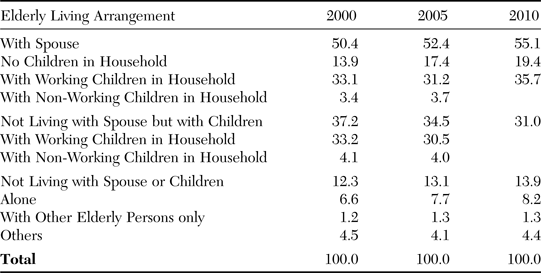
As Teo et al. (Reference Teo, Chan and Straughan2003: 402) have argued, the state's position is rationalised by ‘Asian values’ and based on “the ‘ideal’ family as.…a close-knit family where familial ties bond the unit together, especially in intergenerational transfers on both sides” (conveniently “ignor[ing] literature that documents tensions between older persons and their adult children; on the strains on the caregiver or the family unit; on elder abuse; and most of all, fails to acknowledge the gendered nature of eldercare”). In particular, government policies encourage co-residence “both as a moral obligation of adult children to older parents, and as an attractive financial arrangement” (Chan Reference Chan, Tuljapurkar, Pool and Prachuabmoh2005: 234).Footnote 1 These policies are so “consistent and far-reaching” in encouraging family support that Chan (Reference Chan, Tuljapurkar, Pool and Prachuabmoh2005: 235) concludes that, along with the high cost of housing and declining marriage rates in Singapore, high co-residence levels may be maintained in the future. Nevertheless, while the proportion of the elderly resident population co-residing with their spouse or children remained high at 86% in 2010, the proportion of older persons living alone or only with their spouse is on the increase (Table 2); at the same time, the number of unmarried elderly persons is also expected to increase (MCYS 2001: 5). In this context, the stresses and strains that the family has to absorb are considerable: as summarised in Singapore's Eldercare Master Plan (MCYS 2001: 6), “Children of the elderly need to look after both their own children as well as their parents. With smaller family units [the average household size dropped slightly from 3.7 persons in 2000 to 3.5 persons in 2010 (Singapore Department of Statistics 2010)] and increased longevity, it is more difficult for the family to sustain its role in eldercare without adequate support services.”

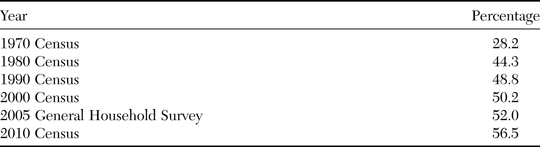
Women, in particular, often bear the brunt of providing care within the family context, sometimes both in terms of child- and elder-care, something the Singapore state recognises (MCYS 2001: 8). The phenomenon of the ‘sandwiched generation’ which has to care for older parents as well as children tends to be highly salient in an Asian context where “filial piety operates within hierarchical family structures which results in women having multiple obligations: to their immediate family, their elderly parents and to their jobs” (Thien et al. Reference Thien, Htwe, Currie and Lewin2010: 305). Thus, women in Singapore are often expected and do continue to play caregiving roles even as increasing numbers have entered the formal labour force (Table 3) as the city-state has moved from export-oriented manufacturing to becoming a major financial and communications centre. For working women, the burden of care is not only heavier as a result of the decline of the extended household and shrinkage in help from extended family members to share domestic and care work, it is further exacerbated by the need to juggle the demands of both home and the workplace.
Labour force participation rate of women in Singapore, 1970–2010 (note: prior to 1990, the data refer to the total population. From 1990, the data refer to only the resident population). (Source: Singapore Department of Statistics 2012).

‘Care’ Migration as a Solution to the Eldercare Deficit
With the exception of Japan where resistance to immigration and migrant workers continues to be high, many Asian societies faced with an eldercare deficit have turned to external sources of care labour. In this context, gender based strategies of care substitution have developed along the global care chain, drawing on the paid and unpaid labour of different groups of transnational subjects, mainly women from less developed parts of Asia participating in what has been called the “feminisation of migration” as well as the “feminisation of survival” (Sassen Reference Sassen2000). These groups of migrant women include transnational domestic workers and transnational careworkers tracing migratory pathways across the globe. Of these, the most visible stream is arguably that of the transnational domestic workers, who, according to the International Labour Organisation (2011), number about 53 million around the world today, including as many as 7.4 million originating from the Philippines alone. Contrasting with this prominent group, transnational healthcare workers constitute a somewhat smaller – though also increasingly important – component of global flows: research examining their mounting significance has, for instance, put the number of migrant care providers in the United States of America (a popular destination and ageing society) at almost 1 million (Martin et al. Reference Martin, Lowell, Gozdziak, Bump and Breeding2009: vi), while reporting the number of migrant registered nurses from the Philippines (the largest exporter) at over a quarter of a million (Pyle Reference Pyle2006).
Transnational Domestic Workers
As mentioned, in Singapore, preserving the notion that the family is ‘the primary caregiving unit’ responsible for taking care of elderly parents and relatives shifts the care burden directly onto family members, primarily the women. In turn, families who can afford it have devolved the responsibility (or at least the physical aspects of caregiving) to foreign domestic workers, particularly in the case of dual-career households striving to maintain middle- and upper- class lifestyles (Yeoh and Huang Reference Yeoh and Huang2009). Ochiai (Reference Ochiai2010) calls this “liberal familialism”, where the cost of purchasing care labour is borne by the family but where filial piety is outsourced to others whose services are bought from the market.
Starting in 1978 when the state first allowed a limited recruitment of domestic servants from Thailand, Sri Lanka, and the Philippines primarily for housework and childcare under the work permit system, there are currently (as of the of end-December 2012) almost 210,000 foreign domestic workers employed in Singaporean homes.Footnote 2 Indonesians, the largest group, followed by Filipinos together dominate about 80–90% of the market, with a smaller number of Sri Lankans, followed by a smattering of other South and Southeast Asian nationalities; this translates to about one in every five households. Singapore's work permit system has been dubbed an “illiberal” immigration-labour regime as it restricts workers to a guest worker status thereby diminishing their social status in the host society (Parreñas Reference Parreñas2008: 89). Regarded as transients, work permit holders are circumscribed from family formation and sinking roots in Singapore; they cannot bring along any dependents and are also prohibited from marrying Singapore citizens and permanent residents, or becoming pregnant, without permission.
While the state has in the past cautioned against the development of a ‘maid dependency syndrome’ in Singapore, it has in recent years liberalised its stand towards households employing foreign domestic workers for the purpose of eldercare. Policy adjustments in the last few years suggest that the state recognises the increasing role that foreign domestic workers play in helping to devolve some of the strain of eldercare from family members in the homespace. For example, since August 2004, families with elderly persons aged 65 years old and above employing a foreign domestic may apply to pay a reduced monthly foreign worker levyFootnote 3 to the state (see Yeoh and Huang Reference Yeoh and Huang2009 for details). Furthermore, older persons aged 60 years or more who do not have the means to employ a foreign domestic worker can do so through a “sponsorship scheme” whereby “the elderly person's child or child-in-law who is not residing with the elderly person can sponsor the [foreign domestic worker's] application provided the criteria for this scheme are satisfied”; while the elderly person is the legal employer and the domestic worker must reside and work in his/her residence, the sponsor has “joint responsibility for the payment of salary and levy, as well as the upkeep and maintenance” of the foreign domestic worker.Footnote 4 More recently, in its 2012 budget announcement, the Singapore government announced that it will provide a monthly grant of S$120 to lower- and middle-income families who choose to employ a foreign domestic worker to care for an elderly family member living at homeFootnote 5 (Singapore Government 2012: 8). The minimum age requirement for foreign domestic workers was also raised from 18 to 23 years (with effect from 1 January 2005); the state contended that “older [domestic workers] are generally more mature and better equipped to provide full-time domestic care for young children and elderly parents.” Footnote 6
Despite the heavy reliance on foreign domestic workers for eldercare in Singapore families, many of the workers have not received specific training for care of the elderly; this is probably because the state does not recognise skill certification for foreign domestic workers (as it does for healthcare workers in the productive sphere), and hence the levies are not calibrated according to certified skills (Yeoh and Huang Reference Yeoh and Huang2009). Instead, increasing concerns for the quality of care that foreign domestic workers provide has led to the implementation of stricter requirements regulating the entry of foreign domestic workers into the country. For example, all foreign domestic workers must attend a safety awareness course (made compulsory since 1 April 2004), while first-time foreign domestic workers (i.e. those who have not worked in Singapore before) must complete a mandatory Settling-In-Programme (SIP) upon arrival in Singapore and prior to deployment (introduced in mid-2012). The SIP replaced a controversial English entry testFootnote 7 and includes “components such as adapting to living and working in Singapore, as well as conditions of employment and responsibilities of the [foreign domestic worker].”Footnote 8
A national survey found that of those aged 60 and above, only 55% had a family member as the primary caregiver; the rest depended on a foreign domestic worker for primary care; it also found that of those with a foreign domestic worker, 79% had hired them specifically to look after aged persons and 89% had the foreign domestic worker as the primary caregiver (Chan Reference Chan2010). The report concluded that foreign domestic workers in Singapore play a significant role in lightening the load of looking after elderly parents by taking the edge off the stress of care-giving. Indeed, importing a live-in foreign domestic worker into the privatised realm of the family is a highly prevalent global householding strategy and the most common de facto mode of providing care to the elderly using non-family members within the context of the home.
Transnational Healthcare Workers
Instead of depending on foreign domestic workers to care for the elderly within their homes, family members may choose to place chronically ill elderly in community hospitals, chronic sick hospitals, and nursing homes. Nursing homes also play a crucial role in the provision of both day care facilities and home care services for the elderlyFootnote 9 but these options are expensive (The Straits Times 13 November 2010). While hospitals do draw upon foreign healthcare workers to fill their ranks, the proportion is usually small (averaging 20%, but not more than 40%, of their nursing strength). It is the nursing homes providing subsidised long-term (two to five years) eldercare that depend primarily on foreign healthcare workers for the majority (up to 80-90%, particularly at the level of enlisted nurses and below) of their workforce (authors’ field interviews with nursing homes, 2007; Get Real, a local investigative television documentary, 6 September 2011).
While the “semi- and unskilled workers” such as enrolled nurses (ENs), nursing aides (NAs), healthcare attendants (HCAs), and domestic workersFootnote 10 are recruited under the state's work permit system, the more skilled and qualified care workers (such as Registered Nurses or RNs) earning a fixed salary of at least S$2000 are eligible for the ‘S-pass’, an intermediate level work pass introduced in 2004 to make the employment of foreign mid-level skilled workers more flexible (The Straits Times 20 March 2004). Most of Singapore's foreign nurses are S-pass holders (Channel News Asia 23 February 2010). The majority of these 7300 foreign nurses are RNs rather than ENs (Singapore Nursing Board Annual Report 2011: 33–345); however, the nationalities that dominate the workforce in nursing homes – those from the Philippines, China, India, and Myanmar – are more likely to be ENs and who, like foreign domestic workers, all enter under the work permit system (Huang et al. Reference Huang, Yeoh and Toyota2012: 202).
Despite the importance of foreign nurses in augmenting Singapore's local pool of healthcare workers, the state does not take an active part in recruiting them. It does, however, play an important regulatory function by controlling the registration and enrolment of nurses and midwives to maintain professional standards; this often results in foreign nurses having to downgrade (e.g. from RN to EN, or from EN to NA, and even in some cases, from RN to NA) in Singapore if they do not meet the criteria. The state's flexibility in exercising its policies with regard to the recruitment of migrant workers for the healthcare industry reflects its recognition of the crucial contributions of foreign healthcare workers to Singapore's institutional eldercare system. For example, while service sector companies in general are allowed a limit of 45% of their total workforce on work permits, nursing homes are permitted to employ up to 85%. This is because the government recognises that not many locals want to work in nursing homes; similar flexibility is also exercised in the source countries from which healthcare workers on work permits may be recruited, and the length of time those on work permits (contracts may be renewed for up to 18 years as opposed to the usual six years) (Huang et al. Reference Huang, Thang and Toyota2012).
Global Householding, Care Migration and Social Implications
Changes in the structural underpinnings of developing and developed countries have thus brought them into closer interplay with each other, creating what Parreñas (Reference Parreñas2000) has called an “international division of reproduction labour” and generating multiple flows of care migrant labour in an “international transfer of caregiving” (Parreñas Reference Parreñas2012). This intensification of interdependencies between the global North and South through global householding and care migration strategies offers us a window to reflect upon the changing implications for broader relations of gender and class in Asia.
Implications for Gender
To some extent, the fall back on transnational care labour to help ease the burden of Asia's developing eldercare deficit can be explained by the gendered way in which care work is being framed in many countries linked by care chains. Though societal values may differ from place to place, the general view remains that women should form the bulwark of the family, such that their changing role as contributors to household income today does not necessarily free them from the responsibilities of domestic work. Such rigidities in the household division of labour end up protecting men from having to step up or share in the burdens of running a household, thereby leaving behind a greater vacuum in the reproductive sphere. Adding to this problem, inadequate welfare regimes in many Asian countries frequently worsen the labour gap. While informal organisations such as shequs in China and social welfare centres in South Korea have partly ameliorated the situation by providing ad hoc social services for senior citizens in these communities, ‘neoliberal’ economies, such as Singapore, Hong Kong, and Taiwan, continue to prefer to relegate the duty of aged care to the privatised family sector on the basis of “Asian familialism” (Ochiai Reference Ochiai2009, Reference Ochiai2010). Without viable institutional support, positioning the family as the primary site for eldercare only becomes increasingly untenable in the face of rapid development and globalisation. Many middle-class households in these economies are therefore also beginning to rely more and more on the market-based option of bringing in women from less developed countries to serve as low-paid, surrogate care.
Tending to the elderly, as with other forms of care work, is particularly idealised as feminised work because women, whether family members or employed care workers, “supposedly possess the desired attributes of face, touch and voice that effectively communicate affective care” (Huang et al. Reference Huang, Yeoh and Toyota2012: 208). In particular, the intimacy associated with caring for elderly bodies which are fragile and often ‘leaky’, effectively constructs women as empathetic and nurturing protectors (against humiliation) vis-à-vis men as potential predators (of the naked body); the giving of intimate care is also often perceived as running counter to ideas of masculinity (Isaksen Reference Isaksen, Morgan, Brandth and Kande2005: 124). Thus, for families that can afford it, rather than expecting male members to contribute to the care of the elderly, women in Singapore households typically turn to live-in female domestic migrant workers employed to provide eldercare (especially its more physically demanding and ‘dirty’ aspects) within the privatised sphere of the home; alternatively, they ‘outsource’ their eldercare work to (mainly female) foreign healthcare workers labouring in the institutionalised space of the nursing home (Huang et al. Reference Huang, Thang and Toyota2012). The association that is made between women and their ‘natural’ abilities to provide eldercare is so strong that many Singapore employers do not consider it necessary to send their foreign domestic workers for eldercare training, despite the existence of many short courses that are offered specifically for this purpose. Male nurses in Singapore also seldom choose to work in the geriatric field. In the long term, the ‘Asian’ value of filial piety is not so much compromised as inflected, as the expected role of children shifts from that of performing actual care work to that of taking financial responsibility for the care of their aged parents, and the practice of monetary support becomes increasingly the currency of (transnational) eldercare (see also Thai Reference Thai2012).
Further down the global care chain, the recent increases in the volume and diversity of transnational labour migration originating from developing countries within Asia – and in particular the feminisation of these movements – suggest that millions of left-behind children are growing up for part or all of their young lives in the absence of a migrant father, a migrant mother, or both, and under the care of a ‘single’ parent or other surrogate caregivers. Gender-differentiated transnational migration is no doubt an increasingly significant driver of contemporary social transformation of the ‘family/household’ in sending communities, as clearly seen in its impact on changing arrangements and relationships of care around left-behind children. While there has hitherto been far less research on how care deficits are dealt with in families and communities with migrant members in sending countries, recent migration studies in Southeast Asia point to the durability of the woman-carer model where the care vacuum resulting from the absence of migrant mothers is often filled by female relatives such as grandmothers and aunts (Gamburd Reference Gamburd2000; Parreñas Reference Parreñas2005; Save The Children 2006; SMC 2004). The continued pressure to conform to gender norms with respect to caring and nurturing practices explains men's resistance to, and sometimes complete abdication of, parenting responsibilities involving physical care in their wives’ absence. These studies conclude that the “delegation of the mother's nurturing and caring tasks to other women family members, and not the father, upholds normative gender behaviours in the domestic sphere and thereby keep the conventional gendered division of labour intact” (Hoang and Yeoh Reference Hoang and Yeoh2011: 722). More in-depth studies combining quantitative and qualitative analyses, however, have begun to reveal a more complex picture of more flexible gender practices of care at the southernmost end of the global care chain. Even in the context of Vietnam with its strong patriarchal traditions, Hoang and Yeoh (Reference Hoang and Yeoh2011: 734), for example, “calls into question the commonly held view of the delinquent left-behind husband who is resistant to adjust his family duties in the woman's absence.” Instead, they argue that Vietnamese men struggle to live up to highly moralistic masculine ideals of being both ‘good fathers’ and ‘independent breadwinners’ when their wives are working abroad, by taking on at least some care functions that signified parental love and authority while holding on to paid work (even if monetary returns are low) for a semblance of economic autonomy (Hoang and Yeoh Reference Hoang and Yeoh2011). It should also be noted that the current research on migrant mothers emphasises the resilience of gender ideals surrounding motherhood even under migration in the transnational context. While mothering at a distance reconstitutes “good mothering” to incorporate breadwinning, it also continues maternal responsibility of nurturing by employing (tele)communications regularly to demonstrate transnational “circuits of affection” (Hondagneu-Sotelo and Avila Reference Hondagneu-Sotelo and Avila1997). Asis (Reference Asis2002) and Graham et al.(Reference Graham, Jordan, Yeoh, Lam and Asis2012) observed that most migrant mothers actively worked to ensure a sense of connection across transnational spaces with their children through modern communication technologies, while Sobritchea (Reference Sobritchea, Devasahayam and Yeoh2007) argued that “long-distant mothering” is an intensive emotional labour that involves activities of “multiple burden and sacrifice”, spending ‘quality time’ during brief home visits, and reaffirming the “other influence and presence” through surrogate figures and regular communication with children.
The rise of transnationally stretched families and global householding practices at different segments of the care chain compel us to rethink gender notions in the social provisioning of everyday and generational care. This requires us to eschew easy gender stereotypes in rethinking the broad range of possibilities in caring practices along the care chain. Women's continued reproductive work needs to be recognised and valorised – and this includes not only the care labour of those who remain ‘at home’ with their families, but also those who contribute as migrant labourers to meeting the care needs in households of wealthier nations, and at the same time provide long-distance care across transnational spaces. At the same time, men's roles in nurturance and providing care to their families also need to be acknowledged and affirmed as a significant element of masculine identities and a crucial resource in transnational families and globalising households (Cheng Reference Cheng2012). A consistent finding of the burgeoning research on caring practices along the care chain is that the costs – emotional, psychological, and material – of global householding or living transnationally as a family is being kept high by the asymmetric reliance on female reproductive labour alone; in other words, the same costs could have been lowered if the strategy had incorporated more egalitarian models of gender relations where sharing the burden of domestic work is given the same weight as sharing the burden of economic provision (Kabeer Reference Kabeer2007). In this context, there is value in putting the analytical spotlight on the family as the prime site where inequitable gender relations and hierarchies are being normalised and reproduced (Lam et al. Reference Lam, Yeoh and Huang2006), to open up possibilities for more flexible gender structures.
Implications for Class
Class dimensions are inherent in shaping the realm of possibility within transnational family or global householding strategies. Beyond the basic divide between receiving states which have greater means to ‘outsource’ their reproductive work, and sending countries which are the price-takers in the domestic labour market (Lan Reference Lan2003), the different means by which migrant women are individually incorporated into the household economy are also equally class-dependent. Indeed, whether recruited as a live-in domestic worker, a healthcare worker, or a commercially matched foreign wife whose ‘lot’ is to take care of domestic affairs, migrant women's diverse pathways to transnationality represent a continuum of solutions to plug the reproductive gap under different, class specific circumstances. As Lan (Reference Lan2003) has argued, unpaid household labour and paid domestic work are not dichotomous categories but constitute different facets of the same structural means of absorbing migrant female reproductive labour – either as waged work to fill a ‘care deficit’ in the home or the public sphere, or as kin labour, to fill a ‘bride deficit’ in the private arena. The practice of middle-class families in Singapore recruiting foreign domestic workers or turning to institutionalised eldercare facilities that depend on foreign healthcare workers for householding purposes (e.g. eldercare) is thus not unrelated to, but somewhat analogous with, the way their working-class counterparts procure reproductive labour (for childbearing, childcare, eldercare and domestic work) by enrolling ‘foreign brides’ as family members, sometimes through the brokerage of commercial agencies. The two sets of householding strategies are arguably most distinguishable from each other along class lines. At one end of the continuum of care strategies, employing a foreign domestic worker as care substitute is only affordable if the Singaporean woman that she is substituting for is earning a wage that puts her in at least the middle-income bracket. Similarly, accessing the labour of foreign healthcare workers employed in institutionalised settings as a routine form of care is beyond the means of many families.Footnote 11 At the other end of the continuum, marrying a ‘foreign bride’ hailing from poorer nations to fulfil the social reproduction needs of the family is a more viable option for working-class men who are unable to attract better-educated Singaporean women who are not amenable to ‘marrying down’.
Corresponding in parallel ways to these dynamics in host societies, the opportunities for migrant women to shape their migratory trajectories are also partly directed by class issues in the countries of origin. Specifically, though most of these migrants are motivated by a desire to escape poverty in sending countries and improve their families’ economic circumstances, it is often the women who have at least some resources to finance their migration who are able to migrate as workers, while their lower-class compatriots have to resort to the marriage route to edge a little closer to global modernity. In Asia, under a migration regime where the bulk of transnational labour migration is brokered by commercial intermediaries which facilitate people movement to meet labour demands for a profit (Lindquist et al. Reference Lindquist, Biao and Yeoh2012), would-be labour migrants have to possess some financial resources (or may have to run up debts) in order to secure a place in the global labour market through a network of recruitment and placement agencies. As brokerage fees are calibrated according to the status of the job and the popularity of the destination, financial wherewithal in terms of the initial outlay is crucial in determining which labour migration circuit – healthcare work or domestic work – the migrant is able to gain a foothold, as well as which country she will be deployed to. International marriage presents the option for migration to a wealthier country which requires little financial investment as the matchmaking fees are largely borne by the would-be husbands (Chee et al. Reference Chee and Yeoh2012).
The significance of class in understanding the relationship between migration and householding goes beyond the question of resources available to different classes at source and destination. It is also important to take into account the way class aspirations are integral to migration strategies. Would-be migrants embark on transnational journeys as projects of ‘becoming’ and in pursuit of upward mobility (see Xiang Reference Xiang2014, in this issue). However, class mobility is not predetermined and often elusive. Within the migration-for-work calculus, while appropriate educational qualifications (e.g. certification is required for enrolled and registered nurses) would be important in setting the floor for aspirants wishing to become healthcare workers in Singapore, they do not automatically place the migrant into a job category that corresponds to her qualifications, as can be seen from the regularity with which Filipina college-educated women end up as domestic workers in Singapore, or Indian, Chinese, Filipino, and Burmese healthcare workers who accept a downgrading of their job status in exchange for the opportunity to work in Singapore institutions. Once in Singapore, those who enter as domestic workers are locked into what is deemed an ‘unskilled’ job category with no prospects for upward movement. Those who enter as healthcare workers have a few more degrees of freedom in terms of acquiring skills and certification in order to aspire to a higher ‘class’ of work. Nursing staff, for example, are provided opportunities to attend training courses to upgrade their qualifications, hence enabling them to move from the work permit to the S-pass (interviews with hospitals and nursing homes, May 2006–August 2007). However, it is important to point out that in reality it is difficult for those starting off as nursing aides (even for those with a nursing degree) to reach the stage where they qualify for an S-pass as their applications to take upgrading examinations (including the Singapore nursing certificate) are dependent on their employer's approval; not all may approve to keep the nurses at lower levels and hence lower pay (Toyota Reference Toyota2009). Media reports suggest that this causes some healthcare workers (including those with nursing diplomas) to leave their jobs as nursing aides; the option of working as a foreign domestic worker for a family with one or two elderly patients (as compared to 30–40 patients in a nursing home) at almost equal pay is sufficient to offset the negative associations of domestic work (The Straits Times 13 November 2010).
Indirectly reflecting class structures as well is the fact that opportunities for migrant women to work as eldercare workers – whether as domestic workers or as healthcare workers – exist because women in receiving societies such as Singapore often regard such work as undesirable. In Singapore, “nursing is perceived as ‘very low-class’ work” and Singaporeans are not willing “to do the ‘hands-on’ dirty work associated with care of the elderly in nursing homes” (Huang et al. Reference Huang, Yeoh and Toyota2012: 206) and as such, most of such work in nursing homes is relegated to migrant nurses rather than local nurses. Furthermore, Huang et al. (Reference Huang, Thang and Toyota2012) found that different nationalities of care workers in Singapore are differentially stereotyped as eldercare workers based on assumptions of natural attributes and abilities to care for and convey care to their elderly charges; for example, Indonesians domestic workers are deemed the best at caring for the elderly within the home, while healthcare workers from Myanmar are regarded as the most natural at bringing a sense of family into the institutional space of the nursing homes.
Class is hence an important dimension of transnational family and global householding projects. It is of some weight in both sending and receiving countries along the care chain as a signifier of the material resources migrants and their families are able to assemble to forward these migration projects. Notions of class are also important to fuelling the aspirations of migrants for pursuing better life chances, even in restrictive migration regimes where the footholds for upward mobility in the sphere of social reproductive work are both scarce and slippery.
Conclusion
In considering care substitution strategies in societies faced with increasing eldercare deficits, we propose several conclusions. First, in considering the way that care work has shifted from the largely invisible and unpaid labour performed by family members to paid alternatives, it is important to take into account both family-based and institutionalised care arrangements within the same frame, as part of global householding practices based on an international division of reproductive labour. Second, the transnational dimensions of care provisioning – as signalled by conceptual approaches such as ‘transnational family’, ‘global householding’ and ‘global care chains’ – are increasingly significant as globalisation makes major inroads into the reproductive sphere beyond the scale of the nation-state (Mackie Reference Mackie2013). Third, as we have shown in this article, the cross-cutting dimensions of ‘gender’ and ‘class’ feature prominently (alongside other axes such as ‘race’ and ‘nationality’ considerations; see Huang et al. Reference Huang, Thang and Toyota2012) in the shaping of transnational family and global householding strategies, and at both the sending and receiving ends of care chains.
In our more ethnographically driven work elsewhere (Yeoh and Huang Reference Yeoh and Huang2010: 221; see also Yeoh and Huang Reference Yeoh, Huang and Momsen1999), we have dwelled on the politics of care work as a site where the differential “power relations between individuals belonging to the same gender but occupying different positions on interlocking hierarchies and matrices of race, class and nationality” are played out. Here, we have highlighted the need not only to increase the visibility and value of care work, but to draw attention to the cross-cutting dimensions of gender and class in pushing for greater inclusionary rights for migrant care workers in societies like Singapore that depend on their labour.
Connell's (Reference Connell2009) work has been influential in proposing “a global gender order” wherein gender relations are configured by power structures that operate beyond the boundaries of any one nation-state and that connect the local gender orders in both sending and receiving countries. In Asia, the feminisation of labour migration as more women seek overseas work and become breadwinners opens up the possibility for a recasting of gender orders. However, being triply marginalised as females, foreigners, and often in ‘unskilled’/low-skilled (and low-paid) labour, migrant domestic and care workers are more often than not relegated to occupational categories shunned by mainstream host society (Yeoh and Huang Reference Yeoh and Huang2010; Huang et al. Reference Huang, Thang and Toyota2012). This genderised mode of care work substitution confirms the prevailing global gender order as it reinforces the construction of such work as women's work, while allowing host-country men to continue to play truant from the manual aspects of reproductive work. Drawing the attention of policymakers and civil society groups to the gender connotations and consequences of relying on transnational domestic workers and healthcare workers as an important component of Singapore's solution to care crises is key to working towards a more gender-equal approach to social reproduction.
By placing care work(ers) in a hierarchy, state policies provide unequal citizenship rights to different groups of transnational carers, with healthcare workers receiving greater rights than domestic workers (Parreñas Reference Parreñas2012). Providing for the possibility of social mobility through skills acquisition (Yeoh and Huang Reference Yeoh and Huang2009) to earn more substantive rights – currently possible for healthcare workers but not domestic workers – will encourage skills upgrading among transnational female migrants. Not only will this measure go some way in valorising social reproductive work that migrants perform, but it will also ensure that immigration status categories do not rigidify and that those performing care work are able to aspire to class mobility. Acknowledging both forms of care work performed within and outside the home as equally worthy of protection under labour laws is also fundamental, and will pave the way for the establishment of standardised and transparent contractual agreements between employers and domestic workers located within the home. Clearly, deliberate attention to gender equality and social class mobility is hence imperative to working towards more emancipatory notions and practices of civic inclusiveness and transnational pathways of hope for all groups of migrants.