The focal article by Jones and Stout (Reference Jones and Stout2015) has revealed just how much there is for industrial and organizational (I-O) psychologists to try to unpack in the implications of nepotism for organizations and employees, particularly in relation to selection and development practices. In this brief commentary, we try to make two contributions to this state of affairs. First, we discuss the importance of disentangling different types of nepotistic and social connection preference (SCP) effects in context because these differences may in turn implicate distinct processes and effects that shape employee outcomes. We do this in part by drawing on findings from some of our own data on nepotistic hiring within a Caribbean coast guard organization (Rajpaul-Baptiste & Calvard, Reference Rajpaul-Baptiste and Calvard2012). Second, we argue that for nepotism and SCP to be considered more fully and fruitfully as topics for I-O research and practice, these topics need to be integrated and consolidated more thoroughly along with existing work on diversity management, cross-cultural psychology, organizational discourses, organizational contexts, institutional logics, and social network approaches. We believe this is likely to produce more theoretical, methodological, empirical, and practical coherence across emerging I-O research in this area, without leading researchers and practitioners to reinvent the wheel or misguidedly rely on cultural stereotypes about nepotism and cronyism.
Nepotism is clearly a controversial, inconclusive, and speculative topic. It seems that organizations and societies cannot live with nepotism and yet cannot live without it. If we consider nepotism along with other types of organizational diversity, then nepotism faces the same issues, being something of a double-edged sword (e.g., Milliken & Martins, Reference Milliken and Martins1996). On the one hand, nepotism runs largely counter to Western principles of meritocracy, fairness, and democracy; nepotism can therefore potentially lead to disruptive jealousy, conflict, and resentment in working relationships and can discourage other talented, diverse parties from wanting to work for an organization (Ewing, Reference Ewing1965). On the other hand, nepotism can be perceived as good business sense by executives: providing human capital where needed, upholding a distinctly successful corporate image, signaling recognition of loyalty, engendering a heightened sense of cultural fit, and shaping a deep responsibility for a company's growth and success (Ewing, Reference Ewing1965). Furthermore, nepotism appears to persist around the world and over time; this is at least partly due to long-standing evolutionary pressures to reciprocally express altruism, generosity, and gratitude toward one's own biological kin (Bellow, Reference Bellow2003).
As a result of all these lines of argument, then, there is a perhaps frustrating sense that the effects of nepotism (and indeed SCP) depend on the situation or context and that these effects need to be considered almost on a case-by-case basis. It seems reasonable to assume that nepotism will be approved of in practice as long as nepotistic hires are capable and loyal and are hired through procedurally fair decision-making mechanisms, although blanket antinepotism and disclosure policies seem to suggest otherwise (Jones & Stout).
This is where I-O psychology comes in. I-O psychologists can empirically and practically start to map some of this contextual variability to try to see where these nuances start and end. Nepotism is a loose phenomenon that “covers the spectrum from blatant favouritism towards an idiot relative to appointing someone you already know to a job” (Reeves, Reference Reeves2003, p. 22). The Jones and Stout article appeared to have emphasize more of the benefits of the latter and to have downplayed to some extent the problems of the former. Finally, there is also the question of perspective. From the perspective of the human resources decisionmaker, the affected “nepot” or SCP employee, their coworkers, or the organization as a whole—who benefits or suffers?
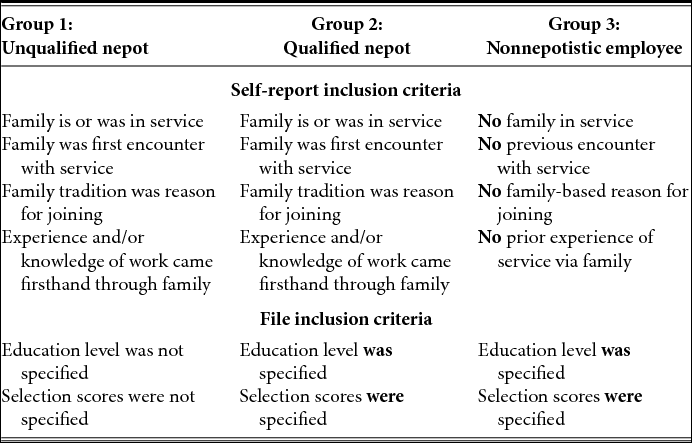
Clearly, there is a general lack of social science or organizational research that makes and explores these distinctions in nepotism (Bellow, Reference Bellow2003; Jones & Stout). This is where our own research, primarily on familial nepotism rather than SCP per se, makes a contribution. We investigated the levels of performance and well-being of 154 employees within a Caribbean coast guard organization. It is crucial to note that we used, in what resembles a quasi-experimental field-study design (Cook & Campbell, Reference Cook, Campbell and Dunnette1976), a mixture of indirect self-report questions and personnel file information to distinguish three employee groups: unqualified nepotistic hires, qualified nepotistic hires, and nonnepotistic employees (see Table 1).
Table 1.Self-Report and Archival Criteria Used to Determine Respondents’ Nepotistic Status
We measured two outcomes: employee performance (the most recent performance appraisal scores, range 0–150) and well-being (measured by a survey with the General Health Questionnaire; Goldberg, Reference Goldberg1978). We carried out a multivariate analysis of covariance test on the data, with performance and well-being as outcomes; nepotistic status as a between-subjects factor; and gender, age, tenure, and initial performance (first appraisal upon joining the organization) as control variables. We found that nepotistic subgroups differed significantly both in well-being, F(148, 2) = 3.68, p < .05, and in performance, F(148, 2) = 4.22, p < .05. Pairwise comparisons of subgroup means confirmed that unqualified nepots showed significantly lower performance ratings than did qualified nepots (M difference = 10.63, p < .05); qualified nepots did not differ significantly from nonnepots. We also found that the General Health Questionnaire well-being scores for unqualified nepots were (marginally) significantly higher (poorer) than were those of nonnepots (M difference = 1.74, p = .06).
We also tested two self-report survey concepts as potential moderators of these nepotistic status effects: role conflict (Rizzo, House, & Lirtzman, Reference Rizzo, House and Lirtzman1970) and coworker support (Bridger, Kilminster, & Slaven, Reference Bridger, Kilminster and Slaven2007). Role conflict showed only a marginally significant interactive effect on well-being, F(148, 3) = 2.33, p = .08, with low role conflict (−1 SD) benefiting all subgroups in well-being terms but with qualified nepots benefiting the most. Similarly, coworker support also showed a significant interactive effect on well-being, F(148, 3) = 6.42, p < .01, with highly supportive coworker relationships (+1 SD) benefiting all subgroups in well-being terms but with unqualified nepots benefiting the most.
In sum, our findings show that type of nepotistic status does matter and indeed shapes some of the dilemmas implied by Jones and Stout in terms of employee competence (and possibly willingness, if we take lower well-being as an indirect indicator of or proxy for lower willingness to play the role for which the employee has been hired). Although some cultural stereotypes of nepots may have them as undeservingly “born with a silver spoon in their mouth,” in organizations, more generally, unqualified nepots may constitute a particularly vulnerable group of employees who underperform (perhaps unsurprisingly given a lack of qualifications) and who have poorer levels of well-being than do nonnepotistic employees. Qualified nepots seem to be more similar to nonnepotistic employees, with their qualifications perhaps giving them a procedural legitimacy to perform effectively. In addition, reduced role conflict (or increased role clarity) and coworker support do not help to compensate for underperformance, but they can help restore diminished well-being among nepotistic employees. In this sample, at least, supportive coworker relationships and clear, uncomplicated roles may represent tools for intervention and important reassurances for supporting nepots who doubt their worth or role in a company. Frontline and midlevel employees hired through family connections may need supports to bolster their well-being and performance levels.
We conclude this commentary by arguing that I-O research can connect and consolidate understandings of nepotism within and across other topical agendas. Once again, context matters in organizational behavior (Johns, Reference Johns2006), so efforts to continue to unpack the components of that context are needed. The example of British politician Tony Benn can illustrate the contextual complexity. In the early 1960s, he campaigned to reform the law and, partly because of his left-leaning politics, actively renounced a hereditary peerage that would have granted him a noble title by birth, preferring to be allowed to continue to work as a career politician at a more modest ministerial level (Adams, Reference Adams2011). In 1999, the United Kingdom further reformed the law in the House of Lords Act to altogether stop people from inheriting by birthright politically influential seats in the House of Lords, although many existing inheritors were allowed to remain. To further complicate matters, Tony Benn's eldest son Stephen went on to inherit the very same noble title (viscount) that his father had renounced, although the law now prevented Stephen from sitting in the House of Lords. Including Stephen, two of Tony Benn's four children work today in politics (Boffey, Reference Boffey2014). For complex job roles like that of a politician, such stories muddy the waters in determining whether and how nepotism could and should be policed and by whom, but at the same time, these stories serve to inform I-O psychologists about legal and other dynamic aspects of context.
In the wider context, institutions, history, norms, and discourses will shape the attitudes toward policing nepotism and SCP. The visibility of a surname carries much weight for softer work in the arts, public relations, and the media; in political roles in which trust and loyalty are desirable, nepotistic networks can be seen as an ultimate security measure; in some occupations, successful marriage matches can double the capacity of an individual's professional network. Yet in science and academia, where anonymity and objectivity are prized in standard peer-reviewing practice, surname-linked nepotism will run largely invisible and unrewarded (Reeves, Reference Reeves2003). To give an example of another difference, in the case of family businesses, successive handovers to other family members may reflect a rational response that minimizes the social and financial risks incurred by instead handing over an idiosyncratic business to a nonfamily agent of potentially lower trustworthiness and/or ability (Lee, Lim, & Lim, Reference Lee, Lim and Lim2003).
As well as occupational context, national context and culture do matter, and they too are complex in their effects. Although Jones and Stout have noted that guanxi social connections in China could boost organizational performance (Luo, Huang, & Wang, Reference Luo, Huang and Wang2012), these “particularistic” (as opposed to universally meritocratic) ties could also harm trust in management or peers, foster perceptions of shirking, and lead to reduced organizational commitment (Chen, Chen, & Xin, Reference Chen, Chen and Xin2004; Pearce, Branyiczki, & Bigley, Reference Pearce, Branyiczki and Bigley2000). A lot probably depends on the perceptions of the tie in question and on other aspects of the relationships involved. So it seems the evidence can remain contested and, one might be inclined to argue, usefully so. Developing countries, island cultures, and politically unstable nation-states will arguably all be strongly affected by more widespread, potentially corrupting forms of nepotism and SCP.
Yet if we consider policing nepotism from a diversity management standpoint, “no spouse” rules may need to be used with considerable discretion lest, as Jones and Stout have noted, those rules prevent the progress of entire demographic sections of women in workplaces and industries in which their husbands hold sway, creating a divisive diversity “fault line” that disproportionately excludes women with social connections. Nepotism, SCP, and I-O psychology can therefore all stand to benefit from a greater mutual integration of research on diversity and cross-cultural psychology (Ferdman & Sagiv, Reference Ferdman and Sagiv2012), provided nepotism and SCP are treated as a valid intersectional dimension of diversity along with gender, race, age, and so on.
In conclusion, then, we as I-O psychologists need to try to map the prevalence, contexts, and diversity of (often overlapping) forms (e.g., favoritism vs. cronyism vs. nepotism vs. other SCP; qualified vs. unqualified) of nepotism and SCP to better understand how to police nepotism and SCP effectively, wisely, and discreetly. Given escalating economic inequality in America and other developed countries (Cowen, Reference Cowen2013), organizations should perhaps remain wary of the ways in which such practices may reinforce the class divisions while acknowledging that work opportunities are often ineluctably social in nature. Nepotism and SCP themselves may seem to be relatively isolated and less salient issues if we widely consider organizations (after all, although people in general are influenced by family and friends, individualistic values do permit many to freely choose not to follow in their footsteps); however, as phenomena, nepotism and SCP do provide lenses for taking fresh looks at a range of other established topics in I-O psychology. These might include psychological contracts, types and characteristics of social network ties, distinctive forms of corporate governance (e.g., the Murdoch media empire), coworker effects, leadership development influences, and so on. In sum, nepotism and SCP can help I-O psychologists to continue to reflect on how to best police the context-sensitive, dynamic boundaries where human capital, talent, and just meritocracy end and where corruption, nepotism, SCP, and other forms of social psychological influence begin.





The focal article by Jones and Stout (Reference Jones and Stout2015) has revealed just how much there is for industrial and organizational (I-O) psychologists to try to unpack in the implications of nepotism for organizations and employees, particularly in relation to selection and development practices. In this brief commentary, we try to make two contributions to this state of affairs. First, we discuss the importance of disentangling different types of nepotistic and social connection preference (SCP) effects in context because these differences may in turn implicate distinct processes and effects that shape employee outcomes. We do this in part by drawing on findings from some of our own data on nepotistic hiring within a Caribbean coast guard organization (Rajpaul-Baptiste & Calvard, Reference Rajpaul-Baptiste and Calvard2012). Second, we argue that for nepotism and SCP to be considered more fully and fruitfully as topics for I-O research and practice, these topics need to be integrated and consolidated more thoroughly along with existing work on diversity management, cross-cultural psychology, organizational discourses, organizational contexts, institutional logics, and social network approaches. We believe this is likely to produce more theoretical, methodological, empirical, and practical coherence across emerging I-O research in this area, without leading researchers and practitioners to reinvent the wheel or misguidedly rely on cultural stereotypes about nepotism and cronyism.
Nepotism is clearly a controversial, inconclusive, and speculative topic. It seems that organizations and societies cannot live with nepotism and yet cannot live without it. If we consider nepotism along with other types of organizational diversity, then nepotism faces the same issues, being something of a double-edged sword (e.g., Milliken & Martins, Reference Milliken and Martins1996). On the one hand, nepotism runs largely counter to Western principles of meritocracy, fairness, and democracy; nepotism can therefore potentially lead to disruptive jealousy, conflict, and resentment in working relationships and can discourage other talented, diverse parties from wanting to work for an organization (Ewing, Reference Ewing1965). On the other hand, nepotism can be perceived as good business sense by executives: providing human capital where needed, upholding a distinctly successful corporate image, signaling recognition of loyalty, engendering a heightened sense of cultural fit, and shaping a deep responsibility for a company's growth and success (Ewing, Reference Ewing1965). Furthermore, nepotism appears to persist around the world and over time; this is at least partly due to long-standing evolutionary pressures to reciprocally express altruism, generosity, and gratitude toward one's own biological kin (Bellow, Reference Bellow2003).
As a result of all these lines of argument, then, there is a perhaps frustrating sense that the effects of nepotism (and indeed SCP) depend on the situation or context and that these effects need to be considered almost on a case-by-case basis. It seems reasonable to assume that nepotism will be approved of in practice as long as nepotistic hires are capable and loyal and are hired through procedurally fair decision-making mechanisms, although blanket antinepotism and disclosure policies seem to suggest otherwise (Jones & Stout).
This is where I-O psychology comes in. I-O psychologists can empirically and practically start to map some of this contextual variability to try to see where these nuances start and end. Nepotism is a loose phenomenon that “covers the spectrum from blatant favouritism towards an idiot relative to appointing someone you already know to a job” (Reeves, Reference Reeves2003, p. 22). The Jones and Stout article appeared to have emphasize more of the benefits of the latter and to have downplayed to some extent the problems of the former. Finally, there is also the question of perspective. From the perspective of the human resources decisionmaker, the affected “nepot” or SCP employee, their coworkers, or the organization as a whole—who benefits or suffers?
Clearly, there is a general lack of social science or organizational research that makes and explores these distinctions in nepotism (Bellow, Reference Bellow2003; Jones & Stout). This is where our own research, primarily on familial nepotism rather than SCP per se, makes a contribution. We investigated the levels of performance and well-being of 154 employees within a Caribbean coast guard organization. It is crucial to note that we used, in what resembles a quasi-experimental field-study design (Cook & Campbell, Reference Cook, Campbell and Dunnette1976), a mixture of indirect self-report questions and personnel file information to distinguish three employee groups: unqualified nepotistic hires, qualified nepotistic hires, and nonnepotistic employees (see Table 1).
Self-Report and Archival Criteria Used to Determine Respondents’ Nepotistic Status
Note. For Group 1, N = 16; for Group 2, N = 74; and for Group 3, N = 59. Nepot = familial relation in the workforce. The bold text indicates response criteria that confirm a relative lack of nepotistic status in employees.
We measured two outcomes: employee performance (the most recent performance appraisal scores, range 0–150) and well-being (measured by a survey with the General Health Questionnaire; Goldberg, Reference Goldberg1978). We carried out a multivariate analysis of covariance test on the data, with performance and well-being as outcomes; nepotistic status as a between-subjects factor; and gender, age, tenure, and initial performance (first appraisal upon joining the organization) as control variables. We found that nepotistic subgroups differed significantly both in well-being, F(148, 2) = 3.68, p < .05, and in performance, F(148, 2) = 4.22, p < .05. Pairwise comparisons of subgroup means confirmed that unqualified nepots showed significantly lower performance ratings than did qualified nepots (M difference = 10.63, p < .05); qualified nepots did not differ significantly from nonnepots. We also found that the General Health Questionnaire well-being scores for unqualified nepots were (marginally) significantly higher (poorer) than were those of nonnepots (M difference = 1.74, p = .06).
We also tested two self-report survey concepts as potential moderators of these nepotistic status effects: role conflict (Rizzo, House, & Lirtzman, Reference Rizzo, House and Lirtzman1970) and coworker support (Bridger, Kilminster, & Slaven, Reference Bridger, Kilminster and Slaven2007). Role conflict showed only a marginally significant interactive effect on well-being, F(148, 3) = 2.33, p = .08, with low role conflict (−1 SD) benefiting all subgroups in well-being terms but with qualified nepots benefiting the most. Similarly, coworker support also showed a significant interactive effect on well-being, F(148, 3) = 6.42, p < .01, with highly supportive coworker relationships (+1 SD) benefiting all subgroups in well-being terms but with unqualified nepots benefiting the most.
In sum, our findings show that type of nepotistic status does matter and indeed shapes some of the dilemmas implied by Jones and Stout in terms of employee competence (and possibly willingness, if we take lower well-being as an indirect indicator of or proxy for lower willingness to play the role for which the employee has been hired). Although some cultural stereotypes of nepots may have them as undeservingly “born with a silver spoon in their mouth,” in organizations, more generally, unqualified nepots may constitute a particularly vulnerable group of employees who underperform (perhaps unsurprisingly given a lack of qualifications) and who have poorer levels of well-being than do nonnepotistic employees. Qualified nepots seem to be more similar to nonnepotistic employees, with their qualifications perhaps giving them a procedural legitimacy to perform effectively. In addition, reduced role conflict (or increased role clarity) and coworker support do not help to compensate for underperformance, but they can help restore diminished well-being among nepotistic employees. In this sample, at least, supportive coworker relationships and clear, uncomplicated roles may represent tools for intervention and important reassurances for supporting nepots who doubt their worth or role in a company. Frontline and midlevel employees hired through family connections may need supports to bolster their well-being and performance levels.
We conclude this commentary by arguing that I-O research can connect and consolidate understandings of nepotism within and across other topical agendas. Once again, context matters in organizational behavior (Johns, Reference Johns2006), so efforts to continue to unpack the components of that context are needed. The example of British politician Tony Benn can illustrate the contextual complexity. In the early 1960s, he campaigned to reform the law and, partly because of his left-leaning politics, actively renounced a hereditary peerage that would have granted him a noble title by birth, preferring to be allowed to continue to work as a career politician at a more modest ministerial level (Adams, Reference Adams2011). In 1999, the United Kingdom further reformed the law in the House of Lords Act to altogether stop people from inheriting by birthright politically influential seats in the House of Lords, although many existing inheritors were allowed to remain. To further complicate matters, Tony Benn's eldest son Stephen went on to inherit the very same noble title (viscount) that his father had renounced, although the law now prevented Stephen from sitting in the House of Lords. Including Stephen, two of Tony Benn's four children work today in politics (Boffey, Reference Boffey2014). For complex job roles like that of a politician, such stories muddy the waters in determining whether and how nepotism could and should be policed and by whom, but at the same time, these stories serve to inform I-O psychologists about legal and other dynamic aspects of context.
In the wider context, institutions, history, norms, and discourses will shape the attitudes toward policing nepotism and SCP. The visibility of a surname carries much weight for softer work in the arts, public relations, and the media; in political roles in which trust and loyalty are desirable, nepotistic networks can be seen as an ultimate security measure; in some occupations, successful marriage matches can double the capacity of an individual's professional network. Yet in science and academia, where anonymity and objectivity are prized in standard peer-reviewing practice, surname-linked nepotism will run largely invisible and unrewarded (Reeves, Reference Reeves2003). To give an example of another difference, in the case of family businesses, successive handovers to other family members may reflect a rational response that minimizes the social and financial risks incurred by instead handing over an idiosyncratic business to a nonfamily agent of potentially lower trustworthiness and/or ability (Lee, Lim, & Lim, Reference Lee, Lim and Lim2003).
As well as occupational context, national context and culture do matter, and they too are complex in their effects. Although Jones and Stout have noted that guanxi social connections in China could boost organizational performance (Luo, Huang, & Wang, Reference Luo, Huang and Wang2012), these “particularistic” (as opposed to universally meritocratic) ties could also harm trust in management or peers, foster perceptions of shirking, and lead to reduced organizational commitment (Chen, Chen, & Xin, Reference Chen, Chen and Xin2004; Pearce, Branyiczki, & Bigley, Reference Pearce, Branyiczki and Bigley2000). A lot probably depends on the perceptions of the tie in question and on other aspects of the relationships involved. So it seems the evidence can remain contested and, one might be inclined to argue, usefully so. Developing countries, island cultures, and politically unstable nation-states will arguably all be strongly affected by more widespread, potentially corrupting forms of nepotism and SCP.
Yet if we consider policing nepotism from a diversity management standpoint, “no spouse” rules may need to be used with considerable discretion lest, as Jones and Stout have noted, those rules prevent the progress of entire demographic sections of women in workplaces and industries in which their husbands hold sway, creating a divisive diversity “fault line” that disproportionately excludes women with social connections. Nepotism, SCP, and I-O psychology can therefore all stand to benefit from a greater mutual integration of research on diversity and cross-cultural psychology (Ferdman & Sagiv, Reference Ferdman and Sagiv2012), provided nepotism and SCP are treated as a valid intersectional dimension of diversity along with gender, race, age, and so on.
In conclusion, then, we as I-O psychologists need to try to map the prevalence, contexts, and diversity of (often overlapping) forms (e.g., favoritism vs. cronyism vs. nepotism vs. other SCP; qualified vs. unqualified) of nepotism and SCP to better understand how to police nepotism and SCP effectively, wisely, and discreetly. Given escalating economic inequality in America and other developed countries (Cowen, Reference Cowen2013), organizations should perhaps remain wary of the ways in which such practices may reinforce the class divisions while acknowledging that work opportunities are often ineluctably social in nature. Nepotism and SCP themselves may seem to be relatively isolated and less salient issues if we widely consider organizations (after all, although people in general are influenced by family and friends, individualistic values do permit many to freely choose not to follow in their footsteps); however, as phenomena, nepotism and SCP do provide lenses for taking fresh looks at a range of other established topics in I-O psychology. These might include psychological contracts, types and characteristics of social network ties, distinctive forms of corporate governance (e.g., the Murdoch media empire), coworker effects, leadership development influences, and so on. In sum, nepotism and SCP can help I-O psychologists to continue to reflect on how to best police the context-sensitive, dynamic boundaries where human capital, talent, and just meritocracy end and where corruption, nepotism, SCP, and other forms of social psychological influence begin.