Antibiotic resistance is a growing threat to public health worldwide.1, 2 New practitioners are at the forefront of the fight against antibiotic resistance, and they need the tools to treat antibiotic-resistant infections and to be vigilant stewards of antimicrobial agents. Previous studies examining attitudes and behaviors of medical residents have demonstrated that diagnostic uncertainty and how clinically ill a patient appears tend to increase prescribing of broad-spectrum antimicrobial agents, although resident prescribers acknowledge that these agents may not be necessary.Reference Laeke, Bernabe, Peterson and Liappis3–Reference Gonzalez-Gonzalez, Lopez-Vazquez and Vazquez-Lago5 Additionally, because training programs in the United States encourage the progressive responsibility and independence of medical residents, attending physicians are unlikely to change empiric or definitive therapy chosen by the medical resident.Reference Laeke, Bernabe, Peterson and Liappis3, 6
Inappropriate antibiotic prescribing is a modifiable contributor to antimicrobial resistance and important target for antimicrobial stewardship programs (ASPs).1 The Infectious Diseases Society of America (IDSA) recommends 2 core strategies for ASPs: prescription audit with feedback and formulary restriction. Provider education is a recommended supplemental strategy to support the core methods.Reference Barlam, Cosgrove and Abbo7 Although global educational strategies and audit with feedback may impact hospital- or health-system–wide stewardship goals, additional targeted education and interventions with resident physicians may be helpful to further establish appropriate antibiotic prescribing behaviors early in clinical practice.Reference Srinivasan, Song, Richards, Sinkowitz-Cochran, Cardo and Rand8, Reference Shukla, Behnam-Terneus, Cunill-De Sautu and Perez9 The purpose of this study was to compare the antimicrobial prescribing practices of 2 separate academic medical teams receiving different approaches to antimicrobial stewardship training along with a hospitalist prescriber control group.
Methods
Study design
This retrospective cohort study evaluated antimicrobial prescribing practices between 3 physician services, family medicine (FM) resident service, internal medicine (IM) resident service, and hospitalist service, for the most commonly encountered infections at a 350-bed community-teaching hospital. Adult patients (≥18 years) admitted between July 1, 2016, and June 30, 2017, were included if they had a discharge diagnosis of pneumonia, cellulitis, or urinary tract infection (UTI). Patients were excluded if they were diagnosed with bacteremia, aspiration pneumonia, catheter-associated urinary tract infection, osteomyelitis, or necrotizing fasciitis; if they were admitted for >10 days; or if they were immunosuppressed (ie, receiving chemotherapy or biologics, neutropenic with ANC <1,000, or solid organ transplant). This study was approved by the local institutional review board.
The hospital’s ASP is co-led by 0.1 full-time equivalent (FTE) infectious diseases (ID) physician and 1.0 FTE ID-trained clinical pharmacist. The program leads are responsible for updating and maintaining the institutional antibiograms and empiric therapy guidelines and providing annual in-person education to house staff regarding significant changes in susceptibility and treatment recommendations. The institution’s empiric therapy guidelines are based on IDSA recommendations along with local susceptibility patterns and current literature. The ID clinical pharmacist is responsible for leading daily audit activities and providing feedback to prescribers hospital-wide, which is accomplished through the network of clinical pharmacists working on each unit. Current stewardship efforts involve reviewing all admitted patients on antimicrobial therapy for appropriateness of selection and planned duration of therapy (DOT). At present, no mechanism exists to provide audit with feedback during the discharge medication reconciliation process. Additionally, each academic medicine service has a dedicated clinical pharmacist who attends patient care rounds and assists with medication selection and optimization, which includes providing feedback on antibiotic prescribing. These clinical pharmacists serve as faculty at an accredited college of pharmacy and have a teaching role during patient care rounds.
The academic medicine services, FM and IM, each consist of an attending physician, a second- or third-year medical resident, 1 or 2 first-year medical residents, 1 or 2 third- or fourth-year medical students, 2 fourth-year pharmacy students, and the clinical pharmacist faculty. Each team is responsible for 12–16 patients per day. In addition to the ASP’s daily audit with feedback, each teaching service receives different methods of supplemental antimicrobial stewardship education. All FM residents receive baseline antimicrobial stewardship education, including orientation to the ASP, during residency program orientation. Additionally, the FM service receives biweekly antimicrobial stewardship-focused rounding and education sessions provided by the ASP co-leads. These educational sessions typically last 15–30 minutes and focus on currently admitted patient cases, with teaching points related to empiric therapy, de-escalation, DOT, or pertinent stewardship topics such as diagnostic testing interpretation and new literature. The IM residents receive the same stewardship education during residency orientation as well as 2 additional education sessions provided during grand rounds by an infectious diseases physician throughout the residency year. The hospitalist service is composed of physicians who have completed an internal medicine residency and do not oversee medical student or resident learners. Similar to the IM residents, hospitalists receive ASP education at new-hire orientation and twice annually from the ASP co-leaders. Patients are assigned to an admitting service based on their primary care provider. Patients cared for by affiliated outpatient family medicine or internal medicine providers are assigned to the respective academic service. All other patients are assigned to the hospitalist service.
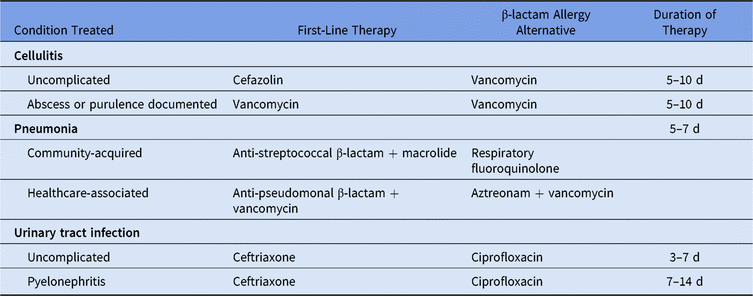
The primary outcome of this study was guideline-concordant antibiotic prescribing at hospital admission between groups. Secondary end points compared between groups included guideline-concordant prescribing at discharge, DOT prescribed, and 30-day readmission rates. Guideline-concordant prescribing was defined based on institutional empiric therapy guidelines (Table 1). Appropriate step-down and oral therapies were determined based on diagnosis, available culture data, and patient characteristics. Data were collected retrospectively from the electronic medical record. The following data were collected: patient characteristics, Charlson comorbidity index, infectious diagnosis, antimicrobial regimens, adherence to institutional antimicrobial prescribing guidelines, DOT, length of stay, in-hospital mortality, and 30-day readmission.
Guideline-concordant Therapy

Data analysis
Statistical analysis was performed using SPSS version 22 software (IBM, Armonk, NY). Outcomes measured on a nominal scale were analyzed using the χ2 test. Three-group comparisons of continuous data were assessed using 1-way ANOVA or Kruskal-Wallis test, as appropriate. Subgroup analyses comparing continuous data between 2 groups were completed using the Student’s t-test or Mann-Whitney U test based on data distribution. Statistical significance was defined as P < .05.
Results
Patient population
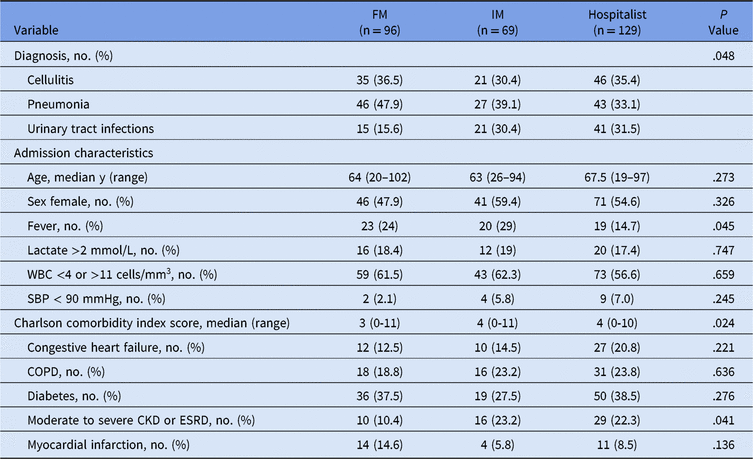
During the 1-year study period, 1,572 patients with a discharge diagnosis of pneumonia, cellulitis, or UTI were screened for inclusion. Of these patients, 295 (18.8%) met inclusion criteria (FM, n = 96; IM, n = 69; hospitalist, n = 130). A detailed breakdown of patient baseline characteristics compared between the 3 groups can be found in Table 2.
Patient Characteristics by Treatment Group

Note. WBC, white blood cell count; SBP, systolic blood pressure; COPD, chronic obstructive pulmonary disease; CKD, chronic kidney disease; ESRD, end-stage renal disease.
Guideline-concordant prescribing and patient outcomes
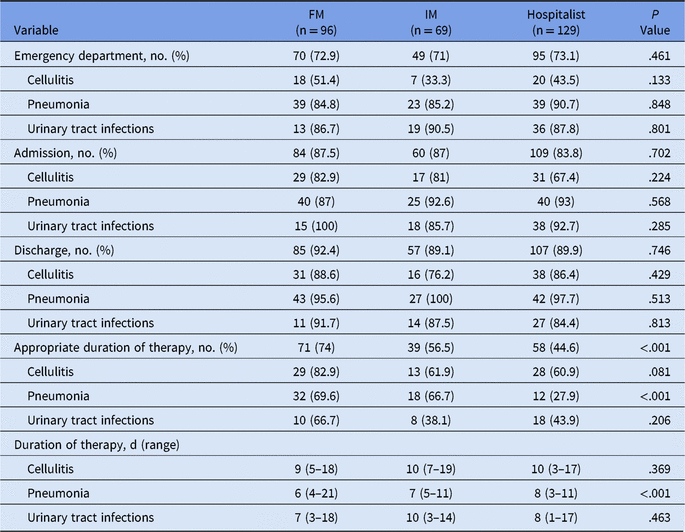
When comparing all 3 physician groups, guideline-concordant antibiotic selection was similar for all diagnoses upon hospital admission and at discharge (Table 3). When considering all diagnoses and prescribing services, a significant difference in overall guideline-concordant DOT was observed between groups (FM, 74%; IM, 56.5%; hospitalist, 44.6%; P < .001). A significant difference was identified for median duration of antibiotics prescribed between groups when treating pneumonia (FM, 6 days; IM, 7 days; hospitalist, 8 days; P < .001). Additional breakdowns comparing the 3 physician groups by diagnosis can be found in Table 3.
Guideline-Concordant Prescribing and Duration of Therapy

Note. FM, family medicine; IM, internal medicine.
Length of stay was similar between prescribing groups for all diagnoses (P = .290). The average length of stay was 3.0 days for cellulitis (P = .145), 4.6 days for pneumonia (P = .144), and 3.1 days for UTI (P = .597). There was no difference in 30-day readmission between groups across all diagnoses (P = .856). Two patients expired; 1 patient was being treated for pneumonia and 1 was being treated for UTI.
Subgroup analysis
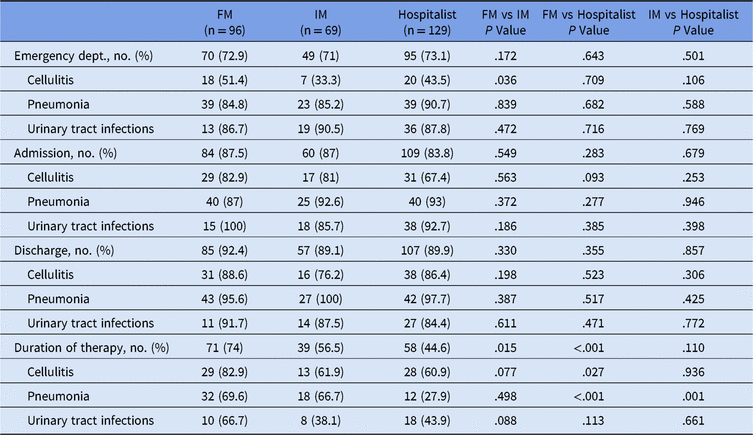
When comparing the FM and IM teaching services, there were no differences in guideline-concordant prescribing upon admission (P = .549). Additionally, there were no prescribing differences in the emergency department or at discharge for any diagnosis; however, the FM service was more likely to prescribe a guideline-concordant DOT (P = .015) (Table 4).
Guideline-concordant Prescribing Subgroup Analysis of Resident Services Compared to Hospitalist Service

Note. FM, family medicine; IM, internal medicine.
Each teaching service was compared to the hospitalist group as a control. The FM and IM teaching services showed no difference in guideline-concordant antibiotic prescribing at admission or discharge when independently compared to the hospitalist group. The FM service was more likely than the hospitalist group to prescribe a guideline-concordant DOT when all diagnoses were combined (P < .001) (Table 4). The IM service was more likely to prescribe a guideline-concordant duration for pneumonia; however, there was no difference in guideline-concordant duration for cellulitis or UTIs (Table 4).
Discussion
During the study period, empiric and definitive antimicrobial selection did not differ for the most common infectious diagnoses, with all 3 prescribing groups illustrating significant adherence to local recommendations. This finding is likely the result of standardized orientation and annual education for all groups. The FM team overall prescribed more appropriate durations of therapy than the IM and hospitalist services when all disease states were considered, which may reflect the added benefit of consistent biweekly presence of the ASP team during patient care rounds on top of routine audit and feedback. These results suggest that more frequent and multifaceted interactions with the ASP team may positively impact guideline-concordant prescribing habits. Furthermore, these study findings highlight the need for ASP interventions at discharge targeting not only appropriate definitive therapy selection but also DOT. Yogo et alReference Yogo, Haas and Knepper10 evaluated 300 patients at a single tertiary-care medical center and found that 53% of antibiotics were prescribed inappropriately at discharge, including 33% with an excessive DOT. Following an intervention that included guideline implementation and prescription audit with feedback at discharge, these researchers demonstrated a reduction in discharge DOT prescribing from 6 days to 5 days (P = .003).Reference Yogo, Shihadeh and Young11 In conjunction with audit-and-feedback, the FM resident service’s frequent contact with the ASP leaders in our study likely further enforced our institutional empiric therapy guidelines including recommendations for durations of therapy.
Several sources have described concerns with prescribing safety in the postgraduate setting and the need to implement strategies for ongoing education.Reference Davey and Garner12 Different mechanisms have been proposed for stewardship education, most of which incorporate interprofessional collaboration.Reference Davey and Garner12–Reference Barsoumian, White and Yun14 Although some data exist regarding trainee perceptions related to feedback and education from professionals outside the traditional educational hierarchy, literature evaluating the impact of different educational strategies on antibiotic prescribing habits and outcomes related to ASPs in the postgraduate setting is scarce. Nori et alReference Nori, Madaline and Munjal15 evaluated the implementation of a multifaceted approach to ASP education across the learning continuum, including postgraduate physicians. Similar to our approach, they provided baseline education, orientation to antibiogram and empiric therapy guidelines, and audit with feedback. Additionally, three 50-minute case-based lectures were presented to postgraduate learners annually, and knowledge was assessed before and after education. This approach demonstrated a 20% improvement in antibiotic prescribing appropriateness, which was sustained 20 months postintervention. These results support our findings that routine face-to-face education involving patient cases or simulation is more effective than lecture-based education and audit with feedback alone.
Our study has several limitations. First, the retrospective study design introduces risk of selection bias as well as reliance on accurate diagnosis and complete documentation. Currently, no standardized documentation exists among prescriber groups outside of billing and coding. Additionally, ED diagnosis and prescribing has been shown to have a significant influence on inpatient prescribing; we collected ED guideline-concordant prescribing and observed no differences across all groups and diagnoses.Reference Kulwicki, Brandt and Wolf16, Reference DeFrates, Weant and Seamon17 The high rate of guideline-concordant antibiotic prescribing in the ED likely influenced rates of guideline-concordant prescribing upon admission in our study. Our inclusion criteria limited our population to uncomplicated infections as we excluded patients who were bacteremic or admitted for >10 days. Although this limits extrapolation of these findings to patients with more complicated infections, this population reflects the patients most commonly cared for by teaching services without a formal ID consult and, therefore, represents those who would benefit most from a multifaceted ASP approach. Durations of therapy may have varied between groups due to differences in baseline characteristics, including Charlson comorbidity index score. Finally, this is a resource-intensive intervention and may not be scalable to other health systems.
In conclusion, annual and consistent education combined with audit with feedback demonstrated adherence to institutional antimicrobial prescribing guidelines across prescriber groups regarding antibiotic selection; however, adding dedicated stewardship-focused rounds into the graduate medical curriculum was associated with increased adherence specifically with DOT prescribing. Antimicrobial stewardship programs should seek out opportunities to incorporate consistent teaching activities, such as patient case simulations, into graduate medical education on top of routine provider education and audit with feedback.
Acknowledgments
The authors would like to acknowledge Nnaemeka Egwuatu, MD for his support and leadership of the resident antimicrobial stewardship-focused rounding and education sessions.
Financial support
No financial support was provided relevant to this article.
Conflicts of interest
All authors report no conflicts of interest relevant to this article.