I. INTRODUCTION
Ti–6Al–4V alloy, designated as one of the most important titanium alloys, has been widely used as an excellent structural material in many fields like aeronautic, astronautic, and biomedical industries due to its outstanding thermal stability, high specific strength, superior corrosion resistance, and fantastic biocompatibility. Reference Bermingham, McDonald, StJohn and Dargusch1
However, the difficulty in the process of forming materials in ambient or low-temperature conditions is the major obstacle for widespread applications of titanium alloys. Reference Lewis, Qidwai, Rowenhorst and Geltmacher2 Gurao et al. Reference Gurao, Sethuraman and Suwas3 found that higher hardness and lower formability of the cross-rolled commercially pure titanium samples are attributed to grain orientation hardening near the basal texture. Their experimental and simulated results indicate there are more basal slips and less intergranular misorientation in the cross-rolled samples. In a word, titanium alloy is hard to form with high producing cost and low yield of processing.
To improve the ductility and formability of titanium alloy in the material processing, many kinds of treatment processing have been introduced to decrease the resistance of deformation in the titanium alloys in the ambient and high-temperature conditions. Nakai et al. Reference Nakai, Niinomi, Hieda, Cho, Nagasawa, Konno, Ito, Itsumi and Oyama4 conducted duplex heat treatments to reduce the anisotropy of mechanical properties of a coilable thin sheet of (alpha + beta)-type titanium alloy for use in aircraft applications. Anisotropy of the tensile properties can be decreased by improving the overall material ductility by increasing the first heat-treatment temperature because the rolling texture was decreased by the treatment. Others like Liu et al. Reference Liu, Wang, Tian and Tang5 designed a subtransus triplex heat treatment on the Ti–5Al–5Mo–5V–1Cr–1Fe near β titanium alloy samples prepared by laser melting deposition with high strength but low ductility.
Controlling the phase change and phase constitution of the materials is a meaningful and effective method in the pretreatment processing to improve the plasticity at room temperature and deformability in the high temperature processing. Reference Buffa, Ducato and Fratini6 Many researchers put forward many meaningful methods and models in studying the phase change from the view of the theory and experiments. Buffa et al. Reference Buffa, Ducato and Fratini6 developed a model tuning both for the thermomechanical analysis and the phase transformation through experimental data, which is able to predict the phase volume fraction (VF) in the typical zones of the joints of friction stir welding (FSW) by varying the main process parameters. Yao et al. Reference Yao, Guo, Yang, Guo and Su7 studied the interaction between hot deformation and phase change on the microstructure and mechanical properties for the isothermal forgings of Ti-17 alloy. Their results showed that the fine, uniform, and globular α structure when forged for more times and just the netted α structure when forged for few times under high temperature (beta phase region) increased the plasticity of the billet.
In fact, the relationship between the phase change and mechanical properties is too complex connected with the phase morphology, VF, even the interaction with the atoms, dislocation, or microtwins. Thus, to highlight the research key point, the phase change–mechanical property relationship has not been introduced systematically. Herein, according to the reviewer's comment, two examples are listed as the reference of the effect of the phase change on the mechanical properties. Yan et al. Reference Yan, Dargusch, Ebel and Qian8 found that acicular alpha precipitates in the beta phase and grain boundary alpha-beta-alpha layered structures both increased the material strength but sacrificing much plasticity. The other one is coarse alpha + beta colony structure with increasing aging temperature would increase the tensile strength while keeping the material ductility using the supratransus-processed and subtransus-processed methods, as reported by Huang et al. Reference Huang, Huang, Huang and Tsay9
Various processing methods are applied in improving the comprehensive mechanical property to facilitate the usability and processability in material engineering. While it is not ideal that high-temperature and multiprocedure processing methods increased the producing cost of the materials and also may deteriorate the material mechanical properties, especially strength, due to incorrect temperature control processing. Not only has the grain coarsening effect appeared, but also both oxidation layer and gas adsorption occurred to increase the material loss and worsen the surface quality, which in fact should be expected to be controlled or even avoided in the material engineering.
Fortunately, in the recent time a novel style of energy input, high energy electropulse effect (EPE), assisted processing technology to process the materials aiming to improve the microstructure and mechanical properties has emerged. Electroplasticity, electric field, and electromagnetic field can be applied concurrently within a short time and lower temperature in this process with ultrahigh efficiency and low-cost. It has been reported that applying an electric current pulse during the solidification process refines the grain size. Reference Okutani, Kabeya and Nagai10 Gromov et al. Reference Gromov, Gurevich, Kurilov and Erilova11–Reference Konovalov, Atroshkina, Ivanov and Gromov13 studied the structure, phase composition, and dislocation substructure of steel subjected to EPE and found that fatigue durability increases within short time treatment. Our previous results also successfully applied the EPE in processing functionally graded materials (FGM) titanium alloys lowering the processing temperature and persisting time Reference Ye, Kuang, Li and Tang16 with improving microstructure and mechanical properties of titanium alloy strips. By applying EPE, metals can be processed with good ductility even though the processing temperature of alloys is relatively low. Therefore, EPE is a potential high-efficient way to improve the microstructure and mechanical property. Recently, EPT has been applied in the phase change process by many researchers. Zhu et al. Reference Zhu, To, Lee, Liu, Jiang and Tang14 applied the high-energy electropulse in the aging process of ZA22 alloy, which finds that electropulsing process is 1200 times faster than the traditional process completing the phase change of eta + T – alpha + epsilon – eta (transformed state). Moreover, Jiang et al. Reference Jiang, Tang, Shek, Zhu and Xu15 accelerated the solid solution process of beta-Mg17Al12 into the alpha matrix with the help of EPT even in a very short time of several seconds. Our previous experiments Reference Ye, Kuang, Li and Tang16–Reference Ye, Liu, Ye, Wang, Tang and Song23 also successfully applied the EPT in processing predeformed titanium alloys lowering the processing temperature and persisting time with improving microstructure in recovery and recrystallization process, thus improving the mechanical properties of titanium alloy strips and obtained FGM in a single long strip material.
As it has been reported by others applying the aging process or solid solution process in the magnesium alloy or zirconium alloy, the research objective is the effect of electropulse on the second phase small particles. EPT in their researches is influential in the mechanical properties through controlling the solid solution or precipitates. It is different from the current study on the phase change process of titanium alloy. In fact, the physical process is a physical transformation process from low-temperature matrix alpha phase into high-temperature beta phase, which is a principal phase transformation instead of second phase change. Thus, the current study is totally different to the previous research, which plays an important role in the research of EPT on the titanium alloy (especially the phase-change treatment) and acts as a novelty in the EPT research field. However, the novel method of on-line high-energy electropulsing treatment (EPT) applied on the interior phase change improving the microstructure, mechanical properties, and fracture behavior of titanium alloys has not been much reported.
In the present study, the influence of EPT on the microstructure evolution, mechanical property, and tensile fracture behavior of as-treated quasi-single phase Ti alloy not only improving the material ductility but also keeping high strength standard is reported and the mechanism of the effect is discussed. The microstructure–mechanical property relationship of materials is reported. The processed high strength and high toughness two-phase Ti–6Al–4V alloy strips/sheets can be widely applied in various fields like navigation, chemical industry or biomedical fields like dental implants or artificial joints.
II. EXPERIMENTAL
A. Original materials
The commercial two-phase titanium alloy Ti–6Al–4V strips (nominal chemical components: 6.66% Al, 5.13% V, 0.21% Fe, 0.03% Mo, balance Ti) with 1.6 mm thickness are used as the original materials in this series of experiments. Original (ORI) specimens with uniform equiaxed microstructure are obtained through 600 °C/30 min low-temperature stress relieving annealing process in the heat treatment furnace.
B. EPT procedure
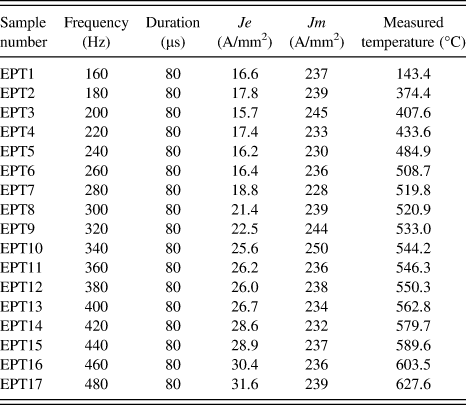
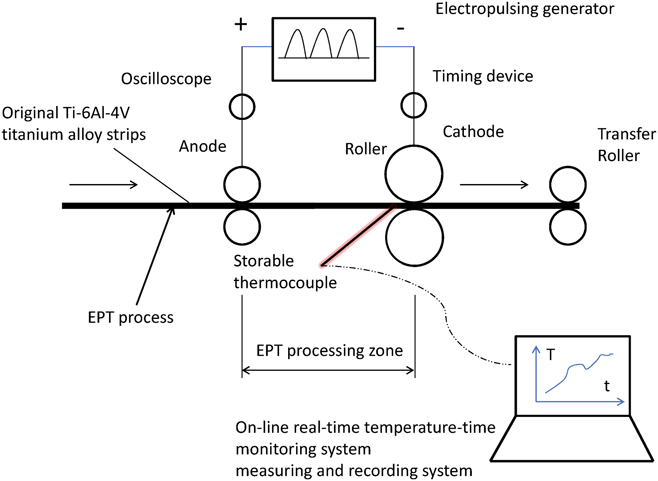
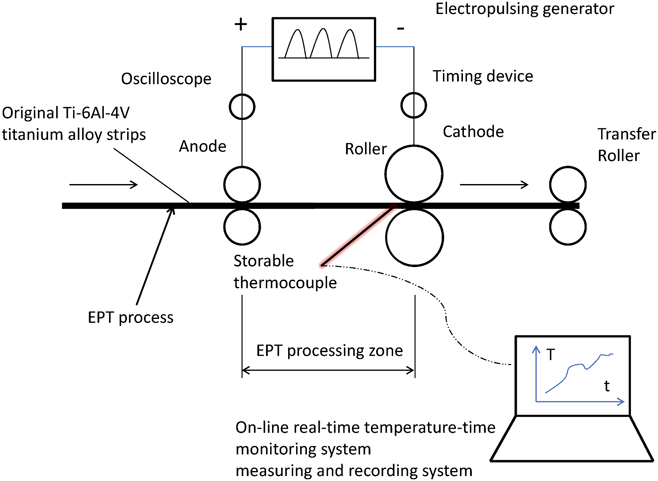
The pretreated titanium alloy strips (ORI) are processed dynamically (persisting time is 6 s controlled by timing device) by high-energy EPT under different processing parameters (as listed in Table I and the schematic procedure can be seen in Fig. 1). The Ti–6Al–4V strips move rapidly through two electrodes (EPT processing zone is about 225 mm long) and the pressure between the two conductive electrodes and the strips is accurate enough not only to keep good electrical contact but also without any deformation. In the EPT system, a self-designed electropulsing generator supplied the positive current multi-pulses within the short time duration (80 μs), which is thus called high energy electropulses. These electropulses were then applied to the moving strips in the meantime, which takes effect in the EPT zone with various discharge frequencies and the same duration of each high-peak value single pulse. The electrical parameters including charge voltage, processing frequency, root-mean-square current (RMS), amplitude of the current, and duration of single current pulse were all monitored by an electrical Hall Effect sensor electrically connected to an oscilloscope. The steady temperature of treated strips was concurrently measured by a storable K type surface contacted thermocouple located near the electroroller and the measured temperature can be recorded and analyzed in the real-time temperature–time evolution monitoring system to ensure the effective processing temperature in the treatment procedure. To compare the thermal effect of EPT on the titanium alloy strips, the CR sample strips are heated up to 630 °C over the course of about 6 s in a traditional heating furnace, followed by natural cooling in air simulating the cooling process of EPT. The average heating rate is about 105 °C/s to accomplish the rapid rising temperature process similar to EPT process. These samples were defined as rapid annealing treatment (RAT) samples.
Electropulsing parameters for treatment of the original Ti–6Al–4V alloy strips with equiaxed microstructure.

Notes: Je represents the RMS value of current density in EPT processing and Jm is the amplitude of current density of the high-energy electropulses.
Schematic diagrams of EPT process and relative on-line temperature monitoring system.
C. Material measurement and characterization
The original specimens and treated specimens under high energy EPT are cut into the standard length for subsequent measurements. The mechanical properties including the ultimate tensile strength (UTS) and elongation-to-failure (EL) of the treated materials in the various processing conditions as introduced above are conducted on the uniaxial tensile machine at ambient condition and 0.6 mm/min tensile speed, which is accomplished in six parallel tests for average measuring each group specimens. X-ray diffraction (XRD) is implemented to characterize the phase constitution of EPT samples by a Rigaku microdiffraction goniometer equipped with a one-dimensional detector using Cu Kα radiation operated with 40 kV/200 mA. Three-dimensional optical stereomicroscope (OSM, HiROX KH-7700 microscope, Japan) is utilized to observe the microstructure evolution of the ORI specimens and EPT specimens. Hitachi S-4800 FEG scanning electron microscope (SEM) was applied to observe the cross-section fracture surface to obtain the dimple size distribution information after the ambient tension process. Three-dimensional (fracture observation mode) OSM is applied to obtain the average dimple depth in the view of three-dimensional depth.
III. RESULTS
A. Effect of EPT on the mechanical properties of the Ti–6Al–4V alloy strip
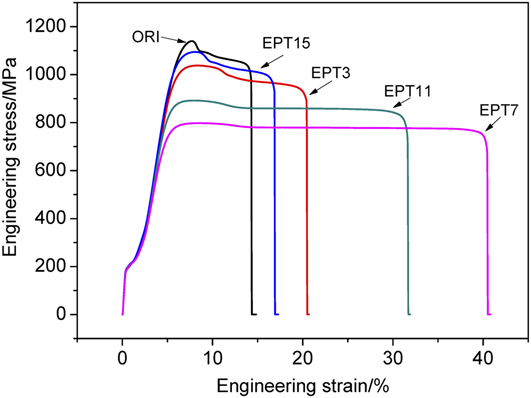
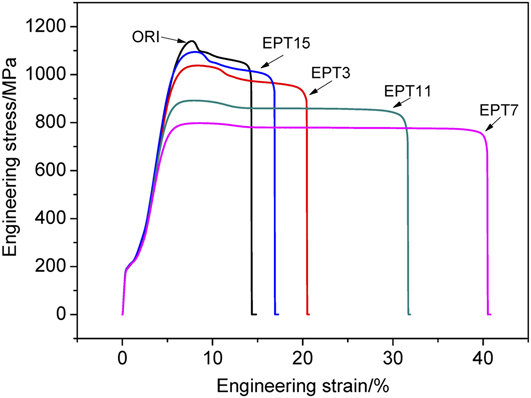
Figure 2 shows the typical engineering stress–strain curves of the original titanium alloy strips and EPT samples. The UTS and elongation-to-failure (EL) of ORI samples are 1126 MPa and 13.6%, respectively. In general, introduction of high-energy EPT enhances noticeable ductility sacrificing little strength. It is depicted that 200 Hz-EPT3 improves dramatically the material ductility by 59.56% to be 21.7% while the strength is still at a high standard. Increasing frequency to 280 Hz-EPT7, the maximum plasticity comes to 41.6% which is 3.06 times of that for the original specimen. On the other hand, the strength of the specimen is only decreased slightly by 29.3%. When it comes to 360 Hz-EPT11, the extent of the increasing ductility is lowered a little to be 31.9% that is about 2.35 times of the ORI samples. At the same time, the strength is recovered to be 886 MPa with only 21.31% decrease. If the applied frequency of EPT is further increased to 440 Hz, the ductility of the samples is still at a slight increasing state to be 17.2% by 26.47% increasing rate compared to that of the EL of ORI samples. In the meantime, the strength of EPT15 is further increased to 1100 MPa with only 2.3% decrease.
Typical engineering stress–engineering strain curves of the samples under the different conditions (original specimen and EPT specimens).
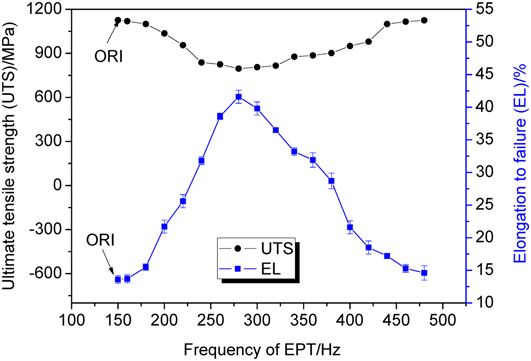
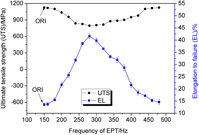
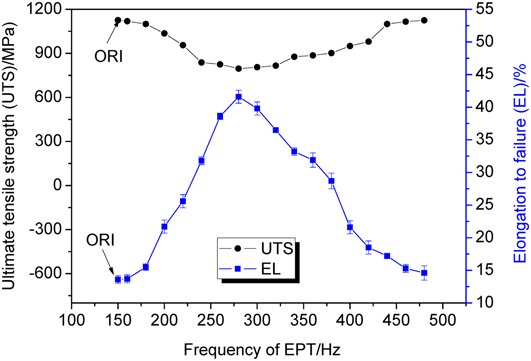
The relationship between the mechanical properties and applied EPT frequency parameters is given in detail in Fig. 3. It is presented that increasing frequency EPT improves the sample ductility and then starts to lower the ductility at the frequency of 280 Hz. On the other hand, the strength of the samples experiences a rise–fall trend with increasing frequency. At high frequency, the UTS of the EPT samples can reach the ORI samples' standard and in the region of 220–420 Hz the UTS can maintain nearly unchanged. Additionally, the whole process of increasing frequency can be roughly divided into three parts: (a) frequency is less than 200 Hz, the plasticity increment and the strength change is little; (b) frequency is between 200 and 280 Hz, the ductility of the EPT samples is rapidly improved and till 280 Hz the ductility reaches the maximum value (the ductility is increased by two times) with slight strength decrease (only 29.3% decrease) to obtain the best comprehensive properties of the titanium alloy strips. At this frequency treatment, the strength abruptly declines with increasing frequency until the frequency is more than 220 Hz the strength keeps unchanged in the 220–420 Hz range; (c) when the frequency is exceeding 280 Hz, the ductility gradually decreases and the strength gradually increases at the same time.
The dependencies of the UTS and elongation-to-failure (EL) of titanium alloy strips on the frequency of EPT processing.
B. Effect of EPT on the microstructure evolution of the Ti–6Al–4V alloy strip
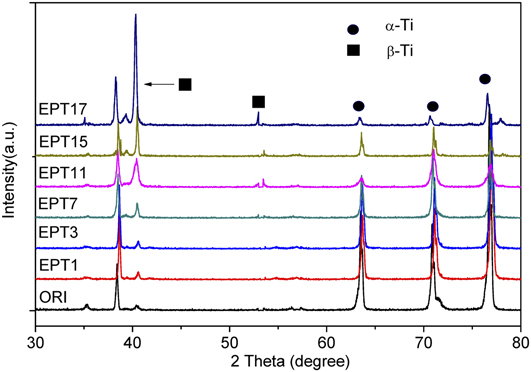
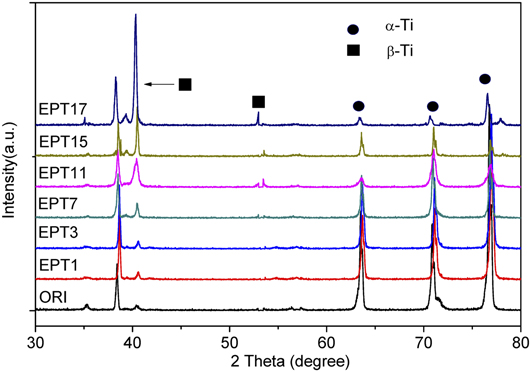
Figure 4 shows the XRD patterns of the specimens of ORI-state and EPT-state. The original sample consists of mainly single matrix α phase with the equiaxed microstructure after furnace treatment. While beta phase peaks of the EPT processing samples intensifies gradually with increasing applied frequency under the coupling of thermal and athermal effects of high-energy electropulses. Thus, alpha phase transforms into beta phase gradually in this process. When the frequency is more than 280 Hz, the transformation accelerates rapidly under the hybrid effects of thermal and athermal effects on the condition that thermal effect is strong enough in the high-frequency EPT. Thanks to the coupling of thermal and athermal effects of EPT, the whole phase transition procedure is finished in an ultrafast process (6 s) and noticeably lowers the temperature of phase transformation (300–500 °C lower than the starting temperature of traditional heating process 676 °C).
XRD patterns of various samples under CR state and high-energy EPT processing.
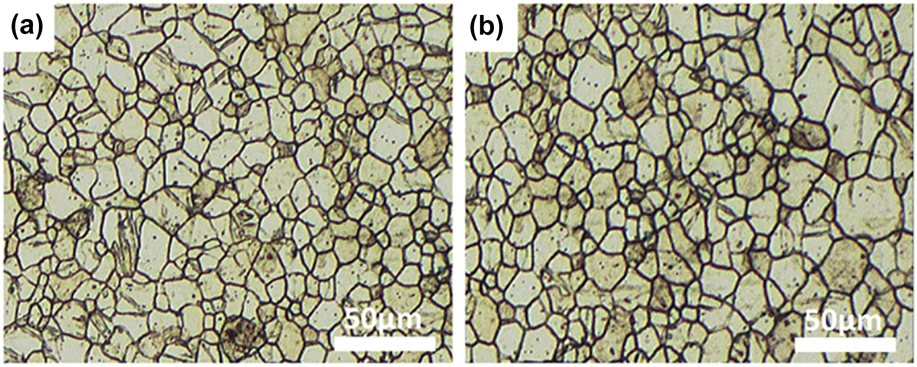
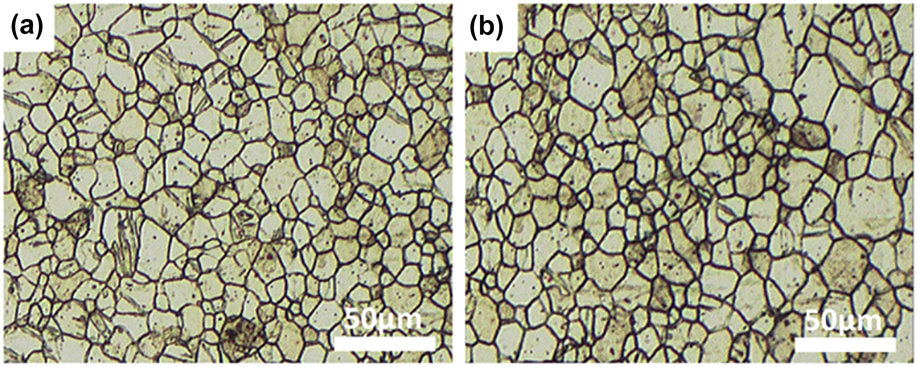
The typical microstructure of original titanium alloy strips is shown in Fig. 5(a), which is treated by the stress relieving annealing process to eliminate the internal concentrated stress and obtained the uniform equiaxed grain microstructure with ∼15 μm average grain size. To make a comparison with similar thermal effect of 480 Hz-EPT, rapid rising temperature traditional heating treatment (THT) lasts for 6 s in 630 °C is implemented and corresponding microstructure is presented in Fig. 5(b). The typical microstructure is not changed noticeably with the original specimen and local grain growth appears. While phase change of the quasi-phase original specimen is not present just under the thermal effect of the THT process, implicating that apart from the thermal effect of EPT athermal effect is predominant in occurrence of phase transition process changing the microstructure morphology and phase constitution. In the later part, the microstructure evolution under various frequency EPT processing will be discussed in detail.
Microstructure of (a) original titanium alloy strips and (b) the samples under 630 °C–6 s furnace THT.
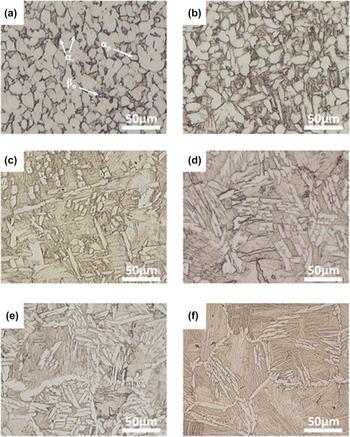
Optical microscopic (OM) micrographs, as shown in Fig. 6, reveal that the duplex microstructure, consisting of αp and βp phases (comprising αs as equiaxed/lamellar/acicular in the continuous β matrix), can be fabricated in the temperature range of 200–630 °C (apparent temperature of EPT processing in Table I), aside from some obvious difference for increasing frequency EPT processed samples in the VF of αp, dimension of βp, and morphology of primary and secondary alpha phase. Detailed information about these duplex microstructures is presented in Figs. 7–10.
Microstructure of titanium alloy strips under various EPT conditions: (a) 200 Hz-EPT3 samples; (b) 260 Hz-EPT6 samples; (c) 280 Hz-EPT7 samples; (d) 320 Hz-EPT9 samples; (e) 360 Hz-EPT11 samples; and (f) 440 Hz-EPT15 samples.

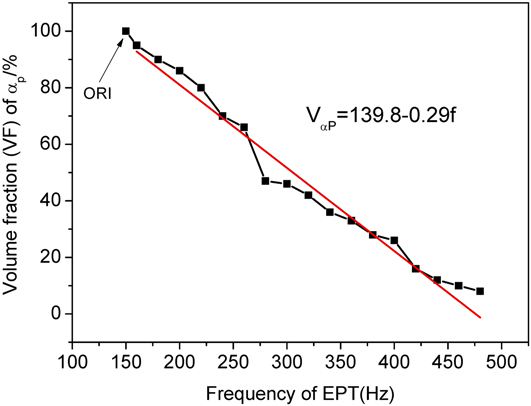
Variation of VF of primary alpha phase with increasing frequency of EPT.

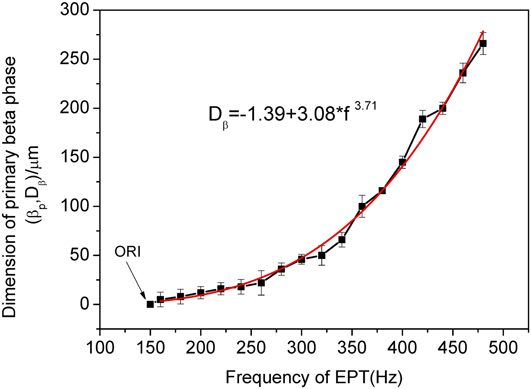
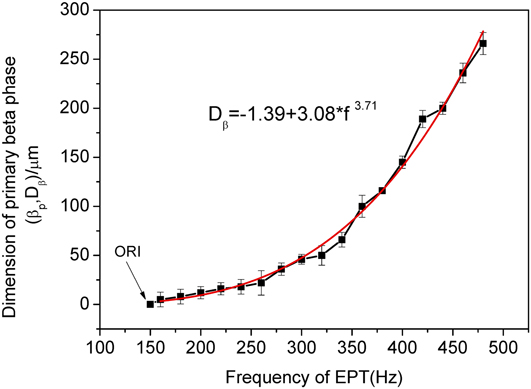
Variation of dimension of primary beta phase with increasing EPT frequency.
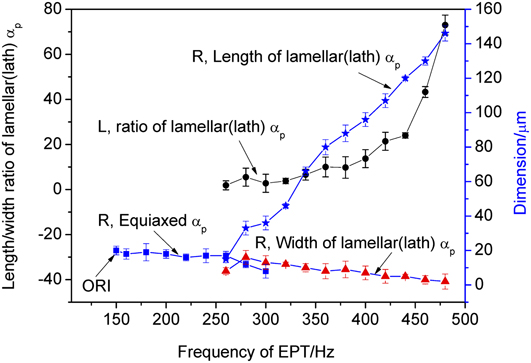
The evolution of characteristic dimension of primary alpha phase (αp) with changing EPT frequency: R, right side shows the dimension parameters of equiaxed αp and lamellar αp; L, left side shows the length/width ratio of lamellar (lath) αp.

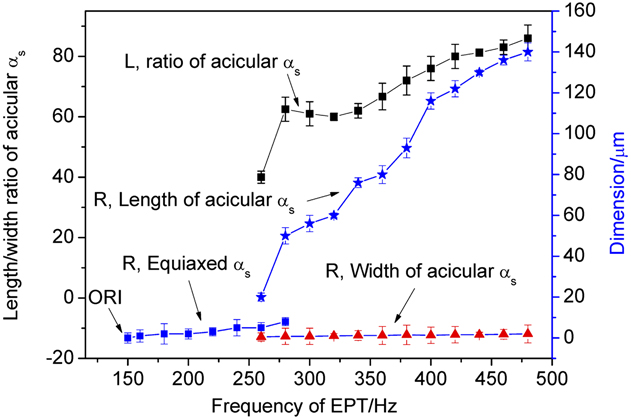
The evolution of characteristic dimension of secondary alpha phase (αs) with changing EPT frequency: R, right side shows the dimension parameters of equiaxed αs and acicular αs; L, left side shows the length/width ratio of acicular αs.
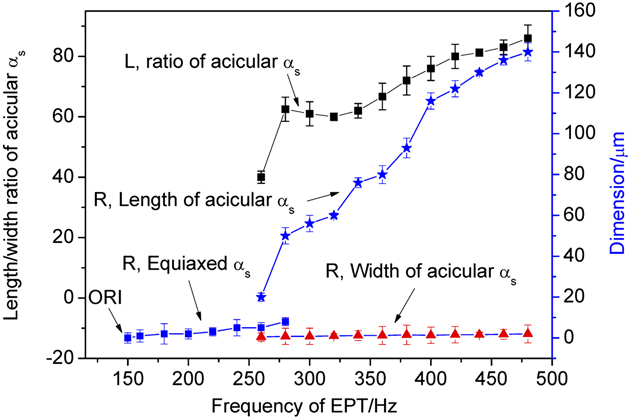
With increasing EPT frequency, phase transition of α → β occurs and there are obvious changes in phase constitutions and size distribution. Figure 6(a) presents the microstructure of samples treated by 200 Hz-EPT3 with a small number of beta phase (depicted as the gray area in the OM) precipitating at the grain boundaries or intersections from the alpha matrix in the phase change procedure induced by high-energy EPT process. Thus, VF of alpha phase is decreased to 86% and the average size of the primary beta phase is 12 μm. In addition, perishable beta stabilized elements in the grain boundaries have the tendency to accumulate to form the beta phase through diffusion and migration so that original grain boundaries evolved to be indistinct. In the meantime, many tiny equiaxed secondary alpha phase (1–3 μm) form in the beta phase. While the size of alpha phase is nearly unchanged, which is the combination of the grain growth and phase change, inducing grain size diminish. By increasing the frequency of EPT to 260 Hz-EPT6, VF of primary alpha phase decreases to 66% with the phase change of α → β as shown in Fig. 6(b). What's more, equiaxed primary alpha phase grains change into lath alpha grains with 15 μm long and 8 μm wide. Similarly, tiny equiaxed secondary alpha phase in the transformed beta phase gradually evolves into acicular secondary alpha phase with 20 μm long and 0.5 μm wide. It is implicated that the Al and V atoms in the alloy achieve the rearrangement through atom diffusion inducing the migration of interface between two phases to transform the equiaxed grains into lath (acicular) grains. Further increasing EPT frequency to 280 Hz-EPT7 facilitates the phase change continue to drop the VF of primary alpha phase to 47% and increase the beta size up to 36 μm. Additionally, the complete shape evolution of primary alpha phase appears with equiaxed grains into lath primary alpha phase (both long and short lath exist by increasing the mean length to 33 μm and mean width to 16 μm). It is inclined to form lath alpha phase compared with 260 Hz-EPT6 with enhanced length/width ratio to 2.06 from previous 1.88. On the other hand, secondary alpha phase is totally transformed into acicular phase with both increasing length (50 μm) and width (0.8 μm), which dramatically improves the ratio of secondary alpha phase length and width to 62.5 from 40 that of 260 Hz-EPT forming longer and thinner acicular alpha phase. Figure 6(d) presents the duplex microstructure of titanium samples under 320 Hz-EPT9 with decreased VF of primary alpha phase (42%) and further increasing the transformed beta phase size (50 μm). Lath primary alpha phase grows into lamellar phase with higher length/width ratio 3.83 (46 μm long and 12 μm wide), which is higher than that of 280 Hz-EPT7 sample. On the other hand, the ratio of secondary alpha phase is not changed noticeably. When it comes to 360 Hz-EPT11, the VF of primary alpha grain decreases to 33% and primary beta size comes up to 100 μm accompanied by continuous αp (primary alpha phase) at grain boundaries, as shown in Fig. 6(e). Lamellar αp gradually grows up to 80 μm long and down to 10 μm wide with additional increasing ratio of length and width to 10, which implicates that longer and thinner lamellar αp appears under higher-frequency EPT. While secondary alpha phase (αs) evolves into longer acicular phase with higher length/width ratio of 66.7 compared to the previous samples. Figure 6(f) demonstrates that 440 Hz-EPT15 drops the VF of αp to 12% and enhances the mean size of beta phase to 200 μm. 120 μm long and 5 μm wide lamellar αp with higher ratio of length and width 24 appears as continuous alpha phase at original beta phase grain boundaries. In addition, high frequency EPT brings in longer acicular αs (130 μm long) with higher length/width ratio of 81.25 in the transformed beta phase forming big-area α/β colonies which grow along a single direction.
Detailed information about these microstructures' evolution under EPT is presented in Figs. 7–10. It can be seen that with the increase in EPT applied frequency from 160 to 480 Hz, the VF of primary alpha phase
 $\left( {{V_{{\alpha _{\rm{p}}}}}} \right)$
is gradually decreased with phase transition of α → β, as an evolutional tendency of linear equation between
 ${V_{{\alpha _{\rm{p}}}}}$
and EPT frequency:
 $${V_{{\alpha _{\rm{p}}}}} = 139.8 - 0.2f\quad {\rm{,}}$$
where f is the applied frequency of high-energy EPT. The VF of αp decreases from 100% (quasi-single phase equiaxed microstructure) to about 10% of Widmanstatten structure through duplex (or triple) microstructure, which is shown in Fig. 6. In the meantime, the dimension of beta phase (D β) enhances with increasing frequency of high-energy EPT in a power functional relationship to 266 μm, which is depicted in Fig. 8 and listed as below:
 $${D_\beta } = 1.39 + 3.08{f^{3.71}}\quad {\rm{.}}$$
The above relationship between dimension of primary beta phase and applied frequency of EPT demonstrates that EPT not only facilitates the transformation process of α → β phase change but also rapid growth of beta phase grains. In this process, morphology change of primary alpha phase and secondary alpha phase with increasing EPT frequency is shown in Figs. 9 and 10. The results show that the size of equiaxed primary alpha phase grain in the procedure of increasing EPT frequency is nearly unchanged but the dimension of equiaxed secondary alpha phase precipitated from primary beta phase is slightly enhanced with increased EPT frequency. When it comes to 260–280 Hz EPT which is a transitional zone of EPT technique, there appears a tendency of equiaxed grains into lamellar (or acicular) grains, as can be seen from Figs. 6(b) and 6(c). Increasing EPT frequency brings in lamellar αp with enhanced length/width ratio (increased length and decreased width at the same time), which presents thin and long continuous primary alpha phase along the original grain boundaries in accordance with Fig. 6(f). Similar morphology evolution trend with increasing frequency of EPT occurs on the acicular secondary alpha phase of titanium samples with unchanged width and increased length inducing higher length/width ratio, which thus forms dense and tenuous α/β parallel colony interior primary beta phase. With increasing applied EPT frequency, the equiaxed grains have a tendency to grow. Simultaneously, not only the phase transformation from α to β but also the opposite process occurs during the EPT, and the former process is faster than the latter. It can be inferred that the disappeared αp grain partially transformed to β phase, and the rest elements diffuse into the residual αp grain to compensate the dimension deletion for the phase transformation, whose process is realized via element diffusion of Al and V and can be an possible explanation of nearly unchanged size of primary alpha phase grain as depicted in Fig. 9.
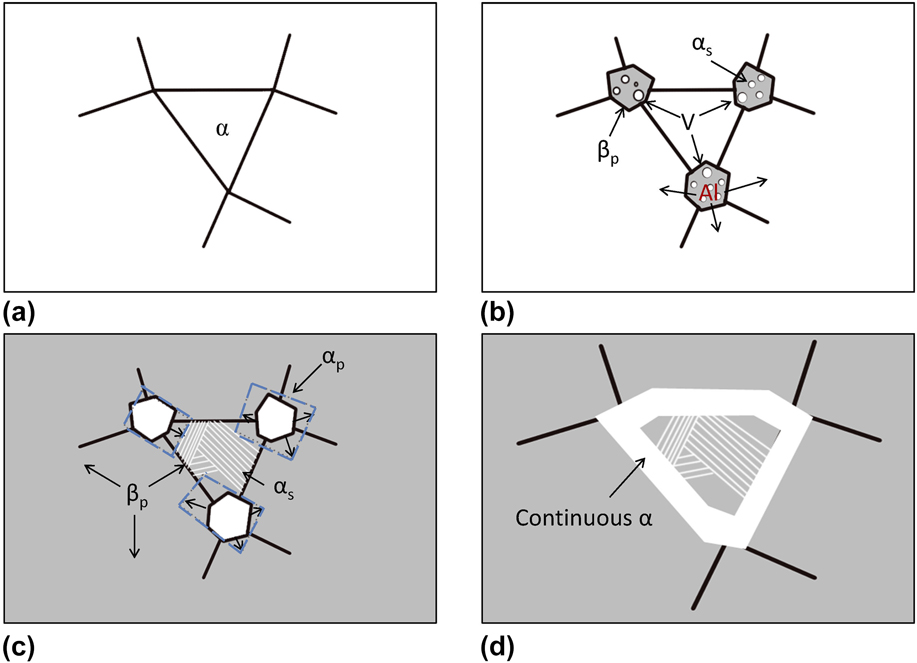
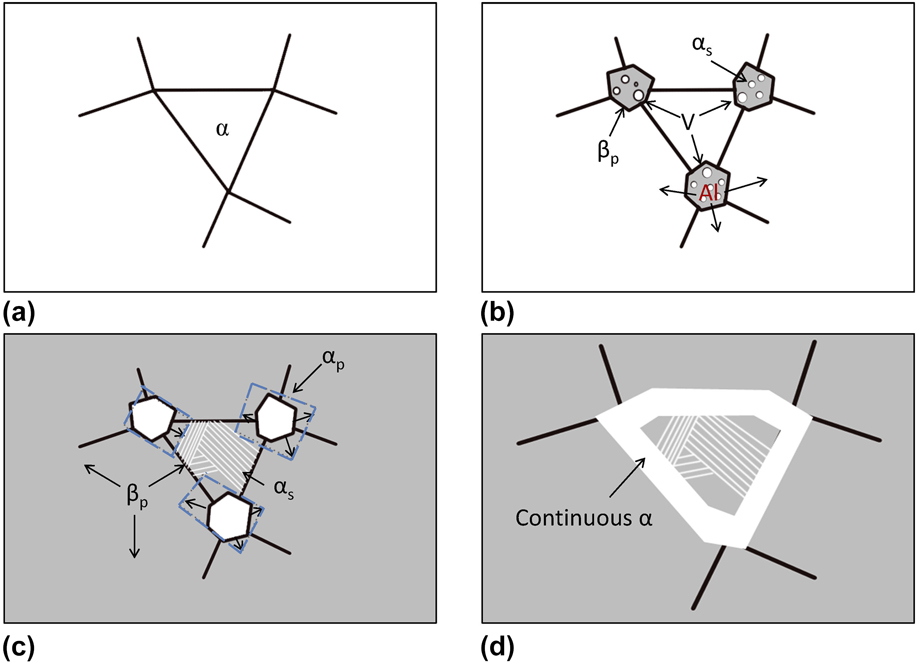
According to the previous results of microstructure evolution of titanium alloy samples under EPT, Fig. 11 shows a schematic view of the grain growth and phase transformation. During the stress-relieving heat treatment at medium temperature, both α and β phases finished the stress-relieve quickly and then become polygonal as the original sample with uniform equiaxed microstructure, as shown in Fig. 11(a). It is known that the content of V element is higher in β phase than that in α phase. Therefore, the V atoms diffuse from β phase to the neighboring α phase; and on the contrary the Al atoms diffuse from α phase to the neighboring β phase, as shown in Fig. 11(b). Therefore, the specific stabilized elements in two phases diffuse and accumulate in the grain lattice completing the phase change procedure with decreasing VF of primary alpha phase and newly formed beta phase occurring from the intersection or grain boundaries of alpha phase. What's more, a fraction of Al atoms in the primary beta phase accumulate forming equiaxed secondary alpha phase. The V element is the strong β phase stabilizer resulting in α phase that receives V atoms transforms into β phase quickly under EPT coupling of thermal and athermal effects, expanding the phase boundary into the original α grains; simultaneously, the β phase that has lost some V atoms transforms to α phase, expanding the phase boundary into the original β grains, as shown in Fig. 11(c). Thus α/β interface expands in the alloy gradually facilitating lath αp from equiaxed αp and equiaxed αs in the newly formed primary beta phase evolves into lamellar αs prior to duplex phase colony. On the other hand, further accelerated phase transition of α → β continuously decreases VF of primary alpha phase (white zone) and increases beta phase (gray zone) with enlarged size. Additional higher frequency EPT accelerates higher transformation rate of α → β, some α grains disappear with some transforming into the β phase inducing further growth of βp. The rest develops into continuous α phase at grain boundaries and parallel dual phase colony with higher length/width ratio in the transformed β grains with acicular αs phase.
A schematic view of grain growth and phase transformation: (a) original equiaxed α grains state; (b) diffusion of Al and V atoms in the phase transition process and formation of βp and equiaxed αs; (c) expansion of interfaces, growth of βp grains and lamellar αs formation and (d) continuous α grain boundaries and further growth of βp.
C. Effect of EPT on the tensile fracture behavior of the Ti–6Al–4V alloy strip
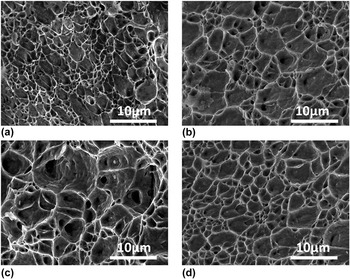
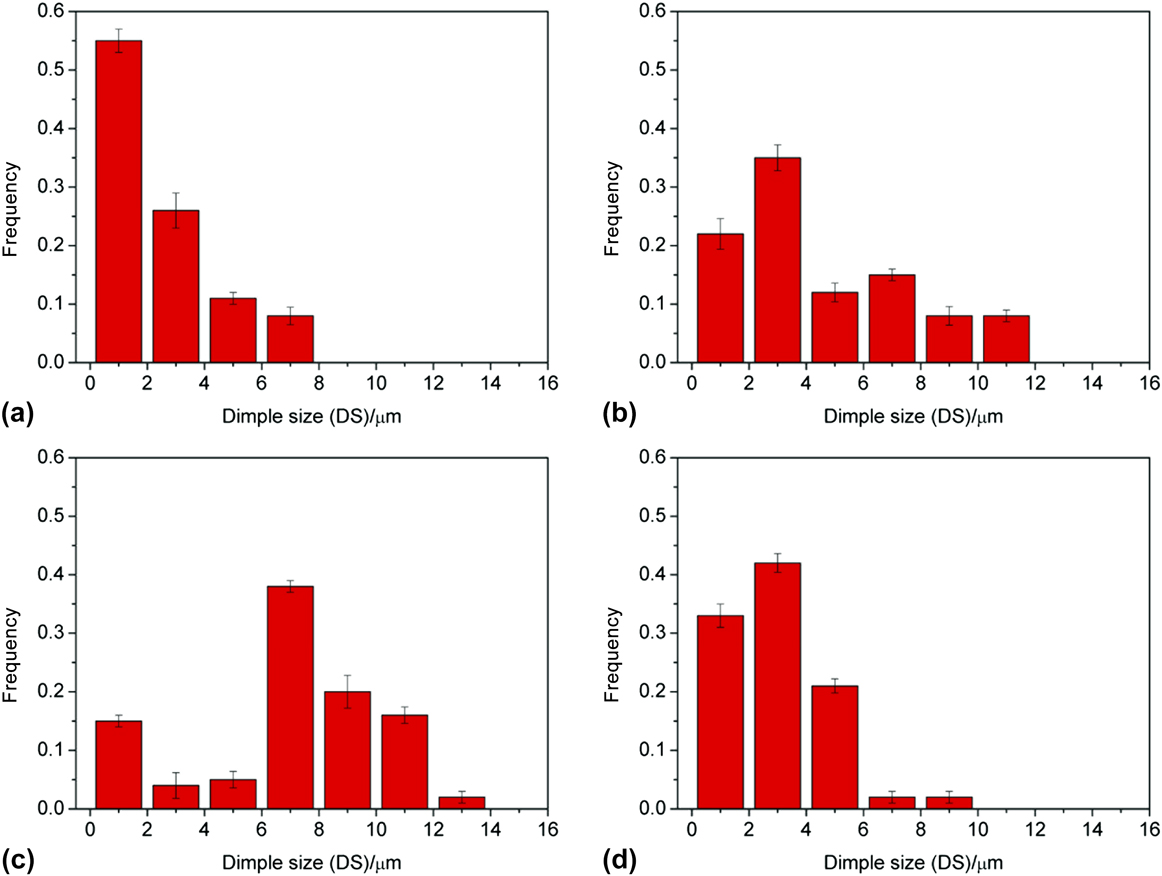
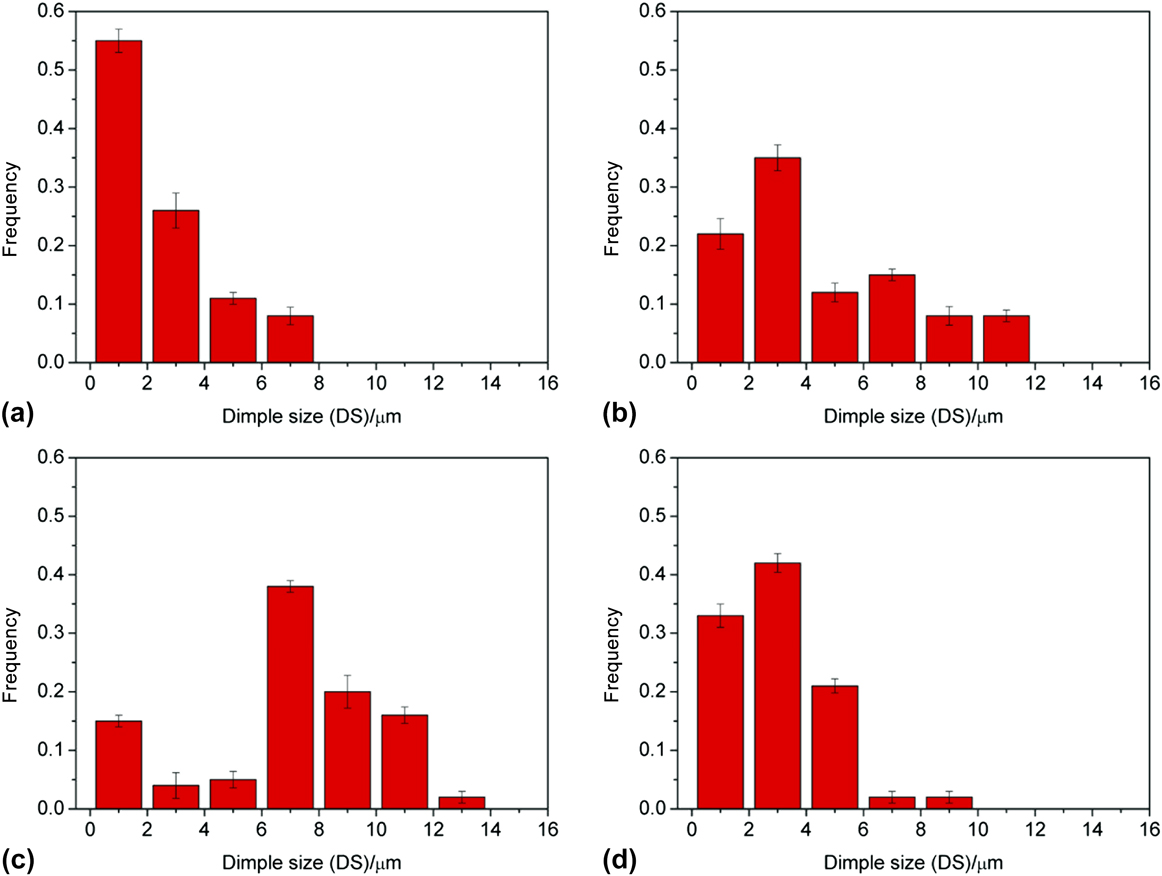
SEM fractographs shown in Fig. 12 reveals that all the specimens fail in an entirely ductile mode consisting of mixed dimples of small and large sizes that are formed by microvoid coalescence. Detailed analysis of the fractographs reveals that there is significant variation in dimple morphology with the variation condition under EPT. The statistics of the dimple sizes are estimated via image and the frequency of dimples of each size range is summarized in Fig. 13. It is interesting to find that the small dimples with a size range of 1–3 μm is predominant, and it is estimated that the dimples are relatively shallow by low difference of gray level interior and around the dimples, as can be seen from Figs. 12(a) and 13(a). In addition, microvoids prefer to accumulate around grains and unite rapidly in the tension process at room temperature leading to local concentrated stress causing fracture and low ductility. With the increase in EPT frequency, the frequency of the smallest dimples gradually decreased, and their leading role was completely replaced by dimples with a size range of 3–7 μm as can be seen from Figs. 12(b) and 13(b). Additionally, the gray difference between the edge and the center of the dimples is increased showing that the dimples get deeper under 200 Hz-EPT3, which displays that more energy is necessary in the ambient tensile process corresponding to the higher ductility with the same strength level. Tiny beta phase formation and equiaxed secondary alpha phase in the beta phase appear in the titanium alloy samples [as shown in Fig. 6(b)] under EPT inhibit the tendency of forming microvoids at the boundaries inducing large dimples in the tensile stretch. While the frequency of larger dimples of >6 μm gradually increase and overtake the dimples of <4 μm when the samples under 280 Hz-EPT7 as shown in Figs. 12(c) and 13(c). The mean dimple size (MDS) is estimated and revealed a slow but visibly increasing tendency from 2.36 to 7.0 μm with increasing EPT frequency. On the other hand, the gray degree difference between the dimple edge and center is enhanced to present deeper dimples obviously, which is corresponding to Fig. 6(c) triple microstructure with lath/equiaxed primary alpha phase and acicular secondary alpha phase. With increased beta phase under high-frequency EPT more slipping systems in the body centered cubic (BCC) crystal structure is facilitated in relieving local stress concentration in the procedure of uniaxial tensile stretch. Compared to the original samples without EPT it is hard to form dense and tiny microvoids accumulation inducing small dimples [depicted in Fig. 12(a)], thus sparse microvoids colony is not easy to cause intergranular fracture due to concentrated stress in the stretch at room temperature. On the other hand, lath primary alpha phase and acicular secondary alpha phase both decrease the effective slip length to improve the strength counteracting the strength loss by grain coarsening in the increasing frequency EPT process. Therefore, much deep dimples appear in the transgranular fracture with dramatically improved ductility of 41.6%, which is the highest ductility in the EPT samples as shown in Fig. 2. When it comes to 440 Hz-EPT15, the dimples on the contrary decrease mainly consisting of 3–5 μm and the depth of dimple colony is also changed to shallower at the same time as depicted in Figs. 12(d) and 13(d). The microstructure under this EPT condition shown in Fig. 6(f) is mainly consisted of primary beta phase and duplex primary alpha phase (continuous grain boundary alpha phase and lamellar primary alpha phase), which is easier to form the expanding passage of microvoids in the tensile stretch due to longer α/β interface resulting in the cracking development and fracture with small-sized and shallow dimples. But the ductility of high-frequency EPT is still higher than that of original materials with equiaxed microstructure thanks to the accommodated deformation of α/β phases and more slipping system of beta phase mentioned previously. On the other hand, duplex primary alpha phase decreases the effective slipping length to facilitate the nucleus of incubating microvoids at the tip of cracking so that concentrated stress and denser microvoids are easily formed to increase the strength prior to fracture failure. Figure 13 presents the size distribution of tensile dimples with increased EPT frequency more directly. The average size of dimples is gradually increased with changing EPT frequency in Figs. 13(a) and 13(c) but the average size on the contrary decreases as 1–5 μm in the 440 Hz-EPT15 sample shown in Fig. 13(d), which is in good agreement with ductility evolution with increasing EPT parameter in Fig. 3.
Cross-section fractographies of (a) original samples and various EPT samples under different conditions: (b) 200 Hz-EPT3, (c) 280 Hz-EPT7, and (d) 440 Hz-EPT15.

Dimple size distribution of (a) original samples and various EPT samples under different conditions: (b) 200 Hz-EPT3, (c) 280 Hz-EPT7, and (d) 440 Hz-EPT15.
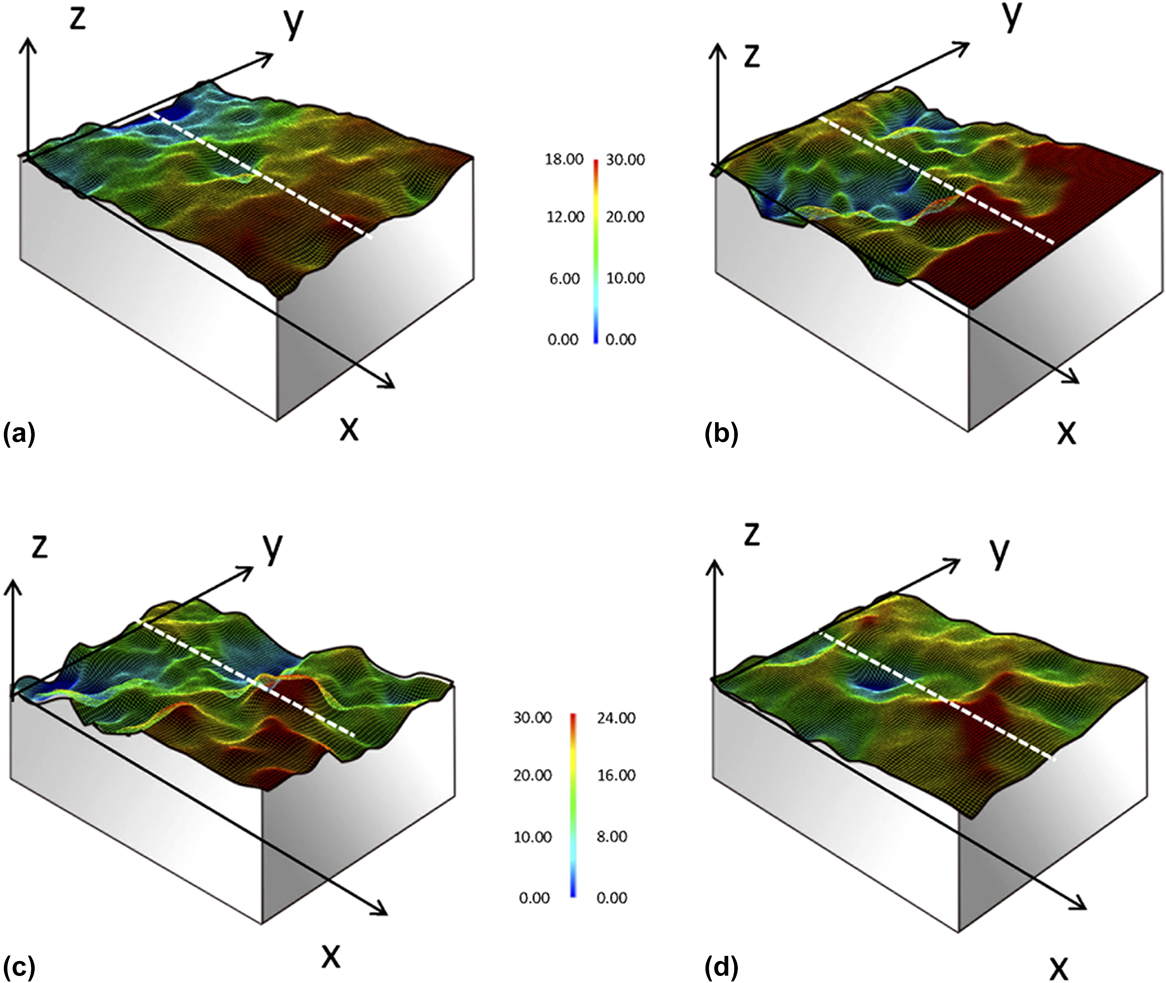
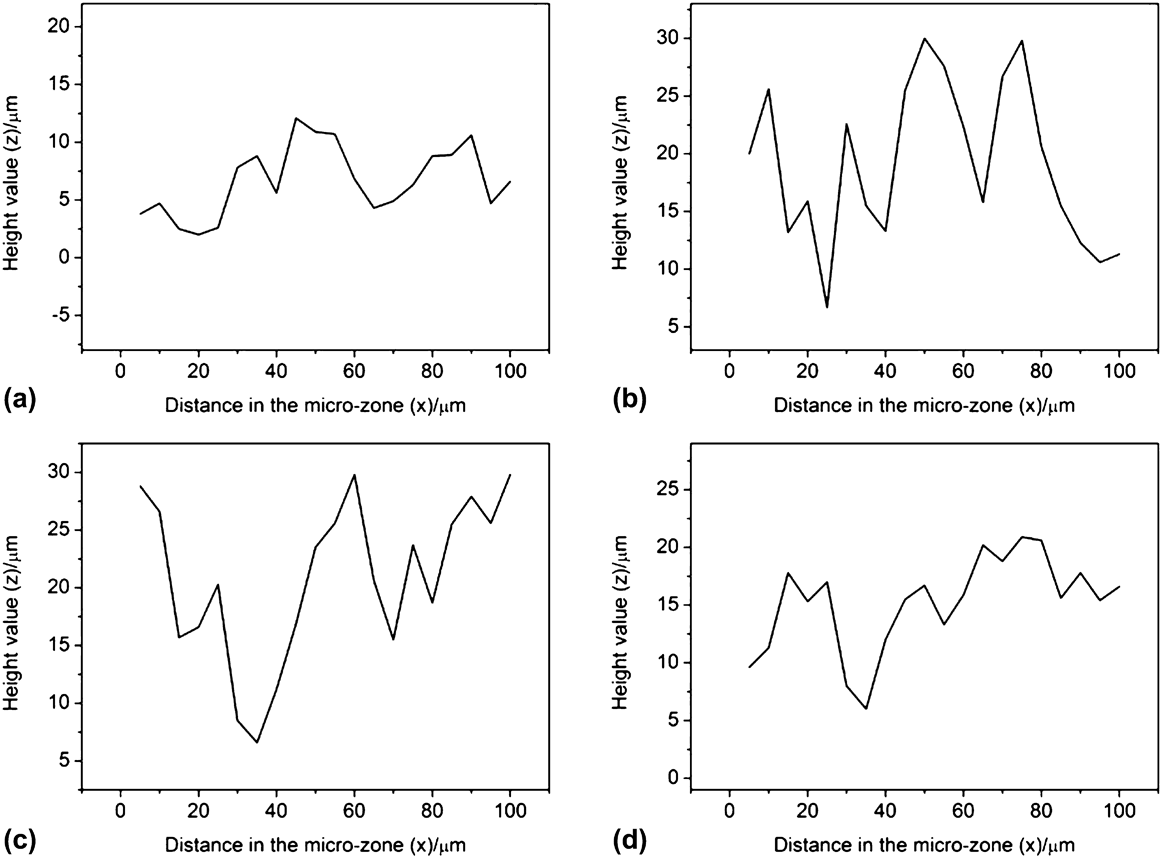
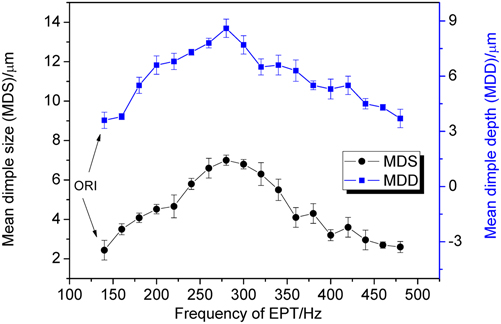
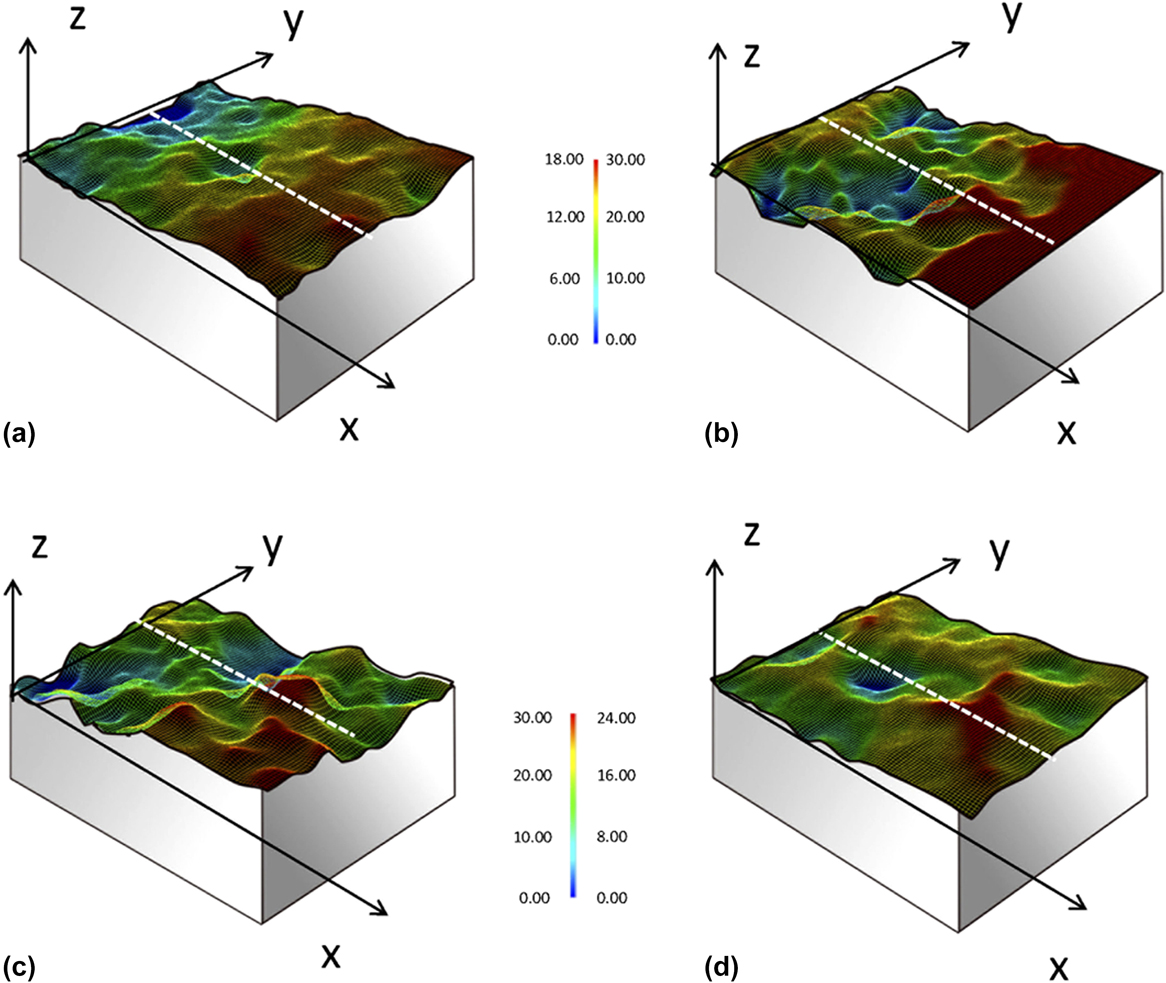
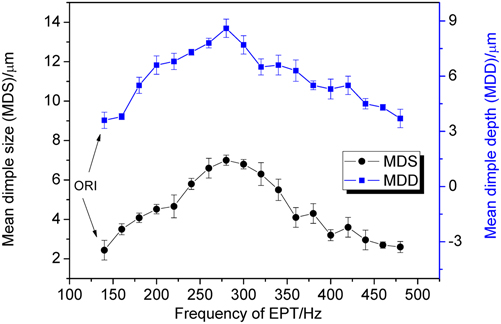
Other parameters reflecting the dimple characteristics and material plasticity, dimple depth, are measured by advanced three-dimensional stereomicroscope. Three-dimensional observations of fractography of various EPT samples under different conditions are presented in Fig. 14 that the dimples formed after tensile deformation grow to be deep and then shallow with increasing EPT frequency. The ductile dimple colonies of 280 Hz-EPT7 are the relatively deepest to show the best toughness in Fig. 14(c). The depth variation at a random white line in the Z-axis of the fracture surface is shown in Fig. 15. Figure 15(a) presents dimple colony under 5 μm in the depth. 200 Hz-EPT3 relieves much of local concentrated stress and forms many small-sized beta phase with multi-slipping systems and tiny equiaxed secondary alpha phase in the transformed beta phase, which restricts the cracking development and increases necessary energy for transgranular fracture so that the depth of dimples evolve up to about 10 μm as shown in Fig. 15(b). When it comes to 280 Hz-EPT7, increasing volume of beta phase supplies more slipping system interior grains and more deformation slipping modes as intergranular and interphase slipping to enrich the possibilities of accommodating slipping increasing sample ductility. Figure 15(d) shows that the depth of 440 Hz-EPT15 dimples grows to be shallower than that of 280 Hz-EPT7, which is the result of primary lamellar alpha phase reducing effective length and increasing the nucleus of incubating microvoids at the tip of the stress-bearing area. Figure 16 concludes the dependence of MDS and depth (MDD) of fractography on the changing EPT frequencies, which presents that the dimples grow to be big-sized and deep with increasing EPT frequency and the turning point comes to be 280 Hz-EPT7 with the highest toughness. Both of MDS and MDD obtain the maximum value at 280 Hz-EPT7 in accordance with Fig. 3 ductility evolution with EPT frequency. When it comes to higher frequency EPT, the size of dimples is decreasing and the depth is growing to be shallow with lowered toughness. Thus, due to small amount of strength change, 280 Hz-EPT7 sample obtains outstanding comprehensive mechanical property with maximum ductility 41.6% to prepare high ductility–high roughness titanium strips.
Three-dimensional observations of fractography of (a) original samples and various EPT samples under different conditions: (b) 200 Hz-EPT3, (c) 280 Hz-EPT7, and (d) 440 Hz-EPT15.
Dimple-depth measurements of three-dimensional fractography of (a) original samples and various EPT samples under different conditions: (b) 200 Hz-EPT3, (c) 280 Hz-EPT7, and (d) 440 Hz-EPT15.

The dependence of MDS and depth of fractography on the changing EPT frequencies.
IV. DISCUSSION
The mechanical properties and tensile fracture behaviors of metals and alloys are strongly dependent on their microstructures. Reference Jiang, Wang and Qu24 For the Ti–6Al–4V alloy in the present work, the microstructural characteristics, including grain size, phase constitution, phase morphology, and defect configuration, which vary noticeably with EPT, strongly affect mechanical properties of the samples.
A. Mechanical properties, microstructure, and tensile fracture behavior of the original quasi-single phase Ti–6Al–4V alloy strip
After low-temperature furnace treatment introduced in the experimental part, most of the stabilizing element of beta phase dissolves into the matrix alloy as original quasi-single phase alloy inducing the increment of the extent of the lattice distortion and atomic acting force as depicted by XRD (Fig. 4) mainly with peaks of alpha phase, thus the strength of the original titanium alloy strips is enhanced to 1126 MPa by the concentrated stress in the interior grains and inter-grains at room temperature uniaxial tensile tests. Thus solid-solution state titanium alloy strips with the most stabilizing elements V atoms dissolving in the matrix alloy obtains relatively high value of strength due to excessive extent of lattice distortion and concentrated stress in the tensile stretch, which presents many obstacles in starting the slipping system of deformation. Shi et al. Reference Shi, Chen and Ke25 conducted a series of experiments on the solid solution effects of the flow stress in Mg–Sn binary alloys with Sn content between 0.18 and 2.18% at temperatures ranging from ambient to 623 K. At room temperature, the strength increases with the Sn content increment following a linear relationship. The excessive lattice distortion leads to the difficulty of dislocations bypassing the microdefects and impelling obstacles of dislocation motion.
On the other hand, the mismatch of the twin structure in the distortion of the matrix alloy forms in the tensile deformation and microcracks is incubated and developed to form fracture phenomenon in this process. Subsequent premature fracture is originated from the blockage of dislocation slipping and twin formation, which decreases the elongation-to-failure as 13.6% in the tensile test at the ambient condition. Thus, insufficient incubation and development of microcracks in the tensile procedure lead to shallow dimples presenting dense and little, as shown in Figs. 12(a)–15(a). What's more, the tiny original microstructure is another factor inducing small average sized dimples incubated around the small-sized equiaxed grains.
B. Effect of EPT on the mechanical properties, microstructure evolution, and tensile fracture behavior of original quasi-single phase Ti–6Al–4V alloy strip
The local vertical section of the phase diagram pertinent to Ti–6 wt% Al–V alloys shows that the precipitated temperature of α → β for the experimental alloy is about 676 °C. It means that β-Ti phase forms from the α-Ti matrix when the temperature is higher than 676 °C, if long-range diffusion of atoms can be achieved. In Table I, the temperatures of the EPT samples are lower than the transitional temperature, which indicates that the phase transformation α → β could take place during the low-temperature heating process of EPT with the coupling of thermal and athermal effects. As shown in Fig. 4, low-temperature EPT can decrease the thermodynamic energy obstacle of phase change and accelerate this process in just several seconds with gradual strengthened peaks of beta phase and weakened alpha phase. In the process of phase transition, grain growth and phase transformation of two phases occur as depicted in Fig. 11. With introduction of high-energy EPT, beta phase appears transforming from equiaxed alpha phase grains. Moreover, interdiffusion of Al and V atoms in the neighboring phase starts rapidly under EPT process, as shown in Fig. 11(b). Therefore, the specific stabilized elements in two phases diffuse and accumulate in the grain lattice completing the phase change procedure with decreasing VF of primary phase. Additionally, a fraction of Al atoms in the primary beta phase accumulate forming equiaxed secondary alpha phase. The stabilized elements of two phases are in the rearrangement under EPT coupling of thermal and athermal effects, which influence the phase boundary evolution and morphology shape of each phase as can be seen from Figs. 11(c) and 11(d). Thus detailed microstructure evolution also takes a leading role in the mechanical behavior.
In the process of increasing frequency of EPT, material ductility increases first and then decreases gradually. Due to more slipping system in the beta phase with body centered cubic structure, obtaining beta phase samples presents better ductility in the tensile deformation test at room temperature. The maximum value of ductility comes to be 280 Hz-EPT7 with 41.6%. Relevant strength presents a slight change of first decrease and then increment, which are the hybrid two controversial effects of decreasing solution strengthening effect and small-sized beta phase precipitation strengthening effect so that the extent of sacrificing strength under EPT is relatively small as 29.3% compared to more than two times increment of ductility. Thus EPT noticeably improves the material toughness with abundant microstructure evolution in applying high-energy EPT as the transformation of equiaxed microstructure to duplex (triple) and Widmanstatten microstructure with continuous grain boundaries alpha phase, as shown in Figs. 5 and 6. The VF of primary alpha phase is decreased within higher processing temperature and the size of beta phase is gradually increased respectively shown in Figs. 7 and 8. When the frequency is less than 280 Hz, the material ductility gradually improves with increasing frequency, thus also enhancing the dimension size of the primary beta phase as shown in Fig. 6(b) to increase the effective area starting slipping systems in the tensile deformation at ambient condition so that the ductility of titanium alloy strips is greatly improved. While the competition of phase change and grain growth guarantees the average dimension of the primary alpha phase at a stable value due to fractional grain growth and size diminish. Grown up alpha grains enhance the initiation modes of slipping system as twin deformation and dislocation slipping deformation. Diminished primary alpha phase grains set in the interphase region and tiny equiaxed secondary alpha phase grains in the transformed beta grains well accommodate the interphase and intergranular deformation improving the ductility greatly. Thus accommodated deformation in the tensile stretch at room condition is facilitated in relieving the concentrated stress interior grains and forming scattered microvoids, which disperses the microcracks accumulation and cracking development to generate big-sized dimples as shown in Fig. 12(b). Although the solution concentration is lowered at some extent, precipitated beta phase with interior tiny secondary alpha phase constitutes many obstacles of dislocation migration in the alpha matrix to recover some sacrifice of strength of lowered solution strengthening effect so that the overall strength of titanium materials is not decreased dramatically. Thus, the material toughness can be effectively improved as shown by enhanced mean dimple depth (MDD) in Fig. 16 from 3.6 to 7.6 μm. When the applied frequency is 280 Hz-EPT7, triple microstructure with equiaxed primary alpha phase, lath primary alpha phase, and acicular secondary alpha phase in the transformed beta phase is occurred with decreasing VF of alpha phase as shown in Fig. 6(c). It is implicated that phase change takes advantage of grain coarsening in this period of EPT process as diminished size of primary alpha phase grain, which is helpful for grains rotation to supply more possibilities of interphase deformation. What's more, lath primary alpha grains increase slip length in the length direction and effective slipping area and more beta phase with BCC structure greatly enhance material ductility to utmost 41.6%, which is in agreement with the research of Li et al. Reference Li, Mi, Ye, Hui, Yu and Wang26 that is conducted in an investigation on the microstructural characteristics and tensile properties of a new high strength–high ductility Ti–6Cr–5Mo–5V–4Al alloy. Interior beta phase in the solid solution and subsequent aging process not only plays a role in the strengthening phase but also increasing slip system in the duplex microstructure to enhance ductility. Therefore, the alloy can be heat treatable through microstructure designing to obtain an excellent balance of strength and ductility, and provide abundant stress levels with optional ductility (900–1600 MPa in ultimate strength and 6–20% in elongation). Additionally, the possibility of concentrating stress is decreased by EPT induced phase change and further lowered solid solution concentration with weakening lattice distortion and diminished equiaxed primary alpha phase and acicular secondary alpha phase so that the incubation and development of microvoids is inhibited. Instead, lath αp presents an advantageous path for developing the microcracks to enlarge the size of MDS in the tensile fracture, as shown in Figs. 12(c) and 13(c). While the slip length in the width direction is decreased to enhance the material strength counteracting the decrease of solid solution strengthening effect, which is similar to the alpha lath evolution in the FSW experiment of a near-alpha titanium alloy by Knipling and Fonda Reference Knipling and Fonda27 that the thinner alpha lath in the heat-affected zone (HAZ) 1.0–1.5 mm from the tool surface presents higher strength level. 280 Hz-EPT7 sample obtains dramatically increased ductility which is more than 3 times that of original sample while keeping the strength standard only decreasing by 29.3%. Thus improving the toughness by EPT process enlarges the depth of the dimples as shown in Figs. 14(c) and 15(c).
Further increasing the frequency EPT leads to the disappearance of equiaxed primary alpha phase into forming lath αp and lamellar αp with enhanced length/width ratio as shown in Figs. 6(d)–6(f) and 9. In the meantime, equiaxed secondary alpha phase is evolved into acicular αs with increasing ratio of length and width as shown in Fig. 10. Thus, increasing length/width ratio decreases the slip length in the tensile deformation dramatically improving the material strength, which is exceeding the weakening effect of phase change-induced solid solution strengthening effect and resulting in the slight improvement of strength. The disappearance of primary and secondary alpha phase under high-frequency EPT causes decrease in ductility mostly due to the contribution of equiaxed alpha phase. Shao et al. Reference Shao, Zhao, Ge and Zeng28 conducted deformation and crack initiation of equiaxed microstructure finding that the best mechanical property combination could be obtained by adjusting the sizes and morphologies of equiaxed alpha(p) and alpha(s) phases and strong relationship between equiaxed alpha phase and ductility. With increment of equiaxed alpha size, the crack growth was put off by continuous slip across the coarsened alpha phase, which depicts that the growth of alpha phase leads to an increase in ductility of the alloy, while it has a slight effect on the strength. On the contrary, the diminished size and even disappearance of equiaxed alpha grains lower the ductility greatly. Therefore, it is inclined to facilitate the piling-up of dislocations and concentrated stress scarce of slipping system of equiaxed grains due to microstructure evolution under EPT. More microvoids accumulate near the grains to develop in the tensile process forming dense and small-sized dimple compared to the 280 Hz-EPT7 sample with outstanding ductility, as can be seen in Figs. 12(d) and 13(d). Due to enormous decreasing extent of ductility and slight increasing strength of the strips, material toughness is gradually decreased with shallower dimples in the increasing EPT frequency trend as depicted in Figs. 14(d) and 15(d).
C. Effect of EPT on the ultrafast phase change of the original quasi-single phase Ti–6Al–4V alloy strip
Figure 5(b) shows the equiaxed microstructure of titanium alloy treated by 630 °C traditional heat treatment lasting for 6 s, which demonstrates that only by rapid thermal effect cannot accomplish the rapid phase transition and change microstructure. In comparison only local grain growth phenomenon occurs under THT. While the coupling of thermal and athermal effects of EPT accelerates the accomplishment of phase change in Fig. 6 showing that it is significant of athermal effect in nucleus and development in the phase transition process and relevant microstructure evolution. Acceleration of Al and V stabilizing element diffusion under coupling effects takes an important role in rapid phase change process as depicted in Fig. 11(b).
Figure 6 shows the microstructural evolution of TC4 titanium alloy with increasing frequency during EPT processing. It is obvious that increasing frequency of electropulsing accelerates noticeably the solid phase transition, α-Ti → β-Ti transformation. It is necessary to be pointed out that the phase transition, α-Ti → β-Ti, is a diffusional phase transformation process, which is in fact a process of long-range diffusion if the thermodynamic conditions are just satisfied. Thus enough time for diffusion should be experienced in the phase change, which is the cause of phase change occurring in the traditional furnace. While EPT with the coupling of thermal and athermal effects speeds up the long-range diffusion tremendously compared to the conventional furnace heating process. Under high-energy EPT, it takes only 6 s to finish the diffusional process of phase transformation of the Ti–6Al–4V alloy strips.
Therefore, the average atomic flux is increased by the help of the athermal effect of EPT, which is an additional energy input compared with the traditional heat treatment. The diffusional phase transformation is accelerated and accomplished at relatively low temperature (lowered more than 100–200 °C) and an ultrafast procedure (6 s). The average atomic flux accelerated by the athermal effect is strongly dependent on the applied frequency, duration, and peak current density of EPT processing when the temperature is at a constant value. At the same time, the temperature will be increased by increasing the electrical parameters as listed in Table I. Higher frequency-EPT leads to higher temperature of the specimens in the same physical conditions. Actually, temperature of the samples is another significant factor for the atomic flux in the case of EPT because D 1 increases exponentially with temperature rise T as the following equation: Reference Xu, Tang, Tian, Ding and Tian29
 $${D_1} = {D_0}\exp \left( {{{ - Q} \over {RT}}} \right)\quad {\rm{,}}$$
where D 0 is the diffusion pre-exponential factor, Q is the activation energy, and R means the gas constant. Obviously, adequate temperature under high-frequency EPT results in the more active long-range diffusion factor which is both relative to the thermal and athermal effects of EPT. In fact, seldom microstructure change can be demonstrated by the low frequency (less than 200 Hz) EPT. At these conditions low temperature EPT (lower than 400 °C) with weak thermal and athermal effects could not facilitate the phase change in the two-phase titanium alloy strips. Only the applied frequency exceeds 200 Hz phase transition can occur with enough temperature of 407 °C. Increasing temperature with the higher frequency EPT dramatically accelerates large amounts of phase change α-Ti → β-Ti and aggregates, as shown in Fig. 6(a). From the above analysis, EPT noticeably enhances the atomic flux and accelerates the diffusional phase transformation only at an adequate temperature during EPT. Liao et al. Reference Haoming, Guoyi, Yanbin, Qing, Shiding and Jianan30 also demonstrate that certain temperature is necessary for dynamic recrystallization process in the electroplastic rolling magnesium alloy strips. Jiang et al. Reference Jiang, Tang, Shek, Zhu and Xu15 pointed out that adequate temperature threshold value as the thermal threshold effect is a leading role in phase precipitation process of solution state AZ91 magnesium alloy. Therefore, the threshold temperature in the processing for phase transition is important in designing and implementing the technique.
During the phase change process, the thermodynamic driving force originates from the decrease in surface free energy of interface between beta phase and α-Ti matrix. Comparing to the interior α-Ti grains the radius of grain boundaries and inter-grain regions is smaller so the lower concentration there would be. The alloy element in α matrix grains diffuse from the place where the radius of curvature is large, in the interior grains, to the place where the radius of the curvature is smaller like near the grain boundaries or inter-grain regions as shown in Fig. 11(b) due to the different concentration distribution of the alloy element. Therefore, β-Ti phase is precipitated first uniformly and then aggregated at the boundaries or intersection of the grains [see Fig. 6(a)]. In the increasing frequency EPT process, more obvious thermal and athermal effects continuously lead to phase change with increasing VF of beta phase and microstructure evolution as discussed previously. In addition, previous studies Reference Zhu, To, Lee, Liu, Jiang and Tang31 indicated that EPT enhances the nucleation of the phase transition by decreasing the thermodynamic barrier greatly. This increasing nucleation effect of high-energy EPT on the phase change can be expressed by the following equation:
 $$\Delta G = \Delta {G_0} + \Delta {G_{\rm{e}}}\quad {\rm{,}}$$
 $$\Delta {G_{\rm{e}}} = {\mu _0}g\xi \left( {{\sigma _1},{\sigma _2}} \right){j^2}\Delta V\quad {\rm{,}}$$
where ΔG is the free energy change for α → β phase transition, ΔG 0 is the change of free energy in current-free system, ΔG e is the energy change due to the change in distribution of the current in the formation of a nucleus, μ0 is the magnetic susceptibility in vacuum, g is the positive geometric factor for coarse-grained materials, j is the current density, ΔV is the volume of a nucleus of the new phase, and ξ(σ1, σ2) is the factor which depends on the electrical properties of nucleus and medium, ξ(σ1, σ2) = (σ2 − σ1)/(σ1 + 2σ2), where σ1 and σ2 are the conductivity of α and β phase, respectively. During the α → β phase transition, (σα = σ1) > (σβ = σ2) results in ξ(σ1, σ2) < 0, therefore ΔG e < 0 according to Eq. (5), which implies that EPT can tremendously accelerate the long-range diffusion of the beta phase stabilizing element V atoms in the α → β phase transition by decreasing the thermodynamic barrier. Reference Jiang, Tang, Shek, Zhu and Xu15 In fact, the long-range atom diffusion is strongly relative to the phase change process microscopically. Zhou et al. Reference Zhou, Zurob, Essadiqi and Voyzelle32 found that growth of the austenite front was controlled by the long-range diffusion of carbon from the center of the delta grains to the growing front in the delta-ferrite to austenite phase transformation of a Fe–Al–C alloy. Tanimura and Koyama Reference Tanimura and Koyama33 also pointed out that a long-range diffusion field has a regular atomic and vacancy configuration, diffusion blocking acts as a nonlinear perturbation in the diffusion kinetics and its appearance should substantially influence the temporal evolution of the macroscopic phase state in a diffusion-controlled phenomenon of Ni-3(Al,V) alloys.
Therefore, large amounts of α → β phase change occur at the grain boundaries in priority and then gradually aggregate coarsening and forms duplex microstructure or even Widmanstatten microstructure. In a word, due to the long-range diffusion leads to the phase change in the titanium alloys strips, EPT accelerates the diffusion process so that phase change can be accomplished at low temperature and ultrafast procedure.
On the basis of the experimental results and analysis above, EPT could effectively accelerate the phase change behavior of the solid-solution state Ti–6Al–4V alloy strips compared with conventional heat treatment. In general, at least one hour is necessary for complete conventional phase change and microstructure evolution of Ti–6Al–4V alloy strips in the temperature range of 673–700 °C. EPT effectively and efficiently inputs instantaneous high-energy electropulses directly to the lattice of the titanium alloy and a large amount of substitution atoms to precipitate β-Ti phase at relatively low temperature (at about 407 °C) in several seconds of EPT. This phenomenon implicates that high-energy EPT can save a great deal of energy and time for phase transition treatment of two-phase titanium alloy strips compared with traditional heat treatment. Therefore, it is reasonable that EPT may provide a highly efficient processing method for rapid improving microstructure and phase change treatment of alloys in the material engineering.
D. The relationship between the phase change and grain coarsening in the EPT process
In the EPT bearing system, athermal effect takes a leading role in phase change according to the research by Zhu et al. Reference Zhu, Tang, Shi and Fu34 and Jiang et al. Reference Jiang, Tang, Shek, Zhu and Xu15 in the phase change of NiTiNb shape memory alloy and Mg–9Al–1Zn alloy under high-energy EPT. While rapid single thermal effect causes grain growth as depicted in Fig. 5(b).
It is pointed out that the phase transformation could propagate back toward the equilibrium phase boundary and stop at such distance from the equilibrium that the growth rate is equal to the growth velocity. As in the two-phase transformation titanium alloy, the phase transformation produces two phases and, thus the transformation is likely to be characterized by long range diffusion and a very fine structure. The grain size after degeneration of the lamellar structure depends on the rates of various competing kinetic processes with phase change process. Grain growth is often occurred via grain boundary migration. Growth of second-phase particles is usually referred as “coarsening” or “Ostwald ripening”. The factor which could be responsible for this growth behavior of beta phase formed in the matrix alloy is assembling first a group of atoms and then attaching the group to the growing grain. A high fluidity of grain boundaries could facilitate this process. In the low-frequency EPT (160–260 Hz), athermal effect takes a leading role in the low temperature condition, the grain boundary migration is restricted by only accelerated atoms participating in the nucleation and growth of phase change so that the dimension of primary beta phase is not changed noticeably, as shown in Fig. 8. However, it is not aware of any evidence that this growth mechanism can operate at high-frequency EPT, typically for Ostwald ripening in the high-frequency part of Fig. 8. Grain growth in the major phase (β-Ti phase) often occurs simultaneously with phase transition process as depicted in Fig. 11(c). The coupling effects of the two processes can be the cause for rapid increment of primary beta phase dimension.
When the applied frequency is less than 260 Hz, the competition of phase transition diminishing grain size and grain growth process is at an equilibrium state, which leads to the size of primary alpha phase is nearly not changed in the increasing EPT frequency process, as shown in Fig. 9. Thus, sluggish size increment is also occurred in two phase microstructure by pinning effect of precipitated second phase in the copper alloy. Reference Cao, Min, Wu, Xian and Shang35 In the process of 260–280 Hz EPT, phase change is prior to grain growth process resulting in obvious primary alpha phase size diminishment as can be seen in Fig. 6(c). When it comes to high-frequency period more than 280 Hz, the transformation of equiaxed microstructure into lamellar (lath) primary alpha phase is occurred. The thermal effect of EPT facilitates the size growth in the length direction and athermal effect restricts the dimension change through phase change in increasing the length/width ratio. Similar phenomena appear in the secondary alpha phase evolution under EPT. Li et al. Reference Li, Liu, Jin and Jin36 conducted grain size dependence of phase transformation and phase stability for nano-grained alloys due to the growth of grains upon heating. Their findings point out that heat treatment induced grain coarsening influencing the phase change direction and stability of transformed phase.
The heating effect accompanied by the electropulsing current going through the specimen is the objective phenomenon whether in the laboratory or industry. In addition, athermal effect is obvious in the microstructure evolution only if the temperature (heating) comes to be a suitable value, that is to say single athermal effect may be not effective in the rapid phase change or mechanical property improvement. In addition, it is more practical and convenient of applying thermal and athermal effects concurrently in the industry. Removing thermal effect in the processing is highly cost and poor effectiveness. Thus, the current research is based on the industrial application with the help of coupling of thermal and athermal effects. However, dividing the thermal effect apart from the athermal effect in the electropulsing process with the help of on-line oil cooling or forcing air cooling will be our next research plan, which is facilitated in the theoretical research of the contribution of athermal effect in the EPT.
V. CONCLUSIONS
The high-energy EPT technique is successfully and innovatively utilized in the phase transition process of titanium alloy strips inducing microstructure evolution and the material ductility improvement while sacrificing slight strength, which is completed in the low temperature (370–520 °C) and ultrafast procedure supplying a new and highly efficient method for preparing high-strength and high-toughness Ti–6Al–4V titanium alloy strips/sheets. The effect of EPT on the microstructure evolution, mechanical properties, and fracture behavior of as-treated Ti–6Al–4V alloy strips at ambient condition is investigated with the help of uniaxial tensile machine, XRD, optical stereomicroscope (OSM), SEM.
Results show that EPT can induce the rapid phase transition and microstructure evolution in the heat-treated Ti–6Al–4V alloy strips, which gives a significant increase in total elongation while keeping the strength at high standard. When the frequency of treated high-energy electropulsing samples is increased, the material ductility is first increased to the maximum value (41.6%) and then decreased with the turning point location in the 280 Hz-EPT7 whose ductility is 3.06 times of original specimens without EPT effect while the strength is only lowered by only 29.3%. Further increasing the EPT frequency brings in slight ductility decrease and strength increase at the same time. Phase change can be accomplished rapidly under high-energy EPT in this process, which facilitates the microstructure evolution from equiaxed microstructure to duplex microstructure and Widmanstatten microstructure. The VF of primary alpha phase decreases and beta phase size gradually increases with increasing EPT frequency. The microstructure morphology of primary alpha phase is transformed from equiaxed into lath and lamellar under EPT. While the size of primary equiaxed is not changed much but the length/width ratio of lath alpha phase is gradually increased. On the other hand, the secondary alpha phase experienced an equiaxed to acicular morphology transformation with slightly increased equiaxed size and length/width ratio. However, the microstructure of titanium samples treated by traditional heat treatment in comparison is not changed much by failure of rapid phase change. The rapid phase transition process is accomplished under EPT by accelerating atom diffusion with the help of thermal and athermal effects. The participation of athermal effect not only decreases the threshold temperature of phase change but also dramatically speeds up this process in just several seconds. The cross-section and three-dimensional view of fracture surface depict that ductile dimples grow to be bigger-sized and deeper with increasing EPT frequency till 280 Hz-EPT7 from which the dimples restrict in the size and depth.
Therefore, EPT provides a highly efficient and energy saving processing method for rapid phase change inducing microstructure evolution of preparing high strength–toughness titanium alloy materials, which can be widely applied in the aerospace and biomedical fields.
ACKNOWLEDGMENTS
The work is supported by National Natural Science Foundation of China (No. 50571048) and Shenzhen science and technology research funding project of China (No. SGLH20121008144756946).