INTRODUCTION
The trematode family Hemiuridae Looss, 1899 is a large group with numerous subfamilies that occur almost entirely in fishes, and especially in the stomach of marine teleosts. They occur widely throughout the world's oceans and in a wide variety of teleosts. The major diagnostic feature of the family is the ecsoma, a protrusible, posterior region of the body, which appears to form a feeding organ and enables the worms to exist in the acid regions of the stomach (Gibson and Bray, 1979). However, this feature has been entirely lost or is vestigial in 4 subfamilies (Gibson, 2002), which exist in other parts of the stomach or intestine. One of these subfamilies, the Bunocotylinae Dollfus, 1950, is the subject of the present paper.
The Hemiuridae is poorly represented in mullets with only 19 nominal species recorded in 14 species of the Mugilidae (8 Mugil spp., 4 Liza spp. and 2 Valamugil spp.) worldwide (i.e. Hemiurus – 1 species, Parahemiurus – 1, Lecithocladium – 1, Lecithochirium – 3, Saturnius – 6, Bunocotyle – 2, Aphanurus – 4, and Opisthadena – 1). Two of these genera are bunocotylines: SaturniusManter, 1969, with 6 species which occur in mullets only, appears a comparatively diverse group; and BunocotyleOdhner, 1928, the only other genus in the subfamily, with 2 species reported from Mugil soiuy in the Azov Sea: B. cingulataOdhner, 1928 (see Domnich and Sarabeev, 1999) and B. constrictusDomnich & Sarabeev, 1999, which later appeared to be a misidentification of Saturnius papernaiOverstreet, 1977 (see inter aliaDomnich and Sarabeev, 1999; Domnich and Sarabeev, 2000a,b).
As part of a study of parasites in mullets from the Mediterranean basin, we found that specimens of Liza aurata (Risso) (Perciformes: Mugilidae) collected from the Ebro Delta harbour had in their stomachs an undescribed species of the Bunocotylinae which represents a new genus. Here we describe Robinia aurata n. g., n. sp. and provide both morphological and molecular evidence for its generic distinction, phylogenetic affinities and systematic position within the Hemiuroidea. Finally, we outline the main problems of the inter-relationships of the Hemiuroidea inferred from the available molecular data.
MATERIALS AND METHODS
Morphological data
Of 30 Liza aurata examined in June, 2004 from the Ebro Delta on the Valencian coast of Spain, 5 (17%) were infected with 2–18 digeneans. The worms were recovered from freshly killed fish and kept alive in saline solution for 4–6 h to release some of the eggs tightly packed in the uterus which obscured the terminal genitalia and the organs in the hind-body. Live worms were fixed for morphological examination by being pipetted into hot saline solution (~80 °C) and immediately transferred to and stored overnight in 70% ethanol, stained with iron acetocarmine (Georgiev et al. 1986), dehydrated through an alcohol series, cleared in dimethyl phthalate and examined as permanent mounts in Canada balsam. Measurements are taken from illustrations, which were made using a drawing apparatus, at high magnification. The type-material has been deposited in the British Museum (Natural History) Collection at the Natural History Museum, London (BMNH). The following abbreviations for ratios (expressed as percentages) are used in the text: BWF/BL, body width at the muscular flange at ventral sucker level as a proportion of body length; FO/BL, fore-body length as a proportion of body length; POSTV/BL, post-vitelline field length as a proportion of body length; plus sucker width (VSW/OSW) and oral sucker to pharynx (OSW/PHW) width ratios. Measurements are given as the range in μm, with the mean in parentheses.
Molecular data
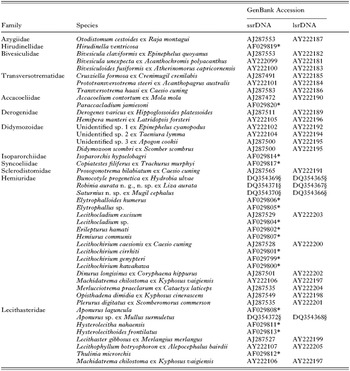
The complete small (ssrDNA) and partial large (lsrDNA) nuclear ribosomal RNA subunits were chosen as targets for molecular phylogenetic analysis, as an extensive reference data set of these genes exists for the Digenea (e.g. Cribb et al. 2001; Olson et al. 2003). Additionally, there exists a diversity of hemiurid sequences for the variable V4 region of ssrDNA published by Blair et al. (1998). Specimens for DNA extraction were fixed alive in 96% ethanol. In addition to the species described here, sequences from 2 new bunocotyline species were obtained: (i) Saturnius n. sp. ex Mugil cephalus from off Santa Pola (Spain) (38 °00′–38 °20′N, 0 °10′–0 °40′W) and (ii) Bunocotyle progenetica (Markowski, 1936) ex Hydrobia ulvae (Pennant) [rediae with cercariae and adults from the molluscan digestive gland] from the Chupa inlet of the White Sea (66 °20′N, 33 °40′E). A full list of taxa and sequences used in this study is given in Table 1.
Table 1. Taxonomic listing of species used in the present analyses with Accession numbers (Asterisks indicate partial ssrDNA (V4 variable region only) from Blair et al. (1998) wherein host identities were not given; § – indicates new sequences.)

Genomic DNA (gDNA) was extracted from specimens that had been stored in 90% ethanol. The ethanol was removed from the specimen by evaporation and the specimen was rehydrated by soaking in 1 M Tris-EDTA (pH 8) buffer for 5 min.
gDNA was extracted using a Qiagen® DNeasy™ tissue kit following the manufacturer's recommended protocol; the final elution volume was 200 μl to give a final concentration of ~10–20 ng/μl. In some cases, the gDNA was further concentrated to a volume of ~20 μl using Millipore Microcon® columns to reach this concentration.
PCRs were carried out in a volume of 25 μl containing Ready-To-Go™ (Amersham Pharmacia Biotech) PCR beads (each containing ~1·5 units Taq DNA polymerase, 10 mM Tris-HCl at pH 9, 50 mM KCl, 1·5 mM MgCl2, 200 mM of each dNTP and stabilizers, including BSA), 1–2 μl of gDNA, 10 mM of each forward and reverse PCR primer and double-distilled water. Thermal cycling was performed in a Perkin Elmer 9600 Thermal Cycler using the following profile: 3 min denaturation hold at 94 °C; 40 cycles of 30 sec at 94 °C, 30 sec at 56 °C, 2 min at 72 °C; and 7 min extension hold at 72 °C. Near-complete ssrDNA amplicons (~1800 bps) were amplified using the primers Worm-A and Worm-B (see Littlewood and Olson, 2001 for primer definitions) and partial (domains D1–D3; ~1400 bps) lsrDNA amplicons were amplified using primers LSU-5 (5′-TAG GTC GAC CCG CTG AAY TTA AGC A-3′) and 1500R (5′-GCT ATC CTG AGG GAA ACT TCG-3′). PCR amplicons were either gel-excised or purified directly using Qiagen Qiaquick™ columns, cycle-sequenced from both strands using ABI BigDye™ chemistry, alcohol-precipitated, and run on an ABI Prism 377™ automated sequencer. ssrDNA amplicons were sequenced in both directions using the 2 original PCR primers and a variety of internal primers (Cribb et al. 2001; Littlewood and Olson, 2001, provide a complete listing of ssrDNA primers designed or modified for platyhelminths), and the lsrDNA amplicons were sequenced using the 2 original PCR primers and internal sequencing primers ECD2 (5′-CTT GGT CCG TGT TTC AAG ACG GG-3′), 900F (5′- CCG TCT TGA AAC ACG GAC CAA G-3′), 300R (5′- GTT CAT GGC ACT CCC TTT CAA C-3′), 1200R (5′- GCA TAG TTC ACC ATC TTT CGG-3′).
Contiguous sequences were assembled and edited using Sequencher™ (GeneCodes Corp., ver. 3.1.1) and submitted to GenBank under Accession numbers DQ354369–DQ354372 (ssrDNA) and DQ354365–DQ354368 (lsrDNA); see Table 1.
Gene alignment and phylogenetic analysis
New sequences of the complete ssrDNA and partial lsrDNA, and published partial (V4) fragments of ssrDNA, were combined with previously published and aligned sequences (Olson et al. 2003). The new sequences were incorporated into the existing alignments with adjustments to the alignments made by eye using MacClade (Maddison and Maddison, 2000). Extraneous taxa from the reference alignment were removed prior to phylogenetic analysis. Sequences for both genes were concatenated in MacClade and regions of ambiguous alignment defined in a character exclusion set. A fully annotated alignment is available from the corresponding author.
Data sets of ssrDNA (using either complete or V4 only regions) and partial lsrDNA were analysed individually and combined using Bayesian inference (BI) methods with MrBayes (Huelsenbeck, 2000) and maximum parsimony (MP) with PAUP* (Swofford, 2002) in order to estimate the phylogeny of the hemiuroids. Data partitions analysed were as follows: complete ssrDNA only, V4 ssrDNA only, partial lsrDNA, and complete ssrDNA and partial lsrDNA where taxa were available for both genes. Prior to BI, Modeltest (Posada and Crandall, 1998) was used to estimate the best model of nucleotide substitution. In each case this was the general time reversible model, with estimates of invariant sites and gamma distributed among-site rate variation (GTR+I+G). Log likelihoods were estimated over 5×10⁶ generations via 4 simultaneous Markov Chain Monte Carlo chains (nchains=4) with every 1000th tree saved. Default values were used for the MCMC parameters. Consensus trees with mean branch lengths were constructed using the ‘sumt’ command option and ignoring the initial topologies saved during ‘burn in’; the initial n-generations before log-likelihood values and substitution parameters plateau. For each analysis we plotted log-likelihood values against generation number and used a burn in of 1000 for estimating sumt and sump. For combined analyses, parameter values for GTR+I+G were estimated independently for the ssrDNA and lsrDNA partitions. Nodal support with BI was given by calculating posterior probabilities. MP analyses were conducted using a heuristic search strategy with 100 search replicates, random-addition taxon sampling, tree-bisection-reconnection branch-swapping, with all characters run unordered with equal weights and with gaps treated as missing data. Nodal support was estimated by bootstrapping (n=2000).
RESULTS
Morphology
Family Hemiuridae Looss, 1899
Subfamily Bunocotylinae Dollfus, 1950
Robinia n. g.
Diagnosis: Hemiuridae. Bunocotylinae. Body small, fusiform. Vestige of ecsoma present. Tegument unarmed, with fine transverse striations. Two weakly developed circular muscular flanges present around body: first flange just posterior to ventral sucker, forms tegumental ridge; second flange close to posterior extremity. Pre-oral lobe distinct. Numerous tegumental sensory papillae present on pre-oral lobe, ventral tegument of oral sucker and surfaces of oral and ventral sucker apertures. Oral sucker subterminal, subglobular, with numerous subconical, muscular papillae which form circle at about its mid-level. Ventral sucker large, in second quarter of body. Pre-pharynx absent. Pharynx small, spherical. Oesophagus very short or apparently absent. ‘Drüsenmagen’ present. Caeca thick-walled, end blindly in post-vitelline field. Testes 2, subglobular, oblique to symmetrical, close to ventral sucker. Seminal vesicle saccular, elongate-oval, entirely in fore-body. Pars prostatica tubular, short. Sinus-sac small, oval. Hermaphroditic duct eversible, forms temporary sinus-organ. Genital atrium distinct. Genital pore median, in mid-fore-body. Ovary oval to subtriangular, post-testicular. Juel's organ, Mehlis' gland and uterine seminal receptacle present. Uterus almost entirely in hind-body, reaches almost to posterior extremity. Metraterm in posterior fore-body, lined with glandular cells. Eggs operculate, numerous, small. Vitellarium a single compact mass, posterior to and contiguous with gonads, distinctly larger than ovary. Excretory pore terminal to dorso-subterminal; vesicle elongate-tubular, divides in anterior hindbody; arms unite at level of pharynx in fore-body. In stomach of mugilid teleosts, Mediterranean Sea.
Type-species: R. aurata n. sp.
Etymology: The genus is named for Professor Robin Overstreet, Gulf Coast Research Laboratory, University of Southern Mississippi, in recognition to his outstanding contribution to the knowledge of parasites of fish and of mullets in particular.
Robinia aurata n. sp.
Type-host: Liza aurata (Risso), the golden grey mullet (Mugilidae).
Type-locality: Off the Mediterranean coast of Spain (at the Ebro Delta) (40 °30′– 40 °50′N, 0 °30′– 1 °10′E); 26.v.2004.
Site: Stomach.
Type-material: Holotype BMNH 2006.2.14.1; paratypes BMNH 2006.2.14.2-17.

Fig. 1. Robinia aurata n. g., n. sp. ex Liza aurata. Holotype (BMNH 2006.2.14.1), ventral view, with uterus in outline.

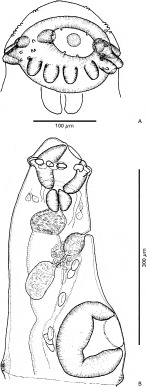
Fig. 2. Robinia aurata n. g., n. sp. ex Liza aurata. Paratypes (BMNH 2006.2.14.2-17). (A) Oral sucker. (B) Forebody, lateral view.

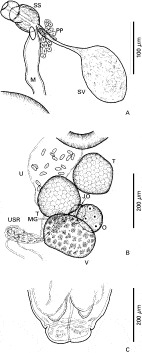
Fig. 3. Robinia aurata n. g., n. sp. ex Liza aurata. Paratypes (BMNH 2006.2.14.2-17). (A) Terminal genitalia, ventro-lateral view. (B) Ovarian region, ventral view. (C) Posterior extremity, ventral view. JO, Juel's organ; M, metraterm, MG, Mehlis' gland; O, ovary; PP, pars prostatica; SS, sinus-sac; SV, seminal vesicle; T, testis; U, uterus; USR, uterine seminal receptacle; V, vitellarium.
[Based on 20 whole-mounted, fully-gravid specimens; metrical data for 18 adult worms.] Body fusiform, 959–1497 (1259) long, with rounded posterior extremity [BWF/BL=24–37% (30%)]. Maximum body width at level of ventral sucker flange 317–509 (377) or at mid-hind-body 300–542 (377). Fore-body 292–492 long [FO/BL 26–35% (32%)]. Tegument unarmed, with fine transverse striations.
Two weakly developed circular muscular flanges present around body. First flange located just posterior to ventral sucker, seen as faint conical thickening in lateral view, 15–64 (38) long and 5–26 (14) deep, forms tegumental ridge clearly distinguishable on ventral surface only of whole-mounts (Figs 1 and 2B). Second flange located close to posterior extremity, poorly developed (Figs 1 and 3C). Vestige of ecsoma clearly present in all specimens (Fig. 1); ecsoma protruded in 56% of cases (e.g. Fig. 3C). Pre-oral lobe distinct, 11–31 (19) bearing relatively large tegumental sensory papillae (1 median, 2×2 mediolateral and 2×5–6 lateral, see Fig. 2A). Oral sucker subterminal, subglobular, 102–158×125–176 (131×149), furnished with 11–15 (13) subconical muscular papillae 18–48 (32) long by 19–37 (26) wide at base, forming circle at about mid-level of sucker (Figs 1 and 2). Oral sucker aperture surrounded by 6 sensory papillae (2×2 anterior and medio-lateral and 2 posterio-medial); 2 additional lateral groups of 5–6 papillae present on ventral tegumental surface of oral sucker (Fig. 2A). Ventral sucker large, subspherical, 196–235×204–270 (214×244), in second quarter of body. VSW/OSW=1[ratio ]1·44–1·75 (1·61). Eight sensory papillae surround ventral sucker aperture, 2×2 antero-lateral and 2×2 postero-lateral.
Pre-pharynx absent. Pharynx small, spherical, 54–74×59–82 (66×68); OSW/PHW=1: 1·81–2·53 (2·21). Oesophagus very short or apparently absent. Caeca wide, thick-walled, form ‘Drüsenmagen’ just posterior to pharynx, end blindly short distance from posterior extremity (Figs 1, 2B and 3C).
Testes 2, oval to subtriangular, slightly oblique (60% of cases) to symmetrical (40% of cases), contiguous or slightly separated, just posterior to ventral sucker; right testis 115–217×97–173 (146×134); left testis 97–171×102–173 (145–134). Seminal vesicle thin-walled, elongate-oval, with attenuated anterior portion, connecting to pars prostatica; in fore-body, not reaching back to anterior margin of ventral sucker, 85–162×56–94 (121×75). Pars prostatica tubular, very short, 24–48×10–19 (33×15), surrounded by relatively large prostatic cells (Fig. 3A) which partly overlap sinus-sac; prostatic cell field 43–104×56–93 (64×72). Sinus-sac oval, 51–82×40–67 (62×53), thin-walled, contains eversible hermaphroditic duct lined by small, intensely stained cells; hermaphroditic duct may form temporary sinus-organ (Fig. 3A), 24–77×21–38 (43×31); lumen of sinus-sac filled with connective tissue and small gland-cells. Genital atrium small but distinct (Fig. 2B). Genital pore median, in mid-forebody (Figs 1 and 2B); distance from anterior extremity of sinus-sac to anterior extremity of body 179–263 (234), 16–21% (19%) of body length.
Ovary oval to subtriangular, post-testicular, sinistral (53% of cases), dextral (40% of cases) or median (7% of cases), contiguous with or slightly separated from testes, 77–140×74–122 (108×96). Juel's organ small, antero-dorsal to ovary, 38–102×46–92 (66×65) (Fig. 3B). Mehlis' gland 82–102×66–77 (92×72), dorsal to ovary, usually obscured by overlapping ovary and uterine coils (Fig. 3B). Uterine seminal receptacle distinct (Fig. 3B). Uterus thin-walled, almost entirely in hind-body, strongly developed in all worms, coiled between ventral sucker and posterior extremity. Metraterm lined with glandular cells, not muscular, in posterior fore-body (Fig. 3A). Eggs operculate, numerous, small, 21–27×10–13 (24×11). Vitellarium single, compact, round to elongate-oval or subtriangular, dextral (40% of cases), median (33% of cases) or sinistral (27% of cases), contiguous with ovary and testis (usually right), distinctly larger than ovary, 120–255×125–242 (193×169); post-vitelline field 267–475 (367) long [POSTV/BL=22–35% (29%)]. Excretory pore usually wide (specimens with non-protruded ecsoma, see Fig. 1), but small in remainder (Fig. 3C), terminal to dorso-subterminal on ecsoma; vesicle elongate-tubular, divides in anterior hind-body; arms unite at level of pharynx.
Molecular analysis
A total of 3842 bp were aligned for the combined ssrDNA and lsrDNA data set. Of these, for ssrDNA, 1714 were unambiguously alignable, 1197 constant and 373 informative under the principles of parsimony. For the lsrDNA 834 were unambiguously alignable, 482 constant and 257 informative under the principles of parsimony. For the ssrDNA data set, where only the variable region V4 was analysed, 236bp were unambiguously alignable, of which 123 were constant and 90 informative under the principles of parsimony.
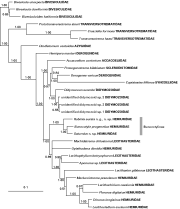
Fig. 4 depicts the classification of the Hemiuroidea that results from Bayesian inference of partial lsrDNA and complete ssrDNA combined, using all taxa for which sequence data for both genes currently exist (a total of 22 species). Maximum parsimony resolved a single tree with a very similar branching pattern and with high (generally >90% bootstrap) nodal support throughout; tree length=2698, CI=0·498, RI=0·612. Minor topological differences between MP and BI are indicated by the nodes shown on Fig. 4 with <50% bootstrap support; nodes were either collapsed or the clade involved a different arrangement of one or more constituent taxa. Independent analyses of the two genes (results not shown) exhibited the same general structure of the clades with minor positional variations. The species from the 6 hemiuroid families form a well-supported clade with the derogenid Hemipera manteri (Crowcroft, 1947) in the basal position and the azygiid Otodistomum cestoides (van Beneden, 1870) as the closest sister taxon. Further major divisions separate the [Accacoeliidae+Sclerodistomidae+Derogenidae+Syncoeliidae+Didymozoidae] and the [Hemiuridae+Lecithasteridae]. Within the latter, R. aurata n. sp. appears as a sister taxon to Saturnius n. sp.+Bunocotyle progenetica, i.e. the Bunocotylinae (sensuGibson, 2002), thus forming a strongly supported clade basal to the remaining hemiurid and lecithasterid species.

Fig. 4. Interrelationships of the Hemiuridae and Lecithasteridae in the context of other closely related digeneans, in order to estimate the relative position of the Bunocotylinae. Bayesian inference tree using complete ssrDNA and partial lsrDNA under the model GTR+I+G on each individual data partition. Nodal support is given by posterior probabilities. The tree was rooted against representatives of the Bivesiculidae.
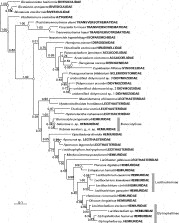
The results from a Bayesian analysis, using only the V4 domain of the ssrRNA gene in an attempt to attain wider taxa sampling (37 species) by adding 15 hemiuroid sequences from a previous study (see Blair et al. 1998), are shown in Fig. 5. This analysis provides strong nodal support for the 2 major clades as depicted in the combined lsrDNA and ssrDNA analysis (see Fig. 4) with the following taxa excluded from the [Hemiuridae+Lecithasteridae] grouping: (i) the hemiurid Opisthadena dimidia Linton, 1910; (ii) the lecithasterids Machidatrema chilostoma (Machida, 1980), Aponurus sp. and Lecithophyllum botryophoron (Olsson, 1868), plus the newly added Aponurus laguncula Looss, 1907, Hysterolecithoides frontilatus (Manter, 1969), Thulinia microrchis (Yamaguti, 1934) and Hysterolecitha nahaensis Yamaguti, 1942; (iii) the Bunocotylinae, which form a well-supported clade with the latter 2 hysterolecithine lecithasterid species. Unlike in the first analysis, the relationships of the 3 bunocotyline genera are relatively poorly resolved. MP analysis found 198 equally parsimonious trees (length=415, CI=0·446, RI=0·705), the strict consensus of which was largely congruent with the BI solution. In Fig. 5, nodes supported by MP (>75% bootstrap support) are indicated with an open circle; only a few nodes in the MP analysis were supported even at the 50% bootstrap level.

Fig. 5. Interrelationships of the Hemiuridae and Lecithasteridae estimated from a denser sampling of taxa using only the V4 variable region of ssrDNA. Bayesian inference tree using GTR+I+G model with nodal support given by posterior probabilities. Open circles at nodes indicate parsimony bootstrap support >75% (n=2000).
DISCUSSION
A range of features of the new species generally correspond to the Hemiuridae Looss, 1899: the presence of a vestigial ecsoma, ‘Drüsenmagen’, a well-developed sinus-sac, Juel's organ and a uterine seminal receptacle, and the location of the bulk of the uterus in the hindbody. R. aurata n. sp. appears the only form within the Hemiuridae to possess both muscular flanges and a vestigial ecsoma (see the family diagnosis in Gibson, 2002). Furthermore, it keys down and exhibits the main distinguishing features of the subfamily Bunocotylinae (see Gibson, 2002): (i) the absence of a blind seminal receptacle (alternatively, a poorly-developed Juel's organ and uterine seminal receptacle were found to be present, see Gibson and Bray, 1979, for a discussion); (ii) vitellarium a single, immediately post-ovarian mass; (iii) gonads not separated by uterine coils; (iv) presence of muscular flanges on the body; (v) smooth body surface; (vi) saccular seminal vesicle; and (vii) short pars prostatica and sinus-sac.
Within the Bunocotylinae, which currently accommodates 2 genera, BunocotyleOdhner, 1928 and SaturniusManter, 1969 (see Gibson, 2002), the new genus exhibits a unique combination of blind caeca, Juel's organ, post-ovarian bulk of the uterus in the hind-body, and tegumental papillae surrounding the oral and ventral sucker apertures. Bunocotyle appears the more closely related genus due to the absence of transverse fibrous septa in the fore- and hind-body, but it lacks a sinus-sac, Juel's organ and uterine seminal receptacle. Furthermore, members of Bunocotyle possess only 2 lateral muscular papillae on the oral sucker and a saccular excretory vesicle; the ventral sucker is located in the anterior third of the body; the configuation of the testes is tandem (B. cingulata, type-species) to oblique (B. progenetica and B. meridionalis Chabaud & Buttner, 1959); and the bulk of uterus in the hindbody is equally pre- and post-ovarian (see Odhner, 1928; Markowski, 1936; Chabaud and Biguet, 1954; Reimer, 1961; Deblock, 1974).
Robinia n. g. differs from both Bunocotyle and Saturnius in the nature of the muscular extensions around the oral sucker, with the shape of a muscular belt in the latter and numerous muscular papillae in the former. In fact, a similar condition is observed only in S. segmentatusManter, 1969, the type-species of Saturnius (see Manter, 1969; Overstreet, 1977). However, the few species of Saturnius can all be distinguished by the presence of transverse fibrous septa in the fore- and hind-body, a vesicular pars prostatica and a cyclocoel (see also Blasco-Costa et al. 2006). Saturnius spp. also exhibit a large separation between the testes and the ventral sucker, a more posterior location of the ovary and a pre-ovarian bulk of the uterus in the hind-body.
The classification of and relationships within the assemblage of species formerly accommodated in the Bunocotylidae are still poorly understood (Gibson and Bray, 1979; Brooks et al. 1985; León-Règagnon, 1998; León-Règagnon et al. 1998, see also Bray and Cribb, 2000 and Gibson, 2002 for the placement of MachidatremaLeón-Règagnon, 1998 within the Lecithasteridae Odhner, 1905). The phylogenetic hypothesis for the Bunocotylinae developed here from sequence data supports the concept of Gibson (2002), who recognized 2 genera in the subfamily in his recent revision of the Hemiuridae. The placement of Robinia n. g. within this subfamily, in combination with the substantial morphological distinction, supports the erection of the new genus.
Overall, both molecular analyses confirmed the monophyly of the Hemiuroidea and its division into 2 major clades, as in prevous studies (Blair et al. 1998; Cribb et al. 2001). The Derogenidae Nicoll, 1910 is polyphyletic, as revealed by Olson et al. (2003). Although this diverse family (22 genera currently considered as valid, see Gibson, 2002) is poorly represented in our data set (sequences of only 2 genera), it appears that the Gonocercinae Skrjabin & Guschanskaja, 1955 (with 2 genera, Gonocerca Manter, 1925 and Hemipera Nicoll, 1913), which is distinguished from all other derogenids by the location of the testes posterior to ovary and vitellarium (vs anterior, 20 genera), may require a distinct familial status, as indicated by the position of Hemipera. Finally, there is poor support for the distinct status of the Lecithasteridae and Hemiuridae, following previous suggestions based on different sequence data sets (Blair et al. 1998; Cribb et al. 2001; Olson et al. 2003).
In contrast to our expectations, an increased number of taxa in the analyses based on the V4 domain of the ssrRNA gene has added little to and has not improved an earlier phylogenetic study of the Hemiuroidea (see Blair et al. 1998). Apparently, the present situation, providing poor support for the Lecithasteridae as a family, results from the rather limited and erratic sampling of the taxa (7 of 19 and 13 of 51 genera sequenced for the Lecithasteridae and Hemiuridae, respectively). It is also possible that this gene region alone is not suitable for the inference of phylogenetic relationships between representatives of these closely related families; although a relatively large proportion of sites were phylogenetically informative in the V4 ssrDNA, the fragment itself is very short (236 unambiguously alignable positions). Analysing the V4 separately failed to resolve many monophyletic hemiurid subfamilies (i.e. only the Bunocotylinae, Lecithochiriinae Lühe, 1901 and Elytrophallinae Skrjabin & Guschanskaja, 1954 were resolved). Few of the nodes in Fig. 5 are well supported. However, the relative contributions of the complete ssrDNA and partial lsrDNA appear sufficient such that much greater taxon sampling is likely preferred for each of these gene regions initially, before additional gene data are needed, in order to test the consistency of the present classification system of the Hemiuroidea with the evolutionary relationships of its members.
Key to genera of the Bunocotylinae
The above comparative analyses show that the characteristics of R. aurata n. sp. are distinct and warrant its separation from the genera currently recognized within the Bunocotylinae. The key to the genera is therefore modified to include Robinia n. g.

We are indebted to Professor Kiril V. Galaktionov, Zoological Institute of the Russian Academy of Sciences, St Petersburg, for the collection of the material of B. progenetica for sequencing. We thank the three anonymous referees for their constructive comments. The study was funded by INTAS grant 03-51-5998 and partly supported by a Synthesys grant GB-TAF-329 to A.K. which enabled her to visit the Natural History Museum, London. M.I.B.C. benefits from a doctoral fellowship from the Ministry of Science and Education of Spain (AP-2004-2999). B.L.W. and D.T.J.L. were supported by a Wellcome Trust Fellowship to D.T.J.L. (043965/Z/95/Z).
Note on authorship: A.K. led research for this paper and is responsible for the discovery of the new genus. P.P. undertook the morphological study. M.I.B.C. collected and provided morphological characterization and identification of Saturnius n. sp. D.I.G. was responsible for the comparative morphology analyses of the Bunocotylinae. B.L.W. carried out the sequencing and D.T.J.L. was responsible for phylogenetic alignment and analysis.