INTRODUCTION
Over the past decade, conservationism and disease ecology have come together in a panglossian view that “all is for the best in the best of all possible worlds” (Voltaire, Reference L1759), adding the utilitarian value of protection against zoonotic infectious disease to the intrinsic value of maintaining biodiversity. At a time of unprecedented pressures on natural resources and concomitant rates of biodiversity loss, and a consequential requirement for scientists to reinforce incentives for biodiversity conservation by outlining the ecosystem services it provides (Tilman et al. Reference Tilman, Knops, Wedin, Reich, Ritchie and Siemann1997; Tilman et al. Reference Tilman, Reich and Knops2006), the claimed reduction in zoonotic risk has emerged as a key exemplar of the value of biodiversity (Daszak et al. Reference Daszak, Cunningham and Hyatt2001; Ostfeld and LoGiudice, Reference Ostfeld and LoGiudice2003; Diaz et al. Reference Diaz, Fargione, Chapin and Tilman2006; Dobson et al. Reference Dobson, Cattadori, Holt, Ostfeld, Keesing, Krichbaum, Rohr, Perkins and Hudson2006; Johnson et al. Reference Johnson, Hartson, Larson and Sutherland2008; Carlson et al. Reference Carlson, Dyer, Omlin and Beier2009; Keesing et al. Reference Keesing, Belden, Daszak, Dobson, Harvell, Holt, Hudson, Jolles, Jones, Mitchell, Myers, Bogich and Ostfeld2010a). The converse, exacerbation of the global burden of disease by biodiversity loss, has been neatly linked with the other environmental bête noir, global climate change (Ostfeld, Reference Ostfeld2009). Both arguments are powerful levers for attracting funding from major agencies (Pongsiri and Roman, Reference Pongsiri and Roman2007). The basic idea arose within the discipline of malaria epidemiology (Macdonald, Reference Macdonald1956) and was absorbed into ecology (Elton, Reference Elton1958); because vertebrate species are differentially competent to support the transmission of various vector-borne pathogens, the distribution of arthropod vectors amongst different host species will have an impact on the transmission potential (R 0 value) of the pathogens. This is the basis for 2 related but distinct phenomena: zooprophylaxis – active or passive use of animals to divert vector bites away from humans to protect the latter against infection (Hess and Hayes, Reference Hess and Hayes1970); and the dilution effect – lowering the abundance of infected vectors by diluting the assemblage of competent hosts with non-competent hosts and thereby reducing the probability that a vector feeds on a transmission-competent host. It is important, although empirically difficult, to distinguish between these outcomes as effects simply of reduced density, rather than of reduced relative abundance, of the competent host species (Begon, Reference Begon, Ostfeld, Keesing and Eviner2008).
In their simplest forms both zooprophylaxis and the dilution effect assume that the total abundance of vectors remains unchanged, which is likely only if the total abundance of bloodmeal hosts stays constant; zooprophylaxis reduces the contact rate of infected vectors with humans, but not necessarily their infection rate, whereas dilution (the replacement of competent hosts with non-competent ones) reduces vector infection rates, but not their contact rates with humans. If, however, these two effects are brought about through the addition of bloodmeal hosts, vector abundance is likely to increase with variable consequences for disease prevalence in the vectors. Addition of competent hosts will increase both vector abundance and vector infection rates, while addition of non-competent hosts will increase vector abundance even if it decreases vector infection rates; both may increase risk to humans. This is likely to occur for ticks, whose population and therefore vectorial potential is strongly affected by host density, but insect-borne disease systems are usually modelled as frequency-dependent transmission (per capita vector-host contact rate independent of host density), which can generate a protective effect of host diversity (Dobson, Reference Dobson2004) (but see results for malaria, below). Ultimately, the risk of zoonotic infections to humans depends upon the ratio of infected vectors per human. This risk will, in general, increase with more infected vectors in the environment, but in some situations vectors reduced in abundance by the removal of preferred hosts may switch their attention to humans, thus increasing risk. Hence vector abundance, vector infection rate, and the vectors' propensity to feed on humans all need to be quantified to determine the precise effects of zooprophylaxis or dilution.
In this review, we argue that while the dilution effect concept may be biologically sound in certain simple systems, in the complex systems typical of zoonoses and vector-borne diseases it is likely to apply only in occasional, often extreme, situations. The new mantra “biodiversity protects against infection” is an extension ad absurdum that simplifies and obscures reality. It should also be noted that, although some individual empirical studies specify the precise index of diversity purportedly related to risk of infection, the general arguments in favour of biodiversity (above) do not distinguish between functional diversity, species richness, relative abundance amongst species or indices that combine these (e.g. Shannon or Simpson indices of diversity).
THE PROMOTION OF THE CONCEPT: LYME BORRELIOSIS
The significance of livestock in diverting mosquito bites away from humans has been credited with contributing to the decline of malaria in northern Europe from the late 19th century (Reiter, Reference Reiter2008), despite doubts over the efficacy of such zooprophylaxis in Pakistan (Bouma and Rowland, Reference Bouma and Rowland1995) and West African contexts (Bogh et al. Reference Bogh, Clarke, Walraven and Lindsay2002). The increase in vector density caused by higher cattle densities, even if a smaller proportion then feed on humans, has been shown by mathematical modelling (Sota and Mogi, Reference Sota and Mogi1989) and empirically (Bouma and Rowland, Reference Bouma and Rowland1995) to result in higher malaria prevalence in humans. Likewise, where realistic values of vector mortality rates during host-questing decrease with increasing host abundance, zooprophylaxis may be ineffective, unless both types of hosts are distant from mosquito breeding sites or humans are protected from bites (Saul, Reference Saul2003). The modelled basic reproduction number for Plasmodium vivax decreases with an increasing ratio of animal to human hosts and greater attraction of mosquitoes to animals, but only in the absence of a response of mosquito demographic rates (and therefore population outcomes) to host density (Nah et al. Reference Nah, Kim and Lee2010).
It is, however, within the context of Lyme borreliosis that the concept of the dilution effect has been most heavily promoted in recent years. The bacteria are transmitted by tick species within the genus Ixodes across much of the northern hemisphere (Piesman and Gern, Reference Piesman, Gern, Bowman and Nuttall2008). Because ticks feed only once per life stage (larva, nymph and adult), at least 2 stages must feed on a host to complete a full transmission cycle, one stage to acquire the infection and the next stage to donate infection to a new susceptible host. Epidemiologically, the most significant vector species are I. scapularis in N America, I. ricinus in Europe and I. persulcatus in Russia. The group of spirochaete agents, Borrelia burgdorferi s.l., comprises a growing list of recognized strains. Four (B. burgdorferi s.s., B. afzelii, B. garinii and B. spielmanii) are known to be pathogenic to humans, and each is differentially adapted to the many different vertebrate hosts upon which these ticks feed (Humair and Gern, Reference Humair and Gern1998; Kurtenbach et al. Reference Kurtenbach, Peacey, Rijpkema, Hoodless, Nuttall and Randolph1998b; Hanincova et al. Reference Hanincova, Ogden, Diuk-Wasser, Pappas, Iyer, Fish, Schwartz and Kurtenbach2008). These include many species of rodents, insectivores, carnivores, lizards and birds in which long-lasting systemic infections are established and then transmitted back to ticks. Amongst ungulates, sheep develop only non-systemic infections yet support persistent transmission cycles between co-feeding ticks in the absence of other vertebrate species (Ogden et al. Reference Ogden, Nuttall and Randolph1997), but deer appear to be solidly non-competent (Matuschka et al. Reference Matuschka, Fischer, Heiler, Richter and Spielman1992; Talleklint and Jaenson, Reference Talleklint and Jaenson1994), despite unrepeated hints of amplification as larval and nymphal ticks co-feed on wild sika deer (Cervus nippon yesoensis) (Kimura et al. Reference Kimura, Isogal, Isogal, Kamewaka, Nishikawa, Ishii and Fujii1995). This pattern of transmission non-competence is mirrored exactly by the degree of borreliacidal activity of each host species' serum (Lane and Quistad, Reference Lane and Quistad1998; Kurtenbach et al. Reference Kurtenbach, Sewell, Ogden, Randolph and Nuttall1998c; Kurtenbach et al. Reference Kurtenbach, Hanincova, Tsao, Margos, Fish and Ogden2006). Within this disease system, non-competent hosts have been credited with having a zooprophylactic effect by decreasing the infection prevalence in the tick population (Spielman et al. Reference Spielman, Wilson, Levine and Piesman1985; Matuschka et al. Reference Matuschka, Heiler, Eiffert, Fischer, Lotter and Spielman1993; Matuschka et al. Reference Matuschka, Schinkel, Klug, Spielman and Richter2000) but, just as with malaria, they may in fact have the opposite effect. Risk to humans is usually related to the abundance of infected nymphal ticks (Glass et al. Reference Glass, Schwarz, Morgan III, Johnson, Noy and Israel1995), or simply of nymphs (Stafford (III) et al. Reference Stafford, Cartter, Magarelli, Ertel and Mshar1998; Falco et al. Reference Falco, McKenna, Daniels, Nadelman, Nowakowski, Fish and Wormser1999), because this stage is numerous but inconspicuous, and infection prevalence is typically above 10% in Europe and >30% in northeastern USA (Hubálek and Halouzka, Reference Hubálek and Halouzka1998; Horobik et al. Reference Horobik, Keesing and Ostfeld2007).
In principle it is clear how the proportion of infected ticks could be diluted; as new (non-competent) species are added to the host assemblage, many infected tick bites will be ‘wasted’ (so-called encounter reduction) and also the proportion of ticks that may acquire the infection will decrease (transmission reduction) (LoGiudice et al. Reference LoGiudice, Ostfeld, Schmidt and Keesing2003; Keesing et al. Reference Keesing, Holt and Ostfeld2006). It is not the proportion of infected ticks, however, but the absolute number that is the salient parameter in risk to humans. Any additional host species that feeds enough ticks to reduce the overall infection prevalence in questing ticks of the next stage by diverting them away from transmission-competent host species would be likely to increase the tick population density (and therefore the density of infected ticks, upon which transmission potential depends) by improving the chances of successful tick feeding. Thus the proportion of infected ticks declines, but their abundance may increase (van Buskirk and Ostfeld, Reference van Buskirk and Ostfeld1995), which itself may enhance transmission potential amongst mice and so ameliorate the reduction in infection prevalence (Ogden and Tsao, Reference Ogden and Tsao2009). This effect of additional hosts is particularly pertinent to ticks, being wingless, especially these sit-and-wait species that rely on host movement to effect chance encounters for feeding opportunities. Deer seem to have played this role in relation to several tick-borne pathogens in northern temperate regions, due to the fact that in the typical woodland habitats they are the most significant hosts for adult reproductive ticks and also feed significant numbers of the immature stages (Wilson et al. Reference Wilson, Litwin, Gavin, Capkanis, Maclean and Spielman1990; Gray et al. Reference Gray, Kahl, Janetzki and Stein1992). In the USA and Denmark, the increase in incidence of Lyme borreliosis has been correlated with the increasing density and distribution of deer (Spielman et al. Reference Spielman, Wilson, Levine and Piesman1985; Jensen and Frandsen, Reference Jensen and Frandsen2000; Jensen et al. Reference Jensen, Hansen and Frandsen2000). In the northeastern USA, this was a result of reforestation with consequent enhanced biodiversity (Spielman et al. Reference Spielman, Wilson, Levine and Piesman1985). Likewise, in Sweden, increased abundance of nymphal ticks was attributed to ‘a drastic increase in abundance and geographic range of roe deer’ (Talleklint and Jaenson, Reference Talleklint and Jaenson1996). Whatever the proportion of larval ticks that feed on Borrelia-competent hosts, variously estimated as 96% (Talleklint and Jaenson, Reference Talleklint and Jaenson1994) in Sweden and ca. 40% in Switzerland (Burri et al. Reference Burri, Bastic, Maeder, Patalas and Gern2011), an increased tick population will generate greater numbers of infected nymphs. In parts of Europe, the risk of viral tick-borne encephalitis (TBE) has been positively related to the presence of deer (Zeman and Januska, Reference Zeman and Januska1999; Hudson et al. Reference Hudson, Rizzoli, Rosa, Chemini, Jones and Gould2001; Rizzoli et al. Reference Rizzoli, Hauffe, Tagliapietra, Neteler and Rosa2009), not because deer can transmit the virus, but because deer support I. ricinus populations. These empirical correlations are supported by the model predictions that increased deer abundance results in increased tick populations (Dobson et al. Reference Dobson, Finnie and Randolph2011; Dobson and Randolph, Reference Dobson and Randolph2011). Similarly, new epidemics of Kyasanur Forest Disease in India appear to have been precipitated by a marked increase in human population during the 1950s: cattle newly introduced into forests, although not hosts for the virus, supported increased populations of ticks which infected humans as they gathered firewood (Hoogstraal, Reference Hoogstraal1981).
The need for several host species with these complementary roles is now recognized as commonplace, especially in systems where the very hosts that contribute to maintaining and enhancing tick populations are typically not competent to transmit the pathogens between ticks; it applies to most I. ricinus-borne pathogens such as B. burgdorferi s.l., tick-borne encephalitis virus (TBEV) and Louping ill virus (Gilbert et al. Reference Gilbert, Norman, Laurenson, Reid and Hudson2001). A net effect of dilution caused by such hosts needs very careful quantitative analysis of field data, not just models, to be upheld. Nevertheless, according to best practice, theoretical studies should precede fieldwork in order to define the questions to be asked empirically.
TESTING THE CONCEPT
Modelling the dilution effect for Lyme borreliosis
The degree of dilution depends on the relative proportion of the vector population fed by different host species, which is highly variable geographically and between habitats. For the specific system of B. burgdorferi s.s., transmitted by I. scapularis in eastern N America, the particular model that was used to predict the negative effect of high mammalian diversity on the infection prevalence in nymphal ticks is guaranteed to give this result (LoGiudice et al. Reference LoGiudice, Ostfeld, Schmidt and Keesing2003). This highly influential model, based upon that of Giardina et al. (Reference Giardina, Schmidt, Schauber and Ostfeld2000), assumes constant tick burdens on each given host, such that the density of ticks is always the sum of all NiBi, where Ni and Bi are the abundance and tick burden, respectively, of the ith host. This central assumption is mentioned in both these models, yet its validity is not investigated. In a subsequent model (Keesing et al. Reference Keesing, Brunner, Duerr, Killilea, LoGiudice, Schmidt, Vuong and Ostfeld2009), it is assumed that constant total numbers of ticks are fed, with all ticks that are not picked up by one host type being re-distributed to others. This assumption was not confirmed when experimental removal of lizards, a major host for I. pacificus larvae in California, resulted in an increased abundance of questing larval ticks (Swei et al. Reference Swei, Ostfeld, Lane and Briggs2011). This is consistent with earlier indications from the UK that rather than ticks being in short supply, the proportion of the questing tick population fed per host depends more on the behaviour of individual hosts (Randolph and Steele, Reference Randolph and Steele1985) than on the availability of ticks. There is no evidence that hosts remove all, or even the majority of, larvae in a season; rather field evidence suggests that many ticks remain unfed, to die of energy exhaustion (Randolph and Steele, Reference Randolph and Steele1985; Randolph and Storey, Reference Randolph and Storey1999; Randolph, Reference Randolph2004; Brunner and Ostfeld, Reference Brunner and Ostfeld2008).
Thus, the central assumption in the above models is invalid. Because they do not take account of the positively non-linear effect on tick population dynamics of increasing host density (as an increasing proportion of an increasing tick population finds hosts and survives) such relatively simple models cannot capture the full variation in tick abundance observed in the field (Brunner and Ostfeld, Reference Brunner and Ostfeld2008). A more comprehensive tick population model (Dobson et al. Reference Dobson, Finnie and Randolph2011) was used to simulate the effects of gradually increasing the abundance of large hosts (i.e. deer) to double over 20, while the density of smaller hosts (set to feed fed 90% of larvae, 55% of nymphs and 0% of adults (Talleklint and Jaenson, Reference Talleklint and Jaenson1994)) was held constant (Dobson and Randolph, Reference Dobson and Randolph2011). Where deer numbers were initially low, the host increase caused a positively non-linear rise in the tick population (as measured by egg-laying females) that continued after host density was then held constant, reaching more than double the initial level. It is in just this kind of depauperate community that the dilution effect is predicted to have its effect (LoGiudice et al. Reference LoGiudice, Ostfeld, Schmidt and Keesing2003), yet the more complete model suggests the increase in tick density in this scenario would counteract any effects of dilution on the density of infected nymphs (not simply the infection prevalence in nymphs). A model specifically designed to investigate the point at which the extra number of hosts causes tick population amplification to negate the dilution effect, given various scenarios of host assemblages, would help to clarify the outcome of these counteractive forces.
Other models have captured the variability in outcome to be expected within such a biodiverse system. The early model of Rosa et al. (Reference Rosa, Pugliese, Norman and Hudson2003) showed that higher densities of non-competent hosts may have either a positive effect, by amplifying the tick population, or a dilution effect, by wasting tick bites. Only when a biologically questionable term, ‘non-linearity due to extended tick feeding’, was included was dilution always seen, but then only at unrealistically high host densities when, presumably, almost all the tick population was indeed finding a host of one sort or another. Later models from the same team aimed to explain some highly equivocal experimental results derived from deer exclosures (Perkins et al. Reference Perkins, Cattadori, Tagliapietra, Rizzoli and Hudson2006); both empirical and theoretical results showed that when deer were excluded, prevalence of infection (this time with TBEV) in nymphs and the density of infected nymphs were higher only in small exclosures (Pugliese and Rosa, Reference Pugliese and Rosa2008). This is not entirely surprising, given the greater potential for other hosts to introduce larval ticks into the smaller exclosures (the very term used to characterize exclosure size mathematically). More general models, less constrained by specific artificial arrangements and untested assumptions, predict an outcome that varies between dilution and amplification depending precisely on mechanisms of inter-specific competition amongst hosts, rates of host contact with ticks and acquired resistance to ticks (Ogden and Tsao, Reference Ogden and Tsao2009). These realistic features of tick biology are crucial if models are to be used to test the universality of the dilution effect.
Empirical tests of the dilution effect for Lyme borreliosis
More difficult but much more telling are empirical tests. Much of the supportive field data and analyses have been generated at a site in southeastern New York State, USA, but even within this narrow ecological setting the results do not always indicate the dilution effect as claimed. All too often general conclusions have been generated from limited data or extreme points extrapolated backwards from an observed high infection hazard under particular conditions to predicted lower hazard with presumed higher biodiversity.
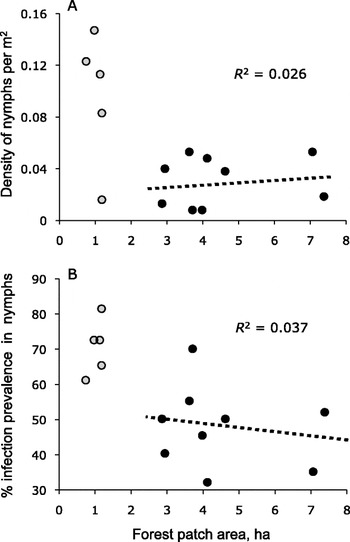
One such example, highly cited in the dilution effect literature, substituted forest fragmentation for actual biodiversity, on the basis that in Indiana (USA) reduced mammalian species diversity and elevated densities of white-footed mice (Peromyscus leucopus) due to less competition for food have been associated with forest destruction and fragmentation into woodlots of <2 ha (Nupp and Swihart, Reference Nupp and Swihart1998), with particularly high mice densities in woodlots of <0·5 ha (Nupp and Swihart, Reference Nupp and Swihart1996). This is the presumed reason for the increased density of I. scapularis nymphs and their infection prevalence with B. burgdorferi s.s., observed in 4 out of 5 forest patches of ca. 1 ha compared with patches of ca. 3–7 ha (Allan et al. Reference Allan, Keesing and Ostfeld2003) (Fig. 1). These smallest forest areas are equivalent to no more than 100–141 m on the side (if square), too small to house resident populations of deer or other larger species even though such hosts may pass through from nearby larger forest stands and deposit engorged adult ticks (necessary to sustain the tick populations). Higher numbers of questing nymphs observed over 1 month in summer may be due as much to the reduced rate of tick pick-up by scarce larger hosts (Randolph and Steele, Reference Randolph and Steele1985; Dobson and Randolph, Reference Dobson and Randolph2011) as to the increased rate of larvae feeding on mice. While such tiny patches may represent small concentrations of risk to humans, they hardly represent a basis for the general extrapolation to the dilution effect driven by reduced biodiversity (Dobson et al. Reference Dobson, Cattadori, Holt, Ostfeld, Keesing, Krichbaum, Rohr, Perkins and Hudson2006). In any case this positive relationship between forest fragment size (0·3–19 ha) and nymphal infection prevalence was not repeated in more extensive samples taken across 3 neighbouring states (Connecticut, New Jersey and New York) (LoGiudice et al. Reference LoGiudice, Duerr, Newhouse, Schmidt, Killilea and Ostfeld2008).
Relationship between forest patch size and (A) the density of nymphal ticks, Ixodes scapularis, and (B) the infection prevalence of Borrelia burgdorferi in nymphs, at field sites in southeastern New York State, USA. The data are presented to reveal the non-significant trends over most of the range of forest patch sizes (filled circles). Redrawn from Allan et al. (Reference Allan, Keesing and Ostfeld2003), with permission.

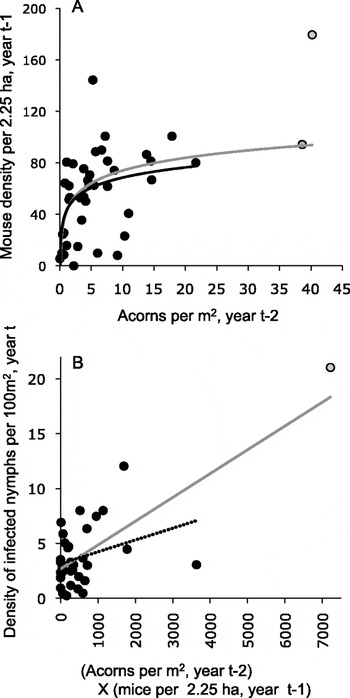
In another study, Ostfeld et al. (Reference Ostfeld, Canham, Oggenfuss, Winchcombe and Keesing2006) disputed the positive effect of deer density on tick abundance, despite overwhelming prior evidence (see above), arguing instead that the abundance of acorns, white-footed mice and eastern chipmunks are the primary determinants of temporal variation in Lyme borreliosis risk. Models were fitted to amalgamated data over several field plots from 13 annual observations of acorns, host and tick abundance and B. burgdorferi infection prevalence in nymphs. Not all potential predictors entered into the models, however, were measured independently for each replicate plot, i.e. were not compared at the same level of analysis; all the climatic variables and direct estimates of deer abundance were attributes of the entire study site but were treated as characteristics of individual plots. The failure of the analysis to acknowledge the hierarchical structure of the data leads to inflated degrees of freedom for the climatic variables, which is classic pseudo-replication. Had the correct structure been identified, both visually in the graphs and statistically in the models, more light might have been thrown on the origin of the extreme outlier (Ostfeld et al. Reference Ostfeld, Canham, Oggenfuss, Winchcombe and Keesing2006), upon which the claimed relationship between rodent and infected tick abundance depends completely (Fig. 2). Only then could firm conclusions have been reached as to whether climatic variables and deer, or rodents and acorns, or a combination of these, are the principal determinants of Lyme disease risk. The conclusions as published explicitly undermine, quite possibly wrongly, much empirical evidence for the potential of deer to enhance tick populations and thereby to amplify Lyme disease risk despite their non-competence as B. burgdorferi hosts.
Relationship between (A) mouse and acorn densities, and (B) density of infected nymphs and the product of previous acorn and mouse densities at field sites in southeastern New York State, USA. The inclusion of the right-hand extreme points (grey circles and lines) in (A) makes little difference apart from increasing the R 2 value from 0·245 (P<0·05) to 0·37 (P<0·01), but in (B) the relationship is significant (R 2=0·57, P<0·01) only with the outlier included (excluded, R 2=0·087, P>0·05). Redrawn from Ostfeld et al. (Reference Ostfeld, Canham, Oggenfuss, Winchcombe and Keesing2006) (Figs 5A and 4A, respectively), with permission.

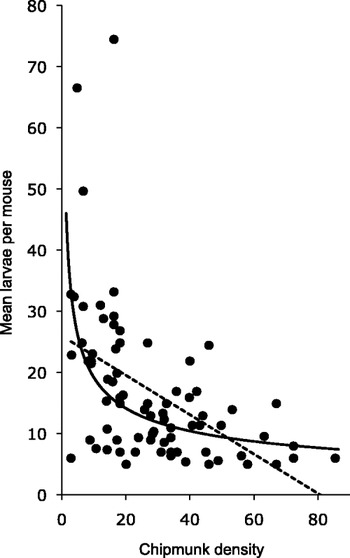
In a further analysis, both temporal and spatial data on chipmunk density and infestation levels of larval ticks on mice were again plotted on the same axes, and a poorly fitting linear regression was selected to conclude that increases in the former reduce the latter (Keesing et al. Reference Keesing, Holt and Ostfeld2006). In fact, a negative power relationship is a better fit (R 2=0·30 rather than 0·22), which indicates not only that mean larvae per mouse varies markedly even at low chipmunk density, but also that low mean larvae per mouse can arise whatever the chipmunk density (Fig. 3). The low R 2 value even of the better model itself indicates that chipmunks are not good predictors of larval infestations on mice. Chipmunks actually produce almost as many infected engorged larvae or questing nymphs per hectare as do mice, while all non-mouse hosts together produce twice as many per hectare (LoGiudice et al. Reference LoGiudice, Ostfeld, Schmidt and Keesing2003). Although these statistics change somewhat when other less commonly studied vertebrates, such as shrews, are included (Brisson et al. Reference Brisson, Dykhuizen and Ostfeld2008), nevertheless adding chipmunks (rather than replacing mice with chipmunks), even if they diverted some larvae from mice, would have little effect on the density of infected nymphs. A similar conclusion arises from experimental data from a large forested area of Connecticut, independent of detailed knowledge of each host species; mice evidently contributed only about half the infected nymphs, with the rest coming from alternative host species (Tsao et al. Reference Tsao, Wootton, Bunikis, Luna, Fish and Barbour2004).
Relationship between chipmunk density and mean larval burdens per mouse at field sites in southeastern New York State, USA. As well as the original linear model (dashed line, R 2=0·22), the more explanatory power model (solid line, R 2=0·30) is shown. Redrawn from Keesing et al. (Reference Keesing, Holt and Ostfeld2006), with permission.

There are, however, some specific situations where competent transmission hosts are more or less completely replaced, rather than augmented, by non-competent host species, and enzootic cycles can be severely limited in those circumstances. This is thought to account for the much lower prevalence of B. burgdorferi s.s. in nymphal ticks in the southeast, compared with the northeast, of the USA (Piesman, Reference Piesman, Gray, Kahl, Lane and Stanek2002), where refractory lizards rather than rodents are the major hosts for immature I. scapularis (Apperson et al. Reference Apperson, Levine, Evans, Braswell and Heller1993). This constitutes a change in host assemblage, but not necessarily an increase in vertebrate diversity. Similarly, although rodents are not replaced, where pheasants are locally very abundant in southern England, they feed such a large proportion of the nymphal I. ricinus population that B. afzelii, which is not transmitted by birds, evidently cannot persist (Kurtenbach et al. Reference Kurtenbach, Peacey, Rijpkema, Hoodless, Nuttall and Randolph1998b). Neither ticks nor small rodents showed any infection with B. afzelii, despite the high abundance and competence of these hosts for this Borrelia strain. In this case, the end point of R 0<1 had evidently been reached, thereby eliminating infection with this one strain altogether, but leaving other strains, B. garinii, B. valaisiana and B. burgdorferi s.s., which are transmissible via birds (Humair et al. Reference Humair, Postic, Wallich and Gern1998), including pheasants (Kurtenbach et al. Reference Kurtenbach, Carey, Hoodless, Nuttall and Randolph1998a). Pheasants feed relatively few larvae (Hoodless et al. Reference Hoodless, Kurtenbach, Nuttall and Randolph2002), however, so that amplification of these Borrelia strains takes place as nymphs feed on these large ground-foraging birds, leaving infection prevalence for each strain at 1–3% in questing nymphs (compared to the more usual ca.10%), but up to 10% in questing adults (Kurtenbach et al. Reference Kurtenbach, Peacey, Rijpkema, Hoodless, Nuttall and Randolph1998b). Thus a high density of one particular host type, but hardly an index of high biodiversity, can cause dilution in one fraction of the tick population, and zooprophylaxis given that humans are most commonly bitten by the ticks in that fraction (questing nymphs). This particular case is largely artificial, created by unnaturally high densities of pheasants released from game farms in the interests of shooting. Usually, hosts large enough to carry very high individual infestation levels of ticks exist at low population densities and so do not necessarily feed any greater fraction of the total tick population than do smaller, abundant hosts such as rodents (Talleklint and Jaenson, Reference Talleklint and Jaenson1994; Craine et al. Reference Craine, Randolph and Nuttall1995).
The western fence lizard in northern California, however, is both non-competent to transmit B. burgdorferi s.l. and so abundant as to feed almost all of the larval and nymphal I. pacificus in some areas, thereby significantly reducing the infection prevalence in adults compared with nymphs (Lane and Quistad, Reference Lane and Quistad1998). As humans are commonly bitten by adult I. pacificus in northern California (Clover and Lane, Reference Clover and Lane1995), lizards might thus offer an element of zooprophylaxis. Experimental removal of this host, however, generated some mixed results, some of which were contrary to the predictions of the dilution effect theory (Swei et al. Reference Swei, Ostfeld, Lane and Briggs2011), but which is to be expected from complex natural tick-host-Borrelia interactions. First, there was an immediate significant increase in questing larvae, suggesting that those not fed by lizards did not switch at once to alternative hosts species (see above). This was consistent with the lower density of questing nymphs the following year. Secondly, of the two mammal species that were monitored and consistently infested by substantial numbers of immature ticks, deer mice (Peromyscus maniculatus) did not feed more larval ticks after lizard removal whereas wood rats (Neotoma fuscipes) did, but this was significant relative to changes on the control plots only for female rats, and sufficient to accommodate only ca. 5% of the excess questing larvae. As there was no detectable effect of lizard removal on the prevalence of infection with B. burgdorferi s.s. in nymphs the following year, the overall density of infected nymphs decreased then. These results from California provide an example of a specific natural host assemblage in which the most abundant host for immature ticks is non-competent, but nevertheless may increase disease risk by maintaining high vector densities, just as deer appear to do in the northeastern states and in Europe. The outcome is likely to be due to the effects of reduced host (lizard) density, without providing any test for a dilution effect driven by changing biodiversity (Begon, Reference Begon, Ostfeld, Keesing and Eviner2008). The individual effects, however, are clearly incompatible with many aspects underpinning the concept of the dilution effect of high biodiversity that has been promoted by studies of Lyme borreliosis.
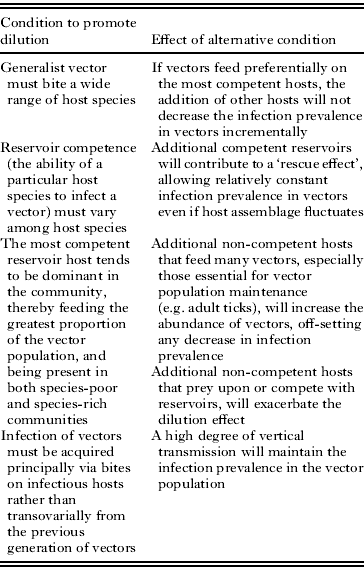
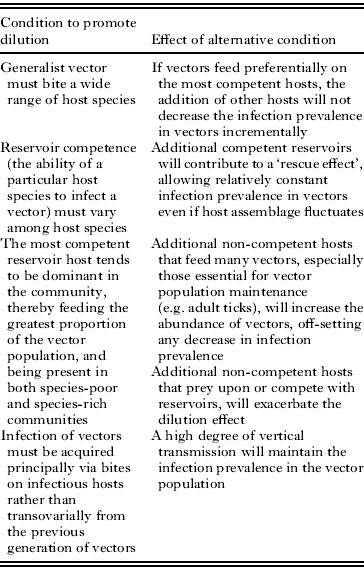
In conclusion, Lyme borreliosis is one of the most robust and biodiverse zoonotic disease systems known, even in the New World (Brisson et al. Reference Brisson, Dykhuizen and Ostfeld2008) with its more limited genetic and phenotypic diversity of B. burgdorferi s.l. than in the Old World (Kurtenbach et al. Reference Kurtenbach, Hanincova, Tsao, Margos, Fish and Ogden2006) where a number of tick species act as vectors amongst a wide variety of competent vertebrate transmission host species (Gern et al. Reference Gern, Estrada-Peña, Frandsen, Gray, J. S., Jaenson, Jongejan, Kahl, Korenberg, Mehl and Nuttall1998). It is strange, therefore, that it should have spawned the prevailing view that high biodiversity habitually protects against zoonotic diseases of all sorts. It is predicated upon, and indeed dependent upon (Ostfeld and LoGiudice, Reference Ostfeld and LoGiudice2003), the assumption that the density of competent hosts species always declines with increasing host diversity sufficiently to reduce the density of infected nymph, as if there were some universal (biologically determined) co-variation between competence and density in bio-depauperate environments. In fact, neither the theoretical nor the empirical basis for the assumption stands up to close scrutiny (see below, also, for a brief discussion of the immuno-ecological trade-off hypothesis). Results from large-scale interstate correlational studies (Ostfeld and Keesing, Reference Ostfeld and Keesing2000a) and the latest experiments in California, where the “Lyme disease system behaves differently” (Swei et al. Reference Swei, Ostfeld, Lane and Briggs2011), undermine the generality of the mantra “diversity protects against infection risk” (Keesing et al. Reference Keesing, Belden, Daszak, Dobson, Harvell, Holt, Hudson, Jolles, Jones, Mitchell, Myers, Bogich and Ostfeld2010a). Indeed, only those systems that conform to certain conditions (Ostfeld and Keesing, Reference Ostfeld and Keesing2000b) (Table 1) are likely to obey this panglossian claim, and these may be more or less exceptional even amongst tick-borne diseases in particular and vector-borne diseases in general, let alone other directly transmitted disease systems.
Attributes necessary for the dilution effect in vector-borne disease systems, taken from Ostfeld and Keesing (Reference Ostfeld and Keesing2000b)
EVIDENCE AGAINST THE DILUTION EFFECT FROM OTHER TICK-BORNE DISEASE SYSTEMS
The tick-borne bacterial agents of human ehrlichiosis (Ehrlichia chaffeensis and E. ewinigii) depend on white-tailed deer (Odocoileus virginianus) as both the principal reservoir host and the major source of bloodmeals for the vector tick Amblyomma americanum (Allan et al. Reference Allan, Goessling, Storch and Thach2010; Paddock and Yabsley, Reference Paddock and Yabsley2007). Although indigenous, these deer have acted as an ‘invasive’ species during the second half of the 20th century, re-colonizing large parts of the USA following re-forestation (Spielman et al. Reference Spielman, Wilson, Levine and Piesman1985), reaching forest-damaging densities in some places (Ward and Mervosh, Reference Ward and Mervosh2008). Environmental changes that favour deer may therefore strengthen transmission cycles of Ehrlichia; invasion of many forests in eastern N America by Amur honeysuckle (Lonicera maackiii) appears to be one such change (Allan et al. Reference Allan, Dutra, Goessling, Barnett, Chase, Marquis, Pang, Storch, Thach and Orrock2011). A significant association was found between the presence of honeysuckle, overall vegetation density, deer density and the density of nymphal ticks infected with E. chaffeensis. When honeysuckle was cleared, densities of deer and infected nymphs were reduced to levels that matched those in naturally non-invaded areas. There was no difference in off-host tick survival that might be due to abiotic conditions associated with the much (ca. 18 times) denser under-storey in honeysuckle stands, but a greater proportion of tick bloodmeals were taken from deer where honeysuckle was abundant, which was in turn associated with a higher density of infected nymphs. Where deer provide crucial bloodmeals for ticks (true also of I. scapularis), and in this case also act as reservoirs for Ehrlichia spp, their enhanced presence evidently increases the risk of human disease. In a reversal of cause and effect, over-browsing of palatable plant species by over-abundant deer allows browse-resistant invasive shrubs (e.g. Japanese barberry, Berberis thunbergii) to dominate; the observed increased density of adult and nymphal I. scapularis appears to be due to the resultant dense thickets that supply shelter and food for birds and mammals, including many important tick hosts, rather than only to the primary factor of high deer density (Elias et al. Reference Elias, Lubelczyk, Rand, Lacombe, Holman and Smith2006), because when barberry was controlled both tick abundance and their prevalence of infection with B. burgdorferi were reduced (Williams et al. Reference Williams, Ward, Worthley and Stafford2009).
Both sets of results emphasize the positive relationship between deer abundance and the risk of various tick-borne diseases, in contrast to the negative dilution effects claimed for this host species in the original work on Lyme borreliosis (above). They highlight the diversity of outcomes to be expected from the diversity of precise biotic and abiotic interactions specific to each disease system. Widespread invasion by another exotic plant, Japanese stiltgrass (Microstegium vimineum), for example, may reduce the abundance of A. americanum and Dermacentor variabilis ticks as they suffer increased mortality rates due to raised temperature and reduced humidity in plots dominated by this particular plant (Civitello et al. Reference Civitello, Flory and Clay2008). Although these examples may be characterized as biodiversity loss through floristic homogenization, at least some involve increased faunistic diversity and each involves a distinct mechanistic pathway between environmental changes and disease risk, leading to disparate outcomes. These need to be recognized explicitly rather than shoe-horned into a single claim for the universal health benefits of biodiversity (Pongsiri et al. Reference Pongsiri, Roman, Ezenwa, Goldberg, Koren, Newbold, Ostfeld, Pattanayak and Salkeld2009).
EVIDENCE FOR AND AGAINST THE DILUTION EFFECT FROM INSECT-BORNE DISEASE SYSTEMS
Amongst insect-borne diseases, West Nile Virus (WNV) in the New World has emerged as the strongest candidate to provide evidence for the dilution effect, despite its reliance on a highly diverse array of mosquito vectors and avian hosts in many parts of the world. Ambivalent conclusions rest on coarse correlational studies at various spatial scales looking for negative relationships between bird diversity and human case numbers, but without taking account of the multiple, but hitherto poorly quantified, mechanistic processes that operate between ecological conditions and the final outcome of public health interest. The first evidence came from the negative relationships between human WNV cases and the diversity and abundance of non-competent non-passerine birds within and among counties in Louisiana, USA (Ezenwa et al. Reference Ezenwa, Godsey, King and Guptill2006). Conversely, the predicted positive relationship between competent passerine species richness and infection rates was not seen, possibly masked by the ubiquity of passerine species. Its absence is, in any case, not inconsistent with the idea that non-competent hosts could dilute the force of the avian transmission cycle. The authors themselves, however, point out a number of gaps in the evidence that allow alternative interpretations. Many other environmental variables, including all abiotic conditions and the diversity of mammalian bloodmeal hosts for mosquitoes, were omitted from the analysis; the avian abundance was possibly inadequately quantified and did not include nestlings, making it difficult to distinguish unequivocally between a density-dependent dilution effect or a truly biodiversity-driven frequency-dependent dilution effect; the single measure of avian abundance did not coincide seasonally with the mosquito surveys. Furthermore, many bird species suffer high mortality from WNV infection, so that the claimed causality in the observed relationship might in fact be reversed.
Results from another correlational study over a much wider geographical range in eastern USA, that took into account possible co-variates of human WNV cases (such as climate, vector species, human socio-economic factors and urbanization), indicated that increased bird diversity did not cause a reduction in either transmission from birds to mosquitoes, or encounter between infected mosquitoes and competent hosts (Swaddle and Calos, Reference Swaddle and Calos2008). Absolute and relative abundance of competent hosts were equally good at explaining human WNV incidence, leaving both density- and frequency-dependent explanations possible and indistinguishable. One set of results indicated more human cases associated with greater relative diversity of non-passerines, thereby implicating non-passerines as more competent reservoirs than previously thought (Swaddle and Calos, Reference Swaddle and Calos2008). Equally ambivalent results on the one hand claimed as evidence for the dilution effect (Allan et al. Reference Allan, Langerhaus, Ryberg, Landesman, Griffin, Katz, Oberle, Schutzenhofer, Smyth, de St Maurice, Clark, Crooks, Hernandez, McLean, Ostfeld and Chase2009) and on the other hand claimed as providing no evidence (Loss et al. Reference Loss, Hamer, Walker, Ruiz, Goldberg, Kitron and Brawn2009), are bedevilled by the lack of detailed quantitative knowledge of the specific vector-host-virus mechanistic relationships under natural conditions. A significant aspect appears to be marked feeding preferences by mosquitoes even amongst the commonly dominant passerine species, disrupting any simple relationship between avian community structure and WNV transmission potential (Kilpatrick et al. Reference Kilpatrick, Daszak, Jones, Marra and Kramer2006). Taking this into account, the ‘community-wide force of infection’ was calculated, and an interaction between this term and avian diversity was best able to predict the observed infection rate in Culex mosquitoes in suburban Chicago, Illinois (Hamer et al. Reference Hamer, Chaves, Anderson, Kitron, Brawn, Ruiz, Loss, Walker and Goldberg2011). American robins Turdus migratorius, house sparrows Passer domesticus and house finches Carpodacus mexicanus were, in that order, most significant in driving the force of infection, while 15 other species present at high-diversity sites did not habitually provide mosquito bloodmeals (Hamer et al. Reference Hamer, Chaves, Anderson, Kitron, Brawn, Ruiz, Loss, Walker and Goldberg2011). In addition, vector-free transmission amongst different types of terrestrial vertebrates (Kostiukov et al. Reference Kostiukov, Alekseev, Bulychev and Gordeeva1986; Hubálek and Halouzka, Reference Hubálek and Halouzka1999; Komar et al. Reference Komar, Langevin, Hinten, Nemeth, Edwards, Hettler, Davis, Bowen and Bunning2003; Miller et al. Reference Miller, Mauel, Baldwin, Burtle, Ingram, Hines and Frazier2003; Sbrana et al. Reference Sbrana, Tonry, Xiao, da Rosa, Higgs and Tesh2005) involving direct contact, fecal contamination or ingestion of infected corpses, could theoretically augment virus circulation (Hartemink et al. Reference Hartemink, Davis, Reiter, Hubálek and Heesterbeek2007), but has so far been ignored when testing the dilution effect in WNV systems.
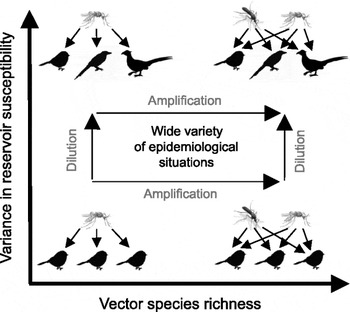
Thus it seems that very similar sorts of observations may be used to argue either for or against the dilution effect, depending not on unequivocal evidence but on the authors' initial predispositions. It is likely that dilution may indeed occur in some circumstances, but is by no means the only outcome of increased biodiversity. Furthermore, WNV offers a good example of transmission potential being affected by community composition, rather than biodiversity per se; the identity of each suite of species is evidently significant. An important theoretical advance is the incorporation of the impact of vector diversity on the outcome, dilution or amplification, of WNV transmission (Roche and Guégan, Reference Roche and Guégan2011). The high diversity of mosquito species in the New World (Turell et al. Reference Turell, Dohm, Sardelis, O'Guinn, Andreadis and Blow2005), together with non-random avian host selection (above), contributes to transmission cycles and the spectacular epidemic of the early 21st century (CDC, 2007, http://www.cdc.gov/ncidod/dvbid/westnile/), in contrast to the much more limited range of competent species and smaller sporadic outbreaks in southern Europe (Murgue et al. Reference Murgue, Murri, Zientara, Durand, Durand and Zeller2001). A new multi-host/multi-vector model indicates that increased richness of vector species, and therefore increased vector abundance, may compensate for any wasted contacts between vectors and poorly competent vertebrate hosts, and may even result in amplification rather than dilution (Roche and Guégan, Reference Roche and Guégan2011) (Fig. 4). These authors point out that even within a single vector species, mosquito abundance will increase with blood-meal host abundance, whether the latter is competent or not, just as in the tick-borne disease systems (above). Indeed, “local richness and composition in host reservoirs and vectors may lead to different combinatorial effects of disease transmission”, whatever the relative competence levels of vertebrate and vector species (Roche and Guégan, Reference Roche and Guégan2011). Amongst many other disease systems that rely on multiple vector species, viruses that cause dengue and chikungunya are each transmitted differentially by 2 species of Aedes mosquitoes with different host relationships in each part of their increasingly extensive ranges. The arrival of A. albopictus in the New World, joining the longer-established A. aegypti, may be contributing to the emerging epidemics of dengue there (Marina et al. Reference Marina, Bond, Casas, Munoz, Orozco, Valle and Williams2011). Similarly, both mosquito species transmit chikungunya virus in tropical regions, that caused dramatic epidemics on Indian Ocean islands in the early years of this century, while the 2007 epidemic in northern Italy depended entirely on A. albopictus. In the veterinary field, the erstwhile uniquely southern African strain of blue tongue virus (BTV8) has been maintained in northern Europe since 2006 by a new suite of Culicoides midges whose feeding habits and vector competence, and therefore variable contributions to maintaining transmission, have not yet been well characterized.
Dual effects of the richness in reservoir and host vector species on the transmission of vector-borne pathogens of zoonotic origin. As variance in reservoir competence increases in species-rich host communities, a decrease in the prevalence of disease pathogens in the vectors may be observed (dilution effect). On the other hand, in species-rich communities of vectors, a larger proportion of vectors, even if poorly competent, can acquire the pathogen from infectious hosts and then amplify the transmission of the disease to susceptible hosts (amplification effect). In natural conditions, these two antagonistic effects can lead to contrasting epidemiological situations depending on the characteristics of the local ecosystems and their biological diversity. Reproduced from Roche and Guégan (Reference Roche and Guégan2011), with permission.

EVIDENCE FOR DILUTING OR AMPLIFYING EFFECTS OF BIODIVERSITY FROM OTHER INDIRECTLY TRANSMITTED PARASITE SYSTEMS
To support the generality of the conclusions drawn from vector-borne disease studies, Keesing et al. (2010) cite studies on the effects of changing host community structures on parasites with complex life cycles that include intermediate hosts and free-living stages. Amongst these, of greatest medical and veterinary importance are the helminths, which offer the valuable element of experimentation to augment the above observational studies. When the community structure of snails, of which only Biomphalaria glabrata acted as intermediate host for Schistosoma mansoni, was changed from single- to mixed-species by adding 2 non-host snail species (but maintaining a constant density of B. glabrata), infection prevalence declined by 25–50%, and 60–80% fewer cercariae were produced per snail (Johnson et al. Reference Costello, Abbas, Allen, Ball, Bellamy, Friel, Grace, Johnson, Kett, Lee, Levy, Maslin, McCoy, McGuire, Montgomery, Napier, Pagel, Patel, de Oliveira, Redclift, Rees, Rogger, Scott, Stephenson, Twigg, Wolff and Patterson2009). The former effect may have been due to a diversion of snail-infective miracidia away from target hosts to non-hosts (a ‘decoy’ effect, equivalent to Keesing et al's (2006) ‘encounter reduction’), while the latter may reflect a competition-mediated reduction in resources available for cercarial production. These effects, however, are potentially offset by an observed increase in host fitness, double the mean per capita egg production by B. glabrata in heterospecific compared with monospecific host communities, as uninfected snails escaped parasite-induced castration. As long as this increased snail fitness exceeds the cost of competition, within the whole system under natural conditions the intermediate host density may increase, thereby enhancing overall cercarial production and thus risk to humans.
Such parasite-mediated facilitation has been observed amongst other helminths, for example the trematode Ribeiroia ondatrae transmitted between snails, amphibians and amphibian-eating birds (Johnson et al. Reference Johnson, Hartson, Larson and Sutherland2008). Experimental manipulation of amphibian host community structure (competent Bufo americanum with or without low-competent Hyla versicolor and Rana clamitans at different relative densities) allowed the authors to conclude that “the reduction in parasite transmission was specifically due to the presence of a low-competency host, rather than to a generic increase in host species richness”, emphasizing the importance of the specific composition of the host community (as distinct from biodiversity per se). Again, however, the competent host enjoyed fitness benefits, specifically fewer limb malformations and higher survival, which was considered likely to offset any negative effects of interspecific competition within more diverse host communities. Given the time constraints on host finding by cercariae, increased competent host abundance is likely to enhance parasite transmission in the long term. In this latter example, the interest lay in the potential conservation of a susceptible host species, which was evidently achieved by the addition of alternative hosts, rather than on the potential for parasite transmission per se, as in zoonotic disease systems.
The significance of the precise species composition and relative abundance of members of the ambient community, rather than simply diversity, has been emphasized for other helminth parasites with complex life cycles. Nevertheless it is true that the more diverse the community, the more likely it is to include zooplankton that act as predators on infective cercariae, non-host decoys or alternative hosts, all of which evidently act additively to reduce parasite loads in any one intermediate host of interest (e.g. digenean trematodes Himasthla elongata in cockles Ceratoderma edule) (Thieltges et al. Reference Thieltges, Bordalo, Cabalerro Hernandez, Prinz and Jensen2009a). In some cases, these sorts of effects may be caused by invading alien species that happen to act as non-host decoys, thereby benefiting native host species (Thieltges et al. Reference Thieltges, Reise, Prinz and Jensen2009b).
Given the complexity typical of many indirect parasite life cycles, the potential for a wide variety of effects of changing host diversity on parasite transmission rates is large, with many examples of negative relationships between biodiversity and disease risk entering the literature. As emphasized by Johnson and Thieltges (Reference Johnson and Thieltges2010), however, this is not an inevitable relationship; converse positive relationships are possible and documented for both vector-borne microbes (see above) and complex life-cycle parasites. For example, the infection prevalence of the myxozoan parasites (Myxosoma cerebalis, that causes whirling disease in salmonid fish) in tubificid intermediate hosts (Tubifex tubifex) was higher in the presence of a non-host tubificid (Limnodrilus hoffmeisteri) than in monocultures (Steinbach Elwell et al. Reference Steinbach Elwell, Kerans and Zickovich2009). Taking into account complex species-specific density-dependent effects of adult tubificid growth rates and reproduction, the authors suggest that the presence of L. hoffmeisteri may have released T. tubifex from intraspecific interactions that limited infection in high-density monocultures.
Another system that yielded results contrary to the dilution hypothesis brings us back to vector-borne infections, but this time the transmission of barley and cereal yellow dwarf viruses (B/CYDV) by aphids amongst grasses, including many crop species (Borer et al. Reference Borer, Mitchell, Power and Seabloom2009). Annual grasses are high-quality hosts that support elevated aphid populations and have relatively high virus reservoir competence, while perennial grasses sustain lower aphid populations and have lower reservoir competence, but are important as between-season virus reservoirs. Forbs (herbaceous flowering plants) are non-hosts, supporting neither aphids nor B/CYDV, but they compete with host grasses for soil and light. The final element is vertebrate herbivores, not within the transmission cycle in any way, but as selective grazers, removing forbs and stimulating plant re-growth, thereby increasing aphid colonization (Borer et al. Reference Borer, Mitchell, Power and Seabloom2009). When these consumers were excluded from the system, B/CYDV infection prevalence decreased from 18% outside the exclosures to 5% inside, i.e. consumers actually allowed greater infection prevalence. This does not in fact contradict the view that consumers of animal hosts (predators) control infectious diseases by removing infected hosts, because that arises when consumers selectively remove infected hosts (Packer et al. Reference Packer, Holt, Hudson, Lafferty and Dobson2003), the very opposite of this B/CYDV system. Here the grazers had no effect on host species richness, evenness or Shannon diversity (i.e. infection prevalence was high in the presence of high host diversity), but they did increase the relative abundance of high-quality hosts, shifting the floristic composition towards one more favourable for virus transmission. Again, the effect of an additional specific element, consumers, to the community varies between systems, undermining the generality of the simple mantra “biodiversity protects against infection”. A similar conclusion arose from earlier experiments with this cereal virus: “host diversity was less important for virus epidemiology than the presence [but not proportional abundance] of one highly suitable host species” (Power and Mitchell, Reference Power and Mitchell2004). In the presence of a highly suitable host species, wild oats Avena fatua, substantial pathogen spillover into other host species occurred, resulting in lower biomass of 2 other grass species in the presence of both A. fatua and the virus, i.e. pathogen-mediated apparent competition (Holt and Lawton, Reference Holt and Lawton1994). This phenomenon itself has consequences for community structure and diversity attributes (beyond the topic of this review), but in the present argument the key point is the ability of one additional host species to determine infection prevalence in other species and thereby drive epidemics, whether amongst wildlife hosts (e.g. red and grey squirrels Sciurus vulgaris and S. carolinensis, respectively – Bruemmer et al. Reference Bruemmer, Rushton, Gurnell, Lurz, Nettleton, Sainsbury, Duff, Gilray and McInnes2010) or involving humans (zoonoses of many types).
LIMITED EVIDENCE FOR DILUTING EFFECTS OF BIODIVERSITY FROM DIRECTLY TRANSMITTED INFECTIOUS DISEASE SYSTEMS
The extension of the dilution effect to directly transmitted diseases is seen as a significant step with broad conservation implications, because “linking human health to biodiversity could be just the [tangible human] benefit for gaining the public's support of conserving biodiverse ecosystems” (Dizney and Ruedas, Reference Dizney and Ruedas2009). Since rodent-borne hantaviruses emerged from obscurity in the mid-1990s, they have become a favourite example in this political endeavour. Human infection (resulting in haemorrhagic fever with renal syndrome in the Old World, and hantavirus pulmonary syndrome in the New World, often with severe and fatal clinical outcomes) occurs through contamination with infected rodent urine and feces. Risk, therefore, increases with the density of infected rodents, abiotic conditions favourable for prolonged survival of the virus in the environment, and human behaviour likely to maximize contact with rodents, which can be higher among low-income households (Linard et al. Reference Linard, Lamarque, Heyman, Ducoffre, Lutasu, Tersago, Vanwambeke and Lambin2007).
Most attention has been focused on determinants of the abundance of infected rodents, for which in Europe there is marked geographical variation (Vapalahti et al. Reference Vapalahti, Mustonen, Lundkvist, Henttonen, Plyusnin and Vaheri2003). In northern Fennoscandia, voles Myodes glareolus, the host of Puumula virus (PUUV), show 3–4 year population cycles probably driven by specialist predators (Hanski et al. Reference Hanski, Hansson and Henttonen1991) within relatively homogenous landscapes (Dalkvist et al. Reference Dalkvist, Sibly and Topping2011), with intense transmission amongst rodents and also to humans associated with these regular high rodent densities (Vapalahti et al. Reference Vapalahti, Mustonen, Lundkvist, Henttonen, Plyusnin and Vaheri2003). In this case, high predator abundance causes rodent population declines as part of the natural predator-prey cycle, but an argument that links the presence of predators (sensu Packer et al. Reference Packer, Holt, Hudson, Lafferty and Dobson2003; Ostfeld and Holt, Reference Ostfeld and Holt2004) with reduced risk of hantavirus infection would be disingenuous within such a system of short-term cycles. In temperate Europe, in contrast, rodent populations are more stable but punctuated by peaks driven by occasional mast years (when oak and beech seed crops are unusually heavy). This leads to irregular epidemics synchronized over large areas, which can be forecast from high temperatures in the preceding summer (year t-2) and autumn (year t-1) (Tersago et al. Reference Tersago, Verhagen, Servais, Heyman, Ducoffre and Leirs2009). Infection risk can be correlated in space and time with rodent population dynamics, in both the long- and short-term (Tersago et al. Reference Tersago, Verhagen, Vapalahti, Heyman, Ducoffre and Leirs2011b), and also with individual rodent behaviour and physiology associated with reproduction at an even finer scale, leading to seasonal shifts in transmission mechanisms (Tersago et al. Reference Tersago, Verhagen and Leirs2011a). Spatial variation in PUUV prevalence in voles and human case incidence within Belgium, lower in the north than the south, has been related to local climate and habitat fragmentation effects on vole density, possibly with a threshold effect, and the relative proportion of non-host wood mice (Apodemus sylvaticus) in the rodent communities, i.e. a dilution effect (Tersago et al. Reference Tersago, Schreurs, Linard, Verhagen, Van Dongen and Leirs2008). Across Europe, however, different rodents are primary hosts for different hantaviruses (Vapalahti et al. Reference Vapalahti, Mustonen, Lundkvist, Henttonen, Plyusnin and Vaheri2003) and therefore greater rodent diversity will permit the circulation of additional viruses and strains (Plyusnina et al. Reference Plyusnina, Krajinovic, Margaletic, Niemimaa, Nemirov, Lundkvist, Markotic, Miletic-Medved, Avsic-Zupanc, Henttonen and Plyusnin2011).
In the New World, outbreaks of hantavirus pulmonary syndrome in humans or the prevalence in rodents of causal viruses, such as Sin Nombre virus (SNV) in North America and related pathogenic viruses in Central and South America, appear to be negatively correlated with the diversity of rodent species, only some of which are competent hosts (Dizney and Ruedas, Reference Dizney and Ruedas2009; Ruedas et al. Reference Ruedas, Salazar-Bravo, Tinnin, Armien, Caceres, Garcia, Diaz, Gracia, Suzán, Peters, Yates and Mills2004; Suzán et al. Reference Suzán, Armien, Mills, Marce, Ceballos, Avila, Salazar-Bravo, Ruedas, Armien and Yates2008). These conclusions suffer from a certain lack of robustness, relying on comparison between a single outbreak and a single negative site (Ruedas et al. Reference Ruedas, Salazar-Bravo, Tinnin, Armien, Caceres, Garcia, Diaz, Gracia, Suzán, Peters, Yates and Mills2004), only 2 selected viruses and rodent hosts amongst others (Suzán et al. Reference Suzán, Armien, Mills, Marce, Ceballos, Avila, Salazar-Bravo, Ruedas, Armien and Yates2008), and a relationship based on 5 sites that shows no trend whatsoever in infection prevalence in rodents as the Simpson diversity index (D s) decreases from about 0·75 to 0·45 at 4 sites, but a marked increase as D s reaches c. 0·38 at the fifth site, with marked inter-annual variation (Dizney and Ruedas, Reference Dizney and Ruedas2009). The L-shaped graph suggests that D s is not actually a good predictor of infection prevalence until perhaps some extreme limiting condition is reached (as seen in Allan et al. Reference Allan, Keesing and Ostfeld2003 and Fig. 1). A model of a simple system in which one non-host rodent species is added to a single reservoir species yielded exactly the prediction to be expected; the existence of a second species that competes with the competent murid host leads to reduction or even elimination of infection at a critical level of the competitor's population (Peixoto and Abramson, Reference Peixoto and Abramson2006). No more convincing is the experimental study in which all non-reservoir species were removed at experimental forest edge sites in Panama, leaving only Zygodontomys brevicauda and Oligoryzomys fulvescens, reservoirs for Calabazo and Choclo viruses, respectively (Suzán et al. Reference Suzán, Marce, Giermakowski, Mills, Ceballos, Ostfeld, Armien, Pascale and Yates2009). Despite claims of significant differences between control and experimental plots, in fact only 3 out of 16 observations for the latter (2 observations, before and after manipulation, for each of 8 plots) show any higher prevalence for hantavirus than the controls (Suzán's Fig. 3), and there was no correlation between species diversity and sero-prevalence (Suzán's Fig. 2B). Furthermore, sero-conversion in each observation period before and after manipulation is presented as absolute numbers (Suzán's Fig. 4) without correction for different densities of these rodent species on the control and experimental plots, i.e. were not “rates” and are therefore impossible to interpret. Overall, the evidence for a dilution effect is overstated.
An alternative element of biodiversity, predator diversity, was investigated with respect to SNV prevalence in reservoir deer mice (Peromyscus maniculatus) on 8 faunistically de-pauperate Californian Channel Islands, where these mice predominate amongst rodents and interspecific competition is low (Orrock et al. Reference Orrock, Allan and Drost2011). The strongest single positive correlate of SNV prevalence was precipitation, possibly related to virus survival in the environment (Linard et al. Reference Linard, Lamarque, Heyman, Ducoffre, Lutasu, Tersago, Vanwambeke and Lambin2007) or food availability for rodents, but positive effects of island area and negative effects of predator diversity (which co-varied) were also significant in a multi-variate model. The point is made that types of predators, avian or mammalian, and their degree of specialization, may be as important as diversity in driving rodent population fluctuations and thereby variable virus transmission potential (Orrock et al. Reference Orrock, Allan and Drost2011). Conclusions about the real importance of predator diversity for rodent-hantavirus systems, especially in mainland contexts, are hard to draw from this study, given the complex and currently unknown precise role of predators in regulating their prey populations in different circumstances, as elaborated by Ostfeld and Holt (Reference Ostfeld and Holt2004). Only where predators or dominant competitors are really instrumental in reducing populations of key hosts for zoonotic infections will their presence control risk of human infection (Packer et al. Reference Packer, Holt, Hudson, Lafferty and Dobson2003; Ostfeld and Holt, Reference Ostfeld and Holt2004), most likely through simple host density-dependent effects (Begon, Reference Begon, Ostfeld, Keesing and Eviner2008), but this is by no means invariably related to increased biodiversity as much as to a specific change in community composition.
CONCLUSIONS
Biodiversity versus community structure
If one were to reverse the order of most of the studies in support of the dilution effect, starting with the non-competent host and then adding the competent one, the natural conclusion would be that biodiversity causes disease amplification, the precise opposite of the dilution effect (see, for example, the penultimate paragraph of Allan et al. Reference Allan, Langerhaus, Ryberg, Landesman, Griffin, Katz, Oberle, Schutzenhofer, Smyth, de St Maurice, Clark, Crooks, Hernandez, McLean, Ostfeld and Chase2009). As many of the examples above show, it is community composition rather than biodiversity that is crucial, largely because of the pathogen-specific differential use of (potential) host species in transmission cycles. In North America, for example, the deer that are claimed to act as dilution hosts for Lyme borreliosis act as reservoir hosts for Anaplasma phagocytophilum, the causative agent of Human Granulocytic Anaplasmosis.
Despite conclusions and examples such as this, there is an emerging assumption that the species competent to transmit human zoonoses of many sorts are most likely to thrive in newly impoverished environments (Keesing et al. Reference Keesing, Belden, Daszak, Dobson, Harvell, Holt, Hudson, Jolles, Jones, Mitchell, Myers, Bogich and Ostfeld2010a) due to the immuno-ecological trade-off between effective immunity and ‘fast’ life-history traits (Hawley and Altizer, Reference Hawley and Altizer2011). According to this framework, those vertebrates most likely to display resilience to anthropogenic habitat disturbance would be those with high reproductive output and rates of population growth, traits that might impose constraints on developmentally costly immune systems through energy limitation or oxidative stress (Dowling and Simmons, Reference Dowling and Simmons2009). While comparisons between closely-related vertebrate species have provided some support for this concept amongst birds (Lee et al. Reference Lee, Martin, Hasselquist, Ricklefs and Wikelski2006; Lee et al. Reference Lee, Wikelski, Robinson, Robinson and Klasing2008; Martin et al. Reference Martin, Hasselquist and Wikelski2006), amongst rodents, Peromyscus species did not differ in immuno-competence per se, but simply used different immunological strategies that were not determined solely by their reproductive pace of life (Martin et al. Reference Martin, Weil and Nelson2007). At higher taxonomic levels, any evolved trade-off balance is unlikely to produce a uniform outcome that precludes species with relatively ‘slow’ life-history traits (e.g. ungulates rather than rodents) from acting as reservoir/transmission hosts, otherwise we should have nothing to fear from swine or primates as sources of zoonotic infections. Past pathogen challenge over evolutionary as well as ecological time-scales is arguably the strongest selection pressure determining the level of investment in immunity, that may itself impose differential constraints on life-history traits (Horrocks et al. Reference Horrocks, Matson and Tieleman2011). Identifying cause and effect under a wide range of natural conditions, which depends on developing the correct indices of parasite load and immune responses (“immunobiotic pressure”) (Horrocks et al. Reference Horrocks, Matson and Tieleman2011), must precede any simplistic conclusion that anthropogenic changes in community structure will typically favour species more competent to act as hosts to all sorts of parasites/pathogens.
It is clear from the examples in this review that simple changes in indices of biodiversity through the loss or gain of certain species may either dilute or amplify the risk of infection through direct or indirect effects, depending on the parasite/pathogen species under study and its transmission cycle. As Ostfeld and LoGiudice (Reference Ostfeld and LoGiudice2003) pointed out, the effects of simulated biodiversity loss depend absolutely on the order in which species are removed (or added); “…individual species have effects that are both idiosyncratic and strongly contingent on the identities of the other members of the community… .”.
Panglossian extension ad absurdam – “biodiversity protects against infection”
Against this background of disparity in natural host-parasite systems, the 4 features identified as likely to predispose vector-borne disease systems to the dilution effect (Table 1, based on Ostfeld and Keesing Reference Ostfeld and Keesing2000b) have been extended to other types of host-parasite interactions (Johnson and Thieltges, Reference Johnson and Thieltges2010; Keesing et al. Reference Keesing, Holt and Ostfeld2006; Ostfeld and Keesing, Reference Ostfeld and Keesing2000a): (1) parasites infect multiple host species, but with a low degree of between-species transmission and rates that are more frequency- than density-dependent; (2) the presence of species within the community that [adversely] affect parasite transmission to the focal host and the resulting disease risk; (3) the domination of low diversity communities by highly competent host species; (4) within more diverse communities, a greater fraction of species that interfere with parasite transmission in some way. Clearly each criterion applies differentially amongst the diverse range of natural disease systems and even in the same system in different ecological contexts. The impact of community structure on infection prevalence has been studied in disease systems involving not only humans, but also hosts of importance to livestock, wild food stocks, crops and conservation. Results consistently show that the effect of increasing biodiversity in all its various forms (non-competing hosts of variable transmission competence, predators, competitors) is not uniform; amplification or neutral effects have been observed as much as reduced infection prevalence. About 60% of emergent pathogens have three or more reservoir host species (in addition to humans) (Woolhouse and Gowtage-Sequeria, Reference Woolhouse and Gowtage-Sequeria2005), indicating that pathogen dynamics driven by a multiplicity of hosts is a more realistic picture for emerging infectious diseases (Begon, Reference Begon, Ostfeld, Keesing and Eviner2008). Indeed, the non-specialist host relationships of B. burgdorferi s.s. strains, together with those of their tick vector, may account for the rapid emergence of Lyme disease in the USA (Kurtenbach et al. Reference Kurtenbach, Hanincova, Tsao, Margos, Fish and Ogden2006). Any synergistic effects of multiple hosts on shared pathogens would enhance persistence and abundance (Begon, Reference Begon, Ostfeld, Keesing and Eviner2008).
This more balanced view undermines the panglossian generalization that biodiversity is likely to protect against infection (Dobson et al. Reference Dobson, Cattadori, Holt, Ostfeld, Keesing, Krichbaum, Rohr, Perkins and Hudson2006; Pongsiri and Roman, Reference Pongsiri and Roman2007; Swaddle and Calos, Reference Swaddle and Calos2008; Pongsiri et al. Reference Pongsiri, Roman, Ezenwa, Goldberg, Koren, Newbold, Ostfeld, Pattanayak and Salkeld2009; Keesing et al. Reference Keesing, Belden, Daszak, Dobson, Harvell, Holt, Hudson, Jolles, Jones, Mitchell, Myers, Bogich and Ostfeld2010), an attractive claim repeatedly used to underpin policy and funding decisions. Studies of the sort that in the past have reported the range of natural biotic interactions that affect pathogen transmission cycles and resultant zoonotic hazards for humans are now couched in terms of the ‘biodiversity-buffers-disease’ paradigm. Any undesirable loss of biodiversity, whatever its precise measure or meaning (e.g. biotic homogenization at specific and genetic levels as local species are replaced by exotics, de-forestation and loss of structural diversity, reduced community composition and assemblages of organisms from microbes to vertebrates), is linked to “effects on human health”, but always with the emphasis on emergence or re-emergence, rather than on reduction, of health risks (Pongsiri et al. Reference Pongsiri, Roman, Ezenwa, Goldberg, Koren, Newbold, Ostfeld, Pattanayak and Salkeld2009).
One obvious exception to the negative relationship between biodiversity and disease risk arises because more or new hosts may harbour more or new pathogens at both local and global scales. The hotspots of biodiversity in the tropics are not disease-poor havens. Even if spatial patterns are not precisely aligned (Dobson et al. Reference Dobson, Lafferty, Kuris, Hechinger and Jetz2008), general patterns of vertebrate and parasite diversity show concurrent latitudinal gradients increasing towards the tropics (Guernier et al. Reference Guernier, Hochberg and Guegan2004; Hechinger and Lafferty, Reference Hechinger and Lafferty2005). Furthermore, the pan-global analysis of emerging infectious diseases between 1940 and 2004 identified mammalian species richness (considered as a proxy for wildlife species richness) as a significant determinant of zoonotic disease risk of wildlife origin (but not of vector-borne disease risk) (Jones et al. Reference Jones, Patel, Levy, Storeygard, Balk, Gittleman and Daszak2008). “ … .why there are apparently more diseases in the species-rich tropics is an entirely separate matter” (Ostfeld and Keesing, Reference Ostfeld and Keesing2000a) is a point of view not shared by everyone, even if biogeographical patterns of species richness on one hand and anthropogenic diversity loss on the other require different policy and management options (Keesing et al. Reference Keesing, Belden, Daszak, Dobson, Harvell, Holt, Hudson, Jolles, Jones, Mitchell, Myers, Bogich and Ostfeld2010). The ecological circumstances may differ markedly, but, until shown otherwise, it is reasonable to assume a similar range of functional processes of pathogen transmission, requiring an explanation as to why the rules of global patterns should not apply at local scales.
It is of course legitimate to identify biodiversity changes as one possible set of causes for disease emergence, but not to preach that high biodiversity always protects against disease. That is little more than a straw man, an argument easily dismantled and dismissed by those whose commercial and political ambitions jeopardise the future of biodiversity and ecosystem function. It adds only fragility to the case for creating a new UN organisation, the Intergovernmental Science-Policy Platform on Biodiversity and Ecosystem Services (IPBES) (Larigauderie and Mooney, Reference Larigauderie and Mooney2010; Marris, Reference Marris2010). There is also the danger of driving public health policy by this inconsistent and therefore unreliable rule of thumb, as these ideas start to infiltrate the medical literature (Costello et al. Reference Costello, Abbas, Allen, Ball, Bellamy, Friel, Grace, Johnson, Kett, Lee, Levy, Maslin, McCoy, McGuire, Montgomery, Napier, Pagel, Patel, de Oliveira, Redclift, Rees, Rogger, Scott, Stephenson, Twigg, Wolff and Patterson2009) and the web (e.g. http://www.cohabnet.org/, http://caha.org.au/ and http://www.diversitas-international.org/activities/research/ecohealth/highlights), including professional medical web sites (http://www.globalpulsejournal.com/blog/index.php/category/national-public-health-week/). The panglossian approach is doomed to fail; we must accept that not everything about biodiversity is necessarily positive for humans.
ACKNOWLEDGEMENTS
We thank Robert Lane, Jean Tsao, David Rogers and Paul Johnson for useful comments on the original draft.
FINANCIAL SUPPORT
This research received no specific grant from any funding agency, commercial or not-for-profit sectors.