Implications
This study contributes towards the understanding of the response of piglets to valine (Val) when receiving diets containing excess leucine (Leu), which could often occur in commercial feeds containing dried distillers grain with solubles or maize gluten. Diets low in Val depress feed intake and growth, more severely so in the presence of excess Leu. Valine supplementation to such an imbalanced diet may reverse the depression in feed intake and growth. The efficiency of utilisation of Val for body protein growth is unaffected by the Leu content of the feed.
Introduction
Current formulation techniques attempt to provide feeds for growing pigs that limit an excess supply of amino acids using a range of synthetic amino acids available to the feed industry. This technique attempts to provide a dietary amino acid balance that closely matches the requirement for each amino acid at the metabolic level without the inclusion of high levels of total protein which, apart from being costly, places a strain on the environment when surplus nitrogen is excreted by animals. Numerous studies have been conducted to measure responses to the most limiting amino acids such as lysine (Lys), methionine, tryptophan (Trp) and threonine. According to Figueroa et al. (Reference Figueroa, Lewis, Miller, Fischer, Gomez and Diedrichsen2002) Val and/or isoleucine (Ile) may become the next limiting amino acids after these four amino acids that restrict growth when feeding low-protein diets based on maize and soyabean meal. Defining the optimal level of Val required in pig feeds will contribute to supplying an amino acid profile that more closely resembles that of an ideal protein when restricting the total dietary protein.
Attempts have been made in the past to determine Val responses in weaned piglets (Wiltafsky et al., Reference Wiltafsky, Pfaffl and Roth2010; Gaines et al., Reference Gaines, Kendall, Allee, Usry and Kerr2011; Nemechek et al., 2014) and finishing pigs (Lewis and Nishimura, Reference Lewis and Nishimura1995; Barea et al., Reference Barea, Brossard, Le Floc’h, Primot, Melchior and van Milgen2009; Liu et al., Reference Liu, Ma, Zeng, Xie, Thacker, Htoo and Qiao2015). Many of these experiments have aimed to determine the optimal Val : Lys ratio, whereas others have addressed the issue of the effect of an imbalance between branched-chain amino acids (BCAA) on feed intake and growth (Edmonds and Baker, 1987; Gatnau et al., Reference Gatnau, Zimmerman, Nissen, Wannemuehler and Ewan1995; Langer and Fuller, Reference Langer and Fuller2000; Peganova and Eder, Reference Peganova and Eder2003). In some of these latter trials an excessive concentration of Leu has been shown to create a deficiency in Val, which could lead to an increase in the requirement for this amino acid. In such cases the supplementation of Val to a diet could alleviate the negative effects caused by high Leu intakes. Gloaguen et al. (Reference Gloaguen, Le Floc’h, Brossard, Barea, Primot, Corrent and van Milgen2011) showed that Leu intake did not affect Val requirement in nursery piglets per se, but that an excess Leu supply attenuated the drop in performance seen with low-Val diets.
In all the above cases the researchers have used a formulation technique in which a basal feed is created that is deficient in the amino acid under test, to which the test amino acid is supplemented in increasing doses. This graded supplementation technique has been subjected to criticism mainly because the addition of increasing doses of the limiting amino acid to the basal diet changes the amino acid balance throughout the series of diets used (Fisher and Morris, Reference Fisher and Morris1970; Gous and Morris, Reference Gous and Morris1985). At high supplementation levels the amino acid under test may no longer be first limiting but a further response might be elicited by increasing the level of the newly created first-limiting amino acid(s). To avoid possible interference of imbalances between other amino acids than Val and Leu, a summit dilution technique (Fisher and Morris, Reference Fisher and Morris1970) was used in the present study.
The objective of this study was to use a summit dilution technique to measure the response of weaned piglets to a range of diets varying in Val content, and to measure any interaction that might occur to excess Leu. These responses would make it possible to determine the dietary Val concentration at different Leu levels that would optimise growth rate and carcass leanness.
Material and methods
The Animal Use and Care Committee of the University of Pretoria approved the application for ethical approval (EC042-10). The experiment was conducted at Ukulinga research farm of the University of KwaZulu-Natal, Pietermaritzburg, South Africa. The 75 Large White×Landrace entire male pigs used in the trial were purchased from a commercial farm near the experimental site. Pigs were weaned at 28 days of age and received a commercial weaner diet for 2 weeks. After they were moved to the experimental site the pigs were continued on the previously used commercial weaner feed for 2 days before being ear tagged and weighed. Totally, 72 piglets were housed individually and randomly allocated to one of 18 treatments using a randomised block design, with four pen replicates per treatment. Because the environmental conditions along the length of the building were not identical, all treatments were represented in each of four blocks, these blocks consisting of 18 pens, nine on either side of the passage.
Each pen was equipped with a nipple drinker and a plastic self-feeder bin (Big Dutchman, Johannesburg, South Africa). Animals received feed and water ad libitum. The crate floors were suspended ~30 cm from the ground to allow faeces, urine and waste water to drop through the plastic slatted floor to the ground. Feed that was wasted by piglets from the feeders was collected in a tray underneath the feeder, which was emptied into a bucket daily and weighed weekly.
The mean starting weight for all piglets was 13.5±1.18 kg. Three piglets were randomly selected to be slaughtered at the start of the trial to determine initial body composition. Pigs and feed were weighed on days 0, 7, 14 and 18 to calculate growth rate and feed intake. All pigs were slaughtered on day 18 for carcass lipid, water, ash and protein analysis.
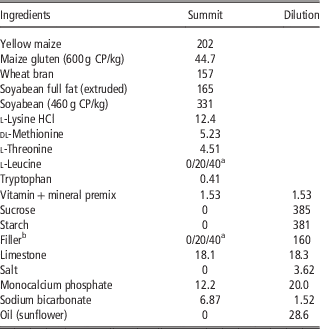
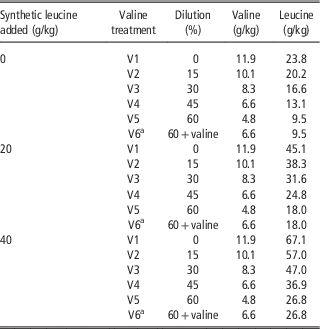
A basal feed was formulated to contain higher levels of the essential amino acids than should be required to sustain potential performance in weaned pigs of the genotype used in this trial, according to the pig growth model of Ferguson et al. (Reference Ferguson, Arnold, Lavers and Gous1994) (Table 1). A dilution feed (Table 1) was formulated to contain the same concentration of all nutrients in the summit feeds, but without CP. The summit feed, made without the addition of synthetic Leu or filler, was divided into three equal amounts, the first being supplemented with 40 g filler/kg feed, the second with 20 g Leu and 20 g filler/kg feed and the third with 40 g Leu/kg feed (Table 2). The three summit feeds were appropriately blended with the dilution feed to create a series of five Val concentrations at three Leu levels (Table 2). The sixth level in each dilution series (T6) had the same proportions of summit and dilution feed as T5 except that 1.8 g crystalline Val was added per kg feed. The objective of such an addition was to determine whether Val was the first-limiting amino acid in the series. The expected Val and Leu concentrations of treatments are given in Table 2. The dietary treatments consisted therefore of six Val levels at three Leu concentrations.
Ingredient composition (g/kg fresh weight) of the summit and dilution mixes

a Three levels of leucine were used, namely, 0, 20 and 40 g/kg, and these were balanced with the use of filler at 40, 20 and 0 g/kg, respectively.
b Filler was composed of milled sunflower husks (53%) and sand (47%).
Extent to which summit diet was diluted (%) and expected digestible valine and leucine concentrations (g/kg)

a The composition of V5 and V6 was the same except that V6 was supplemented with 1.8 g l-valine.
All feed samples were submitted to the laboratory for proximate analysis consistent with Association of Official Analytical Chemists (2000) methods. Neutral detergent fibre content was measured using the method of Van Soest et al. (Reference Van Soest, Robertson and Lewis1991). The CP content was analysed on a Leco FP2000 (LECO Corporation, St. Joseph, Michigan, USA). Amino acid contents were determined using the method outlined by Dennison and Gous (Reference Dennison and Gous1980). This technique involves hydrolysis of the sample with 6 M HCl at 110°C followed by analysis on an automated amino acid analyser (Beckman 119, Beckman Instruments, Palo Alto, CA, USA) using norleucine as an internal standard. Amino acid digestibility was measured on adult roosters according to the precision feeding technique described by McNab and Fisher (Reference McNab and Fisher1984). The digestible energy (DE) was calculated using the equation from Whittemore (Reference Whittemore1998):
 $${\rm DE}\,{\equals}\,3.{\rm 77}{\minus}\left( {0.019{\times}{\rm NDF}} \right){\plus}\left( {0.758{\times}{\rm GE}} \right)\,\left( {{\rm MJ}/{\rm kg}} \right)$$
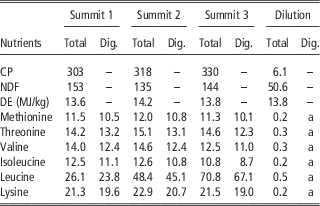
The analysed chemical composition of the basal diets is given in Table 3.
Analysed chemical composition of protein amino acid composition, CP, digestible energy (DE) and NDF (g/kg) of the summit and dilution feeds

Dig. = digestible.
a Protein too low to calculate digestible amino acids.
At the end of the trial all pigs were euthanised by intra-cardiac injection of sodium pentobarbital (1 ml/kg BW). After euthanasia, pigs were cut open to remove and strip the gastrointestinal tract from its contents. The empty body and gastrointestinal tract were stored in plastic bags and frozen at −20°C. Each frozen carcass with viscera and gastrointestinal tract was minced and thoroughly homogenised in a mincer. One representative sample was collected from each homogenate and placed in a 500 g container. Carcass lipid content was calculated from carcass gross energy and CP content according to the method of Ferguson et al. (Reference Ferguson, Emmans and Gous2000):
 $${\rm Lipid}\,{\equals}\,\left( {2.410{\times}{\rm GE}} \right)-\left( {0.5898{\times}{\rm CP}} \right)\,\left( {{\rm g}/{\rm kg}\,{\rm DM}} \right)$$
where GE is the carcass gross energy content expressed in kJ/g DM and CP is the carcass CP content (g/kg DM). The DM content of each sample was determined by freeze-drying each sample for 48 h. The carcass CP was analysed on a Leco FP2000, whereas energy content was determined using the AC500 adiabatic bomb calorimeter (LECO Corporation).
Feed intakes and BWs of all pigs from each treatment were pooled to determine the average daily feed intake (ADFI), BW, average daily gain (ADG) and feed conversion efficiency (FCE, g gain/kg feed) for each of the 18 treatments. Valine concentration of each treatment was calculated from the analysed Val concentration of the respective summit feed and its proportion in the final mix. Total Val intake (VI) and average daily Val intake of each pig was calculated from ADFI and the Val concentration in the feed. Average initial carcass protein content was calculated from carcass protein contents of the three pigs that were slaughtered at the start of the trial. Carcass protein weight of each pig was determined at the start and the end of the trial by using the mean initial and final carcass protein contents multiplied by initial and final BW, respectively. Average daily protein gain (ADPG) of each pig was calculated as the difference between the initial and final carcass protein weights divided by the length of the trial period. Carcass lipid contents for each treatment were calculated using mean carcass contents of all pig samples and mean BWs of all pigs on that treatment.
Statistical analysis
Treatment means were obtained using the general ANOVA in Genstat (Version 12). The response of pigs to VI at three Leu concentrations was analysed by fitting an exponential equation to the data and then comparing the responses at each level of Leu using the Groups directive in Genstat (Version 12). In addition, the relationship between VI and carcass protein gain was determined using a statistical program that fits the Reading Model (Fisher et al., Reference Fisher, Morris and Jennings1973) to the data for each Leu series (available from EFG Software, Reference Edmonds and Baker2010). This program produces two coefficients that describe this relationship, namely, the amount of Val (mg) required per kg BW for maintenance, and the amount of Val (mg) required per g of protein gain.
Results
The analysed chemical composition of amino acids, CP, DE and NDF (g/kg) of the summit and dilution feeds are given in Table 3.
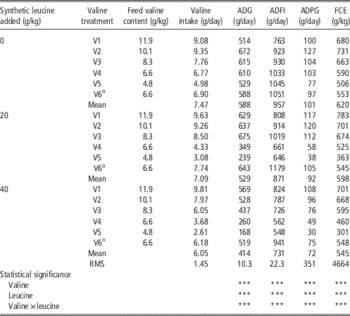
This study investigated the response of weaned piglets to varying levels of Val and Leu in weaner pig feeds. Significant improvements were evident in ADG, ADPG, ADFI, VI and FCE on Val treatment 6 (V6) at all three Leu levels when these were compared with the responses to treatment 5, which had essentially the same nutrient content as treatment 6, but with an additional dose of Val (Table 4). That the pigs responded to the additional dose of Val proved that Val was the first-limiting amino acid in all diets in the series, given that the dilution feed was devoid of protein.
Mean average daily gain (ADG), average daily protein gain (ADPG), average daily feed intake (ADFI), valine intake and feed conversion efficiency (FCE) (g BW gain/kg feed) of pigs over the 18-day trial period

RMS=residual mean square.
a The composition of V5 and V6 was the same except that V6 was supplemented with 1.8 g synthetic valine/kg feed.
***Effects were highly significant (P<0.001).
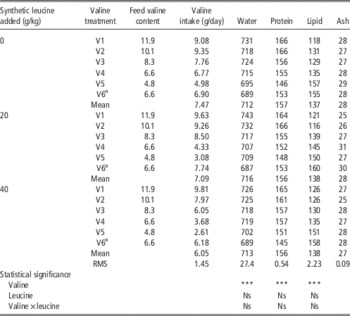
In this trial there were highly significant effects (P<0.001) of Val and Leu content, and their interaction, on all of the measurements taken. Average daily feed intake increased as dietary Val concentration decreased at normal Leu levels (Table 4), the effect of Val content, Leu content and their interaction being highly significant (P<0.001). A moderate excess of Leu in the diet resulted in a slightly imbalanced feed. Such an imbalanced feed caused an even greater increase in ADFI with decreasing Val concentration, but ADFI decreased markedly when Val concentration dropped <8.3 g/kg feed. The same effect was seen when pigs were fed the severely imbalanced feed. Pigs decreased ADFI when dietary Val concentration was decreased.
The increased ADFI when feed Val concentration dropped at a normal Leu level caused an initial increase in ADG, but as feed Val concentration dropped below 10.4 g/kg feed, an increase in ADFI did not compensate for the lower Val concentration in the feed. This resulted in a lower ADG and consequently a poorer FCE. When the feed was marginally imbalanced, the lower feed Val content resulted in an increase in ADFI, but at the expense of FCE. However, when Val content dropped below 8.3 g/kg feed, ADFI and ADG decreased markedly. When the feed was severely imbalanced there was a significant reduction in ADFI, ADG and FCE.
In this study, dietary Val concentration had a significant effect on carcass composition: carcass protein and water contents decreased, whereas lipid content increased as dietary Val concentration declined at all three Leu levels (Table 5). However, carcass composition was not affected by feeding excess Leu to pigs.
Mean final body composition of pigs (g/kg)

RMS=residual mean square.
a The composition of V5 and V6 was the same except that V6 was supplemented with 1.8 g synthetic valine/kg feed.
***Effects were highly significant (P<0.001).
To determine whether the efficiency of utilisation of Val for protein growth was affected by its imbalance with Leu, the Reading Model was fitted to the response data for each Leu series. The result is illustrated in Figure 1. The amount of Val required per kg of BW for maintenance was found to be 29.4 mg, and per g of protein gain, 67.3 mg. These coefficients were unaffected by the amount of Leu in the feed.
The response in protein gain in weaner pigs to valine intake for the balanced (▲), moderately imbalanced (▼) and severely imbalanced (●) treatments. Imbalances were achieved by addition of crystalline leucine to the diets.

Discussion
It was ascertained that Val was the first-limiting amino acid in all the series diets of this experiment, both by analysed amino acid levels of the summit diets and the positive response of the piglets to an additional dose of Val to treatment 5, which had the same nutrient content but lower Val level.
All studies relating to determining the Val requirements of weaned piglets have used the graded supplementation technique. The basis of this method is to produce a diet severely limiting in Val and then to add successive doses of synthetic Val thereby obtaining a response curve from which the optimum level of Val supplementation that yields the best growth performance is determined. The resultant Val requirement is expressed either as standardised ileal digestible (SID) Val : Lys ratio (Barea et al., Reference Barea, Brossard, Le Floc’h, Primot, Melchior and van Milgen2009), percentage SID Val in the diet (Gaines et al., Reference Gaines, Kendall, Allee, Usry and Kerr2011) or SID Val/MJ of metabolisable energy (ME) (Mavromichalis et al., Reference Mavromichalis, Kerr, Parr, Albin, Gabert and Baker2001). When the requirement is expressed as the optimal Val : Lys ratio, Lys has to be the second-limiting amino acid. This method has been criticised mainly because the successive additions of Val change the amino acid balance relative to all amino acids, and not just Lys, at each dose, and it is difficult to formulate a basal diet that is deficient in Val but sufficient in all other amino acids. Furthermore, at high Val supplementation levels, Val may no longer be first limiting and there might be an additional response if new first-limiting amino acids were supplemented to the diet (Fisher and Morris, Reference Fisher and Morris1970; Gous and Morris, Reference Gous and Morris1985).
Due to the limitations of the graded supplementation technique, the summit dilution method was used in this study. With this method the amino acid under test remains first limiting and the amino acid balance remains constant throughout the dilution series. This ensures that the response to the test amino acid is measured without the confounding effect of amino acid imbalances. However, while the summit and dilution diets were isoenergetic, the summit diets contained high levels of CP (300 to 330 g/kg) compared with the low CP levels in the dilution diet (6 g/kg). This inevitably led to large differences in CP to energy ratios and total content of amino acids between the various diluted diets. Results obtained in this study may therefore differ from other studies.
Valine and Leucine content of diet, and their interaction, had highly significant effects (P<0.001) on all of the measurements taken. The effect of Leu and the interaction between the two amino acids is of particular interest in this case. Mavromichalis et al. (Reference Mavromichalis, Kerr, Parr, Albin, Gabert and Baker2001), Barea et al. (Reference Barea, Brossard, Le Floc’h, Primot, Melchior and van Milgen2009) and Gaines et al. (Reference Gaines, Kendall, Allee, Usry and Kerr2011) found that feed intake was reduced as the dietary Val : Leu ratio decreased due to a Val deficiency. Although Lewis and Nishimura (Reference Lewis and Nishimura1995) found that ADFI was unaffected by feed Val percentage, several other have shown a decrease in ADFI when pigs received a low-protein diet deficient in Val (Gloaguen et al., Reference Gloaguen, Le Floc’h, Brossard, Barea, Primot, Corrent and van Milgen2011; Liu et al., Reference Liu, Ma, Zeng, Xie, Thacker, Htoo and Qiao2015). However, in the present trial, ADFI increased as dietary Val concentration decreased at normal Leu levels, but this increase in ADFI also correlated with a decrease in total CP from very high (300 g/kg) to adequate (165 g/kg) levels. It is widely accepted that feed intake is depressed by an excessive supply of total protein and some essential amino acids (Harper, Reference Harper1959; Le Bellego and Noblet, Reference Le Bellego and Noblet2002). The impact of excess protein in the diet may be related to an imbalance among the large neutral amino acids (LNAA: Leu, Ile, Val, phenylalanine and tyrosine) and Trp, an amino acid involved in serotonin production in the brain, with an important stimulatory effect on appetite (Zhang et al., Reference Zhang, Yin, Li, Zhou and Li2007). Henry et al. (Reference Henry, Seve, Colleaux, Ganier, Saligaut and Jego1992) found that feed intake caused by a high protein supply was more severe when Trp was suboptimal. Large neutral amino acids and Trp share the same transport route through the blood–brain barrier and high intake levels of LNAA may therefore limit the production of serotonin. Interestingly, the depressing effect of an excess total CP on ADFI was less apparent when Leu was moderately high and disappeared when Leu was supplied in excess.
There is substantial evidence that verifies the existence of antagonistic effects of excess Leu on animal performance (D’Mello and Lewis, Reference D’Mello and Lewis1970a and Reference D’Mello and Lewis1970b; Gatnau et al., Reference Gatnau, Zimmerman, Nissen, Wannemuehler and Ewan1995; Baker, Reference Baker2005). Wiltafsky et al. (Reference Wiltafsky, Pfaffl and Roth2010) found that an imbalanced feed caused by excess Leu resulted in a depressed ADFI, which is consistent with the present results. The deleterious effect of excess Leu content on feed intake and growth was greatest at the lowest Val concentration, which is a finding previously documented (Wiltafsky et al., Reference Wiltafsky, Pfaffl and Roth2010; Gloaguen et al., Reference Gloaguen, Le Floc’h, Brossard, Barea, Primot, Corrent and van Milgen2011; Millet et al., Reference Millet, Aluwé, Ampe and De Campeneere2015).
The primary response to the feeding of disproportionate amounts of amino acids to animals is a decrease in feed intake (Harper et al., Reference Harper, Benevenga and Wohlhueter1970). Average daily feed intake regulation has been ascribed to the homoeostatic response that regulates the amino acid concentration in plasma and tissues by reducing the influx of amino acids (Harper et al., Reference Harper, Miller and Block1984). The three BCAAs are structurally similar, share common sites for transport through cell membranes and use the same enzymes for degradation. An excessive intake of one BCAA may result in an increase in the concentration of that BCAA in blood, which may lead to depletion of the other BCAAs in the brain, causing secondary anorexia. This is a major factor that causes a decrease in ADFI due to an imbalanced feed (Peganova and Eder, Reference Peganova and Eder2003). A second factor is that high Leu intake stimulates activity of branched-chain α-keto acid dehydrogenase, which is the enzyme involved in the breakdown of all three BCAAs (Harris et al., Reference Harris, Kobayashi, Murakami and Shimomura2001; Baker, Reference Baker2005). The resultant increased oxidation of Val causes deficiency in these amino acids, which results in a performance depressing effect (Smith and Austic, Reference Smith and Austic1978). Third, high plasma Leu levels indicate to the organism that protein intake was sufficient and that intake of feed can be stopped (Wiltafsky et al., Reference Wiltafsky, Pfaffl and Roth2010).
The increased ADFI with decreasing feed total CP and Val concentrations at a normal Leu level initially caused an increase in ADG. However, when feed Val concentration dropped below 10.4 g/kg feed, an increase in ADFI could not prevent a lower ADG and consequently a drop in FCE. With a marginally imbalanced feed, piglets increased ADFI as feed total CP and Val content were lowered, but at the expense of FCE. However, when Val content dropped below 8.3 g/kg feed, both ADFI and ADG were markedly lowered. The severely imbalanced feed had a deleterious effect on ADFI, ADG and FCE. These results suggest that excess Leu causes increased oxidation of Val and decreased performance even at the highest dietary Val concentration. The negative impact on ADG of animals caused by excess Leu intake is more severe at lower feed Val concentrations. At normal and moderately excessive Leu levels ADG of pigs was lower for the highest than the second highest dietary Val concentration. A probable reason for this is that at the highest protein level the ratio of energy : protein was below the threshold of 73 MJ ME/kg digestible CP required to ensure maximal efficiency of utilisation of the protein (Kyriazakis and Emmans, Reference Kyriazakis and Emmans1992a and Reference Kyriazakis and Emmans1992b). When feed Val content dropped below 8.3 g/kg, the resultant sharp decrease in feed intake can be ascribed to the combined effect of an imbalance between that nutrient and energy and a reduced growth rate (Burnham et al., Reference Burnham, Emmans and Gous1992). Higher energy levels should be used in the future when such high dietary protein levels are used in the summit feeds.
Baker (Reference Baker2005) fed pigs a diet containing about six times the required level of Leu and found that this level of surplus Leu caused pigs to deposit more lipid in muscle compared with the control level. However, in this study, carcass composition was not affected by feeding excess Leu to pigs. Carcass protein and water contents decreased and lipid content increased as dietary Val concentration declined at all three Leu levels. Landgraf et al. (Reference Landgraf, Susenbeth, Knap, Looft, Plastow, Kalm and Roehe2006) among others has described the negative relationship between body lipid and body water, which is consistent with our results. At excessive Leu concentrations, even though ADFI declined, carcass lipid content increased, probably because of the inability to deposit body protein at those levels.
An interesting way to determine whether the efficiency of utilisation of Val for protein growth is affected by its imbalance with Leu is to fit the Reading Model to the response data for each Leu series. The amount of Val required per kg of BW for maintenance was found to be 29.4 mg, and per g of protein gain, 67.3 mg. Of particular significance is that these coefficients were unaffected by the amount of Leu in the feed, hence the efficiency of utilisation of Val for the growth of protein is not influenced by the imbalanced nature of the feed. As observed by Harper et al. (Reference Harper, Benevenga and Wohlhueter1970) the response to an imbalance is a decrease in feed intake. The Val content of body protein in pigs according to the Agricultural Research Council (1981) is 49 g/kg. Therefore, the efficiency of utilisation of Val for protein growth in this trial was 49/67.3=0.73. An intake of around 9 g Val/day will yield maximal protein growth in pigs of the genotype used and over the period of growth used in this trial. The optimum economic intake of Val would depend on the marginal cost of Val and the marginal revenue for pig protein.
The present study showed that at high dietary Val levels an increase in the Leu to Val ratio had little effect on feed intake, but diets containing low-Val contents caused feed intake and growth to be severely depressed when excess Leu was added. Valine supplementation to such an imbalanced diet was found to reverse the depression in feed intake and growth. Therefore, if adequate levels of Val are not included in feeds for growing pigs, excess Leu levels may cause feed intake to be depressed, resulting in lower weight gains.
Because Ile is also a BCAA it is likely to be implicated in the possible imbalance between Leu and Val, further complicated by the interaction between the LNAA and Trp and its effect on animal performance. Millet et al. (Reference Millet, Aluwé, Ampe and De Campeneere2015) found that supplementation of Ile or Trp with extra Val did not further counteract the negative effects of excess Leu, which is somewhat unexpected and perhaps warrants further research.
Acknowledgments
This study was funded by the South African Pork Producers Organisation.