Depression is defined as a mental disorder with principal comorbidities, such as anxiety, altered mood and sleep, persistent feelings of sadness, hopelessness and disinterest in life projects, anhedonia, metabolic problems that affect the weight and energy of the patient, and increased negative thoughts and ideas towards life. According to DSM–5 criteria, a diagnosis of depression can be made if the patient shows 5 or more symptoms for 2 weeks and at least one of the following symptoms: Depressed mood or loss of interest or pleasure (American Psychiatric Association [APA], 2015).
This disorder can become chronic or recurrent and alter the performance of daily activities, and in severe cases, could lead to suicide (Jayasingam et al., Reference Jayasingam, Omar, Mustamil, Hashim and Bakar2020). Depression is currently considered one of the top 10 causes of psychiatric disability and is predicted to be the second leading cause of disability worldwide by 2020 after heart disease (World Health Organization [WHO], 2017).
Contrary to beliefs, depression in the elderly is not a natural part of aging. Identifying this condition is important and providing timely and appropriate treatment will help restore health. However, if depression remains untreated, it could lead to cognitive and social deterioration and increased disability (Burke et al., Reference Burke, Goldfarb, Bollam and Khokher2019). Since symptoms of depression are considered a normal part of aging, only 15% of older adults receive appropriate treatment (Christensen et al., Reference Christensen, Oernboel, Nielsen and Bech2019).
Several methods can assess and identify depressive symptoms (measurement scales). These scales (pencil and paper instruments) allow health professionals to identify whether a patient has symptoms of depression. Among the different scales to identify symptoms of depression, the CESD–20 is a research tool that has been validated in different populations, including Mexico (Gonzalez et al., Reference González, Nuñez, Merz, Brintz, Weitzman, Navas, Camacho, Buelna, Wassertheil-Smoller, Perreira, Isasi, Choca, Talavera and Gallo2017; Malakouti et al., Reference Malakouti, Pachana, Naji, Kahani and Saeedkhani2015; van Dam & Earleywine, Reference Van Dam and Earleywine2011).
These scales are associated with biological and social factors (e.g., deficiency of neurotransmitters and loss of a spouse, friends, or work) (Alghadir et al., Reference Alghadir, Gabr and Al-Eisa2016; Paykel et al., Reference Paykel, Cooper, Ramana and Hayhurst1996) that influence the development of depression; however, the pathophysiology of the disease is not clear (Jesulola et al., Reference Jesulola, Micalos and Baguley2018).
Depression is associated with a decrease in serotonin levels in both the brain and blood (Bamalan & Al Khalili, Reference Bamalan and Al Khalili2020; Cha & Hong, Reference Cha and Hong2015). Patients with recurrent episodes of depressive disorder and without medication show lower plasma serotonin levels (Aleksovski et al., Reference Aleksovski, Neceva, Vujović, Manusheva, Rendevski, Novotni, Filipce, Spasovska, Sofijanova, Aleksovski and Gjorgoski2018). Increased plasma serotonin levels showed improvement in a murine model of depression using an antidepressant compared with animals that did not receive the antidepressant (Park et al., Reference Park, Kim, Kim, Yang, Seo, Jung, Jang, Kim and Lee2018). Similar to these findings, elevated serotonin concentrations in plasma improve depression symptoms in patients receiving selective serotonin reuptake inhibitors (SSRI) (Pehrson et al., Reference Pehrson, Leiser, Gulinello, Dale, Li, Waller and Sanchez2015). Researchers have determined that low levels of serotonin inhibit the response to treatment with SSRI in patients with depression (Holck et al., Reference Holck, Wolkowitz, Mellon, Reus, Nelson, Westrin and Lindqvist2019).
The serotonin transporter (SERT) is a protein that is found in the platelet plasma membrane. It regulates circulating serotonin levels by inducing the accumulation of serotonin within platelets (Amador & McDonald, Reference Amador and McDonald2018). The SERT protein expressed in platelets is identical to that found in neurons, displaying similar structural and functional properties in both tissues (Mammadova-Bach et al., Reference Mammadova-Bach, Mauler, Braun and Duerschmied2018).
Other studies have shown that the serotonin transporter gene (SCL6A4) has a polymorphic region in its promoter sequence (5–HTTLPR) that has two forms, one long (L) and one short (S); the S allelic form is associated with depression (Gao et al., Reference Gao, Yuan, Sun, Wang, He and Liu2014; Grzesiak et al., Reference Grzesiak, Beszłej, Waszczuk, Szechiński, Szewczuk-Bogusławska, Frydecka, Dobosz, Jonkisz, Lebioda, Małodobra and Mulak2017).
Few studies have investigated the presence of polymorphisms according to the concentration of peripheral serotonin and 5–HTTLPR polymorphisms were identified in autistic children, where a high concentration of serotonin was reported in plasma but no association was found between the concentration and genotype (S/S, S/L, or L/L) (Meguid et al., Reference Meguid, Gebril and Khalil2015). The pathophysiology of depression is complex, and an endless number of factors are involved. Thus, our objective was to determine the association between biological and genetic factors and depressive symptoms using the CESD–20 Depression Scale.
Method
Study Participants
Eighty-four elderly adults from the Family Care and Integration Center (CAIF) of Saltillo, Coahuila, Mexico, were randomly selected from the list provided by the administration of the Integral Family Development (DIF) System of the State of Coahuila. The size of the sample was determined considering the total number of elderly who attended the CAIF on the day of data collection; non-probabilistic convenience sampling was used. The protocol met the requirements of the Ethics Committee of the University Hospital and the ethical recommendations contained in the Declaration of Helsinki.
Individuals over 60 years of age who provided written informed consent, knew how to read and write, and obtained a score < 6 in the Pfeffer Functional Activities Questionnaire (FAQ), which measures functional changes related to cognitive impairment, were included. Older adults taking antidepressants and smokers were excluded from the study. People on antidepressant treatment were eliminated because the drugs have been shown to alter the concentration of serotonin in plasma (Holck et al., Reference Holck, Wolkowitz, Mellon, Reus, Nelson, Westrin and Lindqvist2019).
All participants were informed about the study protocol, blood sampling, and the scale used (CESD–20). For the collection of sociodemographic data, a Personal Data Card was used that consisted of 11 questions about the participant’s age, marital status, occupation, religion, sex, the occurrence of falls in the last year, household composition, health status, and whether he or she takes any medication.
Assessment of Depressive Symptoms
The Center for Epidemiologic Studies Depression Scale 20–item version (CESD–20) (Radloff, Reference Radloff1977) in Spanish was used to measure depressive symptoms. Each participant was interviewed by the nursing staff. The items assess various components of depression, such as depressed mood, feelings of worthlessness, hopelessness, and loss of appetite. Each item is related to the frequency with which the symptoms occurred in the week before its application.
The participant is asked how many days in the last week he or she has had these symptoms. The response options are 0 days, 1 to 2 days, 3 to 4 days, and 5 to 7 days, or all days, coded with values from 0 to 3. The possible range is from 0 to 60; that is, the higher the score, the greater the presence of depressive symptoms. It has four reverse-worded items (4, 8, 12, and 16) that refer to conditions of positive affect. The cutoff point was 16 points as an indicator of clinically significant depressive symptoms (Radloff & Locke, Reference Radloff, Locke, Weissman, Myers and Ross1986)
The psychometric properties of the CESD–20 according to Radolff (1977) are the following: a) Internal consistency of .85 for the general population and .90 for psychiatric patients; b) the test-retest reliability is .54 for the general population and .53 for psychiatric patients; c) the non-response percentage is low, so its acceptability is high. The scale is generalizable since the analysis by subgroups contains alpha coefficients greater than .80. In the Mexican population, it has a Cronbach´s alpha of .74 to .85 that explains 50.6% of the variance (Aguilera-Guzmán et al., Reference Aguilera-Guzmán, García and García2004; Escobar Bravo et al., Reference Escobar Bravo, Botigué Satorra, Jürschik Giménez, Nuin Orrio and Blanco Blanco2013). To evaluate the structure of the CESD–20 in the studied sample, internal consistency values were estimated, Cronbach’s alpha (α) to establish the reliability of the scale, obtaining a result of .72.
Plasma Serotonin Levels
Peripheral blood samples were collected and sent to a certified laboratory for clinical analysis. Plasma serotonin levels were analyzed by ELISA (Serotonin ELISA; Immuno-Biological Laboratories, Minneapolis, MN). The detection range was 0/15–2500 ng/mL, and the sensitivity 6.2 ng/mL. According to the literature, normal serotonin levels oscillate between 101 and 283 ng/mL (Bamalan & Al Khalili, Reference Bamalan and Al Khalili2020). A concentration of 101 ng/mL was used to categorize 2 groups according to the serotonin levels, under and upper groups.
Analysis of the 5–HTTLPR Polymorphism
The phenol-chloroform technique was used to extract DNA (Ghaheri et al., Reference Ghaheri, Kahrizi, Yari, Babaie, Suthar and Kazemi2016). Polymorphisms were determined by polymerase chain reaction (PCR), following a previously described protocol. The forward primer was 5’– GGCGTTGCCGCTCTGAATGC –3 and the reverse primer 5’– GAGGGACTGAGCTGGACAACCAC –3’ (McCauley et al., Reference McCauley, Olson, Dowd, Amin, Steele, Blakely, Folstein, Haines and Sutcliffe2004). The cycle conditions included an initial denaturation of 94 °C for 5 min, followed by 40 cycles of 95 °C for 1 min, 63 °C for 1 min, 72 °C for 1 min, and a final extension at 72 °C for 10 min. The PCR products were analyzed on 3% agarose gel containing ethidium bromide. The L and S alleles corresponded to 528 and 484 base pair fragments, respectively (Collier et al., Reference Collier, Stöber, Li, Heils, Catalano, Di Bella, Arranz, Murray, Vallada, Bengel, Müller, Roberts, Smeraldi, Kirov, Sham and Lesch1996).
Statistical Analysis
Descriptive analysis was performed (measures of central tendency and frequencies) and qualitative values as percentages. The chi-square (χ2) test measured categorical variables, and when the number was lower than 5, Fisher´s exact test was used. Spearman´s correlation was performed to correlate the CESD–20 score and the plasma serotonin concentration. Analyses of the allele and genotypic frequencies were performed using the Hardy-Weinberg formula (genotype frequency = p2 + 2pq + q2 and allelic frequency = p + q = 1). The Cochran-Armitage trend test was used to associate genotypes and the CESD–20 or serotonin concentration (Runde, Reference Runde2013). The Mann-Whitney U test was used to compare quantitative variables.
Odds ratios (ORs) were determined to estimate the presence of 5– HTTLPR polymorphisms, and if the serotonin concentration is associated with the CESD–20 scale. A p-value < .05 was considered statistically significant. All of the statistical analyses were performed using SPSS software version 21 (IBM, Corp., Armonk, NY).
Results
Sample Characteristics
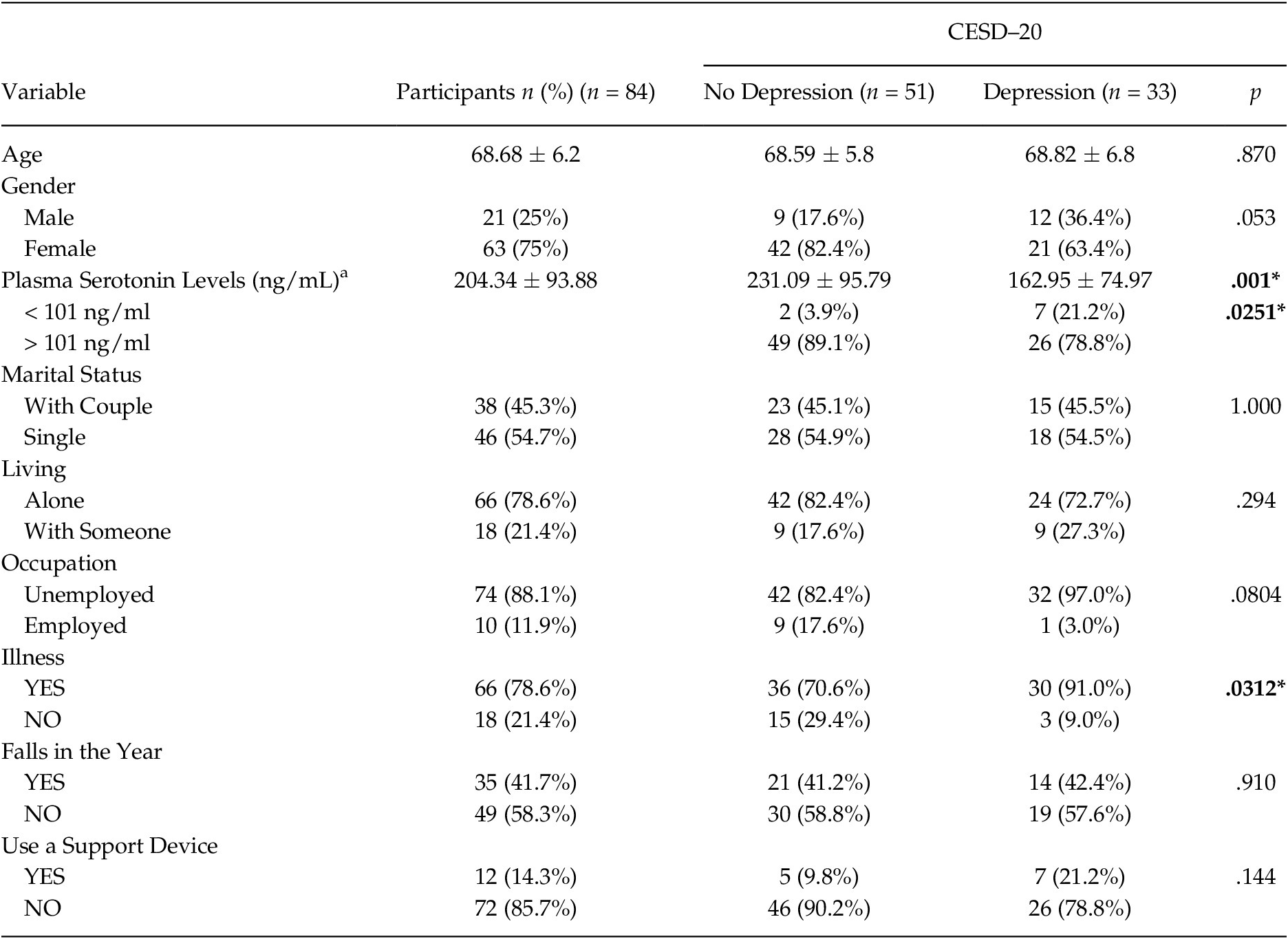
The mean age was 68.68 (SD = 6.2) years. Most of the participants were women (75%) and the median serotonin level was 204.34 (SD = 93.88) ng/mL. Regarding these variables, 54.7% of the participants were not in a relationship and 78.6% lived alone; only 11.9% reported working, and 78.6% had some type of illness (40.1% had diabetes, 37.4% hypertension, and 1.1% Parkinson). Table 1 shows some sociodemographic data that are considered risk factors to develop depressive symptoms, such as living alone, being unemployed, and comorbidities.
Demographic Characteristics of All Participants according to CESD-20 Screening

Note. χ2 and Fisher Test; *p < 0.05 significative difference; aSpearman Coefficient -.256 p = 0.019
Detection of Depression using the CESD–20 Scale
According to the CESD–20, 39.3% (M = 31. 6; SD = 10.1) and 60.7% (M = 8; SD = 4.5) of the participants had and did not have depressive symptoms, respectively. The overall mean was 15.6 (SD = 12.9) (Table 1). Regarding gender, more women than men showed depressive symptoms; a difference that approached statistical significance (p = .053). Social variables were also analyzed (having a partner, living accompanied, and occupation). The variables were compared by proportions using Fisher´s exact test (N ˂ 5) or χ2. There was no association between depressive symptoms and remaining unemployed (p = .0804). Additionally, variables related to functionality—falls during the year, the use of a support device, and comorbidities— were analyzed and the statistical analysis showed an association between comorbidities and depressive symptoms according to the CEDS–20 (p = .0312). Thus, serotonin levels were significantly lower in participants with depressive symptoms (CESD–20) than in those without depressive symptoms (p = .001).
A nonparametric correlation analysis was performed using Spearman´s coefficient. A significant correlation was found between the CESD–20 scale and the plasma serotonin levels of the participants (r = –.256; p = .019). Based on previous studies, the normal peripheral levels of serotonin are 101 to 283 ng/ml. Thus, the population was divided into two groups according to the serotonin level, levels lower than 101.0 ng/ml, and normal levels (above 101.1 ng/ml). The CESD–20 scores were associated with the plasma serotonin concentration (p = .0251) (Table 1)
Analysis of the Population according to Genotype
The presence of the 5–HTTLPR polymorphism was classified as wild-type homozygous LL, heterozygous LS, and homozygous SS. Analysis of the 5–HTTLPR polymorphism showed proportions of 35.7% for the SS, 10.7% for the LL, and 53.6% for the LS polymorphism; however, 89.3% of the Mexican sample had the S allele. No significant difference was found between the allelic variants; thus, the sample was in Hardy-Weinberg equilibrium (Table 2). Frequency analyzes revealed that the presence of polymorphisms was not associated with the CESD–20 score and serotonin levels (p = .587; p = .391, respectively).
Polymorphism Frequency according to the Measurement Instruments

Note. a Cochran-Armitage trend test. p < .05 significative difference.
b χ2 = 0.27, p = .60; c χ2 = 0.4, p = .518; d χ2 = 1.1; p = .29; e χ2 = 0.26, p = .60.
Discussion
The objective of this study was to determine the association between biological and genetic factors and depressive symptoms using the CESD–20 scale. In our current sample, the internal consistency of the CESD–20 was analyzed using Cronbach’s alpha, obtaining acceptable values (.72); similar values have been reported in the Mexican population (Bojorquez & Snyder, Reference Bojorquez and Snyder2009).
In this study, 39.3% of the participants showed depressive symptoms and there was a higher incidence of depressive symptoms in women (63.4%) than in men (36.4%). These data corroborate previous reports in which the prevalence of depressive symptoms was higher in women, especially in elderly women (Carayanni et al., Reference Carayanni, Stylianopoulou, Koulierakis, Babatsikou and Koutis2012; Girgus et al., Reference Girgus, Yang and Ferri2017). Although the results were not statistically significant, there is a trend related to gender and depressive symptoms in the study population (p = .053). The present study was limited by the small number of participants, and like other research, the small sample did not permit controlling for additional covariates such as gender (Lewis et al., Reference Lewis, Camsari, Sonmez, Nandakumar, Gresbrink, Daskalakis and Croarkin2019).
Concerning social variables, such as marital status, living alone, or being unemployed, we did not find an association between these variables and the presence of depressive symptoms. The findings corroborated those in the literature that both marital status and living alone in the elderly are not risk conditions for their health (McLaren, Reference McLaren2018; Paykel et al., Reference Paykel, Cooper, Ramana and Hayhurst1996); in contrast, social isolation represents a risk factor for developing depression (Evans et al., Reference Evans, Llewellyn, Matthews, Woods, Brayne and Clare2019). However, we found that unemployment was not associated with depressive symptoms. This could be related to the daily activity this group of older adults receives at the CAIF (Sarkar et al., Reference Sarkar, Kattimani, Premarajan and Roy2017). Previous literature also demonstrated an association between the presence of comorbidities and depression (Panagioti et al., Reference Panagioti, Bower, Kontopantelis, Lovell, Gilbody, Waheed, Dickens, Archer, Simon, Ell, Huffman, Richards, van der Feltz-Cornelis, Adler, Bruce, Buszewicz, Cole, Davidson, de Jonge and Coventry2016). In addition, pathologies such as diabetes have been shown to affect serotonin synthesis in the brain as well as decreased tryptophan in plasma, with this condition being a risk factor for developing depression since it also suggests antidepressant-induced diabetes mellitus (Manjarrez-Gutiérrez & Hernández-Rodríguez, Reference Manjarrez-Gutiérrez and Hernández-Rodríguez2016; Nguyen et al.,Reference Nguyen, Roussin, Rousseau, Montastruc and Montastruc2018; Prabhakar et al., Reference Prabhakar, Gupta, Kanade and Radhakrishnan2015).
In this study, low serotonin plasma levels correlated with high scores in the CESD–20, indicating that low serotonin levels are associated with depressive symptoms; although the sample size was small, Spearman´s coefficient was close to the intermediate value and showed statistical significance (Amor Andrés et al., Reference Amor Andrés, Holgado-Tello, Lasa-Aristu, Domínguez-Sánchez and Delgado Egido2015). These results were consistent with the correlation between a decreased concentration of plasma serotonin and a mood disorder (Paul-Savoie et al., Reference Paul-Savoie, Potvin, Daigle, Normand, Corbin, Gagnon and Marchand2011; Tong et al., Reference Tong, Zhang, Yuan, Jiang, Zhang, Xu, Ding, Li, Zhou and Zhang2015). Similarly, low serotonin levels in plasma were associated with nonresponses to treatment using selective serotonin reuptake inhibitors (SSRI) (Saldanha et al., Reference Saldanha, Kumar, Ryali, Srivastava and Pawar2009).
Additionally, women with postpartum depression showed low serotonin levels in plasma in a case-control study (Xie et al., Reference Xie, Xie, Krewski and He2018). Furthermore, it was recently established that low serotonin levels in plasma were associated with patients with a low response to antidepressant treatment, presenting depressive symptoms (Holck et al., Reference Holck, Wolkowitz, Mellon, Reus, Nelson, Westrin and Lindqvist2019). Additionally, platelets with low serotonin levels are a reliable biomarker in suicide risk assessment (Giurgiuca et al., Reference Giurgiuca, Schipor, Caragheorgheopol, Crasan, Postolache, Tudose, Prelipceanu and Cozman2016). Thus, lower levels of serotonin in plasma suggest an increased presence of depressive symptoms according to the CESD–20 score.
Analysis of the 5–HTTLPR polymorphism revealed that 89.2% of the sample harbored the S allele, a finding that, in the literature, was associated with developing depressive symptoms (Hu et al., Reference Hu, Zhou, Li, Deng, He, Ye and Ning2019). This prevalence of the allele S is consistent with a recent report in which the S allele showed a prevalence of 78.9% in Mexican adolescents (Sarmiento-Hernández et al., Reference Sarmiento-Hernández, Ulloa-Flores, Camarena-Medellín, Sanabrais-Jiménez, Aguilar-García and Hernández-Muñoz2019). In contrast, in this study, no significant association was observed between the 5–HTTLPR polymorphism and depressive symptoms, as measured by the CESD–20 score. However, our result was consistent with reports showing no association between the 5–HTTLPR polymorphism and major depression in the Colombian population (Perez-Olmos et al., Reference Pérez-Olmos, Bustamante and Ibáñez-Pinilla2016). Additionally, other authors have reported the importance of stress as a priority factor in developing depressive symptoms and not the presence of the S allele; furthermore, the lack of association could be due to the age of the study group because age is a factor in the association between the S allele and depression, with a significant association in patients younger than 37 years (Brummett et al., Reference Brummett, Boyle, Siegler, Kuhn, Ashley-Koch, Jonassaint, Züchner, Collins and Williams2008).
The null association between these two variables can also be due to the scale used to determine the depressive symptoms; differences have been reported in evaluations depending on the scale used (Gao et al., Reference Gao, Yuan, Sun, Wang, He and Liu2014; Rief et al., Reference Rief, Bleichhardt, Dannehl, Euteneuer and Wambach2018; Roppolo et al., Reference Roppolo, Mulasso, Gobbens, Mosso and Rabaglietti2015).
Additionally, plasma serotonin levels were not associated with the presence of the 5–HTTLPR polymorphism; findings that are consistent with those previously reported that the mean 5–HTT RNA expression level was not associated with the 5–HTTLPR genotype in patients or controls (Iga et al., Reference Iga, Watanabe, Numata, Umehara, Nishi, Kinoshita, Inoshita, Shimodera, Fujita and Ohmori2016). Another report supporting the results demonstrated that plasma serotonin levels are not associated with the presence of the 5–HTTLPR polymorphism in autistic children (Meguid et al., Reference Meguid, Gebril and Khalil2015). These results are consistent with reports where the increase in plasma serotonin levels is observed when patients receive treatment and show a good response to clinical symptoms (Saldanha et al., Reference Saldanha, Kumar, Ryali, Srivastava and Pawar2009; Spreux-Varoquaux et al., Reference Spreux-Varoquaux, Gailledreau, Vanier, Bothua, Plas, Chevalier, Advenier, Pays and Brion1996). Likewise, this protective effect of depressive symptoms correlates with the results obtained with the increase in 5–HTT mRNA in response to treatment using antidepressants for 32 weeks (Kao et al., Reference Kao, Chang and Lung2018).
Based on these results, clinical intervention is suggested, such as exercise to increase plasma serotonin levels (Zimmer et al., Reference Zimmer, Stritt, Bloch, Schmidt, Hübner, Binnebößel, Schenk and Oberste2016), thus avoiding symptoms of depression (Kvam et al., Reference Kvam, Kleppe, Nordhus and Hovland2016). One of the limitations of this study was the number of participants and differences in the participant characteristics in each group. To identify differences in the genotype of the SLC6A4 gene, samples with a larger number of participants, as well as homogeneous populations, are needed (Culverhouse et al., Reference Culverhouse, Saccone, Horton, Ma, Anstey, Banaschewski, Burmeister, Cohen-Woods, Etain, Fisher, Goldman, Guillaume, Horwood, Juhasz, Lester, Mandelli, Middeldorp, Olié, Villafuerte and Bierut2018; Zhu, et al., Reference Zhu, Klein‐Fedyshin and Stevenson2017). Additionally, the CESD–20 score, the only screening tool used, would serve better as a supplement to a clinical diagnosis. Specifically for genotype analysis, it is more difficult to detect effects in smaller samples and it would be necessary to increase the sample to improve the statistical power of the methodology; however, with this sample size, it is possible to identify the clear association between the blood concentration of serotonin with the CESD–20 score.
Plasma serotonin levels correlate with the scores obtained using the CESD–20 scale. If an older adult has low plasma levels of serotonin, higher CESD–20 scores likely indicate states of depression. Variables such as comorbidities are influential factors that can cause the elderly to develop depression. The S allele has a high prevalence in the Mexican population participating in this study. Based on these results, we suggest investigating the prevalence of polymorphisms in larger samples to determine this risk factor to prioritize developing anti-depression programs.
The first author (Pedro Enrique Trujillo Hernández) expresses his appreciation to CONACyT for his Master´s scholarship.