1. Introduction
Philosophers and laymen alike routinely deride some voluntary exchanges as repugnant commodification and advocate their prohibition. While trade in human organs and prostitution receive perhaps the best-publicized opprobrium, repugnance may also attach – or may have attached in the past – to commercial surrogacy, usury, life insurance, imports, paid labour on holiday, and indentured servitude, as well as trade in votes, viaticals, child-bearing permits and even art. Such repugnance is widespread and deep-seated, aroused even by transactions among third parties, and does not stem from an ignorance of the gains from voluntary trade.
We propose a formal framework to study repugnance. We start with a pure exchange economy with identical Cobb–Douglas preferences over private consumption bundles. To model repugnance, we partition goods into submarkets, with the allocation within each submarket assumed to be Walrasian. Repugnance proscribes exchange across submarkets. It is interpreted as a social norm, a cultural construct (Haidt Reference Haidt2012), and is distinct from disgust (e.g. toward incest, eating insects or ingesting lactoderm), whose origins are evolutionary (Rozin, Haidt, and McCauley Reference Rozin, Haidt and McCauley2008).
To give an example, one submarket in an economy may comprise conventional goods traded for cash; another submarket may comprise favours exchanged among friends and family, all of whom keep an informal record of the more and less generous among them and reward them accordingly; yet another submarket may comprise kidneys of different tissue and blood types exchanged among donor – patient pairs according to the rules of some centralized algorithm; and still another submarket may comprise political favours. Repugnance norms would then dictate, in particular, that a kidney may not be traded for a car; a car may not be demanded in exchange for caring for an elderly parent; and no amount of familial care would entitle a daughter to her father’s political office.
We interpret the Walrasian allocation within each submarket loosely, as capturing the outcome of a variety of possible modes of exchange, formal or informal, that help agents realize gains from exchange, with or without prices. A paradigmatic example of an allocation rule that delivers a Walrasian allocation without prices is the top trading cycles algorithm (Shapley and Scarf Reference Shapley and Scarf1974). The kidney exchange submarket deployed in practice is based on this algorithm.
In the model, if each agent cared only about his private consumption bundle, then partitioning goods into submarkets would lead to a Pareto inferior outcome. Comprehensive markets, under which everything is tradable for everything else, would be the best. However, partitioning goods into submarkets may improve welfare if we abandon the depiction of agents as unconcerned about others’ consumption and instead assume that each agent cares about the social status conferred on him by his consumption decision. Footnote 1
We model status concern starkly: each agent cares about status first and about consumption utility second. An agent’s status is binary: it is compromised if and only if another agent dominates him by consuming strictly more of every good. For instance, Bob preserves his social status with respect to Alice if he can make a face-saving comparison in at least one good, say, by consoling himself with the words, ‘At least my smartphone is no less capable than hers.’ The critical face-saving comparison can vary across individuals and across comparisons by a single individual. Footnote 2 Preferences are lexicographic: each agent prefers any allocation at which no one dominates him – that is, at which his status is not compromised – to any allocation at which someone does. This lexicographic assumption is made for tractability. Footnote 3
Our operationalization of status accords with the flexible social comparisons observed in daily life. For example, neither a scholar nor an athlete need be threatened by the other, the first being secure in his superior intellect and the latter in his physical prowess. More intimidating to the scholar would be another scholar with better credentials, a better publication record and a keener intellect. Nevertheless, the first scholar may yet save face by choosing to compare along a different dimension, perhaps devoting more time to his family, church or gym than does his rival. Footnote 4
Our dominance criterion for social comparisons is asymmetric. Individuals loathe being dominated but do not enjoy dominating others. Among the early proponents of this asymmetry are Veblen (Reference Veblen1899), Duesenberry (Reference Duesenberry1949) and Frank (Reference Frank1985). Research into this asymmetry, the so-called ‘relative deprivation hypothesis’, was initiated by Stouffer, Suchman, Devinney, Star and Williams (Reference Stouffer, Suchman, Devinney, Star and Williams1949) and Runciman (Reference Runciman1966). Footnote 5 Card, Mas, Moretti and Saez (Reference Card, Mas, Moretti and Saez2012) furnish empirical evidence: ‘We find an asymmetric response to the information about peer salaries: workers with salaries below the median for their pay unit and occupation report lower pay and job satisfaction, while those earning above the median report no higher satisfaction’. This asymmetry may arise when aversion to inequality (Fehr and Schmidt Reference Fehr and Schmidt1999; Blake, McAuliffe, Corbit, Callaghan, Barry, Bowie, Kleutsch, Kramer, Ross, Vongsachang, Wrangham and Warneken Reference Blake, McAuliffe, Corbit, Callaghan, Barry, Bowie, Kleutsch, Kramer, Ross, Vongsachang, Wrangham and Warneken2015) and the stress of maintaining high status (Gesquiere, Learn, Simao, Onyango, Alberts and Altmann Reference Gesquiere, Learn, Carolina, Simao, Onyango, Alberts and Altmann2011) combine to offset the delight in favourable downward comparisons. In acknowledging this asymmetry in a formal model, we follow the practice of Stark and Wang (Reference Stark, Qiang Wang, Bruni and Porta2005) and Immorlica, Kranton, Manea and Stoddard (Reference Immorlica, Kranton, Manea and Stoddard2017).
Our model captures two motives that appear to underlie philosophers’ repugnance toward exchange (Satz Reference Satz2010; Sandel Reference Sandel2012). The first motive is aversion to unequal gains from trade (Kahneman, Knetsch and Thaler Reference Kahneman, Knetsch and Thaler1986). We capture this aversion indirectly, by postulating a social preference that condemns inequality when it stems from one individual dominating another. For example, before selling a kidney, a janitor may be poor but, nevertheless, in decent health and, therefore, undominated by a wealthy lawyer on dialysis. While selling the kidney to the lawyer creates apparent gains to both parties involved, the sale also creates dominance. The lawyer remains wealthier than the janitor but now also enjoys greater longevity. The objection to trade here is paternalistic. Had the janitor correctly anticipated dominance, he would have refrained from selling his kidney, and the need to restrict the tradability of kidneys would not exist. Footnote 6
The second motive for repugnance is subtler. It implicates a third party. To understand the externality, consider a poet (a third party), who subsists in a hovel but delights in a bohemian lifestyle. By consuming copious sex, he is unthreatened by the sprawling estate of a Wall Street financier, a workaholic with no time for cultivating sexual relationships. With legalized prostitution, however, the financier’s purchase of sex leaves the poet without a face-saving comparison; the financier now boasts both greater wealth and a more adventurous sex life. The social preference that we postulate condemns dominance and, with it, the externality that prostitution imposes on the poet. This social preference motivates restrictions on the tradability of sex. The objection to trade here is nonpaternalistic; the poet’s loss of status owes to an externality rather than to naïveté.
In order to examine both paternalistic and nonpaternalistic rationales for repugnance, we alternately populate our model with two types of individuals: naïfs and sophisticates. A naïf chooses a consumption bundle to maximize his consumption utility and is unaware of the painful consequences of dominance. His oblivion can be interpreted as time inconsistency and provides a paternalistic rationale for repugnance. By contrast, a sophisticate is ‘fully rational’. He chooses a consumption bundle that, in accordance with his lexicographic preferences, first avoids dominance whenever possible and only then maximizes his consumption utility.
For both types of agents, we compare welfare at alternative market partitions according to the lexicographic social preference that prioritizes dominance avoidance over consumption utilities, just as agents themselves do. We illustrate how submarkets can mitigate dominance by preventing an agent from leveraging his lavish wealth in some goods to consume large quantities of all goods, thereby dominating other agents. While no market partition stands out as uniformly best, we identify conditions for the optimality of comprehensive markets. The model’s nuanced predictions in the general case echo the diversity of social norms observed across societies, both contemporaneous and throughout history.
What distinguishes a sophisticate from a naïf is the foresight to avoid dominance by targeting the wealthier agent’s consumption of some good. Interpret a targeted good as a status good. Do status goods differ across agents? They do not in our baseline model – at least not ‘generically’ when markets are comprehensive. The good that emerges as the status good is the one that is ‘least important’ in the consumption utility – formally, the one that has the lowest weight in the Cobb–Douglas preference specification. Coca-Cola and luxury watches are examples. Footnote 7 If a status good is expensive, it is expensive due to its status value, which drives up demand. When multiple goods emerge as status goods in a ‘generic’ setting, it is because markets are not comprehensive; different agents target different goods in different submarkets.
When agents are sophisticated, equilibria can be multiple, with different goods targeted at different equilibria. This multiplicity leaves room for equilibrium selection as a policy instrument. Equilibrium selection and repugnance can be complements or substitutes, as we shall discuss. That is, making individuals aware of their status concerns may call for more or less repugnance; it depends.
We examine an extension in which agents’ preferences differ. In this case, under appropriate conditions, the introduction of sufficiently many goods makes both repugnance and equilibrium selection unnecessary to ward off dominance. Each agent, whether sophisticated or naïve, has a good about which he is uniquely passionate. He consumes more of it than anyone else does, thereby avoiding dominance even if he does not actively seek to do so. Heterogeneous preferences can also rationalize the animosity toward trade liberalization as a response to the threat of dominance reversals, which can be interpreted as the crumbling of existing social hierarchies, a painful event to live through for many.
Our contribution is primarily conceptual. We propose a new way of viewing repugnance: as a set of welfare-enhancing social norms that have evolved to enforce prohibitions on exchange across submarkets. Roth (Reference Roth2007) emphasizes that repugnance is an all but ineradicable restriction on trade. The idea that trade restrictions may improve welfare is due to Hart (Reference Hart1975), Newbery and Stiglitz (Reference Newbery and Stiglitz1984) and Malamud and Rostek (Reference Malamud and Rostek2017). Examples of welfare-impairing trade are especially easy to construct when externalities are present. Our contribution is in proposing a particular externality – the social-status externality – that captures common moral objections to comprehensive markets. This externality is nonmaterial (Ambuehl, Niederle and Roth Reference Ambuehl, Niederle and Roth2015), in that an individual cannot tell whether his status has been compromised unless he sees what others consume. We conform with Ambuehl, Niederle and Roth’s (Reference Ambuehl, Niederle and Roth2015) and Roth and Wang’s (Reference Roth and Wang2020) usage of the term ‘repugnance’ by steering clear of material externalities.
Section 2 recounts three historical anecdotes to motivate the model’s central assumption. Section 3 introduces the model, which is analysed in sections 4 and 5. Section 6 posits a formal example to illustrate the common structure of four instances of repugnance. Section 7 relaxes the assumption that all agents’ preferences are the same. Section 8 concludes by speculating about what else could be relaxed and to what effect. Appendix A collects proofs. Supplementary Appendix formalises an additional result mentioned in the main text.
2. Repugnance and Status in Three Historical Vignettes
The three historical vignettes below motivate our premise that the dominance-induced threat to social status makes the integration of submarkets repugnant. We owe the first vignette to Prof. Andrei Gomberg of ITAM.
2.1. Jewish Disabilities
In the United Kingdom, Jews were banned from sitting in Parliament until the passage of the Jewish Disabilities Bill in 1858. An early proponent of the emancipation of Jews was parliamentarian and historian Thomas Babington Macaulay. He sought to discredit the idea ‘[t]hat a Jew [being] privy councillor to a Christian king would be an eternal disgrace to the nation’ and ‘that [putting] Right Honourable before his name would be the most frightful of national calamities’ (Macaulay Reference Macaulay1831). Macaulay argued that Jews already dominated Christians in the commercial sphere. What was the added harm from domination in yet another, political, sphere? In Macaulay’s (1831) words, ‘the Jew may govern the money-market, and the money-market may govern the world.… What power in civilized society is so great as that of the creditor over the debtor?… If we leave it to him, we leave to him a power more despotic by far than that of the king and all his cabinet.’
Christians begged to differ. They were reluctant to expose themselves to dominance in both the commercial and the political spheres. Jewish disabilities would last for thirty more years after Macaulay’s speech in Parliament.
2.2. Abolition of Slavery
In the antebellum U.S. South, most poor white labourers did not own slaves, but, nevertheless, opposed granting them freedom. Their objections were hardly motivated by the fear of depressed wages due to intensified labour-market competition from the freed slaves. The slaves were already formidable competitors: fiercely productive and toiling in the same industries as the whites. ‘The typical slave field hand was not lazy, inept, and unproductive. On average he was harder-working and more efficient than his white counterpart’, Fogel and Engerman (Reference Fogel and Engerman1974) report. ‘Slaves employed in industry compared favorably with free workers in diligence and efficiency.’ Instead, the poor whites resented the idea of exposing themselves to dominance by emancipated slaves in the civic domain while being already dominated by them in the material domain: ‘The material (not psychological) conditions of the lives of slaves compared favorably with those of free industrial workers’, continue Fogel and Engerman (Reference Fogel and Engerman1974).
The whites’ resentment of being dominated is corroborated by the contemporary account of James H. Taylor, a Charleston textile manufacturer who, writing for the magazine De Bow’s Review in 1850, observed: ‘The poor man has a vote, as well as the rich man; and in our State, the number of the first will largely overbalance the last. As long as these poor, but industrious people, could see no mode of living, except by a degrading operation of work with the negro upon the plantation, they were content to endure life in its most discouraging forms, satisfied that they were above the slave, though faring, often worse than he’ (Genovese Reference Genovese1989: 229).
2.3. Women’s Suffrage
At the turn of the 20th century, multiple anti-suffragist associations comprised exclusively of women sprang up across the United States. These associations condemned the extension of voting rights to their own sex and did so in no uncertain terms: ‘We believe woman suffrage would relatively lessen the influence of the intelligent and true, and increase the influence of the ignorant and vicious.’ Footnote 8 Surely these anti-suffragists were not passing judgement on their own talents! All married (prefixed by ‘Mrs’), the signatories explicitly stated that they believed themselves to already exercise political power through their husbands and sons and through philanthropy, presumably in a manner that was neither unintelligent nor untrue. Why, then, did they protest against the extension of suffrage?
One possibility is that by depriving themselves of the right to vote, anti-suffragists hoped to continue claiming that their own contribution to civic life was incommensurable with men’s, thereby ascertaining that even the most accomplished men would not automatically dominate them. Footnote 9 Female anti-suffragists described the incommensurability of women’s and men’s contributions to civic life this way: ‘[W]omen now stand outside of politics, and therefore are free to appeal to any party in matters of education, charity, and reform.’ Footnote 10
3. The Economy
First, we introduce a textbook pure exchange economy and then modify it to accommodate submarkets and social comparisons.
3.1. A Pure Exchange Economy
Agents in the set
 ${\cal I}\equiv\left(1, \ldots ,I\right)$
exchange goods in the set
 ${\cal L}\equiv\left\{ 1, \ldots ,L\right\} $
. Agent i’s endowment is a row vector
 $\omega^{i}\equiv\left(\omega_{l}^{i}\right){}_{l\in{\cal L}}\in\mathbb{R}_{+}^{L}$
, where
 $\omega_{l}^{i}$
is his endowment of good l.
Footnote 11
The aggregate endowment is
 $\Omega\equiv\left(\Omega\right)_{l\in{\cal L}}\equiv\sum_{i\in{\cal I}}\omega^{i}\in\mathbb{R}_{++}^{L}$
. Each agent’s consumption utility
 $u\colon\mathbb{R}_{+}^{L}\to\mathbb{R}$
is Cobb–Douglas and is parameterized by consumption weights
 $\alpha\in\mathbb{R}_{++}^{L}$
; that is, for any consumption bundle
 $x^{i}\in\mathbb{R}_{+}^{L}$
(a row vector),
 $u\left(x^{i}\right)\equiv\sum_{l\in{\cal L}}\alpha_{l}\ln x_{l}^{i}$
. Let
 $x\equiv\left(x^{i}\right)_{i\in{\cal I}}$
be an allocation. An economy is a tuple
 $\left(\omega,\alpha\right)$
, where
 $\omega=\left(\omega^{i}\right)_{i\in{\cal I}}$
.
3.2. Submarkets and Repugnance
A market partition
 ${\cal P}\equiv\left({\cal L}_{k}\right){}_{k\in{\cal K}}$
partitions the set
 ${\cal L}$
of goods into submarkets, where
 ${\cal L}_{k}$
denotes a typical submarket.
Footnote 12
The two extreme partitions correspond to comprehensive markets, with
 ${\cal P}$
being a singleton (i.e.
 ${\cal P}=\left\{ \left\{ 1,2,\ldots,L\right\} \right\} $
), and autarky, with
 ${\cal P}$
being the partition comprised of singletons (i.e.
 ${\cal P}=\left\{ \left\{ 1\right\} ,\left\{ 2\right\} ,\ldots,\left\{ L\right\} \right\} $
). A good l that is isolated in its own submarket is nontradable. A partitioned economy is a triple
 $\left(\omega,\alpha,{\cal P}\right)$
.
Goods cannot be exchanged across submarkets. As a matter of interpretation, we define repugnance as the social norm that proscribes exchange across submarkets. Footnote 13 In practice, repugnance may or may not be accompanied by legal prohibition.
Within each submarket, exchange is Walrasian. Because agents’ preferences are Cobb–Douglas and, therefore, separable across submarkets, a Walrasian equilibrium for a partitioned economy can be defined as a Walrasian equilibrium in every submarket. Formally, a Walrasian equilibrium for a partitioned economy
 $\left(\omega,\alpha,{\cal P}\right)$
is a price–allocation pair
 $\left(p,x\right)\in{\mathbb{R}}_{++}^{L}\times {\mathbb{R}}_{+}^{IL}$
such that, in each submarket
 ${\cal L}_{k}$
, the component
 $\left(p_{l},x_{l}\right){}_{l\in{\cal L}_{k}}$
is a Walrasian equilibrium for the economy
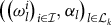 $\left(\left(\omega_{l}^{i}\right)_{i\in{\cal I}},\alpha_{l}\right)_{l\in{\cal L}_{k}}$
. That is, markets clear, and each agent maximizes subject to spending in each submarket, at most, the wealth that he derives from his endowment in that submarket. Proposition 1 characterizes the unique equilibrium.
Proposition 1. Each market partition induces a unique Walrasian equilibrium. The equilibrium allocation x is such that, in each submarket
 ${\cal L}_{k}$
, each agent i consumes an amount proportional to the aggregate endowment:
 $$x_l^i = \left[ {{{\sum\limits_{m \in {L_k}} {{\alpha _m}} \omega _m^i/{\Omega _m}} \over {\sum\limits_{m \in {L_k}} {{\alpha _m}} }}} \right]{\Omega _l},\quad \;\;\;{\kern 1pt} l \in {{\cal L}_k},$$
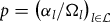
where the coefficient of proportionality (in the brackets) is agent i’s share of wealth in the submarket. The supporting price vector is
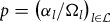 $p=\left(\alpha_{l}/\Omega_{l}\right)_{l\in{\cal L}}$
.
Proposition 2 shows that no one benefits from markets being partitioned.
Proposition 2. Merging submarkets weakly increases each agent’s Walrasian equilibrium consumption utility. As a result, each agent weakly prefers comprehensive markets to any other market partition.
The result prevails because merging submarkets does not affect equilibrium prices but increases ways in which agents can spend their wealth, thereby making them weakly better off. The result relies on consumption utilities being the same for all agents (Chambers and Hayashi Reference Chambers and Hayashi2017: Theorem 1).
Proposition 2 notwithstanding, few non-economists abjure repugnance on the grounds of superior consumption utilities furnished by trade. Footnote 14 Neither do we. Instead, we view the model of Proposition 2 as incomplete and supplement it with the missing element: agents’ concern for social status.
3.3. Social Status Concerns
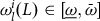
We now assume that, in addition to his consumption utility, each agent cares about the social status that he derives as he compares his consumption bundle with others’ bundles. Agent i is dominated at an allocation x if there exists an agent j with
 $x^{i}\ll x^{j}$
– that is, if there exists an agent who consumes more of every good than agent i does. Each agent lexicographically prioritizes dominance avoidance: he prefers any allocation in which he is undominated (i.e. his social status is not compromised) to any allocation in which he is dominated (i.e. his social status is compromised); if the agent’s dominance status is the same in two allocations, then he prefers the one in which his consumption utility is higher. Even though agents loathe being dominated, no agent enjoys dominating another.
Footnote 15
We compare allocations according to the lexicographic Pareto criterion, which echoes agents’ lexicographic loathing of dominance. The criterion modifies the standard Pareto criterion by prioritizing dominance avoidance. Let
 ${\cal D}\left(x\right)$
denote the set of dominated agents at an allocation x. An allocation x is lexicographically Pareto preferred (LP-preferred) to an allocation y if either
 ${\cal D}\left(x\right)\,{\subsetneq}\,{\cal D}\left(y\right)$
or
 ${\cal D}\left(x\right)={\cal D}\left(y\right)$
and
 $\left(u\left(x^{i}\right)\right){}_{i\in{\cal I}} \gt \left(u\left(y^{i}\right)\right){}_{i\in{\cal I}}$
. The LP criterion captures the social preference.
A market partition coupled with a corresponding equilibrium is LP-optimal (or LP-best) if no other market partition with its corresponding equilibrium induces an LP-preferred allocation.
3.4. Two Types of Maximizing Behaviour
All agents ultimately care about status but may or may not account for it when choosing consumption bundles. A naïf is unaware of the adverse consequences of dominance. He myopically chooses a bundle that maximizes his consumption utility alone.
A sophisticate is foresighted and seeks to avoid dominance. He chooses a bundle that maximizes his full (lexicographic) preference while taking others’ consumption bundles as given.
We examine, in turn, economies populated by either type of agent.
4. Naïfs
Consider the case in which all agents are naïfs.
We call a Walrasian equilibrium with naïfs an nEquilibrium. For any market partition, an nEquilibrium always exists and is unique (Proposition 1). Because the social preference as encapsulated in the LP criterion reflects concern about naïfs’ potential loss of status (even though naïfs themselves do not anticipate this loss), the model no longer advocates comprehensive markets, as Proposition 3 explains.
Proposition 3. Generically in endowments, comprehensive markets maximize the instances of dominance at the nEquilibrium. As a result, all but the wealthiest agent are dominated.
Critical to the proposition’s conclusion are the assumptions that preferences are the same for all agents and that all goods are normal. The two assumptions imply that the wealthiest agent consumes more of every good than anyone else does. The former assumption is relaxed in Section 7. The latter assumption is violated by Wold’s (Reference Wold1948) utility function
 $u\left(x^{i}\right)\equiv\ln\left(x_{1}^{i}-5\right)-2\ln\left(10-x_{2}^{i}\right)$
, which admits Giffen goods and, coupled with the endowments
 $\omega^{1}=\left(8,8\right)$
and
 $\omega^{2}=\left(7,7\right)$
, condemns agent 2 to dominance under autarky but induces the no-dominance nEquilibrium allocation
 $\left(x^{1},x^{2}\right)=\left(\left(6,9\right),\left(9,6\right)\right)$
under comprehensive markets.
Proposition 3 invites a search for market partitions that improve on comprehensive markets. How much dominance can be averted? A naïf avoids dominance at least at some market partition if and only if he avoids dominance in autarky. Indeed, if Alice’s endowment vector dominates Bob’s (i.e. Alice dominates Bob in autarky), then she consumes more than he does in all possible submarkets and at all prices; thus, she dominates him at every partition.
Having identified autarky as the limit on dominance mitigation, one can focus on raising consumption utilities without introducing additional instances of dominance, thereby working towards an LP-best market partition. The logic of Proposition 2 offers guidance. Because agents’ consumption utilities rise when submarkets are merged, any LP-best partition must have the property of being the coarsest partition at which the same agents are dominated as in autarky. Such coarsest partitions can be multiple. Although some of them may not be LP-best, at least one of them is, for partitions are finitely many.
We do not provide an algorithm for finding all LP-best market partitions. Without further restrictions on the environment, no fast and reliable algorithm for finding all LP-best market partitions exists. That is, the associated problem is computationally intractable, NP-hard. Proposition B.1 in Supplementary Appendix B makes this assertion precise. Footnote 16 The assertion is not interesting when goods are few, and exhaustive search over all market partitions is practical.
Another aspect of the intractability of LP-best market partitions is the fact that myopic dynamics need not deliver LP-optimality even approximately. To illustrate, suppose that society starts out in autarky (which, recall, is the state of minimal dominance) and then myopically expands markets by iteratively merging the pair of submarkets whose merger increases the sum of agents’ consumption utilities most without introducing new instances of dominance. Each merger in the sequence is a Pareto improvement. Nevertheless, the entire sequence of such mergers may do arbitrarily badly, in the sense of terminating at a market partition that realizes an arbitrarily small fraction of potential welfare gains. This is Proposition 4, which we owe to Dr Brendan Lucier of Microsoft Research.
Proposition 4. One can construct examples in which the gains in utilitarian welfare delivered by the myopic dynamics described above are an arbitrarily small fraction of the gains realized at an LP-best market partition.
The lesson from Proposition 4 is that history, if interpreted as the myopic dynamics, is unlikely to bequeath to us a set of even approximately optimal repugnance norms. Therefore, while perhaps suggestive, arguments based on LP-optimality cannot be dispositive of the norms that we observe in practice.
5. Sophisticates
Now consider the case in which all agents are sophisticates.
We call a Walrasian equilibrium with sophisticates an sEquilibrium. If at an sEquilibrium a sophisticate ‘overconsumes’ in the sense of consuming more of some good than a naïf would, then we say that he targets that good and matches the consumption of the agent who would have otherwise dominated him. The targeted good is interpreted as an emergent status good. When sEquilibria are multiple, they differ in which (if any) goods are targeted. Equilibrium selection is a policy that coordinates agents on an sEquilibrium.
An sEquilibrium may not exist. The aggregate excess demand may be discontinuous. The discontinuity arises when the set of agents who target a good changes. For instance, no agent may be able to afford to target a good until its price falls sufficiently, at which point the demand for this good jumps.
5.1. The Promise of Sophistication
The possibility of interactions between sophistication and repugnance suggests the following questions [with spoilers in the brackets]:
-
1. Can sophistication avert dominance when repugnance alone cannot? [Yes]
-
2. Can sophistication make repugnance redundant? [Yes]
-
3. Can sophistication create a new role for repugnance? [Yes]
-
4. Does repugnance obviate equilibrium selection? [No]
First, we answer these questions through examples and then turn to general features of sEquilibria.
In Example 1, Bob is endowed with less of each good than Alice is. As a result, no market partition rescues naïve Bob from dominance; repugnance is impotent. By contrast, sophisticated Bob can target Alice’s consumption of either good and avoid dominance. Sophistication averts dominance when repugnance cannot, which answers question 1 in the affirmative.
Example 1 (Sophistication averts dominance). Let
 $$\alpha = \left( {1,2} \right)\quad \;\;\;{\kern 1pt} {\rm{and}}\quad \;\;\;{\kern 1pt} \omega = \left( {\matrix{ 2 & 2 \cr 1 & 1 \cr } } \right),$$
where a row corresponds to an agent, and a column corresponds to a good, so that, for example, agent 2’s endowments of goods 1 and 2 are both 1. For every market partition, at its unique nEquilibrium, each agent consumes his endowment, and agent 2 (Bob) is dominated by agent 1 (Alice). With comprehensive markets, there exists an sEquilibrium, denoted by
 $\left(p,x\right)$
, in which agent 2 avoids dominance by matching agent 1’s consumption of good 1:Footnote
17

 $\triangle$
Fix an economy. Sophistication and repugnance are substitutes if each LP-best partition with sophisticates is coarser than each LP-best partition with naïfs. In other words, under substitutes, optimality calls for less repugnance when agents are sophisticated. In Example 2, naïve Bob trades himself into dominance by Alice. Either sophistication or a trade restriction (enforced by repugnance) would suffice to preclude Bob from executing this self-destructive trade. Sophistication and repugnance are substitutes, which answers question 2 in the affirmative.
Example 2 (Sophistication substitutes for repugnance). Let
 $$\alpha = \left( {1,2} \right)\quad \;\;\;{\kern 1pt} {\rm{and}}\quad \;\;\;{\kern 1pt} \omega = \left( {\matrix{ 1 & 1 \cr 1 & 0 \cr } } \right).$$
The endowment
 $\omega$
is LP-best. Under comprehensive markets, agent 2 (Bob) is dominated by agent 1 (Alice) at the nEquilibrium (not reported), but no one is dominated at the unique sEquilibrium
 $\left(p,x\right)=\left(\left(1,2\right),\omega\right)$
. The same allocation
 $\omega$
trivially obtains at the nEquilibrium under autarky.
$\triangle$
Fix an economy. Sophistication and repugnance are complements if each LP-best partition with sophisticates is finer than each LP-best partition with naïfs. In other words, under complements, optimality calls for more repugnance when agents are sophisticated. In Example 3 below, just as in Example 1, Bob is endowed with less of each good than Alice is, and, as a result, no market partition shields naïve Bob from dominance. In contrast to Example 1, though, under comprehensive markets, sophisticated Bob is too poor to afford to match Alice’s consumption of any good; sophistication alone is not enough to avoid dominance. Repugnance can help sophisticated Bob, however, because he is less far behind Alice in his endowment of some goods than of others. Repugnance can circumscribe a submarket in which Bob is not too far behind and can afford to target Alice’s consumption of some good. Enter equilibrium selection, which, given the market partition enforced by repugnance, coordinates the agents on a LP-superior sEquilibrium. Here, repugnance, sophistication, and equilibrium selection are all essential for LP-optimality, which answers question 3 in the affirmative and question 4 in the negative.
Example 3. (Sophistication complements repugnance, leaves room for equilibrium selection). Let
 $$\alpha = \left( {6,7,7} \right)\quad \;\;\;{\kern 1pt} {\rm{and}}\quad \;\;\;{\kern 1pt} \omega = \left( {\matrix{ {116} & {58} & {58} \cr 2 & {31} & {31} \cr 2 & {31} & {31} \cr } } \right).$$
When agent 2 (Bob) and agent 3 are both naïve, they are dominated by agent 1 (Alice) at any market partition, and, therefore, comprehensive markets are LP-best. Sophistication alone is of no avail: with comprehensive markets, the unique sEquilibrium coincides with the nEquilibrium, as can be checked.
When supplemented with repugnance, however, sophistication precludes dominance. Indeed, take the market partition
 $\left\{ \left\{ 1\right\} ,\left\{ 2,3\right\} \right\} $
. Under this partition, four sEquilibria exist. In one, agent 2 targets good 2, while agent 3 targets good 3:
Footnote 18
 $$p = \left( {1,1,1} \right)\,\,\,\,\,\,\,{\rm{and}}\,\,\,\,\,\,\,{\kern 1pt} x = \left( {\matrix{ {116} & {58} & {58} \cr 2 & {{\fbox {58}}} & 4 \cr 2 & 4 & {{\fbox {58}}} \cr } } \right).$$
In another sEquilibrium, agents 2 and 3 both target good 2:
 $$\hat p = \left( {1,29,11} \right)\quad \;\;\;{\kern 1pt} {\rm{and}}\quad \;\;\;{\kern 1pt} \hat x = \left( {\matrix{ {116} & {40} & {105{5 \over {11}}} \cr 2 & {\fbox {40}} & {7{3 \over {11}}} \cr 2 & {\fbox {40}} & {7{3 \over {11}}} \cr } } \right).$$
The remaining two sEquilibria either flip the roles of agents 2 and 3 in the equilibrium
 $\left(p,x\right)$
or flip the roles of goods 2 and 3 in the equilibrium
 $\left(\,\hat{p},\hat{x}\right)$
. Allocation
 $\hat{x}$
Pareto dominates allocation x and is LP-best when the agents are sophisticated. Because
 $\hat{x}$
cannot be supported by any partition as the unique sEquilibrium outcome, equilibrium selection is indispensable.
 $\triangle$
5.2. Emergent Status Goods
When sophisticates target, do they all target the same good? If they do, the sEquilibrium is pooling. If, instead, they target multiple goods, the sEquilibrium is separating. If no good is targeted, the sEquilibrium is nontargeting and coincides with the nEquilibrium.
Which goods make likely targets, thereby becoming status goods? Proposition 5 shows that they are the goods with the smallest consumption weight.
Proposition 5. Fix a market partition. At any sEquilibrium, the wealthiest agent in a submarket maximizes his consumption utility in that submarket. Any agent who targets in a submarket targets the good whose consumption weight
 $\alpha_{l}$
is the smallest among all goods in that submarket.
An agent who targets prefers to do so at the least cost. Because the agents whose consumption is targeted spend the least on the goods with the lowest consumption weights, these goods are compelling targets. The targeted goods need not be cheap. They are fiercely sought after for their value in preserving status.
Under comprehensive markets, separating equilibria may emerge if multiple goods share the lowest consumption weight and are targeted by different agents. Under noncomprehensive markets, separating equilibria may emerge for two additional reasons: (i) distinct agents target in distinct submarkets, or (ii) the same agent targets in multiple submarkets. Case (i) obtains when distinct agents cannot afford to target in the same submarket but can do so in distinct ones. Case (ii) obtains when a single agent finds matching Alice’s consumption of some good in one submarket and Bob’s consumption of some good in another market cheaper than matching or outspending both Alice and Bob for the same good.
Proposition 5 does not characterize all sEquilibria. It does not say which agents target: Different agents may target at different sEquilibria. A nontargeting sEquilibrium may exist, too.
5.3. Two Interpretations of Targeting
Targeting can be interpreted as ego-defence or as no-envy signalling. In the former case, a sophisticate may target to convince himself, comparison by comparison, that he is not inferior to others. In the latter case, he signals to others that he does not envy them. A sophisticate who signals, first, targets and then makes the speech: ‘This good that I consume in the same amount as you do is actually the only good that I care about. Therefore, even though you may consume more of other goods than I do, I do not actually care and do not envy you.’
5.4. The Welfare Consequences of Sophistication
Are sophisticates better off than naïfs? Not necessarily. When all agents turn from naïfs into sophisticates, a Pareto improvement is not guaranteed. The reason is that, by affecting equilibrium prices, targeting may hurt some agents. Even an LP-improvement (which is weaker than a Pareto improvement) is not guaranteed. Example 4 shows how a universal shift to sophistication may render a formerly undominated agent dominated.
Example 4. (A shift to sophistication creates new instances of dominance) Consider an economy with two goods and ten agents, in whichFootnote 19
 $$\alpha = \left( {4,5} \right)\;\;\;{\kern 1pt} {\rm{and}}\;\;\;{\kern 1pt} \omega = {\left( {\matrix{ {1350} & 0 & 0 & 0 & 0 & {612} & {612} & {612} & {612} & {612} \cr {18} & {1098} & {1098} & {1098} & {1098} & 0 & 0 & 0 & 0 & 0 \cr } } \right)^T}.$$
With naïve agents, comprehensive markets are LP-best and induce the nEquilibrium
 $$p = \left( {4,5} \right)\;\;\;{\kern 1pt} {\rm{and}}\;\;\;{\kern 1pt} x = {\left( {\matrix{ {610} & {610} & {610} & {610} & {610} & {272} & {272} & {272} & {272} & {272} \cr {610} & {610} & {610} & {610} & {610} & {272} & {272} & {272} & {272} & {272} \cr } } \right)^T},$$
at which agents 6–10 are dominated. Once all agents turn into sophisticates, the unique sEquilibrium prevails:
 $$\hat p \approx \left( {2.5,1} \right)\;\;\;{\kern 1pt} {\rm{and}}\;\;\;{\kern 1pt} \hat x \approx {\left( {\matrix{ {603} & {198} & {198} & {198} & {198} & {\fbox {603}} & {\fbox {603}} & {\fbox {603}} & {\fbox {603}} & {\fbox {603}} \cr {1862} & {610} & {610} & {610} & {610} & {22} & {22} & {22} & {22} & {22} \cr } } \right)^T}.$$
At this sEquilibrium, agents 2 – 5 are dominated; none of them was dominated at the nEquilibrium.
 $\triangle$
What if one agent becomes sophisticated while others remain naïve? Footnote 20 If this newly sophisticated agent chooses not to target, then the equilibrium is unchanged and he is indifferent. If he targets, then he is better off, provided that a new equilibrium exists, which need not be the case.
5.5. A Limited Case for Sophistication and Comprehensive Markets
In general, LP-optimal market partitions depend delicately on endowments. More can be said in two special cases:
Proportional endowments. For each agent i, there exists a positive scalar
 $\gamma^{i}$
such that
 $\omega^{i}=\gamma^{i}\Omega$
, where
 $\Omega$
is the aggregate endowment vector.
Specialized endowments. There are as many agents as there are goods (
 $I=L$
), and each agent i holds the entire aggregate endowment of some good, which can be labelled the same as the agent:
 $\omega_{i}^{i}=\Omega_{i}$
.
For the special economies above, Proposition 6 shows that comprehensive markets minimize dominance unless the endowments are specialized and agents are naïfs, in which case autarky minimizes dominance. The proposition can be viewed as making a limited case for sophistication and comprehensive markets.
Proposition 6. Generically in consumption weights and in endowments (drawn from the relevant classes):Footnote 21
-
1. Under proportional endowments,
-
(a) When agents are naïfs, any market partition, including comprehensive markets, is LP-optimal and has each agent consume his endowment. All but the wealthiest agent are dominated.
-
(b) When agents are sophisticates, comprehensive markets minimize the instances of dominance. Each agent i with
 $\gamma^{i}\geq\min_{l\in{\cal L}}\left\{ \alpha_{l}\right\} \max_{j\in{\cal I}}\left\{ \gamma^{j}\right\} $
avoids dominance by consuming the same amount of the lowest consumption-weight good as the wealthiest agent does. The remaining agents are dominated.
-
-
2. Under specialized endowments,
-
(a) When agents are naïfs, autarky is uniquely LP-optimal. No agent is dominated.
-
(b) When agents are sophisticates, comprehensive markets are uniquely LP-optimal. Each agent avoids dominance by consuming the same amount of the good with the lowest consumption weight.
-

6. An Example
Drawing on the equilibrium analysis above, we examine four stories of repugnance, collated in Table 1, in the context of one formal example. This example is designed to bring out these stories’ common structure without necessarily fitting each story perfectly.
Four interpretations of the example
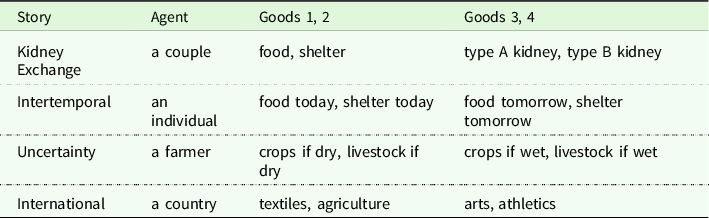
The example has four goods and four agents, with
 $$\alpha = \left( {2,2,1,1} \right)\quad \;\;\;{\kern 1pt} {\rm{and}}\quad \;\;\;{\kern 1pt} \omega = \left( {\matrix{ {84} & 0 & 0 & 0 \cr 0 & {84} & 0 & 0 \cr 0 & 0 & {84} & 0 \cr 0 & 0 & 0 & {84} \cr } } \right).$$
Under comprehensive markets, the unique nEquilibrium is
 $$p = \left( {2,2,1,1} \right)\quad \;\;\;{\kern 1pt} {\rm{and}}\quad \;\;\;{\kern 1pt} x = \left( {\matrix{ {28} & {28} & {28} & {28} \cr {28} & {28} & {28} & {28} \cr {14} & {14} & {14} & {14} \cr {14} & {14} & {14} & {14} \cr } } \right).$$
At this nEquilibrium, agents 3 and 4 are dominated because both are ‘poor’. The unique LP-best partition under naïveté is
 $\left\{ \left\{ 1,2\right\} ,\left\{ 3,4\right\} \right\} $
, with the associated nEquilibrium allocation
 $$x' = \left( {\matrix{ {42} & {42} & 0 & 0 \cr {42} & {42} & 0 & 0 \cr 0 & 0 & {42} & {42} \cr 0 & 0 & {42} & {42} \cr } } \right),$$
at which no agent is dominated.
Under sophistication, comprehensive markets are LP-best. There are four sEquilibria, two separating and two pooling. At one separating sEquilibrium, agents 3 and 4 avoid dominance by targeting goods 3 and 4, respectively:
 $$\hat p = \left( {12,12,7,7} \right)\,\,\,\,\,\,\,\,\,{\rm{and}}\,\,\,\,\,\,\,\hat x \approx \left( {\matrix{ {28} & {28} & {24} & {24} \cr {28} & {28} & {24} & {24} \cr {14} & {14} & {\fbox {24}} & {12} \cr {14} & {14} & {12} & {\fbox {24}} \cr } } \right).$$
At the other separating sEquilibrium, agents 3 and 4 swap the goods that they target. At one pooling sEquilibrium, the poor (agents 3 and 4) avoid dominance by targeting good 3:
 $$\tilde p = \left( {6,6,4,3} \right)\quad \;\;\;{\kern 1pt} {\rm{and}}\quad \;\;\;{\kern 1pt} \tilde x \approx \left( {\matrix{ {28} & {28} & {21} & {28} \cr {28} & {28} & {21} & {28} \cr {16} & {16} & {\fbox {21}} & {16} \cr {12} & {12} & {\fbox {21}} & {12} \cr } } \right).$$
At the other pooling sEquilibrium, the poor target good 4 instead.
Each sEquilibrium under comprehensive markets Pareto dominates the nEquilibrium under the LP-best partition.
6.1. Kidney Exchange
An agent is a couple comprised of a husband and a wife. Goods 1, 2, 3 and 4 are food, shelter, a type A kidney and a type B kidney, respectively. Couple 1 owns a farm and, so, has abundant food. Couple 2 owns an estate and, so, has abundant shelter. In couple 3, the husband is at an elevated risk of needing a type-B kidney transplant, while his wife has perfectly healthy type A kidneys, which are incompatible with the husband. In couple 4, the husband is at an elevated risk of needing a type-A kidney transplant, while his wife has perfectly healthy type B kidneys, which are incompatible with the husband. Footnote 22 In couples 1 and 2, both the husband and his wife face an elevated risk of needing a kidney transplant, and, therefore, they are less well endowed in kidneys than couples 3 and 4 are. Consumption utilities give as much prominence to food and shelter each as they do to the health of both types of kidneys combined.
Under naïveté, the LP-best market partition lets kidneys be exchanged for kidneys but not for food or shelter. The latter type of exchange is repugnant. Such is the current system in the United States.
Footnote 23
The market partition with the kidney exchange,
 $\left\{ \left\{ 1,2\right\} ,\left\{ 3,4\right\} \right\} $
, LP-dominates the market partition in which kidneys are nonexchangeable,
 $\left\{ \left\{ 1,2\right\} ,\left\{ 3\right\} ,\left\{ 4\right\} \right\} $
.
Under sophistication, comprehensive markets are LP-optimal. At a separating sEquilibrium, both types of kidneys are status goods and, as a result, are more expensive (relative to food and shelter) than under naïveté. At a pooling sEquilibrium, only one type of kidney is a status good. (This asymmetry in status makes the pooling sEquilibrium a less plausible prediction than the separating one in the kidney exchange context.) In either case, no agent is dominated, and all agents are better off than they would be under naïveté and repugnance.
In advancing the kidney exchange interpretation of the example, we ignore the indivisibility of kidneys and interpret the amounts of goods 3 and 4 as denominated in some standardized units of kidney quality. We also look past the fact that Cobb–Douglas preferences counterfactually suggest that no matter how severe, kidney failure can be compensated by consuming enough food or shelter. Finally, we ignore the asymmetry inherent in the fact that a kidney transplant raises recipient’s life expectancy by a lot but lowers donor’s life expectancy only by a little.
6.2. Intertemporal
An agent is an individual. Goods 1 and 2, and 3 and 4 are food and shelter today, and food and shelter tomorrow, respectively. Agent 1 is endowed with food today, agent 2 with shelter today, agent 3 with food tomorrow, and agent 4 with shelter tomorrow. The agents are impatient; they discount the future at the rate of 50%.
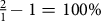
Comprehensive markets, which let agents lend and borrow, are LP-suboptimal under naïveté. The equilibrium interest rate is
 ${2 \over 1} - 1 = 100\% $
, and the poor (agents 3 and 4) are dominated. Dominance is avoided at the LP-best market partition, which permits exchange only within periods, with borrowing and lending being repugnant. This repugnance echoes anti-usury laws, historically espoused by Abrahamic traditions. Because the example focuses on outright prohibitions of exchange rather than the impediments to exchange that take the form of price controls, it does not explain the interest-rate caps at the heart of usury laws.
Comprehensive markets are LP-optimal under sophistication.
Footnote 24
No agent is dominated. At least one tomorrow’s good is a status good, depending on which sEquilibrium is selected. At a separating sEquilibrium, the interest rate is
 ${{12} \over 7} - 1 \approx 71\% $
, lower than the 100% under naïveté. At a pooling sEquilibrium, the interest rate is
 ${6 \over 4} - 1 = 50\% $
for the targeted good and
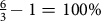 ${6 \over 3} - 1 = 100\% $
for the nontargeted one.
Footnote 25
Interest rates are lower under sophistication because the poor target future consumption, thereby raising its prices. The sophisticated poor borrow today less than they would if they were naïve, in order not to be dominated by the rich tomorrow.
6.3. Uncertainty
An agent is a farmer. Goods are state-contingent, indexed by the weather. Goods 1, 2, 3 and 4 are crops when it is dry, livestock when it is dry, crops when it is wet, and livestock when it is wet, respectively. Agent 1 is endowed with crops when dry, agent 2 with livestock when dry, agent 3 with crops when wet, and agent 4 with livestock when wet. The utility function is interpreted to reflect the fact that dry weather is twice as likely as wet.
Comprehensive markets permit insurance: crops and livestock are tradable across the states of the weather. Under naïveté, the poor trade themselves into being dominated. Dominance is avoided at the LP-best market partition, which permits the exchange of goods within, but not across, the states of the weather; insurance is repugnant. Low penetration of crop and rainfall insurance markets in developing countries is a well-documented phenomenon that allows multiple explanations (Mobarak and Rosenzweig Reference Mobarak and Rosenzweig2013). Repugnance out of fear of dominance is the explanation suggested by our model.
When farmers are sophisticated, they trade insurance in a way that forestalls dominance. Consumption of crops when it is wet or livestock when it is wet, or of both, carries status. That is, what carries status is consumption in case of ‘accident’, the less likely state.
Among other historical examples of repugnant insurance are life insurance and viaticals. These are probably not grounded in social status concerns.
6.4. International
An agent is a country. Goods 1, 2, 3 and 4 are textiles, electronics, performing arts and athletics, respectively. Country 1 excels at textiles, country 2 at electronics, country 3 at performing arts and country 4 at athletics. Performing arts and athletics receive lower consumption weights than do textiles and electronics.
Under naïveté, the poor countries are dominated when markets are comprehensive. Dominance is avoided if immigration is prohibited: performing arts and athletics are nontradable. Xenophobia, a form of repugnance, can be co-opted to enforce this prohibition. An LP-better way to avoid dominance, however, is to let performing arts be exchangeable for athletics (e.g. through cultural exchanges) and to let textiles be exchangeable for electronics while prohibiting exchange across the two submarkets.
Under sophistication, by contrast, comprehensive markets pose no threat of dominance. Status is attached to performing arts or athletics, or both.
7. Diverse Preferences
The hitherto maintained assumption of identical preferences is counterfactual. The threat of dominance is less severe when agents’ preferences differ and vanishes as goods become numerous, as we show. To this end, assume that each agent i’s Cobb–Douglas consumption utility function is parameterized by a row vector
 $\alpha^{i}\in{\mathbb{R}}_{++}^{L}$
of individual consumption weights. In this richer model, under every market partition, an nEquilibrium continues to exist and is unique, for the standard reasons.
7.1. Diverse Preferences Favour Comprehensive Markets
In contrast to the case with identical preferences, with diverse preferences, merging markets may help avoid dominance even under naïveté. A larger submarket enables an agent to direct greater wealth toward his favourite good. When different agents are partial to different goods, specialization in consumption wards off dominance, as Example 5 illustrates.
Example 5. (Merging submarkets wards off dominance). Let
 $$\alpha = \left( {\matrix{ 1 & 2 \cr 2 & 1 \cr } } \right)\,\,\,\,\,\,\,{\rm{and}}\,\,\,\,\,\,\,\omega = \left( {\matrix{ {20} & {20} \cr {10} & {10} \cr } } \right).$$
In autarky, agent 2 is dominated. Under comprehensive markets, the nEquilibrium
 $$p = \left( {4,5} \right)\,\,\,\,\,\,\,\,\,{\rm{and}}\,\,\,\,\,\,\,\,x = \left( {\matrix{ {15} & {24} \cr {15} & 6 \cr } } \right)$$
exhibits no dominance and, therefore, is also an sEquilibrium.
 $\triangle$
Example 5 inspires the conjecture that, when preferences differ and goods are numerous, comprehensive markets eradicate dominance with a high probability even under naïveté. Each agent is likely to have a good that he likes so much that, at equilibrium, he consumes more of it than anyone else does. As a result, no one is dominated. Proposition 7 proves this conjecture in a setting with independently and identically drawn consumption weights.
Proposition 7. Fix a uniformly bounded sequence
 $\left(\omega\left(L\right)\right)_{L=1}^{\infty}$
of endowment matrices, where
 $\omega\left(L\right)$
is an endowment matrix in an L-good economy.Footnote
26
Suppose that, for every
 $L\in{\mathbb{N}}$
, each agent i’s vector
 $\alpha^{i}\left(L\right)\in{\mathbb{R}}_{+}^{L}$
of consumption weights for an L-good economy is drawn uniformly at random and independently across agents from the probability simplex
 $\Delta^{L-1}$
. Then, no matter how small an
 $\varepsilon \gt 0$
, there exists a sufficiently large L such that the probability that no agent is dominated at the nEquilibrium with comprehensive markets (and, therefore, at the corresponding sEquilibrium) exceeds
 $1-\varepsilon$
.
Proposition 7 establishes that a society in which goods are numerous and preferences diverse has little need for taboos on exchange. One can interpret Proposition 7 as saying that, when goods are many, cultural liberalism, which encourages individuals to act on their diverse preferences, recognizes all goods as potential status goods, does not lump goods for the purpose of status comparisons (all implicit assumptions in our model), and engenders economic liberalism, which designates few, if any, transactions as repugnant.
Proposition 7 can be interpreted as describing how repugnance declines as new goods are introduced, while the endowments of, and the tastes for, old goods remain unchanged. For this interpretation, for all L and all L′ with
 $L' \gt L$
, set
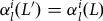 $\alpha_{l}^{i}\left(L'\right)=\alpha_{l}^{i}\left(L\right)$
and
 $\omega_{l}^{i}\left(L'\right)=\omega_{l}^{i}\left(L\right)$
for all i and all
 $l\leq L$
. If each
 $\alpha_{l}^{i}\left(L\right)$
is drawn independently from the standard exponential distribution, then one can show that each agent’s normalized vector of consumption weights is drawn uniformly from the probability simplex, as hypothesized in the proposition.
7.2. Dominance Reversals due to Commodification
Diverse preferences give rise to a new phenomenon: dominance reversals in response to the merger of submarkets. This merger goes by the name commodification in the philosophy literature. With identical preferences, if Alice dominates Bob at some market partition, then there exists no coarser market partition at which Bob would dominate Alice. This is no longer true when preferences differ, as Example 6 shows.
Example 6. (Dominance reversal due to commodification). Let
 $$\alpha = \left( {\matrix{ 1 & 1 & 1 \cr 1 & 1 & 1 \cr 1 & 7 & 1 \cr } } \right)\,\,\,\,\,\,\,\,\,{\rm{and}}\,\,\,\,\,\,\,\,\omega = \left( {\matrix{ {400} & {40} & {40} \cr 0 & {360} & 0 \cr 0 & 0 & {360} \cr } } \right).$$
No agent is dominated in autarky. Under the partition
 $\left\{ \left\{ 1,2\right\} ,\left\{ 3\right\} \right\} $
, agent 1 (Alice) dominates agent 2 (Bob) in the nEquilibrium
 $$p = \left( {1,1,1} \right)\,\,\,\,\,\,\,\,{\rm{and}}\,\,\,\,\,\,\,\,x = \left( {\matrix{ {220} & {220} & {40} \cr {180} & {180} & 0 \cr 0 & 0 & {360} \cr } } \right).$$
With comprehensive markets, the dominance relationship is reversed: agent 2 dominates agent 1 at the nEquilibrium
 $$\hat p = \left( {5,8,5} \right)\,\,\,\,\,\,\,{\rm{and}}\,\,\,\,\,\,\,\,\,{\rm{\hat x = }}\left( {\matrix{ {{\rm{168}}} & {{\rm{105}}} & {{\rm{168}}} \cr {{\rm{192}}} & {{\rm{120}}} & {{\rm{192}}} \cr {{\rm{40}}} & {{\rm{175}}} & {{\rm{40}}} \cr } } \right).$$
$\triangle$
Drastic changes in market structure, as observed during economic transitions toward market economies (either away from the planned economies of Russia, Eastern Europe and China or away from the military order in times of war), generate animosity. Not only do some lose while others gain, but, also, the prevailing social hierarchy crumbles as the dominant and the dominated switch places. This hurts. Footnote 27
Example 6 can be viewed as an illustration of the challenges that a society faces as it transitions from military to civilian life. Interpret agents 1, 2 and 3 as a pilot, a programmer and an artist, respectively and interpret goods 1, 2 and 3 as aviation, information technology (IT) and art, respectively. In the military, art is not traded, and the pilot dominates the programmer. In civilian life, comprehensive markets value the artist’s skills. The artist indulges his strong taste in IT, thereby raising the price of IT relative to aviation. The programmer now dominates the pilot.
8. Concluding Remarks
We conclude by highlighting some of the model’s assumptions and what to expect if they are relaxed.
-
1. The model implicitly assumes that repugnance norms are shared by everyone. One can equally well imagine situations in which repugnance is recognized only by some. The extremely poor, dominated no matter what, have no use for repugnance norms. The moderately poor may adopt certain repugnance norms not shared by the society at large in order to avoid exposing themselves to dominance by naïvely parting with the goods that would have otherwise protected them from dominance. The rich elites may adopt repugnance norms of their own, out of noblesse oblige, in order to avoid the situations in which the wealth derived from a subset of goods spills over into all markets and leads to domination. Exactly how repugnance norms vary with income in practice is not a settled empirical question. Footnote 28
-
2. Trade restrictions in the model are dichotomous: two goods may be exchanged either freely or not at all. Instead of proscribing trade outright, social norms can and do constrain exchange in subtler ways. Examples are the condemnation of price gouging and surge pricing, as are the support for rent control, minimum-wage laws, and ceilings on compensation for organ donation, surrogacy, and participation in medical trials. To illustrate the dominance-mitigating role of subtler constraints on exchange, imagine a warehouse employee who feels dominated unless his pay is sufficiently high. He may be willing to accept the risk of unemployment for the chance of earning a wage that is high enough to avert dominance. He would then support minimum-wage laws even if he knew that these laws would make jobs scarce and lead to rationing.
-
3. Sometimes, social norms regulate endowments or directly constrain consumption rather than the exchange protocol. For instance, one can interpret celibacy, asceticism, penitence and dietary vows as destructive to endowments. Direct restrictions on consumption are, for example, sumptuary laws in Russia under Peter the Great and in Western Europe. These laws prescribed different fashions to different social classes, so that richer merchants would not outdress the nobility.
-
4. Our model neglects the possibility that goods may differ in their conspicuousness and, hence, in their salience for status. One may prefer to avoid dominance with a flashy car or a glossy education credential rather than a rare-stamp collection – the fact that social media make it possible to conspicuously consume anything from lingerie to exotic vacations notwithstanding. As a result, some goods may be a priori more likely to emerge as status goods than others.
-
5. We model legal markets. Compared with them, black markets may increase some participants’ consumption utilities without arousing status-crashing comparisons in others by concealing participants’ identities and consumption. Black markets may, thus, improve welfare.
-
6. Our analysis confronts one market imperfection, an unpriced status externality, with another imperfection, market partitions. The best remedy for the status externality remains an open question. A naïve attempt to introduce a missing market for social status encounters a problem. Unlike, say, pollution, social status is concerned with binary comparisons of entire consumption bundles and cannot be reduced to a one-dimensional taxable ‘bad’.
-
7. We assume that each individual compares himself to everyone. In practice, most comparisons are local. People envy slightly wealthier neighbours but admire Warren Buffett and Elon Musk. Restricting comparison groups to those with whom one interacts through trade would reduce the instances of harmful dominance and would open up a door for modelling the choice of comparison groups.
-
8. Suppose that there is a good of which everyone has the same amount. Then, in our model, all dominance can be forestalled by designating this good as nontradable. Examples include voting rights, access to basic healthcare or primary education, or mandatory military service, whose consumption is indeed often equalized in practice – an expression of the ethical position that Tobin (Reference Tobin1970) calls ‘specific egalitarianism’, Nevertheless, status concerns remain even then. Why? Perhaps, thanks to education, peers or natural predisposition, different people recognize different goods as markers of status. The right to cast a vote in an election may be a marker of status for a constitutionalist but not for an anarchist. A gamer may take pride in acing the latest computer game, but a chemistry professor might not. As a first pass at this situation, suppose that each individual has an identity, defined as the set of the goods that he regards as relevant for social comparisons. These are potential status goods. With diverse identities, dominance mitigation may call not only for equating the consumption of some goods by making them nontradable, but also for restricting the exchange of the remaining goods in some way. Footnote 29
Acknowledgments
For feedback, we thank the audiences at SAET in 2017, the University of Rochester, and the Canadian Economic Theory Conference in 2018. For incisive comments, we are grateful to Brendan Lucier, Doruk Cetemen, Emilio Coya, Mark Bils, Christian List, Hervé Moulin, Arina Nikandrova, William Thomson, and Andrei Gomberg.
A. Appendix: Omitted Proofs
Proof of Proposition 1
The proof relies on the separability of preferences. An equilibrium exists because a Walrasian equilibrium in each submarket exists for the standard reasons: each agent’s consumption utility is strictly monotone, continuous and concave, and he is endowed with a positive amount of at least one good. The equilibrium is unique because each agent’s consumption utility satisfies the gross substitutes condition. Direct computation verifies the equilibrium allocation and prices reported in the proposition.
Proof of Proposition 2
Because preferences are identical, separable, and homothetic, the unique (subject to normalization) Walrasian equilibrium price vector (
 $p=\left(\alpha_{l}/\Omega_{l}\right)_{l\in{\cal L}}$
under the Cobb–Douglas assumption) is independent of the market partition. As a result, the budget constraints for a finer partition imply the budget constraints for a coarser partition; each of the latter constraints is the sum of some of the former constraints. Therefore, each agent’s consumption-utility maximization problem is weakly less restrictive – and, so, each agent is weakly better off – with a coarser partition than with a finer partition.
Proof of Proposition 3
The Cobb–Douglas utility function is of the form
 $u\left(x\right)=\sum_{l\in{\cal L}}u_{l}\left(x_{l}\right)$
, where each
 $u_{l}$
is strictly increasing, strictly concave, and twice differentiable, and it satisfies
 $\lim_{x_{l}\rightarrow0}\partial u_{l}\left(x_{l}\right)/\partial x_{l}=\infty$
and
 $\lim_{x_{l}\rightarrow\infty}\partial u_{l}\left(x_{l}\right)/\partial x_{l}=0$
. As a result, each good l is normal: its consumption strictly increases in wealth. Hence, with comprehensive markets, agents’ nEquilibrium consumption bundles are strictly ordered by dominance if and only if agents’ wealths are strictly ordered, which occurs generically in endowments. Thus, generically, all but the wealthiest agent are dominated.
Proof of Proposition 4
The proof is by example. Let there be n agents and
 $n+1$
goods:
 ${\cal I}=\left\{ 1,2,\ldots,n\right\} $
and
 ${\cal L}=\left\{ 1,2,\ldots,n+1\right\} $
, for some n, later taken to be ‘large’. The consumption utility is
 $u\left(x^{i}\right)=\sum_{l\in{\cal L}}\ln x_{l}^{i}$
. The utilitarian welfare from consumption is
 $\sum_{i\in{\cal I}}\sum_{l\in{\cal L}}\ln x_{l}^{i}$
. The
 $n\times\left(n+1\right)$
endowment matrix is
 $$\omega = {J_{n,n + 1}} + \mathop {\underbrace {\left( {\matrix{ {{1 \over 2}} & 0 & \ldots & 0 & 0 & 0 & {{1 \over n}} \cr 0 & {{1 \over 2}} & {} & 0 & 0 & 0 & {{1 \over n}} \cr \ldots & {} & \ldots & {} & {} & {} & \ldots \cr 0 & 0 & {} & {{1 \over 2}} & 0 & 0 & {{1 \over n}} \cr 0 & 0 & {} & 0 & {{1 \over 2}} & 0 & {{1 \over n}} \cr {{1 \over 2}} & {{1 \over 2}} & \ldots & {{1 \over 2}} & {{1 \over 2}} & 1 & {{1 \over n}} \cr } } \right)}_{}}\limits_{ \equiv e} ,$$
where
 $J_{n,n+1}$
is the
 $n\times\left(n+1\right)$
matrix of ones, and the spelled-out matrix is denoted by e.
Because each agent is endowed with the same amount
 ${1 \over n}$
of good
 $n+1$
, no agent is dominated in autarky.
Each good l is in the same aggregate supply
 $\sum_{i\in{\cal I}}\omega_{l}^{i}=n+1$
. Therefore, for any market partition, the nEquilibrium price of every good can be taken to be the same, say
 $p_{l}=1$
for every l.
Footnote 30
Then, every agent i’s nEquilibrium demand for a good l in a submarket
 ${\cal L}'\subset{\cal L}$
is
 $$x_l^i = {1 \over {\left| {\cal {L}^{\prime }} \right|}}\sum\limits_{m \in {{\cal L}^\prime }} {\omega _m^i} = 1 + {1 \over {\left| {{{\cal L}^\prime }} \right|}}\sum\limits_{m \in {{\cal L}^\prime }} e _m^i.$$
Starting out in autarky, the following mergers of some two submarkets preserve no-dominance:
-
Merge
$\left\{ n\right\} $
and
$\left\{ n+1\right\} $
. Utilitarian welfare rises by
$$\eqalign{ & {f_1}\left( n \right) \equiv \left( {n - 1} \right)2\ln \left( {1 + {1 \over {2n}}} \right) + 2\ln \left( {1 + {{1 + {1 \over n}} \over 2}} \right) - \left[ {\ln 2 + n\ln \left( {1 + {1 \over n}} \right)} \right] \cr & \mathrel{\mathop{\kern0pt\longrightarrow}\limits_{n \to \infty }} \ln {9 \over 8} \approx 0.118. \cr} $$
-
Merge
$\left\{ l\right\} $
and
$\left\{ n+1\right\} $
for any l in
$\left\{ 2,\ldots,n-1\right\} $
. Utilitarian welfare rises by
$$\begin{gathered}
{f_2}\left( n \right) \equiv \left( {n - 2} \right)2\ln \left( {1 + \frac{1}{{2n}}} \right) + 2 \times 2\ln \left( {1 + \frac{{\frac{1}{2} + \frac{1}{n}}}{2}} \right) - \left[ {2\ln \left( {1 + \frac{1}{2}} \right) + n\ln \left( {1 + \frac{1}{n}} \right)} \right] \hfill \\
\!\!\!\!\!\!\!\!\!\!\!\!\!\!\!\!\!\!\!\!\!\!\!\!\!\!\!\!\!\!\!\!\!\!\!\!\!\!\!\!\!\!\!\!\!\!\!\!\!\!\!\!\!\!\!\!\!\!\!\!\!\!\!\!\!\!\!\!\!\!\!\!\!\!\!\!\!\!\!\!\!\!\!\!\!\!\!\!\!\!\!\!\!\!\!\!\!\!\!\!\!\!\!\!\!\!\!\!\!\!\!\!\!\!\!\!\!\!\!\!\!\!\!\!\!\!\!\!\!\!\!\!\!\!\!\!\!\!\!\!\!\!\!\!\!\!\!\!\!\!\!\!\!\!\ \!\xrightarrow[{n \to \infty }]{}\ln \frac{{625}}{{576}} \approx 0.082. \hfill \\
\end{gathered}$$
-
Merge
$\left\{ l\right\} $
and
$\left\{ l'\right\} $
for any distinct l and l’ in
$\left\{ 1,2,\ldots,n-1\right\} $
. Utilitarian welfare rises by
$${f_3}\left( n \right) \equiv 2 \times 2\ln \left( {1 + {{0 + {1 \over 2}} \over 2}} \right) - 2\ln \left( {1 + {1 \over 2}} \right) = \ln {{625} \over {576}} \approx 0.082.$$
-
Merge
$\left\{ l\right\} $
and
$\left\{ n\right\} $
for any l in
$\left\{ 2,\ldots,n-1\right\} $
. Utilitarian welfare rises by
$$\begin{gathered}{f_4}\left( n \right) \equiv 2\ln \left( {1 + \frac{{0 + \frac{1}{2}}}{2}} \right) + 2\ln \left( {1 + \frac{{1 + \frac{1}{2}}}{2}} \right) \hfill \\
\,\,\,\,\,\,\,\,\,\,\,\,\,\,\,\,\,\,\,\,\,\,\,\,\,\,\,\,\,\,\,\,\,\,\,\,\,\,\,\,\,\,\,\,\,\,\,\,\,\,\,\,\,\,\,\,\,\,\,\,\,\,\,\,\,\,\,\,\,\,\,\,\,\,\,\, - \left[ {\ln \left( {1 + \frac{1}{2}} \right) + \left( {\ln \left( {1 + \frac{1}{2}} \right) + \ln 2} \right)} \right] = \ln \frac{{1225}}{{1152}} \approx 0.061. \hfill \\
\end{gathered}$$





We focus on the case in which n is large enough for the most profitable myopic merger to involve submarkets
 $\left\{ n\right\} $
and
 $\left\{ n+1\right\} $
. Such an n exists because
 $$\lim_{n\rightarrow\infty}f_{1}\left(n\right) \gt \lim_{n\rightarrow\infty}f_{2}\left(n\right)=\lim_{n\rightarrow\infty}f_{3}\left(n\right) \gt \lim_{n\rightarrow\infty}f_{4}\left(n\right).$$
Thus, starting out in autarky, the myopic dynamics merge
 $\left\{ n\right\} $
and
 $\left\{ n+1\right\} $
and lead to the allocation:
 $$x = {J_{n,n + 1}} + \left( {\matrix{ {{1 \over 2}} & 0 & \ldots & 0 & 0 & {{1 \over {2n}}} & {{1 \over {2n}}} \cr 0 & {{1 \over 2}} & {} & 0 & 0 & {{1 \over {2n}}} & {{1 \over {2n}}} \cr \ldots & {} & \ldots & {} & {} & {} & \ldots \cr 0 & 0 & {} & {{1 \over 2}} & 0 & {{1 \over {2n}}} & {{1 \over {2n}}} \cr 0 & 0 & {} & 0 & {{1 \over 2}} & {{1 \over {2n}}} & {{1 \over {2n}}} \cr {{1 \over 2}} & {{1 \over 2}} & \ldots & {{1 \over 2}} & {{1 \over 2}} & {{{1 + {1 \over n}} \over 2}} & {{{1 + {1 \over n}} \over 2}} \cr } } \right).$$
Any further merger would lead to dominance. Therefore, the myopic dynamics terminate at the market partition
 $\left\{ \left\{ 1\right\} ,\left\{ 2\right\} ,\ldots,\left\{ n-1\right\} ,\left\{ n,n+1\right\} \right\} $
, with the gains from trade that equal
 $f_{1}\left(n\right)$
.
Consider an alternative market partition,
 $\left\{ \left\{ 1,2,\ldots,n\right\} ,\left\{ n+1\right\} \right\} $
. It induces the allocation
 $$x = {J_{n,n + 1}} + \left( {\matrix{ {{1 \over {2n}}} & {{1 \over {2n}}} & \ldots & {{1 \over {2n}}} & {{1 \over {2n}}} & {{1 \over n}} \cr {{1 \over {2n}}} & {{1 \over {2n}}} & {} & {{1 \over {2n}}} & {{1 \over {2n}}} & {{1 \over n}} \cr \ldots & {} & \ldots & {} & {} & \ldots \cr {{1 \over {2n}}} & {{1 \over {2n}}} & {} & {{1 \over {2n}}} & {{1 \over {2n}}} & {{1 \over n}} \cr {{1 \over 2} + {1 \over {2n}}} & {{1 \over 2} + {1 \over {2n}}} & \ldots & {{1 \over 2} + {1 \over {2n}}} & {{1 \over 2} + {1 \over {2n}}} & {{1 \over n}} \cr } } \right),$$
at which everyone consumes the same amount of good
 $n+1$
, and, so, no one is dominated. This allocation delivers the gains from trade that equal
 $$\eqalign{ {f_5}\left( n \right) &\equiv \left( {n - 1} \right)n\ln \left( {1 + {1 \over {2n}}} \right) + n\ln \left( {1 + {1 \over 2} + {1 \over {2n}}} \right) \cr& - \left[ {\left( {n - 1} \right)2\ln \left( {1 + {1 \over 2}} \right) + \ln \left( {1 + 1} \right)} \right]\,\,\mathop \approx \limits^{n \to \infty } \left( {{1 \over 2} - \ln {3 \over 2}} \right)n \approx 0.095n.}$$
As n grows, these gains become arbitrarily greater than the gains from the myopic dynamics:
 $${{{f_5}\left( n \right)} \over {{f_1}\left( n \right)}}\mathop \approx \limits^{n \to \infty } 0.803n.$$
Thus, the myopic dynamics do not even attain a constant-factor approximation of the LP-optimum. Footnote 31
Proof of Proposition 5
Step 1: The wealthiest agent in a submarket maximizes his consumption utility (i.e. consumes naïvely) in that submarket.
By contradiction, suppose that the wealthiest agent in a submarket did not act naïvely in that submarket. Then, by acting naïvely, he would increase his consumption utility without jeopardizing his status; no agent would be able to afford a bundle that dominated his.
Step 2: Any agent who targets in a submarket targets the good with the smallest consumption weight in that submarket.
Fix an sEquilibrium
 $\left(p,x\right)$
of an economy
 $\left(\omega,\alpha,{\cal P}\right)$
. Suppose that, in some submarket
 ${\cal L}_{k}\in{\cal P}$
, agent i targets agent j’s consumption of good l.
Without loss of generality, we can assume that j consumes naïvely in
 ${\cal L}_{k}$
. Suppose, to the contrary, that j targets some agent h (
 $h\neq i$
) in
 ${\cal L}_{k}$
. That requires h to consume more of each good than j does in every submarket but
 ${\cal L}_{k}$
. Then, the fact that i targets j in
 ${\cal L}_{k}$
means that i does not target h in any other submarket and, so, does not automatically avoid the need to target j. Hence, i targets both j and h in
 ${\cal L}_{k}$
. But then targeting j is redundant; i can target h instead. Repeating the argument (for h instead of j, and so on) for as many iterations as necessary by inviting i to target an ever more
 ${\cal L}_{k}$
-voracious agent with each iteration, we conclude that, without loss of generality, we can assume that i targets only the most
 ${\cal L}_{k}$
-voracious of his targets, who consumes naïvely in
 ${\cal L}_{k}$
.
Footnote 32
Furthermore, without loss of generality, we can assume that, when targeting j in
 ${\cal L}_{k}$
, agent i does not operate subject to a nonbinding yet nonredundant constraint that i not be dominated in
 ${\cal L}_{k}$
by some agent j′ who targets some agent h (
 $h\notin\left\{ i,j\right\} $
) in
 ${\cal L}_{k}$
. Indeed, if j’ targets h in
 ${\cal L}_{k}$
, then h consumes more than j′ does in every submarket but
 ${\cal L}_{k}$
. Then, the fact that j′ constrains the consumption of i in
 ${\cal L}_{k}$
means that i does not avoid dominance by h in any other submarket and, so, does not automatically avoid the need to heed (i.e. be constrained in his optimization by) j′ in
 ${\cal L}_{k}$
. Hence, i heeds both j′ and h in
 ${\cal L}_{k}$
. But then heeding j′ is redundant; i can heed h instead. Repeating the argument (for h instead of j′, and so on) for as many iterations as necessary by inviting i to heed an ever more
 ${\cal L}_{k}$
-voracious agent with each iteration, we conclude that, without loss of generality, we can assume that i heeds only the most
 ${\cal L}_{k}$
-voracious of his heeded agents, who consumes naïvely in
 ${\cal L}_{k}$
.
Furthermore, heeding a j′ who consumes naïvely while targeting a j who also consumes naïvely is redundant because j consumes more of every good than j′ does. As a result, when i targets j in
 ${\cal L}_{k}$
, agent i is unconstrained by other agents’ consumption in
 ${\cal L}_{k}$
.
Before showing that the best way for i to target j is to set l to be the good with the lowest consumption weight in
 ${\cal L}_{k}$
, we simplify notation by assuming, without loss of generality, that markets are comprehensive (i.e.
 ${\cal L}_{k}={\cal L}$
) and by normalizing
 $\sum_{l\in{\cal L}}\alpha_{l}=1$
. Define
 $W\equiv p\cdot\omega^{j}$
. Agent i optimally consumes the bundle
 $$x^{i}\left(l\right)\equiv\arg\max_{y\in\mathbb{R}_{+}^{L}}\left\{ u\left(y\right)\mid p_{l}y_{l}\geq\alpha_{l}W,\,p\cdot y\leq p\cdot\omega^{i}\right\} ,$$
where, by the convexity of i’s problem,
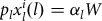 $p_{l}x_{l}^{i}\left(l\right)=\alpha_{l}W$
. The optimization problem reflects the fact that, to avoid dominance by j, it suffices for i to target just one good.
Agent i’s consumption utility from bundle
 $x^{i}\left(l\right)$
is
 $$\eqalign { u\left( {{x^i}\left( l \right)} \right) &= \sum\limits_{s \in L} {{\alpha _s}} \ln x_s^i\left( l \right)\cr& {{= {\alpha _l}\ln \left( {{{{\alpha _l}W} \over {{p_l}}}} \right) + {\sum _{s \in L\backslash \left\{ l \right\}}}{\alpha _s}\ln \left( {{{{\alpha _s}\left( {p \cdot {\omega ^i} - {\alpha _l}W} \right)} \over {\left( {1 - {\alpha _l}} \right){p_s}}}} \right)}} \cr & = \sum\limits_{s \in L} {{\alpha _s}} \ln {{{\alpha _s}} \over {{p_s}}} + {\alpha _l}\ln W + \left( {1 - {\alpha _l}} \right)\ln {{p \cdot {\omega ^i} - {\alpha _l}W} \over {1 - {\alpha _l}}} \cr & = \sum\limits_{s \in L} {{\alpha _s}} \ln {{{\alpha _s}} \over {{p_s}}} + f\left( {{\alpha _l}} \right), \cr} $$
where
 $f\left(\alpha_{l}\right)$
, the only term that depends on l, is defined as
 $$f\left( s \right) \equiv s\ln {{\left( {1 - s} \right)W} \over {p \cdot {\omega ^i} - sW}} + \ln {{p \cdot {\omega ^i} - sW} \over {1 - s}}.$$
To show that the agent targets the lowest-
 $\alpha_{l}$
good, we must show that f is strictly decreasing. Differentiating,
 ${\text{d}} f\left(s\right)/{\text{d}} s=1-\gamma+\ln\gamma$
, where
 $\gamma\equiv\left(W-sW\right)/\left(p\cdot\omega^{i}-sW\right)$
. From
 $p\cdot\omega^{i}\lt W$
and
 $p\cdot\omega^{i}\geq sW$
, we conclude that
 $\gamma \gt 1$
, which implies that
 $1-\gamma+\ln\gamma \lt 0$
. Thus, for any two goods l and l′, the inequality
 $\alpha_{l}\,{\unicode{x003C}}\,\alpha_{l'}$
implies that
 $u\left(x^{i}\left(l\right)\right) \gt u\left(x^{i}\left(l'\right)\right)$
; agent i must target the lowest consumption-weight good.
Proof of Proposition 6
Normalize
 $\alpha$
so that
 $\sum_{l\in{\cal L}}\alpha_{l}=1$
and, invoking genericity,
 $\alpha_{1}{\unicode{x003C}}\alpha_{2}{\unicode{x003C}}\ldots{\unicode{x003C}}\alpha_{L}$
. Recall that
 $\sum_{i\in{\cal I}}\gamma^{i}=1$
and, invoking genericity, normalize
 $\gamma^{1} \gt \gamma^{2} \gt \ldots \gt \gamma^{I}$
.
-
1. Proportional endowments.
-
(a) Naïve agents. For any market partition, at the unique (subject to normalization) nEquilibrium prices
$p=\left(\alpha_{l}/\Omega_{l}\right)_{l\in{\cal L}}$
, each agent optimally consumes his endowment. As a result, all market partitions are LP-equivalent and, so, LP-optimal. In particular, comprehensive markets are LP-optimal. Moreover, because the wealthiest agent’s endowment dominates all other agents’ endowments, so does his nEquilibrium consumption. -
(b) Sophisticated agents. Define
(A.1)
$$m \equiv \max \left\{ {i \in I\mid {\gamma ^i} \ge {\alpha _1}{\gamma ^1}} \right\}.$$
-
i. A lower bound on dominance. Fix an arbitrary market partition
${\cal P}$
and a corresponding sEquilibrium
$\left(p,x\right)$
, if it exists. Let
${\cal L}_{k}\in{\cal P}$
denote an arbitrary submarket. Agent 1 is the wealthiest one in each submarket and, so, maximizes his consumption utility; on any good
$l\in{\cal L}_{k}$
, he spendsFor any
$${p_l}x_l^1 = {{{\alpha _l}\sum\limits_{s \in {{\cal L}_k}} {{p_s}} \omega _s^1} \over {\sum\limits_{s \in {{\cal L}_k}} {{\alpha _s}} }} = {{{\alpha _l}{\gamma ^1}\sum\limits_{s \in {{\cal L}_k}} {{p_s}} {\Omega _s}} \over {\sum\limits_{s \in {{\cal L}_k}} {{\alpha _s}} }} \gt {\alpha _l}{\gamma ^1}\sum\limits_{s \in {{\cal L}_k}} {{p_s}} {\Omega _s}.$$
$i \gt m$
, agent i’s submarket-
${\cal L}_{k}$
wealth iswhere
$$\sum_{s\in{\cal L}_{k}}p_{s}\omega_{s}^{i}=\gamma^{i}\sum_{s\in{\cal L}_{k}}p_{s}\Omega_{s}{\unicode{x003C}}\alpha_{1}\gamma^{1}\sum_{s\in{\cal L}_{k}}p_{s}\Omega_{s}\leq\alpha_{l}\gamma^{1}\sum_{s\in{\cal L}_{k}}p_{s}\Omega_{s},$$
$l\in{\cal L}_{k}$
is arbitrary, and the first inequality uses
$i \gt m$
and the definition of m, in (A.1). Thus, at the sEquilibrium
$\left(p,x\right)$
, no agent i with
$i \gt m$
can afford to match agent 1’s consumption of any good; agents
$\left\{ m+1,\ldots,I\right\} $
– maybe also others – are dominated.
-
ii. Comprehensive markets. We shall construct an sEquilibrium
$\left(p,x\right)$
under comprehensive markets by guessing that, at the prices
Footnote 33
(A.2)agents
$$p = \left( {{{{\alpha _1} + {{{\alpha _1}} \over {1 - {\alpha _1}}}\sum\limits_{i = 1}^m {{\sum _{l \in {\cal L}\backslash \left\{ 1 \right\}}}} {{{\alpha _l}} \over {{\Omega _l}}}\left( {\omega _l^1 - \omega _l^i} \right)} \over {{\Omega _1} - {{{\alpha _1}} \over {1 - {\alpha _1}}}\sum\limits_{i = 1}^m {\left( {\omega _1^1 - \omega _1^i} \right)} }},{{{\alpha _2}} \over {{\Omega _2}}}, \ldots ,{{{\alpha _L}} \over {{\Omega _L}}}} \right),$$
$\left\{ 2,\ldots,m\right\} $
match agent 1’s consumption of good 1, while the remaining agents consume naïvely. That is, agents
$\left\{ 1,2,\ldots,m\right\} $
consume good 1 in the amount
$x_{1}^{1}=\alpha_{1}p\cdot\omega^{1}/p_{1}$
, while each agent i in
$\left\{ m+1,\ldots,I\right\} $
consumes
$x_{1}^{i}=\alpha_{1}p\cdot\omega^{i}/p_{1}$
. Market-clearing for good 1 requires thatwhich can be verified to hold at the guessed prices. The guessed prices can also be verified to clear the market for each good
$$mx_1^1 + \sum\limits_{i = m + 1}^I {x_1^i} {\text{ }} = {\Omega _1},$$
$l\in{\cal L}\backslash\left\{ 1\right\} $
:Finally, note that, consistent with the equilibrium guess, agent m, defined in (A.1), is the least wealthy agent who can afford to target good 1:
$$\sum\limits_{i \in {\cal I}} {x_l^i} = \sum\limits_{i = 1}^m {{{{\alpha _l}\left( {p \cdot {\omega ^i} - {p_1}x_1^1} \right)} \over {\left( {1 - {\alpha _1}} \right){p_l}}}} + \sum\limits_{i = m + 1}^I {{{{\alpha _l}p \cdot {\omega ^i}} \over {{p_l}}}} = {\Omega _l}.$$
The verification of the conjectured sEquilibrium is, thus, complete.
$$\max\left\{ i\in{\cal I}\mid p\cdot\omega^{i}\geq p_{1}x_{1}^{1}\right\} =\max\left\{ i\in{\cal I}\mid\gamma^{i}\geq\alpha_{1}\gamma^{1}\right\} =m.$$
-
iii. Dominance minimization. By part 1(b)i, for any market partition, at least the agents in
$\left\{ m+1,\ldots,I\right\} $
are dominated. By part 1(b)ii, with comprehensive markets, exactly the agents in
$\left\{ m+1,\ldots,I\right\} $
are dominated. Therefore, comprehensive markets minimize the set of dominated agents.
-
-
-
2. Specialized endowments.
-
(a) Naïve agents. Because agents’ endowments cannot be ranked, no agent is dominated in autarky. We show that any nonautarkic market partition
${\cal P}$
entails dominance. For any market partition, the unique (subject to normalization) nEquilibrium price vector is
$p=\left(\alpha_{l}/\Omega_{l}\right)_{l\in{\cal L}}$
. Hence, the wealths of any two distinct agents i and j with nonzero endowments in some submarket
${\cal L}_{k}\in{\cal P}$
are
$\alpha_{i}$
and
$\alpha_{j}$
, respectively, and satisfy
$\alpha_{j}\neq\alpha_{i}$
, by genericity. Assuming that
$\alpha_{j} \gt \alpha_{i}$
, agent j dominates agent i by consuming more of each good than i does in submarket
${\cal L}_{k}$
and the same zero amount in the remaining submarkets.
Footnote 34
Thus, each nonautarkic market partition involves dominance. -
(b) Sophisticated agents. Unless markets are comprehensive, each agent’s consumption utility is
$-\infty$
because each agent has a submarket in which his wealth and, therefore, consumption are both zero. Therefore, to establish the LP-optimality of comprehensive markets, it suffices to construct a corresponding sEquilibrium in which no agent is dominated and in which each agent’s consumption utility is finite. We construct such a comprehensive-markets sEquilibrium by guessing that, at the prices(A.3)all agents consume the same amount of good 1. Agent L is the wealthiest agent: his wealth,
$$p = \left( {{{{\alpha _1}{\alpha _L}L} \over {{\Omega _1}}},{{{\alpha _2}} \over {{\Omega _2}}}, \ldots ,{{{\alpha _L}} \over {{\Omega _L}}}} \right),$$
$p_{L}\Omega_{L}=\alpha_{L}$
, exceeds the wealth
$\alpha_{i}$
of any agent i in
$\left\{ 2,\ldots,L-1\right\} $
, as well as the wealth of agent 1,
$\alpha_{1}\alpha_{L}L$
, because
$\alpha_{1} \lt 1/L$
. Therefore, agent L maximizes his consumption utility and, so, spends
$p_{1}x_{1}^{L}=\alpha_{1}\alpha_{L}$
on good 1. Because this amount is less than the wealth of each of the remaining agents, each of them optimally targets good 1 by consuming
$x_{1}^{L}=\alpha_{1}\alpha_{L}/p_{1}=\Omega_{1}/L$
of it. The market for good 1 clears:
$Lx_{1}^{L}=\Omega_{1}$
. Market-clearing for the remaining goods can also be verified:Because each agent has money left over after targeting good 1, each agent’s consumption bundle is in
$$\sum\limits_{i \in {\cal I}} {x_l^i} = \sum\limits_{i \in {\cal I}} {{{{\alpha _l}\left( {p \cdot {\omega ^i} - {p_1}x_1^L} \right)} \over {\left( {1 - {\alpha _1}} \right){p_l}}}} = {\Omega _l},\quad \;\;\;{\kern 1pt} l \in L\backslash \left\{ 1 \right\}.$$
${\mathbb{R}}_{++}^{L}$
, and consumption utility is positive. Thus, comprehensive markets are uniquely LP-optimal.
-
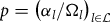













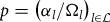





Proof of Proposition 7
We sample each agent i’s utility weights
 $\alpha^{i}\left(L\right)$
uniformly from the
 $\left(L-1\right)$
-dimensional probability simplex by following the procedure described by Devroye (Reference Devroye1986: Ch. V). Take the unit interval
 $\left[0,1\right]$
and sample from it
 $L-1$
points independently and uniformly at random. Add 0 and 1 to the sample. The distance between any two adjacent points in the sample is called uniform spacing. The
 $i^{th}$
uniform spacing defines
 $\alpha_{l}^{i}\left(L\right)$
.
Uniform spacings are distributed identically, although not independently, because they must add up to one (Pyke Reference Pyke1965: Section 2.1). Independence does hold asymptotically, though (Nagaraja, Bharath and Zhang Reference Nagaraja, Bharath and Zhang2015: Lemma 1). In particular, for any fixed positive integer R, we have
 $$\left(L\alpha_{1}^{i}\left(L\right),\ldots,L\alpha_{R}^{i}\left(L\right)\right) \left(L\alpha_{1}^{i}\left(L\right),\ldots,L\alpha_{R}^{i}\left(L\right)\right)\, \raise 6pt d\hskip-7pt{\rightarrow}\left(Z_{1},\ldots,Z_{R}\right)\qquad\text{as}\qquad {\it L}\rightarrow\infty,$$
where
 $Z_{1},\ldots,Z_{R}$
are mutually independent standard exponential random variables, and ‘
 $\ \overset{\raise 1pt d\hskip -1pt}{\rightarrow}$
’ denotes convergence in distribution. That is, the first R spacings are jointly distributed asymptotically independently, each with the asymptotic c.d.f.
 $\Pr\left\{ \alpha_{l}^{i}\left(L\right)\leq u\right\} =1-e^{-uL}$
. Letting
 $M_{R}^{i}\left(L\right)\equiv\max_{l\in\left\{ 1,\ldots,R\right\} }\alpha_{l}^{i}\left(L\right)$
denote the largest of the first R uniform spacings in a model with L goods,
 $$\Pr\left\{ M_{R}^{i}\left(L\right)\le u\right\} \rightarrow\Pr\left\{ \alpha_{l}^{i}\left(L\right)\leq u\right\} ^{R}\qquad\text{as}\qquad L\rightarrow\infty.$$
At the comprehensive-markets nEquilibrium, each agent i′s demand
 $x_{l}^{i}$
for a good l is bounded:
 $$\eqalign{ & {{\alpha _l^i\left( L \right) {\underline \omega} \sum\nolimits_{m \in {\cal L}} {{p_m}} } \over {{p_l}}} \le x_l^i \le {{\alpha _l^i\left( L \right)\bar \omega \sum\nolimits_{m \in {\cal L}} {{p_m}} } \over {{p_l}}}, \cr & \cr} $$
where
 $\left(p_{l}\right)_{l\in{\cal L}}$
is the vector of equilibrium prices. Using the bounds in the display above, agent i is guaranteed not to be dominated if there is a good l such that, for each agent j in
 ${\cal I}\backslash\left\{ i\right\} $
, we have
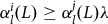 $\alpha_{l}^{i}\left(L\right)\geq\alpha_{l}^{j}\left(L\right)\lambda$
, where
 $\lambda\equiv\overline{\omega}/\underline{\omega}$
. The probability of this no-dominance event is bounded below by the probability that agent i’s maximal spacing
 $M_{R}^{i}\left(L\right)$
weakly exceeds
 $\lambda$
times the spacing for the corresponding good for each other agent, which, in turn, is bounded below by the probability of the event – parametrized by an arbitrary
 $\kappa\in\left(0,1\right)$
– that
 $M_{R}^{i}\left(L\right)\geq\kappa$
, and that the remaining agents’ corresponding spacings do not exceed
 $\kappa/\lambda$
. The latter lower bound is, asymptotically,
 $$\left( {1 - \Pr {{\left\{ {\alpha _l^i\left( L \right) \le \kappa } \right\}}^R}} \right)\Pr {\left\{ {\alpha _l^i\left( L \right) \le {\kappa \over \lambda }} \right\}^{I - 1}} = \left( {1 - {{\left( {1 - {e^{ - \kappa L}}} \right)}^R}} \right){\left( {1 - {e^{ - {{\kappa L} \over \lambda }}}} \right)^{I - 1}}.$$
In the bound above, setting
 $R=\sqrt{L}$
and, for any
 $b\in\left(0,L\right)$
, setting
 $\kappa=b/L$
yields
 $$\left( {1 - {{\left( {1 - {e^{ - b}}} \right)}^{\sqrt L }}} \right){\left( {1 - {e^{ - {b \over \lambda }}}} \right)^{I - 1}} \to {\left( {1 - {e^{ - {b \over \lambda }}}} \right)^{I - 1}}\,\,\,\,\,\,\,\,{\rm{as}}\,\,\,\,\,\,\,\,L \to \infty .$$
If b is arbitrarily large, then the limit in the display above is arbitrarily close to 1. In other words, as the number of goods grows, the probability that a given agent is not dominated at the nEquilibrium under comprehensive markets approaches 1.
We now bound the joint probability of the event that no agent is dominated at the nEquilibrium under comprehensive markets. This probability is bounded below by the probability that, for every agent, his maximal spacing weakly exceeds
 $\lambda$
times the spacing for the corresponding good for each other agent, which, in turn, is bounded below by the probability of the event – parametrized by an arbitrary
 $\kappa\equiv b/L$
in
 $\left(0,1\right)$
– that, for every agent i, we have
 $M_{i}^{R,L}\geq\kappa$
, and that the remaining agents’ corresponding spacings do not exceed
 $\kappa/\lambda$
. Because spacings are asymptotically independent both across and within agents, this event’s probability asymptotically equals
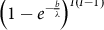 ${\left( {1 - {e^{ - {b \over \lambda }}}} \right)^{I\left( {I - 1} \right)}}$
. If b is arbitrarily large, then the lower bound in the display above is arbitrarily close to 1; the desired result follows.
B. Supplementary Appendix
After discussing preliminaries, this appendix shows that finding all LP-best market partitions is NP-hard.
The following Partition problem is known to be NP-complete (Problem SP12 of Garey and Johnson Reference Garey and Johnson1979).
Problem (Partition). Instance: A multiset
 $A\equiv\left\{ a_{1},a_{2},\ldots,a_{L}\right\} $
of positive integers, with L even. Question: Does there exist a multisubset
 $A'\subset A$
with
 $\left|A'\right|=L/2$
such that
 $\sum_{a\in A'}a=\sum_{a\in\left(A-A'\right)}a$
?
Partition Mean modifies Partition by seeking to equate averages instead of sums.
Problem (Partition Mean). Instance: A multiset
 $A\equiv\left\{ a_{1},a_{2},\ldots,a_{L}\right\} $
of positive integers. Question: Does there exist a multisubset
 $A'\subset A$
such that
 $\sum_{a\in A'}a/\left|A'\right|=\sum_{a\in\left(A-A'\right)}a/\left|A-A'\right|$
?
Lemma 1 shows that Partition Mean is NP-complete by reducing Partition to it.
Lemma 1. Partition Mean is NP-complete.
Proof. Partition Mean is in NP because a nondeterministic algorithm need only guess a multisubset
 $B'\subset B$
and check in polynomial time that the mean of the elements in B′ equals the mean of the elements in
 $B-B'$
.
We reduce Partition to Partition Mean.
Footnote 35
Take an instance
 $A\equiv\left\{ a_{1},a_{2},\ldots,a_{L}\right\} $
of Partition. Define
 $S\equiv\sum_{a\in A}a$
. Create an instance B for Partition Mean by adding to A two copies of an integer m, denoted by
 $B\equiv A+\left\{ m,m\right\} $
, where m is ‘large’ in the sense that
 $m \gt S\left(L+2\right)^{2}$
.
The rest of the proof shows that the constructed instance B of Partition Mean has the answer yes if and only if instance A of Partition has the answer yes. Indeed, suppose that the instance A of Partition has yes: the sum of the elements in some multisubset
 $A'\subset A$
equals the sum of the elements in
 $A-A'$
. Then,
 $B'\equiv A'+\left\{ m\right\} $
trivially satisfies Partition Mean.
For the converse, suppose that the constructed instance B of Partition Mean has yes: the average of the elements in some multisubset
 $B'\subset B$
equals the average of the elements in
 $B-B'$
. The two averages are equal only if B′ and
 $B-B'$
each contain a copy of m, because m is large.
Footnote 36
It follows – again, because m is large – that
 $\left|B'\right|=\left|B-B'\right|$
.
Footnote 37
As a result,
 $A'\equiv B'-\left\{ m\right\} $
must satisfy Partition.
Proposition B.1 shows that there exists no fast and reliable algorithm for finding all LP-optimal market partitions.
Proposition B.1 When agents are naïve, finding all LP-optimal market partitions is NP-hard.
Proof. To conclude NP-hardness, it will be shown that Partition Mean can be reduced to LP-Search, defined as the problem of finding all LP-optimal market partitions when the agents are naïve.
Let
 $\left\{ a_{1},a_{2},\ldots,a_{L}\right\} $
be an arbitrary instance of Partition Mean. To construct the corresponding instance of LP-Search, let
 $\omega^{1}\equiv\left(a_{1},a_{2},\ldots,a_{L}\right)$
and
 ${\cal L}\equiv\left\{ 1,2,\ldots,L\right\} $
; define
 $\bar a \equiv {1 \over L}\sum\limits_{l \in {\cal L}} {{a_l}} $
; let
 $\omega^{2}\equiv\left(\bar{a}+\varepsilon L,\bar{a}-\varepsilon,\ldots,\bar{a}-\varepsilon\right)$
for some
 $\varepsilon\in\left(0,L^{-2}\right)$
; and let
 $\omega^{i}\in\left(0,1\right)^{L}$
for each agent
 $i\in{\cal I}\backslash\left\{ 1,2\right\} $
be such that
 $\sum_{i\in{\cal I}}\omega_{il}=\alpha_{l}$
for all
 $l\in{\cal L}$
. The implied nEquilibrium price vector is
 $p=\left(1,1,\ldots,1\right)$
.
In autarky, every agent
 $i\in{\cal I}\backslash\left\{ 1,2\right\} $
is dominated by agent 1 and, therefore, cannot be protected from dominance by any market partition. Agents 1 and 2 are undominated.
With comprehensive markets, agent 2, who is undominated, dominates agent 1. Footnote 38
Let us look for the LP-optimal market partition that is best for agent 1. At this market partition, agent 1 must be undominated. Furthermore, we cannot do better than letting agent 1 enjoy the same consumption utility as he would enjoy under comprehensive markets. The answer to whether this consumption utility can be attained is the answer to the given instance of Partition Mean and can always be read off the solution to LP-Search, as is argued in the remainder of the proof; LP-Search is at least as hard as Partition Mean.
Any two-element partition
 $\left\{ {\cal L}_{1},{\cal L}_{2}\right\} $
of
 ${\cal L}$
precludes dominance. Indeed, without loss of generality, let
 $1\in{\cal L}_{1}$
and define
 $L_{1}\equiv\left|{\cal L}_{1}\right|$
and
 $L_{2}\equiv\left|{\cal L}_{2}\right|$
. By contradiction, suppose that, in each submarket
 ${\cal L}_{k}\in\left\{ {\cal L}_{1},{\cal L}_{2}\right\} $
, agent 1’s wealth, denoted by
 $W_{k}$
, is smaller than agent 2’s wealth:
 $$W_{1}{\unicode{x003C}}\bar{a}L_{1}+\varepsilon L_{2}+\varepsilon\qquad\text{and}\qquad {\it W}_{2}{\unicode{x003C}}\bar{a}L_{2}-\varepsilon L_{2}. $$
Using
 $\bar{a}L=+W_{1}+W_{2}$
, the two inequalities above can be combined:
 $$\varepsilon {L_2} \lt {{{W_1}{L_2} - {W_2}{L_1}} \over L} \lt \varepsilon {L_2} + \varepsilon .$$
Because
 $W_{1}$
,
 $W_{2}$
,
 $L_{1}$
, and
 $L_{2}$
are all integers, it must be that
 $${{{W_1}{L_2} - {W_2}{L_1}} \over L} \ge {1 \over L}.$$
At the same time,
 $$\varepsilon {L_2} + \varepsilon \le \varepsilon \left( {L - 1} \right) + \varepsilon \lt {1 \over L},$$
where the last inequality is by
 $\varepsilon\in\left(0,L^{-2}\right)$
. Combining the two displays above contradicts (B.1). We conclude that any two-element partition of
 ${\cal L}$
protects agent 1 from dominance.
Therefore, we must determine whether there exists a two-element partition of
 ${\cal L}$
at which agent 1 consumes as he would under comprehensive markets.
Footnote 39
Equivalently, we must solve the given instance of Partition Mean, which, by Lemma 1, is NP-complete. Therefore, LP-Search is NP-hard.
Patrick Harless completed his doctoral studies in economics at the University of Rochester under the supervision of Professor William Thomson. He taught at the University of Glasgow and the University of Arizona. He always had something smart to say.
Romans Pancs is a Mexican economist and the author of Lectures on Microeconomics: The Big Questions Approach (The MIT Press, 2018). He loves people and cities and has never published twice in the same journal. www.romanspancs.com.