INTRODUCTION
The grey reef shark, Carcharhinus amblyrhynchos, is a large requiem shark commonly found on the outer edges of coral reefs and in lagoons adjacent to reefal habitats across the Indian and Pacific Oceans (Compagno, Reference Compagno1984). The association of all life-stages of grey reef sharks (neonate, juvenile, sub-adult and adult) with coral reef systems renders this species vulnerable to exploitation (McVean et al., Reference McVean, Walker and Fanning2006; Robbins et al., Reference Robbins, Hisano, Connolly and Howard Choat2006; White, Reference White2007; Heupel et al., Reference Heupel, Williams, Welch, Ballagh, Mapstone, Carlos, Davies and Simpfendorfer2009) and localized populations are at risk of extirpation (Stevens et al., Reference Stevens, Bonfil, Dulvy and Walker2000). Their inquisitive nature, tendency to aggregate (McKibben & Nelson, Reference McKibben and Nelson1986; Economakis & Lobel, Reference Economakis and Lobel1998), instantaneous response to bait (Nelson et al., Reference Nelson, Johnson, McKibben and Pittenger1986), and the market for fins (Bonfil & Abdallah, Reference Bonfil and Abdallah2004) further exacerbates the pressures on both local and regional populations. The grey reef shark is currently assessed as near-threatened in the IUCN Red List (Smale, Reference Smale2005). Since the pioneering work by Nelson & Johnson (Reference Nelson and Johnson1980), McKibben & Nelson (Reference McKibben and Nelson1986) and Nelson et al. (Reference Nelson, Johnson, McKibben and Pittenger1986) on the movement and behaviour of grey reef sharks in the Pacific, relatively few studies have been undertaken to examine the biology and ecology of this species (Wass, Reference Wass1971; Stevens & McLoughlin, Reference Stevens and McLoughlin1991; Wetherbee et al., Reference Wetherbee, Crow and Lowe1997; Economakis & Lobel, Reference Economakis and Lobel1998; Papastamatiou et al., Reference Papastamatiou, Wetherbee, Lowe and Crow2006; Heupel et al., Reference Heupel, Simpfendorfer and Fitzpatrick2010; Field et al., Reference Field, Meekan, Speed, White and Bradshaw2011) or to monitor population status (Robbins et al., Reference Robbins, Hisano, Connolly and Howard Choat2006; Heupel et al., Reference Heupel, Williams, Welch, Ballagh, Mapstone, Carlos, Davies and Simpfendorfer2009).
With the ever expanding ecotourism and diving industry sectors for marine wildlife viewing (Cater, Reference Cater, Garrod and Gössling2008), grey reef sharks are one of the prominent ‘large sharks’ which are commonly encountered at accessible depths to recreational SCUBA divers (Anderson & Ahmed, Reference Anderson and Ahmed1993). SCUBA diver operators tend to make repeat visits to the same dive sites on a regular basis. The frequency of these visits therefore provides a unique sampling opportunity to engage the recreational SCUBA diver community in monitoring the status of shark populations by standardizing the recordings of SCUBA diver observations and/or archiving photographic material. This has particular benefits for monitoring shark populations in remote locations and/or regions where there are no existing baseline data.
The recreational SCUBA diving community represents a potentially large pool of skilled and often highly motivated volunteers. Accepting known limitations, this human resource base has proven to be valuable in determining residency, movement and migration patterns of whale shark (Rhincodon typus; Graham & Roberts, Reference Graham and Roberts2007) and for estimating population size and monitoring population fluctuations (Meekan et al., Reference Meekan, Bradshaw, Press, McLean, Richards, Quasnichka and Taylor2006; Theberge & Dearden, Reference Theberge and Dearden2006; Holmberg et al., Reference Holmberg, Norman and Arzoumanian2008). The application of this resource base in monitoring other elasmobranchs, includes wobbegong sharks, Orectolobus spp. (Huveneers et al., Reference Huveneers, Luo, Otway and Harcourt2009), sand tiger sharks, Carcharias taurus (Parker & Bucher, Reference Parker and Bucher2000; Bansemer & Bennett, Reference Bansemer and Bennett2008, Reference Bansemer and Bennett2009, Reference Bansemer and Bennett2010), zebra sharks, Stegostoma fasciatum (Dudgeon et al., Reference Dudgeon, Noad and Lanyon2008) and manta rays, Manta birostris (Luiz et al., Reference Luiz, Balboni, Kodja, Andrade and Marum2009). The use of visual marker tags, for example, placard tags, can also be used to provide data on the residency and movement of known individual animals over time, and offers a further opportunity to directly engage the recreational SCUBA diver community in scientific monitoring programmes (Graham & Roberts, Reference Graham and Roberts2007; Rowat et al., Reference Rowat, Gore, Meekan, Lawler and Bradshaw2009a, Reference Rowat, Speed, Meekan, Gore and Bradshawb).
The aim of this study was to use standardized SCUBA diver observations to examine the number, size and sex-composition of grey reef sharks present on a remote, but regularly visited dive site off the Red Sea coast of Sudan. The study also undertook a preliminary investigation to determine the effectiveness of placard tags for monitoring coarse scale residency and movement patterns of individual grey reef sharks.
MATERIALS AND METHODS
Study site
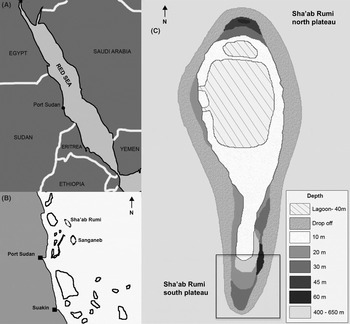
Sha'ab Rumi is annular reef situated ~15 km north-east of Port Sudan (19°56.3′N 37°24.2′E), off the Red Sea coast of Sudan. The reef is approximately 3.8 km long by 1 km wide, orientated north-east to south-west, and enclosing a shallow lagoon (Figure 1). For this study, observations on grey reef sharks were restricted to the south plateau of Sha'ab Rumi. The south plateau extends from the base of the reef slope which descends near vertically to a depth of ~20 m. The plateau itself is ~50 m long (north–south) by ~25 m wide (east–west). The maximum depth at the southern edge of the plateau is ~40 m. The southern, eastern and western edges of the plateau drop off in a near vertical orientation to a depth of ~600 m (Figure 1).
Map of the study location: (A) the Red Sea region; (B) the Sudanese Red Sea coast showing the location of Sha'ab Rumi; and (C) topographic profile of Sha'ab Rumi including the south plateau in inset box.

Dive operator surveys
All data on grey reef sharks reported in the study were recorded as part of an ongoing ‘Divers Aware of Sharks’ programme initiated by Equipe Cousteau in conjunction with SCUBA dive operators in Sudan in November 2007. Between 4 December 2007 and 13 April 2008, dive guides with clients recorded data on: (i) the dive start and finish time; (ii) the number of grey reef sharks observed per dive; (iii) the estimated total length/s (TL, m); (iv) the sex of observed sharks based on the presence or absence of claspers (male/female/unknown); (v) the depth of sighting/s per dive (minimum/maximum (m)); (vi) water temperature (°C); and (vii) evidence of scarring (from mating behaviour) and the presence of fishing hooks. Dive time, depth of sightings and temperature were recorded from dive guide/client diving computers. Current strength and current direction, measured as a compass bearing, e.g. N, NE, NW, were recorded by lead dive guides on each boat. Current strength was defined on a qualitative scale as: (1) surge only (diver gently pushed back and forth in water column); (2) slight current (the current is gentle and not difficult to swim against); (3) moderate current (effort required to swim against); (4) strong current (feels difficult to swim against, can be uncomfortable); and (5) very strong current (too strong for safe recreational diving—exit the water). At the beginning of each live aboard cruise, clients were instructed on data collection including: species identification, sex determination and difficulties associated with size estimation and replicate counting. In addition, each dive boat was provided with an instruction manual containing specific information related to the above points, which was made available to all dive clients at the start of the cruise. Accepting known issues with replicate counts of mobile predators such as sharks when conducting non-instantaneous diver surveys (Ward-Paige et al., Reference Ward-Paige, Mora, Lotze, Pattengill-Semmens, McClenachan, Arias-Castro and Myers2010), the final entered data on the number of sharks observed (and correctly identified) were made by the lead dive guide with the assistance of the clients. In other words, after each dive, the dive guide and clients would report the number of sharks seen but the dive guide, taking into consideration client observations, would make the final decision on the number entered on the survey form. For the study period, data for all dives were recorded, including those where no sharks were observed.
Application and observation of placard tags
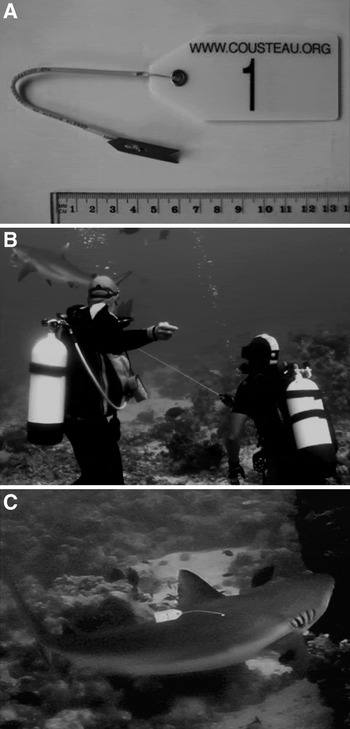
The placard tags used in this study consisted of a bright yellow plastic plate attached to a stainless steel dart tag via a monofilament line (Floy Tags, Seattle, USA). Each plastic plate was marked with an individual identification number (e.g. 001 and 002) and the ‘Divers Aware of Sharks’ website (www.cousteau.org; Figure 2a). The plate section of the tag measured 90 mm×40 mm (length×width) and the combined length of metal dart tag and the monofilament tether measured 250 mm (Figure 2A). Tags were applied in the dorsal musculature at the base of the first dorsal fin using a handheld aluminium tagging pole.
Tagging was undertaken ‘in water’ on the western side of the south plateau at a depth of ~20 m. Sharks were lured into a flat sandy area by a single diver using fish bait secured to a metal pole. A second diver, equipped with a tagging pole was positioned to the left of the first diver and tags were inserted as sharks approached or removed bait (Figure 2B, C). To regulate the number and movement of sharks into the baiting area, two safety divers were positioned 3 m to the left side and 3 m in front, on the opposite side of the sand flat. The TL of all sharks tagged was estimated by all divers present and an average value recorded. The sex of sharks was recorded based on the presence or absence of claspers.
The type of placard tag and the application technique: (A) the placard tag applied to grey reef sharks in this study; (B) a single diver luring in grey reef sharks with a second diver positioned with tagging pole—note safety divers are not visible; and (C) a shark after successful placard tag application.

SCUBA diver operators were requested to record the re-sighting of placard tagged sharks on the survey form detailed previously. The condition of the tag (complete/broken) and if the tag was readable (fouled or not) was also recorded.
Data organization and analysis
As more than one dive was conducted on many of the SCUBA diver observation days, the data were standardized by calculating the mean (± SE) number of grey reef sharks per diving day. This was based on the assumption that all SCUBA dives conducted throughout the survey period were of similar duration (mean ± 1 SD: 51 ± 0.1 minutes). The number of grey reef sharks observed on all diving days (mean ± SE of multiple observations/dive day and single observations/dive day) and the mean (± SE) number of sharks for half-month intervals are presented. A general linear model (GLM) was used to test whether the number of sharks per half-month interval varied over the study period. Mean temperature (°C) per diving day was calculated and time-series data presented. To examine if temperature and current strength had an effect on the numbers of grey reef sharks observed on the site, the number of sharks observed/dive were binned in to: (i) 1°C temperature intervals; and (ii) the pre-determined 4-point current strength scale (no dives were recorded for current strength 5). GLMs were used to test for a significant effect. The number of sharks by sex (male/female/unidentified) per half-month intervals was calculated and a Chi-squared test was used to identify if one sex was more prominent on the site. To interpret trends in grey reef shark numbers by time of day, data on the number of sharks observed per dive were binned into one-hour intervals between 7:00 and 19:00 hours and the mean (± SE) calculated. In most instances, data were normally distributed and equal in variance but were log10 transformed where necessary to meet test requirements. A criterion for significance of P < 0.05 was used for all statistical tests.
RESULTS
Diver observations
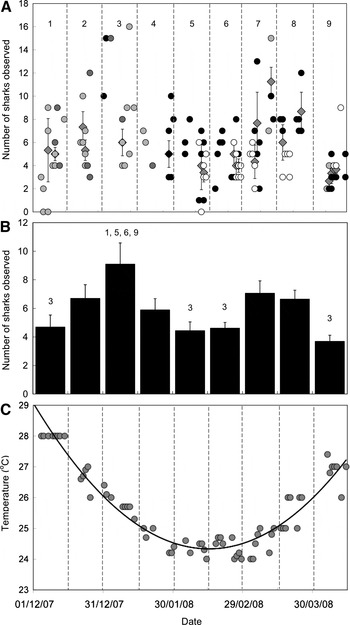
Data on grey reef sharks were recorded from a total of 126 dives over 65 SCUBA diving days (4 December 2007–17 April 2008) by 4 independent SCUBA diver operators. Grey reef sharks were observed on a total of 123 dives (97.6%). The mean (± SE) number of grey reef sharks observed per diving day over the entire study period was 5.9 ± 0.3 and there was no significant difference between the mean number of sharks observed by each SCUBA diver operator (F3,122 = 2.41, P = 0.07). A maximum of 16 sharks were observed on the 11 January; no sharks were recorded during two dives in early December (5 and 7) and on one dive on 11 February. Data on the number of sharks observed per diving day and half-month intervals followed a bimodal distribution with peaks at the end of January/beginning of December and March (Figure 3A, B). The mean number of sharks observed at the beginning of January was higher than early December, February and early April (F8,114 = 3.83, P < 0.001; Figure 3B).
Grey reef sharks on Sha'ab Rumi south plateau: (A) actual number of sharks observed per dive per diving day ( =Don Questo (N = 33),
 = Elegante (N = 56),
 = San Marco (N = 28),
 = Baron Noir (N = 9)) and the mean (± SE) number of sharks observed per diving day (for multiple dives per day ≥3: (B)
 the number of sharks (mean ± SE) observed per half-month interval (values above a given bar indicate the half- month interval(s) for which pairwise tests revealed significant differences with the given month); and (C) the temperature profile (°C) over the four and half-month study period. Dashed grey lines divide the half-month intervals and are labelled 1–9 in (a).

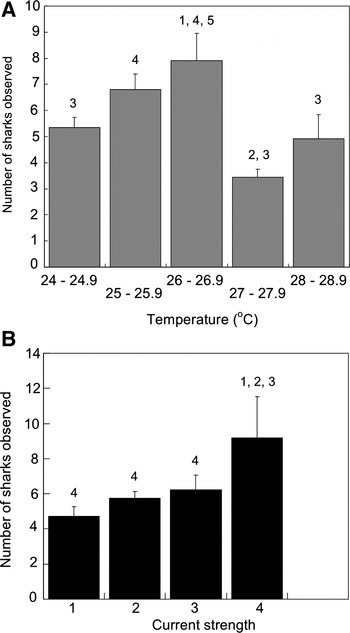
A clear seasonal temperature distribution was evident on the site, ranging from a maximum of 28.0°C in December to a minimum of 24.0°C in January and February rising to ~27.0°C during the beginning of April (Figure 3C). The number of sharks observed per 1°C temperature increment followed a unimodal distribution, with a peak in the number of sharks recorded between 26 and 26.9°C (F4,56 = 6.24, P < 0.0001; Figure 4A). More sharks were observed during strong current conditions (strength 4), than current strengths 1, 2 and 3 (F3,47 = 6.12, P = 0.001; Figure 4B).
The number of grey reef sharks (mean ± SE) observed binned into: (A) 1°C temperature intervals; and (B) by the pre-determined 4-point current strength scale (see Materials and Methods). Values above a given bar indicate the 1°C temperature interval(s)/current strength(s) for which pairwise tests revealed significant differences with the given 1°C temperature interval/current strength.

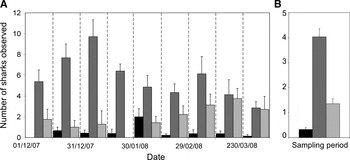
The mean minimum and maximum depth of shark observations for the entire study period were 22.7 ± 0.8 m (confidence interval (CI): 21.1–24.4) and 32.2 ± 1.0 m (CI: 30.3–34.1), respectively. The estimated mean TL of grey reef sharks observed was 1.9 ± 0.03 m (N = 127). The largest grey reef shark was estimated to be 2.5 m and the smallest 1.0 m. Female sharks were encountered more frequently than male and unidentified sharks (χ2 = 484.1, P <0.001, N = 720; Figure 5A, B). Of the sharks where sex was identified, females were dominant during all half-month intervals and over the whole sampling period (Figure 5A, B). Male sharks were present in low numbers throughout the study period, with a small peak in early February (Figure 5A). Scarring on multiple female sharks was reported on 25 March.
The number of grey reef sharks (mean ± SE) observed by sex (male (black)/female (dark grey)/unknown (light grey)) for: (A) each half-month interval; and (B) for the total sampling period. Dashed grey lines divide the half-month intervals denoted in Figure 3A.

Grey reef sharks were present on the site between daylight hours of 7:00 and 19:00 hours. There was no significant difference in number of sharks observed by hour interval (F10,112 = 1.31, P = 0.235). Over the study period, two sharks were observed with fishing hooks present in the mouth region.
Placard tags
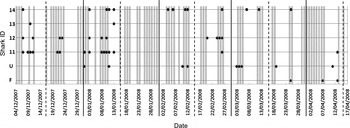
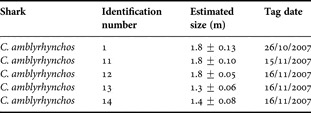
A total of 5 grey reef sharks ranging in size from ~1.3–1.8 m TL were marked with placard tags as part of the preliminary trial (Table 1; Figure 6). All sharks returned to normal swimming patterns <30 seconds after tag application. Tagging of the first grey reef shark (No. 1) took place on 26 October 2007 during the first field phase and dive operators reported repeat sightings on the following days (October—data not shown). During the second field phase 15–16 November 2007, grey reef shark No. 1 was observed to have shed the tag, as indicated by a scar in the dorsal musculature. At this time, four additional sharks were tagged (Nos. 11, 12, 13 and 14; Table 1; Figure 6). During the study period, shark No. 11 was seen on 15 days (23.1% of total dive days), No. 12 on 11 days (16.9%), No. 13 on 3 days (3.1%), No. 14 on 13 days (20.0%) and unidentified tags were observed on 9 days (13.8%) (Figure 6). Multiple tagged sharks were commonly observed together in loose aggregations (Figure 6). Tags fouled with algae were first reported on 25 March 2008 and were observed on 3 days (4.6%). The tags therefore remained clear of fouling for a total of 144 days (18 days prior to the start of the observation period and 126 days of the study). All observed tags remained complete, i.e. wire and plate tag section, for the study period (including those fouled). Shark No. 13 was only identified in December and early January and it is possible this tag was shed. Grey reef sharks Nos. 11 and 12 were identified on the site in December, early January and February and No. 11 was again sighted on 11 April, after an absence of 24 diving days (Figure 6). When No. 11 was re-sighted in April, the tag was completely clear of fouling. Shark No. 14, estimated to be ~1.4 m was sighted in all months with the exception of April (Figure 6). None of the placard tagged sharks were recorded in late January (Figure 6).
SCUBA diver reported sightings of numbered placard tags (11, 12, 13 and 14) attached to grey reef sharks on Sha'ab Rumi south plateau. Dark grey filled bars are days when no diving took place, solid black lines divide months and dashed black lines denote half-month intervals (U, unidentified tag; F, fouled tag).

Information on the size of grey reef sharks (Carcharhinus amblyrhynchos) marked with placard tags on Sha'ab Rumi south plateau. Sizes are mean total length (± SD) from four scientific diver estimates. All tagged sharks were females identified by the absence of claspers.

DISCUSSION
Grey reef sharks were observed during most dives reported on the site suggesting animals were present on a regular basis throughout the study period. This is under the assumption that all dives were logged whether sharks were present or not as requested. In addition, sharks were observed during all daylight hours dived between 7:00 and 19:00 hours. The repeat observations of placard tagged sharks, i.e. known individuals, over the 4.5 months also provide evidence for residency and site attachment of grey reef sharks over short time periods. Short term tracks of the closely related Caribbean reef sharks, Carcharhinus perezi, indicated site attachment to the outer reef area where individuals were tagged (Chapman et al., Reference Chapman, Pikitch, Babcock and Shivji2007). McKibben & Nelson (Reference McKibben and Nelson1986) found that large grey reef sharks on the outer reefs of Enewetak Atoll, exhibited nomadic behaviour, undertaking nocturnal movements along reef edges and relocating to new day time sites where individuals remained resident for short periods of time. In this study, no tagged sharks were reported from the north plateau of Sha'ab Rumi or other nearby reefs (e.g. Sanganeb), which were commonly dived throughout the study. Considering our data are based on SCUBA diver observations and that sharks were absent from the study site for periods of days, it is likely that the grey reef sharks on Sha'ab Rumi south plateau undertake similar movements. The return of placard tagged shark No. 11 in April, after an absence of 24 diving days with the tag free of fouling, would indicate this animal was residing in a different environment, possibly deeper water for a prolonged period of time.
Data on the abundance or expected number of grey reef sharks on offshore reefs are limited. For the Chagos archipelago, Anderson et al. (Reference Anderson, Sheppard, Spalding and Crosby1998) reported an average of 4.2 ± 0.3 sharks per dive, the majority of which were grey reef sharks. This was at a time when the Chagos Archipelago was still considered to be a comparatively pristine environment (Bellamy, Reference Bellamy1979; Sheppard, Reference Sheppard, Wells and Sheppard1988). By the 1990s, this figure declined to 0.6 ± 0.1 sharks per dive (Anderson et al., Reference Anderson, Sheppard, Spalding and Crosby1998) and by 2006 to 0.4 sharks per dive (Graham et al., Reference Graham, Spalding and Sheppard2010). This was likely due to a combination of both licensed and unlicensed fishing activities (Anderson et al., Reference Anderson, Sheppard, Spalding and Crosby1998; Mees et al., Reference Mees, Pilling, Barry, Sheppard and Seaward1999). As the average number of sharks observed on Sha'ab Rumi south plateau are comparable with those observed in the Chagos in the 1970s, these could be considered to represent a healthy, relatively unexploited population. Without a historical dataset with which to compare the data from this study however, it is difficult to draw a definitive conclusion. For example, although current dive operator guidelines prohibit shark feeding, this practice has historically taken place on the site and may have artificially inflated the numbers of sharks present. Additionally, anecdotal reports suggest that shark numbers at other known aggregation sites within Sudan's territorial waters have been dramatically affected by unlicensed artisanal fishers from elsewhere in the region. While the relative proximity of Sha'ab Rumi to Port Sudan may have deterred illegal fishing activities, SCUBA dive operators have reported artisanal fishermen on the reef, and it is likely that shark abundances have declined as a result. Monitoring of grey reef sharks at multiple sites in Sudanese waters is currently underway and future work will address the relative abundance of grey reef sharks at different dive locations and over time.
The estimated mean size of sharks observed of 1.9 ± 0.03 m indicated that most of the animals were mature in agreement with observations by the scientific team. This is based on estimated length at maturity of 1.2–1.4 m and ~1.25 m for males and females, respectively (Wetherbee et al., Reference Wetherbee, Crow and Lowe1997). Few small sharks of ~1 m length were reported and no individuals <1 m were recorded. This suggests that small sharks are not common on the outer reefs of Sha'ab Rumi and likely reside in nursery habitats within the protected lagoonal areas (McKibben & Nelson, Reference McKibben and Nelson1986; Wetherbee et al., Reference Wetherbee, Crow and Lowe1997). It is important to note however, that although dive guides and dive clients receive training in estimating the size of sharks as part of this programme, we recognize that SCUBA diver estimates of shark size may be exaggerated and this may have influenced our results. These data should therefore be viewed with caution.
The presence of grey reef sharks within the depth-range of recreational SCUBA divers, between December and April, demonstrates this species is able to tolerate a temperature range of 23.9°C to 28.0°C. Economakis & Lobel (Reference Economakis and Lobel1998) reported that annual aggregations of female grey reef sharks in shallow lagoons at Johnston Atoll occurred between ~25.5 and 27.5°C, with the largest aggregations recorded at ~26.5°, in agreement with our data. This may reflect a preferred temperature range of these ectothermic sharks. The occurrence of principally mature grey reef sharks on the outer edge of reefs, forming loose aggregations is consistent with observations of this species at Enewetak Atoll (McKibben & Nelson, Reference McKibben and Nelson1986). Whether larger, more uniform aggregations of these sharks occur within Sha'ab Rumi or nearby Sanganeb lagoon, as observed at both Enewetak and Bikini Atolls (McKibben & Nelson, Reference McKibben and Nelson1986; Economakis & Lobel, Reference Economakis and Lobel1998), remains to be found.
The mean maximum and minimum depth of occurrence of sharks, associated with the edge of the plateau, is also in agreement with the principal depth of capture of mature grey reef sharks in Hawaii (Wetherbee et al., Reference Wetherbee, Crow and Lowe1997). Furthermore, the presence of grey reef sharks on a submerged reef system (i.e. low lying) and the higher number of sharks observed during strong current conditions was reported by Hobson (Reference Hobson1963), Wass (Reference Wass1971), and McKibben & Nelson (Reference McKibben and Nelson1986) in the Pacific. Wetherbee et al. (Reference Wetherbee, Crow and Lowe1997) suggested that the grey reef shark may sexually segregate based on the capture of female and male grey reef sharks at different depths (mean 22.2 m and 36.2 m, respectively) in Hawaii. Accepting diver observation error in identifying the sex of individual sharks in this study, the majority of sexed sharks on Sha'ab Rumi south plateau were female. This provides further evidence for sexual segregation in this species, which has implications for fisheries management (Mucientes et al., Reference Mucientes, Queiroz, Sousa, Tarroso and Sims2009). The inability to sex individuals observed in deeper water (i.e. viewed from above) may have contributed to the low number of reported male sharks.
At the beginning of February, more male sharks were observed on the site and in March, scarring was reported on multiple females. Mating grey reef sharks have not been observed at Sha'ab Rumi (Scarpellini, personal communication), but the increase in male sharks coinciding with a decrease in the number of observed females, may indicate that mating occurs in February away from the plateau. In addition, several heavily pregnant females were present on the site in October (Hussey & Kessel, personal observations). During the second field phase in November, no pregnant females were observed, but large mature females with red and swollen cloacas were recorded (Hussey & Kessel, personal observations). This may suggest that parturition had taken place within the two week interval. If mating were to occur in February and parturition in late October/early November, this would indicate a gestation period of approximately 9 months, in agreement with Stevens & McLoughlin (Reference Stevens and McLoughlin1991) for grey reef sharks off northern Australia.
Recreational SCUBA diver observations
Time-series data on shark numbers present at monitoring sites is commonly restricted by sampling effort and associated costs. Recreational SCUBA diver operators, who visit the same sites on a regular basis, provide a resource to monitor shark populations over time. This type of monitoring can also be extended over large spatial scales. Considering the threatened status of many shark species (e.g. Otway et al., Reference Otway, Bradshaw and Harcourt2004) and the reported declines of shark populations (e.g. Baum et al., Reference Baum, Myers, Kehler, Worm, Harley and Doherty2003), recreational SCUBA diver observation programmes may therefore provide an important tool to establish base line abundance data for site-specific shark populations and to examine long-term population trends (Anderson et al., Reference Anderson, Sheppard, Spalding and Crosby1998; Graham et al., Reference Graham, Spalding and Sheppard2010; Ward-Paige et al., Reference Ward-Paige, Mora, Lotze, Pattengill-Semmens, McClenachan, Arias-Castro and Myers2010). By initiating a standardized survey procedure, as detailed in this study, SCUBA diver observation data can form a viable metric for management on both localized and regional scales. Additionally, the recording of site-specific time-series data on sharks in conjunction with basic environmental data can provide insights in to the ecology of the observed species. Accepting the limitations of recreational SCUBA diver observation data for example, size over estimation, replicate counting of individuals and diver disturbance of sharks (Huveneers et al., Reference Huveneers, Luo, Otway and Harcourt2009); recreational diver monitoring programmes for sand tiger sharks (Parker & Bucher, Reference Parker and Bucher2000; Bansemer & Bennett, Reference Bansemer and Bennett2008, Reference Bansemer and Bennett2009, Reference Bansemer and Bennett2010), multiple shark and ray species in the Caribbean (Ward-Paige et al., Reference Ward-Paige, Mora, Lotze, Pattengill-Semmens, McClenachan, Arias-Castro and Myers2010, Reference Ward-Paige, Pattengill-Semmens, Myers and Lotze2011) and Hawaii (Meyer et al., Reference Meyer, Dale, Papastamatiou, Whitney and Holland2009), and monitoring of other marine species (e.g. Goffredo et al., Reference Goffredo, Piccinetti and Zaccanti2005) demonstrate the effectiveness of this technique. Furthermore, because grey reef sharks demonstrate site fidelity (Heupel et al., Reference Heupel, Simpfendorfer and Fitzpatrick2010; Field et al., Reference Field, Meekan, Speed, White and Bradshaw2011) and are inquisitive of divers (McKibben & Nelson, Reference McKibben and Nelson1986; Nelson et al., Reference Nelson, Johnson, McKibben and Pittenger1986), this species is particularly suited to this type of monitoring programme because it can be viewed as an indicator species for the health of localized shark populations. It is important to note, however, that diver observations of more elusive species, for example the pelagic thresher shark (Alopias pelagicus), may be less reliable due to the effect of human disturbance (Oliver et al., Reference Oliver, Hussey, Turner and Beckett2011).
Involving recreational SCUBA dive operators and clients in a scientific programme is of critical importance for raising public awareness and consideration for the marine environment. Increased public awareness of the status of local and regional shark species, coupled with their economic value for wildlife viewing (Topelko & Dearden, Reference Topelko and Dearden2005) can then be used politically to promote marine reserve designation and/or species protection (Hooker & Gerber, Reference Hooker and Gerber2004).
Assessment and future development of placard tags
The repeat sightings of placard tagged sharks demonstrated that this technique is appropriate for monitoring coarse scale residency and movement patterns of individual grey reef sharks and may be applicable to other carcharhinids. SCUBA diver operators reported that placard tags could easily be read underwater (prior to fouling) and that clients were actively involved in reporting observations. These types of tags therefore provide a simple tool to rapidly identify individual animals in comparison with photographic techniques (Arzoumanian et al., 2005; Van Tienhoven et al., Reference Van Tienhoven, Den Hartog, Reijns and Peddemors2007), although we do not question the value of these latter programmes. All the tags applied to animals in this study remained intact over the sampling period and fouling did not render any unreadable for a minimum of four months. Anti-fouling placard tags have been deployed on whale sharks (Rowat et al., Reference Rowat, Speed, Meekan, Gore and Bradshaw2009b), but there is limited data on long-term condition in comparison with standard placard tags. Future work could use recreational diver estimates of the size of placard tagged sharks (i.e. sharks of known length as they are either (i) estimated by the scientific team, or (ii) actually measured in the field if the sharks were caught) to validate size estimates reported by clients to dive guides.
SCUBA diver operators involved in this study reported that clients understood the scientific benefits of placard tag application for monitoring individual sharks and positively supported the programme. This understanding was facilitated by the willingness of SCUBA diver operators to engage in the scientific programme and to explain the benefits to all clients at the beginning of each trip.
Many modern SCUBA divers are also keen photographers, raising concerns over the tags potentially compromising ‘natural wildlife photographs’. Additionally, the dart tag attachment and the permanent nature of this attachment technique may be controversial within the recreational SCUBA diving community due to possible tissue damage as a result of the tag placement (Heupel et al., Reference Heupel, Simpfendorfer and Bennett1998). To minimize the invasive nature of placard tags for SCUBA diver monitoring programmes and underwater photography, the placard tag could be secured to one side of the dorsal fin using a discrete pin. Furthermore, the attachment could be developed to include a corrodible link point, for example an inexpensive galvanic timed release, to detach the tag from the animal after a predetermined time. A similar link point has been used to attach satellite transmitter harnesses to leatherback turtles (Dermochelys coriacea; Benson et al., Reference Benson, Dutton, Hitipeuw, Samber, Bakarbessy and Parker2007) and motion sensitive data loggers to whale sharks (Gleiss et al., Reference Gleiss, Norman, Liebsch, Francis and Wilson2009). These modifications would eliminate unnecessary placard tag retention due to fouling, enable controlled deployment times and reduce their visible appearance above the body of the shark for underwater photography. Placard tags, are relatively cheap to manufacture and with modification, could become an important and accepted tool for the study and management of sharks.
CONCLUSIONS
SCUBA diver observation data found that grey reef sharks were consistently present on Sha'ab Rumi south plateau throughout the study period, but that temperature and current strength preferences were evident. Females were dominant on the site, most of which were mature, suggesting sexual segregation. Near-term pregnant sharks were observed and a predicted gestation period of 9 months was in agreement with Stevens & McLoughlin (Reference Stevens and McLoughlin1991). When compared to the Chagos Islands, the numbers of grey reef sharks reported on Sha'ab Rumi south plateau suggest a healthy, relatively unexploited population. These data on shark numbers are a first for a Red Sea coral reef system and establish baseline data with which to monitor long-term site-specific population trends. This is important considering anecdotal reports of unlicensed artisanal fisheries operating in the region. Placard tags were effective for marking individuals and found that grey reef sharks were sporadically attached to the site. With further development, placard tags may provide an inexpensive tool for monitoring coarse scale residency and movement patterns of carcharhinid sharks in conjunction with recreational SCUBA diver observation programmes. This study highlights the potential for recreational SCUBA diver operators to generate site- and region-specific baseline data on shark numbers and to monitor relative shark abundances over both large spatial and temporal scales.
ACKNOWLEDGEMENTS
We are indebted to the SCUBA dive operators and dive guides in Sudan whose commitment made this monitoring programme a success and provided the required data for this study; Claudio Scarpellini (Elegenate); Lorenzo Oorso (Don Questo), Alessandro Parbelli (San Marco) and Frank Gryner (Le Baron Noir). We also wish to acknowledge all the SCUBA diver operators who have been/are currently involved in the Sudan ‘Divers Aware of Sharks’ programme; Royal Emperor, Sherazade, Felicidad, Cassiopea, Daedalus, Cyclone and Royal Evolution. We are also grateful to the Government of Sudan, the Sudan Wildlife Administration, the Ministry of Tourism, Environment and Wildlife and The Governor of the Red Sea State for official permission and relevant permits to undertake the fieldwork. We thank Captain Halim for his continued support of the ‘Divers Aware of Sharks’ programme. Two anonymous referees are thanked for their comments on a previous draft. This paper is contribution No. 1 of the Sudan Shark and Ray Conservation and Management Project.