Healthy life is an outcome of sustainable development, as well as a powerful and undervalued means of achieving it. We need to see health both as a precious asset in itself and as a means of stimulating economic growth and reducing poverty.—Dr Gro Harlem Brundtland, Director-General Emeritus, World Health Organization
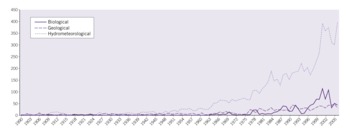
In recent years, disasters triggered by natural hazards have killed a growing number of people and have become increasingly expensive (Figure 1).1 The world's poor, especially in emerging nations, are disproportionately affected, and the most vulnerable and marginalized people in those nations bear the brunt of most disasters.2 In particular, climate-related (eg, hydrological, meteorological) hazards affect this increasing number of people and cause increasingly large economic losses.Reference Thomalla, Downing, Spanger-Siegfried, Han and Rockström3 Between 1970 and 1999, 90% of all disaster-related fatalities were the result of climate-related hazards.1 The Intergovernmental Panel on Climate Change (IPCC) reports that these climate-caused natural hazards are predicted to rise in frequency and severity well into the future.4
Number of natural disasters registered in CRED EMDAT 1900-2005

Source: CRED EM-DAT1
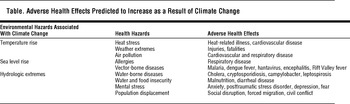
The health impact of climate change is well described in the literature (Table 1).4Reference van Aalst5Reference Mitchell, Lowe, Wood and Vellinga6Reference Woodruff, McMichael, Butler and Hales7Reference Woodruff, McMichael and Hales8Reference Huppert and Sparks9Reference Zell10Reference Parkinson and Butler11Reference Morrissey and Reser12 The positive and negative health effects of climate change vary from 1 location to another and will alter over time as temperatures continue to rise. The IPCC notes, “Critically important will be factors that directly shape the health of populations such as education, health care, public health prevention, and infrastructure.”4
Adverse Health Effects Predicted to Increase as a Result of Climate Change

Human vulnerability to climate-change disasters is also increasing worldwide. To mitigate this vulnerability, scientists have proposed adapting to climate change through a comprehensive approach to disaster risk reduction. This proposal posits that adaptation should occur first at the community level. Public health is uniquely placed at the community level, where it can work to lessen human vulnerability to climate-related disasters. The purpose of this article is to introduce the basic concept of disaster risk reduction so that it can be applied to preventing and mitigating the negative effects of climate change.
PUBLIC HEALTH IMPACT OF NATURAL DISASTERS RELATED TO CLIMATE CHANGE
Climate change is usually defined as “any changing climate, over time, whether due to natural variability or as a result of human activity.”4 In 1988, the World Meteorological Organization and the United Nations (UN) Environment Programme established the IPCC. In 2007, the IPCC concluded that “Most of the observed increase in global average temperatures since the mid-20th century is very likely (90–99%) due to the observed increase in anthropogenic greenhouse gas concentrations.”4 The IPCC further stated that “Warming of the climate system is unequivocal, as is now evident from observations of increases in global average air and ocean temperatures, widespread melting of snow and ice, and rising global average sea level.”4
As 1 of the main health hazards listed in Table 1, extreme weather events predicted to occur as a result of global warming are categorized as either high precipitation (eg, storms, floods, landslides) or low precipitation (eg, heat, droughts, wildfires). Without outside assistance, these events often overwhelm the capacity of communities and societies to respond, and the resulting mismatch between needs and resources generally results in a disaster declaration.
ADAPTING TO THE HUMAN HEALTH IMPACT OF NATURAL DISASTERS
We can mitigate the future effects of climate change by addressing the factors that cause those changes (eg, carbon emissions) and we can adapt to changes in climate by addressing the factors that make society and the environment vulnerable to climatic effects. The IPCC defines climate change mitigation as “initiatives and measures to reduce the vulnerability of natural and human systems against actual or expected climate change effects.”13 Mitigation policies focus on, for example, either controlling the emissions of greenhouse gases or capturing and sequestering those emissions (ie, reducing the hazard).
The IPCC describes adaptation as the “adjustment in natural or human systems in response to actual or expected climatic stimuli or their effects, which moderates harm or exploits beneficial opportunities.”13 Adaptation policies focus on taking steps to reduce the human and environmental impact of climate (ie, reducing the vulnerability). Effective climate policy necessarily requires a combination of mitigation and adaptation, but for the past decade, climate policy has “reflected a bias against adaptation.”Reference Bouwer and Aerts14 Consequently, although adaptation is expected to become increasingly important in future climatic policy, explicit funding possibilities for adaptation activities are limited.Reference Bouwer and Aerts14 Nevertheless, public health can still serve as an important instrument for promoting an adaptation approach to climate-related disasters. This article examines the role of community-focused public health as a means for lessening human vulnerability as an adaptation to extreme weather events predicted to increase as a result of climate change.
DISASTER RISK REDUCTION AND CLIMATE CHANGE
Disaster Risk
Disasters are often described as “a serious disruption of the functioning of a community or a society causing widespread human, material, economic, or environmental losses that does exceed the ability of the affected community or society to cope using its own resources.”15 An emergency is an event that does not exceed a community's or a society's capacity to cope.15 Emergencies and disasters are thus part of a continuum of events that occur when a population is exposed to a “threatening event or potentially damaging phenomenon,” that is, a hazard.15 Risk reduction actions reduce the number of events that exceed the community's or society's ability to respond, thereby preventing some emergencies from ever becoming disasters.15 The following are definitions of terms related to disaster risk reduction15:
Capacity: The combination of all of the strengths, attributes, and resources available within a community, society, or organization that can be used to achieve agreed-upon goals.
Disaster: A serious disruption of the functioning of a community or a society involving widespread human, material, economic, or environmental losses and effects, which exceeds the ability of the affected community or society to cope using its own resources.
Disaster risk: The potential disaster losses, in lives, health status, livelihoods, assets, and services, which could occur to a particular community or a society over some specified future time period.
Disaster risk reduction: The concept and practice of reducing disaster risks through systematic efforts to analyze and manage the causal factors of disasters, including through reduced exposure to hazards, lessened vulnerability of people and property, wise management of land and the environment, and improved preparedness for adverse events.
Exposure: People, property, systems, or other elements present in hazard zones that are thereby subject to potential losses.
Hazard: A dangerous phenomenon, substance, human activity, or condition that may cause loss of life, injury or other health effects, property damage, loss of livelihoods and services, social and economic disruption, or environmental damage.
Mitigation: The lessening or limitation of the adverse effects of hazards and related disasters.
Resilience: The ability of a system, community or society exposed to hazards to resist, absorb, accommodate, and recover from the effects of a hazard in a timely and efficient manner, including through the preservation and restoration of its essential basic structures and functions.
Susceptibility: The state of being at risk, if exposed to a hazard.
Sustainable development: Development that meets the needs of the present without compromising the ability of future generations to meet their own needs.
Vulnerability: The characteristics and circumstances of a community, system, or asset that make it susceptible to the damaging effects of a hazard.
Disaster consequences may include loss of life, injury, disease, and other negative effects on human physical, mental, and social well-being, together with damage to property, destruction of assets, loss of services, social and economic disruption, and environmental degradation.15 The severity of these consequences is referred to as disaster impact. Disasters occur as a result of the combination of population exposure to a hazard, the conditions of vulnerability that are present, and insufficient capacity or measures to reduce or cope with the potential negative consequences.
Disaster risk is “the probability of harmful consequences, or expected losses (deaths, injuries, property, livelihoods, economic activity disrupted, or environment damaged) resulting from interactions between natural or human-induced hazards and vulnerable conditions.”15 Disaster likelihood is the product of the probability of the hazard occurrence and the probability of a vulnerable population becoming affected by a disaster. Thus, a disaster is defined by the vulnerability of the population to a hazard event, not by the mere fact of its occurrence.Reference de Ville de Goyet and Lechat16 For any given hazard, risk is variable according to the particular vulnerability of the population (eg, degree of population susceptibility, exposure to, and resilience against the hazard). Risk reduction measures lessen the number of events that exceed the community's or society's ability to respond, thereby preventing some emergencies from ever becoming disasters.
Risk assessment is widely used to quantify environmental health risk. The risk equation has also been broadly applied to estimate disaster risk according to the following relation17:
P(D) = k[p(H) × p(V)] –AC
where p(D) = risk of disaster occurrence, p(H) = the probability of hazard occurrence, p(V) = the probability of population vulnerability, and AC = absorptive (also known as adaptive) capacity. In this example, vulnerability is the degree to which a community or an asset is unable to resist hazard-related damage and loss owing to that community's specific physical, economic, and environmental circumstances. Absorptive/adaptive capacity is described as a limit to the rate or quantity of impact that can be absorbed or adapted to without exceeding the disaster declaration threshold. According to this equation, among at-risk populations disaster risk is reduced by removing the hazard itself, decreasing the vulnerability to risk, and increasing the capacity to absorb risk.
Disaster Risk Reduction
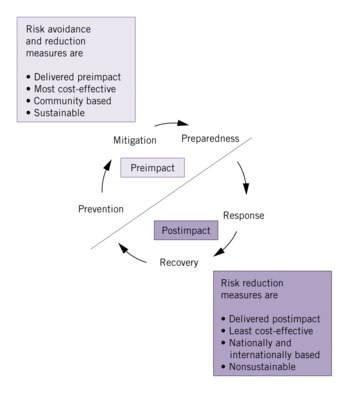
Throughout the world, the overall approach to emergencies and disasters has recently shifted from postimpact activities (ie, ad hoc relief and reconstruction) to a more systematic and comprehensive process of risk management.17 Disaster risk management includes both preimpact disaster risk reduction (ie, prevention, preparedness, and mitigation) and postimpact humanitarian and development action (ie, response and recovery).Reference Schipper and Pelling18Figure 2 represents a diagram of the disaster life cycle comparing risk avoidance, reduction, and retention measures.
A diagram of the disaster cycle comparing risk avoidance, reduction, and retention measures

The underlying goal of disaster management is to reduce risk to both human life and systems important to livelihood: “Climate change adaptation must become part and parcel of comprehensive risk management.”Reference O’Brien, O’Keefe, Rose and Wisner19 The effective impact of the disaster event, then, is determined by the resources of the community and the community's ability to use its resources, referred to here as “capacities” or “coping mechanisms.”Reference Koenig, Dinerman and Kuehl20
Disaster reduction has emerged as a core element of sustainable development: “The continued upward spiral of the costs of natural disasters in the United States will be broken only by a strategy that addresses the full range of obstacles to natural disaster reduction.”21 However, investments in and projects for risk reduction can either increase or reduce vulnerability to hazards.Reference O’Brien, O’Keefe, Rose and Wisner19 This is most often the case with population relocation schemes, in which livelihoods and social networks are disrupted.Reference Schipper and Pelling1822 The 2002 World Summit on Sustainable Development concluded that “an integrated multi-hazard, inclusive approach to address vulnerability, risk assessment, and disaster management, including prevention, mitigation, preparedness, response, and recovery, is an essential part of a safer world in the twenty-first century.”23 Reducing risk requires long-term engagement in the development process,Reference O’Brien, O’Keefe, Rose and Wisner19 and the actual work of disaster risk reduction is largely a task for local actors.Reference Schipper and Pelling18 An example is community-level public health departments, albeit with support from national and international organizations, particularly in humanitarian actions.
Prevention and the Disaster Management Cycle
Disaster risk reduction shares some tenets with preventive medicine.Reference Sidel, Onel and Geiger24 As in preventive medicine, risk reduction calls for a basic attitude shift in the minds of many who traditionally become sick first and seek treatment later. When, however, disasters are understood as the outcome of accumulated risk produced by years of vulnerability and underlying hazard, the case for preventive action can be made more plainly.Reference Schipper and Pelling18
Continuing with the preventive medicine analogy, primary and secondary disaster prevention are activities undertaken during a disaster's preimpact phase.Reference Lechat25 Primary prevention seeks to prevent adverse events from occurring. For example, floodplain management in an area of frequent flooding may actually prevent future inundation disasters altogether. Secondary prevention takes advance measures that decrease or eliminate the effects of risk.17 It involves disaster mitigation, that is, “structural and nonstructural measures undertaken to limit the adverse impact of natural hazards, environmental degradation, and technological hazards,” and preparedness, which is “activities and measures taken in advance to ensure effective response to the impact of hazards.”15 As the level of preparedness increases, the ability of a society to absorb an event becomes a dependent variable of that preparedness, and adverse outcomes are reduced.17 In other words, by increasing public health preparedness, we increase human resilience, decrease human vulnerability, and thus lessen the risk of disasters. In addition, effective risk reduction activities strengthen the buffering capacity of a population to respond to those everyday emergencies found in all societies.Reference de Boer and Dubouloz26 Finally, tertiary prevention activities involve the postimpact phase of disaster response and recovery, when actions are undertaken to minimize loss of life and damage and to return to a preevent status.
In this context, safety is best thought of as the opposite of risk. Risk reduction activities seek to first prevent public health disaster from occurring and then to prepare for and mitigate the health effects of the disaster. Public health may not have the capability to influence the probability of a hazard occurrence (eg, preventing the heat wave itself), but within public health lies a unique ability and opportunity to lessen human vulnerability to the hazard.
PUBLIC HEALTH VULNERABILITY REDUCTION
Vulnerability to Disasters
Human vulnerability to disasters is a complex phenomenon that includes social, economic, health, and cultural factors. Given that an environmental hazard is likely to occur, the risk of a public health disaster is lessened by reducing human exposures to the hazard by a reduction of human vulnerability, lessening human susceptibility to the hazard, and building resilience to the impact of the hazard.Reference Keim27
Exposure Reduction
Within this context, exposure is defined as subjection to the influence or effects of a disaster-related health hazard. The toxicity or lethality of an environmental health hazard is often characterized by a dose–response relation. Typically, as the degree of exposure to a health hazard increases, the human emotion of concern—itself an adverse health effect—appears in more of the population. In the case of natural disasters, the degree of exposure of a given population to the environmental hazard (eg, extremes of wind, temperature, precipitation, seismicity, volcanism) has a direct relation to the incidence and severity of adverse health outcomes.Reference Keim2728Reference Malilay29 People located in close proximity to the disaster hazard have a higher risk for injury and illness as compared with those who are less exposed. For example, people living in temperate climate zones may be at higher risk for exposure to hazardous extremes of temperature.
Mitigation serves to reduce population vulnerability by reducing population exposure to disaster hazards.Reference Keim27 Mitigation may occur as both structural and nonstructural measures.28 Disaster-related mitigation activities reduce deaths and injuries by reducing exposure of the population to the hazard. Mitigation measures ensure structural safety through enforcement of adequate building codes, promulgation of legislation to relocate structures away from disaster-prone areas, land use planning and regulation, and management of high-hazard zones.Reference Malilay29 Critical facilities can be identified before disaster occurrence, and engineering measures may be taken to mitigate loss of critical health infrastructure and assets during extreme weather events.
Susceptibility Reduction
Within the context of disaster risk reduction, susceptibility is defined as the likelihood of experiencing an adverse health effect when exposed to a given health hazard. Populations are not equally susceptible to the same health hazard. Differences among people are due to such factors as sex, age, genetic predisposition, and health status. With natural disasters, the degree of susceptibility to a given environmental hazard also has a direct relation to the frequency and severity of adverse health outcomes. Individuals who are more susceptible to a disaster hazard have a higher risk for injury and illness as compared with those who are less susceptible. For example, older adults living in temperate climate zones are more susceptible to heat wave disasters than are young adults living in the same location; vaccinated people are less susceptible than unvaccinated people to infectious disease disasters; and population-feeding programs reduce susceptibility to malnutrition and associated comorbid conditions. In general, healthy peopleReference Shobha Srinivasan, O’Fallon and Dearry30 are less susceptible than unhealthy people to the adverse health effects of disasters. Populations with a lower burden of communicable and noncommunicable disease are less likely to have such illnesses exacerbated by environmental hazards such as temperature rise, sea level rise, and hydrologic extremes. Healthy populations are also more capable than unhealthy populations of taking actions to mitigate their own risk of illness and injury in the case of disaster.
Resilience Building
The UN International Strategy for Disaster Reduction defines resilience with reference to natural hazards as “the capacity of a system, community, or society to resist or to change in order that it may obtain an acceptable level in functioning and structure.”31 The resilience of a social system is determined by the degree to which the system has the necessary resources and is capable of organizing itself to develop its capacities to implement disaster risk reduction and to institute the means to transfer or manage residual risks. People within a population are not equally resilient to the same disaster hazard. Differences among individuals are typically due to social and economic factors such as socioeconomic status, governmental/organizational structures (eg, the public health and medical system), social capital, political influence, and behavioral determinants. In natural disasters, the degree of resilience to a given environmental hazard has also been implicated as having a direct relation to the incidence and severity of adverse health outcomes.Reference Keim27 People who are less resilient to the disaster hazard have a higher risk for injury and illness as compared with those who are more resilient. For example, poor, socially isolated, or underprepared people living in temperate climate zones (eg, those living in New Orleans, LA, before Hurricane Katrina) are more susceptible to temperature-extreme injury than are affluent, well-connected people who prepare and otherwise ensure their own readiness for such an event. Certain characteristics of the built environment may also affect community resilience and make communities more prone or less prone to disaster. Preparedness implies a behavioral approach focused on actions taken in advance of a disaster to reduce its impact. This helps to build resilience from the adverse health effects of disaster hazards.
Other measures besides preparedness also serve to increase the resilience of a population to disaster hazards. These capacity-building measures may include humanitarian relief and response, poverty-reduction programs, sustainable development, and social networks that link vulnerable populations together and with resources that may assist in the case of disaster. Measures that build surge capacity among human and material resources also help to build disaster resilience.
Reducing Vulnerability
Disaster vulnerability reduction programs strive to minimize exposures, reduce susceptibility, and increase resilience. Public health disasters are prevented when populations are protected from exposure to the hazard from the outset. Depending on social and technical feasibility and cost–benefit considerations, investing in preventive measures may be justified in areas frequently affected by disasters. Prevention may include structural or nonstructural measures. Public awareness and education can be used to promote a “culture of prevention” and to encourage local prevention activities. Public health disasters may also be mitigated through structural measures (eg, engineering techniques, hazard-resistant construction) or non-structural measures (eg, improved policies, legislation, public awareness, training and education, public commitment, operating practices) undertaken to limit the adverse impact of a health hazard. Prevention and mitigation of emergencies decrease susceptibility to the adverse health effects of disasters.Reference Keim27 A capacity for actions related to preparedness, response, and recovery increase resilience to disasters.Reference Keim27
Human vulnerability to climate-related hazards is also increasing because of rising poverty, a growing global population, and other underlying development issues.Reference Schipper and Pelling18 During the last decade, the UN International Decade for Disaster Reduction, the 1994 World Conference on Natural Disaster Reduction (commonly referred to as the Yokohama Conference), the 2002 World Summit on Sustainable Development, and the 2004 World Conference on Disaster Reduction have contributed to a significant shift in disaster management toward a more comprehensive understanding of the underlying causes of hazard vulnerability and the development of a forward-looking, longer-term strategy for anticipating and managing riskReference Thomalla, Downing, Spanger-Siegfried, Han and Rockström3: “Climate-related vulnerability is the set of social, economic, political, and physical factors that determines the amount of damage a given event will cause and the capacity to anticipate, cope with, resist, and recover from that damage.”Reference O’Brien, O’Keefe, Rose and Wisner19
Vulnerability reduction focuses on the ability of people and communities to recover (resilience). It places at-risk people at the center, and it tasks the responsible authorities with enhancing social equity and promoting community cohesiveness while urging a heightened sense of personal responsibility. Fundamental to vulnerability reduction is a change in attitude; a willingness to take on greater personal and local responsibility for mitigating losses that over time will supplant undue reliance on state intervention.Reference Werrity32 The high degree of dependence of many communities on federal and state disaster assistance also raises questions about the sustainability of that assistance. Indeed, sustainability in part embodies a spirit of responsibility and self-sufficiency; heavy reliance on outside resources appears inconsistent with this view. An increased sense of self-sufficiency means communities can better prepare to cope with the financial implications of climate-related disaster events and will likely use more of their own resources, perhaps in all but the most catastrophic of disasters. At least in part, this means accepting more responsibility for development in vulnerable places and striving over time to reduce dependence.Reference Beatley33
Vulnerability links people with their environment and with the social forces, institutions, and cultural values that sustain people. As such, reducing vulnerability is a key aspect of reducing climate-change risk.Reference O’Brien, O’Keefe, Rose and Wisner19 The Yokohama Strategy and Plan of Action for a Safer World led to a change in the UN's approach to mitigating disasters. Previously, the UN had treated human actions and the vulnerabilities of human beings as the main causes of disaster.Reference Schipper and Pelling18 O’Brien et al observed that disaster management has evolved from a “relief and response” approach to a more proactive risk management approach, with a greater focus on reducing vulnerabilitiesReference O’Brien, O’Keefe, Rose and Wisner19; however, initiatives aimed at mitigation and prevention are still too few and too underfinanced.
POVERTY, HEALTH DISPARITY, AND DISASTER VULNERABILITY
The burden of natural disasters falls disproportionately on the disenfranchised—the poor, ethnic minorities, old people, and people with disabilities. Worldwide, loss of life from climate-related disasters is far higher among the less-developed nations than it is in developed nations. Yet, within each nation, including developed nations, poor people are the most affected422Reference Brouwer, Akter, Brander and Haque34: “The poorest people in the poorest countries are the most vulnerable—and it is vulnerability that kills.”Reference Nelson35
Poverty is an important determinant of environmental risk—and hence of socioeconomic vulnerability—and is an important constant of adaptive capacity.Reference Brouwer, Akter, Brander and Haque34 Poverty is both a condition and a determinant of vulnerability; as such, poverty reduction is an essential component of reducing vulnerability to natural hazards and to climate change.Reference Thomalla, Downing, Spanger-Siegfried, Han and Rockström3 To reduce vulnerability to climate-related disasters, a clear understanding is needed of who is the most vulnerable to such disasters. The most vulnerable tend to be particular social groups, such as those with inadequate access to economic (eg, credit, welfare) and social capital (eg, networks, information, relationships).Reference Thomalla, Downing, Spanger-Siegfried, Han and Rockström3Reference Tapsell, Penning-Rowsell, Tunstall and Wilson36 Some of the risk factors for human vulnerability to disaster-related morbidity and mortality include the followingReference Brouwer, Akter, Brander and Haque34Reference Tapsell, Penning-Rowsell, Tunstall and Wilson36:
• Low income
• Low socioeconomic status
• Lack of home ownership
• Single-parent family
• Older than 65 years
• Younger than 5 years
• Female sex
• Chronic illness
• Disability
• Social isolation or exclusion
These groups are most vulnerable to the public health effects of natural disasters. These high-risk populations must be prioritized in efforts to decrease human vulnerability. Because public health is the school of medicine concerned with the health of the community as a whole, it routinely builds capacity and resilience among these populations. In many cases, public health programs uniquely address the issues related to health disparities that arise between the general population and these most vulnerable groups.
SUSTAINABLE DEVELOPMENT AND RISK REDUCTION
The emerging vision of environmental sustainability as wedded to economic vitality and social equity is becoming an important rationale for reducing natural-hazard risk to human settlements.Reference Olshansky and Kartez37 Sustainable development is “development that meets the needs of the present without compromising the ability of future generations to meet their own needs.”38 Principle 1 of the Declaration of the UN Conference on the Human Environment at Stockholm stated, “Man has the fundamental right to freedom, equality, and adequate conditions of life, in an environment of a quality that permits a life of dignity and well-being, and he bears a solemn responsibility to protect and improve the environment for present and future generations.”38
The high property damage levels in recent disasters clearly suggest that current patterns and practices of land use and community building are not sustainable in the long run.Reference Beatley33 For example, the economic effects of Hurricane Katrina, which hit the United States in late August 2005, were far reaching. As of April 2006, the Bush administration had sought $105 billion for repairs and reconstruction in the region, making it the costliest natural disaster in US history. The total economic impact on Louisiana and Mississippi may exceed $150 billion.Reference Burton and Hicks39 By enhancing adaptive capacity and increasing resilience, sustainable development reduces vulnerability to climate change for the long term.440
Developing nations are particularly affected by climate change.4Reference Schipper and Pelling18 Not only can disasters lead to loss of life and destruction of homes, infrastructure, and livelihoods but they can also cause significant financial damage that can impede development. Hurricane Mitch caused losses in Honduras and Nicaragua that set development back 20 years.41 Disasters triggered by natural hazards are a consequence of development failure as much as failed development is the product of disasters.42 Economic development achieved in a sustainable manner could itself be regarded as an adaptation measure for climate change.Reference Fankhauser43
Climate change increases the urgency to integrate risk management into development interventions. Climate change is the nexus at which sustainable development, policy, climate change, and communities intersect.Reference O’Brien, O’Keefe, Rose and Wisner19 Addressing climate change can be viewed as 1 component of a broad, sustainable development strategy that aims to increase national and regional capacity to deal with climate variability and long-term climate change.Reference Schipper and Pelling18 Some believe that risk reduction and, more specifically, measures directed at the underlying macrolevel causes of vulnerability should be integrated into development policy. Others believe that explicit climate change adaptation strategies should respond only to the ramifications of change. Still others advocate that climate change does not call for a different or new strategy because problems created by climate change will build upon existing development problems.Reference Watson44
SUSTAINABLE COMMUNITIES AND CLIMATE CHANGE
Sustainable communities are communities “where people and property are kept out of the way of natural hazards, where the inherently mitigating qualities of natural environmental systems are maintained, and where development is designed to be resilient in the face of natural forces.”Reference Godschalk, Kaiser and Berke45 A community that is healthy and safe promotes the concept of resilience within the community. It can be built and enhanced to support all of the community's members, neighborhoods, schools, churches, workplaces, and government. Also, public health is by definition the science and practice of protecting and improving the health of a community. Community-based public health agencies routinely develop and implement interventions that lessen human vulnerability, often targeting high-risk groups through a wide range of programs. By reducing the vulnerability of the at-risk population, community-based public health is uniquely positioned to match sustainable adaptation to the increasing risk of climate-related disasters.
Mounting evidence suggests that social, health, and economic consequences are inherent in the built environment. Human-modified places such as homes, schools, workplaces, parks, industrial areas, farms, roads, and highways that make up the physical and social construct of the urban environment also promote isolation.Reference Bashir46 This isolation may result in a lack of social networks and diminished social capital that further exacerbates vulnerability to climate-related disasters.Reference Hawe and Shiell47
Although preliminary research demonstrates the health benefits of sustainable communities, the health-related impact of mediating and moderating factors within the built environment needs further exploration. Recent research explores the improved built environment effects of physical activity, asthma, obesity, cardiovascular disease, lung cancer mortality, and mental health.Reference Shobha Srinivasan, O’Fallon and Dearry30 As with environmental disasters in general, the impact of the built environment on the burden of illness is greater among minorities and low-income communities.Reference Shobha Srinivasan, O’Fallon and Dearry30 Consequently, these populations may already experience much greater baseline burdens of disease in addition to any future increases in disaster-related morbidity and mortality associated with climate change.48 In the context of natural disasters, a pressing need remains for more concerted research that will identify ways in which the built environment affects health, either negatively or positively.
BUILDING PUBLIC HEALTH RESILIENCE IN SUSTAINABLE COMMUNITIES
Margareta Wahlstrom, UN Assistant Secretary-General, has said, “Disasters are first and foremost a local phenomenon. It is therefore fitting that we focus our energies on improving local communities' resilience to natural hazards. Disaster reduction begins at home, in our schools, places of work and worship, and throughout local communities.”48 The increased risk of natural disasters brought on by climate change also presents an opportunity to build healthy and disaster-resilient homes and communities. Although disasters destroy lives and property, they also create opportunities to improve safety, enhance equity, and rebuild in new or different ways. Ideally, those opportunities would produce safer communities with more equitable and sustainable livelihoods for people.Reference Bolin49 Community public health and medical institutions can play an active part in lessening human vulnerability to climate-related disasters through promotion of healthy people, healthy homes, and healthy communities.Reference Shobha Srinivasan, O’Fallon and Dearry30 Healthy people are less likely to experience disaster-related morbidity or mortality and are therefore more disaster resilient. Healthy homes are disaster resilient—they are designed and built to remain safe during extreme weather events. Healthy communities minimize exposure of people and property to natural disasters; in other words, sustainable communities are disaster-resilient communities.Reference Beatley33 In this sense, nearly all avenues of public health promotion can also act to reduce the risk of future climate-related disasters.
Populations that have easy access to economical, community-based public health and medical services are obviously more resilient against disasters. After Hurricane Katrina, a 2005 Lancet editorial criticized the level of public and governmental support for a resilient public health system that protects human life when disasters occur.Reference Anonymous50 Significant and growing general concern surrounds the longer-term effects of climate change on human health.4 Sustainable, cost-effective, community-based public health and medical systems strengthen populations' resilience to extreme weather events, and methods that reduce populations' vulnerability also increase resilience against natural disasters caused by climate change.
CONCLUSIONS
Mitigation through large-scale reduction of carbon emissions and increase of sequestration can lessen or avoid altogether many of the effects of climate change. Although humans may not always have the ability to prevent climate-related hazards from occurring, the public health and medical sectors can play an important role in lessening or even preventing the human suffering that is part and parcel of these disasters. Climate change adaptation, public health, and disaster risk management should be mainstreamed with sectoral activities and development processes.Reference Thomalla, Downing, Spanger-Siegfried, Han and Rockström3 At the community level, all 3 of these societal risk reduction programs are characteristically well integrated.Reference Allen51Reference Warner and Oré52 Community-based risk reduction activities that integrate public health, disaster management, and climate change lessen human vulnerability to the effects of natural disasters. In this regard, public health vulnerability-reduction activities that lessen disaster risk can also serve as a sustainable adaptation to climate change, and a supportive policy environment at the national and international level can enable local adaptation.53
Author Disclosures: The author reports no conflicts of interest.