In Gifts of Athena, Joel Mokyr notes that throughout the past, “technological progress has run into an even more powerful foe: the purposeful self-interested resistance to new technology. Outright resistance is a widely observed historical phenomenon.”1
Mokyr, Gifts, p. 220. For recent examples, see Bauer and Gaskell, eds., Biotechnology. In Barriers to Riches, Parente and Prescott argue self-interested resistance to innovation plays a key role in explaining international differences in economic performance.
Olmstead and Rhode, “Agricultural Mechanization,” pp. 35–53, examined the activities of the Horse Association of America, an organization of businesses tied to the horse trade that lobbied to forestall the coming of the horseless age.
This article examines resistance to government-led campaigns to control bovine tuberculosis (BTB) in the United States. By the end of the 1890s, advances in the germ theory of disease led to the identification of the cause of BTB, the bacteria M. bovis, and the development of a new diagnostic tool, tuberculin. These discoveries caused animal health officials to realize that BTB was a serious and growing threat to both human and livestock health. The disease was spreading through the nation's dairies and breeding cattle, creating symptoms similar to those experienced by humans afflicted with M. tuberculosis. M. bovis also infected humans through contaminated dairy products, meat, and direct contact with tubercular animals, killing thousands of Americans every year.
Amidst an international controversy involving many of the world's most eminent scientists, leading public and animal health authorities in the United States began to advocate for the seemingly utopian scheme of banishing BTB from the country by testing all cattle and then culling those that reacted. This was a daring proposal because no nation had ever attempted to eliminate such a widespread (enzootic) disease. The campaign against BTB advanced in two phases. From 1893 to 1917, many states enacted control programs with compensation for the owners of condemned animals ranging from nothing to complete coverage. In addition, most major cities mandated that the milk sold within their jurisdictions be pasteurized and come from cows that had passed the tuberculin test. These state and local efforts were plagued by enforcement problems arising from the movement of infected animals and contaminated products across jurisdictional boundaries. In 1917 the federal government initiated a cooperative campaign with state governments to eradicate the disease. This campaign witnessed the unprecedented peacetime use of police power as testers inspected every dairy and cattle operation in the nation. Officials ordered the destruction of 3.8 million bovines with only partial compensation to the owners. This campaign brought the disease under control by 1941, generating returns to the livestock sector in excess of ten times the program's costs (including the uncompensated losses) and saving tens of thousands of human lives.3
See Olmstead and Rhode, “Impossible Undertaking,” pp. 734–72, for estimates of the financial and human costs, a discussion of the disease and its spread, and an analysis of the eradication program. The United States had previously culled cattle to stamp out contagious pleuro-pneumonia and foot-and-mouth disease, but not on such a grand scale. The attempt to limit the spread of flu by destroying poultry represents a recent example of mass eradication.
Although most dairymen and cattle breeders eventually cooperated with the program, significant segments of the farm population fought BTB eradication initiatives at every step. Early municipal efforts to impose tuberculin testing in Chicago, Milwaukee, and Washington, D.C. met with protests and milk strikes. During the 1920s the federal campaign provoked the opposition of the American Farmers' Union and the American Medical Liberty League (AMLL) as well as vociferous attacks from U.S. Senator Carter Glass. Most notably, prolonged hostilities in Iowa led to farmer riots and the declaration of martial law in 1931. This “Iowa Cow War” attracted national attention and inspired opposition in other states. Indeed, the Golden State emerged as the center of resistance against compulsory testing as Central Valley dairymen tied up the legal system and disrupted testing efforts through the late 1930s.
Drawing on newspaper accounts, court cases, and the archival records of the U.S. Bureau of Animal Industry (BAI), the Federal Radio Commission (FRC), the American Medical Association (AMA), Carter Glass, and others, we analyze the political economy that motivated the forces opposing and supporting BTB eradication. In addition, we explore how the early scientific debates over the danger of M. bovis shaped the discourse and effectiveness of the resistance movement. Further, we examine the range of techniques used to oppose the testing campaign and their parallels in modern efforts to oppose new technologies. Finally, we offer a fresh perspective on the Iowa Cow War by integrating it into the longer story of opposition to tuberculin testing technology. This interpretation contrasts with the standard accounts by Dale Kramer, Roland White, Jean Choate, and others that portray the controversy primarily as a part of a larger farm protest against the Great Depression.4
Kramer, Wild Jackasses, pp. 206–19; Shover, Cornbelt, pp. 28–40; White, Milo Reno, pp. 20–21, 49–64; and Choate, Disputed Ground, p. 44.
THE LOGIC OF RESISTANCE
Resistance to the tuberculin-based eradication effort should not be viewed as a knee-jerk Luddite reaction. The science underlying this innovation was new, controversial, and in many ways counterintuitive. The test-and-slaughter campaign, moreover, had the nature of Rousseau's stag hunt—success required that all parties participate to address spillover effects. The effective use of the new diagnostic technology, as with the construction of railroads and dams and the imposition of vaccination programs, required collective action. This meant that “all-or-nothing” decisions about adoption became public, rather than strictly individual, choices, making organized resistance all but inevitable.5
As Mokyr, Gifts, p. 236 notes, “when major technical choices involve public expenditures, complementary or substitute relations with other technologies, or other types of spillover effects, they will end up being judged by non-market criteria.” In such cases, “artificial distinctions between the ‘economic sphere’ and the ‘political sphere’… are doomed.” p. 221. Mokyr, p. 241 characterizes public health technologies, along with those in transport, education, and the military as especially likely to be subject to political rather that market decisions. For a related discussion, see Duflo and Pande, “Dams.”
Opposition focused on three sets of issues. The first involved the scientific underpinnings and the efficacy of the new technology. Opponents disputed the validity of the new discoveries motivating the eradication campaign, arguing that the disease organism was misidentified and that the testing process was subjective and inaccurate. Some went further, claiming that injecting tuberculin, a product derived from the disease organism, into healthy animals violated “Nature's order” and endangered both animals and humans. Opponents asserted that the scientific understanding behind the program was “mere theory” with insufficient support to justify the slaughter of valuable animals. Even among those who did accept the underlying science were many skeptics who argued that eradication on a national scale was impossible and that less draconian and less risky alternatives were available. In economic terms, this latter point pertained to efficiency questions—that is, whether the net expected benefits of the eradication effort were positive and greater than the alternatives.6
For a related discussion and examples of resistance to the application of new medical science and government-sponsored “mass medication,” see Mokyr, Gifts, pp. 244, 247–48, 250, 252, and 266.
The second set of issues concerned the distribution of the costs and benefits. The benefits of the new test-and-slaughter policy were spread across a large and dispersed population, including consumers, meatpackers, and many farmers. The costs were concentrated among a few. Owners of valuable cattle threatened with immediate destruction risked financial ruin. While arguments about Pareto improvements often discuss hypothetical transfers, designing institutional mechanisms that work in practice is tricky. The tuberculin testing controversy represents an interesting case where the technology's proponents actually devised the means to partially compensate the losers.7
See Mokyr, Gifts, pp. 253–54, 262–63.
The third set of objections involved the implementation of the program and issues of due process. Many farmers were alarmed that outsiders claiming expert status were meddling in their day-to-day operations; opponents also bitterly complained that they had few avenues for appeal if their animals were condemned. These concerns often carried an individualistic or libertarian theme deriding the heavy-handed actions of government bureaucrats who threatened individual liberty, property, and (if the science was wrong) even lives. The objections to the test-and-slaughter program were often tied to other, broader grievances. Indeed, the most vigorous resistance occurred when existing organizations and communities took up the “anti” campaign as part of their broader causes. Mokyr has noted that innovation often encounters “many powerful enemies with a vested interest in the status quo or an aversion to change continuously threatening it.”8
Ibid., p. 221. And in contrast to the interpretation of Parente and Prescott, Barriers to Riches, these resistors were not powerful insiders with monopoly rights.
BOVINE TUBERCULOSIS, TUBERCULIN TESTING, AND THE SCIENTIFIC DEBATE
Bovine tuberculosis was an especially dangerous disease because it could take years for infected and contagious animals to manifest visible symptoms. It was not until the advanced stages that cows lost weight and their milk production dropped by up to 25 percent. Eventually the cattle might show external lesions, have coughing attacks, and die prematurely. M. bovis spread among cattle (and other animals) by contact with infected animals or with contaminated materials. Rates of infection were higher among closely confined cattle than in free-range animals. As a result, BTB was far more common in dairy herds. Public health officials and farmers were shocked when over one-half of the animals in some prized herds reacted to early tuberculin tests. Circa 1917, the best estimate is that 5 percent of U.S. cattle were infected, including 10 percent of dairy animals and 1–2 percent of range cattle. This represented a roughly 50 percent increase from the infection rates prevailing a decade earlier. Without vigorous countermeasures, infection rates would likely have reached those found in many northern European regions where well over one-half of milk cows were diseased.9
See Olmstead and Rhode, “Impossible Undertaking,” pp. 737–40.
Ibid., p. 768
The scientific understanding of tuberculosis was rapidly advancing by the end of the nineteenth century. The most notable contribution was Robert Koch's discovery of the tubercle bacillus, M. tuberculosis, in 1882. But with progress came controversy. In 1898 Theobald Smith identified small differences in cultures drawn from bovine and human sources. At first Koch maintained that the human and bovine forms of the bacteria were identical. At the 1901 International Congress on Tuberculosis held in London, Koch did an about-face, proclaiming that M. bovis was indeed a distinct organism, but that it posed little threat to humans. He noted that “if such a susceptibility really exists, the infection of human beings is but a very rare occurrence. I should estimate the extent of infection by the milk and flesh of tubercular cattle … as hardly greater than that of hereditary transmission, and I therefore do not deem it advisable to take any measures against it.”11
Koch, “Combating of Tuberculosis,” pp. 441–56; Miller, “Tuberculous Cattle,” p. 28; and Myers, Man's Greatest Victory, pp. 106–109.
Myers and Steele, Bovine Tuberculosis, p. 57. On the Koch controversy, see Rosenkrantz, “Trouble,” pp. 156–59, 174–75.
Koch's declarations helped galvanize the opposition to BTB eradication efforts. A 1901 editorial in Breeder's Gazette offers a sense of the rage:
For years the noble army of tuberculin squirt gun manipulators has been marching up the hill, beating tom-toms and brandishing the pole-axe, crying ‘Kill, Kill.’ This fierce and bloodthirsty campaign against our herds has been waged on the disputed assumption that tuberculosis in cattle is a menace to the public health…. Servile worshippers of asserted authority, the half-baked scientists and zealots of the squirt gun brigade have pushed their work of destruction until it has mounted to millions of dollars…. [But following Koch's assertion that the human and bovine diseases were distinct] watch the noble army of matadors march down the hill.13
“Move to Modify Quarantines,” Breeder's Gazette (2 October 1901), p. 507; Myers, Man's Greatest Victory, pp. 345–46. See also Orland, “Cow's Milk,” pp. 179–202.
Miller, “Tuberculous Cattle,” p. 35; and New York Times (1 June 1904), p. 1.
The irony is that the whole testing program rested on one of Koch's many contributions. Control of BTB was impossible without early detection in animals not exhibiting visible symptoms. In 1890 Koch solved this problem with the development of tuberculin. The early tuberculin test involved injecting an animal with the substance and then repeatedly checking for signs of a fever or swelling.15
U.S. Bureau of Animal Industry [hereafter U.S. BAI], Special Report, pp. 416–18; Smith, Conquest, pp. 7–9; Houck, Bureau, pp. 364–66; and Myers, Man's Greatest Victory, pp. 115, 125.
Mokyr, Gifts, p. 236; see also Nelkin, ed., Controversy, pp. 16–17; and Dormandy, White Death, pp. 141–43.
Once injected, tuberculin provided animals with extended immunity against further reactions. As a result, the introduction of tuberculin widened the information asymmetries inherent in the livestock market by providing unscrupulous sellers with knowledge about the health of their animals that buyers could not easily discover. Using privately administered tests, livestock owners could detect the disease in their cattle and then sell the reactors to buyers who could not accurately retest the animals for two to three months. By this time just one sick animal could have infected an entire herd. In many instances, owners of diseased cattle first “plugged,” that is injected their animals with tuberculin, and then submitted them to unwitting state officials for testing and certification. Thus, the invention of tuberculin represented a double-edged sword—it was necessary to bring the contagion under control, but it was also misused, spreading the disease and creating collective action problems.17
Olmstead and Rhode, “Tuberculous Cattle Trust,” pp. 942–44; McCann, This Famishing World, sec. 103; and Schlebecker and Hopkins, History, p. 201.
GOVERNMENTAL CONTROL EFFORTS
The public response to the growing knowledge about BTB represents a prime example of what Jonathan R. T. Hughes has called the “Governmental Habit.”18
Hughes, Governmental.
Teller, Tuberculosis Movement, p. 19; and Peters, “History,” pp. 894–95.
Myers, Man's Greatest Victory, pp. 272–74, 283; Teller, Tuberculosis Movement, p. 20; and Reynolds, “Problem,” pp. 454–58.
By 1900 many other states had initiated programs. In Wisconsin, the state and the university designed programs to encourage widespread testing and remove reactors. Illinois provided voluntary testing of herds but no compensation for reactors. In New Jersey, the State Tuberculosis Commission offered testing of individual animals (rather than herds) and paid full compensation for reactors slaughtered. The State Board of Health bore the responsibility for TB control in New York, providing partial compensation for condemned reactors. In Michigan, reactors were either slaughtered without state compensation or kept isolated. Delaware, Maine, Maryland, Minnesota, New Hampshire, Rhode Island, and Vermont also enacted legislation falling within this range of policy options.21
Myers, Man's Greatest Victory, pp. 278–79; and Salmon, Legislation, passim.
In 1906 the federal government began a voluntary testing campaign in Washington, D.C., and in 1909, the United States Department of Agriculture (USDA) made tuberculin testing mandatory in the District. The government also experimented with relatively generous compensation schemes. These efforts led to a rapid decline in the prevalence of the disease. The fraction of local animals reacting to tuberculin fell from about 18 percent in 1906 to less than 1 percent in 1919. This experience, along with those of several states, convinced USDA officials that a more ambitious national program might work.22
Area dairymen initially responded to the testing program with alarm as the following Washington Post articles attest: “Dairymen Are Up in Arms: Declare Tuberculin Test May Lead to Milk Famine” (18 April 1907), p. 16; “Plead for Milk Cows,” (1 May 1907), p. 16; “Would Oust Dr. Woodward: Milk Dealers to Aid Producers in Fight on Tuberculin Test,” (10 October 1910), p. 3; “Milkmen Going to Court,” (11 October 1910), p. 16; “Milkmen Near Clash,” (18 October 1910), p. 4; and Hickman, “Eradication,” pp. 231–42.
The cooperative state-federal anti-BTB campaign began in 1917 when Congress initiated a voluntary national program and authorized the payment of indemnities. As the program evolved the federal government matched state indemnities, up to one-third of the difference between the animal's appraised value and salvage value, with a cap on the federal payments initially set at $50 per head for registered purebreds and $25 per head for grade cattle.23
Myers, Man's Greatest Victory, p. 295. To provide an example, assume that a purebred cow was appraised at $200 and had a salvage value of $50. In this case the federal government would match a state's payment up to the $50 limit. The state could pay more than $50 if it chose.
Larson, Davis, Juve, et al., “Dairy Industry,” p. 341.
The mechanics of the program differed across states. In general, the program began locally (typically encompassing a county) when a set fraction (at least a majority) of dairymen in the area agreed to participate. The tests were then compulsory for all cattle operators in that area and the slaughter of reactors was mandatory. Owners generally could not appeal the test results, but they could contest the reactor's appraised value, and thus the amount of the indemnity. To spur the lagging localities, states often made testing compulsory later in the process. By 1940 government agents had administered roughly 323 million tests and condemned 3.8 million animals. The national infection rate had fallen from about 5 percent of all cattle in 1917 to below 0.5 percent in the late 1930s.25
Wight, Lash, O'Rear, et al., “Tuberculosis,” p. 237.
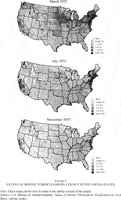
A fuller sense of the geographical patterns of adoption of the eradication program can be gained from Figure 1, which reproduces BAI county-level maps surveying the extent of the disease in March 1922, July 1931, and November 1937. In 1922 the disease was widespread in the dairy regions of the Northeast and Lake States; it was far less common in the South. Significant progress toward eradication was made by 1931. Entire states, including North Carolina (1928), Maine (1929), and Michigan (1930), had achieved the status of “modified accredited areas,” but in much of California as well as parts of the East, the contagion had worsened.26
U.S. BAI, Status, various issues. These three documents are a part of a series issued by the BAI between 1922 and 1941 of 23 maps charting the progress of the control program.

FIGURE 1 EXTENT OF BOVINE TUBERCULOSIS BY COUNTY IN THE UNITED STATES
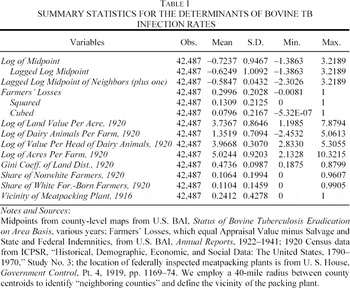
By analyzing the county-level data displayed in the entire set of BAI maps together with information on the characteristics of the farming communities and on the operation of the program, we can more fully explore the determinants of the program's adoption. Tables 1 and 2 present summary statistics and regression results describing the extent of the disease in 3,024 counties over the 1922 to 1935 period. The dependent variable was measured in six categories—infection rates over 15 percent, between 7 and 15 percent, between 3 and 7 percent, between 1 and 3 percent, under 1 percent, and the under 0.5 percent of the “modified accredited area.” For simplicity, the rate of infection is coded as the midpoint—i.e., the 3 to 7 percent range is entered as 5 percent. The explanatory variables include transforms of the past level of infection; the average previous level of infection in neighboring counties; variables reflecting the state-level ratio of the average losses borne by farmers (the reactor's appraised value minus indemnities and salvage value as a share of appraised value); the county-level value of farm land per acre as reported in the 1920 Census of Agriculture; the distribution of acreage as measured by the mean size and Gini coefficient of inequality; the average number of dairy animals per farm and value per head; the 1920 fraction of farmers who were nonwhite or foreign-born whites; and finally, whether the county was in the vicinity of a federally inspected meatpacking plant operating in the late 1910s. The regressions also include time dummies (not displayed) to control for the intervals between the surveys. Because data on the state-level farmer loss ratios are available only through 1935, we limit our analysis to the first 15 surveys. A coefficient may be interpreted as follows: a negative sign means that the variable is associated with more rapid progress at the county level in reducing the prevalence of the disease from its previous level.


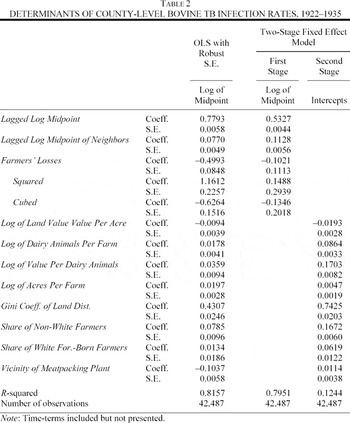
Table 2 displays the estimates using OLS with robust standard errors. It also shows results using a two-stage fixed-effects approach.27
The first stage exploits the panel nature of the data to estimate a fixed effects model for the time-varying variables. The second stage uses the resulting county-level intercepts to estimate the cross-sectional variables.
In the OLS results, the most rapid progress occurs at a loss ratio of 0.26. Over one-half of the observations (54 percent) had loss ratios in the 0.18 to 0.35 range, consistent with an effect of progress within 10 percent of the optimum. Results are less sharp in the fixed effect model, perhaps due to limited variation in the loss ratios within states over time. In the first stage estimation, each of the loss coefficients is statistically insignificant. Jointly the coefficients are significant and indicate a negative relationship.
The results also indicate that, as one might expect, wealthier counties (those with more valuable land in 1920) made more rapid progress. But those counties with more dairy animals per farm and more valuable dairy animals made slower progress. The latter effects might appear surprising at first, but make sense given that the disease was more prevalent and tended to spread more rapidly in the advanced areas where dense populations of high-quality animals (including purebreds) were kept in close confinement. The OLS regression also shows that counties in the vicinity of federally inspected meat plants made more rapid progress. Meatpackers were among the leading advocates of the campaign and often encouraged the effort by paying premiums for cattle and swine from clean areas.29
Myers, Man's Greatest Victory, pp. 368–69. Note that in the second stage of the fixed-effect regressions, the coefficient on packing plants is positive, indicating that they were located in more diseased areas. Responsible meatpackers had an incentive to promote eradication, because the infected portions of diseased animals had to be sent to secondary markets or destroyed. Olmstead and Rhode, “Impossible Undertaking,” p. 740.
An important branch of the political economy literature examines how community-level heterogeneity affects economic performance and specifically the provision of public goods. Alberto Alesina and Eliana La Ferrara argue that ethnically “fragmented societies are often more prone to poor policy management … than homogenous ones….” Gary Libecap suggests that collective action problems are harder to resolve when the assets of economic agents are more unequal.30
Alesina and La Ferrara, “Ethnic Diversity,” p. 763; and Libecap, Contracting, pp. 19–26.
Olmstead and Rhode, “Impossible Undertaking,” pp. 753–55.
EARLY OPPOSITION TO THE ERADICATION PROGRAM
The campaigns to eradicate BTB generally had support from the veterinary community, meatpackers, university agricultural colleges, and an assortment of public health officials. But the enthusiasm among farmers was far from universal, in part due to earlier mistakes. According to D. E. Salmon, chief of the U.S. Bureau of Animal Industry: “the first attempts to control this disease … were so radical and harsh that they aroused the antagonism of the cattle owners, the men who above all others should have been aided and benefited….”32
Salmon, “Tuberculosis,” p. 5.
As an example, in 1908 Chicago passed an ordinance requiring pasteurization of all milk sold in the city as well as tuberculin testing of the cows that produced it. This ignited a maelstrom of protest among dairy operators and milk dealers that lasted for years. During these early and often violent conflicts between the metropolitan interests and dairies, farmers repeatedly blockaded milk shipments. In this hostile environment, dairymen saw the health regulations as unilateral mandates that raised production costs without providing adequate compensation. Breeder's Gazette (16 June 1909) sided with the opponents: “Strange as it may seem there is still suggestion of the ‘kill all’ policy—to kill all reacting cows. It would be a sad day if any legislature should so far forego sanity as to enact such a statute. It would mean a shot-gun reception to the pole-tax [sic] inspectors—a state of real anarchy. There must be more of fact and less of hypothesis before such a policy can be adopted in the name of public health.”33
“Sane Handling of Tuberculosis,” Breeder's Gazette (16 June 1909), p. 1362. A pole-axe (as opposed to a “pole-tax”) was an instrument used to stun and kill cows. The competitive market should have resulted in higher prices allowing farmers to re-coup the costs imposed by regulations, but the dairymen apparently did not fully distinguish between the incidence and ultimate economic burdens of the policy. In 1925, a number of Chicago-area dairymen formed a “Pure Milk Association” that supported stricter quality regulations which would have raised their rivals' costs. Olmstead and Rhode, “Tuberculous Cattle,” p. 941.
In response to the Chicago ordinance, dairy organizations rallied the downstate representatives in the Illinois legislature to join the fight. The Speaker of the House, Edward Shurteff, convened a special investigating committee, which assembled a 2,000 page report largely opposing tuberculin testing and pasteurization. Repeating the heresies of Koch, this 1911 document became a mainstay for the opposition for many years. The legislature also overturned existing municipal pure milk ordinances and prohibited Illinois cities from enacting future testing and pasteurization regulations. This rollback remained in effect until a new governor, Chicago-based reformer Edward Dunne, took office in 1913.34
Olmstead and Rhode, “Tuberculous Cattle,” pp. 940–42, 954; and Pegram, “Public Health.”
The legislative reversal of the Chicago ordinance was one of many nullifications that farmers obtained, but in almost all cases, the courts eventually ruled on behalf of the advocates of public health legislation. Cases concerning the testing and destruction of tuberculous cattle reached the Supreme Courts of Minnesota (1925), Iowa (1926, 1927, 1928, 1930, 1932), Nebraska (1927, 1928, 1930, 1931), Michigan (1929), Ohio (1929, 1930, 1931), Washington State (1932), Illinois (1934), California (1937), and the Court of Appeals of New York (1928). In every case the laws, apart from minor technicalities, were upheld. The underlying reasoning was that the laws protected against disease and, under the common law, cattle infected with contagious diseases were public nuisances and could be summarily destroyed by public officials without compensation to their owners. The courts held that the killing of diseased cattle was not a taking of private property for public use, but an abatement of a public nuisance.35
Tobey, Legal Aspects, pp. 77–81. In Lawton v. Steele, 152 U.S. 136 (1894), the Supreme Court affirmed that the police power “is universally conceded to include everything essential to the public safety, health and morals, and to justify the destruction or abatement, by summary proceedings, of whatever may be regarded as a public nuisance [including] … the slaughter of diseased cattle; the destruction of decayed or unwholesome food.”
The country's farm journals and agricultural organizations split on the issue of the BTB eradication campaign. Hoard's Dairyman was an early advocate whereas Breeder's Gazette and the Rural New Yorker adopted hostile stances. The Farm Bureau and the National Grange endorsed the program while the American Farmers' Union and the American Medical Liberty League (AMLL) mounted stiff opposition that retarded acceptance in several states. Whereas officials of the American Meat Packing Institute, headed by Oscar Meyer, lobbied Congress for the program, the Farmers' Protective Association of Pennsylvania leveled sharp criticism in the 1928 USDA appropriation hearings. One apparent consequence was that Congress, at the behest of President Coolidge, increased the indemnity limits in 1929.36
Smith, Conquest, pp. 13, 17–19, 29–31; U.S. House. Agricultural Appropriation, 1929, pp. 1110–40. See also U.S. Congress, Congressional Record, pp. 10343–44.
The AMLL, a small but vocal group established in Chicago in 1918, remained a committed foe.37
Kaufman, “American Anti-Vaccinationists,” pp. 463–79, esp. p. 466. According to the AMA's Propaganda Department (which kept the League under close surveillance), the AMLL was allied with the British Anti-Vaccination Society and operated into the 1950s. Although AMA officials often ascribed self-interested motivations to the AMLL's actions, an ideology opposing “State Medicine” appears to have been the driving force. The League was not simply a refuge for marginalized faddists and patent medicine peddlers. Among the distinguished speakers at the early AMLL conventions was Clarence Darrow. See “American Medical Liberty League,” pp. 395–98, and AMLL materials in file 15, Box 49, files 1–4, Box 50, in Historical Health Fraud and Alternative Medicine Collection, American Medical Association Archives [hereafter AMA HHF].
Dormandy, White Death, pp. 344–45. This episode led The Rural New Yorker (31 May 1930), p. 715, to condemn advocates of vaccination as “professional fanatics.”
The League's anti-TB testing efforts were spearheaded by the organization's Secretary, Lora C. Little of Chicago, by Joseph W. Sharts of Dayton, Ohio, and by Dr. Eugene Underhill of Philadelphia. In the early 1920s the League raised the hackles of animal health authorities by flooding Midwestern counties likely to mandate testing with anti-tuberculin pamphlets. This literature generated “a great deal of dissention and ill feeling among the farmers” to testing.39
Letter from J. S. Sturve, 7 March 1924, file 2, Box 50 “AMLL-Corr., 1913–26,” AMA HHF. Files 1–4 contain numerous complaints about the AMLL that the AMA received from agricultural journalists, farm officials, and health workers.
Truth-Teller (22 September 1927), p. 7. For an excellent treatment of Lora C. Little's career as an antivaccination crusader, see Johnston, Radical Middle Class, pp. 197–213.
The most prominent critic of the national eradication program was Virginia Senator Carter Glass. In January 1922 a veterinarian representing the Commonwealth of Virginia tested Glass's prized herd of Jerseys and condemned two heifers that reacted. By Glass's account he immediately quarantined the two suspect animals and then asked for a retest.41
Palmer, Carter Glass, pp. 187–91, 257; Smith and Beasley, Carter Glass, pp. 264–67; Glass, Tale, p. 2; and Carter Glass Papers, University of Virginia Special Collections [hereafter Glass Papers], Box 11, file B.
U.S. Senate, Tubercular Infection, passim. In Mohler, Reliability, the BAI offered a point-by-point rebuttal to the major charges.
Glass clearly hit a nerve. Farmers from across the country requested copies while registering their own complaints of arrogance and abuse by officials.43
Glass Papers, Box 88, files 1 and 2.
Truth-Teller (22 August 1928), p. 5; and Glass Papers, Box 88, files 1–3.
THE IOWA COW WAR
The conflict between the pro-testing forces and the “antis” soon unleashed one of the most serious civil disturbances in the history of American agriculture—the Iowa Cow War of 1931. This conflict was first and foremost a response to the BTB campaign. Voluntary tuberculin testing began in the state in 1919. A 1923 law allowed counties to begin compulsory testing if three-quarters of the cattle owners petitioned to implement the program. At this time counties adopting the program had to pay the nonfederal portion of the indemnities. Revisions to the law in 1925 and 1927 shifted the financial burden to the state and lowered the threshold for action. Testing became compulsory if 65 percent of cattle owners in a county signed the petition or if a simple majority voted in favor in a special election. In 1929 the Iowa legislature made testing mandatory across the state. The movement from voluntary to compulsory programs was a general pattern in other states, reflecting the changing self-interest of many farmers. As more herds became TB free, their owners had an incentive to urge their political representatives to force all farmers to participate to prevent the re-infection of clean herds. As the scientific evidence became firmer, health officials, consumers, and pro-testing farmers were emboldened to press for a general cleanup.45
Iowa Dept. of Agriculture, Laws, pp. 2–14; Myers, Man's Greatest Victory, pp. 363–64. The Iowa program provided state funding, but once these allocations were exhausted, local property taxes financed further spending.
In Iowa, opponents of compulsory testing constituted a determined minority. The Cow War erupted in Tipton in eastern Iowa on 8 March 1931 when about 1,000 farmers confronted the state veterinarians and 20 sheriffs sent to test herds on the W. C. Butterbrodt and E. C. Mitchell farms.46
Davenport Democrat (9 March, 10 March, 1931), pp. 1–2. These newspaper articles were collected in the scrapbooks of George Ormsby, a participant in the Cow War. George J. Ormsby Papers, Iowa State University Special Collections [hereafter Ormsby Papers], Box 2, file E. See also Archie, “Times of Trouble,” pp. 28–35, 52–53.
Choate, Disputed Ground, p. 44. One speaker read a poem that echoes the language of the Breeder's Gazette articles noted above: “Knights once went forth with lances/ Clad in coats of mail/ Now they go with squirt guns/ And shoot cows in the tail.” At roughly the same time, Governor Bryan of Nebraska suspended testing in counties in his state where opposition was active. Francis to headquarters, 7 April 1931, U.S. BAI Records, Central Correspondence, 1913–1953, National Archives and Records Administration [hereafter BAI Records].
White, Milo Reno, pp. 53–55.
Many abattoirs that were not federally inspected ground the infected parts for hamburger and sausage. Today, the UDSA bans meat from tubercular animals from the food supply, but in the past only thoroughly rotten animals were “tanked.” Discarding all the meat was considered wasteful, and would have significantly raised program costs. Other countries accepted greater risks. In Germany shops known as “Freibanks” specialized in selling the infected cuts to the poor. Vendors provided special cooking instructions and banned sales to restaurants and boarding houses. Some meat was better than no meat. Emilia Kanthack, “Utility,” pp. 119–21.
A second series of conflicts broke out when testing resumed in Cedar County during September 1931. On the twenty-first of that month, several dozen state agents descended on Lenker's farm in a high-profile effort to enforce the testing mandate. Several hundred farmers confronted the veterinarians and their phalanx of sheriff's deputies, violently driving the outsiders away. In response, Governor Daniel Turner imposed martial law in the area, calling out 1,700 national guardsmen to protect the testers. Two protest leaders, Jacob Lenker and Paul Moore, were arrested and charged with conspiring to interfere with the testing.50
Des Moines Register (22 September 1931), p. 1; Davenport Daily Times (22 and 24 September 1931), p. 1 each day; Tipton Advertiser (24 September 1931), p. 1; and Midwest Free Press (22, 23, and 24 September 1931), p. 1 each day. Baker's Midwest Free Press gave heavy play to his protest activities. Ormsby Papers, Box 2, file F. Lenker and Moore were convicted and sentenced to three-year prison terms, but the new governor pardoned the pair after they served a month in jail. White, Milo Reno, p. 64.
New York Times (1 November 1931), p. 58. A local slogan was “get the boys out of the barnyard before Christmas.” “A Little Private Revolution,” The Nation (7 October 1931), p. 349; Davenport, “Get Away,” pp. 10–12; Myers, Tuberculosis, pp. 228–29; Smith, Conquest, p. 45; Wiser, Mark, and Purchase, eds., “100 Years,” p. 40; and Myers, Man's Greatest Victory, pp. 360–61, under the subtitle “Opponents Move Westward.” But according to a 10 February 1933, p. 6 article in Farmers' National Weekly, a paper associated with the U.S. Communist Party, farmers in eastern Pennsylvania also waged an active resistance campaign after the Iowa Cow War. The paper repeatedly expressed sympathy for opponents to anti-BTB and Bang's disease programs. A 3 March 1933, p. 1 article blamed grafting “bankers and politicians” for the testing program. A 19 October 1934, p. 3 article carried charges that “the Bangs disease contract robs the farmer of his cows without compensating him for this value” and was a pretext to benefit rich farmers.
Historians often treat the Cow War as the opening salvo in Milo Reno's Farmers' Holiday Movement. During a series of violent strikes in August 1932, Midwestern farmers blocked roads to prevent the shipment of dairy products. They also halted farm foreclosures and intimidated court officials, going so far as to kidnap Judge C. Bradley in April 1933.52
Wall, “Iowa Farmer,” p. 124.
“The Cow War,” Iowa Stater; Shover, Cornbelt Rebellion, p. 29; see also DiLeva, “Frantic Farmers,” pp. 81–109.
In a 20 March 1935 letter to “Brother Members” of the Farmers Union, George Ormsby, President of the Cedar County unit, wrote that the TB test battle in his county “was not started with the intentions of winning, for the law was against us. But it was started with the intention of trying to get the uninformed public to understand the detrimental tactic's [sic] that were used against the farmer under the law, and also how the consuming public was deceived, by making them believe that they were getting meat that was free from the T. B. germ.” Ormsby Papers, Box 2, file I. A 23 September 1931 Associated Press newspaper story posted from Tipton, IA explicitly lists three reasons for the farmers' “displeasure with the law”: “the value of the tuberculin tests … has never been adequately proven”; the “inadequate return for the reactors …”; and “the compulsory nature of the law violates their sense of freedom” especially their inability to “choose their own veterinarians.” Ormsby Papers, Box 2, file D, item no. 29.
The papers of Milo Reno at the University of Iowa are mostly silent about the Cow War, focusing on later developments.
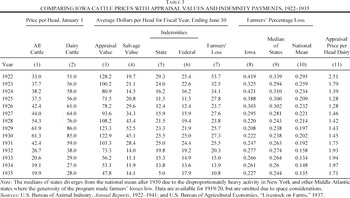
More importantly, this argument ignores the generosity of the eradication program in the early 1930s. Table 3 provides data for Iowa on the average current-dollar values of appraisals, salvage, and payments with the average current-dollar price per head of all cattle and dairy cows for the 1922–1935 period. It includes statistics on the national average and median state loss ratios. As these numbers indicate, the proportional losses borne by Iowa farmers in 1931 were less than those in the typical state. And the losses compared favorably with those in nearby states such as Illinois, Missouri, and Kansas that did not experience such disturbances. The loss ratio in Iowa in 1931 was the fifth lowest out of the 16 years for which we have state data and well below that prevailing in the 1920–1922 economic downturn. Taking a broader perspective, the 1931 ratio for Iowa ranked well below the median of all of the 784 annual state loss ratios we were able to calculate. Though less generous than in the immediate past, the Iowa program in 1931 was more generous than those in most other times and places. Moreover, losses remained relatively small because few animals were condemned. In Iowa, over the 1927–1931 period, less than 1.7 percent of tested animals reacted. In fiscal year (FY) 1931, for example, out of 1.5 million tests, only 23,200 Iowa cattle reacted.55
U.S. BAI, Service, 1927–34.

Iowa farmers' losses in FY 1931 were surely less, and probably a lot less, than the loss ratios presented in Table 3 suggest because of the appraising practices. There are hints that the appraised values in most years were above market value because appraisers were sympathetic to beleaguered dairymen. Unlike the buyers for meatpackers, government appraisers had no self-interest in driving a hard bargain. But more than this, the downward adjustment of appraised values to reflect falling prices was very sluggish in the early 1930s. Column 11 of Table 3 shows the ratio of appraised values of condemned stock in Iowa to the average value of all dairy cattle in the state. In FYs 1925 and 1926 the appraised values were 28 percent above average values. In 1927 through 1930 the premium climbed to 44 percent, and in 1931 it jumped to 75 percent. It appears that losses incurred by Iowa farmers on average were much less than reported, and many dairymen received more than their cattle were worth in the open market. To be specific, the $77.80 of compensation that the owners of condemned animals in Iowa received per head in FY 1931 was well above the state's prevailing average price of dairy cattle ($59) and even above the value derived based on the 1925–1926 appraisal premiums. And as events unfolded, dairymen who had their cows condemned in 1931 were better off than those who held onto their animals into 1932 and 1933 and watched the value of their animals plummet.
Iowa was not alone in its largesse. At the national level, the generosity of the program was never greater than in FY 1931, because the average payments remained high while prices per head were falling.56
To adjust for the higher livestock values, Congress had raised the limits on federal indemnities from $50 to $70 per head for registered purebreds and from $25 to $35 per head for grade animals in 1929. The limits were not revised to reflect depression-era deflation until 1932.
Chief of BAI to his agents, 23 March 1933, BAI Records, Box 375.
Munce, “Tampering,” 29 March 1932, BAI Records, Box 375; and Arburua, Narrative, p. 83.
Myers, Tuberculosis, pp. 228–29; Smith, Conquest, p. 45. The farmers in this region were not slow to adopt other new technologies. Ryan, “Study,” p. 278 finds the “eastern livestock” area was among the earliest adopters of hybrid corn.
NORMAN BAKER, RADIO STATION KTNT, AND THE DEBATE OVER DISSENT
If the economic forces fail to explain why eastern Iowa erupted, what did account for the disturbances? Local observers and BAI's records point to the crucial role of one southeastern Iowa radio station in catalyzing opposition. According to George Mills, a Tipton newspaperman, a “major” reason for the Cow War
was the inflammatory broadcasts over Muscatine Radio Station KTNT (The Naked Truth) by station owner Norman Baker…. He was out to raise all the hell he could with the state government, the newspapers, and anyone else who got in his way…. The war was confined to the few counties in the range of KTNT and neighboring areas in eastern Iowa…. There might have been no Cow War at all without KTNT and Norman Baker even though farmers were not doing all that well.60
Mills, “Comment,” p. 129. Ossian, “Bandits,” situates the mob actions of the Cow War and the Farmers' Holiday Strike in an atmosphere of “far more widespread, insidious, and personal” violence and fear pervading rural Iowa in the early 1930s.
As an example, J. A. Barger stated that Baker's “radio activities have been largely responsible for much misinformation that has gone out regarding tuberculin testing….” Barger to Chief of Bureau, 8 June 1931, BAI Records, Box 373. For the extent of diffusion of the radio in Iowa, see Bureau of Market Analysis, Radio Market, pp. 8–9.
Bromwell to Barger, 28 Feb. 1927, BAI Records, Box 373.
Fowler and Crawford, Border Radio, pp. 67–102.
“Warns Broadcasting by Quacks May Soon Swamp Radio in U.S.,” Chicago Tribune (12 Octpber 1932).
Baker struck his first blow against the eradication campaign in early September 1926 when his broadcast advanced the AMLL arguments that BTB was harmless to humans and that testing poisoned the animals. He discouraged farmers from signing county petitions to begin testing and boldly offered $1,000 to any doctor who could prove that BTB could be transmitted from cows to humans.65
Barger to Smith, 6 October 1926; and Lake to Lintner, 10 September 1926, BAI Records, Box 373.
Bromwell to Barger, 28 February 1927; Spence to Mohler, 25 February1927; and Munger to Mohler, 24 February 1927, BAI Records, Box 373.
Baker to Mohler, 25 March 1927; Mohler to Baker, 2 April 1927; Baker to Mohler, 7 April 1927; Baker to Mohler, 11 May 1927; and Mohler to Baker, 24 May 1927, BAI Records, Box 373; Winston, Throttle, p. 190.
The KTNT broadcasts induced a vigorous debate over free speech on the public airwaves. On many occasions, local dignitaries wrote to the BAI demanding that Baker be silenced. The BAI officials were more tolerant than their state and local allies, repeatedly championing free speech and stressing that the press generally presented the BAI's efforts in a favorable light.68
Baker lobbied as well. In a letter to Carter Glass on 7 June 1928, Baker wrote that as part of his campaign against BTB testing he was reading the Senator's entire “Tale of Two Heifers” on KTNT over a series of nights and “lauding you to the sky.” Baker sought the Senator's aid to reverse the FRC's decision regarding KTNT's wattage, which “has been cut down … because I have practiced free speech.” Glass Papers, Box 88, file 1. For the continuing controversy, see the “Opposition” files in BAI Records, Box 373 and KTNT file, RG 173, Entry 3, Box 426.
Wolfe, “Norman Baker,” p. 396; Winston, Throttle, pp. 159, 172, 179–205. The FRC was a forerunner to the Federal Communications Commission.
The eradication troops in the field also advocated muzzling their opponents' use of the mails. In January 1932, J. C. Exline, a chief inspector from Olympia, Washington, asserted that the AMLL was “in violation of the Postal laws” for mailing “scurrilous and defamatory matter.” In a similar fashion, Dr. A. H. Quinn, Jr., President of the Iowa Veterinary Medical Association, wrote Mohler in September 1932, inquiring if Baker's use of the U.S. mail left him vulnerable to prosecution from the Post Office, Interstate Commerce Commission, or some other federal agency. Such complaints elicited patient responses from the BAI in Washington, D.C.: “no prosecution could be successfully maintained for violation of the postal laws” and the best that could be done is to educate the public regarding the disease and the tuberculin test.70
Exline to Chief, 30 January 1932; Quinn to Mohler, 10 September 1932; Chief of Bureau to Exline, 8 February 1932; Mohler to Quinn, 16 September 1932; and attached handwritten note of 15 September 1932, BAI Records, Box 373.
The Glass document has unquestionably done a great injury to the cause…. Why a United States Senator is privileged under Government expense to send throughout the country thousands and perhaps million of these documents to add perhaps millions to the cost to the Government and the States in the eradication of tuberculosis is something beyond my comprehension. There ought to be some kind of censorship on material sent out by the representatives of Congress.71
H. R. Smith to Barger, 3 November 1931, BAI Records, Box 373.
Like his critic Smith, Glass was no champion of free speech. In 1928 Senator George McLean of Connecticut wrote Glass, complaining that proponents of the testing program were traveling his state showing “lantern slides carrying pictures of crippled and emaciated children due to milk from untested cows.” Glass replied that such speakers “ought to be in the penitentiary” for engaging in ignorant fear-mongering and the USDA “should be mercilessly condemned for permitting such an outrage.”72
McLean letter, 11 June 1928; Glass reply, 19 June 1928, Glass Papers, Box 88, file 1.
THE LAST STAND IN CALIFORNIA
When the BAI finally certified California's Merced and Kings counties as BTB-accredited areas in late 1940, the last bastions of the disease in the United States were officially conquered. California's position as a laggard in the national anti-BTB campaign stands in stark contrast to the state's well-cultivated image as a pace-setter.73
California's troubled experience in controlling BTB calls into question popular generalizations promoted by historians such as Kevin Starr, about the state's preeminent role as a vanguard of progress over the twentieth century. This role is illustrated, for example, by California's early development of an extensive quarantine system to control the introduction of plant diseases and insect pests. See Iranzo, Olmstead, and Rhode, “Historical Perspectives,” pp. 55–67. But the same efficiency and zeal did not carry over to controlling several animal diseases.
As early as 1929, a BAI inspector observed “California has a very large Portuguese population engaged in dairying [which] … represents an antagonistic element, or at least it assumes a passive attitude towards the eradication program.” Foster to BAI Chief, 21 January 1929, BAI Records, Box 356.
California's health officials had long recognized the state's BTB problems. In 1899 the State Veterinarian observed: “tuberculosis exists to an alarming degree among the dairy herds of this State, especially in and around the larger cities where … from 50 to 90 per cent [of the dairy cows] … are affected with the disease.”75
Boyd, “Review,” p. 510.
Jackley, “Report,” p. 661, Iverson, “Report,” pp. 389–91; Iverson, “Division,” pp. 228–29; Duckworth, “Tuberculosis,” p. 227. Ironically California's problems were the result of its past good fortune. Most states in the East and Midwest had struggled with constitutional problems of paying compensation during earlier foot-and-mouth disease and contagious bovine pleuropneumonia epidemics, and by the time of the BTB campaign, these issues had long been resolved. California had escaped these earlier outbreaks and confronted such constitutional challenges for the first time in the mid-1920s.
Patrick v. Riley, 209 Cal. 350 (1930); Iverson, “Progress,” p. 673; and San Francisco Chronicle (7 November 1930), p. 2, notes that the Proposition, No. 13, won with 779,696 yes votes to 169,286 no votes.
That year, a new governor, James “Sunny Jim” Rolph Jr. took office. The popular Republican ex-mayor of San Francisco packed his administration with spoilsmen. As one part of this transition, Rolph replaced the long-standing and highly respected director of the Division of Animal Industry with a crony, Joseph J. King. In 1931 the legislature appropriated $450,000 for indemnities, making California the forty-sixth state to join the national program. But depressed economic conditions undercut state revenues. Charges of mismanagement and graft added to the problems. By late 1932, Rolph's appointees at the Agriculture Department had alienated the State Grange, the Farm Bureau, and the Pacific Rural Press, giving momentum to a drive to recall “Sunny Jim.”78
Arburua, Narrative, pp. 124, 139; McDonald, “Tuberculosis Control,” p. 22; and San Francisco Chronicle (20, 21, 22 October 1932), p. 1 each day.
Highly publicized complaints about the mismanagement of the BTB program fueled the anti-Rolph movement. When King proposed a $1 tax on all dairy animals to finance the program, opposition intensified. (The “Jo King” proposal included centralizing dairy inspection at the state level and fully compensating owners for reactors.) At the same time, the press reported that program officials were conspiring with private veterinarians and dairymen in an illegal indemnity scheme.79
The State Grange and the Farm Bureau were concerned about the indemnity fund and worsening relations between the State and the USDA. San Francisco Chronicle (2 December 1932), p. 16; Pacific Rural Press (8 October 1932), pp. 246, 253, 276; (22 October 1932), p. 278; (29 October 1932), pp. 292, 295; (12 November 1932), p. 342; (26 November 1932), pp. 371, 374; (3 December 1932), p. 388; and (31 December 1932), p. 545. Washington got wind of the scandal by early 1933; Chief of Bureau to Howe, 10 January and 2 February 1933, BAI Records, Box 375.
Matters came to a head in 1933. In early February the Grange started a recall drive against Rolph and later that month, a State Senate committee began investigating charges of indemnity fraud in Marin County. The case grew out of the activities of Eugene Biggio and Antilio Lertora, who, with the backing of Frank J. de Benedetti, assembled hundreds of cows at a dairy north of San Francisco in June 1932. All of these animals were suspect and had recently been purchased at rock bottom prices of about $15 per head in anticipation of a change in state policies. In December 1932 testing in Marin County revealed that the Biggio-Lertora herd was rotten—over 80 percent of the 640 animals reacted. After some wrangling, Harold Gardner, the chief state appraiser, and J. M. Holzer, his federal counterpart, placed values ranging from $40 to $120 per head, making the indemnity bill $15,000. These were exceptionally generous valuations because the average price of a dairy cow in the state at this time was about $38.80
New York Times (2 February 1933), p. 13; Los Angeles Times (5 February 1933), p. 1; (23 February 1933), p. 5; (24 February 1933), p. 1; (25 October 1933), p. 5; San Francisco Chronicle (24 February 1933), p. 1; (3–7 April 1934); Lertora v. Riley, 6 Cal. 2d 171 (1936); USDA, Yearbook 1933, p. 635.
Federal and state authorities refused to pay. The federal grand jury investigation of the “Cow Racket” in October 1933 grabbed front-page headlines for weeks in the Los Angeles Times and San Francisco Chronicle. King, Gardner, Holzer, Biggio, Lertora, and de Benedetti were all indicted, and the case went to trial in April 1934. The judge threw out the charges against the public officials, and the jury reached a hung verdict on Biggio, Lertora, and de Benedetti.81
Chief to Howe, 20 February 1933, BAI Records, Box 373, File 9.212.4; Los Angeles Times (29, 30 September; 2, 4, 6, 25 October 1933); San Francisco Chronicle (29, 30 September; 1–11 October 1933; and 3–7, 13, 17, 19, 20 April 1934); Sacramento Bee (5 October 1933); Western Livestock Journal (5 October 1933), p. 8; Pacific Rural Press (28 October 1933), p. 331; also see Lertora v. Riley, 6 Cal. 2d 171 (1936); and Arburua, Narrative, p. 109.
Craig, Schudder, and Robinson, “Report,” pp. 3016–18.
In 1934 President Roosevelt signed the Jones-Connally act, which for the first time allowed federal payments without state matching funds. At the behest of the Farm Bureau and many dairymen, the Boards of Supervisors in several counties without state money imposed compulsory testing.83
In Tulare County testing became compulsory after a vote of dairymen attending a mass meeting. Fresno Bee (9 December 1934), p. C1, (20 December 1934), pp. B1–B2.
Fresno Bee (13 December 1934), p. A4; (20 December 1934), pp. B1–B2; (30 December 1934), p. B2; (10 January 1935), p. A2. California indemnities averaged $11.82 per head in FY 1935. U.S. House, Agricultural Appropriation, 1937, p. 173.
Beginning in mid-1934, an “organized group of dairymen in certain counties resorted to injunctions and court actions in an endeavor to obstruct and hinder tuberculin testing progress.”85
Duckworth, “Bovine,” (1935), p. 366. See also U.S. House, Agricultural Appropriation, 1935, p. 143; “Here and There with Jack Klein,” California Cultivator (30 November 1940), p. 644; and Smith, Conquest, pp. 31, 48.
One-percent IPUMS sample for 1920 from Ruggles, Sobek, Alexander, et al., IPUMS; Bohme, “Portuguese,” pp. 242–43; Graves, Portuguese Californians, pp. 69–73. Graves further asserts that the Portuguese dairy farmers grew distrustful of animal disease control authorities following the imposition of draconian measures to suppress foot-and-mouth disease in California in 1924.
Among the leaders of the Portuguese resistance were Fresno attorneys Louis Coehlo and Thomas Lopez, who helped organize the Western Cooperative Dairymen's Union. This group assessed members one dollar per cow to pursue its court challenges to testing. The spokesmen asserted that testing program enforcement would discriminate against political outsiders such as the Portuguese and that high reaction rates (which resisters reckoned would average over 20 percent) would drive many dairymen to bankruptcy. In 1934/35 farm conditions improved as the prices for milk and livestock rose and a local drought eased. In this relatively favorable setting, Coehlo urged delaying the implementation of the program, so San Joaquin Valley farmers “have a chance to recoup some losses of the last few years.”87
Fresno Bee (20 December 1934), pp. B1–B2; (6 January 1935), p. B3; Los Angeles Times (9, 12 January 1935; 19 June 1936). Coehlo also argued “the possibility of humans contracting tuberculosis from tuberculin cows is extremely remote.” For the activities of another resistance leader, Frank Correira, see Stonehill, Barrelful, pp. 228–36; and Graves, Portuguese Californians, pp. 86–88. In contrast to the Portuguese community, the Danish Creamery Association refused to take a stand on the issue of testing. Fresno Bee (9 December 1934), p. C1.
The leading non-Portuguese opponent was J. E. Van Sant, a veterinarian who operated a biologics laboratory in Bakersfield. Van Sant began his career at the Cutter laboratories of Berkeley in the late 1910s. He ventured out on his own in the 1920s, producing and marketing a treatment against Bang's disease (brucellosis). State authorities considered his serum snake oil and banned its sale in 1933. At this point, Van Sant began agitating against the tuberculin testing program. Dedicated to stopping “the insidious encroachment and betrayal by government agencies,” he helped organize and became president of the “Dairy Protective Association.” In 1934 the state clamped down on his veterinary practice because he failed to brand reactors. Van Sant continued to be a thorn in the side of the program.88
Arburua, Narrative, p. 311, Los Angeles Times (15 March 1934), p. 7; Sacramento Union (15 March 1934), p. 8; Pacific Rural Press (20 April 1935), p. 415; Tulare Daily Advance-Register (12 March 1934), p. 4; (14 March 1934), p. 1; (15 March 1934), p. 4; and Fresno Bee (15 March 1934), p. B1; (4 Nov. 1936), p. B3.
The opponents relied on an argument often used to justify inaction in Europe. BTB was so prevalent “that California could not do without the products of untested cows because a shortage would be created.” But the progress of the campaign nationally was turning this argument on its head. After Washington, Oregon, and Idaho approached accredited status, testing proponents responded that the clean herds of the Pacific Northwest “are able and willing to supply California with all the dairy products it can use.” And “it will be only a matter of time until all clean states forbid the sale of all kinds of dairy products” from untested or unclean cows.89
California Cultivator (12 September 1936), p. 670; and Fresno Bee (20 December 1934), pp. B1–B2.
Craig, Schudder, and Robinson, “Report,” p. 3018.
Duckworth, “Bovine,” (1939a), pp. 44, 47.
The most violent incident in California broke out in May 1937 when an angry mob of over 500 protesters harried officials and prevented testing on a Crows Landing dairy in Stanislaus County. The subsequent crackdown saw five farmers arrested and a warrant was issued for a “Communist organizer” who escaped.92
In June 1936 a protest meeting held in the Portuguese Hall in the small town of Gustine reportedly attracted over one thousand participants. Stonehill, Barrelful, pp. 86–87; Los Angeles Times (4 May 1937), p. 5; (5 May 1937), p. 11; (6 May 1937), p. 3; Modesto Bee (3 May 1937), pp. 1, 10; (4 May 1937), pp. 1, 12; (5 May 1937), pp. 1–2; (6 May 1937), pp. 1–2; Hanford Daily Sentinel (3 May 1937), p. 1; (5 May 1937), p. 1; Los Angeles Times (1 September 1935), p. 29; (15 February 1936), p. 6; (10 November 1936), p. 8; (2 April 1937), p. 23; (22 April 1937), p. 8; (8 December 1937), p. 8; (16 March 1938), p. 12; Pacific Rural Press (18 August 1938), p. 140; (15 October 1938), p. 358; California Cultivator (5 August 1937), p. 437. In early 1936, six “bovine disease rebels” were arrested in Kings County for refusing testing. Fresno Bee (4 February 1936), p. B6; (6 February 1936), p. B6; (9 February 1936), p. C4.
Duckworth, “Bovine,” (1935), p. 366; Duckworth, “Bovine,” (1938), p. 488. The Attorney General over much of this period was Earl Warren.
The anti-testing forces in California emphasized a different message than earlier opponents. Senator Glass and the participants in the Iowa Cow War had objected chiefly to the science of the enterprise, and essentially argued that the net social benefits were negative. Indeed, they viewed the anti-BTB campaign as a conspiracy of self-interested veterinarians, meatpackers seeking cheap stock, and politicians desiring greater opportunities for graft. Up to the early 1930s, the legal cases focused on the nature of the disease and the scientific merits of the tuberculin test. In Loftus v. Department of Agriculture of Iowa (211 Iowa 566, December 1930), for example, opponents argued that the “tuberculin test in fact is not a test” and “the serum injures the cattle, … causes abortion, and stringy and unhealthful milk, and even frequently introduces the disease into the bodies of healthy animals, and sometimes even causes their death.” In a similar fashion, in Panther v. Department of Agriculture of Iowa (211 Iowa 868, January 1931), the plaintiffs charged that the test “actually injures the animal.” By the mid 1930s few, if any, suits challenged the science of BTB testing in California.
Objectors in California emphasized distributional and procedural issues, initially focusing on the lack of indemnities and later on the discrimination faced by dairymen in voluntary control areas. Portuguese farmers who were not U.S. citizens took a novel approach, suing the state in federal courts for violating their rights to due process. By the late 1930s, both the state and federal courts regularly found that legal precedents and scientific evidence supported the eradication initiatives.94
See State cases: Coehlo v. Truckell, 9 Cal. App. 2d 47 (1935); Stanislaus County Dairymen's Protective Association v. County of Stanislaus, 8 Cal. 2d 378 (1937); Loftus v. Superior Court of Kings County, 25 Cal. App. 2d 346 (1938); Affonso Bros. v. Brock, 29 Cal. App. 2d 26 (1938); Western Cooperative Dairymen's Union v. County of Merced, 30 Cal. App. 2d 722 (1939); Mattos v. Superior Court of Merced County, 30 Cal. App. 2d 641 (1939); Gomes v. Superior Court of Merced County, 30 Cal. App. 2d 650 (1939); Thome v. Superior Court of Merced County, 32 Cal. App. 2d 521 (1939); and Federal cases: Borges v. Loftus, 87 Fed. 2d 734 (1937); Borges v. Loftus 301 U.S. 714 (1937); and Aguiar, Bello v. Brock, 24 Fed. Suppl. 692 (1938). The Affonso Bros. decision effectively undermined the legal basis of the opposition but the Thome decision saved face for the opponents by specifying their private veterinarians could monitor the testing.
Modesto Bee (4 May 1937), p.12; See also (3 May 1937), p. 1, 10.
But there were key similarities among the anti-testing campaigns. Opponents everywhere parroted Carter Glass, complaining of high-handed treatment by testing officials who combined the roles of “accusers, prosecutors, judges, and executioners.”96
Panther v. Dept. of Ag. Iowa, 211 Iowa 868 (20 January 1931).
Archie, “Times of Trouble,” p. 30; and 19 October 1918 Letter of Paul P. Moore in Grant White Papers, University of Iowa Special Collections, folder 4.
In July 1937 the California legislature redressed past grievances by extending indemnities to all the state's counties and allocating $1.5 million for the payments. But even this legislation did not entirely mollify the opponents. Duckworth noted that it “formerly was the complaint of this group that tuberculosis eradication was not uniform through the state…. [The] new law … apparently has not deterred this organization from continuing attempts to obstruct the work.”98
Duckworth, “Bovine,” (1937), p. 362.
Duckworth, “Bovine,” (1938), p. 488, and “Bovine,” (1939a), p. 44.
The California opponents had built an organization committed to resisting testing. Rather than accede to the program once one of their demands was met, they were emboldened to press harder. In addition, many opponents continued to resist in the hope of more favorable terms, including clemency for past transgressions. Several leaders, for example, faced criminal trials for obstructing the tests by keeping their cattle out of their barns. Other dairymen had forfeited their claims to indemnities because they had refused to slaughter their reactors in a timely fashion. By 1939 the state legislature conceded by approving special appropriations to pay the contested indemnities.100
Duckworth, “Bovine,” (1939b), p. 629.
CONCLUSION
Writing in 1905, one of America's most prominent veterinary scientists, Leonard Pearson, noted “There is scarcely a subject related to agriculture or public health that has occasioned as much or as bitter discussion, or has led to the expression of so many divergent views as this one of tuberculosis in cattle.”101
As cited in Myers and Steele, Bovine Tuberculosis, p. 91.
Rosen, “Pollution Regulation.”
There were important differences between the anti-testing movements and other celebrated episodes of resistance. The Luddites protested that the new textile machinery and the factory system would cause unemployment and alter the balance of power in the workplace. Critics of many agricultural machines, such as the tractor, cotton picker, and tomato harvester, complained they would hurt “the little guy” who could not afford the fixed costs associated with the new machines. Such concerns are of little relevance here because the testing technology was largely scale neutral and threatened few jobs. Contrasts with recent opposition to biological technologies such as GMOs are also telling. Much of the resistance to GMOs comes from consumers and their representatives who fear the unknown—something yet undiscovered in the new organisms might prove harmful. During the BTB eradication program, consumer groups were generally among the strongest advocates. Most of the opposition came from producers who believed that tuberculin might harm their stock. Such fears were fuelled by the counterintuitive nature of the science underlying the testing program—how could a serum derived from the disease organism be safe? Early disputes within the scientific community added to the uncertainty. Koch's statements were especially influential and well-placed contrarians such as Carter Glass, Norman Baker, and J. Van Sant were able to inflame the controversy.
In his analysis of the opposition to new technologies, Mokyr notes that “The political economy of technological change thus predicts that it will be resisted by well-organized lobbies, whereas its defenders will usually be a motley group of consumers and inventors and perhaps a few groups with a direct interest in economic growth. The struggle between the two parties will always take the form of a non-market process ….”103
Mokyr, Gifts, pp. 253–54.
Unlike the situation in Europe, American consumers did not need to fear BTB eradication would lead to food shortages and price increases. Opponents to tuberculin testing in Europe, where BTB was far more widespread, frequently warned of politically unacceptable reductions in the food supply. This contrasts with current opposition to GMOs from European farmers and governments who oppose technologies that threaten what they perceive to be a harmonious (if heavily subsidized) balance in the farm economy. Productivity-enhancing technologies that increase the food supply will only lead to pressures for more subsidies.
Innovations that are true Pareto improvements are rare because most technological changes have winners and losers. The opposition was first and foremost based on the perceived economic interests of the participants. Even a farmer who saw most of his herd condemned as reactors would be unlikely to protest if the indemnities were high enough. But early state experiments with indemnities showed that overly generous payments led to moral hazard problems by removing farmers' incentives to protect against the disease and encouraging disposal of low-grade animals at the taxpayers' expense. For this reason, a program generating zero opposition, even if possible, would not have been optimal.
We acknowledge the helpful comments of Robert D. Johnston, Thomas A. Mroz, Barbara Orland, James Steele, Richard Sutch, and the participants at the 2004 Economic History Association and the 2004 Social Science History Association conferences. Jeremy Atack and two anonymous referees deserve special mention. We also appreciate the assistance of Jeffrey Graham, Shelagh Mackay, and Janine L. F. Wilson. Work on this article was facilitated by a fellowship granted by the International Centre for Economic Research (ICER) in Turin, Italy.