Introduction
Marriage is one of the most important proximate determinants of fertility (Bongaarts, Reference Bongaarts1978). In countries like India, where marriage is the gateway to sexual intimacy, the different dimensions of marriage are important for the study of fertility patterns and behaviours. In populations where the mean age at marriage is high fertility is generally lower as married women are exposed to the risk of pregnancy for a shorter length of time (Davis & Blake, Reference Davis and Blake1956). In recent times, many marriages in India have begun to stray away from regular, rigid traditional rituals and practices. The emergence of love marriages, inter-caste marriages, exogenous marriages and legal marriages is likely to lead to changes in the old ideas of the religious connections with marriage. However, marriage remains one of the most important social institutions in India irrespective of any religious obligations (Ghosh, Reference Ghosh2017).
Census data suggest a change in trends and patterns of marriage in India. Amidst the many factors associated with changes in marriage, such as increased age at marriage, love marriages rather than arranged marriages, consanguineous marriages and cohabitation, a key factor that has emerged is women’s increased decision-making autonomy with modernization. Women now have more say in deciding who they marry (Prakash & Singh, Reference Prakash and Singh2014) than on what they should wear at their wedding. This is an important change, giving women extra control over their reproductive lives. They now have more say in family planning, such as delaying childbearing and the use of contraception.
One important aspect of the study of fertility preference is the perceived value of children by the mother, the father and their families. The desire for children might not necessarily be same for the couple and their families. Women bear the fetus and give birth, and most modern family planning methods are women-centric. Yet the importance of men and their reproductive choices cannot be denied. Beckman (Reference Beckman1983) identified husbands as the chief pro-fertility decision-makers, whereas Caldwell (Reference Caldwell1982, Reference Caldwell1983) located fertility decision-making not with the biological parents but with the older members of the husband’s lineage or kinsfolk. Another issue in India is ‘son preference’. Whether the mother herself having a preference for a son over a daughter, or just pressure from her spouse and his family, compels her to go for an additional birth is an interesting question. If a woman is worried that her husband might prefer a son, which is a very common situation in India, she will never be comfortable to talk freely about family size with her husband. Thus, she would have to avert some births or give birth to some unwanted children.
The desire for children varies between and within couples. Eberstadt (Reference Eberstadt1981) stated that ‘most of the information gathered through fertility surveys suggests that women consistently desire smaller families than their husbands’. On the other hand, other studies have documented that there is a greater demand for children among women than men when they are relatively powerless (Cain, Reference Cain1978). It might be that a woman wants to restrict her number of children to a maximum of three but that her husband wants to have five. Better interaction between spouses might help them avert unwanted childbirths. If couples have a clear idea about the desires of their partners on number of children they can plan for an improved investment in their children. It has been observed that couples frequently discuss fertility and contraceptive use during their daily routine (Rutenberg & Watkins, Reference Rutenberg and Watkins1997; Boulay & Valente, Reference Boulay and Valente1999; Oyediran et al., Reference Oyediran, Isiugo-Abanihe and Bankole2006). These informal discussions, and the process of knowing and understanding each other’s experiences, can smooth the course of relationships after marriage as spouses can modify their own preferences accordingly. The growing interactions between the spouses as they discuss fertility matters culminates in better understanding and helps in decision-making, even though the discussions are not always aimed at influencing each other directly (Feyisetan, Reference Feyisetan2000).
Demographers have repeatedly emphasized the role of demand for children in changing the reproductive behaviour of individuals (Bulatao, Reference Bulatao1981; Bulatao & Lee, Reference Bulatao and Lee1983; Bankole, Reference Bankole1995). Recent studies have shown that the demand for children forms the cornerstone of all determinants of fertility (Bongaarts, Reference Bongaarts2001; Dharmalingam et al., Reference Dharmalingam, Rajan and Morgan2014). Couples’ desired family size could easily be accomplished without the burden of excess children in Indian settings if spouses are clear about each other’s desires. That said, this study is not suggesting that couples do not communicate post-marriage and take the consequent steps to achieve their desired family size. What it tries to capture is whether pre-marital relationships indeed help couples make fertility decisions, especially in the early years of marriage. Changes in socioeconomic and demographic conditions might prompt individuals to rethink and reformulate their fertility preferences. Mishaps such as infant/child death (psychological and volitional replacement) can elevate fertility by increasing number of births without changing desired family size (Preston, Reference Preston1978). It is quite evident that in most cases, especially in India, fertility preferences do not completely transform into actual action, often due to sheer family pressure. Thus, the present study also provides an important insight into the gap between actual and desired family size.
The northern part of India is characterized by a traditional patriarchal society that confers on husbands explicit authority and control over their wives in reproductive matters. Yet, most Indian survey data put the emphasis on women to capture reproductive behaviour prevailing in the society. The 1994 International Conference on Population and Development (ICPD) resulted in an increased interest in the relative roles played by men and women in reproductive decision-making, especially desired number of children and fertility regulation (Isiugo-Abanihe, Reference Isiugo-Abanihe1994; Feyisetan et al., Reference Feyisetan, Oyediran and Ishola1998; Odusola et al., Reference Odusola, Oyediran, Bogunjoko and Adeyemo1998; Zulu, Reference Zulu1998). Despite numerous studies focusing on fertility behaviour in India, little appears to have been done to explain the processes of family-building and decision-making. Though many studies have described the close association between marriage and the fertility behaviours of couples/women, only a few have stressed the role of pre-marital communication (Rele, Reference Rele1962; Van de Walle, Reference Van de Walle1968; Bongaarts, Reference Bongaarts1983).
This study examined the role of pre-marital relationships in the fertility behaviour of couples after marriage. Women who choose their own life partners could be thought to enjoy a more powerful position in their families. They might feel more relaxed and confident discussing sensitive issues such as family planning with their partners. The reproductive goals of wives and husbands might differ in terms of number and sex composition of children, but marital fertility involves the participation of both the husband and wife. The study aimed to capture a ‘snapshot’ of the roles of pre-marital relationships in fertility preferences of married couples and their contraception use; the gaps between desired and actual numbers of sons/daughters/children; and who has most say on the number of children a couple have. It also aimed to assess the gender differences in reproductive preferences and husbands’ influence in decision-making regarding family size and contraceptive use.
Methods
Data
Data were from the India Human Development Survey II 2011–12 (IHDS-II) – a nationally representative survey of 204,569 individuals across 42,152 households covering all states and union territories of India. The survey asked questions of women about their socioeconomic and demographic characteristics. The present study focused on all currently married women of reproductive age (15–49 years), and the study sample constituted 31,276 such women.
In addition to questions on age at marriage, date of marriage, age of menarche, age when they started living with their husband and status of marriage, the survey asked questions of women on pre-marital communication and fertility preferences. Questions on pre-marital communication between spouses included: who chose their husband, their say in choosing their husband, whether they got the chance to meet their husband before marriage, and talk to them, look at their future husband’s photograph or send them emails/chats. Questions on fertility preference included: total number of children, whether they were currently pregnant, whether they were using any contraception, whether they (or their husband) wanted any more children, the timing of their next pregnancy and their ideal number of children.
It should be stressed that the questions related to fertility preferences were only asked to the wives and not to their spouses. Hence, there was a lack of scope to include the concordance/discordance of the mutual decisions on fertility by the couples.
Dependent variables
A contraception-use variable was created with three categories: not using; using any temporary methods of contraception (oral pill, copper-T/IUD, diaphragm/jelly, injectable contraception, condom, periodic abstinence, withdrawal and others); and using any permanent method of contraception, including female sterilization, male sterilization and hysterectomy.
The question on who had most say on the number of children was re-categorized into ‘most say by wife’, ‘most say by husband’ and ‘most say by others’. The wives were asked about the number of children, number of sons and number of daughters they desired. Questions were also asked about the number of children, sons and daughters surviving. So, the gap between the surviving number of children/sons/daughters and the desired number of children/sons/daughters was studied for women with completed family size, which constituted around 47% of the sample. A value of 0 was administered if the actual number of children/sons/daughters matched the desired number of children/sons/daughters; a value +1 if the actual number of children/sons/daughters was more than the desired number of children/sons/daughters; and a value of −1 if the desired number of children/sons/daughters was more than actual number of children/sons/daughters.
Independent variables
It was not possible to segregate marriages into love marriages and arranged marriages. The question on who chose the husband was categorized in the IHDS-II as: respondent herself; respondent and parents/other relative; parents/other relatives alone and others. In this study this was re-categorized as: respondent herself; respondent and parents together; and others comprising of parents/other relatives alone and others (where the respondent had no say).
Years of marriage was calculated using the survey date and year of marriage as reported by the wives, and was categorized into: 0–1 years, 2–5 years, 6–10 years, 11–15 years and 16+ years of marriage. The variable ‘any kind of communication between the wives and their husbands before marriage’ was a dummy based on whether they had met before marriage, talked over the phone or emailed/internet chatted with their future spouses. The variable on how long the wives knew their spouses before marriage was re-categorized into: on wedding/gauna day only; less than a month; and more than a month.
For the multivariate analysis, the study controlled for caste, religion, education, economic status (based on consumption expenditure of households) and place of residence (rural/urban). The years of completed education of the wives were re-classified as: not educated; up to secondary; and more than secondary. The consumption quintile was used to stratify wives as: poorest, poorer, middle, richer and richest. Place of residence was classified as rural or urban areas.
Analysis
Simple bivariate tables were constructed to examine the association between wives’ contraception use and pre-marital communication with their husbands. Multinomial logistic regressions were used to understand the effects of different dimensions of pre-marital relationships on fertility preferences while controlling for socioeconomic variables based a total of 14,546 (Table 3) and 31,276 (Table 4) observations. To understand the gap between actual and desired number of sons/daughters/children, women who themselves or whose husbands were infertile or sterilized were excluded.
In Table 3 the base outcome (y=0) was having as many sons/daughters/children as desired. The specific equations for having more than desired (y=+1) and having fewer than desired (y=−1) are as follows:
 $$\eqalignno{ & {\rm logit}\,\left( {y\,{\equals}\,{\plus}1} \right)\,{\equals}\,\log \left( {{{p\left( {y\,{\equals}\,1} \right)} \over {p\left( {y\,{\equals}\,0} \right)}}} \right)\,{\equals}\,\beta _{0} {\plus}(\beta _{1} {\times}{\rm Choice}\,{\rm of}\,{\rm husband}) \cr & {\plus}(\beta _{2} {\times}{\rm Whether}\,{\rm had}\,{\rm communication}\,{\rm before}\,{\rm marriage}) \cr & {\plus}(\beta _{3} {\times}{\rm How \ long\ respondent}\,{\rm knew}\,{\rm her}\,{\rm husband}\,{\rm before\ marriage}) \cr & {\plus}(\beta _{4} {\times}{\rm Completed}\,{\rm years}\,{\rm of}\,{\rm education}){\plus}(\beta _{5} {\times}{\rm Caste}) \cr & {\plus}(\beta _{6} {\times}{\rm Consumption\ quintile}){\plus}(\beta _{7} {\times}{\rm Place\ of\ residence}).$$
 $$\eqalignno{ & \kern-20pt{\rm logit}\,(y\,{\equals}\,{\minus}1)\,{\equals}\,\log \left( {{{p\left( {y\,{\equals}\,{\minus}1} \right)} \over {p\left( {y\,{\equals}\,0} \right)}}} \right)\,{\equals}\,\beta _{0} {\plus}(\beta _{1} {\times}{\rm Choice\ of\ husband}) \cr & {\plus}(\beta _{2} {\times}{\rm Whether}\,{\rm had}\,{\rm communication}\,{\rm before}\,{\rm marriage}) \cr & {\plus}(\beta _{3} {\times}{\rm How}\,{\rm long}\,{\rm respondent}\,{\rm knew}\,{\rm her}\,{\rm husband}\,{\rm before}\,{\rm marriage}) \cr & {\plus}(\beta _{4} {\times}{\rm Completed}\,{\rm years}\,{\rm of}\,{\rm education}){\plus}(\beta _{5} {\times}{\rm Caste}) \cr & {\plus}(\beta _{6} {\times}{\rm Consumption}\,{\rm quintile}){\plus}(\beta _{7} {\times}{\rm Place\ of\ residence}), $$
For Table 4, the base outcome was the most say by wives (y=1); the specific equations for most say by husbands (y=2) and most say by others (y=3) are as follows:
 $$\eqalignno{ & {\rm logit}\,\left( {y\,{\equals}\,2} \right)\,{\equals}\,{\rm log}\left( {{{p\left( {y\,{\equals}\,2} \right)} \over {p\left( {y\,{\equals}\,1} \right)}}} \right)\,{\equals}\,\beta _{0} {\plus}(\beta _{1} {\times}{\rm Choice}\,{\rm of}\,{\rm husband}) \cr & {\plus}(\beta _{2} {\times}{\rm Whether}\,{\rm had}\,{\rm communication}\,{\rm before}\,{\rm marriage}) \cr & {\plus}(\beta _{3} {\times}{\rm How}\,{\rm long}\,{\rm respondent}\,{\rm knew}\,{\rm her}\,{\rm husband}\,{\rm before}\,{\rm marriage}) \cr & {\plus}(\beta _{4} {\times}{\rm years}\,{\rm of}\,{\rm marriage}){\plus}(\beta _{5} {\times}{\rm Completed}\,{\rm years}\,{\rm of}\,{\rm education}) \cr & {\plus}(\beta _{6} {\times}{\rm Caste}){\plus}(\beta _{7} {\times}{\rm Consumption}\,{\rm quintile}){\plus}(\beta _{8} {\times}{\rm Place}\,{\rm of}\,{\rm residence}) $$
 $$\eqalignno{ & \kern-20pt{\rm logit}\,(y\,{\equals}\,3)\,{\equals}\,\log \left( {{{p\left( {y\,{\equals}\,3} \right)} \over {p\left( {y\,{\equals}\,1}\right)}}} \right)\,{\equals}\,\beta _{0} {\plus}(\beta _{1} {\times}{\rm Choice}\,{\rm of}\,{\rm husband}) \cr & {\plus}(\beta _{2} {\times}{\rm Whether}\,{\rm had}\,{\rm communication}\,{\rm before}\,{\rm marriage}) \cr & {\plus}(\beta _{3} {\times}{\rm How}\,{\rm long}\,{\rm respondent}\,{\rm knew}\,{\rm her}\,{\rm husband}\,{\rm before}\,{\rm marriage}) \cr & {\plus}(\beta _{4} {\times}{\rm Years}\,{\rm of}\,{\rm marriage}){\plus}(\beta _{5} {\times}{\rm Completed}\,{\rm years}\,{\rm of}\,{\rm education}) \cr & {\plus}(\beta _{6} {\times}{\rm Caste}){\plus}(\beta _{7} {\times}{\rm Consumption}\,{\rm quintile}) \cr & {\plus}(\beta _{8} {\times}{\rm Place}\,{\rm of}\,{\rm residence}) $$
For the simplicity of the interpretations results are presented as predicted probabilities following multinomial logistic regressions in each of the models, holding the values of the predictor variables constant at their means over all observations.
Results
Pre-marital communication and contraception use
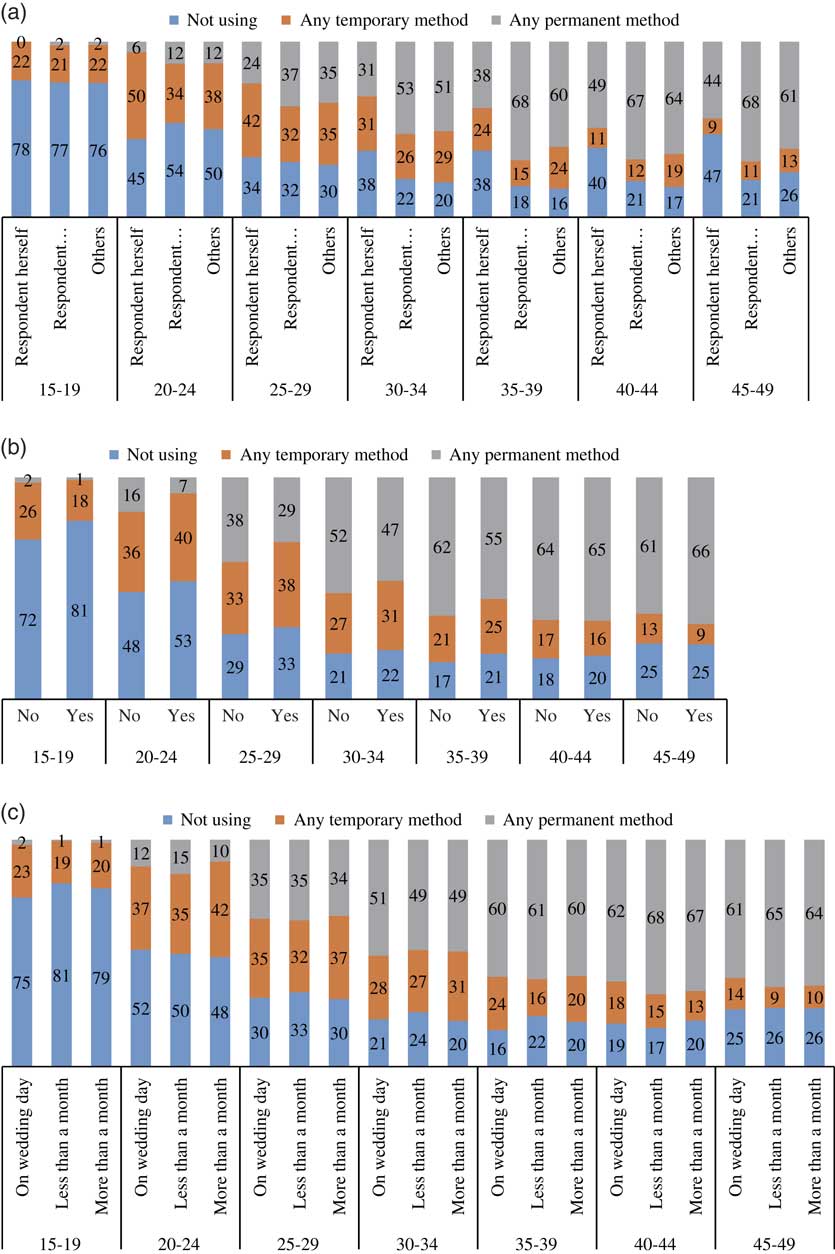
The results showed that 48% of the respondent wives used no contraception, 27% went for permanent sterilization and 25% used a temporary method of contraception (Figure not included). The fertility behaviour of the women generally changed over their reproductive lifespan. It was mainly high in the age group 15–19 years, peaking in the 20–29 year age group, started decreasing from 30 years onwards and reached its lowest level in the 40s. The contraception use could be affected by ages of the wives. No marked differences in the patterns of contraception use were found in the 15–19 year age group of women by who chose their spouses. However, use of any temporary method of contraception was higher in the 20–39 year age group if the wives had chosen their partners on their own rather than with the mutual consensus of their parents or others. Use of permanent methods was found to be highest in all age groups when partners were chosen by the mutual consensus of the wives and their parents (Fig. 1a).
Percentage share of types of contraception used by wives by age group and: a) choosing of husbands; b) communication between couples before marriage; and c) duration of time they knew husbands before marriage.
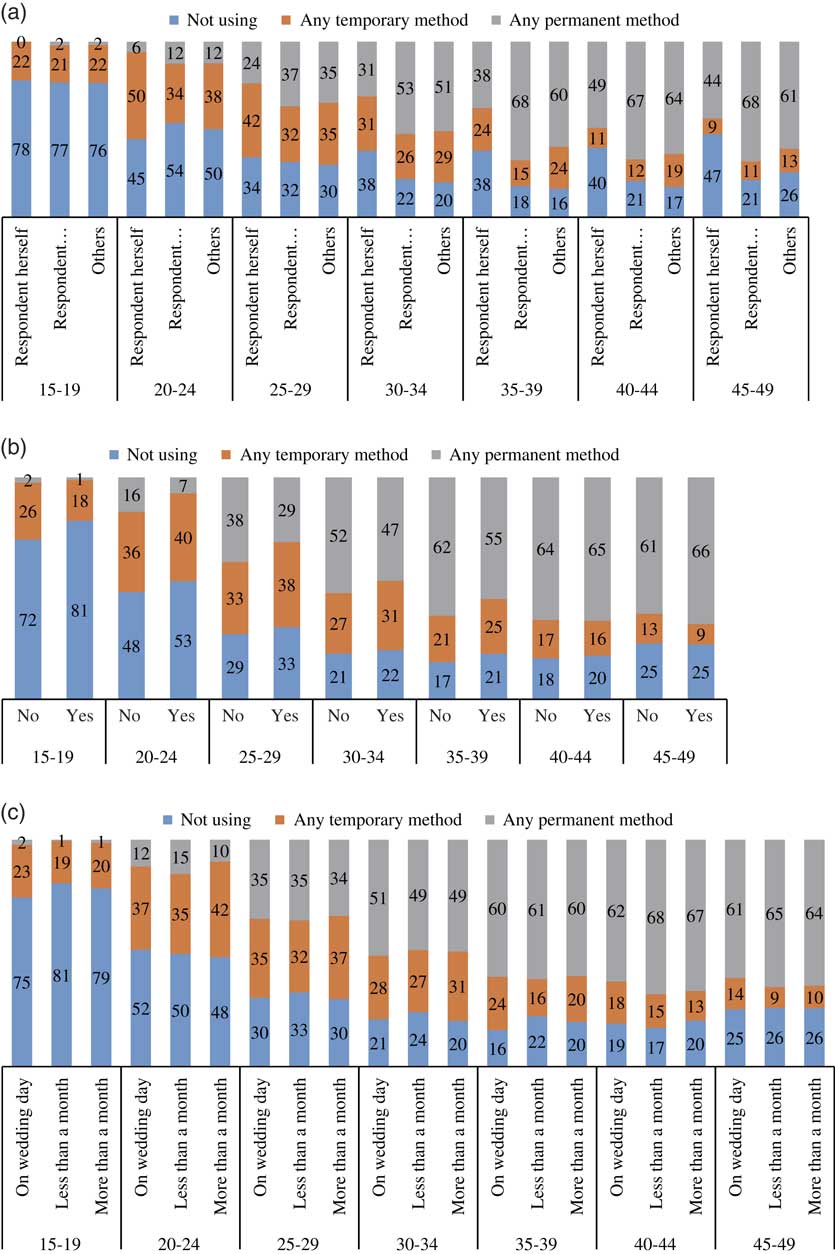
The chances of not using or using any permanent method were respectively lower and higher for women in their late 30s and 40s because of the approaching menopause, whereas women in age groups 15–19 or in their 20s could wait to bear children. Women in the age group 20–34 were more likely to use a temporary method of contraception if they had communication with their husbands before marriage. Women not having any communication before marriage mostly went for permanent methods of contraception (Fig. 1b). The tendency to go for permanent methods of contraception was lowest among women who only knew their husbands from the day of their wedding. Having known their husbands for over a month increased the chances of using permanent methods of contraception in the 30–49 year age group. The differences in the percentage share of contraception use in the 40–44 year age groups were very small irrespective of whether spouses had any communication before marriage (Fig. 1c).
Pre-marital communication and decision on family size
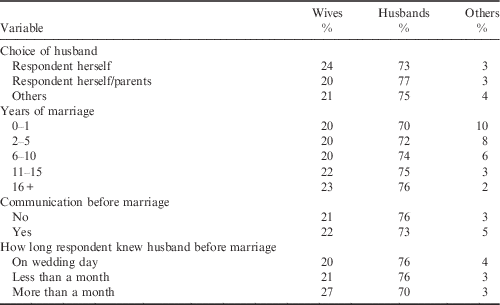
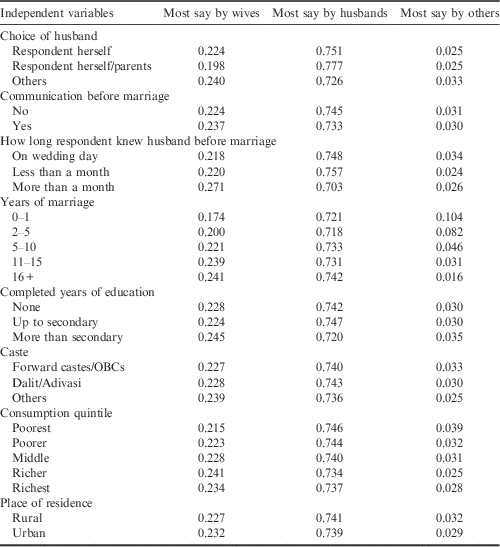
Table 1 shows that for three-quarters of the respondent wives it was their husbands who had most say on the number of children, with just 21% of the wives having most say. A higher percentage of the wives who chose their husbands themselves had most say on the number of children (24%) compared those who chose their husbands with mutual consensus with parents (20%) and others (21%). Women who were married for more than 16 years had higher participation in choosing the number of children than those who were married for 0–10 years. Couples who had communication before marriage had a higher say on the number of children compared with those who did not communicate before marriage. Wives who knew their husbands for more than a month before marriage took more decisions regarding the number of children (27%) than those who only knew their husbands from the day of their wedding (20%).
Who has most say on number of children: wives (respondents), their husbands or others?

Pre-marital communication and the gap between desired and actual family size
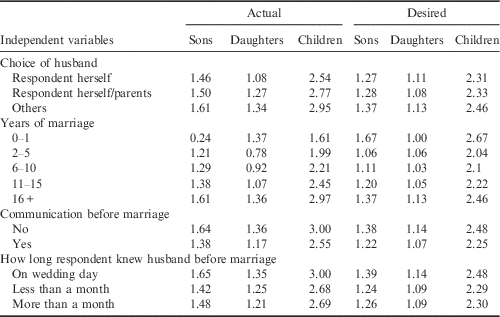
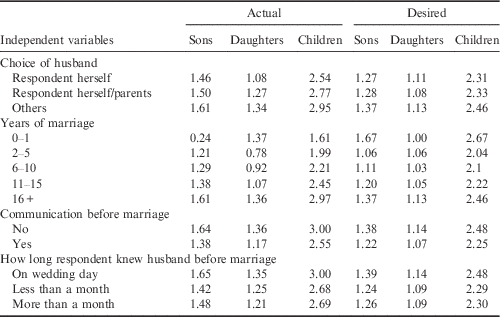
Table 2 shows that, on average, the respondent wives desired 2.42 children, 1.35 sons and 1.12 daughters, but after completing their fertility they had a higher mean number of children (2.89 children, 1.58 sons and 1.31 daughters). Wives who chose their husbands themselves had more sons and children than they desired and fewer daughters than they desired. The wives who were married for 0–1 years desired to have 1.7 sons, 1 daughter and 2.7 children on average but in reality had 0.2 sons, 1.4 daughters and 1.6 children. Women who had been married for more than 11 years might be assumed to have reached their complete family size. The wives who had any communication with their husbands before marriage had a gap of 0.16 sons, 0.1 daughters and 0.3 children, compared with a gap of 0.26 sons, 0.22 daughters and 0.52 children for wives who did not have any communication with their husbands before marriage. The gap between the desired and actual mean numbers of sons, daughters and children was 0.26, 0.21 and 0.52, respectively, if the wives only knew their husbands from the day of their wedding/gauna. The gap was reduced to 0.18 sons, 0.16 daughters and 0.39 children if the wives knew their husbands for less than a month before marriage. The gap was 0.22 sons, 0.12 daughters and 0.39 children if the wives knew their husbands for at least a month before their marriage.
Actual and desired (mean) number of children, sons and daughters of wives (respondents) using any permanent method of contraception
Impact of pre-marital communication on actual and desired family size
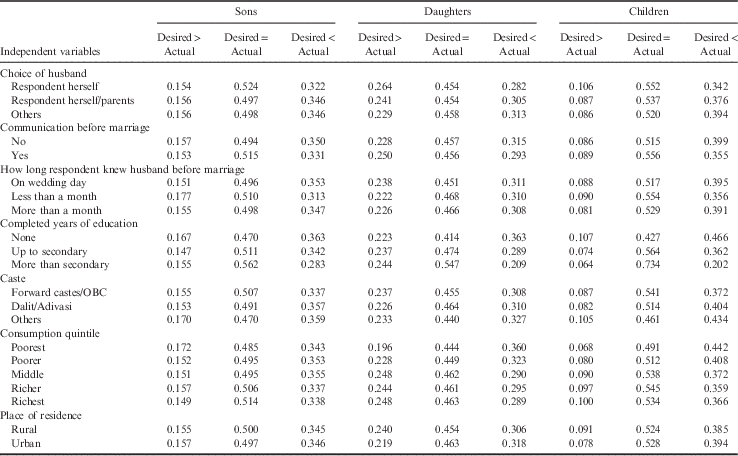
Table 3 shows the predicted probabilities of gaps between actual and desired numbers of sons, daughters and children. In general, in the cases of sons, wives had the highest chances of meeting their desired number of sons when they chose their husbands themselves. Overall, the predicted probability was highest for reaching their desired number of children when spouses were chosen by the wives themselves. They were more likely to bear more sons/daughters/children than desired when their spouses were chosen by the mutual consensus of themselves and their parents or were chosen by others. Women who had communication with their future husbands tended to have a higher chance of having the same number of sons/daughters/children as desired than women who had no pre-marital communication. The probability of having the burden of more sons/daughters/children than desired was higher when spouses had no communication before marriage. The chances of having the desired number of sons/daughters/children were lower when wives only knew their spouses from the day of their wedding. In such cases they bore the burden of having more sons/daughters/children than desired. A higher level of completed education by wives resulted in a higher chance of attaining their desired number of sons/daughters/children. Moreover, the burden of having additional sons/daughters/children was much lower among women with a higher level of education. Typically, the Forward castes/OBCs had the highest likelihood of having their desired number of sons/daughters/children. Dalit/Adivasis showed higher chances of having the burden of additional sons/daughters/children. The richer groups were more likely to attain their desired number of sons/daughters/children than the poorer ones. The poorer groups showed a higher likelihood of bearing the burden of additional sons/daughters/children.
Predicted probabilities of the gaps between actual and desired number of sons, daughters and children of wives (respondents)
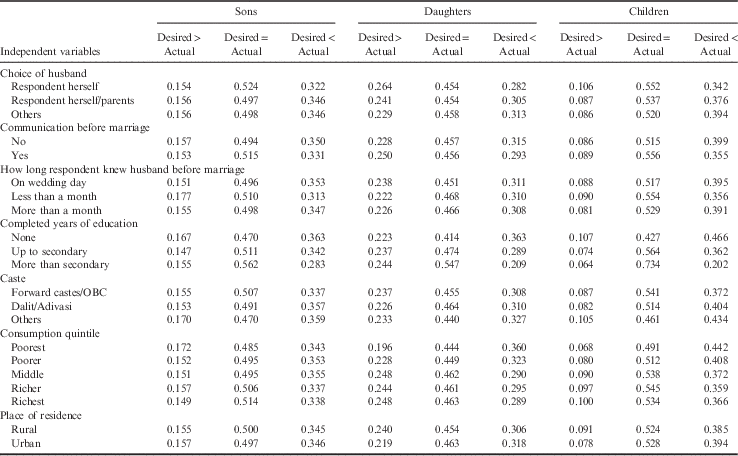
All effects were statistically significant at p<0.01.
Impact of pre-marital communication on decision about family size
Table 4 shows the predicted probabilities of having most say on the number of children to have controlled for socioeconomic covariates. Subsequent to the bivariate results, the predicted probabilities implied that men had a higher say on the number of children across all categories. Overall there was little difference between the groups in who had most say on number of children, apart from wives who knew their husbands for more than a month before marriage. Women had higher probabilities of participating in making decisions about number of children if their spouses were chosen by others. Women having any communication with their future husbands had a higher likelihood of having greater roles in making decisions on the number of children. Similarly, the probability of women having a say on number of children was higher among women who knew their spouses for more than a month before marriage (0.271) compared with women who only knew their spouses from the day of their wedding (0.218) or for just a month before (0.220). Women tended to have more participation in decision-making on number of children with higher duration of marriage. Those who were highly educated had a greater chance of taking part in decision-making on number of children. Those in the ‘others’ category in the caste variable had greater roles in decision-making on family size. The probability of participating in decision-making on number of children was higher among the richer than the poorer groups. Women in rural areas were less likely to make decisions on number of children than their counterparts in urban areas.
Predicted probabilities of who has most say on number of children: wives, their husbands or others
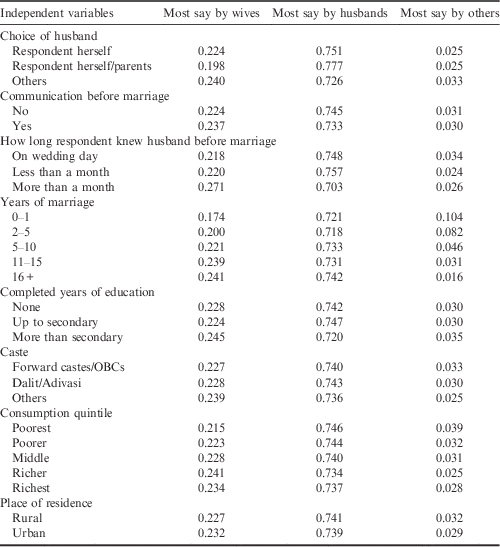
All effects were statistically significant at p<0.01.
Discussion
Marriage, being the entry to the coitus between couples, is one of the most important determinants of fertility, particularly in India. The levels and patterns of marriage and dissolution of marriage directly affect fertility rates in the country. Pre-marital relationships play a significant role in influencing the initial fertility behaviours of married couples in India right after marriage. Cultural factors such as religion, education and other socioeconomic factors affect the marriage system in India. They control how husbands are chosen for women, and whether women can get to know or have any communication with them before marriage. This might indirectly affect fertility preferences and behaviours post-marriage. The purpose of this study was to assess the correlates of spousal communication before marriage on family planning and reproductive decision-making post-marriage.
It was found that 78% of the study wives in the age group 15–19 years were not using any kind of contraception. The main reason given for adolescent pregnancies is that the forthcoming baby is wanted. Mostly, couples reported preferring giving birth to their first child, then going for spacing for higher order births. Those who did not plan to become pregnant believed that they were protected by their youth, infrequent sex or time of the month (Zelnik & Kantner, Reference Zelnik and Kantner1979). It is possible that couples’ discussions on family size affect their desires regarding limiting and spacing their fertility (Short & Kiros, Reference Short and Kiros2002).
Fertility peaks in the age group 20–29 years, but remains high in the 15–19 year age group in India. Adolescent motherhood is high as child marriage still prevails in Indian society due to low controlled fertility (Raj et al., Reference Raj, Saggurti, Balaiah and Silverman2009). The use of temporary contraception among the study wives was highest if they had chosen their husband on their own, or had any kind of communication with him before marriage or had known him beforehand. The use of temporary methods of contraception allows the planned spacing and postponement of births. Thus, communication within couples before marriage might affect their fertility preferences and decisions.
The second aspect captured in this paper was the link between marital history and who had most say on the number of children a couple have. Overall, for 75% of the respondents it was their husbands who had the most say on the number of children. However, communication between spouses before marriage increased the chances of wives being involved in deciding on the number of children/sons/daughters.
Knowing their husbands before marriage appeared to be crucial for wives actively taking part in their fertility decisions. In general, if spouses get to know each other before marriage this improves their relationship after marriage. They become more united on their fertility decisions as they can discuss their views more freely. The findings suggest that the gap between the mean actual and desired number of children, sons and daughters was reduced when spouses interacted before marriage.
After a year of marriage, the study women were found to have completed half of the fertility that they wished to have throughout their reproductive spans. Henceforth, for the next birth orders they tend to start using contraception to space or delay pregnancy. It was observed that women had more daughters than desired after 0–1 years of marriage and fewer sons than desired. This might prompt them to go for a greater number of children in order to reach their desired number of sons. They were observed to have more sons and children and fewer daughters than they desired, which fits in with the prevailing son preference in Indian society. Also, the failure to take a mutual decision or one’s fecundity might be an acceptable reason.
The multivariate results also supported the bivariate results. The gap between the desired number of children, especially for sons and daughters, showed that couple communication leads to more planned fertility. Other family members actively took part in a couple’s fertility decisions where they had initiated the marriages. A number of studies have found that fertility declines can be linked to increased nucleation of families (Caldwell & Caldwell, Reference Caldwell and Caldwell1976; Mason, Reference Mason1986), which implies that the importance of other family members is decreasing. The close interactions and discussions between couples regarding their reproductive preferences is reflected in the decreasing gaps between actual and desired number of children or a substantial change in contraceptive use. The chance of attaining desired fertility size was higher if a woman herself chose her husband. In contrast, the burden of having more than the desired number of children was higher if the women only knew their husbands from the day of their wedding. Socioeconomic factors also play an important role in shaping the fertility behaviour of couples. Education was found to have a major impact on the chances of women achieving their desired number of children. More highly educated women have been found to be more likely to attain their desired number of children/sons/daughters (Muhoza et al., Reference Muhoza, Broekhuis and Hooimeijer2014).
Unwanted fertility results in substantial negative consequences for women, their families and society and can be averted by empowering women to make their own marital decisions and, subsequently, reproductive choices (Klima, Reference Klima1998).
In conclusion, this study highlights the importance of communication between marital partners for rational fertility decision-making. Individual choice on number of children might differ between spouses, and some might not be sure how many they want. Planned fertility behaviour is an essential strategy to lower fertility rates in India. In order to reduce unplanned pregnancies, spouses need to have free flowing conversations about fertility decisions. This study shows that the main decision-makers on fertility in India are undoubtedly the husbands. Interestingly, where there were any kinds of spousal interactions, the wives had higher participation in making fertility decisions. Education has helped women to become more involved in fertility decisions. However, there is still a gap between the number of children women have and their desired number – a gap that prevails because most of the decisions are taken by their husbands. Autonomy and women empowerment might alleviate the problem. One may argue that the major obstacles to spousal communication on fertility matters are cultural opposition and ignorance about modern norms. The government should create cultural awareness to encourage a more enlightened attitude to the harmful aspects, taboos and stigmas of cultural norms. People should be educated to appreciate close conjugal relationships and to disregard male dominance. If families became lesser rigid in fixing marriages and encouraged healthy communication between spouses so that they formed a close bond, it would be easier for them to discuss sensitive issues such as fertility preferences. A positive association was observed between a higher level of women’s education and their reproductive decision-making. For policymakers, education is the easiest way to help women form close marital relationships and lower their burden of unwanted fertility.
Acknowledgments
The authors sincerely thank the anonymous reviewer for his/her constructive comments and suggestions for improving the quality of this article. This research received no grant from any funding agency in the public, commercial or not-for-profit sectors.