
Please, can somebody break this glass bottle for me?
Further extracts from this poem can be found on pages 274 and 305.
Samuel, talking about why he needed asylum, and what happened when he was refused asylum and sent back home:
I remember how my father was attacked in his shop by some of his enemies. They set our house on fire and shot my father. My mother and sister were away at the time in my aunt’s house. I managed to escape from the killers of my father …. We escaped to the town where my mother grew up … [but] they came to our house, raped my mother and sister, asked me about my father, and when they confirmed my father’s identity, they shot my mother and sister. I was also shot but I managed to escape and reached a local church. The church pastor helped me leave the country and come to the UK.
My mental health problems started when I was deported back to my country [from the UK]. I was arrested after arriving [back home]. [I] was identified as the son of the man who was killed as he had converted, and as the son who had managed to escape. I was accordingly raped and tortured, stabbed and beaten in prison. I was in prison for a whole year. After coming out of prison, I was seeing things, hearing voices, talking to myself. I also suffered loss of memory and had to struggle to remember things.
[Back in the UK again] my mental health problems got worse when I was in immigration detention …. I was very suspicious, very watchful of my environment and I wanted to kill myself. I thought myself to be a failure and did not feel that there was any future for me, or [that] I could ever lead a normal life.
We lost our home, which means the familiarity of daily life. We lost our occupation, which means the confidence that we are of some use in this world. We lost our language, which means the naturalness of reactions, the simplicity of gestures, the unaffected expression of feelings. We left our relatives in the Polish ghettos and our best friends have been killed in concentration camps, and that means the rupture of our private lives … Once we were somebodies about whom people cared, we were loved by friends, and even known by landlords as paying our rent regularly. Once we could buy our food and ride in the subway without being told we were undesirable.
Introduction
I am no stranger to harrowing tales. Indeed, working in the field of mental health, they are something of an occupational hazard. Time and experience do not make you immune to such stories; yet, necessarily, you become able to listen without being too shocked, and, remarkably, you seem to be able to lay aside most of what you have heard, without carrying it around for days afterwards. Some things can remain, however – snatches of conversations, flashes of imagery, or sudden rushes of emotion – long after the patient has left your clinic.
One such harrowing tale was that of a young man, a destitute asylum seeker I saw in clinic one day. I remember glancing quickly through the healthcare notes beforehand – single male, failed appeal, awaiting deportation, nightmares and flashbacks worse, increased medication, can’t cope – and wondering what I could possibly do for him. When we met, he described how he had been repeatedly detained and tortured because he was from a persecuted ethnic group; how when the militia arrived with tanks, they shot indiscriminately and people dropped all around him. Their cattle had fled, wounded, caught up in a conflict beyond their understanding, screaming, squealing, wailing – he could hear those sounds at night, every time he closed his eyes.
It occurred to me that I had never even thought about the animals that live with some farmers: their livelihood, but also part of the family; depended upon, but also cherished in their own right. I felt overwhelmed, not just by his account but also by a sense of futility: that there was nothing that could make me truly understand what he had experienced; that our lives were so very different; that everything about him seemed entirely foreign – the country I did not know anything about, the language whose unfamiliar sounds grated against my ear. And, after all, there was nothing I could do anyway. But as he spoke, the notes I had glanced at briefly suddenly came together with the story of the man in front of me, with his shaking hands and the haunted eyes which could not quite meet my gaze, a story overlaid with the sounds of gunfire and wounded cattle on a frenzied rampage. I discovered that he was not in fact a single male: he had a wife and children, left behind when he fled his country for his life. He did not know if they were alive or dead and had not been able to contact them. Nobody had asked him about them.
This gaunt, haggard man sitting before me in despair, pleading for the nightmares to stop, had not always been like that. His extraordinary story was full of ordinariness too. There had been people who loved him, enjoyed his company, and sought his eye in a joke; a child who clung to his leg when he returned home; animals that recognised his voice when he entered their pen. All of this had been erased in every interaction he had had with healthcare services. He was merely an asylum seeker with PTSD waiting to be deported: one of many, perhaps deserving of pity, but not of interest. Erasing people’s stories means that we are left only with the unsurmountable barrier of difference, that there is no rich tapestry of narrative in how we relate to other people; even beyond that, it means we are destined never to understand, or even to begin to understand, what people have experienced.
This chapter takes an overview of the context within which people may have arrived in the United Kingdom seeking asylum, and what they may have experienced in the course of their journey. Mental health and well-being are, of course, always embedded within a wider social, cultural, and political context. When this context is familiar, or we can easily relate to it, we rarely consider it specifically and it may seem natural to focus solely on an individual. But what happens when the knowledge we have is incomplete or no longer applies, when we are faced with something well outside most of our experience? Understanding the context in which people may seek asylum helps us better understand the person in front of us and allows us to situate individual stories in a wider, more meaningful whole.
Leaving home and seeking asylum
There was a war in my country, and it lasted for decades. It had started even before I was born, and it ‘ended’ only a few months before I came to the UK. Any war is never clean: no matter how you try to construe it. There were crimes against humanity committed by the government during that war.
I had a brother who worked as an informant for the intelligence department. He had access to very sensitive government information, including its military operations. This led to his assassination by the military. And then there was a threat to my safety as well because of the association I had with my brother.
The government has a well-knit system; they store data of people that they have an adverse interest in, and since the risk is by the state, moving to an internal safe area isn’t an option. Nowhere is safe and there is no place to go to seek safety in my country. So, the risk I am facing is not a generalised risk if I had to return; I am an individually targeted person and this means even any change in the general situation in the country would not make a difference.
I have learned that people flee their country when their lives are in grave danger, it’s an instinctive reaction. All living creatures do it – it is natural. Safety and security is a fundamental necessity for any living creature, not just for humans. People are fleeing their country of origins when they are facing risk, such as political persecution, war, torture, sexual violence and the list goes on and on.
Ruptured lives: Why do people leave their homes and become refugees?
The desire for home is part of being human. We long for a place of our own, belonging, and rootedness. Home is much more than a mere plot of land or a house; it is the web of relationships that provides us with stability and identity, through people and other living creatures, the environment, and inanimate objects. Leaving your country as well as your home means leaving the familiarity of everything you know: your house, family, community and social networks, occupation and social roles, possessions, land passed through generations, graves of loved ones, memories that are inextricably woven through the landscape, your sense of belonging, and perhaps your very identity.
Most people, then, do not readily leave without a compelling reason. Many have no choice. It is rarely a quick decision, or the first option, even for those who leave voluntarily to seek a better life elsewhere. For some, it will require more courage than anything else they have done in their lives.
For many, too, leaving home is involuntary. For those who leave and become refugees, their home has, by definition, become a place of fear and danger. There are many possible reasons for this, often with different causes acting simultaneously (Box 1.1).
The reasons can be broadly summarised as follows:
Conflict – war and organised violence
Persecution or repression of individuals
Instability in ‘fragile states’
‘Modern slavery’ and human trafficking
Climate change
This list is not exhaustive, and the categories are not mutually exclusive. Difficulties often converge and act cumulatively. For example, there may be a long-standing regional conflict in a fragile state where a minority ethnic group has been persecuted. A political activist is targeted and flees following imprisonment and torture. They are subsequently trafficked through several countries.
Conflict and war cause significant displacement. In 2020, around half of all refugees worldwide were from four states in conflict: Syria, Afghanistan, South Sudan, and Myanmar. Among refugees who reach the United Kingdom, the majority are from areas of conflict. People may also flee other forms of violence, such as that of organised criminal groups.
Persecution refers to being targeted as an individual due to a specific characteristic, or as a member of a particular group. The internationally accepted definition of a refugee makes reference to five possible grounds for persecution: race, religion, nationality, membership of a particular social group or political opinion (UN General Assembly, 1951 p. 137). These grounds are also recognised as covering persecution on the basis of sexual orientation or gender identity and gender-based human rights abuses, such as female genital mutilation, domestic violence and forced marriage, and rape of women in the context of war and conflict. Such examples also illustrate that persecution may happen where the state is not itself the perpetrator, although some definitions have in the past required this. This has now been expanded to recognise people becoming refugees both when persecution is being perpetrated by the state and when there is a failure of the state to provide protection against persecution by others.
There is no universally accepted definition of persecution as such, although there is agreement that it includes threats to life or freedom and serious violations of human rights, such as torture (see Box 1.2). Other types of harm may also amount to persecution, for example, the cumulative effect of lesser harms, such as some forms of discrimination (UNHCR, 1992).
Definitions:
Torture is both a broad concept and a specific form of deliberate mistreatment that fulfils particular criteria under international law.
Legal definitions rely on the meeting of a number of criteria, including those related to the capacity in which the person inflicting the suffering is acting.
Amnesty International uses the following definition:
Torture occurs when a person in an official capacity inflicts severe mental or physical pain or suffering on another person for a specific purpose. This can be, for example, to extract information or a confession for a crime, or more generally to spread fear in society.
The United Nations Convention against Torture and Other Cruel, Inhuman or Degrading Treatment or Punishment (CAT) defines torture more specifically as:
Any act by which severe pain or suffering, whether physical or mental, is intentionally inflicted on a person for such purposes as obtaining from him or a third person information or a confession, punishing him for an act he or a third person has committed or is suspected of having committed, or intimidating or coercing him or a third person, or for any reason based on discrimination of any kind, when such pain or suffering is inflicted by or at the instigation of or with the consent or acquiescence of a public official or other person acting in an official capacity. It does not include pain or suffering arising only from, inherent in or incidental to lawful sanctions.
Even if these criteria are not all met, such as due to unclear intent, survivors may still have been subject to cruel, inhuman or degrading treatment or punishment.
Types of torture
Physical – such as beating and stabbing, electric shocks and burning, positional trauma (e.g., suspension), asphyxiation
Sexual – such as rape, instrumentation, and other forms of sexual assault
Psychological – such as sleep deprivation, sensory deprivation, prolonged isolation, humiliation, threats, and use of psychological techniques to break down the individual
Environmental – such as exposure to extremes of temperature, contaminated food, and water
In practice, these are artificial distinctions. For example, sexual torture can have both physical and psychological aspects.
Although prohibited by international law, torture is practised in the majority of countries worldwide, including those that have ratified the UN Convention against Torture. In 2019, the UK government refused to hold an independent inquiry into its complicity in torture and rendition, despite the United Nations Committee against Torture recommendations that it do so (UN Committee against Torture, 2019).
Fragile states have a ‘combination of exposure to risk, and insufficient coping capacity of the state, system, and/or communities to manage, absorb, or mitigate those risks’, with consequent ‘negative outcomes including violence, the breakdown of institutions, displacement, humanitarian crises or other emergencies’ (OECD, 2016). Citizens of relatively stable countries often overlook or take for granted the governing capacity and institutions of the state, such as the police, courts, and regulatory bodies. In fragile states, the core institutions struggle and cannot provide the public services and civic order expected elsewhere. Parts of the territory may be outside state control, perhaps with competing militarised power bases. Potential impacts of this on the population can be profound. Law and order readily break down, and relatively minor incidents may trigger outbreaks of mass violence or conflict.
There is some difference of opinion regarding how exactly fragility is conceptualised and measured, with criticism of the concept itself as simplistic and superficial (Reference NayNay, 2013). Nonetheless, it is helpful to consider the types of indicators involved, which are often found in combination and exist on a spectrum – political, societal, economic, and environmental – contributing to overall instability. The most unstable places are often also areas of conflict, but not invariably so. Increases in fragility worldwide are paralleled by increases in forced displacement. Whilst a large proportion of internally displaced persons and refugees originate from extremely fragile areas such as Syria, Afghanistan, and South Sudan, it is worth remembering that fragile states also host large numbers of refugees from neighbouring countries. In 2016, for example, six of the top ten countries hosting refugees were themselves considered fragile states (Democratic Republic of Congo, Ethiopia, Iran, Kenya, Pakistan, and Uganda) (OECD, 2018).
Modern slavery and human trafficking: ‘Modern slavery’ includes slavery, servitude, forced and compulsory labour, and human trafficking, all of which may result in people being moved within countries and across international borders, and being unable to return, or in fear of returning, to their home. Human trafficking refers to the acquisition and transfer of people through the threat or use of force or other forms of coercion, deception or abuse of power or a position of vulnerability, for the purpose of exploitation (UN General Assembly, 2000).
Human trafficking is a lucrative international industry that generates financial or other benefits for traffickers through the commodification of people and often involves organised criminal groups. People may have been deceived through promises of employment or kidnapped expressly for the purpose of exploitation. It differs from migrant smuggling, which usually involves some form of payment to a smuggler to assist with travel through an irregular channel, and the ending of the relationship following this transaction. Some people may experience both, and both perpetrators and migration routes may be the same. Although smuggling may appear to be a voluntary interaction, migrants’ vulnerability and the significant disparity in power mean that it too may involve abuse and exploitation and lead to the endangering of life and safety for many.
In the United Kingdom, it is estimated that there have long been at least tens of thousands of victims of modern slavery, including trafficking. The extent of the problem over many years led to the Modern Slavery Act 2015. Subsequently, the number of cases referred to UK authorities as potential victims of slavery increased. In 2019, there were 10,627 people referred, of which 4,550 were children. Albanians and Vietnamese were the most common non-UK nationalities referred (Home Office, 2020a).
Climate change: Unfortunately, some of the people worst affected by climate change are already the poorest and most disenfranchised, with the least developed countries often being the most vulnerable to its effects. Millions have already fled their homes in anticipation of, or in response to, natural disasters or more insidious changes, often after years of attempting to mitigate or adapt to them. As climate change progresses, so too will its impact, with some predictions that it is anticipated to become the largest driver of involuntary displacement worldwide. The majority of this displacement occurs internally within countries, but climate change effects are also inextricably linked with other factors that lead to people becoming refugees. Food and water insecurity readily leads to resource-based conflicts, and there is often a complex interplay between conflict, persecution, poverty, and climate. For example, by 2019, changes in rainfall in Somalia had destroyed crop and livestock productivity and this, alongside violence from armed groups, led many to flee to neighbouring Ethiopia.
Some statistics
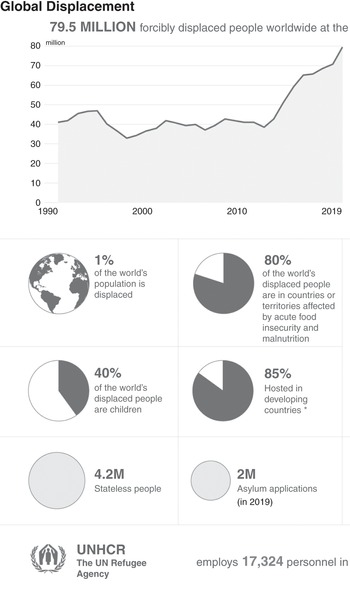
According to UNHCR figures (UNHCR, 2020), at the end of 2019, about 79.5 million people worldwide had been involuntarily displaced from their homes as a result of persecution, conflict, violence, human rights violations or serious disturbances of public order. Of these, around 40% (a disproportionate amount) were children. Approximately 1% of the world’s population (1 in 97 people) had been forcibly displaced, compared to 1 in 159 in 2010, and 1 in 174 in 2005.
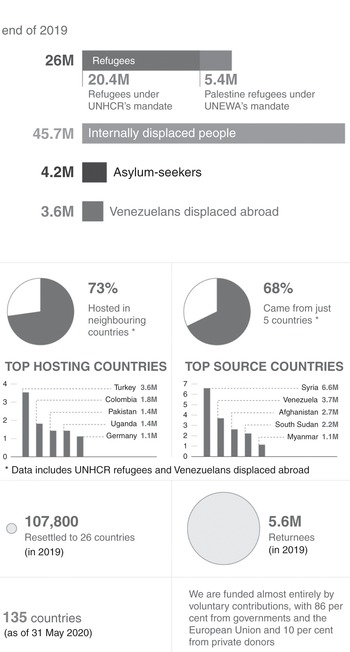
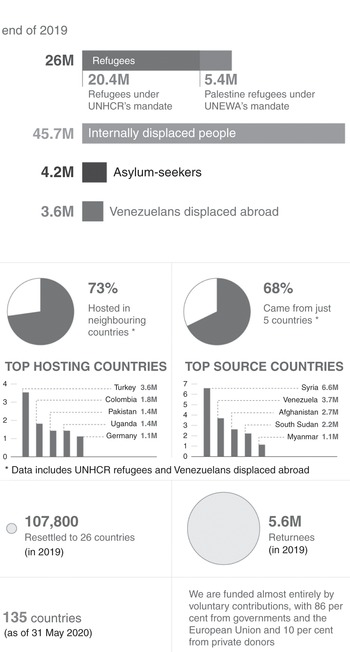
Of the 79.5 million forcibly displaced, 33.8 million also left their country, whilst the remaining 45.7 million were internally displaced within the borders of their own country (Figure 1.1). Events in only a small number of countries can lead to significant changes in migration trends worldwide. For example, in 2018, approximately two-thirds of all refugees came from Syria, Afghanistan, South Sudan, Myanmar, and Somalia, whilst 2019 saw the situation in Venezuela deteriorate to the extent that numbers of those displaced abroad exceeded those for many other longer-standing conflicts.
UNHCR global refugee statistics 1990–2019.

It is estimated that 30–34 million (38–43 per cent) of the 79.5 million forcibly displaced persons were children below 18 years of age. In 2019, unaccompanied and separated children lodged around 25,000 new asylum applications, and by the end of 2019 at least 153,300 unaccompanied and separated children were reported among the refugee population, though these are considered to be significant underestimates due to the limited number of countries reporting data.
Journeys: The missing link
I fled my country due to persecution from the government because of my political beliefs.
One fateful day after a non-violent protest, I was arrested and severely tortured and detained by the forces of law and order. I managed to sneak myself out of the police station that same day. This made my situation worse because I was now facing double crimes and was seriously wanted. I resorted to living in awful hideouts for a couple of years before fleeing to the UK. Living in hopelessness and despair has been the most distressful moment in my entire life.
The journey from my country to the UK was with an agent who went ahead and arranged it with the airport officials (I do not know how), and I was smuggled through the airport and into the plane without passing through the necessary checkpoints. I was constantly nervous throughout my journey. Despite arriving in the UK safe, I was frightened each time I saw a police officer. This feeling only left me the moment I was granted asylum.
Most people do not understand why refugees should embark on such risky ventures simply because they have not been in that position to know how desperate refugees are when seeking for refuge or protection. ‘Only the wearer knows where the shoe pinches.’ I would rather die fleeing persecution than being killed or tortured by my persecutors.
Irrespective of why a person leaves home, once they have done so, what happens next is often simply a matter of chance. For some, their plans had never extended beyond escaping alive. Others with more time and resources may have been able to make more plans, but few will have had absolute control over what happens next.
Journeys – a crucial part of the refugee story – are often overlooked in clinical practice. How a person reached the United Kingdom, and their experiences along the way, may vary considerably. Their route to the UK border may range from a direct flight lasting some hours to a journey of months or even years. Some people may have first been internally displaced, whilst others will have crossed borders directly into other countries. Many first find themselves in refugee camps, whereas others will have spent time in urban areas of neighbouring countries. Journeys may then be protracted, cover large geographical areas, and have a significant and lasting impact on people’s life. For some, the terrors of the journey will have been even worse than those they initially fled from. Many will have walked long distances or used dangerous modes of transport, and for some the journey in search of safety will have cost them their life. For example, thousands of people have died crossing the Mediterranean Sea attempting to reach Europe, with the number peaking in 2016, when more than 5,000 people drowned or went missing (IOM, 2021).
Journeys, especially if unplanned, are often the worst period in people’s experiences, wherein they are coming to terms with rapid changes in their lives, making decisions with little information, and facing constant fear and uncertainty. They may be separated from family and friends, and vulnerable to abuse and exploitation by others. They might need to travel by night or under cover, for fear of being caught by authorities or others, and lack food, shelter, and basic resources. This is often the most unstable and unpredictable period they will have in their lives.
A vast and profitable international industry has proliferated around migration, with much money to be made at every point of people’s journeys, whether this be through smaller informal interactions and bribes or organised criminal networks involved in people smuggling – or, on the other hand, large multinational companies involved in managing border security, detention centres, and deportation, all of which attract lucrative government contracts. Those who have been forcibly displaced, due to their limited options, may easily find themselves trapped in a web of exploitation that compounds their other problems, including being trafficked, held for ransom, or forced into dangerous situations.
Even before leaving the European Union, the United Kingdom was not part of the Schengen free-movement area. This, alongside its geographical location, has meant that some UK border security and control activity is actually carried out in France. This has led to makeshift encampments of people trying to reach the United Kingdom, such as the infamous Calais ‘Jungle’, which at its peak held thousands of people, including unaccompanied children. The treatment of refugees in such camps has drawn widespread criticism due to harassment and intimidation by French police, destruction of people’s belongings, and violent evictions. At one point in 2017, the authorities had barred aid groups from distributing food, water, and blankets. Although the ‘Jungle’ was officially demolished in 2016, Calais and Dunkirk continue to attract many seeking entry into the United Kingdom.
Reaching the United Kingdom
Where exactly people relocate to can depend on the social, economic, political, and geographical influences on the underlying drivers of migration, and the flow may alter considerably even in the course of a single conflict. Geographical proximity is important – people are likely to move as close to their homes as safely possible, and the majority travel relatively short distances. Those who cross borders are most likely to seek refuge in a neighbouring country, and the countries that have hosted the most refugees, such as Turkey, Colombia, and Uganda, are close to those from which large numbers of people have been forcibly displaced. Political decisions also play a role, leading to countries opening or closing their borders to particular groups of refugees at particular times. Some major recent diasporas are listed in Box 1.3.
The number of forcibly displaced people around the world has more than doubled since 2011.
Approximately 4.5 million Venezuelans fled political and socio-economic instability and a humanitarian crisis to countries across Latin America and the Caribbean within the latter part of the decade, peaking in 2019.
From mid-2017 onwards, violence in Myanmar led to more than 700,000 Rohingya Muslims, a persecuted, stateless minority, fleeing to Bangladesh, subsequently rising to more than a million.
Conflict in Yemen from 2015 led to the displacement of more than 3 million people alongside a critical humanitarian crisis.
From the end of 2013, approximately 4.3 million people fled their homes due to conflict in South Sudan following its independence, with over 1 million of these in Uganda alone.
Following the start of civil war in 2011, Syrians became the largest group of forcibly displaced people in the world, with approximately 13.2 million people displaced by the end of 2019, and more than 6.6 million of these having left the country.
As a legacy of wars in Iraq in the 1990s and 2000s, by 2014, more than 3 million people had been internally displaced.
Repeated wars and ongoing conflict and insecurity in Afghanistan ever since the 1980s has resulted in millions of refugees – the largest number of refugees from any country for the 20 years until 2013. In 2019, there were 2.7 m refugees, the majority of whom were in Pakistan and Iran.
Between 2015 and 2019, the European ‘refugee crisis’ arose due to the arrival of hundreds of thousands of refugees and migrants from a range of different countries.
There are many myths about why people seek asylum in the United Kingdom. For many, the reality is simple; there is little choice involved. Those that specifically want to come to the United Kingdom may have family or community connections already in place, they may speak English, or they may have historical colonial links (Reference CrawleyCrawley, 2010). When faced with the decision about where to attempt to rebuild your life, these factors can be crucially important.
Preferred destinations are rarely identified solely, or even primarily, on the basis of migration policies devised by different governments with the explicit aim of reducing the number of arrivals. Rather they reflect the ‘coming together’ of a wide range of factors, including access to protection and family reunification, the availability/accuracy of information, the overall economic environment and social networks.
In general, decision-making is a complex and dynamic process with various factors in play. Many refugees do not have a clear destination in mind when they set out.
Historically, the United Kingdom has provided refuge to several different waves of refugees, including some Jews from Germany in the 1930s and 1940s, Asians from Uganda in the 1970s (after expulsion by Idi Amin), Bosnians escaping genocide in the 1990s, and, most recently, Syrians fleeing the conflict in Syria. There have been smaller groups of refugees from other places. In 2019, the majority of asylum applicants came to the United Kingdom from Iran (4,853), followed by Albania (3,453), Iraq (2,971), Pakistan (1,930), and Eritrea (1,885) (Home Office, 2020b).
The UK government controls its own borders, with immigration checks at airports, sea crossings, and the Channel Tunnel. People enter by various different means, both regular and irregular (sometimes spoken of as ‘legal’ and ‘illegal’) channels, and may claim asylum either at entry or at a later time. For example, people arriving via regular channels such as airports or ports may claim asylum at that point, whereas others may enter by stowing away in lorries or crossing the Channel on small boats. It is also possible, for example, that someone may originally enter on a tourist, work, or student visa and retrospectively apply for asylum. Once people arrive in the United Kingdom and claim asylum, their claims are assessed by the Home Office (Chapter 2).
The United Kingdom’s immigration policy, which determines who is to be allowed to remain in the country, how they are treated if they arrive through irregular channels, and how their asylum claims are dealt with, is frequently a subject of political debate and rhetoric. Policy depends on various factors, including the particular position of the government of the day, wider public opinion, and an interplay with various other events on the national and international levels.
For some time, the UK government has accepted a number of refugees through various temporary schemes whereby, following multiple rounds of selection and interviews, people are recognised as refugees before coming to the United Kingdom. Some such programmes were run in partnership with the UNHCR and IOM (see Box 1.4) and included the Vulnerable Children’s Resettlement Scheme (VCRS); the Vulnerable Persons Resettlement Scheme (VPRS) for Syrians, which granted five years’ leave to remain; and the Mandate and Gateway programmes, which granted indefinite leave to remain. In 2019, the total number of people resettled across all schemes in the United Kingdom was 5,612, of which 2,677 were children (Reference WilkinsWilkins, 2020). Ultimately, refugees who come to the United Kingdom through resettlement schemes are a small proportion of those requiring resettlement, and many of those seeking asylum through other channels are at least as vulnerable, if not more so, and certainly equally entitled to protection under international law. The acceptance of refugees through resettlement schemes – particularly where the focus is on a specific group, such as Syrians or unaccompanied minors – can be politically prudent and is often used to justify claims that the United Kingdom has a progressive and humane record in this area, despite the relatively very low numbers of refugees taken overall, by comparison with our EU-15 neighbours.
UNHCR: The Office of the United Nations High Commissioner for Refugees was established in 1950 to coordinate the international effort to safeguard the rights and well-being of refugees. It has a supervisory role relating to the 1951 Convention, assessing asylum claims in some areas, monitoring asylum claims on an international scale, and providing humanitarian assistance.
UNRWA: The United Nations Relief and Works Agency for Palestinian Refugees was developed after the 1948 Arab–Israeli war to provide services to Palestinian refugees. It delivers aid, education, and health and social care to Palestinian refugees from the 1948 and 1967 wars and their descendants. There are now approximately 5.4 million refugees registered under the UNRWA.
IOM: The International Organization for Migration was established in 1951 and is a related organisation of the UN. It works with government and non-government partners to promote humane and orderly migration, including encouraging international co-operation and providing humanitarian aid.
Contrary to what is often depicted, immigration to the United Kingdom is tightly controlled and the numbers of people seeking asylum here are relatively few in proportion to the UK population. As an example of relative proportions, within the EU in 2018, when Britain was still a member, Germany received the largest number of asylum applications (184,180 applicants; 29% of the EU total), followed by France (120,425; 19%), Greece (66,965; 10%), Italy (59,950; 9%), and Spain (54,050; 8%). Only 6% (37,730) of total asylum applications in the EU were to the United Kingdom. Taking account of population size and considering asylum applications per 1,000 resident population, the United Kingdom ranked 17th among the EU-28 nations (0.6 compared with 1.2 across the whole of the EU-28), and 14th among the EU-15 nations (Reference WalshWalsh, 2019).
Numbers of asylum applications to the United Kingdom vary considerably from year to year, with peaks and troughs ranging from 84,132 at the highest in 2002, to 17,916 in 2010, and 35,566 in 2019 (Reference SturgeSturge, 2020). A significant proportion of these are also applications from unaccompanied asylum-seeking children (UASC). In the year ending March 2019, approximately 10% or 3,223 of all asylum applications were for unaccompanied asylum-seeking children (Home Office, 2019).
Even within the United Kingdom itself, some areas host relatively large numbers of asylum seekers, often through dispersal (whereby asylum seekers receiving state support are moved to different parts of the United Kingdom), whilst other areas have very few or none at all, resulting in different impacts on local healthcare and other services. For example, at the end of June 2019, the South East and East of England had the fewest asylum seekers relative to their populations at 0.01%, compared with 0.19% in the North East. Glasgow was the local authority with the highest number overall (Reference WalshWalsh, 2019).
The context of seeking asylum
Humans have long migrated over the earth, often moving their homes far from where they were born or where they lived their early lives. Some were nomadic farmers, following the rain, seeking food and water, or pasture for their livestock. Then, as societies became more developed, people sought work and economic stability, education and opportunity, and the chance to join family or friends elsewhere. At the same time, some travelled to conquer new territories, build empires, and take whatever they could find. Others, perhaps as a consequence, were forced out of, or fled, their homes, escaping danger or persecution to seek refuge elsewhere.
Involuntary migration has a long history over many different geographical areas, cultures, and religions. A right of asylum was recognised by the Egyptians and Ancient Greeks, and was offered by major world religions, usually associated with the inviolability of holy places. Examples of large groups of refugees include the Jews and Muslims expelled from Spain in the late fifteenth and early sixteenth centuries, and the exodus of the Protestant Huguenots from France in the seventeenth century. More recently, the Partition of India following independence from British rule in 1948 caused one of the largest movements of refugees in history.
Before the emergence of fixed state borders and the accompanying restrictions on freedom of movement, there was considerable fluidity in the movement of even large numbers of people. Over time, with the rise of nation states, the authority to grant asylum came to be viewed solely as a function of states. The twentieth century brought further, more systematic persecution of Jews in Europe, and a vast wave of various refugees by the end of World War II. The victorious nations had to address this urgently, and what followed forms the basis of our asylum laws today. The rights of the refugee were enshrined within the United Nations Universal Declaration of Human Rights in 1948, followed by the Convention Relating to the Status of Refugees in 1951 and the Protocol Relating to the Status of Refugees in 1967, which gave people the right to seek asylum on a number of grounds including race, religion, nationality, membership of a particular group, and political opinion.
Levels of involuntary displacement, both within and across borders, have increased since then, and have become a formidable political and economic problem, on a global scale. Controversies over legal responsibilities have played out in various fora. There is now a complex web of interested parties: host and neighbouring countries, other individual states, the United Nations, donors, humanitarian and non-governmental groups, and, of course, refugees themselves.
Refugee policy can be both a polarised and a polarising issue, with strong views held by all. The rise of 24-hour mass media has now catapulted once-remote conflicts into Western living-rooms, with emotive images giving rise to conflicting rhetoric of both ‘rescue’ and ‘immigration control’. Few subjects can inspire such a moral panic whilst stirring primitive fears: ‘there will not be enough for us’; ‘we are being taken advantage of and already do more than we have to’; ‘we are under threat; our whole way of life is at stake’. Such alarmist reactions to refugees and migrants, fuelled by both media and some politicians, have deepened and legitimised long-standing xenophobic and racist discourses, often severed from historical and political issues.
Visibility, whether in the media or politically, is rarely commensurate with numbers and the reality of the situation on the ground. Yet such visibility, or the lack thereof, often defines the nature and terms of the discourse and, consequently, public opinion. This in turn can determine the public acceptability of government policy, such as with the United Kingdom’s ‘Hostile Environment’ policies introduced in 2012 (see Chapter 2). Government policies and public discourse are crucial components of the external environment which shapes the experience of refugees. But long after striking images fade, harsh realities linger, and beyond the sensationalised headlines it is important to have an accurate wider understanding of a topic whose presentation is often subject to the vagaries of the politics of the day.
International refugee law: Fit for purpose or a relic of a bygone era?
At the end of World War II, states took responsibility for providing asylum to those fleeing persecution and for stateless persons. In 1948, the United Nations adopted the ‘Universal Declaration of Human Rights’, which gave individuals the right to apply for asylum, and the United Nations ‘Refugee Convention’ of 1951 became the foundation on which international refugee law was based. This defined who a refugee was, the protection and rights they should receive, and the legal obligations of states towards them. A person was a refugee once the defined criteria were met, and this was not contingent on the decision of a state receiving an application for protection. The main principle was that of ‘non-refoulement’: that a person should not be sent back to a place where they may face serious threats to their life or freedom. Originally, this was limited to events occurring before 1951 in Europe only. However, as the problems relating to World War II and its aftermath receded and new wars loomed, the subsequent 1967 ‘Protocol Relating to the Status of Refugees’ applied the framework to refugees worldwide, irrespective of when they had left their homes.
International standards were not comprehensive, however, and were then developed further, regionally. In Africa and Latin America, the definition of a refugee was extended to include those fleeing civil disturbance and violence. In the EU, additional regional instruments addressed issues such as temporary protection, the reception of asylum seekers, how people qualify as refugees, and the rights they receive. Other international human rights treaties not specific to refugees also provided for complementary protection. These included, notably, the Convention against Torture and other Cruel, Inhuman or Degrading Treatment or Punishment (CAT), the Convention on the Rights of the Child (CRC), and, in Europe, the European Convention on Human Rights (ECHR). All of these prohibit torture, with the CAT specifically prohibiting non-refoulement (people being returned to a country where they would still face a threat).
The main international legal instruments were thus developed within a specific historical and geopolitical context and applied to individuals persecuted, or failed, by the state in post-war Europe and in the early years of the ‘Cold War’. Later, the Cold War’s end ushered in significant geopolitical shifts and changes in international displacement trends. Existing approaches did not adequately address the changing needs on a global level. The legal concept of ‘persecution’ in the 1951 Refugee Convention struggled to cover the array of circumstances which now made people leave their homes. Cold War-related strategic interests that had favoured the general acceptance of certain refugees, such as those from Hungary in 1956, were no longer applicable.
By the 1990s, states were less inclined to solidarity when it came to refugees, or to advocating for the human rights and entitlements of forcibly displaced people. Responsibility was increasingly shifted to multilateral agencies (Reference LeeLee, 2010), and refugees were viewed through the lens of a ‘security’ model. There were efforts to control and deter refugees, both internally through immigration policy and externally through foreign policy and the steering of international agencies (Reference Goodwin-GillGoodwin-Gill, 2001). Policies of deterrence became increasingly visible at militarised borders, such as those of the EU, often attracting media attention. Perceptions of threat grew, with images of large numbers of migrants finding any way they could to gain entry, and with the criminality of those arranging their travel frequently invoked. Refugees were viewed as a threat to the national culture and people’s livelihoods – often in relatively rich countries at a far remove from the initial displacements, which were actually taking place into neighbouring states.
Although history shows that these were by no means new attitudes, they began to regain a more prominent place in political discourse, replacing the expressions of idealism of the 1940s and ’50s. Across Europe, far-right and nationalist political movements with explicit anti-immigration stances have become more mainstream, achieving considerable success, and across the political spectrum, harsher rhetoric towards migrants has been used in political campaigns, reflecting the wider socio-political climate within which policymakers operate, as well as that which greets many refugees when they arrive.
Overall, existing refugee law has been unable to meet the demands of new crises, resulting in the adoption of a series of ad hoc measures by which states continue to attempt to minimise their obligations, including through restrictive interpretations of the 1951 Refugee Convention and adopting deterrent measures, such as visa requirements or supplements to domestic asylum laws (Reference PestrovaPestrova, 1995). The non-binding nature of some agreements means that despite expressed good intentions, there is no guarantee that states comply fully and in a timely manner. Ironically, some of the countries that did not sign the 1951 Refugee Convention and 1967 Protocol, such as Lebanon and Pakistan, have gone on to host large numbers of refugees.
Insofar as a rational and humane approach would aim to offer rescue, support autonomy, and provide a route towards some form of long-term stability, the current standards fall short. Despite widespread recognition of the scale of the overall problem and the need for a robust and binding international legal framework that proactively addresses contemporary challenges and reaffirms human rights, there has been no revision of international standards. Instead, policy has developed in an inadequate manner, nation by nation, with widespread differences in asylum policy and practice from place to place.
Some problems with the global approach
The approach to refugees globally is thus uncoordinated, and is beset with practical and ethical issues which profoundly affect the experiences of people needing asylum. These include exactly how and where support should be offered to forcibly displaced people worldwide, and the multiple difficulties which arise in dealing with a large-scale, multifaceted phenomenon, working with international organisations affected by their own issues; nation states with different policies, procedures, and cultures; and the ever-present inflexibility of bureaucracy. Some of the current key international organisations are listed in Box 1.4.
The manner in which protection and assistance are provided can induce or aggravate problems and affect mental well-being. For example, many refugees – including those in refugee camps – are prohibited from working, significantly limiting their ability to develop and rebuild their lives. In general, many of the processes and situations faced by people seeking protection appear to undermine rather than promote autonomy and dignity. Such assistance as is provided often does not consider the emotional and cultural impact that its delivery may have on individuals, family dynamics, gender relations, and traditional household roles. This risks undermining the dignity of the recipients and may disorient them further (IASC, 2012).
Refugee camps
Often the first, and possibly the only, step of the journey outside one’s home borders, refugee camps are physically segregated from areas where non-refugees live. They are often situated close to country borders, with a view to dealing swiftly with the aftermath of conflict or humanitarian catastrophe. Whilst they may ‘protect and rescue’, meeting urgent humanitarian needs, they are designed to offer only a temporary solution. In reality, they may well last many years, leaving millions living in limbo, facing detrimental forced immobility and inactivity. By 2019, there were approximately 15.7 million people (77% of all refugees worldwide) in what the UNHCR designates as ‘protracted refugee situations’ (defined as more than 25,000 refugees of the same nationality in exile in a given host country for at least five consecutive years; UNHCR, 2020), although not all, by any means, remained in camps. In Jordan, hundreds of thousands of Palestinian refugees have grown up in multigenerational refugee camps, many dating back to 1948 or shortly after. In Kenya, the Dadaab refugee camp, first established for Somalis fleeing the civil war in 1991, later had another large influx of refugees fleeing drought and famine in 2011, and grew to house more than 200,000 people. Under international law, children of refugees remain refugees, adding further weight to the need to find just and durable solutions in a timely manner.
Those in refugee camps still face many problems. Even safety is not guaranteed, particularly for women and children, who are commonly exposed to gender-based violence. In 2020, around 9,000 Malian refugees fled the Goudoubo camp in Burkina Faso after attacks and threats from armed groups. Most camps are very overcrowded with cramped conditions, and often a lack of access to even the minimum resources that people need to live, such as basic healthcare, education, or opportunities to work.
Restricted lives in neighbouring countries
Other refugees – the majority overall – will end up in cities and urban areas, most often in neighbouring countries. This usually means foregoing the provision of shelter and food aid, but may come with the advantage of some relative freedom. Whilst urban refugees still cannot access the rights of citizens of the host country, their movement will be less restricted and there may be opportunities to work in some, usually irregular, capacity. However, most remain in poverty, with legal restrictions limiting integration, often alongside xenophobia and discrimination from host communities. In Jordan in 2020, approximately 80% of the more than 0.6 million Syrian refugees lived outside refugee camps, and more than 93% of all refugees worldwide live below the poverty line (UNHCR, 2020).
Favouring the better off
People are less likely to return home the further away they have moved and the more links they have cut. If the aim is to facilitate long-term solutions as close to home as possible, focusing resources on more distant locations, or even different continents, is likely to be counterproductive. Providing little for the majority who remain nearby creates clear incentives for moving on. Such scenarios promote a process of self-selection that can lead to ‘brain-drain’ situations, with a significant loss of human capital. Those with personal resources can seek more opportunity, and so there is selection on the basis of age, gender, strength, intelligence, education, and wealth. For example, those Syrians who have settled in European countries following the civil war are far more likely to be male, educated, and of working age than are those who remain in neighbouring states (Reference Betts and CollierBetts and Collier, 2017).
Problematic funding patterns
There is a significant discrepancy between where the largest numbers of refugees are found and where the world’s attention and resources are directed. Developed regions, hosting around 10% of refugees at the time, attracted $75billion a year in funding in 2016–17, whereas only $5billion was spent on the 90% who remained in developing countries – a ratio of approximately $135:$1 (Reference Betts and CollierBetts and Collier, 2017). Although the relative proportions have changed slightly since then, the funding disparity has not.
Such differences reduce the likelihood of the much larger, financially neglected group finding durable long-term solutions close to their original home. Indeed, where funds are directed to those in developing countries, they are primarily for humanitarian assistance rather than for developing long-term solutions. Furthermore, large numbers of refugees have a disproportionate impact on small countries with low populations. Thus, in Lebanon, one in seven people is a refugee (UNHCR, 2020), which means that it hosts the largest proportion of refugees worldwide. Nearby Turkey, with a much larger population and land mass, despite taking large numbers has one refugee in 23 people.
Lack of long-term solutions
People who have been involuntarily displaced to a neighbouring country require long-term solutions. One possibility is eventual repatriation, for example if a conflict ends or political transition makes it safe to return. Another is local integration, which depends upon the host country granting citizenship and/or removing restrictions such as those on work. Another alternative is resettlement in a third country. However, globally less than 1% are resettled in countries beyond their region of origin, and only 0.5% in developed countries. A balance has to be struck between protecting people from ongoing risks until they are safe to return home, and facilitating integration in neighbouring countries or further afield.
The treatment of children – for whom durable solutions are a particular and pressing need – is a case in point. Host countries are obliged to offer legal support, housing, education, care, and protection. However, whilst these rights are enshrined in legal frameworks of the UN and EU, local policies, practices, and implementation have varied considerably across Europe and the United Kingdom. Yet, as well as there being this overarching human rights perspective, there is an additional argument for positive action: not only do children and young people show a remarkable adaptability and capacity for recovery from adverse experiences, but with the right support they have significant potential for resultant growth and development. Accordingly, a policy briefing of the European Expert Network of Economics in Education (Reference BoninBonin, 2017, p. 2) highlights that the integration and education of migrant children may result in substantial gains for the host society and ‘warrant a strong focus on education policies fitting migrants’. There may also be more far-reaching benefits. Some of these child refugees will return to their countries of origin as adults, and this may make an important contribution to peace, stability, and development (Reference Koehler and SchneiderKoehler and Schneider, 2019).
Ultimately, only a small proportion of the world’s displaced people achieve lasting security. From 2000 to 2019, 100 million people were forcibly displaced, and more than 62 million remained with no durable solution (UNHCR, 2020).
Barriers to resettlement in wealthier third countries
There is a large discrepancy between numbers of refugees and the options for resettlement through ‘regular’ immigration channels to third countries such as the United Kingdom. Stricter limitations and restrictions on these, alongside the growing numbers of forcibly displaced people, has meant that many refugees resort to irregular options, planning to seek asylum following ‘spontaneous’, unsanctioned arrival in a country such as the United Kingdom. As the likelihood of finding a long-term solution through the regular pathways is so low, it is not difficult to see how many feel they have no choice but to take the matter into their own hands. Many states have responded with stricter policies preventing entry at borders and limiting movement between countries. Such measures include returning people to ‘safe third countries’ that they may have passed through in transit, and the use of controversial offshore detention facilities such as that on Nauru Island in the Pacific by the Australian government.
Restrictive and punitive asylum and immigration policies have a high human cost. Framing the movement of people through the Mediterranean Sea as a human trafficking or smuggling issue blames smugglers or even refugees themselves for deaths, and obscures the role of EU immigration policies in the crisis through the hardening and militarising of borders, thereby restricting safer routes (Reference JonesJones, 2016) whilst failing to develop realistic alternatives.
Within the EU, the ‘Dublin III Regulation’ of 2013 dictated that people should apply for asylum in the first member state reached, and that this state is then responsible for processing their asylum claim. As a result, those seeking asylum can be detained and forcibly transferred between states. There is no provision for understandable choices to seek asylum in a particular country on the basis of language or family links, for example, still less for any other grounds of preference. The implicit assumption is that all member states are equal in the protection they offer, to say nothing of their resources, and the number of asylum seekers that reach them. Yet in practice, this is not the case and there is wide variation between countries. Some member states such as Greece or Italy, due to their location, have disproportionately high numbers of people arriving on their shores, as is reflected in the number of applications they are expected to process. Differences in the asylum processes and laws between countries are also marked and can appear arbitrary, with significant variation in the likelihood of being granted asylum. For example, in 2014 the recognition rate for Eritreans was 100% in Spain and Sweden, but only 26% in France; and for Iraqis in France, it was 94% but 35% in the United Kingdom, and only 14% in Greece (ECRE, 2015).
Limitations of international co-operation
All these issues illustrate how the current legal framework, developed in the aftermath of World War II, is a poor foundation for the situation we have today. Attempts to negotiate international agreements which address the core issues and share responsibility in an equitable manner have not been successful.
Legal discussions of human rights are thus played out in the everyday lives of millions of forcibly displaced people, according to rules established more than seventy years ago in a different world. In the meantime, much of the burden inevitably falls onto states that neighbour areas of conflict, fragility, and climate change – and which may well be affected by similar issues themselves. Richer and more developed nations are generally more able to choose how, and to what extent, they are willing to become involved.
Finally, one cannot overlook the need to consider the very situations which cause forced displacement and think of prevention rather than cure. The discomforting reality is that often those states cast in the ‘saviour role’ bear some responsibility for the problem: from the lasting impact of colonial legacies to the current foreign policies of many countries, including the United Kingdom, to say nothing of the arms trade. These matters contribute both directly and indirectly to the forced displacement of millions of people. The responsibility of the ‘international community’ lies not just in considering the protection of people following forced displacement or providing humanitarian aid, but in reviewing its role in causing the problems, for example, its support of conflicts and human rights abuses for geopolitical reasons or as a chance to sell weapons.
Why does all this matter to mental health professionals?
Healthcare professionals are themselves part of the context in which people seek asylum. We are consumers of media, electors of governments, interpreters of people’s stories, and, like everyone else, we are liable to assumptions, biases, and misconceptions. A better understanding of the context in which people seek asylum can mean a better chance of avoiding misjudgements and of noticing the structural and institutional factors that are often overlooked, yet profoundly impact health. Any service which ignores the context people have come from itself risks promoting inequality if it does not take into account specific factors or differences and merely provides ‘treatment as usual’.
A better understanding of what may have happened to the people we meet might also help us do better at understanding their individual presentation. Prior to arrival, those seeking asylum in the United Kingdom have a high likelihood of having witnessed and/or experienced violence, including sexual violence and torture, as well as having experienced cumulative losses, trafficking, detention, destitution, and discrimination. Box 1.5 lists some common experiences that clinicians may want to hold in mind. Even in isolation, and without being compounded by the loss of home and all that is familiar, many of these experiences are associated with higher rates of mental illness or exacerbation of existing problems.
| Factors to consider | Source of psychological impact | Notes |
|---|---|---|
| Different periods of difficulty |
|
|
| Different locations of difficulties |
| People may have had life-changing experiences in all of these locations |
| Different sources of danger |
|
|
| Family context |
| |
| Experiences of individuals and families |
|
|
|
| |
| Processes by which mental health may be adversely affected |
|
|
People seeking asylum may also have had experiences of healthcare professionals being untrustworthy, having links to persecutors, turning a blind eye, or even being involved in torture. They may not trust clinicians they meet in the United Kingdom and their assurances of confidentiality. They may not volunteer important information spontaneously and, even when asked, they may be reluctant to disclose what the clinician feels is crucial or basic information. Being aware of what types of adversity people might have experienced means more chance of eliciting relevant stories, perhaps by asking key questions and following clues, or noticing significant hesitations and silences.
Important differences
Many who seek asylum describe the dehumanising experience of being treated as a homogenous group, with the underlying implication that all are similar, and having to face others’ expectations of ‘refugeeness’ and what this entails (Reference KhosraviKhosravi, 2010). It is important not to make assumptions. Each person has had different experiences of leaving home and coming to the United Kingdom, and quite apart from experiences linked to migration or seeking refuge, each has also of course had their own particular experience in relation to every other aspect of life – family, culture, community, country, class, education, employment, economic situation. As with anyone else, they may have been affected by misfortunes unrelated to their refugee status, for example grief, poverty, or abuse.
It is equally important not to make assumptions about the impact that people’s experiences have on them. Suffering and psychological distress are mediated by many factors, including a person’s history, culture, and values. If we overlook the individual story, we risk projecting our own ideas of suffering and well-being in an oversimplified way onto people to whom they may not apply, or whose whole frame of reference is fundamentally different.
One common mistaken assumption is that post-migration difficulties, such as with housing, finance, or asylum claims, have less impact than the problems experienced before and during migration. In reality, these are often important stressors that lead to destabilisation, and may be responsible for uncovering the impact of experiences that were hitherto felt to be manageable; they may even at times constitute traumatic experiences in and of themselves. We will approach these issues in Chapter 2.
Another misapprehension is that seeking asylum is the defining part of someone’s story. Many do not see either the experiences they have been through, or the role of a ‘refugee’ or ‘asylum seeker’, as a primary part of their identity; sometimes being a refugee will not even be relevant to a person’s presentation. Focusing on vulnerabilities and the ‘asylum seeker’ identity alone risks undermining autonomy and dignity, and possibly recreating aspects of the adverse experiences that individuals may have had before arriving in the United Kingdom.
Finally, it should not be assumed that everyone seeking asylum has been made mentally unwell by what happened to them. Humans have a remarkable capacity to bear adverse experiences, and the majority of refugees do not present to, require, or indeed want input from mental health professionals.
Involuntary displacement disrupts and erases stories, and the perspectives of the protagonists themselves. At times, as in the case I described at the beginning of the chapter, we are complicit in this as healthcare professionals. Healthcare services become a microcosm of the global context: oscillating between hostility and pity, controlling access and excluding some, whilst tolerating or advocating for others deemed sufficiently worthy. The knotty ethical issues of providing equitable services in a hostile environment are often ignored or avoided.
Erasing context means erasing both the richness of people’s stories and our ability to understand them, relate to them, and to bear witness. One great tragedy, then, of being a person seeking asylum is to be misunderstood, or not understood at all; finding that people have no interest in you and what has happened to you; that you are viewed with pity or resentment or indifference, but never just as an individual like any other: always too different, never just ‘one of us’, never at home.