I. INTRODUCTION
The anticipation surrounding the March 2018 ruling of the Court of Justice of the European Union (CJEU) in Slovak Republic v Achmea was palpable.Footnote 1 Most expected the ruling to mark a sea change for international investment law and the law of the European Union (EU).Footnote 2 It promised institutional, political and economic ramifications that were sure to be felt across the globe. Yet, when the judgment finally arrived, it came less as a tsunami and more as a splash. On a practical level, the ambiguity surrounding its scope means that whilst some insist that the judgment precludes all types of investment arbitration between European investors and EU States, others argue for a narrow interpretation that would allow arbitration arising from intra-EU investment treaties (intra-EU BITs) to proceed under almost all circumstances. Moreover the reasoning of the CJEU is brief and is widely considered unsatisfactory, provoking more questions than it answered.Footnote 3
Nevertheless, these critiques aside, there may be an important bright side to the Achmea judgment. International and European perspectives had little common ground between them. Indeed, over the past decade there had been no meaningful change in the approach of the European Commission to its fight against intra-EU arbitration, nor in the jurisprudence of arbitral tribunals concerning this issue. This is not surprising, since each is firmly anchored in its own legal regime and institutions. However, Achmea introduces a new common touchstone that, although imperfect, could prove to be a much-needed bridge between the international and European perspectives. Rather than a drawback, its imprecision could be seen as a form of constructive ambiguity, allowing a sufficient margin of appreciation for all stakeholders to avoid direct confrontation between the European and international legal orders. As such, Achmea might be best understood as giving a firm nudge: pushing stakeholders away from the current untenable status quo of intra-EU investment arbitration, and toward a more sustainable and consistent regime.Footnote 4
This article interprets Achmea—the judgment and the phenomenon—through the prism of legal pluralism in order to provide a response to the current clash between the European and international legal orders. It is argued that actors on all sides may be more comfortable working with a more flexible interpretation of the judgment, rather than carrying it to its extremes. Instead of considering European and international investment law regimes as irreconcilable, it understands Achmea as reflecting a moderate version of legal pluralismFootnote 5 that promotes coordination and seeks to addresses the legitimate concerns of both.Footnote 6
Such pluralist approaches avoid perpetuating regime conflict and are a natural corollary of the foundational principles of both the EU and international legal orders. As acknowledged by Maduro who, as Advocate General, said that ‘concurrent claims to legal sovereignty are the very manifestation of the legal pluralism that makes the European integration process unique’.Footnote 7 Similarly, in the context of the International Law Commission's (ILC) report on the fragmentation of international law, Koskenniemi concluded that ‘pluralism should be understood as a constitutive value of the system’.Footnote 8
Concretely, a legal pluralist lens as applied to Achmea requires dismissing the red lines that certain actors on both sides have purported to draw. Rather, an incremental approach centering on judicial discretion and dialogue, and complemented by political compromise, should be favored. For example, the numerous conflicts tools of public international law offer flexibility and a degree of discretion to arbitrators seeking to adopt a graduated approach to jurisdictional objections arising under Achmea. As has been acknowledged by some tribunals, these tools allow for the application of different methodologies to different circumstances, such as bilateral intra-EU BITs and the multilateral Energy Charter Treaty (ECT).Footnote 9 At the same time, the constructive ambiguity of the Achmea judgment appears to have allowed EU States to adopt a somewhat flexible and incremental ‘transitional’ approach to phasing out intra-EU arbitration, by adopting different approaches to concluded, pending and future arbitrations.Footnote 10
The seed of legal pluralism—present all along—has started to germinate as actors on both sides have begun to abandon hardline approaches. As we enter a new phase of post-Achmea developments, pluralism should be nurtured to fruition, and all actors should avoid the temptation to uproot it.
The rest of the article is composed of five sections. Section II offers a brief background to the underlying tensions between EU law and international investment law and traces the development of the Achmea phenomenon through three phases. Section III highlights the inherently pluralist nature of both legal regimes. The following three sections explore the Achmea judgment from three different perspectives. First, a European perspective seeks to situate the decision within the context of CJEU jurisprudence in order to better understand its implications, limits, and potential for pluralism and convergence with international law (Section IV). Second, an international perspective demonstrates how pluralist approaches found in public international law allow the Achmea judgment to be taken into account when considering questions of jurisdiction arising from intra-EU investor–State arbitration provisions (Section V). Finally, a legal pluralist approach is used to reconcile the EU and internationalist perspectives, harnessing both approaches considered in the previous sections (Section VI).
II. THE UNDERLYING CHALLENGE: MAPPING THE CLASH OF EU AND INTERNATIONAL LAW
Foreign direct investment (FDI) has been described as the ‘lifeblood of the global economy’.Footnote 11 Since the Washington Convention of 1965 established the International Centre for Settlement of Investment Disputes (ICSID), FDI across the world has largely been governed by thousands of multilateral and bilateral treaties.Footnote 12 European Union Member States were no exception. Many followed in the footsteps of Germany—which concluded the world's first modern BIT with Pakistan in 1959—and have entered into BITs with both future EU and non-EU Member States.Footnote 13 With the entry into force of the Lisbon Treaty in 2009, competence over FDI was transferred from the Member States to the EU by bringing it under the ambit of the EU's Common Commercial PolicyFootnote 14 and it was the subject of the Commission's 2010 Communication paper which outlined the EU's approach to future investment policy.Footnote 15
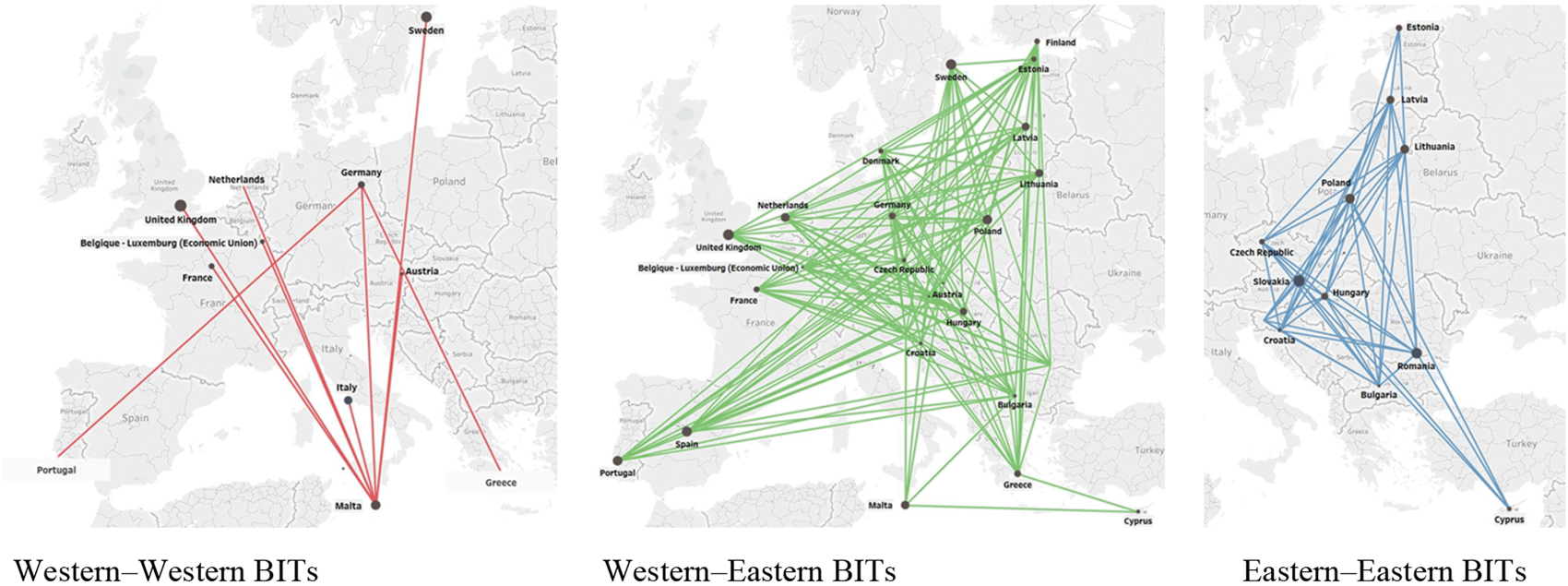
Yet, even as the EU moves toward a unified investment policy, an inconvenient truth lingers.Footnote 16 The gradual enlargement of the bloc means that, prior to their accession, many newer member States have previously concluded BITs with long-term Member States. The first set of bilateral treaties between current Member States dates back to the accession of Spain and Greece in 1981 and 1986 respectively,Footnote 17 but as shown in Graph 1, the great majority of intra-EU BITs currently in force relate to treaties concluded between the first 15 EU Member States and Central and Eastern European Member States following the multiple enlargements of 2004, 2007 and 2013. Despite the fact that no two Member States of the EU have ever entered into a BIT, a tangled web of so-called intra-EU BITs continues to exist.
BITs between Member States of the EU by Region

As will be seen, the procedural and substantive protections granted by BITs are at times considered incongruous with the EU legal framework. This overlap is not an isolated phenomenon, with UNCTAD concluding that international investment law is ‘gradually shifting from bilateral to regional treaty-making’.Footnote 18 Indeed, as Alschner shows, many bilateral relationships are governed by more than one investment treaty.Footnote 19
EU law attempts to prevent possible conflicts with prior obligations of acceding States under international law through Article 351(2) of the Treaty on the Functioning of the European Union (TFEU). This requires Member States to ‘take all appropriate measures to eliminate the incompatibilities established’ between EU law and international obligations.Footnote 20 However, as evidenced by Graph 1, Member States did not terminate pre-existing BITs upon accession.
A. The First Phase
A first phase of what would become the intra-EU BIT saga, centred on the European Commission's attempts to eliminate this ‘anomaly within the EU internal market’Footnote 21 through intervening in arbitrations in order to assert that investment tribunals cannot exercise jurisdiction under the auspices of intra-EU treaties.Footnote 22 The Commission's first known intervention came in the form of a 2006 letter to the tribunal in Eastern Sugar v Czech Republic.Footnote 23 Since then, it has intervened more directly, at the invitation of tribunals, as amicus curiae.Footnote 24 It has made similar submissions in cases brought under the ECT, which although not an intra-EU BIT per se, presents similar concerns for the Commission.Footnote 25
In its various interventions, the Commission has argued that, by eliminating review by the EU judicial system, intra-EU investor–State arbitration agreements put the primacy and autonomy of EU law at risk.Footnote 26 It has also argued that by granting preferential procedural treatment to investors from certain Member States, there is a conflict with the EU principle of non-discrimination,Footnote 27 and that arbitral awards are potentially incompatible with EU competition law.Footnote 28 However, arbitral tribunals, Member State governments,Footnote 29 and even some national courts have been hesitant to accept the Commission's arguments.Footnote 30 In June 2015, in the light of this deadlock, the Commission took the firm step of initiating infringement proceedings against five Member States.Footnote 31
However, the Commission's greatest hope for doing away with intra-EU BITs came with set-aside proceedings before the German Federal Court of Justice (BGH) in Slovakia v Achmea. The Slovak Republic alleged that an award rendered pursuant to the arbitration provision—Article 8—of the Netherlands–Czechoslovakia BIT was contrary to Articles 344 and 267 TFEU as well as to the principle of non-discrimination set out in Article 18 TEU, and was thereby null and void. The BGH submitted three questions to the CJEU, asking whether any of the above cited provisions of the EU founding treaties ‘preclude the application of a provision in [an intra-EU BIT] under which an investor of a contracting State … may bring proceedings against the latter State before an arbitration tribunal … ?’
Yet, before the Court's final ruling in Achmea, the Advocate General charged with briefing the Court concluded that the Court should find that there was no incompatibility between intra-EU investor–State arbitration and the EU Treaties.Footnote 32 Nevertheless, as discussed in detail in the following sections, the CJEU eventually rejected this position, holding that Article 8 of the Netherlands–Czechoslovakia BIT is incompatible with EU law.
B. The Second Phase
The 6 March 2018 judgment of the CJEU marked the beginning of a second phase of the intra-EU saga, in which all stakeholders were left to grapple with the meaning of the judgment, and its impact on intra-EU arbitration. Yet, a first wave of reactions to the ruling demonstrated that both sides of the divide continued to operate on different wavelengths. On the European Union side, the Commission persisted in its strategy of intervening in arbitral proceedings in order to advance wide-ranging arguments against intra-EU disputes being subject to arbitration.Footnote 33 Moreover, the Commission showed little willingness to distinguish between different forms of intra-EU arbitration, and refused to acknowledge that Achmea could have different implications in different contexts.Footnote 34 Likewise, EU Member State governments made purportedly binding declarations interpreting the Achmea judgment as precluding the jurisdiction of intra-EU tribunals.Footnote 35
On the other hand, not a single arbitral tribunal has declined jurisdiction on the basis of the Achmea judgment. Many tribunals have lacked the appetite to thoroughly grapple with the Achmea judgment, preferring instead to rely on institutional and procedural means in order to avoid giving it effect.Footnote 36 Other tribunals have recognised that the judgment represents a potentially important new development, but ultimately decline to pay it much deference, thus reinforcing the pre-Achmea reality of intra-EU jurisdictional objections being unanimously rejected.Footnote 37 In the meantime, new arbitral tribunals continue to be constituted under intra-EU BITs.Footnote 38
C. A Third Phase?
It remains to be seen whether a new phase will emerge, in which the initial perspectives on the Achmea judgment will begin to evolve in light of the presence of multiple new variables and pressure points. Set-aside proceedings before domestic courts threaten to limit the effectiveness of arbitral awards or lead to further preliminary rulings from the CJEU.Footnote 39 At the same time, the European Commission is finding it increasingly difficult to build a global consensus for reforming investor-State dispute resolution whilst it alienates key stakeholders in the intra-EU context. By exerting pressure on EU Member States not to comply with intra-EU awards, the Commission is potentially undermining the integrity of the ICSID system of automatically enforceable awards, upon which European investors across the world have come to rely.Footnote 40
In this connection, the CJEU's 30 April 2019 ruling in Opinion 1/17 concerning the EU's trade and investment agreement with Canada has further complicated matters. In its judgement, the CJEU has demonstrated flexibility with regard to the autonomy of EU law when it comes to ISDS proceedings involving non-EU Members.Footnote 41
The arbitral community was rattled in February 2020 when an arbitrator issued a strongly worded dissenting opinion asserting that arbitral jurisdiction is lacking under intra-EU BITs in light of the Achmea judgment.Footnote 42 This first-of-its-kind development in ISDS jurisprudence brings an end to the unanimity that had prevailed in the arbitral community, even among those arbitrators most often appointed by States.Footnote 43
On 5 May 2020, 23 EU Member States adopted an agreement for the termination of intra-EU BITS (Termination Treaty).Footnote 44 Although the Termination Treaty is subject to ratification, it can be applied provisionally with regard to certain BITs provided that such an intention is properly notified by both States parties. Distinguishing between concluded, pending, and new arbitrations, the Termination Treaty foresees ‘transitional measures’ which allow for structured settlement negotiations with investors.Footnote 45
It remains to be seen how (and whether) arbitral tribunals will take into account the Termination Treaty in their analyses going forward, and whether the other aforementioned developments will come to be viewed as contributing to a turning point in the Achmea saga.
III. EU LAW AND INTERNATIONAL INVESTMENT LAW AS PLURALIST LEGAL ORDERS
The incompatibility found by the CJEU between EU law and intra-EU investment arbitration raises the general question of the conditions under which both legal regimes may coexist. The lack of a hierarchical relationship between those legal orders when viewed from an external perspective, and the lack of any overarching system of judicial review, means that there cannot be formal deference by one regime to the other. As a consequence, legislative or judicial action will not bring about convergence. Nevertheless, it is argued that a viable form of coordination may result from exploiting the inherently pluralist features of both legal orders, and which enables an ordering on a case-by-case basis without rigid structures and which maximises common interests.
Legal pluralism is not unknown to the European Union. Indeed, it is not only its reality and its mandate, but above all, it is its raison d’être. Footnote 46 The EU seeks to bring multiple national legal orders into a Union de droit Footnote 47 by drawing on a plurality of sources: international treaties, EU and administrative law (ie secondary legislation), national law, and new instruments of governance and regulation.Footnote 48 All this is supported by an interconnected and semi-autonomous judicial system composed of national judges and tribunals, and exclusive EU jurisdictions. In brief, the EU legal order results from the encounter of national and international law, which ultimately conditions its existence.
For Weiler the EU can accommodate such diverse orders because of its constitutional nature, which includes both ‘hierarchical and pluralist features’.Footnote 49 However, as AG Maduro notes, the EU is not only exposed to internal pluralism, ie ‘[the] plurality of constitutional sources (both European and national) which have fed the EU constitutional framework and its general principles of law’,Footnote 50 but also to external pluralism, which ‘derives from the increased communication and inter-dependence of the European Union legal order with international and foreign legal orders’.Footnote 51 Indeed, the EU increasingly takes part in international agreements. For instance, the EU is a party to the World Trade Organization (WTO) and the ECT, and more recently it sought—albeit unsuccessfully—to become a party to the European Convention of Human Rights.Footnote 52 The success of the Union de droit seems to depend largely on the capacity of the EU judicial system to embrace both types of pluralisms while ensuring the effectiveness of EU law.Footnote 53
Like the EU, legal pluralism is also found in international law. Derived from a multiplicity of sources—treaties, custom, and general principles—international law lacks a single normative fountainhead. Moreover, there is no single institution—such as a legislature in a domestic legal order—charged with coordinating the norms arising from various sources.Footnote 54 This decentralised structure of international law makes it naturally predisposed to legal pluralism. As observed by Koskenniemi, ‘in a world of plural sovereignties, this has always been so’.Footnote 55
Investment law is a branch of international law that is particularly ripe with aspects of legal pluralism. Its substantive protections can be found in multiple layers of international law: general international law, customary standards of international economic law,Footnote 56 and bilateral and multilateral treaty provisions. However, it often also includes and makes reference to the rules of the legal system of the host State.Footnote 57 Legal pluralism is the rule rather than the exception in terms of substantive law applicable to investment disputes. Similarly, procedural aspects of investment dispute settlement touch upon the institutions of multiple legal orders. Some BITs, such as the France–Argentina BIT, allow investors to choose between State courts and international tribunals.Footnote 58 Choice is often even provided from between any number of institutions equipped to administer investment disputes, each with different rules, and varying degrees of attachment to national jurisdictions. While ICSID arbitration requires minimal reference to national legal orders, other arbitral proceedings may interact with domestic regimes should they be concerned in regard to questions of the procedural rights of the parties, the requirements for the appointment of arbitrators and most notably the enforcement of awards. By virtue of the simultaneous relevance of one or several legal orders, international arbitration has come to be described as being ‘founded on a plurality of state legal orders’.Footnote 59
It could be argued nonetheless that EU law and international law both separately embrace what Delmas-Marty describes as a form of ‘ordering pluralism’—ie they provide for mechanisms to unify, harmonise and coordinate several legal orders and to establish hierarchy and a ‘common law’ without requiring their merger into a single order.Footnote 60 However, intra-EU BITs and Achmea might seem to reflect an unordered or undomesticated pluralism, which is incompatible with a well-functioning legal order. Yet this would fail to take account of the ‘pluralist perspective’ of legal pluralism.Footnote 61
As Moore argues, any conception of law as a ‘semi-autonomous social field’,Footnote 62 any idea of legal closeness or legal centralism, should be dismissed.Footnote 63 Or using Griffiths’ words, it is ‘myth, an ideal claim, an illusion’.Footnote 64 If any coordination is to be established between legal orders or simply between applicable legal provisions, it needs to be constructed over time and in relation to the specific subject matter. It cannot be fixed once and for all from the outset. Seeing intra-EU BITs as undomesticated pluralism incompatible with EU law reinforces a formalistic approach to normative overlaps and conflicts, inevitably leading to a dead end. Rather, through their decisions, judges, arbitrators, and lawmakers (in this case States) have the capacity to contribute to the ordering of legal regimes such as international investment law and EU law.
The next sections analyse the implications of the decision reached by the CJEU in Achmea from the perspective of EU law and international investment law. They attempt to show how each approach could facilitate coordination between the regimes by proposing a common ground of understanding which avoids hard clashes and moves towards the establishment of a more sustainable approach.
IV. EUROPEAN PERSPECTIVES ON ACHMEA
The 15-member Grand Chamber delivered a concise judgment on the compatibility of Article 8 of the Netherlands–Czechoslovakia BIT with the EU Treaties, primarily from the perspective of the autonomy of EU law. It will be seen that, while the Court's reasoning in and of itself does not appear to embrace a particularly pluralist approach, its overarching conclusions can be—and has been—understood to support a moderate pluralist approach to the relationship between EU law and international investment law.Footnote 65
A. A less than pluralist Judgment?
As a result of the inherently pluralist nature of the EU legal order, international agreements providing for international courts to interpret or apply provisions of EU law is not, in principle, incompatible with EU law, provided the autonomy of the EU legal system is preserved. This is true even where an international court's decisions are binding on EU institutions, including the CJEU.Footnote 66 It is for this reason the EU itself is able to submit to international dispute resolution, such as before the dispute settlement mechanism of the WTO.
Therefore, the first key question when assessing the compatibility of Article 8 of the Netherlands–Czechoslovakia BIT with the Treaties is, whether the arbitral tribunal provided for under that provision could conceivably present a threat to the principle of autonomy. Accordingly, the initial section of the Court's analysis seeks to determine ‘whether the disputes which the arbitral tribunal mentioned in Article 8 of the BIT is called on to resolve are liable to relate to the interpretation or application of EU law’.Footnote 67 If that first question is answered in the affirmative, then it falls to the Court to determine whether sufficient safeguards exist to ensure that such interpretation and application would not prejudice the autonomy of the EU legal order.
1. The Interpretation and Application of EU Law by Arbitral Tribunals
The Netherlands–Czechoslovakia BIT provides that arbitral tribunals shall take into account both national and international law in adjudicating disputes. Reflecting the inherent pluralism underpinning international investment law, Article 8(6) of the Treaty provides that the tribunal shall take into account the law ‘of the Contracting Party concerned’, the provisions of the BIT, general principles of international law and ‘any other Agreements between the Contracting Parties’—naturally including the EU Treaties. Given that EU law is also integrated into the legal orders of its Member States, ie that of the Slovak Republic in the case at hand, the Court swiftly concluded that an arbitral tribunal such as the one in Achmea was bound to take EU law into account: ‘the arbitral tribunal referred to in Article 8 of the BIT may be called on to interpret or indeed to apply EU law, particularly the provisions concerning the fundamental freedoms, including freedom of establishment and free movement of capital’.Footnote 68
This step in the Court's reasoning—moving from the fact that the arbitral tribunal is bound to take EU law into account in its decisions to the proposition that the tribunal may be called upon to interpret or apply EU law—marks an important point of departure between the Court's analysis and that of its Advocate General. Whilst acknowledging that EU law might have a bearing on the scope of rights and obligations of the contracting parties in a dispute as the lex loci arbitri, the Advocate General argued that EU law ‘has no impact on the substance of the dispute between Achmea and the Slovak Republic’.Footnote 69 Furthermore, the Advocate General reasoned that the BIT establishes rights and obligations ‘which neither reproduce nor contradict the guarantees of the protection of cross-border investments afforded by EU law’.Footnote 70 In consequence, ‘the fact that EU law is part of the law applicable to disputes between investors and States … does not mean that those disputes concern the interpretation and application of the EU and FEU Treaties.’Footnote 71
This illustrates the difference of approach between the CJEU and the Advocate General. While the CJEU brings the dispute fully under its jurisdiction because EU law standards could possibly be implemented in the arbitration dispute, the AG adopted a pragmatic approach to the law and sought to analyse whether the law of the European Union actually has a concrete impact on the outcome of the dispute. The latter reflects a pluralist approach to the intra-EU BIT question because, in the event of a negative response, it offers and guarantees a space and a certain degree of autonomy for investment arbitration in relation to the European legal order.
However, when looking at the Achmea Award on Jurisdiction,Footnote 72 it might be argued that the arbitral tribunal was faced with questions of interpretation of EU lawFootnote 73—for instance on the compatibility of the free transfer of capital under the BIT and Article 63 TFEUFootnote 74 or whether EU law prohibits treatment which is not fair and equitable.Footnote 75 As Achmea illustrates, claimants can and do invoke arguments related to EU law before arbitral tribunals.Footnote 76 Points of EU law may also feature as part of the relevant legal background for the arbitral tribunal's decision, as in the Maffezini case where the correct application of an EEC directive setting out the requirements for Environmental Impact AssessmentsFootnote 77 was relevant to the compatibility of the State's actions with the provisions of the BIT.Footnote 78
This may explain the cautious stance taken by the CJEU, since arbitral decisions might conceivably pose a threat to the autonomy of the EU legal system by implying that arbitral tribunals are empowered to issue authoritative interpretations of EU law binding in the EU legal order. However, adopting a moderate form of pluralism in this case would have allowed the consideration of legal provisions by differing legal orders and jurisdictions, as is the case in commercial arbitration, but without the resulting interpretations being binding on the legal order which was the origin of the provisions in question, as that would, ultimately, affect its autonomy.
2. Article 267 TFEU: A Safeguard to Autonomy?
Having found that the arbitral tribunal could, potentially, affect the autonomy of EU law, the following stages of the Court's analysis focus on the articulation of intra-EU arbitration with the mechanisms designed to preserve the autonomy of the EU legal system. In other words, despite calling upon arbitral tribunals to interpret and apply EU law, could intra-EU arbitration nonetheless leave intact the autonomy of the European legal order?
Many EU Treaty provisions were designed and have been interpreted as instruments protecting the autonomy of EU law. These include (i) Article 344 TFEU, limiting the ability of Member States to submit disputes to methods of settlement not provided for in the Treaty, (ii) Article 19(1) TEU, conferring on the CJEU the power to ensure that the Treaty is observed, (iii) Article 267 TFEU establishing a preliminary ruling procedure, controlling the interpretation of EU Treaty provisions, and (iv) Article 4(3) TEU, concerning the Member States’ duty of loyalty, which has been interpreted as an obligation to ‘ensure, in their respective territories, the application of and respect for EU law’.Footnote 79
Much of the Court's analysis is based on the application of Article 267 TFEU, the ‘keystone’ of the EU judicial system, which seeks to secure the uniform interpretation of EU law under the CJEU, thereby ensuring the consistency, full effect and autonomy of EU law with respect to national or international law.Footnote 80 The Court's ruling contains practically no explicit references to Article 344 TFEU, although some conclusions regarding this provision may perhaps be inferred from its reasoning.
Article 267 TFEU establishes a dialogue between the various courts and tribunals of the Member States, where the CJEU has been understood to be ‘essential for the preservation of the Community character of the law established by the Treaties, [which] aims to ensure that, in all circumstances, that law has the same effect in all Member States’.Footnote 81 The CJEU applies a number of criteria to determine which adjudicative instances are able, and in some cases bound to, submit questions under Article 267 TFEU. Particularly, it considers ‘whether the body is established by law, whether it is permanent, whether its jurisdiction is compulsory, whether its procedure is inter partes, whether it applies the rule of law and whether it is independent’.Footnote 82 Applying these criteria, the Court has historically declined to extend the rights and obligations under the preliminary ruling procedure to arbitral tribunals.Footnote 83
Once again, the Court reached a very different conclusion than its Advocate General, finding that an arbitral tribunal acting under the BIT at issue could not be ‘classified as a court or tribunal ‘‘of a Member State’’Footnote 84 nor as a ‘‘court common to a number of Member States’’’.Footnote 85 As a body tasked with adjudicating disputes arising out of an international agreement, intentionally distinct from the contracting Member State's national legal systems, the Court determined that the arbitral tribunal ‘is not part of the judicial system of the Netherlands or Slovakia’.Footnote 86 Contrary to other instances common to a number of Member States, such as the Benelux Court of Justice which is able to use the Article 267 TFEU procedure, recourse to an arbitral tribunal is not a step foreseen in proceedings before the national courts and therefore lacks sufficient links with judicial systems of Member States. Indeed, the fact that arbitral tribunal decisions are not subject to appeal within the national judicial system is one of the defining features of this method of dispute resolution.
Drawing on its reasoning with regard to the proposed creation of the Patent Court,Footnote 87 the Court's position appears to reflect the concern that the rules and enforcement mechanisms relating to Article 267 TFEU could not readily be extended to arbitral tribunals created under BITs.
The Treaty and the CJEU's jurisprudence set out a number of circumstances in which ‘courts or tribunals of the Member States’ are obliged to submit questions to the CJEU. Foremost, any questions concerning the validity of secondary legislation or decisions of the EU institutions and related entities must be referred.Footnote 88 Any departures from the CJEU's case law must first be sanctioned through a preliminary ruling.Footnote 89 Furthermore, any court or tribunal against which there is no judicial remedy under national law is obliged to submit questions of interpretation of EU law to the CJEU under the third paragraph of Article 267 TFEU.Footnote 90
Since arbitral tribunals are bodies that are, by design, independent from the Member States, the mechanisms designed to ensure compliance with Article 267 TFEU, and thereby the full autonomy and effectiveness of EU law, cannot be imputed to the Member States.Footnote 91 As the Micula saga highlights, the Commission can use the threat of infringement proceedings to prevent Member States from complying with arbitral awards. However, the arbitral tribunal's comments in that case, as to the pertinence of enforcement considerations, would seem to underline the limited efficacy of these mechanisms on instances established outside of national legal systems.Footnote 92
Once again the assessment of the CJEU and its AG Wathelet differ substantially since the latter argued that arbitral tribunals could be considered as ‘courts’ that could ask questions for a preliminary ruling.Footnote 93 This solution offered the advantage of allowing the arbitrators autonomy while also allowing the CJEU to oversee questions of interpretation and validity and thereby ensuring a form of moderate pluralism inspired by the notion of ‘ordering pluralism’. Footnote 94
Having excluded the possibility of direct referrals by investment tribunals, the Court's analysis then focuses on whether the autonomy of EU law might, nevertheless, be preserved indirectly via referrals under Article 267 TFEU on review of arbitral awards by courts of Member States. Indeed, whilst denying commercial tribunals the ability to submit questions under Article 267 TFEU, the Court considered that indirect review through the tribunal's interactions with national courts may be sufficient to ensure the effective and uniform application of EU law.Footnote 95
This question is closely tied to the Member State's obligations under Article 19 TEU to ‘provide remedies sufficient to ensure effective legal protection in the fields covered by Union law’. The Court has recently interpreted this provision as a duty to ‘establish a system of legal remedies and procedures ensuring effective judicial review in [the fields covered by EU law]’.Footnote 96 The responsibility for ensuring judicial review in the EU legal system is divided between both the national courts and the CJEU.Footnote 97 Thus, in order to guarantee full and effective judicial review in fields covered by EU law, the Member States are required, under Article 19 TEU, to ensure that questions of EU law can be submitted to the CJEU by a ‘court or tribunal’ of a Member State.
The Court's analysis focuses on two interrelated obstacles to the effective review of arbitral awards, namely the limited and potentially varying scope of review permitted under national law, and the arbitral tribunal's discretion in choosing the jurisdiction in which it sits. On this first point, the German Code of Civil Procedure allows only for a very limited review on the grounds that the BIT is invalid under the laws it is subject to, or where the recognition or enforcement of the award would lead to a result contrary to public order. In addition, ICSID awards are subject to even more limited review, since Article 53(1) of that Convention leaves no scope for review of arbitral tribunal awards in the courts or tribunals of the Member States.
As previously noted, the Court's interpretation of the ‘public policy’ ground for review under Article V 2(b) of the 1958 New York Convention in Eco Swiss allows courts of the Member States to refuse recognition and enforcement of an arbitral award that is incompatible with the EU Treaty provisions.Footnote 98 Whilst providing some scope for effective review by national courts, and potential referrals to the CJEU, this solution extends only as far as the borders of the EU. An arbitral tribunal's choice of seat, on the other hand, extends well beyond this point, removing all possibility of indirect review as a result.
The Court acknowledges that these considerations would equally apply to commercial arbitral awards. However, it draws a distinction between them insofar as the latter ‘originate[s] in the freely expressed wishes of the parties’ whereas BIT arbitral tribunals derive ‘from a Treaty by which Member States agree to remove from … their own courts … disputes which may concern the application or interpretation of EU law’.Footnote 99 Thus, whilst it may be open to parties, as a matter of freedom to contract, to opt for a method of dispute resolution which may not guarantee the full protection of their rights under the Treaty, Member States, on the contrary, act in breach of their obligations under Article 19 TEU by concluding international agreements containing provisions such as Article 8 of the BIT. The CJEU thus sends a strong message indicating that the Member States are not permitted to create what it perceives as institutionalised gaps in the effective judicial review of disputes in fields covered by EU law.
Once again, the position of the AG is more marked by moderate pluralism and would, if it had been followed, allow a more ‘harmonious’ coexistence as exists with international commercial arbitration. In essence he considers that ‘notwithstanding their binding nature, no arbitral award can be enforced without the assistance of the State, which, in the case of investment arbitration, places its enforcement mechanisms at the disposal of the investor’.Footnote 100 ‘The characteristics of the arbitral tribunals constituted in accordance with Article 8 of the BIT, and in particular of the arbitral tribunal involved in the present case, are such that they allow the ordinary courts and tribunals of the Member States to ensure compliance with those principles, as they do in the context of international commercial arbitration.’Footnote 101
3. Article 344, Mutual Trust and Sincere Cooperation
Whilst the Court does not explicitly refer to Article 344 TFEU in its reasoning, its conclusions on the application of it can perhaps be inferred from its ruling. Building on the MOX Plant case and Opinion 1/09, Achmea can be read as extending the application of this provision to disputes concerning the interpretation or application of the Treaties between individuals and Member States. This is a significant step. As to the appropriate method of settlement provided for in the Treaties, the Court sends a very clear signal that, in a legal system based on common values and mutual trust in each Member State's respect for those values,Footnote 102 European investor–State disputes should be brought through the national legal systems.
This case actually concerns the content of two core principles which underpin the entire legal structure of the European Union: the principle of mutual trust and the principle of loyal cooperation.Footnote 103 More specifically, the fundamental question to be answered by the CJEU in Achmea is whether these ‘fundamental premises’ of EU Law are compatible with intra-EU BITs. The CJEU considers that this is not the case but justifies this decision mainly through the prism of Article 267 TFUE. Although it would probably have been preferable for the CJEU to deal more frontally with the question of the compatibility of these principles with intra-EU BITs, this should not obscure the essential point: intra-EU BITs must be denounced as incompatible with EU law insofar as they ‘call into question’Footnote 104 these two fundamental principles of European construction. This reading of the judgment makes it easier to understand why the Court reached the conclusion it did, and why it deserves a degree of deference from a pluralist perspective.
B. EU Law after Achmea: Embracing Pluralism?
Although the Achmea judgment itself may not appear pluralist at first glance, a careful reading suggests an approach that is more pluralistic than it seems. Indeed, this judgment contains many silences and is characterised by a certain brevity (only 62 paragraphs) which can be understood as a desire for self-restraint. It is striking in this respect that the CJEU does not address the question of discrimination, even though it is the subject of a preliminary question, nor does it deal with the substance of the BIT or its scope. These different silences provide a flexible framework and allow the parties involved to benefit from a certain margin of appreciation. In other words, the brevity of this judgment and its silence on important points creates the conditions for constructive ambiguity, which is fertile ground for cultivating pluralism.
In the same vein, the Achmea judgment, although clear on the fate of intra-EU BITs, gives little indication of its scope for mixed agreements with third countries, or even the ECT, which has been interpreted as providing for intra-EU arbitration. This vagueness is reinforced by paragraph 57 of the judgment, which recalls that:
It is true that, according to settled case-law of the Court, an international agreement providing for the establishment of a court responsible for the interpretation of its provisions and whose decisions are binding on the institutions, including the Court of Justice, is not in principle incompatible with EU law … provided that the autonomy of the EU and its legal order is respected.
This point of the judgement recalls the inherently pluralist nature of the EU legal order. Indeed, it acknowledges courts or tribunals other than those of the Union (or a court or tribunal of a Member State) can apply and interpret a provision of EU law without necessarily affecting the autonomy of the EU legal order. In that sense, a few months after pronouncing the Achmea judgment, the CJEU had the opportunity to clarify its vision of investment arbitration and the scope of Achmea through Opinion 1/17 Footnote 105 concerning the compatibility between Union Law and the Investment Court System (ICS) as provided for in the Comprehensive Economic and Trade Agreement (CETA) concluded in 2016 between the EU and Canada.
The key question concerns whether the treaty's limitation of the international adjudicator's ability to interpret EU law only ‘as a matter of fact’ will serve as a sufficient protection of the autonomy of the European legal order.Footnote 106
The opinion delivered by AG Bot suggests that it may.Footnote 107 In his conclusions, the AG was clear in stating that the reasoning developed in Achmea could not be transposed to the CETA Tribunal.Footnote 108 In particular, he emphasised the fundamental difference between ISDS provisions included in an agreement between States operating within the EU judicial system, predicated on mutual trust and sincere cooperation, and, conversely, an international trade agreement with a third State, where the absence of these common principles provides the very rationale for ISDS.Footnote 109 Moreover, according to the AG, the careful drafting of the relevant provisions of the CETA agreement guarantee as little interference as possible with the EU legal system.Footnote 110 These provisions suffice to ensure that the tribunal would operate within a ‘narrowly circumscribed jurisdiction’Footnote 111 and generally contain ‘sufficient safeguards to prevent the CETA Tribunal from being able to impose an interpretation of EU law within the EU legal order’Footnote 112.
AG Bot was widely followed by the Court. This contribution does not intend to describe this opinion in detail. However, it is still interesting to note that the Court takes the time to return to the differences existing between the arbitral tribunals provided for in intra-EU BITs, as in the Achmea case and the ICS.Footnote 113 It recalls that the former established tribunals to resolve disputes which may concern the interpretation or application of Union law and that they result from an agreement between Member States bound by the principle of mutual trust. However, according to the Court, CETA does not confer on the court envisaged any power to interpret or apply Union law other than that relating to the provisions of that agreement, and the principle of mutual trust does not apply to relations between the Union and a third State such as Canada.
In brief, a decontextualised reading of the Achmea judgment leads to the conclusion that investment arbitration must be fully subject to the rules and principles of the European legal order and that arbitrators have very limited room for manoeuvring. The analysis of the Opinion 1/17 nuances this reading by accepting, under certain conditions, that other ‘courts’ may decide on a provision of EU law without necessarily affecting the autonomy of the EU legal order. Indeed, Opinion 1/17 and the conclusions of the AG Wathelet discussed earlier embrace a pluralistic perspective of the EU legal order, offering a window of opportunity for a rapprochement between European and international perspectives. However, this rapprochement should not sideline the decision of the CJEU in Achmea. A moderate version of legal pluralism based on the notion of ‘orderly pluralism’Footnote 114 offers a bridge to organise investment protection in the European Union along those lines, while debunking claims of anarchical pluralism. In other words, it seems appropriate not to limit oneself to a formalistic reading of the Achmea judgment. Taking into account the developments that have taken place since then (mainly Opinion 1/17, recent ISDS jurisprudence and the Termination Treaty—see above) and adopting an approach favourable to ‘orderly pluralism’, it is possible to identify mechanisms that allow international investment arbitration to retain its specificity and a significant degree of autonomy while allowing the CJEU to control, if only marginally or even potentially, that the essential principles of Union law are not undermined.
V. INTERNATIONALIST PERSPECTIVES ON ACHMEA
The shift towards an internationalist perspective does not imply that all considerations of EU law are to be put aside, or that the conclusions to be reached will necessarily differ from those offered above. To the contrary, the law of the European Union remains relevant to the international lawyer grappling with the jurisdiction of an intra-EU investment tribunal. This is for the simple reason that, as has been emphasised by numerous arbitral tribunals, the founding treaties of the European Union are fundamentally instruments of international law.Footnote 115 The CJEU has also recognised this to be true since as far back as 1963, when it held in the van Gend & Loos case that ‘the Community constitutes a new legal order of international law’.Footnote 116 Although it never misses an opportunity to emphasise that the EU Treaties are ‘unlike ordinary international treaties’, the Court has consistently maintained their status as international legal instruments.Footnote 117 This was made clear most recently when it analysed the United Kingdom's notification of its intention to withdraw from the EU partly through the lens of the VCLT.Footnote 118 Thus, as instruments of international law, the EU Treaties can and do enter into the field of vision of the internationalist.
Yet, despite the theoretical convergence of EU and international law, barriers to harmony still exist. These barriers are not so much substantive as they are institutional, since each so-called system boasts ‘its experts and ethos, its priorities and preferences’.Footnote 119 On the European side, the CJEU has increasingly emerged as the sole arbiter of not only the European legal order, but also its interaction with international law. This was made clear by, inter alia, the CJEU's refusal to pay absolute deference to binding resolutions of the United Nations Security Council, and its decision not to submit the EU to the jurisdiction of the European Court of Human Rights.Footnote 120 On the international side, scholars and practitioners tend to approach questions of international law—including those involving the Treaties—by relying on traditional institutional sources of clarity like the International Court of Justice or the International Law Commission. Moreover, despite the absence of a doctrine of stare decisis in the field of investment law, arbitrators have demonstrated a strong tendency to embrace what can be described as a ‘de facto doctrine of precedent’.Footnote 121 This encourages tribunals to stay lodged within the ‘ethos’ of their field, thereby embracing and entrenching its orthodoxy.
However, despite these institutional cleavages, public international law remains a fundamentally pluralist creature. As demonstrated in Section III above, international law has never enjoyed a formalised coherence, but rather strives toward maintaining a degree of ordered pluralism. This is done through the ‘basic professional tool-box’ at the disposal of adjudicators and stakeholders seeking to avoid hard clashes between norms.Footnote 122 These tools include techniques of treaty interpretation designed to serve as horizontal conflicts rules among seemingly incongruous rights and obligations. After first analysing how the pluralist toolbox is made available to international arbitral tribunals, this section examines how such techniques allow—and often require—a tribunal to take into consideration and ascribe weight to Achmea when assessing its jurisdiction under international law.
A. Achmea as ‘Applicable Law’
In many instances, arbitral tribunals have proven unable or unwilling to have recourse to the palette of pluralist tools of international law when grappling with Achmea. This aversion to ordered pluralist methodologies has led to an entrenching of outcomes that have unanimously favoured traditional investment law approaches. The analytical framework adopted by the tribunal in Vattenfall v Germany serves as the best example of how a tribunal's methodology can impact and even prejudge the outcome of its analysis.
Faced with an objection to its jurisdiction, the tribunal first considered whether or not Achmea formed part of ‘the applicable law when examining the Tribunal's jurisdiction’ in order to determine whether it could be taken into account in the tribunal's analysis.Footnote 123 Having found that it did not, the tribunal saw no need to engage in a detailed analysis of the judgment's scope and implications.Footnote 124 Thus, with Achmea excluded in limine from the legal framework, it became impossible for the tribunal to have meaningful recourse to the pluralist tools of international law that would have allowed it to take the judgment into consideration—however peripherally—in the interpretation and application of the treaty provision affording it jurisdiction.
This qualification of the relevance of Achmea to the tribunal's jurisdiction as a question of ‘applicable law’ seems to borrow from the vocabulary of private international law, and specifically the possibility that, either by virtue of party autonomy or a conflict of laws analysis, different national laws may be applicable to the substance, procedure, and compromissory clause of a single arbitration.Footnote 125 While a helpful heuristic, this applicability approach has the effect of favouring the ‘A ou non-A’, that is to say, the choice of a single applicable law to the exclusion of all other laws.Footnote 126 This traditional approach of private international law presupposes a choice between self-sufficient legal regimes each containing a complete set of legal rules capable of offering a solution in every scenario.Footnote 127 That is to say, once French law is chosen over English law, it is presumed that it will contain the rules necessary for adjudicating any issues in dispute. Traditionally speaking, these rules and their associated outcomes are not examined a priori when conducting a choice of law analysis.
In contrast, as Forteau and other scholars have pointed out, public international law allows for the applicability of multiple norms, which can then be taken into account by the adjudicator before choosing the most appropriate norm to apply in a particular case.Footnote 128 It is therefore not necessary to proceed with an applicable law analysis when interpreting and applying a treaty provision granting jurisdiction to a tribunal. Such a provision, like all treaty provisions, is governed by public international law, the only regime governing the international obligations of States. The question becomes, rather, what specific rule or norm should be applied by the tribunal. The law of treaties, in large part codified within the VCLT,Footnote 129 provides tools for assessing and balancing all available rules of international law. As discussed above, this includes EU law, which as international law can be taken into account in a tribunal's analysis of its jurisdiction under an international treaty.
Certainly, as pointed out by the tribunal in RREEF v Spain, an adjudicator may eventually be minded to see the instrument vesting its jurisdiction prevail over other sets of legal rules.Footnote 130 However, this does not exclude the need to first have recourse to a thorough examination of all rules of international law, including those ‘foreign’ to the adjudicator. As put by the tribunal in GPF v Poland, ‘interpretation of both the EU Treaties and the [intra-EU BIT] is necessary’ to determine whether to give effect to an arbitration provision.Footnote 131
Instead, Vattenfall endorses a highly fragmented vision of international law, which would necessitate an a priori conflicts of law analysis between different sub-regimes, in the same way a commercial arbitral tribunal would need to determine whether to apply English or French law to the analysis of ‘the validity and scope of the arbitration agreement’.Footnote 132 Whereas Vattenfall offers a choice among opaque toolboxes of unknown content, public international law—as an ordered pluralist system—offers a transparent choice among a wide array of tools.
B. The Pluralist Toolbox of International Law
As is evidenced from the several arbitral awards that have surfaced in the wake of Achmea, parties have made submissions and tribunals have ruled on the various ways in which the judgment, pursuant to the law of treaties and other principles of international law, may be directly relevant to the jurisdiction of a tribunal constituted under an intra-EU investment dispute resolution provision.Footnote 133 This pluralist toolbox is examined below.
1. Article 31(3)(c) of the VCLT
Article 31(3)(c) of the VCLT provides that ‘any relevant rules of international law applicable in the relations between the parties’ are to be taken into account in the interpretation of a treaty. From an international law perspective, the rule of interpretation contained in Article 31(3)(c) is admittedly one of the more ambiguous provisions of the VCLT. It stands for a general proposition that, in the words of the ICJ, ‘an international instrument has to be interpreted and applied within the framework of the entire legal system at the time of the interpretation’.Footnote 134 As the ICJ notes, and the ILC confirms, this provision does not freeze a treaty in time, but allows it to be interpreted in light of the contemporary legal landscape prevailing at the time of interpretation.Footnote 135 It has thus been viewed as a tool of systemic integration that would prevent instruments of international law from being applied in isolation with the result of manifestly conflicting obligations.Footnote 136
Article 31(3)(c), however, is not per se a rule on the avoidance of conflicts. Nor does it establish a strict hierarchy among norms, such as principles of ius cogens.Footnote 137 Rather, what it does is provide a tool through which the adjudicator can assess the ‘normative weight to be given to particular rights and obligations at the moment they appear to clash with other rights and obligations’.Footnote 138 The European Court of Human Rights adopted this approach when confronted with a conflict between a human rights norm and the procedural guarantees of State immunities, concluding that the provisions of its own convention ‘cannot be interpreted in a vacuum’ and ought to be ‘so far as possible interpreted in harmony with other rules of international law of which it forms a part’.Footnote 139 Indeed, ‘the Court used article 31(3)(c) so as to set aside, in this case, the rules of the Convention’.Footnote 140
In sum, while not governing conflicts between norms or setting forth a hierarchy of norms, Article 31(3)(C) sets forth a systemic approach to international law, which encourages harmonious interpretations. It thus serves as a significant pluralist tool in the arsenal of the international adjudicator, so much so as to allow otherwise binding obligations to be set aside ‘on a case-by-case basis’.Footnote 141
Both before and after Achmea, the Commission and respondent States have argued that EU law constitutes relevant international law applicable in the relations between the parties to intra-EU treaties.Footnote 142 Therefore, the holdings in Achmea would form part of such relevant EU law, and ‘must be considered in determining the extent of consent’ to investment dispute resolution.Footnote 143 It is argued that, in order to prevent incoherence in the international legal system, an interpretation of the intra-EU dispute resolution provision cannot find consent to arbitrate in the wake of Achmea.
Yet, arbitral tribunals have failed to meaningfully rely on Article 31(3)(c). The tribunal in Sunreserve v Italy admitted that the EU Treaties constitute international law, but did ‘not consider the EU Treaties to be relevant rules that are applicable in the relations between the parties, such that systemic coherence requires taking them into account for a harmonious interpretation of Article 26 ECT’.Footnote 144 In direct contradiction with the position of the ILC, the tribunal concluded that Article 31(3)(c) could not allow ‘case-by-case consideration’, as this would ‘not achieve the objective of affording a consistent and universal interpretation to a treaty provision’.Footnote 145 Similarly, the Tribunal in Vattenfall held that ‘it is not possible to apply article 31(3)(c) in the manner sought’, since it would ‘bring uncertainty and entail the fragmentation of the meaning and application of treaty provisions and of the obligations of ECT Parties’.Footnote 146 Ironically, the desire to promote harmony and prevent fragmentation has led tribunals to spurn a provision specifically designed for that purpose. It would appear that harmony within international investment law is preferred over harmony within international law more generally.
2. Article 30 of the VCLT
In addition to considering the way in which intra-EU dispute resolution provisions must be interpreted by reference to international law, the adjudicator must also take into account the conflict rules of treaty interpretation, which could result in one obligation prevailing over a separate conflicting obligation. This conflicts regime aims to prevent incoherence in international law. Article 30(3) VCLT, which is the most relevant provision in this context, reflects the long-standing principle of lex posterior, which was recognised as a conflict rule by the PCIJ as early as 1924.Footnote 147 It provides that, ‘when all the parties to the earlier treaty are parties also to the later treaty … the earlier treaty applies only to the extent that its provisions are compatible with those of the later treaty’. By virtue of a renvoi contained in Article 30(4)(a), the same rule applies even if certain parties to the earlier treaty are not parties to the later treaty—as is the case with the ECT.
In early cases, respondent States and the Commission argued that intra-EU dispute resolution clauses are incompatible with the EU Treaties, and that since they are almost exclusively contained in treaties adopted before the conclusion of the EU Treaties—or before one of the relevant State's accession to the EU—they therefore cannot be applied.Footnote 148 This argument has been reignited in the wake of Achmea, which some assert confirms the incompatibility of the Treaties with intra-EU investor–State dispute resolution agreements.Footnote 149
Despite some apparent confusion in recent arbitral jurisprudence,Footnote 150 Article 30 concerns neither the validity of treaties, nor their termination by implication. The former was rejected by the ILC as a means to deal with conflicting provisions, while the latter concerns a conflict between treaties in their entirety by virtue of a separate rule enshrined in Article 59 VCLT.Footnote 151 Rather, Article 30 concerns the priority among conflicting treaty provisions in their application. For example, in the Mavrommatis case, the PCIJ had to determine whether the compromissory clause of an earlier treaty was affected by the presence of a later related treaty which contained no such clause. It was held that the provisions of the earlier treaty were only ‘applicable in so far as they are compatible with’ the later treaty.Footnote 152 Had the later treaty contained a conflicting provision on dispute resolution, it would have prevailed.
As indicated in the title of Article 30, it only applies when the treaties in question are ‘relating to the same subject-matter’. That said, for the ILC, this formulation was to be understood widely, and covering at least all situations in which provisions were incompatible.Footnote 153 Indeed, the ‘notion of (in)compatibility remains the issue of crucial importance’ when assessing whether or not to apply Article 30.Footnote 154 Accordingly, in the pre-Achmea days, most tribunals that dealt with the intra-EU question focused on whether or not an incompatibility or inconsistency could be identified between EU law and the intra-EU agreement at issue.Footnote 155 At least three well-known tribunals—in EURAM, Electrabel, and the original Achmea arbitration—all reached the conclusion that, were an incompatibility or inconsistency to be identified, Article 30 of the VCLT would come into operation. In Electrabel, the tribunal held that although ‘EU law would prevail over the ECT in case of any material inconsistency … the Tribunal has concluded that none exists’.Footnote 156 This sentiment was also adopted by the tribunal in EURAM. Coincidentally, it was the tribunal in the underlying Achmea arbitration that most explicitly addressed the issue as it now stands in the wake of the CJEU's judgment: ‘it is difficult to see how Article 30 could deprive the Tribunal of jurisdiction … The one exception would be if Article 8 of the BIT, which provides for arbitration between the investor and the State, were by itself incompatible with EU law … If that were so, that would, at least arguably, deprive the Tribunal of jurisdiction.’Footnote 157
It thus appears that in the days before Achmea, there was a degree of consensus that Article 30 would allow the provisions of the EU Treaties to prevail over intra-EU investor–State dispute resolution provisions. The sole missing element was the identification of a genuine incompatibility between the obligations at hand. Following Achmea, the first question becomes whether or not the judgment has sufficiently elucidated the existence of an incompatibility in the eyes of international law. Since the Achmea judgment represents a binding interpretation of Member States’ international obligations under the EU Treaties, its holdings are of the highest relevance for any interpretation of the Treaties. Presumably, since when the ‘earlier treaty only applies to the extent that its provisions are compatible with those of the later treaty’, it would be sufficient to identify that an incompatibility existed in the eyes of the later regime.
However, it must be noted that, as far as the ECT is concerned, the applicability of Article 30 is less straightforward. As noted by the tribunal in Vattenfall, the ECT itself contains a provision concerning conflicts, which creates ‘a potential conflict between the different conflict rules’.Footnote 158 While it would not be appropriate to examine this issue at length here, given that it concerns only one treaty, a brief remark is warranted. Article 30(2) makes clear that the parties to a treaty are free to establish their own regime for resolving conflicts implicating that treaty. For this reason, the Vattenfall tribunal concludes that ‘[w]here a treaty includes specific provisions dealing with its relationship to other treaties, such as appear in Article 16 ECT, the lex specialis will prevail’.Footnote 159 However, conflicts clauses that purport to resolve conflicts with future unidentified treaties are of ‘limited legal effect’,Footnote 160 since, in the words of the ILC, States remain ‘fully competent to abrogate or modify the earlier treaty which they themselves drew up’.Footnote 161
Yet, the tribunal in both Vattenfall and Greentech v Italy, another post-Achmea ECT case, found that the rules contained in Article 30 posed no obstacle to jurisdiction.Footnote 162 Even in cases brought under bilateral agreements, Article 30 arguments have been consistently rejected.Footnote 163 In GPF v Poland, the tribunal held that ‘the requirement of sharing the same subject matter within the meaning of [Article 30(3)] should be understood broadly’. In contrast with the approaches adopted by the ILC and the ICJ, it considered that the mere presence of a conflict between two treaties is not sufficient to establish a commonality of subject matters, reasoning that the applicability of Article 30(3) ‘cannot be reduced to a requirement that the two treaties potentially govern the same set of factual circumstances’.Footnote 164 However, what is at issue is not whether two treaties potentially govern the same set of factual circumstances, but rather, the conflict of norms that arises when both treaties do in fact purport to govern the same set of circumstances, and provide for incompatible results.
The positions adopted by recent arbitral tribunals are somewhat surprising in light of the consensus before the Achmea judgment on the relevance of Article 30 in the event of an identifiable incompatibility between treaties. The Achmea judgment has cast new light on the existence of such an incompatibility, which should be taken into account. While the details of the analysis will inevitably vary from treaty to treaty, the Article 30 regime remains an appropriate tool for ordering pluralism post-Achmea.
3. Other provisions of the VCLT
The usefulness of the above tools does not imply that all conflictual provisions of the VCLT will necessarily be useful in the context of Achmea. Arguments concerning the termination and suspension of intra-EU agreements in their entirety pursuant to Article 59 VCLT have been raised in multiple cases.Footnote 165 However, given that Achmea concerned only a single provision and not the entire Netherlands–Czechoslovakia treaty, the judgment does not represent a meaningful development in the time since tribunals exhaustively dealt with the Article 59 issue in the years before the CJEU judgment.Footnote 166 In this connection, the sole dissenting opinion by an international arbitrator on the question of intra-EU arbitration did not find Article 59 to be pertinent, citing the inconsistencies in the positions of the Commission and Member States as to whether intra-EU BITs have been terminated by implication.Footnote 167
On the other hand, in the wake of the January 2019 Declarations of EU Member States by which they declared all intra-EU BIT arbitration provisions ‘inapplicable’, a new legal argument has surfaced.Footnote 168 A respondent State could very well argue that these declarations could be relevant under Article 31(3)(a) of the VCLT, which provides for the taking into account of ‘any subsequent agreement between the parties regarding the interpretation of the treaty or the application of its provisions’. In Eskosol v Italy, the respondent did just that when it asserted that the tribunal lacked jurisdiction by virtue of the fact that both Italy and the home State of the investor, Belgium, had declared that a ‘systemic interpretation in conformity with the Treaties precludes intra-EU investor-State arbitration’.Footnote 169 Relying on Article 31(3)(a), it further explained: ‘it is no longer “a matter of discussion how to interpret Achmea”, but rather a requirement to acknowledge that the Member States signing the Declaration interpret the Achmea Judgment as applying to the ECT, with the “consequence of prohibiting any pending or future arbitration procedure concerning the ECT”’.Footnote 170 Yet, given the multilateral nature of the ECT, the tribunal was not satisfied that such a declaration, without the consent of all the parties to the treaty, could be given the effect that Italy desired.Footnote 171
Nevertheless, there is no reason why Article 31(3)(a) cannot be relied upon by arbitrators in analysing their jurisdiction under bilateral intra-EU treaties. This is all the more the case once the Termination Treaty enters into force, or even before such a time, by virtue of its provisional application. Article 31(3)(a) thus represents a powerful tool in certain contexts, which discourages application of the dispute resolution provisions that are the most obviously incompatible with the autonomy of EU law.
C. Pluralism and International Judicial Dialogue
Having examined the tools through which the Achmea judgment can be taken into account in an international legal analysis, the task becomes to identify the exact scope of the judgment from the perspective of international law, and the weight that can be afforded to it. The Vattenfall tribunal correctly recognised that, not only would the Treaties themselves constitute international law, but also the interpretation given to them by the CJEU.Footnote 172 This is a recognition of the fact that, by virtue of the Treaties, CJEU judgments are binding on EU Member States, and thus their holdings form a part of their international obligations. In other words, as has been argued by Member States, the CJEU judgment can be seen as an ‘authentic interpretation of the EU Treaties’.Footnote 173
In order to support this understanding of CJEU interpretations, some respondents have had recourse to the holding of the ICJ in the Diallo case, whereby that court determined that the interpretations of treaty bodies, such as the Human Rights Committee, should be ascribed great weight when understanding the provisions of the relevant treaty. This analogy is useful, given that ‘the point here is to achieve the necessary clarity and the essential consistency of international law, as well as legal security’.Footnote 174 The Diallo analysis could even be applied a fortiori to the CJEU, since its rulings are binding and constitute an expression of Member States’ treaty obligations. Such an analysis represents another tool for ordering pluralism, which allows a tribunal to modulate the degree to which it will apply the findings of another body depending on their relevance and persuasiveness. However, as discussed in Section III above, the relevance of Achmea to different scenarios, such as the ECT, remains subject to debate.
On the one hand, a narrow interpretation would see the ruling only extended to dispute resolution provisions comparable to the Netherlands–Czechoslovakia BIT. In this sense, its Article 8 is distinguishable from other provisions in a few ways. First, Article 8(6) explicitly allows the tribunal to apply ‘the law in force in the Contracting Party concerned’, which thus includes EU law. Given that the question of autonomy of EU law was central to the Achmea judgment,Footnote 175 it could be argued that certain applicable law provisions that provide exclusively for the application of international law may not qualify as provisions ‘such as’ Article 8. This would ostensibly be the case even though the tribunal would remain competent to examine a host State's compliance with EU law, since it would not be applying EU law per se, but considering it as part of the factual matrix of the case.Footnote 176 A second way in which Article 8 can be distinguished from other provisions is that it provides only for UNCITRAL arbitration, which—unlike delocalised ICSID arbitration—remains anchored within the domestic legal system of the seat of arbitration, often an EU Member State.Footnote 177 This distinction was picked up on by the tribunal in UP and CD v Hungary. Footnote 178
On the other hand, the Commission and respondent States have argued that the CJEU ‘intentionally kept its findings broad’.Footnote 179 In fact, the Commission would see the Achmea ruling extended to its widest possible extent, so as to preclude even arbitrations conducted under the ECT. This is despite the fact that ‘unlike the Dutch-Slovak BIT, the ECT is a “mixed agreement” between both Member States and third States, in addition to the EU itself’.Footnote 180
However, as pointed out in the context of Qatar v United Arab Emirates case before the ICJ, it is difficult to ascribe great weight to interpretations of other bodies that are either ambiguous or unsupported.Footnote 181 The Commission's position likely stretches the tools of the international adjudicator too far. The CJEU may very well eventually rule that the intra-EU arbitration provisions of the ECT are incompatible with the EU Treaties.Footnote 182 However, for an international adjudicator to adopt such an expansive understanding of the holding in Achmea would arguably be inappropriate. In the same way deference must be paid to authoritative interpretations—à la Diallo—the integrity of those interpretations must also be respected by not ascribing to them expansive meanings. That said, the identification of insignificant distinguishing features—such as the reliance on a different arbitral mechanism—would result in too narrow an understanding of the CJEU holding, which would deprive it of any real effect.
The tools of public international law may at times call out for harmonious interpretations, just as they may also militate in favour of discounting unpersuasive ‘external’ rules. A moderate pluralist approach invites a tribunal to weigh the persuasiveness and relevance of Achmea on a case-by-case basis. Accordingly, it preserves a degree of discretion for all stakeholders, and discourages entrenchment in the orthodoxy of one single field.
VI. EMBRACING PLURALISM
The decisions from the CJEU and the arbitral tribunal in Achmea bring forth the limitations of the idea of self-contained legal orders.Footnote 183 Scholars have shown that in practice, legal orders interact and often regulate simultaneously the conducts of individuals and States.Footnote 184 Legal pluralism is a fact.Footnote 185 Dismissing it on purely formalistic grounds precludes legal users and operators from engaging pragmatically in the design and implementation of institutional mechanisms to coordinate overlaps and normative conflicts. It is true, as Twining notes, that the judge often has to take a ‘monist view of a legal order’.Footnote 186 However, the way courts and tribunals currently approach jurisdiction in intra-EU investment disputes seems at odds with the reality States and economic actors experience in everyday interactions. This must be addressed by all stakeholders, on both sides of the divide.
Underlying the current clash lies the fact that there are no overarching legal rules, and none will likely emerge in the short term, coordinating the trend towards regionalisation of investment protection, as reflected in the European self-contained legal order, and international investment law as usual. Finding a way out of this impasse calls on legal scholars and operators to complement the formalist and internal perspectives put forth by each side with a pragmatic and moderate pluralist approach. A pragmatic approach is desirable here because it favours an enabling and non-essentialist view of legal orders in which their provisions are seen as tools in the engineering of legal solutions.Footnote 187 In turn, a moderate pluralist perspective is justified because it allows finding legal solutions that maximise the common objectives pursued by both legal orders without threatening their integrity.
This process of decentring national perspectives and embracing pluralism can favour what Calliess and Zumbansen call a ‘rough consensus and running code’.Footnote 188 In the case of Achmea, it means focusing on the legal engineering at the concrete level of the case and provisions in question, which may eventually lead to a common set of standards and practices, rather than focusing from the start on the compatibility of the regimes as such. The Achmea judgment, through its built-in flexibility from both European and international perspectives, provides an opportunity to promote a pluralist approach, thereby avoiding the continuation of hard clashes. Such a pluralist perspective of intra-EU investment law could provide—and in some cases has already provided—a way out of the current impasse.
First, on the EU side, the long-standing orthodoxy espoused by the Commission in its amicus submissions has given way to a moderate form of legal pluralism embodied in the Termination Treaty. Indeed, in contrast with the Commission's interventions in arbitral proceedings, which have evolved little since Eastern Sugar in 2006, the Termination Treaty demonstrates a moderating of the European attitude toward intra-EU arbitration. Indeed, by adopting a graduated approach to dealing with concluded, pending, and new arbitrations, the Termination Treaty seeks to order the relationship between EU law and international law, without imposing absolute conclusions. Rather, it employs the language of moderate legal pluralism by providing for ‘transitional measures’ and ‘structured dialogue’.Footnote 189
The EU can continue down the pluralist path by acknowledging the likely inapplicability of the Achmea judgment to the ECT. Indeed, the CJEU did not address the particularities of ECT arbitration in its Achmea judgment, and Member States continue to disagree as to the application of Achmea to the ECT.Footnote 190 Instead, Member States and the Commission should focus their efforts on ending arbitrations that are the most at odds with the Achmea ruling, such as those brought under bilateral treaties. In terms of substance, this requires consistently presenting only the most convincing legal arguments. There is no place for time-worn theories supported by neither the Achmea judgment nor international law generally.
Second, for their part, arbitral tribunals should be receptive to such convincing and sound arguments advanced under international law, including Articles 30(3), 31(3)(a), and 31(3)(c) of the VCLT. This would amount to acknowledging the will of Member States to uphold their obligations under international law vis-à-vis both investors and the other Member States of the EU. This approach is not unprecedented in investment law, with the tribunal in Electrabel concluding that ‘if there were any material inconsistency between the ECT and EU law, the ECT and EU law should, if possible, be read in harmony’.Footnote 191 At the time, such a harmonious approach was endorsed by investor, respondent State and the Commission alike.Footnote 192Achmea has now identified such an incompatibility between the dispute resolution provisions of intra-EU BITs and EU law. A harmonious application of the BIT and EU law would function as a way of ordering the pluralism of applicable legal orders. Above all, tribunals should avoid the temptation of falling in line with the orthodox ethos of their own arbitral community. The sheer number of arbitral decisions refusing to take Achmea into consideration should not be a reason, in and of itself, to perpetuate a hard clash of regimes.Footnote 193
Third, all stakeholders should bear in mind the benefits derived from the existence of parallel legal regimes, such as international investment law and EU law. BITs were designed to establish international standards of protection for investors where national law was unable to guarantee legal stability, predictability and the rule of law.Footnote 194 Despite the high standards of protection and level playing field guaranteed by EU law, de facto legal predictability continues to vary across the Union. Acknowledging this reality may stimulate institutional innovation and open a path to designing new mechanisms to ensure effective investment protection—both procedurally and substantively—across the EU. The Commission's efforts to address this issue through its Communication of 19 July 2018 is a welcome development.Footnote 195 Similarly, with its Opinion 1/17, the CJEU resisted the temptation to overextend the implications of Achmea to the point of precluding even extra-EU investor–State dispute resolution.
At the same time, stakeholders on all sides should acknowledge the shortcomings of the global system of investment dispute resolution, and join efforts to reform the investment law system in order to carry it through its current crisis of legitimacy.Footnote 196 The Commission, through its support of an investment court system, has been a leader in this regard.Footnote 197 Others, mostly advocating on behalf of international investors, remain sceptical of the need for a significant overhaul of the system, and offer valid critiques of such projects.Footnote 198 Although new reforms and proposals should be subject to criticism in their own right, it must not be forgotten that, without drastic steps, the existential crisis facing ISDS may not be overcome.
The period immediately following the Achmea judgment saw both sides perpetuate their hardline approaches. The Commission's intervention efforts, as well as the declarations of most Member States, advocated for an overly broad interpretation of the Achmea judgment that offered little flexibility to arbitral tribunals. At the same time, those same tribunals refused to give up any ground, insisting on tired and, at times, inconsistent legal reasoning in order to ignore the Achmea judgment as an undeniably significant legal development.
However, following the adoption of the Termination Treaty, and the emergence of new dissenting voices in the arbitral community, a new phase of the intra-EU saga appears to have begun in which a moderate ordered pluralism can begin to thrive. As has been shown above, this can be achieved through the tools and institutions of both European and international law, with Achmea serving as a new common touchstone, imbued with sufficient flexibility to nudge all stakeholders away from confrontation and toward ordered pluralism. Through adopting the approaches offered above—which stand on firm legal ground from the perspective of both regimes—adjudicators and policy-makers can avoid perpetuating a hard clash. At the same time, a practical and moderate approach like the one proposed in this article could be employed in order to ensure the continued flow and protection of FDI in the EU and beyond for many years to come.