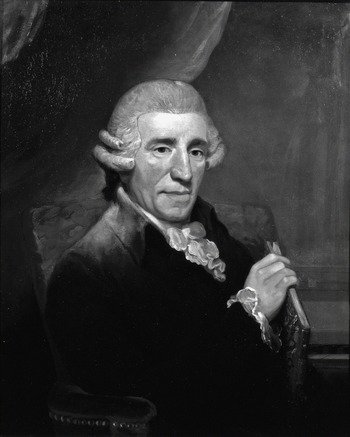
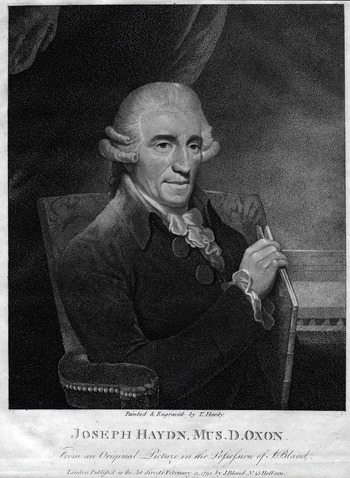
It comes as no surprise that Haydn's arrival in England on his first trip in 1791 heightened the literary efforts of both his supporters and detractors. Charles Burney celebrated with his effusive Verses on the Arrival of Haydn in England, while in the same year William Jackson published his diatribe against modern music and the unnamed Haydn in his Observations on the Present State of Music in London.Footnote 2 These were just two contributions to an ongoing debate conducted since the previous decade that encompassed a wide range of issues, including musical taste, modern versus ancient music, the nature of the symphony, the responsibility of the listener and indeed the nature of Haydn's genius. While contemporary support for Haydn in the form of published documents like Burney's Verses is immediately recognizable to historians and musicologists, there is another piece of Haydn propaganda from the time that is less well understood: Thomas Hardy's oil portrait and subsequent engraving of the composer of 1791–1792 (see Figures 1 and 2 respectively).
This oil portrait is familiar today as one of the most frequently reproduced images of the composer. The engraved version has been widely copied since it was first published in February 1792 by the music seller John Bland. Bland almost certainly commissioned the oil portrait for use as the basis for the print. A detailed discussion of the visual traditions that formed the context for the portrait has been presented elsewhere,Footnote 3 as has a study of Haydn's concern for his image and reception more generally.Footnote 4 This article will instead concentrate on the significance of Hardy's portrait in relation to Haydn's reception in England at the time.
Thomas Hardy, Joseph Haydn (1791). Oil on canvas. Royal College of Music. Used by permission

The portrait is at first glance rather matter-of-fact, and hardly seems to evoke a sense of genius befitting the ‘Shakespeare of music’. Its evidently prosaic manner was recognized by Peter Kivy when he wrote:
Look at the portrait of 1792, of Haydn at the height of his creative powers … What do you see? If you did not know that what he grasps is a musical score – because you know that it is Haydn – might it not just as well, even more appropriate to the face depicted, be the account books of a prosperous merchant? It is as hard to see genius here as it is to see it in the story of the man and his life – far easier to see hard-won prosperity.Footnote 5
While it is certainly the case that the portrait conforms to a rather typical Georgian template, there are several clues indicating that Haydn was being presented here as much more than a generic successful businessman. Indeed, the portrait actually presents the composer as a creative genius – something he was acknowledged to be in his own lifetime, but a view that changed dramatically after his death.Footnote 6
That a portrait is a form of propaganda is such a commonplace that it barely requires emphasis. What is more interesting for the historian or biographer is to what extent any given portrait responds to or reflects specific circumstances, and how it may in turn then provide an insight into those circumstances. The immediate context of Hardy's portrait of Haydn was the composer's visit to England and the interests of the two men closely associated with bringing him there: the impresario Johann Peter Salomon and the music publisher John Bland. For Burney's good friend Salomon there was the pressing concern of the publicity campaign being waged over Haydn, notably in connection with the competing concert series and the advocates of Ignace Pleyel.Footnote 7 Salomon's rivals at the Professional Concert began a campaign to discredit Haydn by trying to convince anyone that would listen that he was past his prime, publishing a scurrilous attack in the Morning Chronicle of 13 January: ‘Upon the arrival of HAYDN, it was discovered that he no longer possessed his former powers. Pity it is that the discovery did not possess the merit of novelty.’Footnote 8 Bland was selling Haydn's music in competition with other publishers, and he appears to have commissioned oil portraits of several leading musicians of the day from Hardy, although any details surrounding this are unknown. Bland also published the engravings that were based on them, proudly proclaiming in the captions that he possessed the original pictures.
Thomas Hardy, Joseph Haydn (1792). Stipple engraving. Royal College of Music. Used by permission

Bland had formed close ties with Salomon during the late 1780s and was, at his peak, the rival of the two other leading music retailers in London at the time, William Forster and Longman & Broderip.Footnote 9 He visited Haydn in November 1789 at Eszterháza to press for publishing rights, and probably also to encourage the composer to visit London. Haydn evidently thought highly of Bland, referring to his ‘valued friendship’ in a letter of 12 May 1790, and even stayed at the publisher's house on his very first night in London. In this same letter Haydn wrote: ‘Concerning the portraits you ask for, you must be patient until I arrive in Vienna. I shall then be able to satisfy you.’Footnote 10 Bland was clearly seeking a portrait or portraits of Haydn, no doubt to support the marketing of Haydn's music, and, of course, he would eventually acquire one in the form of Hardy's oil painting.
As Thomas Tolley has shown, Bland was keen to stress his personal connection with the composer even prior to Haydn's first stay in London, and ‘Bland's commission for the Hardy portrait, of course, served to confirm this connection at the expense of rivals’.Footnote 11 Moreover, Bland's role in Salomon's efforts to bring Haydn to England had been made public almost as soon as the composer arrived, via an announcement in the Morning Chronicle of 3 January: ‘Yesterday arrived at Mr. BLAND's in Holborn, the celebrated Mr. HAYDN, the composer from Vienna, accompanied by Mr. SALOMON: and we understand that the public is indebted to Mr. BLAND as being the chief instrument of Mr. HAYDN's coming to England.’Footnote 12
Thomas Hardy, the man who actually executed the portrait, is something of an enigma, with a dearth of contemporary references to his name.Footnote 13 He painted a remarkable selection of musical sitters, including Haydn, Muzio Clementi, Wilhelm Cramer, Salomon, Pleyel, Samuel Arnold, Edward Miller and William Shield.Footnote 14 Many of Hardy's portraits are lost, or of unknown whereabouts. Fortunately, his portraits of musicians were engraved, and numerous copies are extant today. The originals of Haydn, Salomon and Shield are at the Royal College of Music in London, while that of Cramer can be found at London's National Portrait Gallery.
What little is known of Hardy can be quickly outlined. He was one of three sons of a Derbyshire miner, William Hardy, and his wife Mary.Footnote 15 Thomas was born in 1757 and died ‘after a long illness’ on 14 September 1804, according to an obituary in The Gentleman's Magazine.Footnote 16 He went to the Royal Academy schools in 1778, and exhibited over thirty paintings at the Academy exhibitions over the next two decades, nearly all portraits. He was employed during 1784 to repair wall paintings at the Duke of Devonshire's estate at Chatsworth, and was in all likelihood supported by the Duke, along with his younger brother John. Hardy worked not only as an oil painter and portraitist, but also as an engraver, producing prints of both his own originals and those of other, more notable painters such as Joshua Reynolds and William Beechey. He worked mainly in the two particularly common forms of engraving at the time, mezzotint and stipple.
Hardy's life prior to attending the Royal Academy schools is largely unknown, but the Royal Academician Joseph Farington confirms that he was born in Derbyshire, and adds that he studied under Joseph Wright of Derby.Footnote 17 Farington notes that he ‘died aged 47 in consequence of a cold caught at the Academy while painting Copies of the Portraits of the King & Queen for Lawrence’.Footnote 18 A survey of Hardy's addresses in London given in the Royal Academy catalogues shows that he lived shoulder-to-shoulder with tradesmen, instrument builders, printmakers and sellers, and never made it to the more upmarket streets inhabited by the likes of Reynolds and Romney.Footnote 19 This is hardly surprising, as his paintings suggest a generally modest or at most well-to-do clientele, but not the fashionable ladies and gentlemen that frequented the highest echelons of society. It is difficult to place Hardy with any more certainty than as being one of many versatile artists making a living through painting, engraving and copying the works of others. What all this suggests is that he was one of a multitude of minor portrait painters who failed to excite much recognition in his own day, and has fared no better since. This would not necessarily be a loss to the sum total of present knowledge of the late eighteenth century if it were not for the fact that Hardy painted some of the most important musicians of his time, a veritable who's who of leading figures in the London musical world during the 1790s. So while his portrait of Haydn has become famous, he remains shrouded in obscurity.
How Hardy came to be Bland's artist of choice is not known, but it may have been linked to practical matters of geography. Hardy lived directly opposite Salomon's house in the late 1780s, when he resided at 23 Great Pulteney Street, before moving just a little north to Great Marlborough Street. Salomon is known to have lived at 18 Great Pulteney Street during 1791 at least, alongside the harpsichord builder Jacob Kirkman at No. 17 and near Broadwood at No. 33.Footnote 20 Although Hardy had left Great Pulteney Street by the time Haydn was staying with Salomon and composing at Broadwood's, Salomon or Broadwood may have known of him as a recent neighbour.
While Hardy's connection to Bland provides the immediate and commercial motivation for his portrait of Haydn, the wider aesthetic and critical context can be located within the reception of the composer up to and during 1791. Well before Haydn's arrival, critics and supporters had been debating his music and his status as a genius, either directly or indirectly. Elaine Sisman and Thomas Bauman have both highlighted the connection between critical responses to Haydn and contemporary accounts of genius.Footnote 21 Sisman links the frequent comparisons of Haydn to Shakespeare to the latter's status as a genius of originality, while Bauman argues that Haydn could be identified as a specific form of eighteenth-century genius, the ‘learned’ genius.Footnote 22
However, while contemporary debates over the nature of genius may have been a pressing matter among intellectuals, notions of genius and originality as applied to Haydn often involved specific criticisms rather than philosophical musings. A survey of selected musical writings from the decade prior to Haydn's first visit will give an indication of what themes emerged in public debate, and show how some influential critics applied terms like ‘genius’ and ‘invention’ in the case of Haydn. Yet while late eighteenth-century sources are crucial in establishing a framework for interpreting the portrait, there is an obvious danger in using images to support an argument that has already been decided by other means – an affliction recently bemoaned by Simon Schama.Footnote 23 The underlying method, or ‘critical mood’, as the art historian Michael Baxandall would have termed it,Footnote 24 applied here suggests that there must be aspects of the portrait that invite explanation on their own terms: the visual and stylistic. Thus I will first highlight unusual or notable aspects of the portrait and then examine the wider musical and aesthetic context of the reception of Haydn, before returning to the portrait in the light of this discussion.
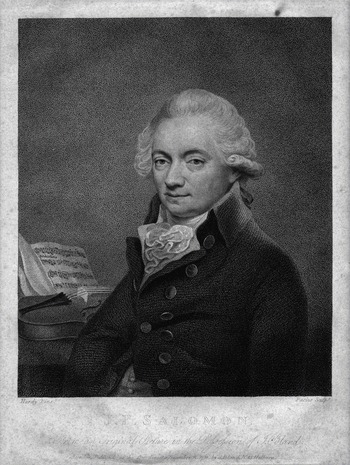
The roughly sixty-four- by seventy-six-centimetre dimensions of Hardy's portrait of Haydn are found repeatedly in late eighteenth-century England, as this was the smallest and cheapest of the commonly used standard sizes in portraiture.Footnote 25 Known as the ‘head’, the format actually shows the sitter from the waist up, and is typically rather minimal and unassuming. Being so much smaller than the full-length portrait, and correspondingly less ambitious in its intentions, such works tended to show their sitter modestly presented, seated, with little other obvious content. Several features of this particular portrait are noteworthy, both in relation to Hardy's other portraits and more generally in comparison to those by other artists of the time. Quite apart from the modest format, the economics of painting meant that displaying anything additional to the head and upper torso, such as the sitter's hands, added further cost to the commission.Footnote 26 Therefore hands were excluded if unnecessary or too expensive, and indeed Hardy's portrait of Pleyel leaves them out. Here, however, Haydn's right hand is obviously required in order for him to be shown holding the hard-bound score and marking a page. Hard-bound scores were certainly not the norm at this time in portraits, and the richly ornamented one here suggests that it was a commemorative gift or something produced for a special occasion.Footnote 27 It would have been a time-consuming object for the artist to paint, and so would not have been included without good cause. Moreover, the very act of holding up a (nearly) closed score is atypical of portraits of musicians at the time. Much more common is to find the manuscript held in a relaxed hand or sitting on a nearby table. Even in Hardy's portrait of Salomon, where the score is placed behind the composer, its immediate proximity to the violin makes the obvious connection of the notes on the paper to the imagined sound.Footnote 28 (See Figure 3.) In fact, Haydn's gesture implies that he has been pondering his own completed music, rather than thinking of new composition.
Facius (Georg Sigmund or Johann Gottlieb), after Thomas Hardy, Johann Peter Salomon (1792). Stipple and line engraving. Royal College of Music. Used by permission

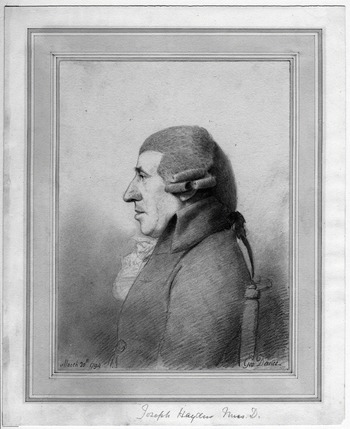
The ubiquitous red drape – a feature of so many portraits in the eighteenth century – is expected, although again this would have added to the cost. Its presence is not particularly significant in itself, but its function within the composition of the painting certainly is: most unusually, it intersects exactly with Haydn's head, falling in a distracting diagonal line behind it. If playing any noteworthy part in the composition of a portrait at all, drapes typically framed or otherwise highlighted the sitter's features, rather than interfering with or distracting from them, as in this case.Footnote 29 Finally, Haydn's features are in all likelihood somewhat distorted and highlighted in a way that does not reflect his true physiognomy, as can be seen by comparing Hardy's portrait with the profile drawing by George Dance (see Figure 4 and the related discussion below).
In short, the superficial matter-of-factness of the painting is quite misleading. What we should be expecting to see is something along the lines of innumerable other Georgian portraits, including all of Hardy's other depictions of musicians, such as his portraits of Cramer, Pleyel and Salomon. Instead, we find several anomalies, each of which invites an explanation. The discussion that follows argues that these visual elements were a carefully contrived image constructed by the artist and those connected with Haydn's visit in order to present him in such a way that celebrated his genius and fame while also defending him against long-held criticisms. Because so little is known of the artist and of music publisher Bland, the probable commissioner of the portrait, the painting will be situated in relation to a ‘circle’ of Haydn's champions, most notably the trio of Salomon, Bland and Burney.
The efforts of Haydn's advocates can be set against the backdrop of the wider debate over the merits of modern versus ancient music. And here the stage for the debate was, if not exactly set, then at least turgidly restated by the music scholar and lawyer John Hawkins, Burney's main antagonist in opinions on music.Footnote 30 In his five-volume A General History of the Science and Practice of Music (1776) Hawkins railed against recent developments in music, and concluded his History with a typically verbose attack on modern music and those who support it:
The prevalence of a corrupt taste in music seems to be but the necessary result of that state of civil policy which enables, and that disposition which urges, men to assume the character of judges of what they do not understand. The love of pleasure is the offspring of affluence, and, in proportion as riches abound, not to be susceptible of fashionable pleasures is to be the subject of reproach; to avoid which men are led to dissemble, and to affect tastes and propensities that they do not possess; and when the ignorant become the majority, what wonder is it that, instead of borrowing from the judgment of others, they set up opinions of their own; or that these artists, who live but by the favour of the public, should accommodate their studies to their interests, and endeavour to gratify the many rather than the few?Footnote 31
Decline in musical taste was thus a symptom of wider social decay, and the implication is clearly that it was the responsibility of the expert to guide the music lover towards what they should be listening to.
The earliest English biography of Haydn appeared in the following decade, in the European Magazine, and London Review in October 1784: the anonymous ‘An Account of Joseph Haydn, a Celebrated Composer of Music’. If not actually written by Burney, it certainly parallels some of his opinions. Here Haydn is praised for creating an ‘original, masterly, and beautiful’ new species of music.Footnote 32 The ‘Account’ emphasizes Haydn's genius and tries to explain away the ‘wildness’ evident in some of his music, evidently in response to attacks from North German music critics. It is full of inaccuracies, but as Howard Irving notes, these are ‘clearly motivated by an attempt to account for Haydn's “soaring genius,” his early music's alleged lack of “regularity and consistency,” and the “wildness of nature and luxuriance of fancy” that needed to be tamed through proper education’.Footnote 33 These sentiments can be aligned with the strong emphasis on the place of learning in the development of genius found in several philosophical texts in the eighteenth century.Footnote 34
In the same year as the ‘Account’, William Jones published A Treatise on the Art of Music. A practical guide to music composition, the Treatise shows above all else the conservatism of English music theory at the time. In the chapter ‘On the Analysis of Air, and the Conduct of Subject’, where he outlines a very restricted approach to the treatment of melodic dissonance, Jones refers to Haydn in the following way:
As for Haydn and Boccherini, who merit a first place among the Moderns for invention, they are sometimes so desultory and unaccountable in their way of treating a Subject, that they may be reckoned among the wild warblers of the wood: And they seem to differ from some pieces of Handel, as the Talk and the Laughter of the Tea-table (where, perhaps, neither Wit nor Invention are wanting) differs from the Oratory of the Bar and the Pulpit.Footnote 35
Neither for the first nor the last time, Handel is invoked as the touchstone of learnedness, and the more modern composers receive backhanded compliments for their invention while being derided for their apparently uncouth musical creations.
Jones was not alone, for Charles Dibdin's The Musical Tour of 1788 follows up on the theme of undisciplined invention. The Tour is a typical eighteenth-century potpourri of criticism and musings in the form of letters. In letter XLIV he addresses melody and rules of composition, and Haydn is inevitably discussed. The main thrust of the letter is that ‘simple unadorned melody [should] be accompanied only by such modulations as arise from the general and perfect nature of the subject’.Footnote 36 Alas, some composers, even ‘a man of such admirable genius’ as Haydn, overdo things. Haydn is like a ‘rope-dancer, who, though you cannot too much admire how prettily he frisks and jumps about, keeps you in a constant state of terror and anxiety for fear he should break his neck’. Do Haydn's compositions, Dibdin asks, ‘consist of any thing more than the strong effusions of genius turned into frenzy, and labouring as ineffectively to be heard as a flute in a belfry, or equity in a court of justice?’.Footnote 37 As with Jones, it is not Haydn's originality or inventiveness in itself that is being questioned, or even that he may be a genius – philosophical discussions over the nature of genius are not the concern here – but rather the intelligibility and taste of his music.
Staunch defence of Haydn was again at hand only a year later. Apart from his Verses, Burney's enthusiasm for Haydn is evident in volume four (1789) of his monumental General History of Music. In chapter ten, ‘Of the Progress of Music in Germany, during the present Century’, he finally comes to discuss Haydn and makes his feelings readily apparent: ‘I am now happily arrived at that part of my narrative where it is necessary to speak of Haydn! the admirable and matchless Haydn!’.Footnote 38 He defends his hero against claims that he composed in apparent ignorance of the rules of composition, ‘a censure which the admirable Haydn has long since silenced: for he is now as much respected by professors for his science as invention’.Footnote 39 Burney gives the music lover and performer a new weight of responsibility in dealing with Haydn's music: ‘his compositions are in general so new to the player and hearer, that they are equally unable, at first, to keep pace with his inspiration’; and, though his works may at first seem odd, ‘by frequent repetition’ both ‘performer and hearer are at their ease’.Footnote 40
Burney, in his famous ‘Essay on Musical Criticism’ contained in the History, also emphasized the importance of repeated hearings. Here, the point is made in relation to modern German music generally, and it is worth quoting at length:
[Music] is only understood and felt by such as can quit the plains of simplicity, penetrate the mazes of art and contrivance, climb mountains, dive into dells, or cross the seas in search of extraneous and exotic beauties with which the monotonous melody of popular Music has not yet embellished. What judgment and good taste admire at first hearing, makes no impression on the public in general, but by dint of repetition and habitude. … The extraneous, and seemingly forced and affected modulation of the German composers of the present age, is only too much for us, because we have heard too little.Footnote 41
This directly challenges the views of Dibdin, and puts the onus on the concert-goer or music lover to put effort in rather than sit back and expect to be entertained.
The debate was far from over, however, and following on from Hawkins's efforts to protect the concert-going public from themselves was William Jackson's Observations on the Present State of Music in London, published as a pamphlet in October 1791. Unlike Hawkins, Jackson was writing after Haydn's music had become enormously successful in England during the 1780s, and so his criticisms are obviously a rearguard action. Jackson was an author, aspiring painter and composer who seriously fell out with Burney around 1789 after he published a critical review of the latter's History.Footnote 42 Jackson's pamphlet is a biting attack on the moderns and a thinly disguised swipe at Haydn. Jackson outlined what he saw as the problematic qualities of various genres, but reserved particular criticism for the symphony. While first generously acknowledging the efforts of Richter and Abel, he soon changed his tone with more recent composers, who
to be grand and original, have poured in such floods of nonsense, under the sublime idea of being inspired, that the present Symphony bears the same relation to good Music, as the ravings of a Bedlamite do to sober sense. Sometimes the Key is perfectly lost, by wandering so far from it, that there is no road to return …. The Measure is so perplexed by arbitrary divisions of Notes …. And, when Discords get so entangled, that it is past the art of man to untie the knot …. All these paltry shifts to conceal the want of Air, can never be admitted to supply it's [sic] place.Footnote 43
Crucially, Jackson is not only criticizing what he finds excessive in the music, but also mocking what, to his mind, was the contrived posturing of composers as inspired and original. Thus ‘genius’ in this form leads to a degradation of music.
For Jackson, even when ‘Air’ is present, composers ruin its effect by violent changes in dynamics. What, he asks, are we to do when the music shifts from ‘so delicate as almost to escape the ear’ to ‘a sudden change into all the Fortissimo that Fiddling, Fluting, Trumpeting and Drumming can follow?’.Footnote 44 Burney could not let Jackson's pamphlet sit, and he responded to the Observations with his own scathing piece in the Monthly Review of October 1791.Footnote 45 Burney memorably wrote: ‘We are not yet certain that our present musical doctors and graduates are quite up to Haydn’.Footnote 46
Writing after Haydn's departure, John Marsh, the English composer, writer and friend of Burney, attempted to bring a conciliatory tone to the debate. Marsh wrote an essay that appeared in the Monthly Magazine in 1796, ‘A Comparison between the Ancient and Modern Styles of Music, In which the Merits and Demerits of Each are Respectively Pointed Out’.Footnote 47 Marsh's essay provides the reader with an ostensibly even-handed guide to the virtues and limitations of the two styles. Marsh acknowledges that the consequence of inventiveness such as Haydn's could become hard to digest in the fleeting moment, especially if taken too far:
It must however be confessed that since these two great masters [Pleyel and Haydn] have been in England, they have in their symphonies and concertantes written expressly for the concerts, at Hanover-Square, in a great measure departed from that simplicity which alone is capable of giving general pleasure. It is impossible for any ear to receive and clearly distinguish the effect of many parts together, unless assisted by the eye in looking over the score, at least not till after several hearings.Footnote 48
Here Marsh reinforces the notion that general pleasure might be forsaken, and, as with Burney, that repeated hearings are needed.
In summary, it would appear that the symphony epitomized all those things that were offensive to reactionaries, while for the ‘moderns’ it was held up as the ideal conglomeration of new trends. Haydn, being at the vanguard of modern – Viennese symphonic – music, was a pivotal figure for both his supporters and detractors, held up as the ‘spiritual leader of the musical “moderns”’.Footnote 49 The arguments can be distilled down to a few recurring topics: genius, originality, rules, symphony and Haydn.
By the time Hardy's portrait of Haydn was exhibited at the Royal Academy in 1792, music lovers would have had ample time to digest the issues raised in the skirmishes of critics like Burney and Jackson. Bland may well have thought that any publicity was good publicity, but he was obviously not just content with selling Haydn's music. At some stage he must have arranged for Haydn to sit for Hardy, and he finally obtained the painting of the Master he had desired since at least 1790. The resulting portrait was one of three the artist exhibited at the Royal Academy that year, the other two being of Salomon and the well-known London actor Robert Baddely. The Salomon portrait must in some sense have been paired with the Haydn, as Salomon had taken credit for bringing Haydn over. They were not hung together, however, as their catalogue numbers indicate they were in different rooms. Paintings by non-Academicians had to go through a selection process in order to be hung, and so to have three portraits hung for that year was no mean achievement, and was a fine opportunity to display one's work to thousands of people and potential clients.Footnote 50
The precise date of the oil portrait is uncertain, but considering the fact that the engraving based upon it was published in February 1792, and the Royal Academy exhibition opened in late April, some time late in 1791 or very early in 1792 would appear to be the likely range.Footnote 51 The portrait's fate after Bland is unknown, but it came into the possession of Alfred Hill late in the nineteenth century. It was exhibited at the Worshipful Company of Musicians' music loan exhibition held at Fishmongers' Hall in June–July 1904, and was reproduced in the illustrated catalogue that followed in 1909. Hill gifted the portrait to the Royal College of Music in 1933, where it remains.
As with Hardy's other portraits of this format, Haydn engages the viewer with his eyes, and a very slight smile. The body is turned three-quarters but the head much less so, allowing for a near full-face view. Lighting comes from high to the left of the viewer, revealing all of the face, which thus lacks strong shadow. The right shoulder and coat collar are highlighted with diffuse lighting, creating the rather pastel-like effect found in Hardy's other portraits. The forehead is high and brilliantly lit, although a clear sense of Haydn's swarthy complexion is indicated by the ruddy cheeks. The result is a sharp contrast between the almost white purity of the forehead and the rather less noble skin tones that Haydn actually possessed. Haydn's very distinctive physiognomy is easily recognizable, especially with his prominent nose and rather protruding lower lip. He wears a dark coat with large buttons, and a frilly silk necktie and cuffs. The tie and cuffs are effectively painted with lively and economical brush strokes, a typical feature of Hardy's portraits.
Besides Haydn himself, there are several other noteworthy features in the portrait. The armchair is covered with plush fabric, and a row of studs outlines the side of the right arm. Haydn holds a bound score with a marbled cover, red rectangular section on the spine and possibly a gold crest. Although no title or text is present, Hardy has gone to some trouble to paint something that is absent from all his other portraits of musicians, where only unbound sheet music or the score by itself is shown. In addition to the detailing on the score cover, Haydn also marks the work by prominently holding it up, marking a page with his second finger. This gesture is that of a man of letters pondering a venerable text, although in this case the implication is that it is Haydn's own work being contemplated. To the right of the score is a portion of a keyboard, visually separated from the composer through its positioning; the nameboard is blank, but the keyboard is clearly English. Behind all of this is the clichéd red drape, although the familiar pilaster is absent.
The sheer succinctness of the ‘head’ portrait, even if driven by economic factors, led to a visual style of utmost brevity. Accoutrements, if any, take on a prominence and a strikingly direct relationship to the main subject of the painting, the sitter. Likewise, gesture and posture, and any deviation from an often unrelenting standard, gain a significance lacking in freer genres. While a larger-scale portrait might have enabled an artist to set up complex or narrative relationships between objects and the sitter, the head portrait necessarily had a directness that could be considered from the outset to be symbolic, and much more than a realistic representation of space.
It is easy for modern eyes to interpret the accoutrements shown in a portrait such as Hardy's Haydn in a rather facile manner; as little more than obvious and conventionalized signs of vocation.Footnote 52 Doubtless they suggest the profession and the interests of the sitter, such as in paintings where an architect holds drawing plans or a judge holds tomes of law, and so forth. But what can be missed is the way in which these objects interrelate with the sitter, in a symbolic rather than literal space.Footnote 53 This almost ‘abstracted’ space takes on particular significance when multiple objects are shown, and the positioning of the objects, both in relation to each other and to the sitter, are emphasized owing to the succinctness of the image.
By far the most prominent object in addition to the composer himself is the score. It is not just that Haydn holds a bound score, but how he holds it, and the score's priority over the other main object – the keyboard – that is full of meaning. The score is not only emphasized in the painting's composition, but also frames Haydn off from the instrument, prioritizing his relationship to the musical text. Hardy has thus managed to imply that Haydn's connection to the keyboard is only indirect; the score (intellectual, non-manual work) is the primary object, and the keyboard shows his leadership of and connection to actual performances. In relation to these points, Simon McVeigh has observed that in London in the 1790s:
Composers were undoubtedly regarded above executants: one commentator directly contrasted ‘mere mechanical performers’, their lives shortened by dissipation and debauchery, with long-lived composers, the real artists. Respect increasingly attached to composers with doctorates, a degree achieved by composition in a cathedral idiom … Another development of the 1790s enhanced their profile. This was the rise of the keyboard conductor, who (though not baton-waving) was a figure of authority, divorced from the mere mechanics of playing an instrument.Footnote 54
Hardy's other portraits, as indeed is the case with most other portraits of musicians from this time, tend to show the score held loosely in the hand (such as his Clementi), or perhaps rolled-up (as in his Cramer), with Reynolds's famous portrait of Burney as a recent model for the latter. Holding up a book or other text of some sort strengthens the inference of ownership and the sense that such a book is a historically significant object.Footnote 55 The implication is that Haydn is doing to his own music what his champions said was expected of listeners of the day: that his music required repeated listening and study. Perhaps Haydn here presents his music as a model, an exemplar by which the works of followers or imitators will be judged.Footnote 56
In contrast to the dramatic effects seen in paintings of romantic composers, there is at first glance little hint of the ‘fire’ that Haydn's supporters spoke of in this portrait. But there are subtle cues that indicate something of the fire still burning in the ageing composer. The portrait uses lighting and colour to suggest the creative energy of the composer through the brilliant highlighting of the forehead and the unusual placement of the drape. The latter falls across behind Haydn's head just in line with the most brilliant emphasis on the forehead, an effect that draws more attention to the glowing front of the cranium.
Compositionally, the painting provides a visual corollary to Haydn's own ‘fantastic whim’ controlled by ‘certain science’. The surprising ‘misplaced’ drape, a whimsy of Hardy's visual play, is integrated within the overall design via the strong diagonal lines emanating from Haydn's head. Haydn's rather formal upright posture and the score held close to the body imply a man who controls and fully ‘owns’ the results of his creative process. No hastily scribbled notes on manuscript paper here. All in all, and within its own parameters, it is a perfectly judged reflection of Haydn's – and his supporters' – preferred form of genius in the English context: inspired and full of fire, capable of novelty and invention and yet controlled by taste and judgment.
Other than these painterly and compositional effects, further comment on Haydn's physiognomy is in order. Although the style of the painting suggests a matter-of-fact depiction, a comparison with another portrait, the profile drawing by George Dance, suggests otherwise (see Figure 4). Dance was an architect who drew hundreds of profiles of acquaintances and friends. They are often unrelentingly dull, but seem to offer good likenesses, being in the tradition of the physiognomic silhouette. Here we can see that Haydn's forehead was much lower than that shown in Hardy's portrait, even taking into account the differing view of the head. Also clearly evident in Dance's portrait is the protruding lower lip and open mouth. Haydn suffered from nasal polyps, and may well have been breathing through his mouth when sitting for this.Footnote 57
George Dance, Joseph Haydn (1794). Pencil on paper. Royal College of Music. Used by permission

Hardy's stipple engraving of Haydn based on his oil portrait was published by Bland on 13 February 1792. (See Figure 2 above.) As he did in the case of other prints, Bland announced that he had the original portrait in his possession. The print also carries a large caption, ‘Mus.D.Oxon’, following Haydn's name, referring to the composer's recent honorary degree received in July 1791. Bland tried to cash in on the interest Hardy's portrait might have attracted at the Royal Academy exhibition, announcing the print in a notice in The World on 22 May 1792 and a few days later in The Morning Herald.Footnote 58 Bland and Hardy might have been hoping for some critical acclaim for the portraits to bolster public interest in their musical and artistic products respectively, but none appears to have come their way.
Although the print is a very close reproduction of the oil portrait, the face has been narrowed slightly and the mouth and chin have been altered. The protruding lower lip especially has been ‘corrected’ a little, as this could have suggested, according to the precepts of physiognomy, a lowly character. The more consistent shading of the face in the print also suggests that Hardy realized that the effect created in the oil painting could not be convincingly reproduced in the stipple engraving. Overall, the face appears more taut and youthful in the engraving, at least partly due to the slight narrowing of the image overall in comparison with the original. Though taking a slightly different route with each medium, it appears that Hardy endeavoured in both painting and engraving to show his sitter as being full of creative energy. This very energy was recognized years later by Marion Scott, who wrote that in the engraved portrait Hardy had ‘caught more of the essential man and musician than anyone else [and] imparted to Haydn's eyes a suppressed fire, to his face a lean, very driven look that fits exactly with his history during 1792’.Footnote 59
Also of interest in the engraved version is the less detailed rendition of the score. Hardy has not even attempted to reproduce the marbled effect from the oil, and there are no distinct markings on the spine. A very straightforward explanation is possible, one that also supports the interpretation of the role of the score in the painting. Haydn's honorary degree is acknowledged in the print, and so the caption takes over some of the symbolic ‘commemorative’ role of the score. Haydn himself credited at least some of his success in England to his Oxford degree,Footnote 60 and the likely role it played is here reinforced by Hardy's print.
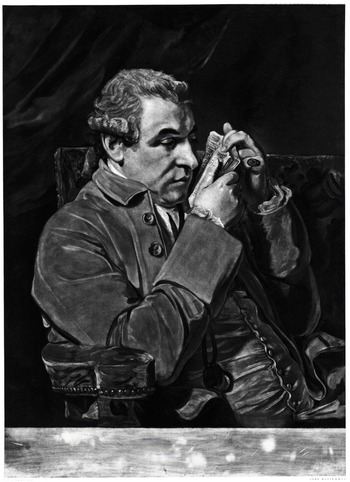
Hardy may have obtained his inspiration for the novel composition of this painting from a very well-known portrait of similarly modest proportions that serves as a precedent: Reynolds's famous Streatham portrait of the Italian author Giuseppe Baretti (1773). (See Figure 5.) Baretti had been arrested in 1769 after a street brawl that left a man dead. At the subsequent trial, Reynolds spoke in defence of his friend, and he later painted a portrait that aimed to situate the author firmly in the tradition of the bookish scholar. Duncan Robinson has argued that the portrait ‘was designed not to stir controversy but to silence it’.Footnote 61 In showing Baretti as a myopic literary man, Reynolds distanced the writer from the more pervasive characterization of a hot-headed Italian. In both the portrait of Haydn and that of Baretti, the positioning in the armchair is similar, as indeed are the chairs themselves, and, more significantly, the red drape in both cases intersects diagonally across behind the sitter's head. Hardy was almost certainly aware of the portrait, for his younger brother John had engraved it by at least 1793.Footnote 62
John Watts, after Joshua Reynolds, Giuseppe Baretti (1780). Mezzotint engraving published by John Boydell. Copyright Trustees of the British Museum

Where might Haydn himself have stood on the vexed issues of invention and rules? Haydn is on record displaying several ‘contradictory poses’ over rules, as Sisman notes. On the one hand, he was keen to stress his independence from models (other than C. P. E. Bach) and to criticize pedantic laws, and yet he followed the ‘rules of art’.Footnote 63 Yet, as Bauman points out, Haydn was obviously annoyed by the criticism that his breaking of ‘pedantic’ rules attracted:
Had he thought of himself as an original genius … he would have perhaps welcomed rather than deplored the pedantic application of traditional compositional rules to his music …. For a learned genius like Haydn, however, rules still mattered, and indeed he entertained a lifelong ambivalence about compositional rules.Footnote 64
Whether Haydn was categorized as an original or a learned genius by his supporters in England may well be a moot point in the interpretation of Hardy's portrait, for, as several contemporary writings argue, both invention and judgment are required for genius to be truly successful.Footnote 65
What contemporaries thought of Hardy's painting of Haydn is difficult to know, given the paucity of references to the painter. The portrait visualizes a conception of genius which was on the cusp of becoming fully romanticized, but which still held to Enlightenment notions of learnedness and taste. Haydn is shown as a ‘law-giver’ – someone whose work is exemplary, but not as the figure of the isolated genius that would dominate the imagery of later decades.Footnote 66 In many ways the painting pales alongside John Hoppner's more evocative, though incomplete, portrait, but Hardy's work could well be the more informative about its context.Footnote 67
The reception history of the portrait from the time of its inception through to its apparent popularity now is another study in itself, although it is tempting to speculate on its trajectory. If our current response to the portrait is to view it as straightforward or even unimaginative, perhaps its appeal lies in the assumed direct access afforded by Hardy to the composer. It would indeed be an ironic twist of history if what was originally a carefully manipulated representation of a genius is now seen to be an unmediated likeness. The interpretation of the painting today – as that of little more than a portrait of a self-made man – is valid as a measure of the great aesthetic shifts that have occurred since the late eighteenth century. Neither our notion of genius nor our expectations of what genius should look like can be made to sit with what Hardy created. Haydn's reputation for genius and Hardy's subtle manipulation of portrait conventions have not fared well in the face of changing tastes, yet, in its own day, the portrait was a fine defence against Haydn's detractors.