Information recently discovered in the National Archives reveals that bank failure rates peaked in New York City, at the center of the United States money market, in July and August 1931.Footnote 1 During those months, a banking crisis peaked in Germany. One month later, Britain abandoned the gold standard. According to the conventional academic wisdom, Britain's departure from gold transmitted a financial crisis in Europe to the United States.Footnote 2 Anticipating a similar action on the part of American monetary authorities, central banks and private holders in Europe converted dollar assets in the New York money market into gold. The unloading of bills swiftly assumed panic proportions. Gold outflows rose rapidly, draining funds from the United States and threatening the solvency of financial institutions in the central money market. To stop the international drain, the Federal Reserve System raised the discount rate from 1.5 to 3.5 percent between October 9 and October 16. This was the sharpest rise within so brief a period in the whole history of the system, before or since … the move intensified internal financial difficulties and was accompanied by a spectacular increase in bank failures and runs on banks.Footnote 3 Barry Eichengreen refers to this reaction as one example of the “golden fetters” of the period.Footnote 4
Combining the new data and the conventional wisdom creates a paradox of timing not previously apparent. Events in New York preceded events in Britain and coincided with events in Germany. The initially plausible answers—that links of debt or deposit left New York banks vulnerable to European difficulties—do not explain the nature and timing of events. Bank distress in New York City during the summer of 1931 appears to have another explanation: intensified regulatory scrutiny combined with declines in the value of domestic assets owned by the banks. The impetus for additional scrutiny began with the failure of The Bank of United States in December 1930. Politicians throughout the state of New York criticized the Superintendent of Banks for his failure to forestall that institution's collapse. The state legislature demanded heightened vigilance and augmented the bank superintendent's staff. Additional regulatory resources came online during the summer of 1931. At the same time, legislatures questioned the superintendent's abilities and threatened to remove him from office. Additional resources enabled and political pressure prompted the superintendent's office to demonstrate his vigor and vigilance by closing (either liquidating or merging) institutions in New York City. This surge in scrutiny generated the wave of bank distress in the summer of 1931 that appears correlated with events in continental Europe.
POTENTIAL LINKS BETWEEN NEW YORK AND EUROPE
An initial inspection of the evidence suggests direct connections existed between the banking crises in Germany and New York. The chronological correlation is striking. Figure 1 illuminates the relationship. The figure plots weekly hazard rates for liquidation and consolidation due to financial difficulties for banks in New York City. The probability of failure increased during July 1931, as a banking panic spread through central Europe. The probability rose higher when bank runs swept Germany and the German government shut down the nation's banking system. The probability of failure peaked in August, immediately after the reopening of banks in Germany but several weeks before Britain's departure from gold.
WEEKLY HAZARD FOR LIQUIDATION AND CONSOLIDATION DUE TO DISTRESS NEW YORK CITY, JULY 1930 THROUGH MARCH 1933

Recent research reveals reasons that events in Germany and New York might have been linked. Banks in New York held large sums deposited by European clients. The foreign branches of New York banks held deposits totaling over $600 million dollars. New York banks organized over $1.4 billion in loans to German corporations, utilities, and governments (including local, state, and national) from 1924 through 1930.Footnote 5 Nearly $1 billion of those loans floated in the United States were outstanding in June 1931.Footnote 6 Econometric analysis of the links between the German and United State's economies during the 1930s suggests that German debt played a role, perhaps substantial, in transmitting financial shocks across the Atlantic.Footnote 7 Analysis of equity returns also suggests a link through this channel.Footnote 8
By participating in schemes designed to stem the Austrian crisis, banks in New York directly exposed themselves to risks rising on the continent. The Austrian Central Bank established an intricate series of cross deposits to covertly “direct funds to the Creditanstalt via American and British banks—to compensate it for taking over the bankrupt Bodencreditanstalt.”Footnote 9 All of the American institutions involved in this shell game operated in New York City. The cross-deposit involved tens of millions of dollars, a substantial multiple of the capital of the banks involved, indicating that they took on risks large enough to put them out of business.
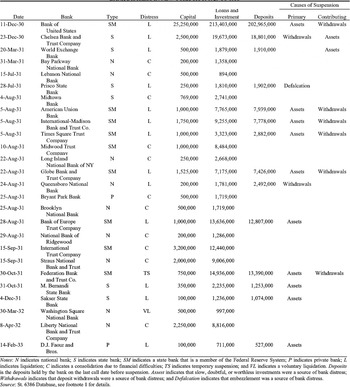
Table 1 provides details about the banks that experienced distress in New York City during the Great Depression. The first column indicates the date at which the bank closed its doors to depositors or consummated a consolidation with another institution. More than 60 percent of these transactions (16 out of 26) occurred during the two month period bounded by the failure of the Darmstadter- und Nationalbank on July 13, 1931 and Britain's departure from gold on September 21, 1931. Only two banks failed in the wake of Britain's departure from gold. One additional institution temporarily suspended payments during that period.Footnote 10
DOMESTIC SOURCES OF DISTRESS
While chronological patterns reveal correlations between events in New York and central Europe, further examination of the evidence suggests the correlation is coincidental, not causal. We again refer to Table 1. The fourth column, labeled “Distress,” shows that two types of distress predominated amongst banks in New York City. The letter L indicates that a bank entered receivership and underwent liquidation. In all cases but one, the liquidation began at the behest of the Superintendent of Banks of the State of New York, after bank examiners determined that the institution faced financial difficulties so severe that it had to be closed to protect the interests of depositors and determining that no other bank wished to consolidate with the afflicted institution. The letter C indicates that financial difficulties compelled the bank to consolidate with another institution. Most of these consolidations occurred at the behest of regulators after examinations revealed looming financial problems.Footnote 11
Contemporary observers had access to an array of information unavailable to modern scholars, including detailed, daily data about the financial status of and events affecting commercial banks. Detailed records survive from several sets of contemporary observers. The first (and arguably the most important) is the St. 6386 database constructed by the Federal Reserve Board's Division of Bank Operations. Column 8 in Table 1 summarizes the results of the division's analysis of bank suspensions. In 11 of 14 cases, the primary cause of suspension was the depreciation in the value of the bank's assets. In two cases, heavy withdrawals were the primary cause of suspension. In another case, a bank failed after losing a substantial share of its capital to embezzlement. Comments from the St. 6386 forms discuss reasons for the depreciation in the value of the bank's portfolio, principally the declining value of stocks, corporate bonds, and real estate. In all cases, the comments refer to declines of domestic assets. In no instance do the comments refer to foreign investments or German debt.
The Division of Bank Operations also tracked consolidations due to financial difficulties. Table 1 also contains the results of this endeavor. All but one of the banks forced to consolidate in 1931 suffered from frozen assets or impaired capital. In almost all of these cases, the absorbing bank took all of the assets of the troubled bank in exchange for assuming the deposits and some, but not all, of the other liabilities of the troubled institution. The Division of Bank Operations attributed the financial difficulties to domestic factors. In no instance does the division discuss international events, deposits, or debts.
Like the Division of Bank Operations, the New York State Bank Superintendent's office investigated the cause of suspension for each state-chartered bank, trust company, and private bank. These amounted to 13 of the 14 institutions that closed their doors to depositors during the summer of 1931. The superintendent released initial statements about the cause of each closure on the date that the institution closed and in the weekly bulletin of the Department of Banking. Final conclusions appeared in the Department of Banking's Annual Report. These sources described the cause of Chelsea Bank and Trust Company's demise to be “rumors” that circulated “which have caused abnormal withdrawals of deposits,” prompting the examiners to close
BANK DISTRESS IN NEW YORK CITY, 1929 TO 1933

Notes:
N indicates national bank; S indicates state bank; SM indicates a state bank that is a member of the Federal Reserve System; P indicates private bank; L indicates liquidation; C indicates a consolidation due to financial difficulties; TS indicates temporary suspension; and VL indicates a voluntary liquidation. Deposits is the deposits held by the bank on the last call date before suspension. Assest indicates that slow, doubtful, or worthless investments were a source of bank distress; Withdrawals indicates that deposit withdrawals were a source of bank distress; and Defalcation indicates that embezzlement was a source of bank distress.
Source:
St. 6386 Database, see footnote 1 for details.
the bank to conserve its assets. In all other instances, the Department of Banking attributed financial difficulties to domestic factors, particularly the declining values of securities, bonds, and real estate, which reduced the value and liquidity of banks' portfolios. In no instance does the Department of Banking discuss international factors, such as foreign deposits or German debt.
Contemporary conclusions are clear. During the summer of 1931, banks that ceased operations in New York City did so for reasons unrelated to the financial crisis in Europe. The sources of distress were the declining value of domestic assets and withdrawals from banks that appeared headed for financial trouble. Widespread withdrawals did not occur in the summer of 1931. The small fall in deposits during the summer (approximately 4 percent) resembled typical seasonal variation.Footnote 12 Banks that closed their doors or consolidated with other institutions did not do so because German debt declined in value or because foreign depositors withdrew funds.
Data from call reports reveal why contemporary observers focused on domestic causes of bank distress. None of the banks that departed from the banking business in the summer of 1931 possessed foreign branches, while two of the banks that survived the summer did. Furthermore, none of the banks that departed from the banking business in the summer of 1931 possessed time deposits from financial institutions in foreign countries, while eight of the banks that survived the summer held such deposits. Finally, none of the banks that departed from the banking business in the summer of 1931 belonged to syndicates that extended loans to Germany during the 1920s, while four of the banks that survived the summer led such syndicates. In sum, none of the banks that departed from the banking business during the summer of 1931 were exposed to foreign financial shocks, while many of the banks that survived the summer (and the depression) had such exposure.Footnote 13
INTENSIFIED REGULATORY SCRUTINY
The behavior of the New York's Banking Department changed during the summer of 1931. Eight months before, in December 1930, The Bank of United States failed. It was the fourth largest depository institution in New York and the eighth largest in the nation. From December 1930 through June 1931, “practically the entire examination force in the metropolitan district was engaged in the liquidation of The Bank of United States.”Footnote 14 This concentration of examination resources compelled the superintendent's office to expand the size of its staff. The rigidity of civil service regulations, however, impeded the hiring of experienced individuals. Eventually, “it was necessary to obtain executive permission to employ temporary examiners not taken from civil service lists and to reinstate former examiners whose wide experience was desperately needed.”Footnote 15 The Civil Service Commission insisted that for each examiner appointed who was not a civil servant, an appointment had to be made from the civil service list. This included few individuals with the training, talent, or aptitude for bank examination work.
The department managed to increase the examination staff to 192 members at the end of 1931, up from 131 in December 1930. In addition, for a period of seven months, the department “obtained the assistance of twenty-eight men whose services were donated by various banks as well as the aid of fifteen Federal Reserve examiners who were temporarily lent to the department.”Footnote 16 Bureaucratic delays and the time required to train the new examiners meant that the size of the effective examination staff increased substantially during the summer of 1931. At the same time these new resources came on line, the permanent examination staff for the metropolitan district, which had focused on The Bank of United States from January through June, finished that investigation and returned to regular duties. Thus, in the summer of 1931, the effective number of examiners in New York City increased substantially. The number of bank examinations, conducted infrequently for many months, increased commensurately.
The examinations also increased in intensity. The banking department adopted “new regulations for the purpose of obtaining more complete information on loans and security portfolios.”Footnote 17 These changes included new reporting forms designed to “instantly reflect trends and policies of each state bank and trust company” and new methods for “arriving at fair values of securities.”Footnote 18 These innovations stemmed from a reorganization of the banking department begun in the spring of 1929 and completed after of the failure of The Bank of United States.
The post-examination powers of the banking department also increased. In the spring of 1931, the state legislature passed three reform bills introduced at the request of the state bank superintendent. The first bill permitted the hiring of additional examiners in an emergency. The second reduced the time allowed for filing claims against a bank by the superintendent after notice had been sent to the creditors from 30 to 20 days. The third allowed the superintendent to act on the findings of clearing house examinations as if they were conducted by the state banking department.
Criticism of the superintendent, Joseph Broderick, peaked in June, when the case against the directors of The Bank of United States reached trial. A New York Times headline blared, “STATE CALLED LAX IN BANK FAILURES (emphasis in original).”Footnote 19 Another headline reported that the superintendent had been accused of “Gross Negligence” for his performance on The Bank of United States.Footnote 20 A former state attorney general circulated a letter calling for a general investigation of the banking department and drawing parallels between its performance in the current case and problems in the past. The chairman of the Republican State Committee sent a letter to Governor Roosevelt requesting an inquiry and demanding the removal of Superintendent Broderick.Footnote 21 The state legislature discussed the creation of a special committee to investigate the banking department and considered a bill authorizing suits against state bank employees who performed their jobs negligently.
The chorus of criticism focused on the banking department's slow response after discovering the financial problems faced by The Bank of United States. In reaction, the superintendent testified that the irregularities which led to the bank's demise were first brought to his attention in the summer of 1929. He believed that “he would have been ‘gravely remiss in his sworn duty if he did not exhaust every possible resource to save the situation before deciding that the doors must be closed’.” He allowed The Bank of United States to continue operations for more than a year, and during that time, to continue conducting transactions, “which he admits were dishonest even if inside the letter of the law,” and to continue to accumulate losses, in hopes that some remedy for the situation would be found.Footnote 22
In the summer of 1931, the superintendent planned to deal with such situations expeditiously, and requested an expansion of his powers to enable him to take control of banks whenever he deemed it in the public interest. He planned to encourage the consolidation of banks “in cases where it appeared the result would be generally beneficial. This tendency toward consolidation, resulting as it does in the disappearance of many independent units, effects a concentration of banking resources and improved management which should lend itself to the development of sound policies and the elimination of unwarranted competition.”Footnote 23
The impact of the superintendent's new policies and increased authority can be seen in the wave of examinations that swept New York City in the summer of 1931. New stringent procedures highlighted investment losses and potential problems at numerous institutions. The superintendent's office moved swiftly to rectify such shortfalls. The department demanded that the bank's shareholders, directors, and management come up with capital to cover the losses, or consolidate with other institutions, which typically required them to realize large losses or face seizure by the superintendent's office. A dramatic climax of the campaign came on August 5, when Superintendent Broderick seized three banks (American Union, International-Madison, and Times Square Trust), on the same morning. The seizures upset the plans of the joint legislative committee on banking to hold a hearing that afternoon to discuss the performance of the banking department. The announcement cancelling the hearings noted that “the taking over of the three banks made it impossible for Mr. Broderick or the bankers to appear before the committee.”Footnote 24 During the next three weeks, Superintendent Broderick oversaw the liquidation of those three depositories, compelled the consolidation of five other New York City banks, and supervised the examination and sanctioning of a number other institutions. His office remained so busy that the public hearings on his performance appear to have been postponed indefinitely.
In sum, bank supervision in New York City became more aggressive during the summer of 1931. It seems likely that the change stemmed from pressure on the bank superintendent, changes in the incentives and attitudes of the superintendent and his staff, the growth of resources available to the banking department, and the expansion of de jure and de facto regulatory authority.
ECONOMETRIC METHODS AND RESULTS
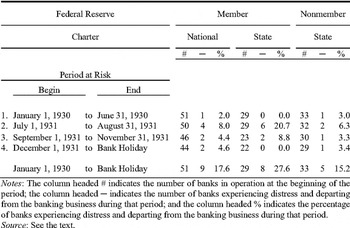
Our empirical analysis compares competing explanations for the summer 1931 surge in bank suspensions in New York City. Several considerations shape our analysis. One consideration is the availability of evidence. For Federal Reserve member banks, call reports provide detailed data on seven measures of foreign exposure: (i) balances payable in dollars due from foreign branches of American banks; (ii) due from banks in foreign countries; (iii) due to banks in foreign countries; (iv) time deposits of other banks and trust companies in foreign countries; (v) foreign government bonds owned; (vi) other foreign securities owned, including bonds of municipalities; and (vii) number of foreign branches.Footnote 25 Similar data does not exist for banks that did not belong to the Federal Reserve System. Therefore, we exclude nonmember banks from our analysis.Footnote 26 This exclusion does not, in all likelihood, bias our conclusions. All extant information indicates that nonmember banks had little (usually no) foreign operations and limited (usually no) foreign exposure. Nonmember banks in New York City failed at extremely low rates that peak when failures for all other banks peaked (see Table 2 for details).
These seven dimensions of foreign financial exposure are closely correlated and raise concerns about multicollinearity. To address this issue, we create an index of foreign financial exposure by deriving the principal components from the above seven measures of foreign financial exposure. The first principal component is a linear transformation of the vectors that explains the greatest possible variance in these vectors and serves as our index. Banks for which the value of the index is lowest have the least foreign financial exposure. Banks for which the value of the index is highest have the most foreign financial exposure.
An additional concern is the chronological pattern of bank distress. During 1931 bank distress in New York City was clustered in three periods. The first occurred in March, during the months following the demise of The Bank of United States and preceding the banking crisis in Austria. The second spanned July and August, when banking problems beset Germany and the banking department examined all of the state-chartered banks in New York City. The third period followed Britain's
BANK SUPERVISION AND DISTRESS IN NEW YORK CITY JANUARY 1930 UNTIL THE NATIONAL BANKING HOLIDAY IN MARCH 1933

Notes:
The column headed # indicates the number of banks in operation at the beginning of the period; the column headed — indicates the number of banks experiencing distress and departing from the banking business during that period; and the column headed % indicates the percentage of banks experiencing distress and departing from the banking business during that period.
Source:
See the text.
abandonment of the gold standard and the Federal Reserve's interest rate reaction. Figure 1 displays these three periods as three periods of increased risk, separated by periods without bank distress. Table 2 displays these patterns by separating the data into four periods: the three described above and one additional period representing the rest of the contraction. These periods form the foundation of our analysis.
The four periods also encompasses patterns of regulatory activity in New York City. During 1931 the failure of The Bank of United States distorted schedules for state bank examinations, occupying almost the entire state bank examination staff from January through June. Examinations resumed in the month of July under new and stricter standards and returned to normal after August. The Comptroller of the Currency and Federal Reserve System did not face the same manpower constraints and maintained a regular examination schedule throughout the year. Thus, state banks experienced no state examinations during our first analytic period, intense examinations during the second, and regular examinations during the third and fourth periods. National banks experienced regular examinations across all four periods. As a result, the inspection regime for Federal Reserve member banks with national charters differed from that of Federal Reserve members with state charters in one period: July and August of 1931. All of the state chartered banks that closed were taken over by state examiners in the wake of these examinations.Footnote 27
These circumstances lend themselves to statistical methods akin to discrete time survival analysis. We observe whether banks survived during a period, conditional on having survived through the previous period. This conditionality is captured by a panel logit specification:

The dependent variable, Dit, equals one if during the period t, bank i experienced distress, (i.e. either entered receivership or consolidated due to financial difficulties) and zero otherwise. The dependent variable is regressed on a series of explanatory variables. Pt is an indicator variable that equals one during period t and zero otherwise. The coefficient, αt, indicates the baseline hazard for period t. Fi indicates bank i's foreign exposure as measured by our index. Fi is measured before the onset of risk in period one. The effect of foreign exposure is allowed to vary across periods by interacting the variables Fi and Pt. The coefficient βt indicates whether foreign exposure increased or decreased the probability of distress during period t. Si equals one if bank i is a state-chartered bank and zero otherwise. Xij is a vector of bank characteristics measured before the onset of risk. The letter j = {1,…, J} indexes the characteristics.Footnote 28
The coefficients of interest are those indicating the influence of foreign financial exposure, β1 through β4, and the impact of intensive examinations of state banks during the second period (i.e., July and August 1931), ϕ. Table 3 reports these coefficients.Footnote 29 Column 1 reports
PANEL LOGIT ESTIMATES OF PROBABILITY OF DISTRESS

* indicates significance at 5 percent level.
** indicates significance at 10 percent level.
Notes:
Robust standard errors clustered for each bank appear within brackets below coefficients.
Sources:
See the text.
the baseline hazard rates estimated without other covariates. The baseline rates for periods one through four were 1.3 percent, 12.7 percent, 5.8 percent, and 3.1 percent respectively.Footnote 30 Column 2 reports the model with the inclusion of our index for foreign exposure. The coefficients indicate that banks with more foreign exposure failed less often than banks with less exposure. The magnitude of the effect was substantial. In the first period, increasing foreign exposure by one standard deviation reduced the probability of distress from 1.3 percent to less than 0.0013 percent. In the second period, increasing foreign exposure by one standard deviation reduced the probability of distress from 12.7 percent to less than 0.0005 percent. In sum, the more foreign exposure possessed by banks, the lower the likelihood of their failure.Footnote 31 Column 3 presents the full model, where the last coefficient indicates the impact of intensified state examinations. The examinations increased the odds of distress nearly fourfold.
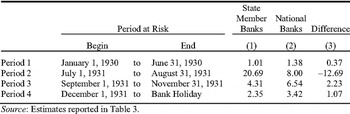
Table 4 puts these estimates in perspective. Column 1 indicates the predicted probability of failure in each period for state member banks. Column 2 indicates the predicted probability of failure in each period for national banks. Column 3 indicates the difference for each period between columns 1 and 2. In the first, third, and fourth periods, national banks experienced distress at higher rates than state member banks (in the later two periods, significantly so). During the second period, however, the risk of distress for state member banks exceeded the risk for national banks by more than 12 percent. Our model attributes indicate that this difference arose due to the intensified inspection regime. Without these intense inspections, our model indicates the risk of distress for state member banks would have been less than 6 percent during the second period.
IMPACT OF INTENSIFIED INSPECTION REGIME PREDICTED PROBABILITY OF FAILURE ACROSS FOUR PERIODS AT RISK

Source:
Estimates reported in Table 3.
DISCUSSION
The statistical and historical evidence presented in this essay point to a common conclusion. The chronological correlation of the banking crises in Germany and New York City was coincidental, not causal. Foreign exposure did not lead to distress among banks at the center of the American money market. An intensified inspection regime, which was a delayed reaction to the failure of The Bank of United States, caused the surge of bank liquidations and consolidations in New York City during July and August of 1931.
This realization raises several issues regarding bank distress during the Great Depression. The first pertains to the uniqueness of the United States central money market. Scholars have long recognized that the pattern of bank distress in New York City differed from the pattern of distress for the nation as a whole. In New York City, few banks closed their doors to depositors; in the rest of the nation, nearly a third of all banks went out of business. Our study suggests that the behavior of the New York state banking department had much to do with the fates of banks in the central money market. The superintendent's office actively merged weak banks with stronger institutions. Banking law required banks in New York City to hold larger reserves and greater capital than depository institutions elsewhere in the nation. These legal requirements left a large cushion between the onset of difficulties and the point of no return. The superintendent used this cushion as a window of opportunity to resolve bank distress short of receivership. The superintendent's vigilance meant that few institutions failed in New York City and those that did go out of business returned substantial sums to depositors.
A second issue is the political economy of bank regulation. Regulators determined the fate of many banks. What influenced the decisions made by bank regulators, such as the New York Superintendent of Banks and his subordinates? Ideology, experience, politics, legislation, and self-interest all played a part. The superintendent's treatment of troubled banks changed over time. Changing economic conditions may have been one reason. The optimal method of resolving financial difficulties depends on the short-term prospects for sustaining cash flow and the long-term prospects for earning profits. Both factors fluctuated during the 1930s. Changing legislation was another reason. Politicians provided the banking department with additional tools for dealing with bedeviled banks. Political decisions also changed the incentives of the superintendent, who had been appointed as a reformer in the spring of 1929 and was criticized as incompetent two years later. The failure of The Bank of United States was the principal cause of criticism. Its demise led to political pressures which pushed the superintendent of banks to take a prophylactic approach towards imperiled banks.
A third issue concerns correlations between events in financial centers in the United States and Europe. Causal links may have created some of these correlations. But, this article shows that coincidences created others. This realization suggests that there is a danger of drawing false inferences from correlations between events in different countries during the Great Depression. With so many things going wrong in so many countries in such a short span of time, numerous chronological correlations would have been generated by random chance.
A final issue concerns the international transmission of the banking crisis in the summer and fall of 1931. This article demonstrates that direct links between banks in Europe and the United States did not, in fact, spread the crisis across the Atlantic. The most plausible reason for the transatlantic transmission of the crisis, therefore, remains golden fetters.
Appendix: Data Sources Used for Statistical Analysis
Several sources provide the data that we employ in our econometric analysis. Rand McNally Bankers' Directory describes correspondent network, foreign branches, and international transactions services provided to consumers. The Senate Hearings on the Sale of Foreign Bonds or Securities in the United States reports loans to Germany arranged by banks in New York and outstanding during the summer of 1931. Call reports collected by the Federal Reserve Board and Comptroller of Currency provide detailed information for banks belonging to the Federal Reserve System. For state-chartered member banks, balance sheets and income statements survive for the December and June calls for the first five years of the depression (i.e., December 1929 through December 1933). For national banks, balance sheets survive from the December 1929 and December 1931 calls. Income statements survive from the December 1929, June 1931, and December 1931 calls. The balance sheets provide detailed data about bank's foreign exposure. Schedule G indicates holdings of foreign government bonds and other foreign securities. Schedule I indicates balances due in dollars and foreign currencies from foreign banks and foreign branches of U.S. banks. Schedule J indicates balances due to banks in foreign countries. Schedule L indicates time deposits of foreign banks and trust companies. Schedule D indicates the number of branches in foreign countries. A balance sheet also exists for each foreign branch, which provides additional information about overseas operations.
Information on bank distress—including temporary suspensions, liquidations, mergers of solvent institutions, and consolidations forced by financial difficulties—comes from the archives of the Federal Reserve Board of Governors' Division of Bank Operations. Combining the St. 6386 forms and the bank balance sheet data described above yields a cross-sectional database of banks on the eve of the financial crisis at the beginning of 1931. The database contains more information about banks' characteristics, financial health, and fates than any other extant source.
Data on economic conditions comes from several sources. Bradstreet's Weekly, Dun's Review, the Commercial and Financial Chronicle, the Federal Reserve Bulletin, and the Annual Reports of the Federal Reserve Board and the Federal Reserve Bank of New York provide data on building permits, business failures, commodity prices, market interest rates, Federal Reserve discount rates, prices, and industrial production. The same sources also include data on international flows of gold, goods, and funds.