Introduction
Nodulation is an important trait of legumes that allows atmospheric nitrogen to be converted into plant-consumable ammonia by symbiosis with the rhizobia (Ferguson et al., Reference Ferguson, Indrasumunar, Hayashi, Lin, Lin, Reid and Gresshoff2010). This process can be exploited in sustainable agriculture to replace chemical nitrogen fertilizers, the cost of which continues to rise along with the price of fossil fuels. For the breeding practices to improve its efficiency, it is essential to understand the molecular basis of nitrogen fixation.
Previous research has attempted to identify nodulation-related genes using mutants of two major model legumes, Medicago truncatula and Lotus japonicus, with regard to flavonoid compound secretion for attracting rhizobia and bacterial Nod factor (NF) perception of the root and autoregulation of nodulation (AON). Several genes have been reported to be involved in the steps of these processes (Ferguson et al., Reference Ferguson, Indrasumunar, Hayashi, Lin, Lin, Reid and Gresshoff2010).
In this study, we sequenced the leaf and root transcriptomes of Vigna angularis (accession IT213134) using Illumina HiSeq2000 and then assembled using the Trinity software. Cluster analysis of the coding sequences for each tissue revealed tissue-specific genes. The homologues of nodulation-related genes were assessed for tissue specificity and conservation among the legume genomes.
Materials and methods
V. angularis (accession IT213134) was used in this study. The leaf triplet and root tissue samples were harvested at stage V4. RNA was extracted using TRIzol (Invitrogen, Life Technologies, Carlsbad, CA, USA) according to the manufacturer's instructions. The mRNA was converted into the template-sequencing library suitable for subsequent cluster generation using the TruSeq RNA Sample Preparation Kit (Illumina, San Diego, CA, USA). For RNA sequencing, the Illumina HiSeq2000 platform was used to produce about 5 GB for each library, and de novo assembly using the Trinity software resulted in 49,509 and 62,922 complete coding sequences for leaf and root tissues (Table S1, available online) (Grabherr et al., Reference Grabherr, Haas, Yassour, Levin, Thompson, Amit, Adiconis, Fan, Raychowdhury, Zeng, Chen, Mauceli, Hacohen, Gnirke, Rhind, di Palma, Birren, Nusbaum, Lindblad-Toh, Friedman and Regev2011).
Results and discussion
Transcriptome assembly and clustering
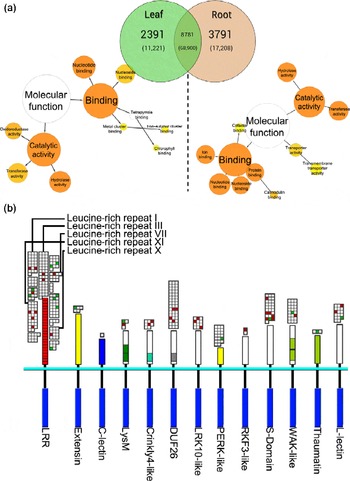
The peptide sequences derived from each tissue were clustered using the OrthoMCL software to identify tissue-specific peptides (Fig. 1(a)) (Li et al., Reference Li, Stoeckert and Roos2003). The longest peptide from each cluster was chosen as a representative gene for gene ontology (GO) enrichment analysis (Fig. 1(a)). Notably, GO enrichment of root-specific clusters revealed genes associated with ‘ion binding’, ‘protein binding’ and ‘calmodulin binding’ within the ‘Binding’ category, which is consistent with published reports that demonstrated a role for MtDMI3/PsSYM9, a calcium- and calmodulin-dependent protein kinase, in the NF signalling cascade (Levy et al., Reference Levy, Bres, Geurts, Chalhoub, Kulikova, Duc, Journet, Ane, Lauber, Bisseling, Denarie, Rosenberg and Debelle2004; Mitra et al., Reference Mitra, Gleason, Edwards, Hadfield, Downie, Oldroyd and Long2004). The ‘Protein binding’ category includes receptor-like kinases (RLKs) involved in NF binding. The RLK-like genes in V. angularis were surveyed in detail following RLK classification by Shiu and Bleecker (Reference Shiu and Bleecker2001) using the MapMan software (Fig. 1(b)) (Thimm et al., Reference Thimm, Blasing, Gibon, Nagel, Meyer, Kruger, Selbig, Muller, Rhee and Stitt2004). This analysis revealed that LRR I, III, VII, X, and XI, Crinkly4-like, DUF26, LRK10-like and RKF3-like are mainly found in root-specific clusters.
(a) Venn diagram depicting the tissue-specific peptide clusters and common peptide clusters. BinGO ontology diagrams show the gene ontology enrichment pattern of leaf- and root-specific clusters. The numbers within parentheses indicate the number of peptides within the clusters. (b) Receptor-like kinases (RLKs) in leaf- and root-specific clusters. Several types of RLKs are root specific.

Identification of nodulation-related genes
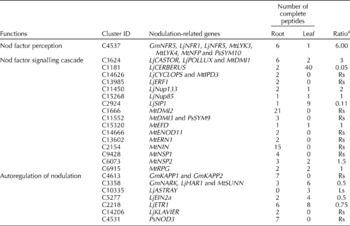
The 38 nodulation-related genes were obtained from the NCBI (National Center for Biotechnology Information) according to the literature (Ferguson et al., Reference Ferguson, Indrasumunar, Hayashi, Lin, Lin, Reid and Gresshoff2010). Of these, 37 sufficiently matched to representative genes from 24 clusters (Table 1). In addition, we aligned these nodulation-related genes against peptides derived from the entire V. angularis transcriptome, including those predicted from partial coding sequences, and retrieved best hits to determine the orthologues of V. angularis genes derived using the BLAST score (Table S2, available online). All genes related to NF perception matched to cluster C4537. The orthologues of these genes were all root-derived peptides.
Nodulation-related peptide clusters derived from root and leaf transcriptomes

Rs, root specific; Ls, leaf specific.
a Ratio refers to number of complete root peptides to number of complete leaf peptides.
Genes associated with NF signalling were matched to 16 clusters. Root-derived orthologues were identified for ten genes, namely MtDMI2, MtDMI3/PsSYM9, MtNSP1, MtERN1, MtIPD3/LjCYCLOPS, LjCERBERUS, LjERF1 and MtEFD (Table S2, available online). On the other hand, leaf-derived peptides were identified as the orthologues of five genes, MtNIN, MtENOD11, LjSIP1, MtRPG and MtHMGR1. However, the expression of MtENOD11 has been demonstrated during nodule development in M. truncatula (Journet et al., Reference Journet, El-Gachtouli, Vernoud, de Billy, Pichon, Dedieu, Arnould, Morandi, Barker and Gianinazzi-Pearson2001), while MtNIN is reportedly expressed in the leaf, root and nodule, where its expression is highest (Schauser et al., Reference Schauser, Roussis, Stiller and Stougaard1999). The expression of LjSIP1 has also been shown in the leaf and root tissues of L. japonicus (Zhu et al., Reference Zhu, Chen, Zhu, Fang, Kang, Hong and Zhang2008), while MtRPG has been detected at low levels in the leaf and root of M. truncatula (Arrighi et al., Reference Arrighi, Godfroy, de Billy, Saurat, Jauneau and Gough2008). Nevertheless, MtHMGR1 is expressed in the root and nodule of M. truncatula (Kevei et al., Reference Kevei, Lougnon, Mergaert, Horvath, Kereszt, Jayaraman, Zaman, Marcel, Regulski, Kiss, Kondorosi, Endre, Kondorosi and Ane2007). The differences might result from the sampling time of mRNA extraction. MtDMI1/LjCASTOR/LjPOLLUX, LjNup85, LjNup133, MtNSP2 and LjERF1 had orthologues that were co-expressed in both leaf and root tissues (Table S2, available online), consistent with previous research on these model legumes. MtDMI1/LjCASTOR/LjPOLLUX encodes potassium ion-channel proteins. Although MtDMI1 is reportedly root specific in M. truncatula, LjCASTOR and LjPOLLUX are expressed in the leaf and root (Imaizumi-Anraku et al., Reference Imaizumi-Anraku, Takeda, Charpentier, Perry, Miwa, Umehara, Kouchi, Murakami, Mulder, Vickers, Pike, Downie, Wang, Sato, Asamizu, Tabata, Yoshikawa, Murooka, Wu, Kawaguchi, Kawasaki, Parniske and Hayashi2005). LjNup133 and LjNup85 encode nucleoporins, which are expressed in both the root and leaf of L. japonicus (Kanamori et al., Reference Kanamori, Madsen, Radutoiu, Frantescu, Quistgaard, Miwa, Downie, James, Felle, Haaning, Jensen, Sato, Nakamura, Tabata, Sandal and Stougaard2006; Saito et al., Reference Saito, Yoshikawa, Yano, Miwa, Uchida, Asamizu, Sato, Tabata, Imaizumi-Anraku, Umehara, Kouchi, Murooka, Szczyglowski, Downie, Parniske, Hayashi and Kawaguchi2007). Similarly, MtNSP2 is expressed in the leaf and root of M. truncatula (Kalo et al., Reference Kalo, Gleason, Edwards, Marsh, Mitra, Hirsch, Jakab, Sims, Long, Rogers, Kiss, Downie and Oldroyd2005). The expression of LjERF1 has been assessed in nodule-containing root tissues and found to be present at the initial stage of nodulation (Asamizu et al., Reference Asamizu, Shimoda, Kouchi, Tabata and Sato2008).
AON-related genes were matched to seven clusters, of which three consisted of only root-derived peptides. This analysis demonstrated that the orthologues of GmKAPP1, GmKAPP2, PsNOD3 and LjKLAVIER were root-derived peptides (Table S2, available online). Grafting experiments have linked PsNOD3 to a root-specific function in Pisum sativum (Li et al., Reference Li, Kinkema and Gresshoff2009). LjKLAVIER is expressed in the leaf and root of L. japonicus (Miyazawa et al., Reference Miyazawa, Oka-Kira, Sato, Takahashi, Wu, Sato, Hayashi, Betsuyaku, Nakazono, Tabata, Harada, Sawa, Fukuda and Kawaguchi2010), while GmKAPP1 and GmKAPP2 have been found to be expressed in the soybean leaf tissue (Miyahara et al., Reference Miyahara, Hirani, Oakes, Kereszt, Kobe, Djordjevic and Gresshoff2008). Similarly, the orthologues of GmNARK/LjHAR1/MtSUNN were leaf-derived peptides. GmNARK, LjHAR and MtSUNN have been found to be expressed in the leaf and root of Glycine max, L. japonicus and M. truncatula, respectively (Nishimura et al., Reference Nishimura, Hayashi, Wu, Kouchi, Imaizumi-Anraku, Murakami, Kawasaki, Akao, Ohmori, Nagasawa, Harada and Kawaguchi2002a; Searle et al., Reference Searle, Men, Laniya, Buzas, Iturbe-Ormaetxe, Carroll and Gresshoff2003; Schnabel et al., Reference Schnabel, Journet, de Carvalho-Niebel, Duc and Frugoli2005). GmNARK controls root nodule development by recognizing the root-to-shoot Q signal and its orthologues expressed in the leaves of V. angularis may play a similar role. It is notable that the orthologues of GmKAPP were detected in the root tissue and that its corresponding cluster, C4613, consisted of only root-derived peptides (Table 1). We identified partial coding sequences in the leaf that aligned against GmKAPP with a score similar to that of the root orthologue (Table S2, available online). This leaf-derived partial sequence may play a role similar to that played by Kinase-associated protein phosphatases (KAPP), which interacts with Nodule autoregulation receptor kinase (NARK) in the leaf according to the model of systemic communication for nodulation in P. sativum (Li et al., Reference Li, Kinkema and Gresshoff2009). The orthologues of LjASTRAY were found among both the leaf- and root-derived peptides, despite a previous report showing the presence of LjASTRAY complementary DNA in only the root tissue of L. japonicus (Nishimura et al., Reference Nishimura, Ohmori, Fujita and Kawaguchi2002b). LjETR1 and LjEIN2a are required for monitoring ethylene sensitivity. While the orthologue of LjETR1 was co-expressed in the leaf and root, that of LjEIN2a was leaf specific.
Conclusion
We used clustering and GO enrichment analysis to identify candidate RLK genes that may participate in NF signalling and the orthologues of nodulation-related genes. Transcriptome-derived peptides of V. angularis possessed the orthologues of nodulation-related genes with a high similarity. Tissue specificity was slightly different between the model legumes; however, possible paralogues that clustered with the orthologues exhibited root- or leaf-specific expression, suggesting that the evolution of V. angularis subfunctionalization differs from that of other model legumes. These results demonstrate the feasibility of applying the NGS technology to effectively discover agriculturally important genes in minor crops that do not have a complete reference genome sequence.
Supplementary material
To view supplementary material for this article, please visit http://dx.doi.org/10.1017/S1479262114000185
Acknowledgements
This study was supported by a grant from the Next-Generation BioGreen 21 Program (no. PJ008060) of the Rural Development Administration, Republic of Korea.