For weeks on end, sitting in a local café, these amateur archaeologists had argued over their conflicting theories as to the origins of these remains. Two of them were even in the process of writing an article for a magazine, expressing their learnt and audacious theses, when the little group of bone hunters arrived. Having wandered into the museum quite by chance, the expert had of course recognized the skeleton immediately for what it was. Footnote 1
INTRODUCTION: ETHICS AND CEMETERIES
In this article, we discuss a piece of “dark history” still in the making: the Mamilla cemetery (once one of the largest and most important Muslim cemeteries in Jerusalem) and the “Museum of Tolerance.” The building of this museum led to the destruction of hundreds of graves; the bones were exhumed and reburied, but few know where and in what circumstances. Our focus is archaeological. While we also discuss other aspects, our main concern is the ethics of excavation of graves, the reburial of bones, and the acknowledgement of descendant communities.
Archaeological discourse on excavating graves stresses respect to the dead and recognition of Native/descendant communities ever since the influential 1989 Vermillion Accord on Human Remains. It states:
1. Respect for the mortal remains of the dead shall be accorded to all, irrespective of origin, race, religion, nationality, custom and tradition …
3. Respect for the wishes of the local community and of relatives or guardians of the dead shall be accorded whenever possible, reasonable and lawful. Footnote 2
While the accord does not explain how to define rights of local communities, Footnote 3 archaeologists are expected to consider their feelings: “Excavations in sensitive areas should be planned and conducted in close consultation with local people, and care should be taken to do the minimum of damage to tombs and graves.” Footnote 4
A revolutionary piece of legislation acknowledging descendant communities was the 1990 Native American Graves Protection and Repatriation Act (NAGPRA). Footnote 5 It provided legal basis for the repatriation of human remains and rules of conduct concerning their excavation. NAGPRA proved a benefit for all sides—museums, scholars, and communities. Its success owes much to the long history of legal and other relations between the US government and Native communities. Footnote 6 NAGPRA has been acknowledged in ethical codes, Footnote 7 and repatriation has become a global issue: descendant communities are now acknowledged all over the world. Footnote 8
The African-American burial ground in New York (City Hall Park) offers an example. Professionals knew about it but assumed that the tombs had long since been destroyed. Development in the 1990s revealed hundreds of graves. The government intended to exhume the remains and continue with the project. Public dismay and activity of the African-American community managed to rewrite the significance of the site. The construction was altered. Part of the area was designated a national monument. Decisions concerning the ceremonial reburial were made by the descendant community, which also became involved in anthropological research. Footnote 9 Out of respect to the community, researchers gave as detailed as possible descriptions of the dead:
With the African Burial Ground Project, the descendant community is interested in where each individual comes from, what their lives were like, whether or not they received enough to eat, how many mothers were buried with their children, and so on. These are questions that go to the heart of the cultural and spiritual connection between these skeletal remains and the descendant community. Footnote 10
In the wake of NAGPRA, state authorities can no longer assume total control over antiquities “without acknowledging the special cultural affinities and identity expressions of contemporary sub-state groups.” Footnote 11 The essence of repatriation is not giving back objects but, rather, recognizing descendant communities. Ignoring them does not make archaeologists more objective since they still serve interests, just of other stakeholders: Footnote 12 “All the values of heritage should enter into decisions about the management and fate of the historic built environment. It is untenable to simply ignore the values of some stakeholders because we may disagree ideologically.” Footnote 13
Old Jewish cemeteries in Western Europe offer another example. The ancient Montjuïc cemetery in Barcelona was deserted after the expulsion of the Jews in 1391 bc. In 2006, the authorities planned to turn it into a park (without damaging the burials). However, a Jewish Orthodox group, speaking in the name of religious customs (Halacha), managed to stop the project. Footnote 14 Similar cases, with mixed results, have occurred elsewhere. Footnote 15 Questions whether lineages of communities are real or assumed are “inapplicable or irrelevant.” Footnote 16 While not every demand can be met with, the ideal is dialogue, not one-sided decision. Compare the recent case of Hôtel-Dieu in Lyon; through dialogue, the community wishes not to exhume the bones and to build a “floating floor” (financed by the developers) were accepted. The municipality promised to put a memorial plaque in a highly visible place. Footnote 17 The Faro Convention on the Value of Cultural Heritage for Society acknowledges that all those interested in heritage are legitimate stakeholders, regardless of ethnic, cultural, or other affiliations. Footnote 18 Similarly, the 2007 UN Declaration on the Rights of Indigenous Peoples recognizes repatriation of human remains and the rights of Indigenous peoples in archaeological/historical sites. Footnote 19
MAMILLA: AN IMPORTANT CEMETERY
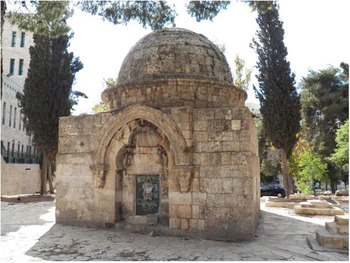
Mamilla (Ma’man Allah) cemetery, which was active for some 900 years, was one of the largest and most important Muslim cemeteries in Jerusalem (Figure 1). In the late nineteenth century, it was fenced by new neighbourhoods, and new burials declined. When it became part of West Jerusalem in 1948, it was detached from its community and neglected. In 1964, the Jerusalem municipality persuaded the Muslim Qadi of Jaffa to abolish the sanctity of the cemetery in favor of a public garden (Independence Park). Yet, in the following years, the municipality used parts of the cemetery as its private property, not just for the garden, but also for a parking lot, school buildings, and a road. Tombs were destroyed without documentation, and the cemetery was reduced from approximately 13.5 to 1.5–2 hectares. Footnote 20
The Kubakiyya Mausoleum at Mamilla (photo courtesy of R. Kletter).

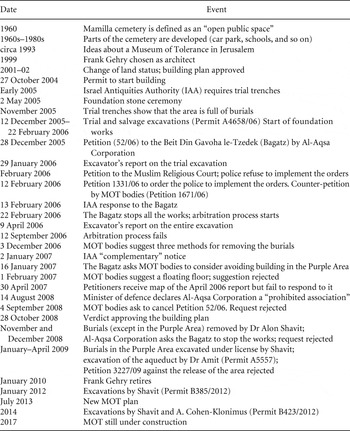
Around 1993, probably after Tedi Kollek (then mayor of Jerusalem) visited the Museum of Tolerance in Los Angeles, the idea was raised to make a similar Museum of Tolerance (MOT) in Jerusalem. A daughter company was established for this aim, the Simon Wiesenthal Centre Corporation (we use “MOT bodies” here as a collective name for all MOT-related organizations). After several locations were rejected, the then Jerusalem Mayor Ehud Olmert suggested Mamilla. The participation of dignitaries in the foundation ceremony, such as California Governor Arnold Schwarzenegger and Israel President Moshe Katzav, suggested that this was not just a rich private project but also a national undertaking (Table 1). Since the site was a declared antiquities site, the Israel Antiquities Authority (IAA) entered the picture. In early 2005, one of us (Gideon Sulimani, who was then the IAA District Archaeologist of Jerusalem) requested making trial trenches, which was a regular procedure of initial examination before development. These were made in November 2005, showing the presence of burials over the entire area. Hence, the IAA demanded trial excavations, which started in December 2005. They revealed dense, important burials:
The density of the burials and the organization and order of the burial area testify to a central administration of the cemetery and to a continuation of burial over a long period … Recommendations: a salvage excavation of the entire area designed for building is required; or alternatively, performing a partial salvage excavation and covering the rest of the area without destroying the burials. Footnote 21
Accordingly, the IAA required full excavation, and the trial excavation developed without break into a large-scale salvage excavation with approximately 200 workers. In the meantime, on 28 December 2005, the Al-Aqsa Corporation, affiliated to the Northern Islamic Movement in Israel, handed a petition to the Supreme Court of Justice (Beit Din Gavoha le-Tzedek [Bagatz]) to stop all the works. The Bagatz asked for opinions from involved bodies, but the excavations still continued.
Timelines

The IAA handed its position to the Bagatz on 13 February 2006 (box 1, Figure 2). It fully matched that of the excavator, stressing that Mamilla was “one of the most important Muslim cemeteries in Jerusalem.” The excavations showed “dense burial in five burial layers” and “continuous use of the cemetery for hundreds of years.” In sum, “the importance of the excavation for advancing archaeological science is considerable and unequivocal” (box 1, no. 4, 12, 16). Meanwhile, Muslim families from Jerusalem, who had distant relatives buried in Mamilla, applied to the Muslim Religious Court in Israel, which issued orders to stop the works on the argument that the area was a religious foundation (wakf). Footnote 22 The police refused to implement the orders, claiming that the land was no longer wakf. Hence, on 12 February 2006, the same families asked the Bagatz to order the police to implement the orders, while the MOT bodies initiated a counter-petition. On 22 February 2006, the Bagatz ordered that all work must be stopped and sent the sides to arbitration. The salvage excavation was also abruptly halted.
Box 1. Israel Antiquities Authority (IAA) response, 13 February 2006.
IAA Response to Bagatz (52/06)
At the High Court (Bagatz)
Before her honour Judge A. Proccachia
[Details of the petitioners and respondents]
Response of the Antiquities Authority, Respondent no. 8 to the Petition
1. The area known as Mamilla Cemetery compound is a declared antiquities site since the British Mandate Period; [see] Official Gazette, second addition 1375 of 1944. It has been declared again in 1964 (Publication Gazette 1091, p. 1462).
2. The Muslim Cemetery at Mamilla is known as an antiquities site and a recognized burial site in Jerusalem. The Mamilla Cemetery is known already from the Crusader Period as the burial place of senior priests of the Sepulchre Church. From this period several architectural items have survived, including a complete tomb located south of the present work area.
3. In the Ayyubid Period (13th century) the cemetery served the Muslim community of Jerusalem. Within the cemetery’s area there is a fabulous burial structure named after Al-Kubbaki from the end of the 13th century. Names of those buried in the cemetery are listed in the book of Mujir Al-Din of the 14th century, which notes the presence of tombs of companions of Salah Al-Din.
4. The Mamilla Cemetery continued to be used as one of the most important Muslim cemeteries in Jerusalem from the Ayyubid Period until the end of the 19th century. The Cemetery served as the burial place of the elite of Jerusalem’s Muslim society.
5. In addition, a large water pool is located in the cemetery, forming part of Jerusalem’s water system of the Second Temple Period.
6. The importance of the cemetery as an antiquities site was recognized already in the British Mandate period, but nevertheless, areas of the cemetery were used for development by the initiative of the wakf and by agreement of the Supreme Muslim Council. In addition, the Palace Hotel was established in this area already during the British Mandate Period, and several plans were made for massive dwelling and commercial buildings within the cemetery’s area.
7. The northern part of the cemetery was developed in the 1970s as a parking lot and on this area MOT is designed, based on an approved City Plan. This is the area under dispute, the subject of this petition.
8. Once the building plan for MOT—City Building Plan 8030—was approved, the entrepreneurs of the plan apparently hired Moriah Co. for the Development of Jerusalem Ltd., to handle the building project. Since, as mentioned before, the area is a declared antiquities site, the IAA demanded that trial trenches would be made in the place before the start of building, in order to estimate the extent of the ancient remains; and [that] in view of the finds exposed by the trial trenches, a salvage excavation would be carried out to document the antiquities that will be found.
9. On 9.12.05, the IAA started trial trenches, and the trial trenches showed that the entire [area] is full of tombs. In addition pottery from the Iron Age (6th and 7th centuries bce) until the Ottoman Period was found in the area.
10. As mentioned, the area was mostly used as a parking lot. At first, the project entrepreneurs removed the asphalt that served for parking, and exposed the fill layers placed in the area as basis for the parking lot. It seems that during the process of levelling the area in order to lay the fills, when the parking lot was built in the 1970s, tombstones (as far as they existed) were removed, something for which the IAA has no documentation. However, once the fill layers had been removed, many tombs were exposed.
11. Following the finds of the trial trenches, the IAA demanded to carry a full archaeological excavation in the entire area. The excavation is located in the northern part of the cemetery. At the first stage an area of c. 1.5 dunams [1500 m2] was excavated and many tombs have been found in it. Later, following more excavations and more exposure, more than 200 tombs have been exposed and removed during the continuation of the excavation. Presently, c. 200 more tombs have been exposed.
12. The results of the excavation so far point at dense burial in five burial layers, one on top of the other, a fact which indicates burial over a long period and continuous use of the cemetery for hundreds of years.
13. The cemetery’s organization is exemplary, a fact which indicates central administration of the cemetery through the generations.
14. The burial form in the site is homogeneous. The deceased are laid on the right side, the head in the west and the legs [in] the east; the face is directed southwards—towards Mecca. This tradition of burial is typical to Muslims.
15. There are several types of burials—a deceased laid under stone slabs; a deceased laid in a built tomb; secondary burials; multiple burials; and one tomb with a deceased [laid] in a Christian burial position. Secondary burial was made by collecting the bones of the deceased and placing them in a tomb of a limited size. Secondary burial is probably a form of burial unknown so far [from Muslim Cemeteries].
16. The importance of the excavation for advancing archaeological science is considerable and unequivocal. The methodical excavation teaches much about burial customs during hundreds of years. The research of burial customs, types of tombs, and anthropology of the deceased may teach about the population of Jerusalem from the 12th century ce onwards.
17. Excavation in cemeteries forms a known and important field of study in Archaeology all over the World. We may refer to many excavations of this sort, from the same periods as that of the present site.
18. It is difficult to date the burials, since they concern burials without accompanying objects. The tombs are dug into an archaeological layer which includes sherds dated from the Iron Age to the Ottoman Period. The discovered tombs most likely belong to the Mamluk and Ottoman periods.
19. Several inscriptions have been found in the area of the excavation, including one tombstone marking the date 1783 ce. Additionally, walls of an ancient structure from the Iron Age, whose exposure was not yet completed, have been found.
20. The archaeological treatment of the human bones in the site was done according to the instructions and protocols of the IAA, as approved by the Government’s Attorney General. The IAA and the excavators of the site act according to these instructions and to professional ethics, with proper and fitting respect for the remains. The human remains are collected and gathered into containers in order to remove them to the Religious Dept. at the Prime Minister’s Office for re-burial.
21. Thus far [we handed] a concise description of the IAA activity in the area that concerns the present petition.
[Signed] Yoram Bar-Sela, Lawyer,
Representative of the IAA
Israeli Antiquities Authority’s first response, February 2006.

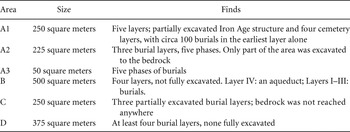
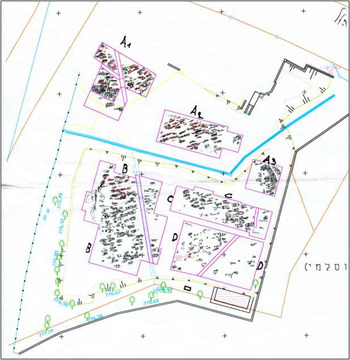
In April 2006, Sulimani handed the regular “Report to the Entrepreneur” to the IAA management (Table 2, Figure 3). It stressed the large number and scientific importance of the burials and stated that the area could not be released without full excavation:
The Muslim cemetery exposed in the excavation is the important and major phase of use in the area … The stopping of the excavation due to order of stopping work by Bagatz … creates a situation, in which the excavation in most of the areas has not been completed—except part of areas A1, A2. It is impossible to release the area for building without finishing the excavation. In total c. 250 skeletons have been excavated in c. 200 excavated tombs … Some further 200 tombs have been exposed, but not excavated … We estimate that there are a total of c. 1000 tombs. Footnote 23
The IAA sent the report to the MOT bodies but not to the Bagatz or the petitioners; they learned about its existence only much later (see discussion below). As a government authority, the IAA should have made all of the relevant documents available to all sides and to the Bagatz so that a just decision could be reached. The Mamilla burials were not discovered by chance during the recent work, as assumed by the Bagatz. The Bagatz even thought that the area was not a declared antiquities site, but it has been since the 1940s. Footnote 24 After 1948, many burials on the surface were destroyed, but the area remained a declared site protected by law. The number and density of the burials were unknown, but once clarified by Sulimani’s excavations, the alternatives should have been clear: either carry out a full salvage excavation or avoid damaging the burials further.
Summary of the April 2006 report
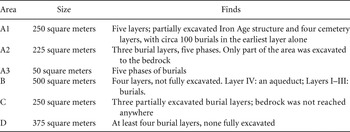
Map attached to Gideon Sulimani’s “Report to the Entrepreneur,” April 2006 (courtesy of G. Sulimani).

REVERSAL OF COURSE: THE “COMPLEMENTARY” NOTICE
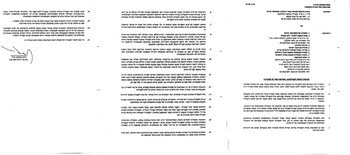
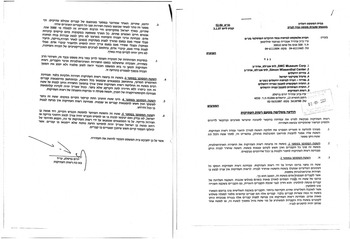
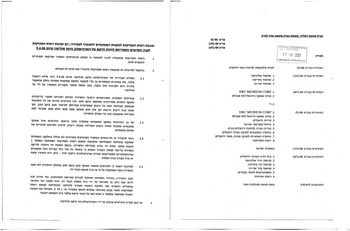
After the arbitration had failed, the Bagatz asked the MOT bodies to offer solutions for either removal of the burials or replanning. The MOT bodies suggested only to remove the burials, and the Al-Aqsa Corporation rejected the suggestion. The Bagatz was going to decide the case, and the prospects of the MOT were uncertain. Then the IAA intervened. On 18 December 2006, it asked the court for additional time in order to produce a “complementary notice.” Ten months had passed after the termination of the excavations, and nothing had changed on the ground. What was there to complement? This was revealed on 2 January 2007 (box 2, Figure 4), when the notice together with a new map (Figure 5) were handed to the Bagatz.
Box 2. The complementary notice.
At the High Court Bagatz 52/06
Sitting as High Court of Justice Set for 3.1.07
Concerning: Al Aqsa Corporation [details] The petitioner
Against
1. SWC Museum Corp, Los Angeles, USA.
2. Simon Wiesenthal Centre, Los Angeles, USA
[List of more respondents]
8. The IAA The Respondents
Complementary Notice on behalf of the IAA
The IAA wishes to detail its position regarding the response handed by the responders, concerning the discussions and the arbitration process that were carried out in regard to the petition.
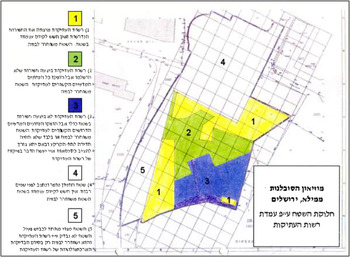
1. Attached to this notice is a map detailing the division of the area, in order to describe the position of the IAA. The area where MOT is planned is divided, in this map, to sub-areas. Each sub-area has been marked by a number.
2. The area marked 1: in this area the IAA has completed the archaeological excavation. In this area all the burials have been removed and there is no danger of existence of bones in the area. The area was released for building, and in the view of the IAA it can be dug and built as the entrepreneurs wishes.
3.A. The area marked 2:
Most of this area was excavated by the IAA. In the view of the IAA all the scientific data found in this area has been gathered [lit. “extracted”] and the area has been released for building. The IAA has no further interest in carrying more archaeological excavations in it.
Concerning tombs and human remains in this area, the situation is as follows:
In most of this area the dead were buried over hundreds of years in three layers. The upper layer of burials was completely removed. So was the second layer, also the tombs in the second layer were completely removed.
As for the third layer, which is the earliest: the burials in the third layer were mostly removed and only a few dozen burials were left in this area. These are still early burials, more than three-hundred years old. Concerning the IAA, there is no objection for removing these burials in a dignified way; one can bury them in the area of the [Mamilla] cemetery which extends over a large area near this [excavated] area, or [move them for reburial] to another area which can be agreed upon.
3.B. We stress two [arguments]. First, one speaks about a limited number of tombs, all ancient. This number remained after excavations have been carried out in this area, and all the other tombs that existed [formerly] have been removed.
Second, in Eretz-Israel material life existed for over 5000 years now. People live and people die. All the land is full of places with human burials. Regarding needs of building and of development in our land, it is impossible for us to perform works of building and of development without damaging antiquities occasionally (of course, after excavation, examination, documentation, and research); and without shifting and moving human burials occasionally. Without removing from time to time human burials, following the objective needs of building and development, one will not be able to build in the land.
3.C. Following the special circumstances of the case standing to trial before this respectable court, the prolonged delay in [handing] the petition, and the fact that the archaeological excavations and the removal of burials have already been almost completed, the IAA wild claim that the respectable court should not prevent the continuation of the building, subject to what was detailed in this notice.
4. The area marked 3: in this area the IAA performed only partial excavations. Concerning scientific interest, in regard to the discoveries all over the area, and in view of the existence of many tombs in this area, the IAA has decided that there is no need for continuation of excavation and that it is possible to build on this area while covering it without penetration of the un-excavated sub-soil. As far as it will be required to drill foundation piles for the building’s construction, this act will be performed under the supervision and observance of the IAA.
5. The area marked 4: [This] is the underground parking lot existing in the place. This area was already excavated in depth and there is no worry for existence of bones or tombs. In the IAA’s opinion there is no objection to build in it whatever is required.
6. The area marked 5: this area and the area designed as an alternative to the existing road, Menashe ben-Yisrael road, were not checked. If one asks to build in it or to move the road, trial trenches or trial excavations will be required. According to the data available to the IAA so far, in the southern part of the Menashe Ben-Yisrael road which will have to be moved, it is likely that there will not be burials. As for its northern part, there is danger that it may include burials.
Therefore, the respected court will be asked to reject the petition.
[Signed] Yoram Bar-Sela
Representative of the IAA
The complementary notice, January 2007.

Map attached to the complementary notice (Areas 1, 2, and 4 “are being released”; Area “3” later became known as the “Purple Area” due to the colors used in the original map).

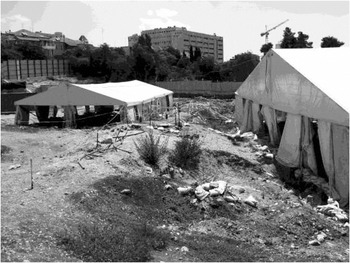
In the complementary notice, the IAA claims that it has finished work in four areas (88 percent of the entire plot) and that it has already released them for development! Allegedly, only one area remained full of burials—the “Purple Area” (Area 3). However, the IAA states that this area can also be released without more excavations on condition that the burials will not be further damaged. This implies building a “floating floor” to prevent physical contact between the building and the graves. The complementary notice was a reversal of position. Compare the areas that are full of burials in the April 2006 report (Figure 3) and the photograph from May 2006 (Figure 6), with the empty areas of the complementary notice (Figure 5). The Bagatz accepted the notice fully. The verdict never mentions the first IAA position of February 2006, citing and following only the complementary notice: “[Area 1 was] excavated by the IAA, announced as having no more burial remains, therefore released … [Area 4 was] hewn years ago, therefore, considered free of graves. This area was released by the IAA for building.” Footnote 25
The excavation “frozen” by the court, early 2006 (notice the unexcavated areas outside the shaded areas) (photo courtesy of L. Nilsson-Stutz).

On 16 January 2007, the Bagatz asked the MOT bodies, based on the complementary notice, if they could avoid building in the Purple Area. The MOT bodies replied that this was “the heart of the project,” Footnote 26 and they offered to build a floating floor instead, but Al-Aqsa Corporation rejected this suggestion. The petitioners failed to understand the complementary notice and did not respond to it. Around April 2007, they finally learned about Sulimani’s 2006 report and asked to receive its map. The court approved this request and gave them seven days to respond, but they failed to do so. In July 2007, they raised this issue again, armed with an expert opinion from Rafi Greenberg of Tel-Aviv University. Due to the delays, the Bagatz refused to accept this opinion or reopen the issue. The issue resurfaced in 2009 in a new petition (3227/09). By then, almost no burials were left, and the court took the Purple Area for granted. It interpreted Sulimani’s April 2006 report as a private view (although it was an official IAA report). Since legal power in matters of antiquities is vested in the hands of the IAA director, the excavator’s opinion was deemed irrelevant. Footnote 27
The complementary notice was not an innocent change of opinion. In 2005, writing in memory of former IAA Director Amir Drori, Uzi Dahari (then deputy IAA director) declared: “Amir [Drori] did not compromise about a sacred principle: an area will not be released for any development without a total excavation of everything that is going to be destroyed.” Footnote 28 By 2007, nothing remained of this sacred principle. The complementary notice presented incomplete excavations as being finished and reduced the number and scientific importance of the remaining burials. It convinced the Bagatz that the problem was limited to one small area, leading to a verdict that approved the building. Footnote 29
A BREACH OF ORDERS
The complementary notice and the Bagatz’s quotations take from it speak in the past tense: the areas “had been released.” Compare an IAA response to the 2009 petition, quoted by the Bagatz:
The decision of the IAA Director [to release the areas] was made after consulting many archaeologists … Its [IAA] decision reflects a proper, just balance between the needs of research and documentation and the needs of development … Some thought that the Purple Area should be further excavated, others thought that concerning the historical-archaeological results, the excavations were already more than enough. At the end of the day, the Director of Respondent 1 [IAA] was convinced by the position that from a historic-scientific regard the excavations have been more than enough. Footnote 30
Compare an IAA response to journalist Meron Rapoport:
In accepting decisions at the end of the excavation there is considerable weight to the excavator’s recommendations. However, the IAA holds professional discussions with other expert archaeologists from the IAA and outside it, and so was in this case. At the end of the discussion the decision was made, according to which the [complementary] notice was handed to Bagatz.
The IAA decided to move from a method of systematic excavation to a method of exhuming the bones under supervision, taking care about respect to the dead. Footnote 31
There is no scientific method for “exhuming bones under supervision,” and supervision cannot replace scientific archaeological excavations. Only an archaeological excavation can expose and document each burial. This requires a full team that follows trusted excavation methods.
Sulimani excavated until the very day that the Bagatz stopped the works (22 February 2006). As the IAA testified, discussions were undertaken, which involved time, and “considerable weight” was allegedly given to Sulimani’s recommendations, which were given only in his April 2006 report. Nothing was released earlier or else Sulimani would have referred to it in his report.
From 22 February 2006 until the verdict of October 2008, the entire area was under court jurisdiction. Any change required explicit court orders. Indeed, both sides requested orders for all sorts of trifles (cutting weeds, visiting the area, and so on), and the Bagatz issued appropriate orders each time. Footnote 32 Releasing land for development changes its legal status and affects its fate. To release areas at Mamilla, the IAA had to apply to the court first. The court could have issued appropriate orders but only after it gave the petitioners an opportunity to respond. Nothing of the sort happened. The IAA did not apply to the court. The petitioners had no chance to respond. The court never ordered the IAA to release any areas. Later, the IAA tried to claim that
The said plan [of the April 2006 report (Figure 3)] reflects a given time during the excavation and not the state of the excavation when it was stopped by the order of this honourable court. The state of the excavation … for the day when this honourable court gave the temporary orders [to stop the works], is the situation as described in the plan … attached to the complementary notice on behalf of the IAA [Figure 5], which was coloured in four colours and marked by numbers from 1 to 5.
This claim tries to project the complementary map of January 2007 (with the released areas) back to February 2006 (Figure 7). It is impossible. If 88 percent of the area was released already in February 2006, how could Sulimani be unaware of it in April 2006? The areas (except Areas A1 and A2) remained full of burials when the excavation was halted. The map that is shown in Figure 3 was mostly drawn after 22 February 2006 in the “post-excavation” days, when the IAA archaeologists still work in the field in order to tie down their excavations. Footnote 33
Israeli Antiquities Authority’s second response, 6 May 2007 (courtesy Bagatz archive, Jerusalem).

The names and colours of the released areas (Areas 1–5, purple, yellow, and so on) did not exist before the complementary notice was written. The labels of the complementary map (Figure 5, left) are in present tense: “the area is being released.” Antiquities areas are either released or not. There is no transitional phase—a “half-released” area. The language reveals the truth: the areas were not released in the past. They were being released hereby: the act of writing the complementary notice and of drawing its map was the act of releasing these areas. The release of the areas, presented by the IAA as a routine action performed in the past, was a complete reversal of policy. It was a rope thrown out to save the MOT at a critical time when the IAA had no authority over Mamilla. The IAA’s release of areas was a breach of the court’s orders of 22 February 2006 “forbidding the continuation of the works at the site and performing any acts that may change the existing situation in the area.” Footnote 34 These orders allowed the IAA to perform only the vital acts necessary for shutting down the excavations (completing the mapping and photography, writing the Locus cards by area supervisors, and so on).
Years later, on the brink of death, Shuka Dorfman called Mamilla a “sad” case. He admitted part of what transpired, blaming others and distancing himself from responsibility:
These were stormy days … The museum entrepreneurs, which included key figures, well-connected to known political personae, employed heavy and at times unacceptable pressures upon the IAA team, in order that it would hasten the excavations and complete them soon … The affair of the Museum of Tolerance occupied many people with personal motivations, aggressive, well-connected and rich entrepreneurs, Jerusalem municipality leaders, lobbyists, project managers, self-appointed journalists and archaeologists … I do not deny the possibility that the heavy pressures laid upon us somewhat obscured our judgement, bringing finally to the decision to excavate hundreds of graves. Footnote 35
This is not what the IAA said at the time: “The claims about political pressures and threats on the IAA to hasten the pace of the excavations are completely unfounded. Such things never happened. The IAA acts solely on the basis of professional judgments and is not affected by political and other foreign factors.” Footnote 36
TOLERANCE
The Bagatz’s verdict creates a picture of uncompromising petitioners. Yet the petitioners hardly received generous offers. At first, the MOT bodies only suggested removing the burials, “offering” to cover the expenses. Footnote 37 Similarly, in December 2006, the MOT bodies listed three methods for the removal of burials. One was archaeological, the two others were not:
Freezing: a set of metal tubes is inserted into the ground to freeze it, then the entire grave is cut and removed without human touch.
Mechanical cutting system: it cuts the ground on the sides of the grave and lifts it onto a wooden board, without human touch. Footnote 38
The language is disheartening—freezing and cutting without human touch—and the suggestions are impractical. In a dense ancient cemetery, few burials are exposed on the surface. Cutting by saws or inserting tubes around an exposed burial might dissect hidden ones. There is no alternative—if the dignity of the dead is to be respected—to careful archaeological excavations by hand. Presenting freezing and cutting as legitimate solutions shows an inability to recognize the petitioners as fellow beings. Would the MOT bodies recommend freezing and cutting in Jewish cemeteries too?
Tolerance is a complex term, which involves the inequality of power: “The tolerated end up with what many of them will feel as a poor second best, for toleration is a poor substitute for recognition, and particularly so when identities as well as opinions are at issue.” Footnote 39 The Bagatz assumed that the MOT advocates universal, humanistic tolerance:
The Museum of Tolerance is in essence an idea for establishing a spiritual centre, which will spread a massage of human tolerance between peoples, between segments of population, and from person to person … Viewed in relation to the on-going Israeli-Arab conflict, [this museum] carries a special weight concerning the dynamics of dialogue and efforts of bridging between the opponent sides. Footnote 40
The Museum of Tolerance … is meant to deliver a message of tolerance, which will strengthen human dignity and maintain trust and friendship between peoples and human beings, regardless of differences of religion, race, sex, or nationality. Footnote 41
However, the MOT is dedicated to only one people:
A place that will remind us that greater than any external threat is the internal divide that separates us. A Place that will reinforce the idea that Jewish unity is not a slogan, but an essential recipe for survival in the 21st century. Footnote 42
Inside the museum, [Marvin] Hier [founder and dean of MOT Bodies] said, there will be two principal sections: A people’s journey, “which will ask: How did the Jews survive for 3,500 years?” and a social lab, “which will confront Israel’s issues as they are today, domestic and international issues, but not the Middle East peace process.” Footnote 43
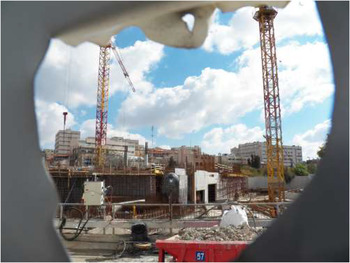
The peace process lies outside the MOT tolerance antenna because showing it means acknowledging the “other” of Israel (Figure 8). The builders now guard the contents as a secret, refusing to say anything about the planned exhibitions, even to members of the Jerusalem Municipality Council. Footnote 44
A glimpse of the Museum of Tolerance through a tear in the fence, 2015 (photo courtesy of R. Kletter).

After the verdict, the MOT bodies forgot the promises about Muslim supervision, taking care of the leftovers of the cemetery, buying land for reburial, and so on. Footnote 45 They acted to remove all of the burials immediately, employing Dr Alon Shavit, head of the Ramot Excavation Company, which is affiliated with Tel Aviv University. Footnote 46 Workers were sworn to secrecy and deprived of cameras and mobile phones. Footnote 47 Those responsible gave a strange description of Shavit’s “work”:
In this work there was no scientific aspect and no license … In the continuation of the process the need arose for an additional excavation in a specific area [= Purple Area]. This work—the small part of the total work in the area—was done by the [Ramot] Association under a license that was indeed issued [by the IAA] on behalf of the Institute of Archaeology of Tel-Aviv University … The works in this stage were done exactly as any other archaeological excavation, and will be published in a scientific way. Footnote 48
Notice the language: “scientific aspect”; continuation of “process,” and “works” done exactly like archaeological excavations. From this description, we see that Shavit first exhumed the burials outside the Purple Area. The IAA did not issue an excavation license for these areas. The Israel Law of Antiquities prohibits archaeological excavations without a license: they are illegal. Footnote 49 Shavit’s work at this stage, therefore, was not archaeological. He did not work in his capacity as a professional archaeologist but possibly as an undertaker. The work was performed not by one of the few bodies qualified for archaeological excavations in Israel (such as Ramot Company), but, rather, by a private company established specifically for this project. Footnote 50 Without a license, Shavit had no obligation to keep records or publish anything from these “works.” We cannot say what methods were employed in these “works.” Readers may ask Shavit or those responsible at Tel Aviv University.
After two months, Shavit moved to the Purple Area. At this point, archaeology made a comeback, and an excavation license was issued. A qualified company (Ramot) took charge, although the same hired workers continued working at the site. As revealed by Lipschits, the work in the Purple Area was “the small part” of Shavit’s work at Mamilla. This contradicts the complementary notice, which claimed that all of the areas (except the Purple one) were empty of burials. In 2010, the MOT bodies mentioned that:
[d]uring the excavations, three aqueducts dating to the Iron Age (Hezekiah’s kingdom), the Hellenistic period, and the Herodian (Second Temple) period were uncovered. This clearly confirms that long before it served as a Muslim cemetery, Mamilla was deeply, profoundly Jewish and was part and parcel of the Jewish history of Jerusalem. Footnote 51
In the complementary notice, the IAA stated that there were no more remains worthy of scientific interest in Mamilla. It forgot these “Jewish” remains, which had been discovered already (but only partially excavated) in 2005–06. Footnote 52 When science made a comeback in 2009, the IAA issued a new license to David Amit (Permit A5557) for their excavation. The dates of the aqueducts are disputed, Footnote 53 but what matters are the feelings that they are “ours.” “Our” remains (the aqueducts) are carefully excavated and preserved, while “theirs” (the graves) are destroyed. Care for our remains at the expense of theirs is intolerance.
BONE CONSIDERATIONS
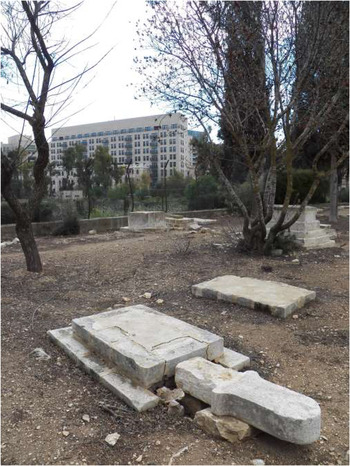
The “neglect” of Mamilla is largely due to the authorities, coupled with vandalism (Figure 9). It served as a justification for “development” and proof of a lack of feelings. Yet, when Muslim activists tried to repair graves and clean the remaining cemetery in 2011, it was interpreted as a fraudulent step that was aimed at taking over state land. Footnote 54 Jewish Orthodox groups often manage to stop or change building plans because of ancient graves, speaking out in the name of religious customs and respect for the dead. Footnote 55 The dignity of the dead was a major issue for the Bagatz. Time and again, the court stressed the importance of following this principle, Footnote 56 and the IAA also stated on many occasions its commitment to it (box 1, no. 20; box 2, no. 3a). Was this principle followed in Mamilla?
Broken graves at Mamilla, March 2015 (photo courtesy of R. Kletter).

In 2010, the MOT bodies stated that the bones from the Mamilla graves “were respectfully reinterred in a Muslim cemetery.” Footnote 57 They did not mention which cemetery. In the same year, an anonymous MOT employee told journalist Nir Hasson:
By mistake the fence that has been build [around the MOT for the construction period] was larger than the area of the museum; so at the end of the day the mass burial [of the exhumed bones] will be in the area [left] of the Muslim Cemetery, which is not part of the Museum’s area. That is, the Museum will not be built above the place where the bones have been re-buried. Footnote 58
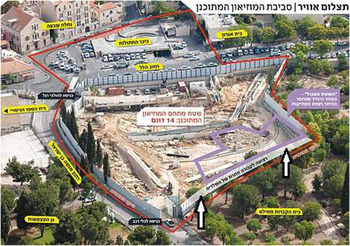
This story was glaringly contradicted by the MOT bodies themselves: “After due consideration, the SWC [Simon Wiesenthal Centre, which is one of the MOT bodies] elected to relocate the graves [meaning the bones; the graves were all destroyed] to a nearby strip of land that is adjacent to, and will be incorporated into, the Mamilla Cemetery.” Footnote 59 The MOT bodies had at their disposal an “extra” piece of land, which was not required for the construction. They deliberately planned to use it for reburial—inside the temporary fence and outside the future permanent fence (Figure 10). The reburial was performed in secret, and the exact place was never mentioned in public. In 2012, when “asked about the morality of building a museum near [sic; should be “on”] a Muslim cemetery,” Hier responded emphatically: “All the Muslim graves have been removed; they’ve gone. The site has been clean for more than a year.” Footnote 60
Aerial photo of Museum of Tolerance area, 2010 (the label on the white-painted band south of the Purple Area [marked by arrows] reads: “a zone for reburial of the skeletons”) (photo courtesy of Haaretz and Tal Cohen).

If this was true, what was Shavit doing in the MOT area in 2012, working as an archaeologist under Excavation License B385/2012 and yet again in 2014 (Excavation License B423/2014) (Table 1)? Responsibility for the “bone-yard” does not rest with the MOT bodies alone. The IAA stated in the complementary notice: “Concerning the IAA, there is no objection for removing these burials in a dignified way; one can bury them in the area of the [Mamilla] cemetery which extends over a large area near this area, or [remove them] to another area.” Footnote 61 The “due considerations” of the MOT bodies probably relate to the fact that in Judaism priests must avoid contact with human remains (so Hier’s allusion to a “clean” site, quoted above, refers to religious purity). Since all those carrying the common family name “Cohen” are considered priests, they might be unable to visit the museum; so the developers wanted to disassociate it from the bones. However, making room for reburial at Mamilla itself caused further, unnecessary damage to the cemetery. The “bone-yard” area should have been left in peace, and the bones taken for reburial elsewhere (a promise made in court but conveniently forgotten later). Living in a promised land, the MOT bodies and the authorities supporting them did not see the Muslim cemetery around. For them, it was empty land, a piece of real estate: “What is being expressed here is a kind of genuine blindness, an inability to understand or even to recognize the other.” Footnote 62
CONCLUSIONS
The petitioners against the MOT were not ready to compromise. Their petitions were grasped as political acts and the burials become one more casualty in the Israeli–Palestinian conflict. Footnote 63 This explains also why the earlier projects (road, school, parking lot) were made without any regard for the cemetery. That the petitioners had political motives does not mean that they lacked genuine feelings for the cemetery. Footnote 64 One does not doubt that Jews living in the United States, for example, can have genuine feelings for abandoned cemeteries in Europe, even if they are not personally active in their concern.
The IAA caved in to pressures, instead of guarding the interests of archaeology. It breached the court orders, handed a misleading notice to court, waived excavations that could have furnished important scientific data, and caused the removal of many graves without proper excavation. The archaeological community remained largely indifferent. Few archaeologists showed interest in the cemetery, but many came to see the excavation of the aqueduct. Footnote 65
Mamilla is part of a “dark history” still in the making. Footnote 66 Development is often necessary, but Mamilla should not have been chosen as a building site, especially for a museum about tolerance. Only lip service was paid to the principles of acknowledging descendant communities and respecting the dead. “Their” heritage (the cemetery) was destroyed and removed, while “ours” (the aqueduct) was carefully excavated and preserved. No matter how splendid the architecture, as long as it fails to acknowledge the other, this “museum of tolerance” would only be a valley of dry bones.
ACKNOWLEDGEMENTS:
All of the archival documents cited in this article are open to the public. The Bagatz overruled a request by the MOT bodies to prevent access to the case files (Supreme Court of Justice, Temporary Orders - Request to Study Files, 30.6.2015, Petitions 1331/6, 52/06, 1671/06). Translations from Hebrew are by the authors. We have received no payments or grants for this article. We thank a legal expert who wished to remain anonymous for reading and commenting on the manuscript. We are indebted to Meron Rapoport, Rafi Greenberg, Tawfiq Da‘ādli, and Liiv Nilsson-Stutz for their help and to the Supreme Court of Justice for approving the request to see and publish documents from its files. Vadim Asman, Tanja Kornfeld, and Slava Pirski have prepared Figure 3, and Figure 6 is by Liiv Nilsson-Stutz. Finally, we are grateful to the editors and readers of the International Journal of Cultural Property for their helpful comments and dedicated work on the manuscript.