Introduction
The Hypertension in the Very Elderly Trial (HYVET) was a double-blind randomized placebo controlled trial designed to assess the risks and benefits of treating hypertension among people aged 80 and over. The main trial protocol has been previously published (Bulpitt et al., Reference Bulpitt2001) as has the protocol for the sub-study on cognitive function (Peters et al., Reference Peters, Beckett, Nunes, Fletcher, Forette and Bulpitt2006). In addition to assessing the effects of lowering blood pressure on vascular events and mortality, the HYVET also assessed cognitive function. As participants in the HYVET were very elderly and hypertensive, they were consequently at high risk of cognitive decline (Elias et al., Reference Elias, Wolf, D'Agostino, Cobb and White1993; Feigin et al., Reference Feigin, Ratnasabapathy and Anderson2005; Fratiglioni et al., Reference Fratiglioni2005). Previous studies broadly agree in concluding that there are relationships between cardiovascular risk, high blood pressure and dementia or cognitive decline (Elias et al., Reference Elias, Wolf, D'Agostino, Cobb and White1993; Kilander et al., Reference Kilander, Nyman, Boberg, Hansson and Lithell1998; Tzourio et al., Reference Tzourio, Dufouil, Ducimetière and Alpérovitch1999; Birkenhager et al., Reference Birkenhager, Forette, Seux, Wang and Staessen2001; Feigin et al., Reference Feigin, Ratnasabapathy and Anderson2005; Fratiglioni et al., Reference Fratiglioni2005; Qiu et al., Reference Qiu, Winblad and Fratiglioni2005)
The aims of the present report were to examine the distribution of vascular risk factors and cognitive function at baseline and to assess the associations of these risk factors with cognitive function among all individuals with available data on cognitive function. It is hypothesized that higher blood pressure and other cardiovascular risk factors including gender will have a cross-sectional relationship with lower cognitive function in this very elderly group.
Methods
The HYVET is registered with ClinicalTrials.gov (number NCT00122811) and the data presented here are from the baseline trial visit and were collected prior to randomization. The HYVET protocol for the design and methods used to assess cognitive function has been previously published (Peters et al., Reference Peters, Beckett, Nunes, Fletcher, Forette and Bulpitt2006). Briefly, participants were recruited from general practice and hospital-based centers in Europe, China, North Africa and Australasia. Patients were aged 80 and over and had mean baseline sitting systolic blood pressures (sSBP) of ≥160 mmHg, standing systolic pressures (stSBP) of ≥140 mmHg and sitting diastolic pressures (sDBP) of <110 mmHg. An initial requirement for a minimum diastolic pressure of ≥90 mmHg was removed approximately a quarter of the way through the trial (Beckett et al., Reference Beckett2008). Blood pressures were an average of measures taken after one and two months in a placebo run in phase. Entry blood pressures were chosen to be appropriate in this very elderly group where equipoise existed with regard to the use of antihypertensive medication. Other inclusion criteria included a baseline creatinine ≤150 μmol/l and potassium ≥3.5 mmol/l and ≤5.5 mmol/l and no clinical diagnosis of dementia at baseline. Before randomization the Mini-mental State Examination (MMSE) was administered and the answers for each question sent to the coordinating office at Imperial College London. Training in the administration of the MMSE was provided to the local investigators and the MMSE was scored by the coordinating office. Full details are available in the protocol paper (Peters et al., Reference Peters, Beckett, Nunes, Fletcher, Forette and Bulpitt2006). Baseline characteristic information was collected just prior to randomization (“entry” visit) on age, sex, anthropometry, living arrangements, educational status, blood pressure, current concomitant medication, current smoking, alcohol consumption and an electrocardiogram. All participants had a blood sample taken to provide data on biochemistry including hemoglobin, serum creatinine, and total and high density lipoprotein (HDL) cholesterol. Ethics committee approval was obtained from each relevant institution, and research governance and other approvals gained. Relationships between risk factor variables and baseline MMSE score were examined using univariate and multivariate analyses. All analyses were performed using SAS software version 9.1.
Those participants who remained in the trial and provided at least one subsequent MMSE were included in a longitudinal analysis where a fall in MMSE to <24 or by >3 points in a year prompted assessment for incident dementia using DSM-IV criteria, CT scan, Hachinski score and validation by a panel of experts. The results of this analysis have been published elsewhere (Peters et al., Reference Peters2008a).
Results
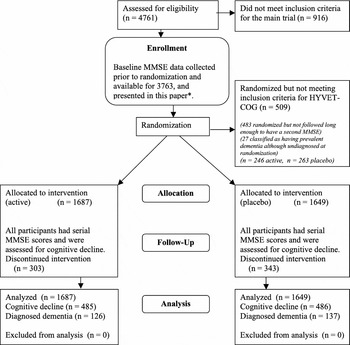
Figure 1 shows the flow of participants through the trial, including the double blind longitudinal follow-up. It should be emphasized that the data presented here relate to a cross-sectional analysis of the baseline data only and provide additional information to supplement the double blind results.
The flow of participants through the trial.
*Note: this paper presents the baseline MMSE data for the HYVET trial. The cognitive function results of the double-blind follow-up HYVET-COG have been published elsewhere (Peters et al., Reference Peters2008a).

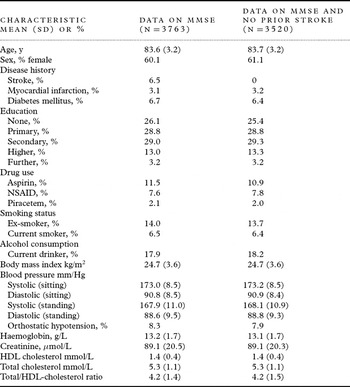
At baseline there were 3763 participants for whom MMSE data were available (Table 1). Their mean age was 83.6 years (range: 80–105 years), and 60.1 percent were female. Consistent with the inclusion criteria, all participants were hypertensive (the entry criteria specified the following blood pressures: sSBP ≥160 mmHg, stSBP ≥140 mmHg and sDBP <110 mmHg). At baseline 6.7 percent of participants had a diagnosis of diabetes (given by the investigator) and the average number of reported non-cardiovascular comorbidities per participant was 1.7 (range: 0–9). Participants were ineligible for inclusion in the trial if they had a clinical diagnosis of dementia (no patients reported such a diagnosis although 27 patients were retrospectively diagnosed as likely to have had prevalent dementia at baseline; however, removing these patients from the analyses did not materially change the results). Nootropics (drugs thought to enhance brain activity, such as piracetam or Ginkgo biloba) were not widely used at baseline with only 0.5 percent taking Ginkgo biloba and 2.1 percent taking piracetam. Only 0.4 percent of participants reported taking statins at baseline. Recruitment into the cognitive function part of the HYVET trial involved participants from a variety of countries, including Bulgaria (43.2%), China (39.1%), Romania (6.9%), Russia (6.2%), Western Europe (2.7%), and New Zealand and Tunisia together (1.9%). Descriptive information relating to factors that may impact upon cognitive function can be found in Table 1. The data are also presented for those who had suffered from no prior stroke at entry although the differences are not great: 6.5 percent had a previous stroke declared at their baseline visit. Heavy drinking over the recommended U.K. limits (more than or equal to 14 units – 10 ml pure alcohol – per week for women and 21 units for men) was extremely rare in the HYVET.
Characteristics of all participants and the subset with no prior stroke

MMSE = Mini-mental State Examination; NSAID = non-steroidal anti-inflammatory drugs; HDL = high-density lipoprotein.
The median MMSE was 26, the mode was 29 and the mean was 25.3, with a standard deviation of 3.9. Data on MMSE were complete in most individuals (mean number of missing values was less than one MMSE point). Eighty-two patients presented with baseline MMSE scores of 14 or lower although all were labeled as having no diagnosis of dementia. The latter participants were excluded from the analysis of cognitive function as they were likely either to have undiagnosed but prevalent dementia, or to have performed uncharacteristically poorly for some other reason such as unreported ill health or poor test administration. These participants were included in subsequent analyses (not reported here) if they became eligible for inclusion via follow-up MMSE scores.
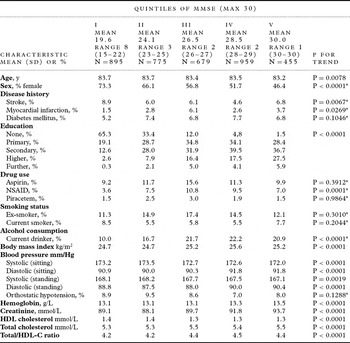
Table 2 shows the cross-sectional analyses of risk factors by quintiles of baseline MMSE. Increasing age, female gender, stroke prior to baseline, lower educational level, absence of non-steroidal anti-inflammatory drug (NSAID) use, no baseline use of alcohol, lower body mass index, higher sitting and standing systolic blood pressure and lower sitting and standing diastolic blood pressure, lower hemoglobin, lower creatinine, lower total and higher HDL cholesterol were also associated with lower MMSE scores. The total cholesterol/HDL cholesterol ratio showed a significant relationship with lower levels of MMSE. Additional analysis examining the relationship between MMSE and systolic blood pressure found no U-shaped curve, i.e. lower MMSE scores were not associated with lower blood pressure values.
Characteristics of participants by baseline MMSE quintiles

*Cochran-Armitage trend test used for binary variables. ANOVA used for continuous variables.
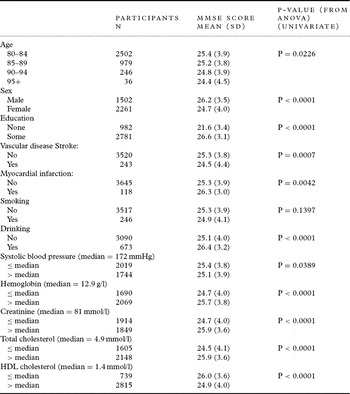
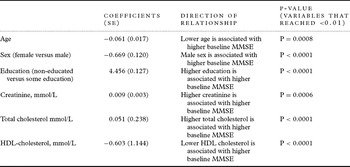
Table 3 presents MMSE scores by age in five-year intervals, variable presence/absence for other categorical variables and above/below the median for continuous variables. All risk factors, except current smoking, were significant. A multivariate linear regression analysis was carried out including only those variables that reached a significance level of <0.01 after univariate analysis. Table 4 shows that this resulted in remaining statistical significance for age, gender, education, creatinine, total and HDL cholesterol. Participants who were older, female, with lower education, lower creatinine, lower total cholesterol and higher HDL cholesterol were more likely to have a lower baseline MMSE when included in a multivariate analysis. Re-analyzing the results without those participants who had not received formal education did not materially change these results.
Cognitive function in participants at enrolment according to risk factors

Multivariate regression coefficient (se) for effects on cognitive function

SE = standard error; HDL = high density lipoprotein; MMSE = Mini-mental State Examination.
Discussion
Among the 3763 participants in HYVET with data on cognitive function, the mean age was 83.6 years and the median MMSE score was 26. Consistent with their age, there was a higher prevalence of females and those with low educational levels. Participants were generally healthy with relatively few having had a previous stroke or suffering from diabetes. The prevalence of orthostatic hypotension prevalence is consistent with a previous study (Vanhanen et al., Reference Vanhanen1996), and although the percentage consuming alcohol was higher than expected, this fits with previously reported data suggesting that moderate drinking may be protective (Ruitenberg et al., Reference Ruitenberg2002). Consistent with extreme old age, only 6.5 percent were current smokers.
The MMSE has been used before in this age group and in a population with low to no education (Spreen and Strauss, Reference Spreen and Strauss1998) and this provides a guide to normative values which fit well with our data. It is acknowledged that the use of the MMSE has limitations: the truly illiterate will struggle to answer all the questions on the MMSE, and because it is designed only as a screening test it is not the ideal test to use. Additionally low mood or depression may impact upon cognitive testing and information relating to this was not routinely collected for all trial participants. However, it was the most pragmatic option available during the study for a variety of reasons. It is fairly quick to administer, which is important given that the elderly patient may already have had to endure blood pressure measurement, an ECG, and a series of other questions. Training was provided to the investigators; however, trained neuropsychologists were not available in the settings where the HYVET was being run and are unlikely to be so for a while to come. It is unfortunate that more sophisticated international tests and the means to administer these were not available to us when the trial began. However, the use of the MMSE does also allow a comparison with previous studies and trials available in the area of cognitive decline and dementia.
A substantial body of evidence supports our findings that both increasing age, female gender and lower levels of education are associated with poorer cognitive function (Norbury et al., Reference Norbury2003; Baum Reference Baum2005; Fratiglioni et al., Reference Fratiglioni2005). It is interesting to note that this is still present in the very elderly even within the 80–105 age range. Post-menopausal females may be at higher risk (Norbury et al., Reference Norbury2003; note that none of our participants was taking hormone replacement therapy at baseline). However, there may be confounding variables, particularly in this very elderly group given that females would have been likely to experience different lifestyles and work and educational environments in comparison to males of the same age. The different areas of trial recruitment, different countries, socioeconomic groups and rural and urban settings may also act as confounders although the trial was not designed or powered to examine this. Females may also have been less likely to indulge in smoking or drinking to excess (Steen, Reference Steen2002) and there is clear evidence that smoking is likely to act as a risk factor for the development of dementia (Anstey et al., Reference Anstey, Sanden, Salim and O'Kearney2007) although the consumption of alcohol may be more protective (Peters et al., Reference Peters, Peters, Warner, Beckett and Bulpitt2008b). Detailed data pertaining to prior smoking and drinking (alcohol) behaviors was not collected in the HYVET and it may be that such historical health behaviors do have an impact which could not be examined, although once smoking ceases the risk of future adverse effects starts to fall and those who continued to smoke may not have reached 80 years. The available data pertaining to blood pressure and cross-sectional analyses is mixed, with poor cognitive function having been associated with both low and high blood pressure levels (Launer et al., Reference Launer, Masaki, Petrovitch, Foley and Havlik1995; Qiu et al., Reference Qiu, Strauss, Fastbom, Winblad and Fratiglioni2003). It seems likely that low blood pressure may well occur just prior to, or at the onset of, cognitive decline and high levels may act over a longer term as a risk factor (Launer et al., Reference Launer, Masaki, Petrovitch, Foley and Havlik1995; Qiu et al., Reference Qiu, Strauss, Fastbom, Winblad and Fratiglioni2003). The time scale required for this risk to become apparent is not clear (Launer et al., Reference Launer, Masaki, Petrovitch, Foley and Havlik1995; Kivipelto et al., Reference Kivipelto2001), particularly when considering the very elderly who may well be closer to any threshold that exists with regard to cognitive decline. As participants in the HYVET were required to have hypertension at baseline, no very low blood pressure values were seen at baseline and the range of blood pressures was limited on account of the strict inclusion criteria. This may explain the lack of a significant affect for blood pressure in multivariate analyses despite a significant trend test suggesting that higher systolic pressures and lower diastolic pressures were associated with poorer baseline cognitive function, implying that pulse pressure may be important. This cannot easily be extrapolated further given that an initial requirement for a minimum diastolic pressure was removed approximately a quarter of the way through the trial.
With regard to cholesterol, higher HDL and lower total cholesterol were associated with lower MMSE. A higher HDL associated with poorer cognitive function has been reported in the literature, at least in those with a cardiovascular risk factor and positive for apolipoprotein E e4 (Kalmijn et al., Reference Kalmijn, Feskens, Launer and Kromhout1996), although many studies have focused on total or low density lipoprotein cholesterol levels. In the very elderly with atherosclerotic vessels, the larger size of an HDL particle may impart increased risk of ischemia, although this can only be speculative. Since these data are cross-sectional, it is not possible to exclude the possibility of reverse causality bias from a causal relationship (Prospective Studies Collaboration, 2007; Solomon et al., Reference Solomon2007). Previous studies have found a link between lower or declining total cholesterol and failing cognitive function (Solomon et al., Reference Solomon2007; Stewart et al., Reference Stewart, White, Xue and Launer2007) and the Prospective Studies Collaboration meta-analysis of 61 prospective studies with 56,000 vascular deaths reported that among older people (70–89 years) and, particularly, for those with systolic blood pressure over 145 mmHg, total cholesterol was inversely associated with total stroke mortality, with a similar pattern for hemorrhagic and ischemic stroke subtypes. It is possible that the inverse association of intact cognitive function with total cholesterol levels is related to that observed for stroke in the former meta-analysis, but the cross-sectional study design makes it difficult to interpret the direction of such associations (Prospective Studies Collaboration, 2007). Alternatively, low levels of total cholesterol in the elderly may be due to an ongoing disease process or stem from an early decline associated with lower baseline body mass index or a more restricted diet, resulting in lower total cholesterol and higher HDL cholesterol. It could be nutritional or dietary factors rather than the cholesterol levels specifically that are prompting, or resulting from, poorer cognitive function. Previous research has largely failed to find a relationship between HDL levels and cognitive decline or dementia in younger populations (Yaffe et al., Reference Yaffe, Barratt-Connor, Lin and Grady2002; Geroldi et al., Reference Geroldi2003; Cankurtaran et al., Reference Cankurtaran, Yavuz, Halil, Dagli, Cankurtaran and Ariogul2005; Arai et al., Reference Arai2006; Packard et al., Reference Packard2007), and although there are inborn errors in HDL metabolism (Hersberger and Eckardstein Reference Hersberger and Eckardstein2003), it seems unlikely that this could explain this finding in the very elderly. Treatment may also impact upon cholesterol level although the number of patients taking statins was extremely low at only 0.4 percent. Information on prior use of statins was not collected although we might expect it to be low in this very elderly group particularly given that the majority of trial participants would have been required to pay for these medications. Clearly, further investigation into cholesterol levels, aging and cognition is required in order to explore this area. Higher creatinine too was associated with higher MMSE values and this may be related to changes in diet and muscle mass, prompting lower creatinine levels in those who are starting to undergo cognitive decline (Donini et al., Reference Donini, Felice and Cannella2007). It should also be noted that the trial inclusion criteria excluded those with a creatinine level >150 mmol/l and that the mean creatinine of the population under study in this paper was 89.1 mmol/l, a value well within the normal ranges.
The results presented here provide a cross-sectional survey of key descriptive and statistical information relating to the growing population of the very elderly with hypertension. Although the results cannot shed light on the causality of relationships, they supplement the main and cognitive function longitudinal trial endpoint results which have been published elsewhere (Beckett et al., Reference Beckett2008; Peters et al., Reference Peters2008a). It is possible that the participants in randomized controlled trials are not necessarily representative of the overall elderly population and may be the more health conscious and fitter individuals; however, it is the healthier elderly who are likely to be increasingly representative of the aging population in the years to come.
Appendix
The committee members and investigators for HYVET were as follows:
Coordinating Centre: C. J. Bulpitt (lead investigator), A. E. Fletcher (co-investigator), N. S. Beckett (trial coordinator), R. Peters (deputy trial coordinator), HYVET coordinating team at Imperial College London (1999 to 2008).
HYVET Committees: Steering Committee T. McCormack, J. Potter, B. G. Extremera, P. Sever, F. Forette, D. Dumitrascu, C. Swift, J. Tuomilehto, J. Coope (retired in 2001), C. Nachev (deceased); Data Monitoring Committee J. Staessen, L. Thijs, R. Clarke, K. Narkiewicz; End Points Committee C. Davidson (retired in 2003), J. Duggan, G. Leonetti, N. Gainsborough, M. C. De Vernejoul, J. Wang, V. Stoyanovsky; Dementia Validation Committee J. Tuomilehto, R. Clarke, A. Waldman, I. Walton, C. Ritchie; Ethics Committee R. Fagard, J. Grimley Evans, B. Williams.
Investigators (* = National Coordinators)
Australia: R. Warne* and I. Puddey*, M. Woodward, R. Penhall, C. Inderjeeth, S. Roger, R. Scholes, C. Johnson; Belgium: H. Celis*, G. Adriaens, W. Onsea, K. Cornelli, D. Vantroyen, P. Cleen, P. de Voogt; Bulgaria: C. Nachev* (deceased) (national coordinator from 1998 to 2005), V. Stoyanovsky* (national coordinator after 2005), P. Solakov, R. Prokopova, E. Mantova, D. Smilkova, S. Mantov, K. Yankulova, R. Kermova, D. Popov, V. Sirakova, V. Gergova, D. Kamenova, F. Grigorov, T. Vassileva, R. Alahverdian, M. Tzekova; A. Postadjian, M. Geneva, V. Mincheva, T. Petrusheva A. Toncheva, I. Gruev, V. Tsanova; China: L. Liu*, H. Ge, S. Wang, J. Wang, W. Zhang, S. Jin, L. Ge, Y. F. Lu, S. Ma, L. Shen, J. Guo, Z. Lv (deceased), R. Huang, X. Li, B. Guo, GE Yuan, T. Zhang, L. Zhang, J. Feng, Z. He, J. Wang, L. Deng, L. Liu, Q. Yuan, F. Zhang, H. Li, D. Wang, K. Yang, M. Sun, H. Liu, X. Yan, F. Ren, J. Tang, M Zhao, X Luo, H. Zhou, H. Sang, Jie Wang, L. Yan, Zhixing Wang, J. Zhang, Chengzhi Wang; Finland: R. Antikainen*, T. Strandberg, T. Konttila, A. Hynninen, M. Jääskivi, J. Airas, T. Jääskeläinen, J. Tuomilehto, H. Litmanen, T. Karhi, H. Yliharsila; France: F. Forette*, J. Doucet, J. Belmin, A. Benetos, G. Berrut, T. Boge, M. Bonnefoy, A. Carre, N. Charasz, J. Covillard, T. Dantoine, M. Escande, Y. Frances, R. Joire, C. Jeandel, S. Legrain, A. Lion, M. Maillet-Vioud, J. P Escaillas, S. Meaume, P. Pfitzenmeyer, F. Puisieux, Quercy, O. Rodat, J. Soubeyrand, B. de Wazieres, H. Hindennach, L. Lugassy, J. Rossi, M. Martel, J.-M. Paladel, C. Ravier, A. Visconti, J. P. Gallet, D. Zygouritsas, D. Charles, F. Flamand, G. Grandmottet, M. Grandmottetegermann, C. Gevrey, P. L. Mesnier, G. Robert, C. Besset-Prat, A. Brousse, P. Lafont, J. Morelli, P. Vernede, A. Volkmann, X. Bodin, B. Destrube, R. Eoche, A. Boye, F. Seropian, P. Gernigon, D. Meker, J. Thomere, Y. Thual, F. Volny, E. Grassart, M. Herent, D. Lejay, J.-P. Lopez, B. Mannessier, G. Pruvost, J.-C. Urbina; Ireland: J. Duggan* New Zealand: C. Anderson*, S. Lillis, J. Gommans; Poland: T. Grodzicki*, Z. Chodorowski, Z. Gaciong; Romania: D.Dumitrascu*, M. Comsa, V. Sandru, G. Prada, M. Dunca-Moisin, D. Jianu, D. Jinga-Lazar, V. Enachescu, C. Zaharia; Russia: Y. Nikitin*, A. Kirichenko, L. Olbinskaya, A. Martynov, V. Zadionchenko, V. Moiseev, G. Storohzakov, S. Nedogoda, R. S. Karpov, O. Barbarash, G. Efremushkin, V. Kostenko, M. Boyarkin, S. Churina, T. Tyurina, M. Ballyuzek, L. Ermoshkina, A. Timofeev, S. Yakusheva, N. Shilkina, V. Barbarich, L. Latunceva, S. Burakova, T. Ripp, S. Pekarsky, V. Mordovin; Tunisia: A. Belhani*, E. Boughzela, S. Soraya, B. Youssef-Zouari, A. B. Khalfallah, M. H. Houman, A. K. Abida; United Kingdom: C. Rajkumar*, M. Wilkins, N. D. Pandita-Gunawardena, J. Potter, E. Ekpo, M. Price, N. de Kare-Silver, A. Starczewski, S. Chandran, N. Nasar, M. Datta-Chaudhuri, T. McCormack, N. Majmudar, A. Gordon, L. Brawn, T Solanki, F. Dockery, R. Schiff.
Conflict of interest declaration
HYVET was funded by grants from the British Heart Foundation and the Institute de Recherches Internationales Servier. The trial was coordinated within the Faculty of Medicine, Imperial College London. Imperial College received salary support from the British Heart Foundation and Servier for Ruth Peters, Nigel Beckett and Ruth Poulter and consultancy fees from Servier for Christopher Bulpitt. Additional speaker/writing fees have been received by Christopher Bulpitt, Nigel Beckett and Ruth Peters from Servier. None of the other authors has received funding for the HYVET.
Imperial College was the sponsor of the trial and required confidentiality agreements with all committee members and investigators. The analysis, interpretation of the data, generation of the manuscript and decision to submit for publication were carried out independently of the funding bodies and the primary author had full access to all of the data and final responsibility for the decision to submit for publication. The HYVET is registered with Clinical Trials, gov. number NCT00122811.
Descriptions of authors' roles
RP carried out the analyses, drafted the manuscript and aided in trial co-ordination. NB co-ordinated the trial and provided critical comment on the analyses and the manuscript. FF was involved in the trial design and provided critical comment on the analyses and the manuscript. JT chaired the dementia diagnosis committee, was involved in the development of methodology for dementia diagnoses and provided critical comment on the analyses and the manuscript. CR, IW and RC participated in the dementia diagnosis committee, were involved in the development of methodology for dementia diagnoses and provided critical comment on the analyses and the manuscript. AW participated in the dementia diagnosis committee was involved in the development of methodology for dementia diagnoses, evaluation of CT scans and provided critical comment on the analyses and the manuscript. RPo co-ordinated the collection of the dementia related information and collated the cognitive function assessments. AF, the co-main investigator of the HYVET trial, was involved in the design of the study and provided critical comment on the analyses and the manuscript. CB, the main investigator of the HYVET trial, was involved in the design of the study and provided critical comment on the analyses and the manuscript. All authors read and approved the final manuscript.
Acknowledgment
We wish to acknowledge the work of Professor C. Nachev (Steering Committee member, National Coordinator of Bulgaria and HYVET investigator from 1998 until his death in 2005).