Introduction
The genus Canthidium Erichson, 1847 (Coleoptera: Scarabaeidae: Scarabaeinae) is a poorly known group of dung beetles that includes 171 valid species (Cupello Reference Cupello2018; Génier and Cupello Reference Génier and Cupello2018). Modern revisions of the genus in North America and some Central American countries are available (Howden and Young Reference Howden and Young1981; Kohlmann and Solís Reference Kohlmann and Solís2004, Reference Kohlmann and Solís2006a); these include illustrations and photographs of species and redescriptions of a majority of the species described in those regions during the 19th century and at the beginning of the 20th century. Cupello (Reference Cupello2018) rearranged the subgeneric classification and provided a checklist with information on type locality, type material, synonymy, and distribution of all the valid species of Canthidium.
The revision of Canthidium from North America reported 13 species (Kohlmann and Solís Reference Kohlmann and Solís2006a): Canthidium andersoni Kohlmann and Solís, 2006; C. ardens Bates, 1887; C. centrale Boucomont, 1928; C. delgadoi Kohlmann and Solís, 2006; C. hespenheidei Howden and Young, Reference Howden and Young1981; C. howdeni Kohlmann and Solís, 2006; C. laetum Harold, 1867; C. macclevei Kohlmann and Solís, 2006; C. moroni Kohlmann and Solís, 2006; C. pseudoperceptibile Kohlmann and Solís, 2006; C. pseudopuncticolle Solís and Kohlmann, 2004; C. riverai Kohlmann and Solís, 2006; and C. smithi Bates, 1889. The number of species of Canthidium in North America increased to 15 with the description of C. margaritae Kohlmann and Solís, 2006 and C. quercetorum Kohlmann, Arriaga-Jiménez, and Rös, 2018 (Kohlmann and Solís Reference Kohlmann and Solís2006b; Kohlmann et al. Reference Kohlmann, Arriaga-Jiménez and Rös2018). The aim of this study was to describe two new species of Canthidium from Mexico and to modify the Kohlmann et al. (Reference Kohlmann, Arriaga-Jiménez and Rös2018) key to include the new species. We briefly discuss the taxonomic and biogeographic implications of the new species.
Methods
Type material of the newly described species is deposited in the Colección Entomológica Dr. Miguel Ángel Morón Ríos, Instituto de Ecología A.C., Xalapa, Mexico (IEXA); the personal collection of Gonzalo Halffter, Instituto de Ecología A.C. Xalapa, Mexico (GHC); the Seção de Entomologia da Coleção Zoológica, Departamento de Biologia e Zoologia, Universidade Federal de Mato Grosso, Cuiabá, Mato Grosso, Brazil (CEMT); the Canadian Museum of Nature, Ottawa, Ontario, Canada (CMNC); the Texas A&M University Insect Collection, Texas, United States of America (TAMU); and the personal collection of Victor Moctezuma, Xalapa, Mexico (VMC).
The phylogenetic species concept is used in this work (Wheeler and Platnick Reference Wheeler, Platnick, Wheeler and Meier2000), which defines the species as the smallest aggregation of populations or lineages that is diagnosable by a unique combination of character states. This concept is known as the diagnosability version by Zachos (Reference Zachos2016).
Type specimens bear determination labels printed on red acid-free paper. For type material, verbatim label data is used. The aedeagi were prepared with a KOH solution and were stored in microvials containing glycerol. These microvials were pinned under the type specimen. Measurements and pictures were taken using a Leica Z16APOA stereomicroscope (Wetzlar, Germany) and processed with the software of the manufacturer (z-stack image capture method).
Canthidium nebularum Moctezuma, Sánchez-Huerta, and Halffter, new species
http://zoobank.org/urn:lsid:zoobank.org:act:EBD1B8CC-772B-4A79-8FC8-86D486CB50F8
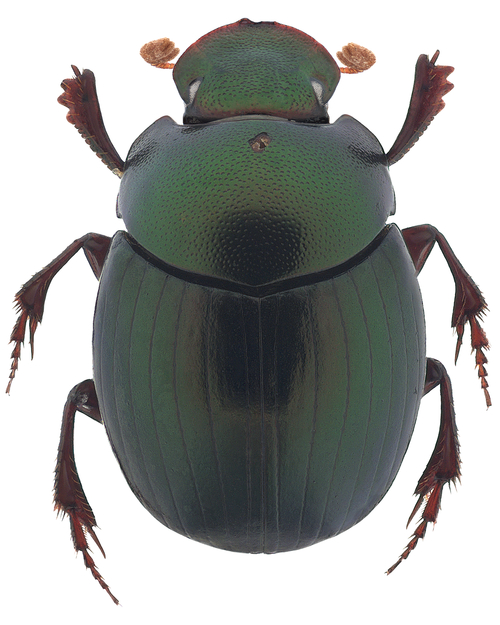
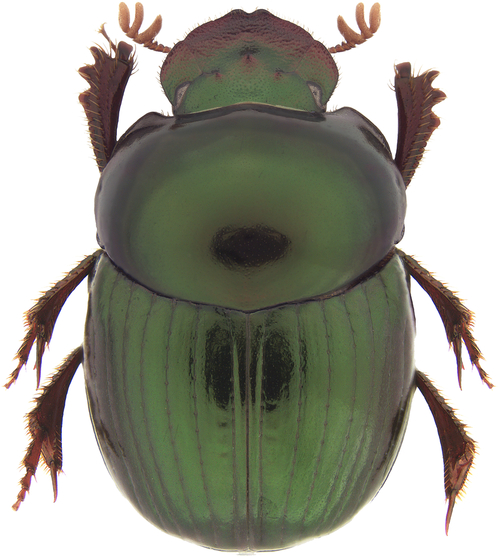
Dorsal habitus of male Canthidium nebularum.
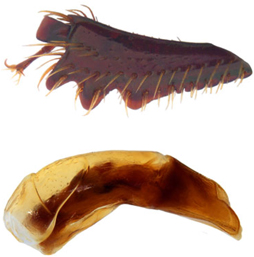
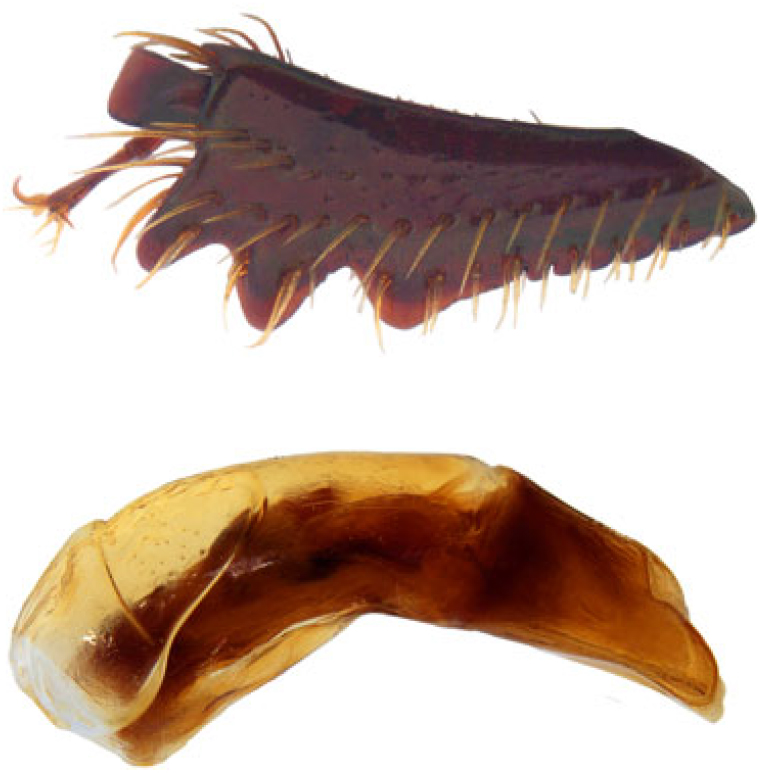
Canthidium nebularum. 2, Protibia of male; 3, lateral view of the aedeagus.
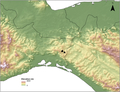
Distribution map of Canthidium nebularum (black triangles).
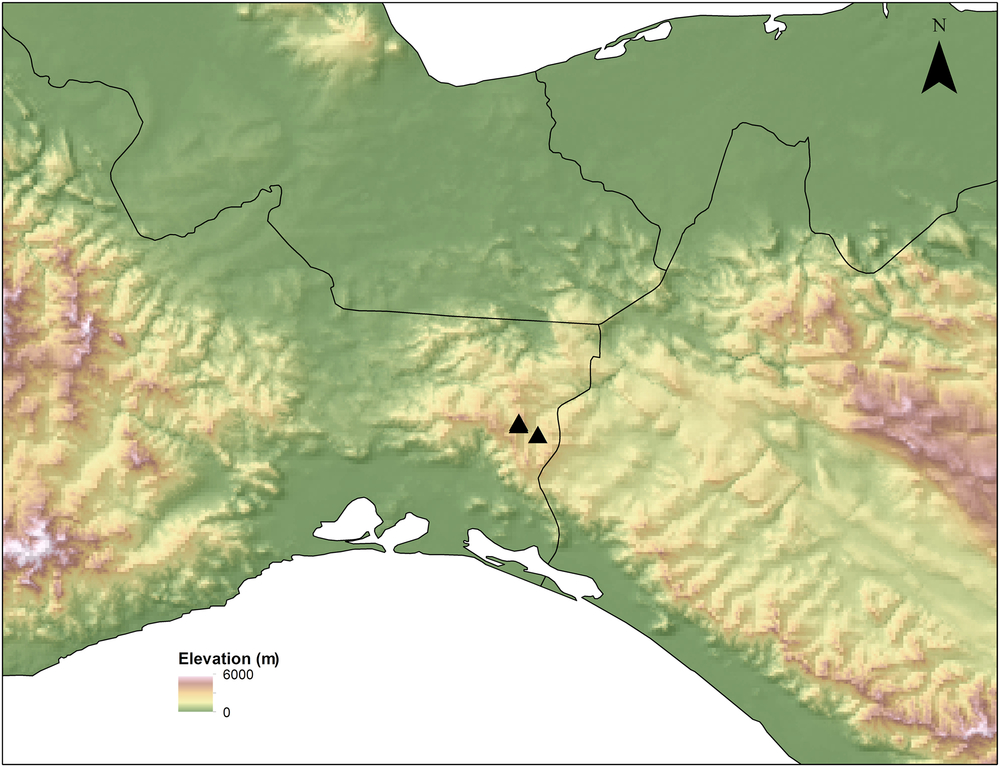
Type locality. Benito Juárez (16°41′25.3″N, 94°7′33.3″W), San Miguel Chimalapa, Oaxaca, Mexico.
Diagnosis. This species keys out into O. delgadoi in the key of Kohlmann et al. (Reference Kohlmann, Arriaga-Jiménez and Rös2018), but both species can be separated by colour (metallic black with a green-red cast in C. nebularum, Fig. 1; black-dark blue in C. delgadoi) and shape of the aedeagus in lateral view (apex of the parameres rectangular in C. nebularum, Fig. 3; apically rounded but the base of parameres straight in C. delgadoi).
Description. Holotype ♂. Measurements. Length: 5.5 mm, pronotal width: 2.8 mm, elytral width: 3.4 mm. Dorsum shagreen, black with a green-red metallic cast (Fig. 1). Head. Surface uniformly punctate with coarse umbilicate punctures. Micropunctures sparse. Clypeal apex bidentate, median emargination slightly V-shaped. Frons slightly convex, lacking carinae or tubercles. Antennae yellow. Pronotum. Surface deeply and uniformly punctate with coarse umbilicate punctures. Sparse micropunctures. Lateral fovea inconspicuous and simple. Posterior margin lacking elongate punctures or groove. Elytra. Striae distinctly impressed, with evenly spaced and weakly impressed umbilicate punctures. Interstriae lacking umbilicate punctures but showing sparse micropunctures. Ventrites. Metasternum shagreen, strongly punctate anteriorly with oval punctures; punctures reducing in size medially, impressed with U-shaped carinae laterally. Micropunctures present throughout surface of the metasternum. Abdominal sternites shagreen, lacking carinae or punctures, but showing sparse micropunctures. Pygidium. Convex, shagreen, with oval and weakly impressed punctures, micropunctures. Legs. Protibia with three teeth on external border, inner apical margin of protibia produced into an obtusely triangular projection and slightly bent downwards. Apical spur of the protibia spiniform (Fig. 2). Aedeagus. Apex of the parameres rectangular in lateral view (Fig. 3).
Female. Differs from the male by the shorter pygidium, last abdominal segment broader medially and the inner apex of protibia lacking the triangular projection.
Variation. Mean length: 5 mm (4.4–5.6 mm), mean pronotal width: 2.7 mm (2.4–3.0 mm), mean elytral width: 3.2 mm (2.9–3.6 mm).
Type material (3 ♂♂, 5 ♀♀). Holotype ♂: “México, Oaxaca, San Miguel Chimalapa, Benito Juárez, 28/IX/2015, coprotrap t9c32, 16°41′25.3″N, 94°7′33.3″O, pino-encino, 1220 m, Victor Moctezuma Col.” (IEXA). Paratypes: 3 ♀♀ “México, Oaxaca, San Miguel Chimalapa, Benito Juárez, 28/IX/2015, coprotrap t9c32, 16°41′25.3″N, 94°7′33.3″O, pino-encino, 1220 m, Victor Moctezuma Col.” (2 ♀♀ GHC, 1 ♀ VMC); 1 ♂ “México, Oaxaca, San Miguel Chimalapa, Benito Juárez, 8/X/2015, coprotrap t12c03, 16°44′29.3″N, 94°12′20.1″O, bosque de niebla, 1275 m, Victor Moctezuma Col.” (VMC); 1 ♂ “México, Oaxaca, San Miguel Chimalapa, Benito Juárez, 8/X/2015, coprotrap t12c28, 16°44′1.6″N, 94°12′31.6″O, bosque de niebla, 1368 m, Victor Moctezuma Col.” (CEMT); 2 ♀♀ “México, Oaxaca, San Miguel Chimalapa, Benito Juárez, 8/X/2015, coprotrap t12c33, 16°43′56.2″N, 94°12′23.6″O, bosque de niebla, 1325 m, Victor Moctezuma Col.” (CMNC, TAMU).
Etymology. The name of this species refers to the habitat (cloud mountain forest) where the type series was collected.
Ecology and distribution. This species was collected using pitfall traps baited with human excrement. It inhabits the cloud mountain forest and the pine-oak forest between 1200–1400 m, with a mean annual temperature of 20–22 °C and annual rainfall between 1500–2000 mm in the region of Los Chimalapas, eastern Oaxaca, Mexico (Instituto Nacional de Estadística y Geografía 2019).
Canthidium chimalapense Moctezuma and Halffter, new species
http://zoobank.org/urn:lsid:zoobank.org:act:BD925298-B7AB-4DF9-AAD8-5C707B408615
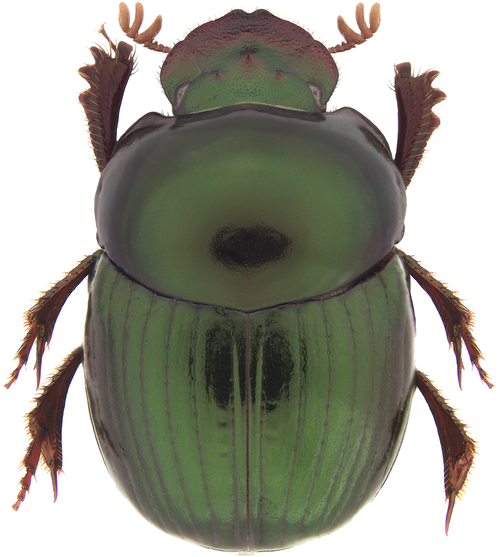
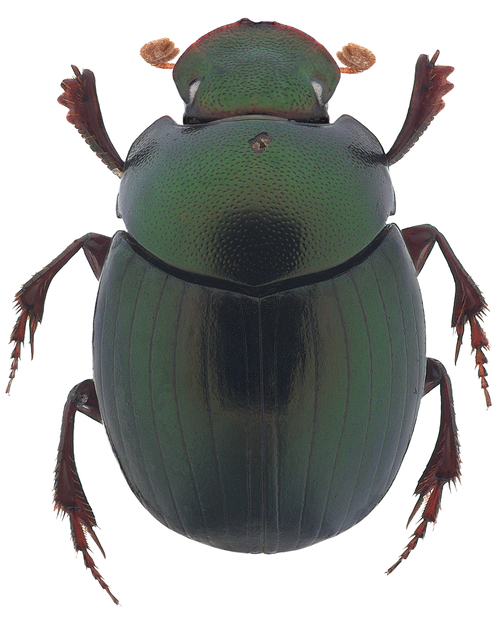
Dorsal habitus of male Canthidium chimalapense.
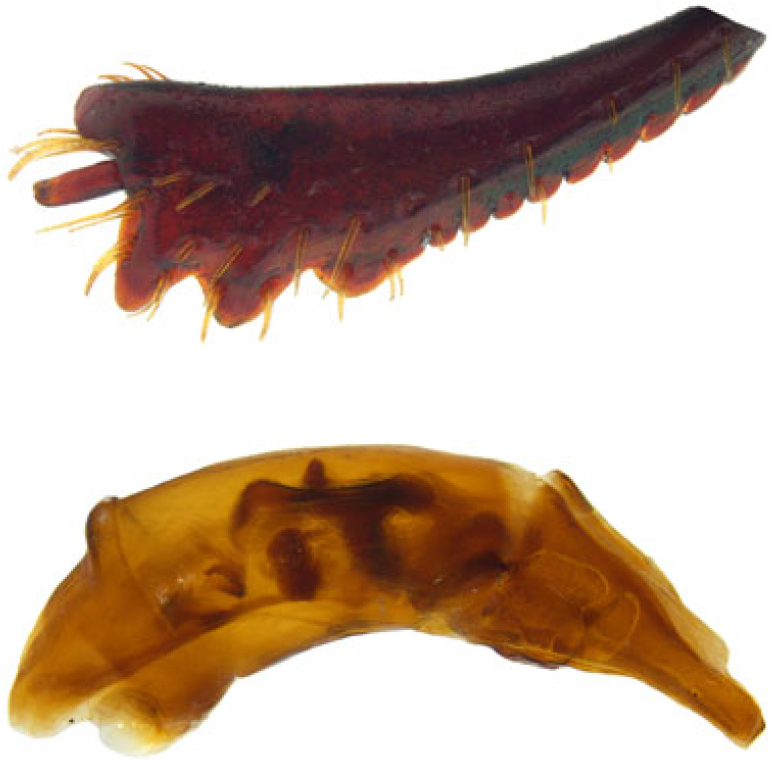
Canthidium chimalapense. 6, Protibia of male; 7, lateral view of the aedeagus.
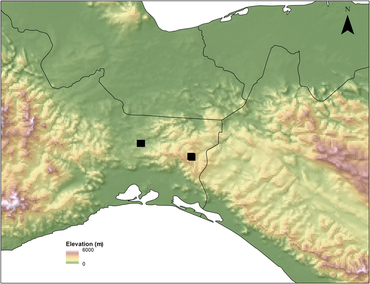
Distribution map of Canthidium chimalapense (black squares).

Type locality. Benito Juárez (16°43′56.2″N, 94°12′23.6″W), San Miguel Chimalapa, Oaxaca, Mexico.
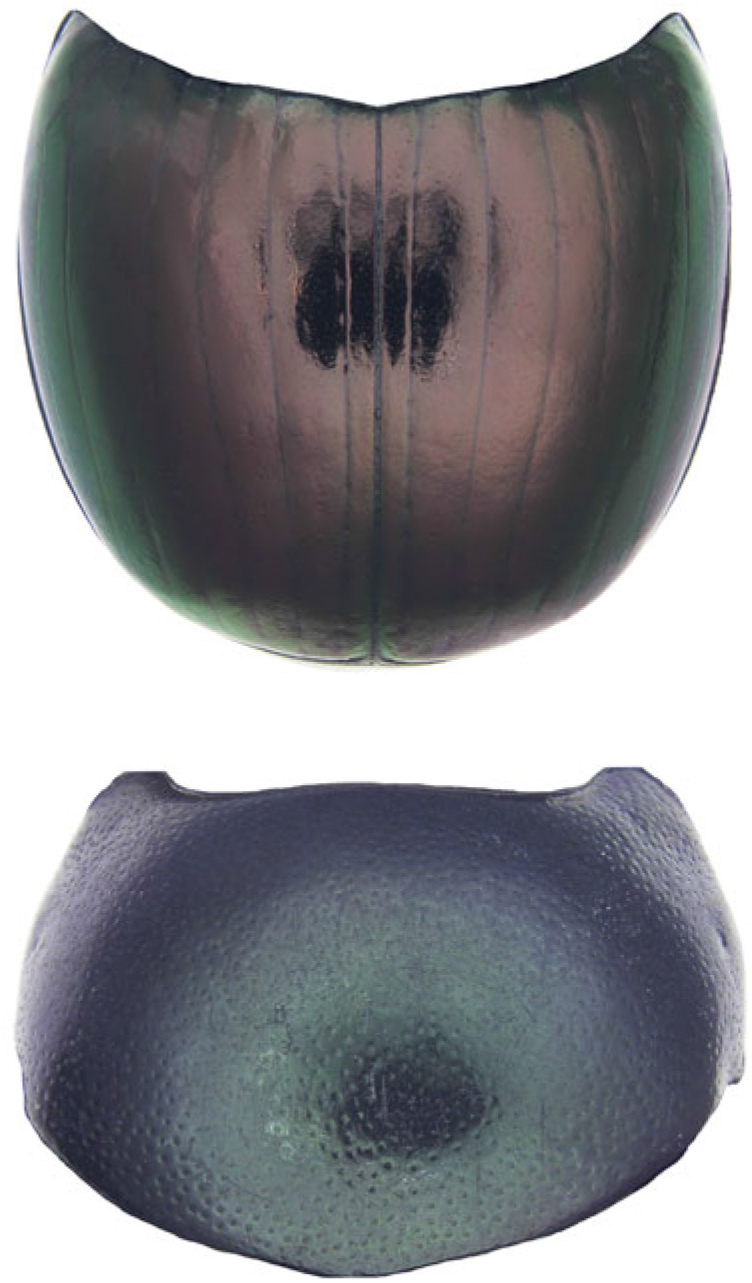
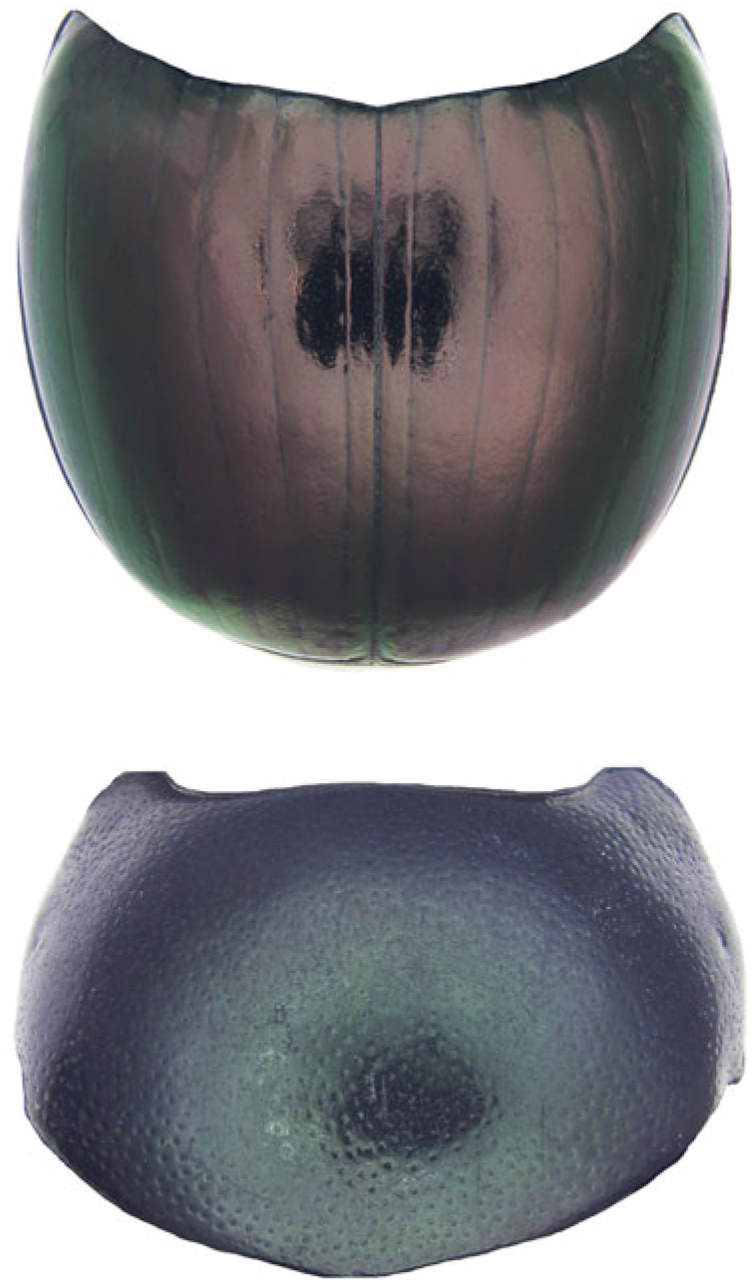
Diagnosis. This species keys out into the couplet 5 in Kohlmann et al. (Reference Kohlmann, Arriaga-Jiménez and Rös2018) where C. ardens and C. pseudopuncticolle are placed, both with three conical tubercles on the clypeofrontal region (as in Fig. 5). Canthidium chimalapense may be separated from C. ardens by the elytral striae (distinctly impressed in C. chimalapense, Fig. 5; lacking or indicated by faint, often obsolete lines in C. ardens, Fig. 9), the elytral striae punctation (coarsely punctate in C. chimalapense, Fig. 5; impunctate or very lightly punctate in C. ardens, Fig. 9), the pygidial punctation (coarsely punctate in C. chimalapense, impunctate or very lightly punctate in C. ardens), the protibial spur of the male (inner apical margin produced into a spatulate projection in C. chimalapense, Fig. 6; this projection is spiniform in C. ardens, as in Fig. 2), and the apex of parameres (medially notched in C. chimalapense, Fig. 7). Canthidium chimalapense and C. pseudopuncticolle can be separated by the pronotal punctation (very lightly punctate in C. chimalapense, Fig. 5; coarsely punctate in C. pseudopuncticolle, Fig. 10), and the protibial spur of the male (widened in C. chimalapense, Fig. 6; spiniform in C. pseudopuncticolle, as in Fig. 2).
Canthidium dorsal structures. 9, Elytral view of Canthidium ardens; 10, pronotal view of Canthidium pseudopuncticolle.
Canthidium ardens, C. chimalapense, and C. pseudopuncticolle share the three conical tubercles in the clypeofrontal region and the narrow eyes with the Central American C. annagabrielae Solís and Kohlmann, 2004; C. aurifex Bates, 1887; C. darwini Kohlmann and Solís, 2009; C. discopygidiale Howden and Young, Reference Howden and Young1981; C. emoryi Solís and Kohlmann, 2004; C. leucopterum Howden and Young, Reference Howden and Young1981; C. marianelae Solís and Kohlmann, 2004; and C. variolosum Howden and Young, Reference Howden and Young1981. All these Mexican and Central American species may conform a species complex. Canthidium aurifex, C. chimalapense, and C. discopygidiale seem to be closely related, sharing the apical spur of the male protibia widened, but C. chimalapense is the only one with the apical spur obtusely rectangular in shape.
Description. Holotype ♂. Measurements. Length: 5.1 mm, pronotal width: 3.5 mm, elytral width: 3.7 mm. Dorsum shagreen, metallic black with a green-red cast (Fig. 5). Head. Clypeus with a red cast, rugosely punctate, apex bidentate, median emargination U-shaped. Frons with a green-red cast, finely punctate, sparse micropunctures, slightly convex, lacking carinae, with three conical tubercles. Genae with a red cast, rugousely punctate. Antennae yellow. Pronotum. Surface with a green cast, finely and uniformly punctate, with sparse micropunctures. Lateral fovea inconspicuous and simple. Posterior margin with fine, sparse punctures. Elytra. Striae distinctly impressed, with evenly spaced, coarse punctures. Interstriae finely punctate with irregular-in-shape punctures and sparse micropunctures. Ventrites. Metasternum shagreen, with a green-red cast, finely punctate with circular punctures, impressed with U-shaped carinae laterally. Sparse micropunctures. Abdominal sternites shagreen, with sparse micropunctures. Pygidium. Convex, with a green-red cast, shagreen, distinctly punctate with oval punctures. Legs. Protibia with three teeth on external border, inner apical margin of protibia produced into an acute, obtusely triangular projection that slightly bends downwards. Apical spur of the protibia produced into an obtusely rectangular projection that bends downwards (Fig. 6). Aedeagus. Apex of the parameres rounded in lateral view, showing a notch in the medial portion (Fig. 7).
Female. Differs from the male by the shorter pygidium, last abdominal segment broader medially, and the protibial apical spur spiniform.
Variation. Mean length: 5.7 mm (5.1–7.0 mm), mean pronotal width: 3.4 mm (3.2–3.9 mm), mean elytral width: 3.2 mm (2.9–3.8 mm). The dorsal metallic cast varies among the type series, being completely red or dark green in some specimens, but all showing punctation, elytral striae, and aedeagi as the holotype.
Type material (4 ♂♂, 3 ♀♀). Holotype ♂: “México, Oaxaca, San Miguel Chimalapa, Benito Juárez, 8/X/2015, coprotrap t12c33, 16°43′56.2″N, 94°12′23.6″O, bosque de niebla, 1325 m, Victor Moctezuma Col.” (IEXA). Paratypes: 1 ♂ “México, Oaxaca, San Miguel Chimalapa, Benito Juárez, 8/X/2015, coprotrap t12c33, 16°43′56.2″N, 94°12′23.6″O, bosque de niebla, 1325 m, Victor Moctezuma Col.” (GHC); 1 ♂ “México, Oaxaca, San Miguel Chimalapa, Benito Juárez, 8/X/2015, coprotrap t12c26, 16°44′6.2″N, 94°12′20.6″O, bosque de niebla, 1374 m, Victor Moctezuma Col.” (VMC); 1 ♀ “México, Oaxaca, San Miguel Chimalapa, Benito Juárez, 9/X/2015, coprotrap t13c20, 16°44′27.2″N, 94°13′4.9″O, bosque de niebla, 1131 m, Victor Moctezuma Col.” (VMC); 1 ♂ “México, Oaxaca, Santa María Chimalapa, Cerro Azul, 17/VI/2015, coprotrap t2c5, 16°53′18.8″N, 94°46′36.3″O, selva mediana, 226 m, Victor Moctezuma Col.” (TAMU); 1 ♀ “México, Oaxaca, Santa María Chimalapa, Cerro Azul, 17/VI/2015, coprotrap t2c36, 16°53′17.2″N, 94°47′16.8″O, selva mediana, 222 m, Victor Moctezuma Col.” (IEXA); 1 ♀ “México, Oaxaca, Santa María Chimalapa, Cerro Azul, 17/VI/2015, coprotrap t2c1, 16°53′17.4″N, 94°46′31.1″O, selva mediana, 265 m, Victor Moctezuma Col.” (GHC).
Etymology. The name of this species pertains to the region of Los Chimalapas, where type series was collected.
Ecology and distribution. This species was collected using pitfall traps baited with human excrement. It inhabits the subtropical rainforests and the cloud forests between 200–1400 m, with a mean annual temperature of 20–24 °C and annual rainfall between 1500–2000 mm from the region of Los Chimalapas, eastern Oaxaca, Mexico (Instituto Nacional de Estadística y Geografía 2019). This new species may occur in the states of Veracruz and Chiapas (Fig. 8).
Key to the Canthidium of North America (modified from Kohlmann et al. 2018)

Discussion
Taking into account the geographical distribution and the taxonomical affinities of the North American Canthidium, this genus fits with the Typical Neotropical and the Mountain Mesoamerican distribution patterns (Halffter and Morrone Reference Halffter and Morrone2017). The Typical Neotropical pattern corresponds to taxa mainly distributed in lowland tropical habitats in the Neotropical region, and it is represented by genera widespread in South America where they evolved (a majority of Canthidium species have been described from South American countries). Canthidium ardens, C. centrale, C. laetum, C. macclevei, C. moroni, and C. pseudopuncticolle seem to follow the Typical Neotropical pattern by their affinities to tropical lowland habitats (Kohlmann and Solís Reference Kohlmann and Solís2006a, Halffter and Morrone Reference Halffter and Morrone2017).
Canthidium chimalapense, C. hespenheidei, and C. pseudoperceptibile also fit with the Typical Neotropical pattern since they inhabit tropical lowland forests, but also occur in mountain cloud forests (Kohlmann and Solís Reference Kohlmann and Solís2006a). The distribution of these three species might be a result of the vertical colonisation process, where montane habitats were colonised by species that originated through allopatric speciation of elements distributed at lower elevations (Lobo and Halffter Reference Lobo and Halffter2000).
Canthidium andersoni, C. delgadoi, C. howdeni, C. quercetorum, C. margaritae, C. nebularum, C. riverai, and C. smithi inhabit montane ecosystems as the cloud mountain forest and the pine-oak forest (Kohlmann and Solís Reference Kohlmann and Solís2006a, Reference Kohlmann and Solís2006b). These species are proposed to follow the Mountain Mesoamerican pattern, which accommodates species of the mountain forests of Central America and southern Mexico. Taxa assigned to this pattern are thought to have ancient (Miocenic) South American phylogenetic affinities, and probably evolved in the Central American Nucleus, then dispersing northwest and southeast of it (Halffter and Morrone Reference Halffter and Morrone2017).
The description of two new Canthidium from the region of Los Chimalapas seems noteworthy. Nevertheless, this might be explained because the region of Los Chimalapas represents a huge unexplored tropical area (≈ 600 000 ha), with most of the region forested by heterogeneous ecosystems (Peterson et al. Reference Peterson, Navarro-Sigüenza, Hernández-Baños, Escalona-Segura, Rebón-Gallardo and Rodríguez-Ayala2003). Los Chimalapas has been an important source of discovery of new taxa in several groups of scarab beetles (Coleoptera: Scarabaeoidea) as Archedinus Morón and Krikken, 1990 (Coleoptera: Scarabaeidae: Cetoniinae: Incini); Ateuchus Weber, 1801 (Coleoptera: Scarabaeidae: Scarabaeinae: Ateuchini); Chrysina Kirby, 1828 (Coleoptera: Scarabaeidae: Rutelinae: Rutelini); Copris Geoffroy, 1762 (Coleoptera: Scarabaeidae: Scarabaeinae: Coprini); Onthophagus Latreille, 1802 (Coleoptera: Scarabaeidae: Scarabaeinae: Onthophagini); Phanaeus MacLeay, 1819 (Coleoptera: Scarabaeidae: Scarabaeinae: Phanaeini); Proculus Kaup, 1868 (Coleoptera: Passalidae: Passalinae: Proculini); Uroxys Westwood, 1842 (Coleoptera: Scarabaeidae: Scarabaeinae); and Vindex Kaup, 1871 (Coleoptera: Passalidae: Passalinae: Proculini), with several taxa awaiting to be described (Pereira and Halffter Reference Pereira and Halffter1961; Morón and Vaz-de-Mello Reference Morón and Vaz-de-Mello2007; Delgado and Mora-Aguilar Reference Delgado and Mora-Aguilar2014; Mora-Aguilar and Delgado Reference Mora-Aguilar and Delgado2015; Moctezuma and Halffter Reference Moctezuma and Halffter2017; Ariza-Marín et al. Reference Ariza-Marín, Reyes-Castillo, Moctezuma and Sánchez-Huerta2018; Kohlmann and Vaz-de-Mello Reference Kohlmann and Vaz-de-Mello2018; Moctezuma et al. Reference Moctezuma, Sánchez-Huerta and Halffter2018; Mora-Aguilar et al. Reference Mora-Aguilar, Curoe, Delgado and Ramírez-Ponce2018).
The new Canthidium were discovered in Los Chimalapas, but these taxa might also occur in the states of Veracruz and Chiapas. Los Chimalapas, the Uxpanapa region (eastern Veracruz), and the Selva El Ocote Biosphere Reserve (western Chiapas) represent neighbouring areas in the Tehuantepec Isthmus, all connected and comprising the Selva Zoque Macroregion, which holds similar forests that have not been adequately explored through biological surveys (Peterson et al. Reference Peterson, Navarro-Sigüenza, Hernández-Baños, Escalona-Segura, Rebón-Gallardo and Rodríguez-Ayala2003; Aguilar-López et al. Reference Aguilar-López, Pineda, Luría-Manzano and Canseco-Márquez2016; Moctezuma et al. Reference Moctezuma, Sánchez-Huerta and Halffter2018). A recent study in the Selva El Ocote (Sánchez-Hernández et al. Reference Sánchez-Hernández, Gómez, Delgado, Rodríguez-López and Chamé-Vázquez2018) reported C. centrale, C. pseudoperceptibile, C. pseudopuncticolle, and two unidentified morphotypes. Those morphotypes might represent additional records for the species described in this work, but the reported specimens must be further examined. Cupello (Reference Cupello2018) commented that Canthidium species referred as “morphotype” are frequent in literature and represent an extent of our ignorance on the alpha taxonomy of this genus. As a matter of fact, the revisions for North American and some Central American countries (Howden and Young Reference Howden and Young1981; Kohlmann and Solís Reference Kohlmann and Solís2004, Reference Kohlmann and Solís2006a) cover a small percentage of the total number of Canthidium, being a predominant genus in South America (Cupello Reference Cupello2018).
Acknowledgements
This project was possible thanks to the support of the residents of Los Chimalapas, particularly those in the communities of Benito Juárez, López Portillo, San Antonio, and Santa María Chimalapa. The Consejo Nacional de Ciencia y Tecnología, Mexico, awarded a grant for postgraduate studies to V. Moctezuma (412700). We thank the General Direction of the Instituto de Ecología, A.C. (20035/30916), the Sectorial Research Fund for Education Secretaría de Educación Pública-Consejo Nacional de Ciencia y Tecnología, Mexico (257039), and the Organization for Tropical Studies (Hovore-Horn Fellowship 3116) for funding of this work. F. Escobar-Hernández (Instituto de Ecología, A.C.) helped us with the fieldwork.