INTRODUCTION
According to Barnard (Reference Barnard1972) the New Zealand intertidal zone can be considered to be a distinct gammeridean biogeographical province, since more than 50 per cent of its species are endemic. More than 100 species of gammaridean amphipods are known to live amongst algae in New Zealand, but few are considered to be obligate algal dwellers or tunnellers. The family Eophliantidae, however, are one such group.
The Eophliantidae contain 14 species belonging to six genera. The main distribution is in the southern hemisphere, with the exception of Ceinina japonica Stephensen, Reference Stephensen1933 found in Japan and Wandelia orghidani Ortiz & Lalana, 1997 from Indonesia, just north of the equator. Lignophliantis pyrifera J.L. Barnard, 1969 is described from California, but the placement of this species in the Eophliantidae is uncertain. Its taxonomic position is briefly discussed below. Information regarding species of the Eophliantidae is scattered throughout the literature, and to facilitate identification we have also included a key to the world species. Finally, a new species was found burrowing in the algae Carpophyllum maschalocarpum (Turner) Grev. off New Zealand and is described in detail below.
All eophliantids are assumed to be algal dwellers, although no record of algae association is found for Cylindryllioides kaikoura Barnard, Reference Barnard1972 or for Wandelia orghidani Ortiz & Lalana, 1997. Several species from the family Eophliantidae live in positively buoyant macroalgae, such as Macrocystis pyrifera (L.) C. Agardh, Durvillaea antarctica (Cham.) Har. or C. maschalocarpum. These algae are commonly found floating in coastal waters of New Zealand (Kingsford, Reference Kingsford1992) and in the Southern Ocean (Helmuth et al., Reference Helmuth, Veit and Holberton1994). Several recent studies indicate that the biota (including Eophliantidae) associated with these floating macroalgae might be dispersed via algal rafting (e.g. Donald et al., Reference Donald, Kennedy and Spencer2005). This will also influence the phylogeography of these organisms. We propose that algal rafting might have contributed to the evolutionary radiation of the Eophliantidae, originating in Australasia.
MATERIALS AND METHODS
Field collecting
The alga Carpophyllum maschalocarpum was collected by snorkelling in about 2 m depth at Kau Bay, Wellington Peninsula, New Zealand, in May 2009. The brown alga Carpophyllum maschalocarpum is common in coastal regions of New Zealand (including the Wellington area), where it grows in shallow subtidal waters. Carpophyllum is a common habitat for several groups of peracarids (e.g. Taylor & Cole, Reference Taylor and Cole1994; Taylor, Reference Taylor1998) and a food source for herbivorous labroid fish (Choat & Clements, Reference Choat and Clements1993). It has a distinct main stem with alternating lateral blades, and its texture is characterized as leathery and tough (Adams, Reference Adams1997). Several pieces were kept in seawater before examination under a stereomicroscope. Photographs were taken of live amphipods in their holes in the algae stem. Amphipods were removed from small holes in the algae by forceps and fixed in either buffered formalin or in 90% ethanol.
Morphological description
Specimens were examined and dissected under a Leica MZ9.5 stereomicroscope and drawn using a camera lucida. One of the selected paratypes was completely dissected and mounted on one slide in Faure's solution. The holotype was temporarily mounted in glycerol. These specimens were examined and drawn using a Nikon compound microscope fitted with a camera lucida. The body lengths of specimens examined were measured by tracing individual's mid-trunk lengths (tip of the rostrum to end of telson) using a camera lucida. All illustrations were digitally ‘inked’ following Coleman (Reference Coleman2003). Setal terminology follows Watling (Reference Watling, Felgenhauer, Watling and Thistle1989).
Type material is held in the National Institute of Water and Atmospheric Research Invertebrate Collection, Wellington, New Zealand (NIWA). Comparative material of Wandelia dronga (Myers, Reference Myers1985) was borrowed from the Australian Museum, Sydney.
Functional morphology
An extensive literature search was conducted for all species of Eophliantidae. Morphometric measurements were taken from published descriptions (e.g. length of coxae related to length of pereonites).
RESULTS
DIAGNOSIS (AFTER BARNARD & KARAMAN, Reference Barnard and Karaman1991)
Body cylindroid (vermiform), coxae small, often discontiguous. Head spheroid. Cuticle smooth. Eyes bilateral. Antennae short, sparsely articulate, accessory flagellum absent. Mandibular palp vestigial or absent; molar nontriturative, often absent or spinose, rakers sparse to absent. Palp of maxilla 1 vestigial or absent. Gnathopods thin, feeble, parachelate, or minutely subchelate. Pereopods short, article 2 of pereopods 5–7 expanded. Uropod 3 vestigial, ramus absent. Telson usually deeply cleft or fully bilobate, with exception of Lignophliantis bearing an entire telson. The telson lobes usually forming tent and slightly fleshy. Urosomites 2–3 occasionally coalesced.
DIAGNOSIS (AFTER BARNARD & KARAMAN, Reference Barnard and Karaman1991)
Pereonite 1 with ventral cradle for support of head.
Flagella of antennae 1–2 with four or more articles. Coxae 2–4 or 4–5 discontiguous. Posterior lobe on articles 4–5 of pereopods 5–7 with 2–3 medium size setae. Pleopods biramous, peduncles expanded. Telson almost fully cleft.
REMARKS
Examination of the type material of Bircenna dronga Myers, Reference Myers1985 revealed that this species lacks a cradle on pereonite 1 and its coxae are contiguous. Based on this we herewith remove this species from Bircenna to the genus Wandelia Chevreux, Reference Chevreux1906.
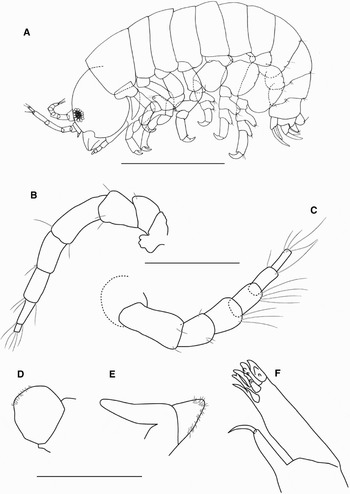
Bircenna macayai sp. nov. (A) Holotype: adult male 1.52 mm, NIWA 49241; (B–F) paratype undetermined sex, 1.4 mm, NIWA 49243. (A) Habitus; (B) antenna 1; (C) antenna 2; (D) labrum; (E) hypopharynx (lower lip); (F) maxilla 1. Scale bars; A: 0.4 mm, B–F: 0.1 mm.

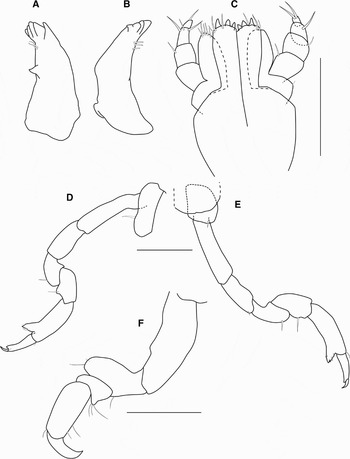
Bircenna macayai sp. nov. (A–E) Paratype undetermined sex, 1.4 mm, NIWA 49243; (F) holotype: adult male 1.52 mm, NIWA 49241 (A, B) mandible; (C) maxilliped; (D) gnathopod 1; (E) gnathopod 2; (F) pereopod 4. Scale bars: 0.1 mm.

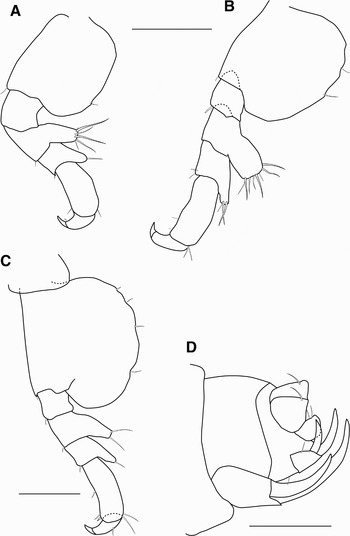
Bircenna macayai sp. nov. (A–C) Holotype, adult male 1.52 mm, NIWA 49241; (D) paratype undetermined sex, 1.4 mm, NIWA 49243. (A) pereopod 5; (B) pereopod 6; (C) pereopod 7; (D) urosome including uropods and telson. Scale bars 0.1 mm.

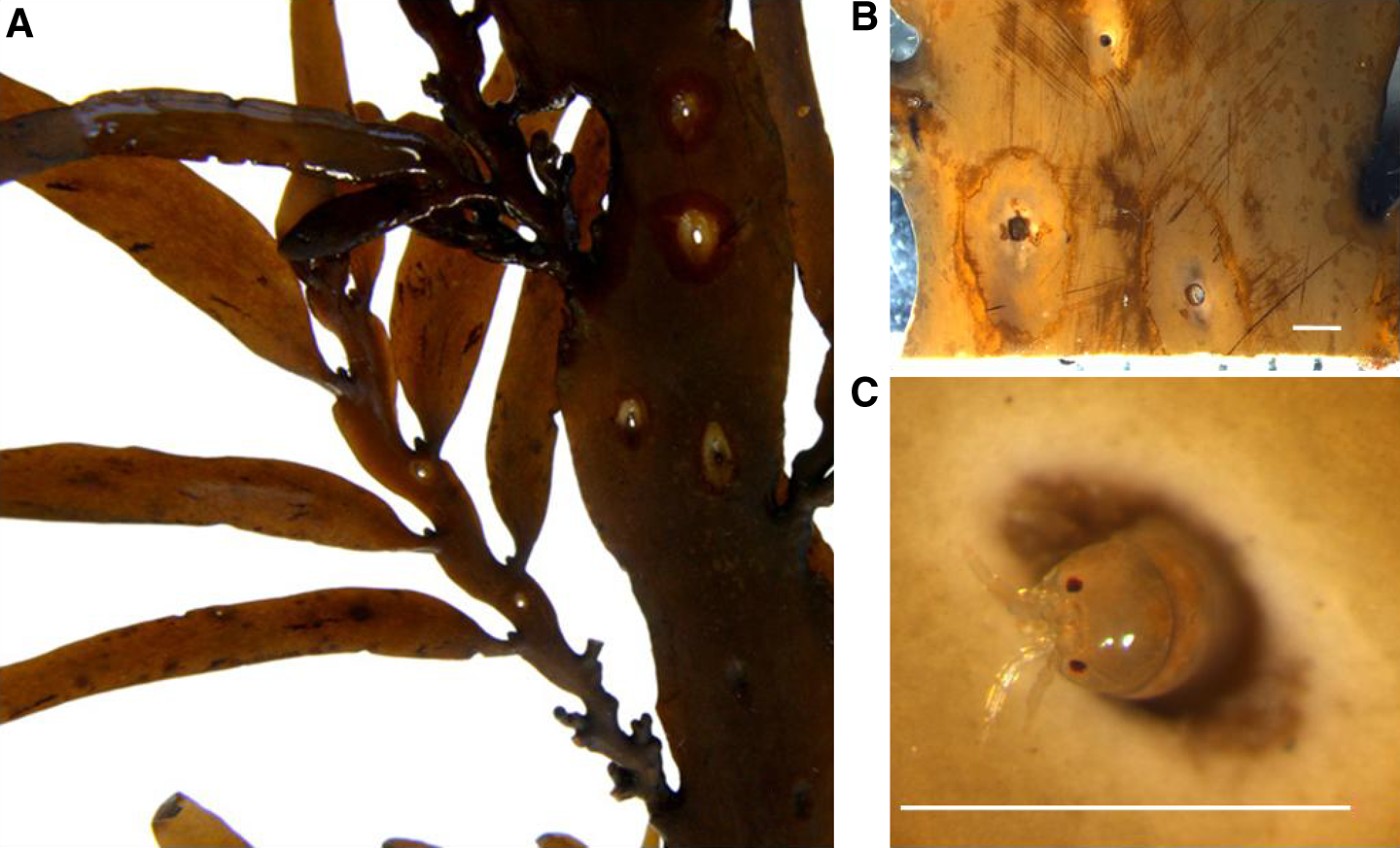
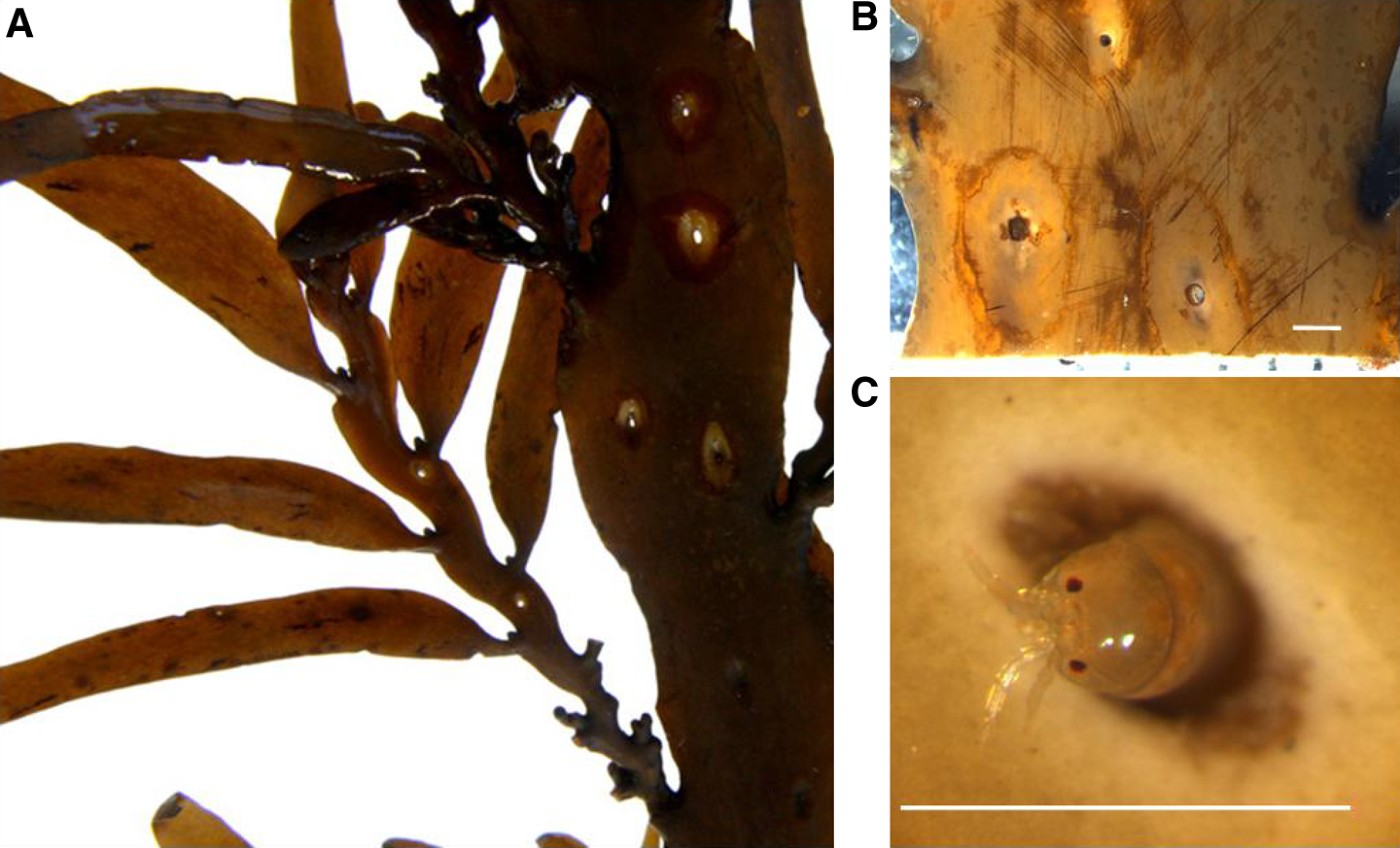
(A) Carpophylum maschalocarpum; (B) thallus detail of Carpophylum maschalocarpum with holes burrowed by Bircenna macayai sp. nov. (C) Bircenna macayai sp. nov. within its hole. Scale bars: 1 mm.
TYPE MATERIAL
Holotype: adult male 1.52 mm, in ethanol; New Zealand, Kau Bay, Wellington Peninsula, 174°49′48″E–41°17′16″S, subtidal water depth 2 m, NIWA 49241. Collected by snorkelling 5 May 2009.
Paratype: adult female 2.6 mm, (bearing 4 spherical eggs, 0.2 mm in diameter each) NIWA 49242 collection details as for holotype, in ethanol.
Specimen of undetermined sex, 1.4 mm, NIWA 49243, fully dissected on one slide.
COMPARATIVE MATERIAL EXAMINED
Bircenna dronga Myers, Reference Myers1985, holotype AMP35194 and paratype AMP35195 from the Australian Museum, Sydney. Fiji, Makuluva Isaland, Viti Levu, collected 13 August 1979 from mixed red algae, by A. Myers.
Bircenna fulva Chilton, Reference Chilton1884 from the NIWA Invertebrate Collection, NIWA7188, NIWA 7181. New Zealand, 174°49′60″E–41°20′05″S, collected November 1968 by J. Barnard, 0 m depth.
ETYMOLOGY
The species is named for Erasmo Macaya Horta, in acknowledgement of his hospitality, participation in collection of algae, and taking photographs of specimens during the visit of M. Thiel to Wellington.
DESCRIPTION OF BIRCENNA MACAYAI SP. NOV.
Body shape cylindrical, head rounded with hemispherical incision anteroventrally. Eyes round. Coxae 1–5 small and discontiguous. Pereopods 5–7 increasing in length, pereopod 7 twice the length of pereonite 7. Urosomites two and three are fused (Figure 1A).
Antennae 1 and 2 subequal in length (Figure 1B, C). Antenna 1 flagellum with four articles. Upper lip rounded and slightly setose apically (Figure 1D). Mandible lacking palp, incisor dentate, bearing 4 to 5 teeth (Figure 2A, B); lacinia mobilis not apparent, potentially modified to resemble spine in spine row. Maxilla 1 lacking palp; inner plate slender, bearing 1 stout seta; outer plate with 7 setal teeth (Figure 1F). Lower lip slender lobe, apically setose (Figure 1E). Maxilliped palp four articulate; article four blunt; inner plate long, reaching fourth article of palp; inner plate bearing three apical robust setae; outer plate shorter than inner plate (Figure 2C).
Gnathopod 1 coxa bilobed, twice as wide as long; ischium two-thirds of basis length; carpus and merus subequal in length; propodus posterodistally produced into triangular parachela; dactylus unguiform (Figure 2D). Gnathopod 2 coxa small, rectangular; basis to dactylus similar to gnathopod 1 (Figure 2E). Pereopods 3 and 4 very similar; merus expanded anterodistally (Figure 2F). Pereopod 5 basis subrectangular, merus and carpus anterodistally produced; rounded protrusion of merus bearing five long setae, protrusion of carpus bearing one seta; dactylus unguiform (Figure 3A). Pereopod 6 basis as wide as long; merus and carpus anterodistally produced; rounded protrusion of merus bearing eight long setae, protrusion of carpus bearing three seta; dactylus unguiform (Figure 3B). Pereopod 7 basis rounded posteriorly and crenulated; merus and carpus anterodistally produced; protrusion of merus bearing two long setae, protrusion of carpus bearing one seta; dactylus unguiform (Figure 3C).
Pleopods 1–3 peduncle broad; pleopods 1–3 biramous (not drawn). Urosomite 1 more than double the length of fused urosomites 2 and 3; uropod 1 peduncle shorter than outer ramus; outer ramus about two-thirds the length of inner ramus (Figure 3D). Uropod 2 peduncle shorter than outer ramus; outer ramus about 75% of inner ramus (Figure 3D). Uropod 3 very small, uniarticulate, two apical slender setae. Telson fleshy, bilobed, deeply cleft; each lobe with 1 apical slender seta (Figure 3D).
DISTRIBUTION
On Carpophyllum maschalocarpum in Kau Bay and Breaker's Bay, Wellington, New Zealand, subtidal.
NOTES ON THE BIOLOGY OF BIRCENNA MACAYAI SP. NOV.
Bircenna macayai sp. nov. excavate burrows across the main stem of Carpophyllum maschalocarpum (Figure 4A–C). Burrows of large individuals have two openings on either side of the stem, but burrows of smaller individuals may have only a single opening. Around the openings of the burrows, circular holes of brownish-yellowish colour indicate the presence of active amphipod burrows (Figure 4A, B). These holes are produced by the grazing activity of the amphipods, which removes the dark brownish meristoderm layer on the blade-like stems of the thallus. Living amphipods can frequently be seen consuming algal tissues within their burrows (Figure 4C). Occasionally they ventilate their burrows with repeated pleopod beats. They can easily turn around in their burrows. Specimens of Bircenna macayai sp. nov. appear quite reluctant to abandon their burrows: only cutting away of surrounding tissues and slight squeezing of the remaining burrow walls induces amphipods to leave. They can then be seen walking around on the blade stems. Eophliantids are also relatively agile swimmers.
Several burrows are often found together on individual thallus stems of C. maschalocarpum. Other grazers (e.g. snails) appear to be attracted to burrows of Bircenna macayai sp. nov. where they can be seen feeding in the burrow holes. In combination with a high prevalence of amphipod burrows, the combined grazing activity of different grazer species causes weakening and subsequent breakage of the stems.
KEY TO THE WORLD SPECIES OF EOPHLIANTIDAE, 14 SPECIES IN TOTAL
1. Telson uncleft and fused to urosomites 2–3, flagella of antennae 1–2 with one article only … (Lignophliantis, 1 species) … Lignophliantis pyrifera J.L. Barnard, 1969
— Telson cleft, distinct from urosome, flagella of antennae 1–2 with more than 1 article 2
2. Pleopods with 1 ramus 3 (Cylindryllioides, 2 species)
— Pleopods with 2 rami 4
3. Uropod 3 with heavy apical jewel spine; telson rounded, bilobed; upper lip evenly roundedCylindryllioides kaikoura Barnard, 1972
— Uropod 3 lacking apical jewel spine; telson pointed, deeply cleft, upper lip bilobedCylindryllioides mawsoni Nicholls, 1938
4. All coxae contiguous 5 (Wandelia, 4 species)
— Some or all coxa discontiguous 8
5. Slightly bilobed coxa 1, posterior lobe longer than anterior lobe, not overlapping coxa 2; upper lip rounded and setulose; telson lobes triangular shapedWandelia crassipes Chevreux, 1906
— Coxa 1 not bilobed, telson lobes rectangular shaped6
6. Broad coxa 1, overlapping coxa 2; upper lip quadrate and asetulose; distinct incision of head for reception of antenna 2; antenna 1 flagellum 2 articulate.Wandelia wairarapa Barnard, 1972
— Head not incised; flagellum of antenna 1 more than 2 articles7
7. Uropod 1 outer ramus distinctly shorter than inner ramus; epimeral plate 3 posterior margin smooth,Wandelia orghidani Ortiz & Lalana, 1997
— Uropod 1 outer ramus about subequal to inner ramus; crenulate posterior margin of epimeral plate 3Wandelia dronga (Myers, Reference Myers1985)
8. Pereonite 1 with ventral cradle 9 (Bircenna, 4 species)
— Pereonite 1 lacking ventral cradle12
9. Outer rami of uropods 1–2 reaching less than 75 per cent along inner rami, locking spine on pereopods 1–5 very small, parachela of gnathopods strong.Bircenna fulva Chilton, 1884
— Outer rami of uropods 1–2 reaching more than 75 per cent along inner rami, locking spine on pereopods 1–5 large, parachela of gnathopods weak10
10. Parchela of gnathopods quadrate, pereopod 7 length about equal to height of pereonite 7, antenna slender.Bircenna nichollsi Sheard, 1936
— Parachela of gnathopods triangular, pereopod 7 length about twice height of pereonite 7, bilobed coxa 111
11. Posterior margin of epimeron 3 and of pereopod 7 basis smooth, merus and carpus of pereopods 5–7 weakly extended posteriorly, pereopod 7 basis subequal in length and width Bircenna ignea Nicholls, 1939
— Merus and carpus of pereopods 5–7 strongly extended posteriorly, crenulate basis of pereopod 7 and smooth posterior margin of epimeron 3; pereopod 7 basis longer than wide.Bircenna macayai sp. nov.
12. Posterior lobe on articles 4–5 of pereopods 5–7 with 0-1 vestigal seta13 (Ceinina, 2 species)
— Posterior lobe on articles 4–5 of pereopods 5–7 densely setose, setae elongate(Eophliantis, 1 species) Eophliantis tindalei Sheard, 1936
13. Basis of pereopods 6 and 7 posteroventral corner enlarged, carpus of pereopods 6 and 7 posteriorly producedCeinina japonica Stephensen, 1933
— Basis of pereopods 6 and 7 inflated, carpus of pereopods 6 and 7 not producedCeinina latipes Ledoyer, 1978
DISCUSSION
Taxonomy
We assume the Eophliantidae (excluding Lignophliantis) are a monophyletic line. Discussing evolutionary patterns in gammaridean amphipods, Barnard (Reference Barnard1974) noted that the cylindroid Eophliantidae may be a monophyletic line based on a neotenous phliantid. Hatched juveniles of phliantids resemble eophliantids, but phliantids have special cuticular craters found also in ceinids and rudimentarily in hyalids, whereas eophliantids have apparently lost these structures. The eophliantid uropod 3 is slightly more complex than that of phliantids, the juveniles recapitulating their phylogeny. Two genera have been removed from the Eophliantidae by Barnard (Reference Barnard1972): Amphitholina Ruffo 1953 (to the Ampithoidae) based on its biramous ampithoid uropod 3 and Biancolina Della Valle 1893 (to the Biancolinidae) based on the shape of the uropod 3 and the maxillipedal plates.
Lignophliantis is a monotypic genus bearing characters, which distinguish it clearly from other species of eophliantids: an uncleft telson, a very short first antenna with only one article, and a maxilliped outer plate that is much larger than the inner plate. Therefore, Lignophliantis should probably be removed from the family Eophliantidae, and as such, a phylogenetic analysis of the family Eophliantidae is needed to clarify the position of this genus. We have thus excluded the genus Lignophliantis in the following discussion regarding evolutionary trends in the Eophliantidae.
Barnard (Reference Barnard1972) noted a general trend within eophliantid genera towards reduction of coxae in the sequence of Wandelia–Bircenna–Eophliantis–Ceinina–Cylindryllioides. Based on the body shape, after measuring the coxa height in relation to height of the corresponding pereonite we suggest that Wandelia wairarapa and Wandelia dronga are primitive species, wheras Cylindryllioides kaikoura and Bircenna macayai sp. nov. are highly developed species. While we therefore in general agree with Barnard's (1972) observations regarding evolutionary trends, based on the description of new species and additional data since 1972, we regard our new species of Bircenna as highly derived. Barnard (Reference Barnard1972) also noted an evolutionary trend within eophliantid genera towards a loss or reduction of lacinia mobilis in the sequence of Wandelia to Ceinina, incision of head from Bircenna to Ceinina, loss of inner lobes on lower lip from Wandelia to the others.
Functional morphology
We agree with Barnard's (1972) suggestion that the evolutionary trend of the eophliantids is characterized by morphological adaptations for life in an algal habitat. The species benefit from three main morphological characters: (a) narrow, cylindrical body shape; (b) mouthparts combined with a strongly rotating head suitable for shaving algal tissue; and (c) reduced pleopods.
A cylindrical body shape confers distinct advantages to algae-boring arthropods, streamlining the body to enable the animal to fit neatly into and move easily within its tunnel. As such, this trait has also evolved convergently in other algal-dwelling taxa such as the amphipod Biancolina (previously considered to be an eophliantid until removed to its own family by Barnard, Reference Barnard1972), and in the wood- and kelp-boring limnoriid isopods (Kreibhom de Paternoster & Escofet, Reference Kreibhom de Paternoster and Escofet1976).
The loss or reduction of the lacinia mobilis would seem to be a disadvantage to a burrowing organism, as the lacinia mobilis should double the rasping ability of the mandible; however, the strongly rotating head coupled with the flattening of the incisor may together be better for boring soft living tissues of algae (Barnard, Reference Barnard1972). Barnard (Reference Barnard1972) noted that living plant tissues may actually have to be shaved rather than rasped and the buccal mass of Wandelia wairarapa (from New Zealand) appears well suited to that task; the mandibles project in such a way as to suggest a blade in a razor. Our preliminary examination of the mouthparts of the Eophliantidae revealed this to be true for all fourteen species.
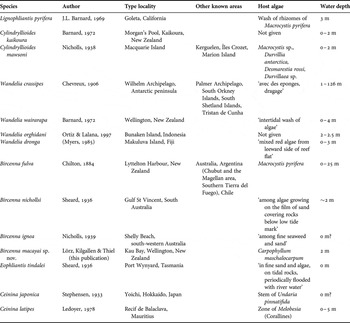
The reduction of pleopodal peduncles from Wandelia to Bircenna and Ceinina with an aberrancy in Cylindryllioides suggests that the prototypical eophliantid may have had expanded peduncles and that narrowing those is the evolutionary trend (Barnard, Reference Barnard1972). Our initial morphological examination of the eophliantids agrees with Barnard's (1972) theory and supports the hypothesis of Wandelia being the most primitive genus. The strong peduncular paddles on the pleopods may be a substitute for decreased ramal lengths, necessarily advantageous because of confinement of the organism in a tunnel, but the reduction of the adaptation in Cylindryllioides can, according to Barnard (Reference Barnard1972) only suggest that this genus has a habitat distinct from its congeners. However, since C. mawsoni is found on Macrocystis sp. (Table 1) and B. fulva is also found on Macrocystis sp., we assume that the genus Cylindryllioides does not have an algal habitat different from other members of Eophliantidae.
Record of distribution and host algae of the Eophliantidae.

Ceinina is reported to penetrate the stem of the brown alga Undaria pinnatifida (Harv.) Suringar and the pleopodal paddles seem very solid, although the peduncle is not as expanded as in other eophliantids. Ceinina does retain a strong, sharply serrate lacinia mobili, has the thinnest body of eophlinatids, and generally the shortest legs and antennae, and is therefore well adapted as a tunneller. Perhaps the other species bore into more tender species of algae (Barnard, Reference Barnard1972). Unfortunately, most authors describing species of eophliantids do not name the species of the associated algae (Table 1). Nevertheless two species bearing very differently shaped pleopods (Lignophliantis pyrifera and Bircenna fulva) are reported from the same species of algae: Macrocystis pyrifera. Cylindryllioides mawsoni, bearing very narrow pleopodal peduncles, also lives on M. pyrifera (in the original publication this alga was reported as M. laevis).
Biogeography
Currently our knowledge about the biogeography of the eophliantids is so speculative, that it is only briefly discussed in the following. A more substantial biogeography of the Eophliantidae will follow a detailed phylogenetic analysis which is presently in preparation.
All species of Eophliantidae are found in shallow waters, from 0–4 m (see Table 1), except Bircenna fulva (0–25 m) and Wandelia crassipes (1–126 m). Since the reported depth below 10 m often refers to stations sampled by dredges (e.g. Chevreux, Reference Chevreux1906; De Broyer et al., Reference De Broyer, Lowry, Jażdżewski and Robert2007) and this gear has no closing mechanism, thus also sampling the water column, it is very likely that the eophliantids were taken on pieces of algae close to the surface. All eophliantids are algal dwellers, even though not all authors mention the associated algae (Table 1).
There are currently two main mechanisms hypothesized for long-range biotic distributions in the southern hemisphere; vicariance due to continental drift and rafting dispersal via the West Wind Drift (Waters, Reference Waters2008). Numerous studies have remarked on biogeographical connections among biota from regions linked by the West Wind Drift (Thiel & Haye, Reference Thiel and Haye2006). For example, recent molecular studies have identified biogeographical links between South Africa, Tasmania and New Zealand (e.g. Waters & Roy, Reference Waters and Roy2004). An extensive literature search has revealed five algae identified to species level that are associated with eophliantids (Table 1). Ceinina japonica is described from the stem of Undaria pinnatifida in Yoichi, Hokkaido (Stephensen, Reference Stephensen1933). Cylindryllioides mawsoni has been found on Macquarie Island, Kerguelen, Crozet Island and Marion Island on Macrocystis pyrifera (reported as M. laevis) and Durvillaea antarctica (e.g. Beckley & Branch, Reference Beckley and Branch1992). Macrocystis pyrifera is also the habitat of Lignophliantis pyrifera from California (Barnard, Reference Barnard1972), while Bircenna fulva is known from M. pyrifera off Argentina (Kreibohm de Paternoster & Escofet, 1976; Alonso, Reference Alonso1980), off Chile (Martin Thiel, personal observation), and off New Zealand (Chilton, Reference Chilton1884). Thus, due to the algal-dwelling habitat of these animals, we assume that they are ideal candidates for dispersal via rafting.
Biotic connections between New Zealand and South America (e.g. Donald et al., Reference Donald, Kennedy and Spencer2005; Fraser et al., Reference Fraser, Nikula, Spencer and Waters2009) are often discussed controversially (e.g. Heads, Reference Heads2005). Studies on the alpha-diversity of peracarids from New Zealand and Chile have reported several peracarid species that are apparently common to both regions (e.g. Barnard, Reference Barnard1972; Thiel, Reference Thiel2002; Gonzalez et al., Reference Gonzalez, Haye, Balanda and Thiel2008). However, there is a high possibility that these ‘bi-regional’ species such as Bircenna fulva are mis-identifications and/or represent (several) cryptic species but at the generic level the connections may be significant. If algal rafting was the main explanation for the biogeography of the Eophliantidae family, the same species should be found in, e.g. Chile, Australia and New Zealand. The current generic level connectivity may support a vicariant biogeography because similarities at generic level indicate an archaic relationship.
The highest eophliantid species diversity, four of the 14 known species, occurs in New Zealand. These represent three of the six genera. Another species is found on Macquarie Island, south of New Zealand, and a further three species in southern Australia (including Tasmania) (Figure 5). At this point, we therefore speculate that Australasia is the evolutionary origin of this amphipod family, and species have radiated to Antarctica, Chile, Mauritius and Japan from here. Again, without a detailed phylogenetic analysis of the family, this biogeographical hypothesis cannot be confirmed.
Worldwide distribution of the species of Eophliantidae (Amphipoda).

Summary and outlook
Very little is known about the systematics and evolution of obligate algae dwelling amphipods. This initial study, focusing on the taxonomy, has highlighted that the family Eophliantidae is a suitable model group to study the phylogeography of obligate algal dwellers.
We currently postulate Australasia as the evolutionary centre of the Eophliantidae, having four of the six currently known genera. Both species with pututatively plesiomorphic and derived characters are found in Australasia. Based on the ecology of the algae dwelling Eophliantidae, their biogeographical distribution and that of their host algae, we believe rafting on macroalgae, e.g. on Macrocystis sp., is a viable distributional mechanism for this amphipod family. At present, the observed distributions could be consistent with vicariant or dispersalist mechanisms. A detailed phylogenetic analysis of the Eophliantidae will be conducted in a following paper to help clarify this issue.
ACKNOWLEDGEMENTS
Specimens were collected as part of the ISAT funded visit of Martin Thiel to Wellington, May 2009, project ISATA08-31, project ‘Biogeographic links between New Zealand and Chile—shallow water peracarids as a model group’.
We are grateful to our colleagues for the smooth running of the NIWA Invertebrate Collection. Erika McKay (NIWA) kindly inked some of the plates; Erasmo Macaya Horta (Victoria University Wellington) took the photographs. This research was funded by NIWA's Biodiversity & Biosecurity programme CO01X0502 of the New Zealand Science Foundation. We gratefully acknowledge two anonymous referees who provided constructive comments that improved this paper.