The increasing rate of antibiotic resistant infections and growing awareness of the harms of indiscriminate antibiotic use have spurred the growth of antimicrobial stewardship programs (ASPs). As ASPs continue to evolve, novel approaches are needed to provide integrated services across the healthcare continuum.
ASPs have historically existed mainly in acute-care hospitals and have focused on inpatient care. Although numerous studies have shown improvement in inpatient antibiotic use as a result of stewardship interventions, these interventions are often not designed to facilitate transitions of care or improve antimicrobial prescribing occurring at hospital discharge. Recent studies suggest that 30%–40% of antibiotic use associated with an inpatient stay occurs after discharge.Reference Feller, Lund and Perencevich1–Reference Madaras-Kelly, Burk and Caplinger3 Studies evaluating the appropriateness of antibiotic prescribing at discharge have estimated that 50%–70% of antibiotic discharge prescriptions are inappropriate, and courses are often longer than necessary.Reference Madaras-Kelly, Burk and Caplinger3–Reference Vaughn, Flanders and Snyder5
Discharge antibiotic prescribing is an important factor contributing to inappropriate antibiotic use, but it is unknown whether interventions targeting this stage of prescribing are effective. We conducted a systematic review to determine whether stewardship interventions aimed at the hospital discharge process reduce antibiotic use, improve appropriateness of prescribing, or improve patient outcomes.
Methods
Published studies describing implementation of antimicrobial stewardship interventions aimed at improving antibiotic prescribing at hospital discharge were identified through PUBMED, EMBASE, CINAHL, and the Cochrane Library. Searches included the time from database inception to January 2020. Reference lists of pertinent articles were manually searched to identify additional relevant citations.
English-language studies of hospitalized patients discharged to another setting were included. Studies must have included at least 1 hospital-based antimicrobial stewardship intervention targeted at improving antibiotic prescribing at the point of hospital discharge. Outcomes included antibiotic use, appropriateness of prescribing, hospital readmission, incidence of Clostridium difficile infection (CDI), and antibiotic-related adverse events. Studies that assessed impact of interventions on medication use in general or that included medication classes other than antimicrobials were excluded, as were studies evaluating outpatient parenteral antimicrobial therapy (OPAT) programs. Randomized and noncontrolled studies, before-and-after studies, and observational studies were considered eligible given the paucity of literature on this subject.
Titles and abstracts were assessed for eligibility. Publications with abstracts that appeared relevant underwent full-text review. Additionally, studies with titles and abstracts lacking adequate information to determine inclusion or exclusion underwent full-text review.
Results
In total, 1,262 unique studies across all sources were identified. Of these, 1,162 (92%) were excluded at the screening stage, 100 full-text articles were assessed for eligibility, and 6 studies were included.Reference Jones, Leedahl, Losing, Carson and Leedahl6–Reference Caplinger, Crane, Wilkin, Bohan, Remington and Madaras-Kelly11 Across all studies, there was pronounced heterogeneity in intervention components. Most interventions relied on pharmacists and physicians,Reference Jones, Leedahl, Losing, Carson and Leedahl6,Reference Yogo, Shihadeh and Young7,Reference Chavada, Davey, O’Connor and Tong10,Reference Caplinger, Crane, Wilkin, Bohan, Remington and Madaras-Kelly11 whereas 2 studiesReference Antonioli, Formaglio and Gamberoni8,Reference Schuler, Courter and Conneely9 described more multidisciplinary approaches and 3 studies targeted specific indications.Reference Antonioli, Formaglio and Gamberoni8,Reference Schuler, Courter and Conneely9,Reference Caplinger, Crane, Wilkin, Bohan, Remington and Madaras-Kelly11 Caplinger et alReference Caplinger, Crane, Wilkin, Bohan, Remington and Madaras-Kelly11 incorporated a pneumonia treatment evaluation into pre-existing processes of medication reconciliation. In addition, 4 studies included an educational component, and 3 included an institutional guideline for antibiotic prescribing. Most studies included a prospective audit with feedback component. Only 1 study incorporated an electronic order set as part of the intervention.
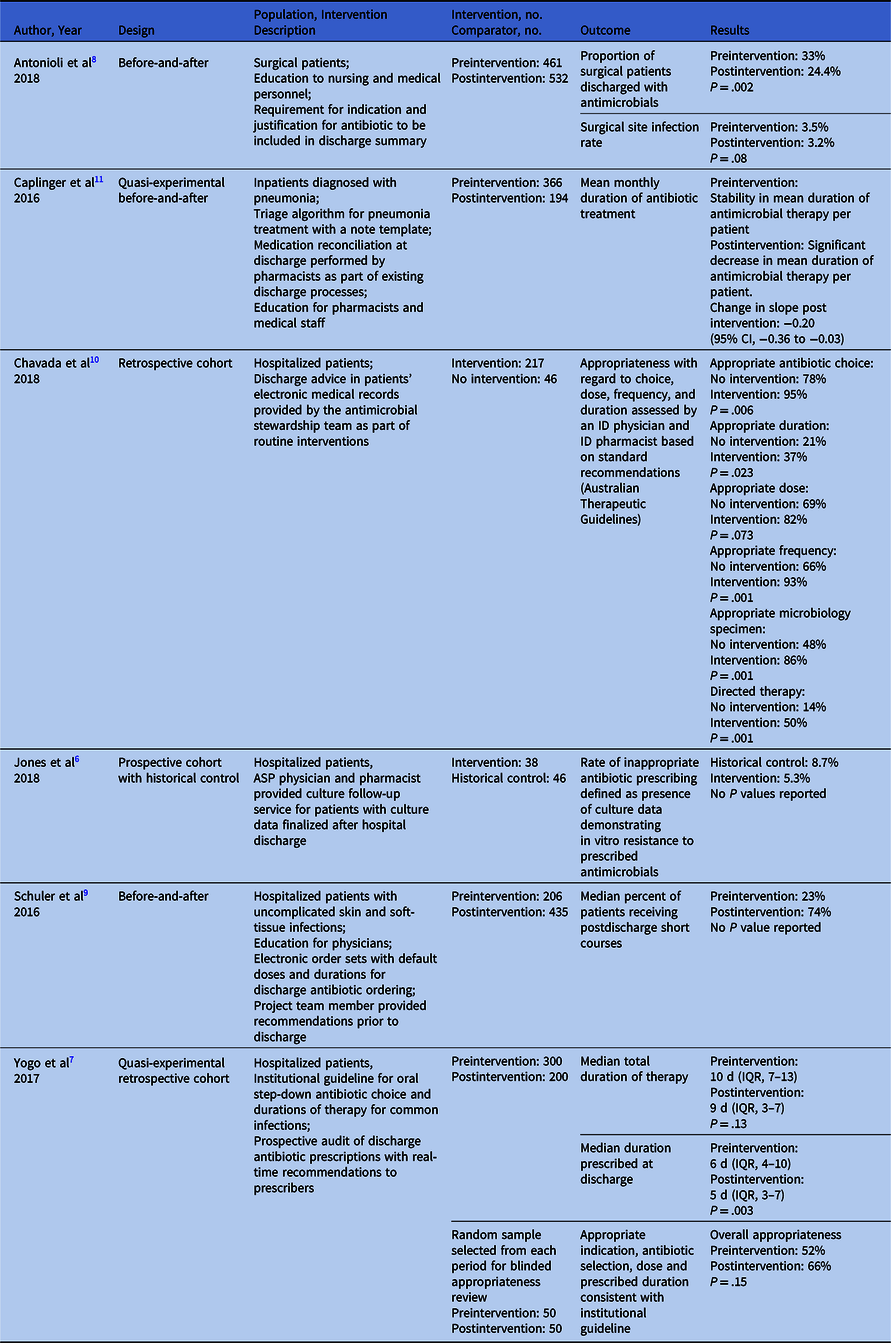
Interventions resulted in a decrease in the antibiotic use measure in all 4 studies that measured this outcome (Table 1).Reference Yogo, Shihadeh and Young7–Reference Schuler, Courter and Conneely9,Reference Caplinger, Crane, Wilkin, Bohan, Remington and Madaras-Kelly11 Yogo et alReference Yogo, Shihadeh and Young7 reported a significant decrease in the median duration of therapy prescribed at discharge, but the decrease in median total durations of therapy was not statistically significant.Reference Yogo, Shihadeh and Young7
Published Studies Evaluating Interventions to Improve Antibiotic Prescribing at Hospital Discharge

Note. ID, infectious diseases.
In our review, 3 studies measured prescribing appropriateness, using varying definitions.Reference Jones, Leedahl, Losing, Carson and Leedahl6,Reference Yogo, Shihadeh and Young7,Reference Chavada, Davey, O’Connor and Tong10 Chavada et alReference Chavada, Davey, O’Connor and Tong10 showed improvement for each component measured (ie, antibiotic choice, duration, frequency, and directed therapy) except dose, which improved, but this finding was not significant. Jones et alReference Jones, Leedahl, Losing, Carson and Leedahl6 defined appropriateness more narrowly, only encompassing antibiotic choice based on microbiologic susceptibility. Rates of inappropriate therapy decreased when compared to the historical control, but this study was small and likely underpowered to detect a difference. Yogo et alReference Yogo, Shihadeh and Young7 showed a trend to improvement in appropriateness.
No differences were seen in hospital readmission rates in the studies that evaluated this outcome.Reference Yogo, Shihadeh and Young7,Reference Schuler, Courter and Conneely9–Reference Caplinger, Crane, Wilkin, Bohan, Remington and Madaras-Kelly11 In the only study assessing rates of CDI, low rates were seen with no difference between the pre- and postintervention groups and no differences in adverse drug events or treatment failure.Reference Yogo, Shihadeh and Young7 In a study assessing the impact of an intervention to decrease unnecessary antibiotics for surgical prophylaxis, antibiotic prescribing at discharge decreased without negatively affecting rates of surgical site infections.Reference Antonioli, Formaglio and Gamberoni8
Discussion
Reduction of unnecessary and inappropriate antibiotic prescribing at the point of hospital discharge is an important priority that is often not addressed by ASPs. In this review, few studies were identified that evaluated interventions aimed at the discharge process. In the studies we included, interventions decreased antibiotic use, though not all of the reductions were statistically significant. Interestingly, Yogo et alReference Yogo, Shihadeh and Young7 showed a significant decrease in the median duration prescribed at discharge, but no change in the median total duration of therapy. This finding highlights the importance of tracking both inpatient and discharge prescribing to capture the true impact on overall antibiotic use.
Studies that included prospective audit and feedback noted challenges related to resources, timing of interventions, and availability of stewardship personnel. Given the resource-intense nature of prospective audit and feedback, these types of interventions may not be realistically sustainable. Many hospitals have multidisciplinary systems in place to facilitate transitions of care and medication reconciliation at discharge. Incorporating stewardship components into these existing models may represent opportunities for ASPs to gain efficiencies.
Several methodological issues limited our ability to draw conclusions. All of the studies included were single-center retrospective studies. Types of interventions were variable, and reporting of outcomes was inconsistent. Most studies evaluated a combination of interventions, often in the setting of already established ASPs, limiting generalizability.
Although we focused solely on interventions aimed at improving prescribing at discharge, other types of interventions may impact discharge prescribing. In screening abstracts and reviewing full texts, we observed several studies describing more general interventions not specifically targeting discharge prescribing that evaluated postdischarge antibiotic use as an outcome.Reference Haas, Dalton and Knepper12–Reference Yadav, Masuda, Minejima and Spellberg14 In one study, a pneumonia order set significantly decreased total duration of therapy and duration prescribed at discharge.Reference Haas, Dalton and Knepper12 Another study showed improvement in antibiotic discharge prescribing by incorporating durations of therapy guidance into pre-existing ASP activities.Reference Yadav, Masuda, Minejima and Spellberg14 These findings are encouraging and suggest that discharge prescribing can be improved without additional resources directed at the discharge process. Notably, however, some inpatient interventions may have unintended effects on discharge prescribing. In a study evaluating stewardship strategies across 48 hospitals in Michigan, inpatient interventions aimed at fluoroquinolone use were associated with decreased inpatient prescribing but higher rates of fluoroquinolone prescribing at discharge.Reference Vaughn, Gandhi, Conlon, Chopra, Malani and Flanders15 Regardless of the aim of the interventions, postdischarge antibiotic prescribing measures should be integrated into monitoring procedures for hospital ASPs.
Antibiotic prescribing at discharge remains an important gap not addressed in the literature. Opportunities exist to determine best practices and optimal strategies to improve discharge prescribing. Questions remain about which types of interventions are most effective and most sustainable. Additionally, the optimal measure for monitoring discharge antibiotic use is unknown as is the optimal method for accurately capturing postdischarge prescribing data. Because a large percentage of hospital-associated antibiotic use occurs immediately after discharge, metrics that account for this use should be incorporated into ASP outcomes, and there is a critical need to develop efficient methods to monitor these outcomes.
Antibiotic stewardship to improve hospital discharge prescribing is an unmet need, and interventions focused on this area warrant further study. As ASPs continue to evolve to encompass all healthcare settings, it will become essential for these programs to evaluate all aspects of the antibiotic use process and find opportunities to integrate antimicrobial stewardship into transitions of care processes.
Acknowledgments
None.
Financial support
No financial support was provided relevant to this article.
Conflicts of interest
Both authors report no conflicts of interest relevant to this article.