INTRODUCTION
Among the vertebrates, fish have the highest rates of parasitic infection, due to the aquatic environment which facilitates dispersal, reproduction and the life cycle of parasites, among other factors relevant to their survival (Eiras, Reference Eiras1994). Nematodes as parasites of fish are included in this group. Members of the superfamily Dracunculoidea Stiles, 1907, represent a large and diverse group of parasites with a worldwide distribution. Most nematodes of this superfamily are viviparous and include 166 recognized species, of which 150 (90%) are parasitic of about 300 species of fresh water, brackish-water and marine fish (Moravec, Reference Moravec2004).
Nematodes belonging to the family Philometridae Baylis & Daubney, 1926 are frequently found in various organs, tissues and body cavities of a wide variety of fish. The genus Philometra Costa, 1845 (Nematoda: Dracunculoidea: Philometridae) is widely distributed and is a parasite of marine as well as fresh water fish (Quiazon et al., Reference Quiazon, Yoshinaga and Ogawa2008; Moravec & Buron, Reference Moravec and Buron2009; Moravec et al., Reference Moravec, Charo-Karisa and Miloslav2009). During recent years, the importance of Philometra spp. parasitizing marine fish has increased due to the accelerated development of marine aquaculture. These parasites cause serious damage to infected fish and when they parasitize the gonads, a significant decrease in reproduction has been observed (Ramachandran, Reference Ramachandran1975; Sakaguchi et al., Reference Sakaguchi, Yamagata and Sako1987; Moravec, Reference Moravec2004). Philometrids parasitizing in the gonads of their fish hosts may cause serious damage to these organs (by sucking blood, causing atrophy of developing ova in the ovary, fibrosis of ovarian tissue, increased granulocytes and haemorrhages), thus negatively affecting the reproduction of some species of marine fish (Moravec et al., Reference Moravec, Ogawa, Suzuki, Miyazaki and Donai2002).
The lane snapper, Lutjanus synagris (Linnaeus, 1758) (Perciformes: Lutjanidae), is an important fishery resource and is highly esteemed for its tasty white meat. They are silvery-pink to reddish in colour, with short, irregular pink and yellow lines on their sides with a diffuse black spot. Juvenile fish are found inshore over shallow reefs and adults are found offshore. The lane snapper has been reported from the western Atlantic (Bermuda and North Carolina, USA) to south-eastern Brazil, including the Gulf of Mexico and the Caribbean Sea. It is most abundant around the Antilles, off Panama and the northern coast of South America (Cervigón et al., Reference Cervigón, Cipriani, Fischer, Garibaldi, Hendrickx, Lemus, Márquez, Poutiers, Robaina and Rodriguez1992). The lane snapper becomes sexually mature at 15 cm total body length at one year of age, is a generalist carnivore, and a trophic opportunist fish, preying on a wide range of feeding resources (Duarte & Garcia, Reference Duarte and García1999).
This study reports on the first occurrence of parasitism by the nematode Philometra sp. in the host L. synagris in the coastal waters of Rio Grande do Norte, Brazil.
MATERIALS AND METHODS
Sampling was done in the coastal waters of Natal, Rio Grande do Norte, geographical coordinates 37°14′ longitude W to 4°54′ latitude S and 34°59′ longitude W to 6°34′ latitude S. A total of nine specimens of Lutjanus synagris were caught during January to April, 2008, with the help of local fishermen, using bottom-trawl nets and motor boats. The total body length and weight of fish samples were measured (in centimetres and wet body mass in grams). The fish were necropsied and dissected out to examine the gonads. The parasites found were removed carefully and were fixed in hot 4% formaldehyde solution in physiological saline and cleared in Amann lactophenol for microscopic examination (Eiras et al., Reference Eiras, Takemoto and Pavanelli2006). The identification of the genus of the parasite was carried out according to Crisp & Klein (Reference Crisp and Klein1973), Martínez & Ventosa (Reference Martínez and Ventosa1982), Moravec & Justine (Reference Moravec and Justine2005). Parasitic ecological indices were calculated and expressed as per Bush (Reference Bush, Laffehty, Lotz and Shostak1997).
RESULTS
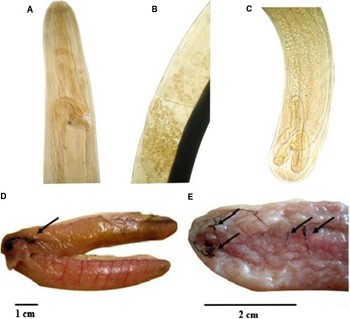
Fish samples (2 females and 7 males) presented total length ranging from 19.8 to 39.3 cm (24.64 ± SD 6.10) and total weight of 145.5 to 558.5 g (241.89 ± 142.04). Of the nine fish examined, two females were parasitized by the nematode Philometra sp. The parasites were found fixed on the surface and inside the ovarian tissue of mature fish (Figure 1).
Philometra sp. gravid female: (A) anterior region; (B) middle region with eggs; (C) posterior region; (D) parasitized fish ovary; (E) dissected ovary of Lutjanus synagris showing Philometra sp. (arrows).

Parasites obtained from the ovaries of L. synagris were all gravid females (N = 26), and possessed a cylindrical body, dark-brown in colour that ranged from 30 mm to 70 mm in length. The minimum and maximum width of the body was 2.5 mm and 4.0 mm respectively. The cephalic extremity was rounded. The intestine was visible through the smooth cuticle. The oesophagus showed an anterior bulbous inflation of 1.0 mm long. The intestine had a blind end. Long, narrow ovaries consisting of spherical eggs and larvae were located near the extremities of the body. Caudal end was rounded with no projections.
The parasitic prevalence was 22.22%, mean was 13 parasites per infected fish and mean density was 2.89 per host sampled.
DISCUSSION
This study provides sufficient observations to confirm that Philometra sp. is an efficient parasite of Lutjanus synagris. The preferred target location for the nematode infection: 5 the host ovaries, confirming the results of Moravec & Buron (Reference Moravec and Buron2009) who worked with estuarine fish in South Carolina.
In the present study the prevalence of Philometra sp. was higher than that registered by Perez et al. (Reference Perez, Roumillat, Levesque, Connors and Buron2009) for the species P. carolinensis found in the gonads of fish Cynoscion nebulosus from the estuaries of South Carolina. Hesp et al. (Reference Hesp, Hobbs and Potter2002) reported that gonadosomatic indices provided no evidence that infection by P. lateolabracis leads to a conspicuous atrophy of ovaries, which contrasts with the situation with the gonads of some of the teleost fish infected by Philometra species, and presumably reflects, in part, the small volume of the ovary occupied by P. lateolabracis (~ 3%) and the low intensity of infection (mean = 2, maximum = 7). Moravec & Justine (Reference Moravec and Justine2008) encountered a species of Philometra parasitizing the gonads of Lutijanus vitta in New Caledonia, with a parasitic prevalence of 100% and an intensity of 2.
Moravec (Reference Moravec2004) states that the frequency of Philometra spp. parasitizing the gonads of many marine fish species has increased due to the rapid development of marine aquaculture. This parasite can lead to a significant decrease in fish reproduction or even cause total castration of the host.
Moravec et al. (Reference Moravec, Glamuzina, Marino, Merella and Di Cave2003) suggests that P. lateolabracis presents a wide geographical distribution. Philometra lateolabracis was reported from the Inland Sea and off the Pacific coast in Japan (Yamaguti, Reference Yamaguti1935), off the coast of Somalia (Moravec et al., Reference Moravec, Orecchia and Paggi1988) and from the Mediterranean Sea (off the Balearic Islands, Spain, Morocco, Iskenderun Bay), Tyrrhenian Sea (off Sicily, Italy) and south-eastern Adriatic Sea (Croatia) (Moravec et al., Reference Moravec, Glamuzina, Marino, Merella and Di Cave2003; Moravec & Genc Reference Moravec and Genc2004; Merello et al., Reference Merella, ReZones and Garippa2004, Reference Merella, ReZones and Garippa2005). Martínez & Ventosa (Reference Martínez and Ventosa1982) registered the species P. lateolabracis (Nematoda: Philometridae), parasitizing the lane snapper Lutjanus synagris (Osteichthyes: Lutjanidae) in Cuba.
Crisp & Klein (Reference Crisp and Klein1973) registered the first occurrence of the females of P. leteolabracis Yamaguti, Reference Yamaguti1935 in the fish white grunt, Haemulon plumierii from the coast of Ceará, Brazil. They also reported the presence of a male with miniature proportions close to the females of P. leteolabracis. Possibly the parasite found in the present study on the new host L. synagris is the same as found by the authors in Ceará.
Females of Philometra sp. are commonly encountered parasitizing fish hosts. This makes it a difficult task to identify this parasite to the species level. Similar problems have been encountered by Rego & Santos (Reference Rego and Santos1983). Moreover, the great similarity between the philometrids, especially those that infect the fish gonads, is a complicating factor in identifying these organisms (Moravec, Reference Moravec2004; Moravec & Buron, Reference Moravec and Buron2009). Further studies using better techniques such as light microscopy and scanning electron microscopy are necessary for a better description of this parasite.
ACKNOWLEDGEMENTS
This study was supported by the National Council for Scientific and Technological Development of Brazil (CNPq) in the form of Research grants and the Post-Graduate Federal Agency CAPES/MEC.