Ata Anzali’s “Mysticism” in Iran is an important contribution to the fields of Shīʿite studies and Islamic mystical thought. It is the first comprehensive examination of the meaning and use of the term ʿirfān from various intellectual perspectives such as historical, theological, anthropological, and sociological. Anzali’s work initially examines how gnosis (maʿrifa), as a term, was first used by early Sufis and philosophers such as Sarī Saqaṭī (d. circa. 866) and Avicenna (d. 428/1037). Anzali then examines how a term related to maʿrifa, ʿirfān, became the axial term that Shīʿites would use to describe their mysticism from the Safavid period (1501–1736) until Ayatollah Khomeini’s Islamic Revolution in 1979. Although brief summaries and glosses of mysticism in the Shīʿite world are found in the works of Henry Corbin, Alexander Knysh, Roy Mottahedeh, Reynold Nicholson, Seyyed Hossein Nasr, Sajjad Rizvi, and others, Anzali’s work fills a lacuna by examining how ʿirfān developed against the background of Sufism throughout Iran’s history. Anzali provides translations from works of major figures of ʿirfān that prove not only how these figures found and developed a new school within Shīʿism, but also how their thought was politically, religiously, and socially received. Furthermore, Anzali structures his work such that the reader can observe parts of it independently and understand how the term ʿirfān was developed from the Safavid period until the modern era.
Anzali’s goal is to understand Shīʿite mysticism in Iranian history through the lens of the term ʿirfān. Through a close reading of major works by philosophers and theologians, he argues that “the invention of ʿirfān can be attributed to a handful of religious scholars of the Safavid era who hailed from Shiraz” (p. 119). Furthermore, he acknowledges the need to reevaluate how Sufi concepts were incorporated into Shīʿite mysticism during the Safavid era. For Anzali, ʿirfān became the Shīʿite axial term around which all forms of knowledge of mysticism revolve.
In the book, Anzali argues that Safavid-era Shīʿites used the term ʿirfān to build a distinct form of mysticism that was significantly different from Sunni Sufism. However, the term’s initial development first occurred in the works of Sunni Sufis, and continued to be associated with them until Safavid Shīʿites implemented it as their term for their form of mysticism. Anzali traces how various terms from the Arabic root ʿa-r-fbegan in the Qur’ān, and then demonstrates how the nouns such as knowledge (ʿirfān), knower (ʿārif), and gnosis (maʿrifa) (p. 10), were first found in the works of ninth-century mystical thinkers, such as Dhūl-Nūn al-Miṣrī (d. 245/859 or 248/862) who said, “the renunciants are the kings of the afterlife, and the knowers (ʿārifūn) are the kings of the renunciants.” Anzali then focuses on how Ibn Sīnā used it as an important category in his Remarks and Admonitions (al-Ishārāt wal-Tanbīhāt) in the section entitled “On the Stations of the Knowers” (fī maqāmāt al-ʿārifīn).
Anzali narrates how the Safavid dynasty’s implementation of Shīʿism as the state religion of Iran caused the clergy to disengage itself from its former Sufi heritage. Honorific Sufi terms that were used for the shah, such as the “Perfect Guide” (murshid-e-kāmil), were eliminated from the royal vocabulary. Furthermore, various Safavid Shīʿite policies, such as the cursing of the enemies of the Prophet’s family (tabarrā), and the belief in the occultation of the twelfth Shīʿite Imām, Muhammad ibn Ḥassan al-Mahdī (b. 255/868), caused Sufi orders to flee Iran for friendlier areas such as Mughal India or Ottoman Turkey. Orders that survived in Safavid Iran were forced to adapt Shīʿism as their theological and religious doctrines. An example of this is the Dhahabīya Raḍawīya Murtaḍawīya Mahdawīya Kubrawīya (Pers. Zahabiyya) Sufi order, which claimed spiritual descent from the Shīʿite Imāms.Footnote 1 Given their allegiance to the Shīʿite Imāms, they removed major Sunni Sufi figures from their hagiographic or photographical genealogies (silsilas) to appease the Safavid clergy. Despite Anzali’s historical study of the Zahabiyya’s Sufi manual, the Gift of Abbas (Tuḥfah-e-Abbasī), Anzali overlooked some basic facts regarding how this work reintegrated Sufi terminology into Shīʿite thought. For example, when the Zahabiyya transitioned to Shīʿism, they emphasized the mystical science of letters (ʿilm al-ḥurūf), which was attributed to the first Shīʿite Imām, ʿAlī ibn Abī Ṭalib (d. 40/661).
Mysticism in Iran continued to flourish in Shiraz with Shāh Muḥammad Dārābī (d. ca. 1130/1718) and his student, Najm al-Dīn Maḥmūd Nayrīzī (d. 1173/1760). Dārābī argued that the Imāms should be taken as de facto spiritual masters. However, in the absence of the Twelfth Imām, Muḥammad ibn Ḥassan al-Mahdī (b. 255/868), a deputy can be appointed amongst the knowers (ʿārifīn).Footnote 2 The knower (ʿārif) must be morally upright, spiritually connected to the unseen world (ʿālam al-ghayb), and the greatest defender of the law. In articulating the nature of the knower’s guardianship, second only to the “spiritually present and accessible, yet hidden imam,”Footnote 3 Anzali confuses the concepts of “spiritual teachings” (walāyah) and “spiritual and political authority” (wilāya), attributing walāyah to “a sense of guardianship” when wilāya is more commonly used.Footnote 4 I argue that Dārābī gave the knower a kind of acquired infallibility that was not synonymous with the infallibility of the fourteen infallibles of Twelve-Imām Shīʿism, but instead was a kind of spiritual soft power. It was through this argument that modern scholars such as Seyyed Hossein Nasr asserted that Sufi masters throughout the history of Shīʿite Islam claimed to be the poles (aqṭāb) of the Twelfth Imām (Quṭb al-Zamān).Footnote 5
Dārābī’s thought created a spiritual and epistemological bridge between the unseen Shīʿite Imāms and the living spiritual master. Furthermore, Dārābī demonstrated how spiritual authority can flow from the Imām to a disciple by means of a spiritually upright master. An example of this was ʿAbd al-Rahīm Damawandī (d. 1160/1747), who claimed guidance directly through dreams and visions from Ḥusayn ibn ʿAlī, the third Imām of Twelve-Imām Shīʿism (pp. 164‒6). Moreover, he and Dārābī established ʿirfān as a distinct form of Shīʿite mysticism, and that only an initiated deputy of one of the Twelve Imāms could teach spiritual doctrines, logic, and philosophy (ḥikma).
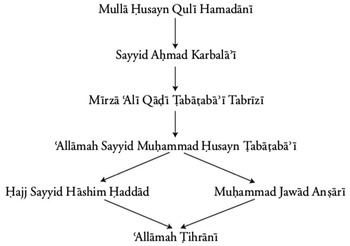
As Anzali implies, the use of the term ʿirfān in the modern era was applied to three groups. The first group continued Damawandī’s approach to ʿirfān. Here, a hierarchical order of knowers (ʿurafāʾ) was formed with a Sufi-like chain. This began with Mullā Ḥusayn Qulī Hamadanī (d. 1823), succeeded by ʿAllāma Sayyid Muḥammad Ḥusayn Ṭabāṭabāʾī (d. 1981), who was recognized during his lifetime as the knower of the age. He was succeeded by ʿAllāma Ḥassan Ḥassanzādeh Āmulī (b. 1928), whom many consider the knower of the twenty-first century.
Like Damawandī, many of those shown in Figure 1 claimed to have been either disciples of one of the Twelve Imāms or at least inspired by them. Furthermore, they all underwent training at one of the shrined-cities seminaries and subscribed to the schools of Mullā Ṣadrā. It is ironic that Anzali focused on Ayatollah Morteza Moṭahharī (d. 1980) in his last chapter, instead of any of the twentieth-century figures, given the intellectual differences between Moṭahharī and his teacher Muḥammad Ḥusayn Ṭabāṭabāʾī.Footnote 6
Chart borrowed from Ṭihrānī, Kernel of Kernels, p. xvii.

The second group that used the term ʿirfān were Iranian scholars in western academic circles. Anzali mentions Mohammad-Hoseyn Faroqi (d. 1907), who defined ʿirfān as that which must be “defended by modern reasoning and interpretation” (p. 198). Included in this group is the Qazwin-born, Najaf-trained, Keyvan Qazvinī (d. 1938), who spent much of his early life with branches of the Niʿmatullāhī Sufi order but became disillusioned with them due to political differences. Qazvinī created his own definition of ʿirfān as “a universal concept, unbound by particular religious creeds or institutions.” Anzali comments that Qazvinī’s definition of ʿirfān is associated with mystical intuition, which complements the rational basis to philosophy. The last group that employed the term ʿirfān in the modern period were the Niʿmatullāhī Sufis, who returned to Iran after three centuries of exile in India.
Given the importance of seminaries in the modern Shīʿite world, and Anzali’s lack of attention to them, it should be noted that the majority of Shīʿite seminaries are not mystically oriented (Najaf, Karbala, Qom, and Mashhad). Furthermore, only after a scholar has attained the rank of high jurist (Ayatollāh al-ʿUẓmāʾ, lit. Great Sign of God) can he be allowed to approach a scholar of mysticism for teachings and initiation, which give him the ability to embark on the path towards ʿirfān.
While the value of Anzali’s book cannot be overlooked, his work could have been improved with the following considerations. First, although Anzali approaches the topic of ʿirfān from a historical perspective, he never explicitly states which historical or historiographical tools he employed to verify his arguments. Furthermore, he takes many events in the history and transformation of ʿirfān uncritically for granted .
Second, the work is replete with untranslated Arabic and Persian terms and titles. Furthermore, many Arabic titles are transliterated in Persian, thus creating Arabic mistakes. Anzali also confuses the concepts of walāya and wilāya in his analysis of Dārābī’s thought, thus leading the reader to believe that walāya concerns spiritual authority when its “semantic fraternal twin,” wilāya, actually pertains to this concept. Footnote 7 Given the number of works that Anzali references, and their importance, it would have been better if he had included a bibliography of relevant texts. While the majority of the book is clearly written, it suffers from several errors. For example, toponymics that are mentioned are not given clear locations, and the reader has to visit the index to find clearer definitions. Starting on page 112, Anzali mentions the “ʿAtabat” without explicitly mentioning that it refers to the shrine cities of Iraq—Najaf, Karbalā, Kāẓemayn, and Samarra, where six of the twelve Shīʿite Imāms are buried. Moreover, he inconsistently names places as “holy” without providing a reason. Furthermore, when Anzali introduces different Shīʿite theological schools such as the Akhbārīs or the Uṣūlīs, he fails to mention why these schools are different and what differentiates one from the other. Aside from these distracting errors, this work employs a very confusing footnote system and has small spelling errors such as “Kabala” instead of “Karbala.” Throughout this work, the publisher has employed an asterisk (*) and cross (‡) footnote system, which is confusing to the reader. Lastly, in certain places the writing style made the text difficult to comprehend.
Anzali deserves much praise for writing a nearly complete overview of the development of mysticism in Iran from the Shīʿite Safavid period to the Islamic Revolution. He provides a much-needed history of the term ʿirfān and its uses from the Safavid period onward. Furthermore, he reconciles seemingly contradictory views regarding the history of ʿirfān, without compromising the distinctions of its use in different parts of the religious hierarchies. Anzali’s novel approach to the term ʿirfān and its history can lead to new discussions of chronology, theology, and philosophy in the Shīʿite and wider Islamic world. Given its breadth and depth, Anzali’s work is a model for evaluating little studied topics in Islamic philosophy from a critical perspective. It could be profitably used in a class surveying Islamic mysticism in the Shīʿite world and should not be limited to serving merely as a reference book to ʿirfān.