Implication
A total of 140 Tibetan Mastiffs sampled in China were investigated using 10 microsatellite loci at the first time. A highly significant deficiency in heterozygote was observed within populations, along with strong inbreeding coefficients, suggesting that intense inbreeding occurred in Tibetan Mastiff. Therefore, effective and appropriate breeding management projects in present Tibetan Mastiff will be desirable and urgent.
Introduction
Tibetan Mastiff, known as ‘oriental deiform dog’ and one of the most archaic and ferocious breeds in the world, distributes mainly in Tibet, Qinghai, Gansu and Sichuan provinces of China, and used as guard dog in China from 1000 BC. It was described by Marco Polo, one of the most famous travelers in 13th Century, as ‘as big as donkey, when running they are as swift as the tiger, roaring as loud as the lion, with good looking’. In the beginning of the 13th century, Tibetan Mastiff was introduced into the West following the Mongolian army of Genghis Khan, for improving the germplasm of local large dog breeds, such as Sain Bernard (Switzerland), English Shepherd (England), Pyrenean Mountain dog (France) and Great Dane (Germany) (Ni, Reference Ni2004). In 1996, Tibetan Mastiff was registered as a breed in American Kennel Club. Unfortunately, because of the huge profits, the outflows of Tibetan Mastiff have become much more serious since the 1980s, resulting in a great decrease in the basic group. It has reported that there are approximate 300 000 Tibetan Mastiffs, but no more than 100 high quality and purebred individuals, of which less than 20 are in America and 10 in Taiwan, China (Li et al., Reference Li, Liu, Li, Zhao, Dong, Pan, Sun, Li, Xu and Xie2008). Therefore, their protection, utilization and research are extremely urgent. However, to our knowledge, there are few published literatures related to Tibetan Mastiff at the molecular level. Herein, the purpose of this study was to investigate the genetic diversity of Tibetan Mastiff distributed in China based on microsatellite loci.
Material and methods
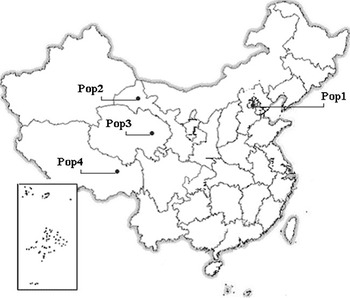
In this study, we collected blood samples from a total of 140 unrelated individuals in four geographically separated regions of China, including Tibet Autonomous Region (n = 20), Gansu Province (n = 19), Qinghai Province (n = 45) and Beijing City (n = 56) (Figure 1). Ten polymorphic markers on eight different chromosomes were selected from the commercial StockMarks® Dogs Parentage Typing Kit (Applied Biosystems, Foster City, CA, USA). Forward primers for these loci were labeled with fluorescence dyes of FAM or HEX (Sangon, Shanghai, China). Genomic DNA used for polymerase chain reactions was extracted from blood samples using the conventional phenol/chloroform extraction method. Markers were amplified in a 15-μl PCR mixture with optimal annealing temperatures. Amplifications were performed in a PTC-200 Thermal Cycler (Bio-Rad, CA, USA). PCR products were diluted and analyzed on an ABI PRISM®3130XL Genetic Analyzer and were recorded with GeneMapper™ Genotyping version 3.7 (Applied Biosystems, Foster City, CA, USA). Observed heterozygosity (HO), expected heterozygosity (HE), polymorphism information content (PIC) (Botstein et al., Reference Botstein, White, Skolnick and Davis1980) and Hardy–Weinberg equilibrium (HWE) test were calculated using CERVUS v.2.0 (Marshall et al., Reference Marshall, Slate, Kruuk and Pemberton1998). Weir and Cockerham F-statistics (FIT, FST, FIS) (Weir and Cockerham, Reference Weir and Cockerham1984) and allelic richness were calculated using FSTAT v.2.9.3. Coancestral genetic distances between pairs of Mastiff populations were computed using GDA (version 1.1) software package (Weir, Reference Weir1996). Inbreeding coefficients (Fis) within populations were counted with GENEPOP computer package (version 4.0.7) (Rousset, Reference Rousset2008).
Sampling locations of four Tibetan Mastiff populations in China. Pop1: Beijing City (n = 56); Pop2: Gansu Province (n = 19); Pop3: Qinghai Province (n = 45); Pop4: Tibet Autonomous Region (n = 20). Rectangle: south ocean and islands of China.

Results and discussion
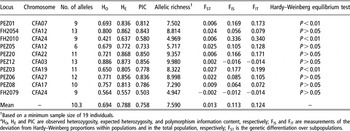
A total of 103 alleles were detected at the 10 loci assayed in four Tibetan Mastiff populations, and the number of alleles ranged from 6 (PEZ05) to 13 (PEZ12 and FH2054) alleles per locus (Table 1). All loci showed sufficient polymorphism for evaluating genetic diversity. Deviations from HWE were statistically significant (P ⩽ 0.05) and three of ten markers showed significant deviation from HWE. The HO for 10 loci ranged from 0.421 (FH2010) to 0.886 (PEZ12), with an average of 0.694 (Table 1). The HO was lower than the expected HE at each locus except PEZ12. Inbreeding coefficients for samples collected from Beijing (Fis = 0.093), Gansu (Fis = 0.126), Qinghai (Fis = 0.102) and Tibet (Fis = 0.167) suggested obviously heterozygote deficit across loci in the population samples. The average PIC value was 0.758, ranging from 0.503 (FH2079) to 0.856 (PEZ12). Allelic richness based on a minimum sample size of 19 individuals varied from 4.947 (FH2079) to 9.980 (PEZ12), with an average of 7.590 (Table 1). The mean FST, FIS and FIT values at these loci were 0.013, 0.113 and 0.124, respectively.
Characterization of 10 microsatellite loci in Tibetan Mastiff (n = 140)Footnote a

1 Based on a minimum sample size of 19 individuals.
a HO, HE and PIC are observed heterozygosity, expected heterozygosity, and polymorphism information content, respectively; FIS and FIT are measurements of the deviation from Hardy–Weinberg proportions within populations and in the total population, respectively; FST is the genetic differentiation over subpopulations.
Tibetan Mastiff is one of the most ancient and rare breeds and is also the ancestor of many large breed dogs in the world (Wang et al., Reference Wang, Shi, Yu, Feng and Song2003; Ni, Reference Ni2004; Li et al., Reference Li, Liu, Li, Zhao, Dong, Pan, Sun, Li, Xu and Xie2008). However, as reported by Wang et al. (Reference Wang, Shi, Yu, Feng and Song2003), the purebred Tibetan Mastiff is at the edge of extinction because of the changed environment and improper mating project after purchased and departed from their hometowns. In this study, Tibetan Mastiffs from four different locations were investigated by using 10 microsatellite loci. Results showed relatively high levels of genetic diversity, with an average HO value of 0.694, along with allelic richness for the whole breed (7.59), which presumably is the lack of official systematic artificial selection. Another reason may be due to the short time inbreeding practice within populations despite the sudden huge profits since 1980s. However, a highly significant deficiency in heterozygote was found within populations (mean FIS = 0.11, bootstrap 95% confidence interval (0.06, 0.17)) and total inbreeding (mean FIT = 0.12, bootstrap 95% confidence interval (0.06, 0.18)), together with strong inbreeding coefficients within populations (Fis > 0.09). Results indicated that Tibetan Mastiffs were suffering from a loss of genetic variation and inbreeding depression. The first reason may be the existence of genetic isolation because of the rare founders and remote and isolated locations in Qinghai-Tibet plateau of China. The second reason may be attributed to the sudden huge profits since 1980s, which resulted in high degree of inbreeding practice within populations. Dog breeds are required to conform to a breed standard, the pursuit of which often involves intensive inbreeding, including use of ‘popular’ sires. Therefore, possible remedial action includes limits on the use of popular sires and encouragement of matings across locations and nations. In addition, line breeding or repeats of the same matings may also cause a deficit of heterozygotes and maintain large differences in allele frequencies. DeNise et al. (Reference DeNise, Johnston, Halverson, Marshall, Rosenfeld, McKenna, Sharp and Edwards2004) have reported the genetic characteristics of Mastiff (n = 121) in American Kennel Club (AKC) by using the same microsatellite loci. The mean number of alleles, HE, HO, PIC and inbreeding coefficient were 5.1, 0.52, 0.51, 0.46 and 0.031, respectively, all of which were lower than the observed in this study. Lower genetic diversity may be due to the founder effects of Mastiff in AKC. Scientific breeding program by breeders and rigid registration rules in AKC may be the main reasons for lower inbreeding coefficient. Additionally, they have also researched the genetic characteristics of Tibetan spaniel and Terrier and obtained lower values compared to the results in this study as well (DeNise et al., Reference DeNise, Johnston, Halverson, Marshall, Rosenfeld, McKenna, Sharp and Edwards2004).
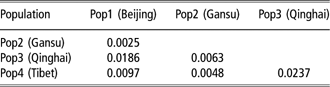
Although the four populations have common historical origins, the inter-population gene flow among populations may be prevented by isolated locations, which could result in great genetic differentiation. Unexpectedly, the overall FST value (0.013) revealed little genetic differentiation among the study populations. Approximately 1.3% of the total genetic variation could be attributed to differences among populations, the remaining 98.7% being accounted for by differentiation among individuals within populations. Therefore, the traditional uncontrolled mating practices and lack of breed improvement projects could avoid genetic differentiation within populations. Additionally, the coancestral genetic distances were computed by using GDA software version 1.1 (Table 2). Four Tibetan Mastiff populations showed close relationships in neighbor-joining polygenetic tree, and Tibetan Mastiff from Beijing and Tibet were clustered together, coinciding with the records that founders of Tibetan Mastiff in Beijing were taken from Tibet as pets since the 1980s.
Coancestral genetic distances between pairs of Tibetan Mastiff populations

In summary, the study populations exhibited relatively high genetic diversity in Tibetan Mastiff, which is important for future breed development. However, the Tibetan Mastiffs are at risk of becoming genetically homogenous because of high degree of inbreeding practices. Though relative small marker sets have been used in this study, the assessment of genetic characteristics in Tibetan Mastiff will help for the understanding of present situation at the molecular level, breed conservation and utilization.
Acknowledgements
We appreciate the assistance of other colleagues in police dog base of Nanchang. This study was financially supported by the Application and Innovation Program of Ministry of Public Security (2007YYCXNCJQ160) and Doctoral Starting Foundation of Jiangxi Agricultural University of China (2676).