Introduction
On average, 88 tropical storms occur each year on the Earth’s waters, among which, 48 become tropical cyclones.Reference Shultz, Russell and Espinel 1 These weather events are among the most devastating natural disasters and represent about 20% of deaths and damage around the world. Their potential for destruction caused by cyclonic winds, torrential rains, and storm surges (sometimes accompanied by floods, tornadoes, and landslides) depends on their intensity, structure, and duration. Each year, tropical cyclones produce thousands of victims and considerable damages.
The Southwest Indian Ocean is particularly concerned by these weather events. In Reunion Island (France), the cyclonic threat stretches from December through April each year, with a maximum risk on the first three months of the austral summer between January and March. In this context, the Prefecture organized a regional response plan, which included a health component about epidemiological surveillance. 2 The main objective of this surveillance was to orientate public health control measures.
At the beginning of January 2014, a tropical cyclone named Bejisa occurred. At 12:00 pm on December 31, 2013, the Prefecture issued a cyclone early warning for Reunion Island. The orange alert was triggered on January 1st with a “heavy swell,” “strong wind,” and “heavy rain” warning. The red alert was activated on January 2, 2014 at 10:00 am. The eye of the cyclone passed 30 miles, and the eye-wall about nine miles, from the west coast of the island. Bejisa produced strong wind gusts with an average of 130-150 km/h along the coast. The swell reached seven to eight meters, and more than 600 millimeters of rainfall were measured over 24 hours.
Bejisa disturbed electricity supply and drinking water systems. On January 3, 2014, 171,000 homes had a power outage, and 60% of households did not have drinking water anymore. In several municipalities, floods, roof destruction, and the threat of landslides led to the evacuation of about 800 residents to emergency shelters. Thirty percent of cell phone service was temporarily lost due to the blackout. Main roads were closed after the cyclone. It took several days to restore the drinking water supply and electricity, especially in the western and southern parts of the island. The state of natural disaster was declared in Reunion Island, and there was a major economic impact with several million Euros of damage.
In this context, the Regional Office of French Institute for Public Health Surveillance in Indian Ocean (Cire OI; Saint-Maurice, Paris, France) set up an epidemiological surveillance in order to assess the health impact in the aftermath of Cyclone Bejisa. The objective of this surveillance was to describe short-term health effects of the cyclone using a syndromic surveillance system and a medical chart review from January 2, 2014 through January 5, 2014.
Methods
Reunion Island
Reunion Island is a French overseas territory located in the Southwest Indian Ocean, at 5,900 miles of France and 500 miles of Madagascar. There is a tropical climate with two main seasons: a hot and rainy season from November through April (“austral summer”), and a dry season from May through October (“austral winter”). The population was estimated at 840,000 inhabitants in 2013. Medical facilities are similar to those in metropolitan France.
Data Sources
The assessment of the short-term health effects in the aftermath of Cyclone Bejisa was based on several data sources:
-
1. a syndromic surveillance system based on all emergency departments (EDs) of the island (Organisation de la Surveillance Coordonnée des Urgences (OSCOUR; Saint-Maurice, Paris, France) network).Reference Vilain and Filleul 3 Data were collected each day directly from patients’ computerized medical files that were filled in during medical consultations at EDs. Among the collected variables, the diagnosis was categorized according to the 10th revision of the International Classification of Diseases (ICD-10). This surveillance system was completed by aggregated data of Emergency Medical Services (EMS);
-
2. a network of sentinel general practitioners (GPs), based on the voluntary participation of 57 GPs and two pediatricians, who monitored continuously the weekly number of consultations for acute diarrhea and acute respiratory infections;Reference Filleul, Brottet and Gauzere 4 , Reference Caillère, Vilain and Brottet 5
-
3. the notifiable diseases surveillance system. Surveillance data reported were in individual case-specific form. The objective was to detect outbreaks and to monitor trends of 31 notifiable diseases;
-
4. the regional surveillance systems of leptospirosis and arboviruses based on the case report by physicians and laboratories of the island;Reference Pagès, Polycarpe and Dehecq 6 , Reference Larrieu, Dehecq and Balleydier 7
-
5. a toxicovigilance network based on the case report by different partners (pharmacists, school medicine, and EDs); and
-
6. the surveillance of mortality by analyzing every paper death certificate and electronic death certification where “cyclone” was mentioned as cause of death.Reference Vilain and Filleul 3
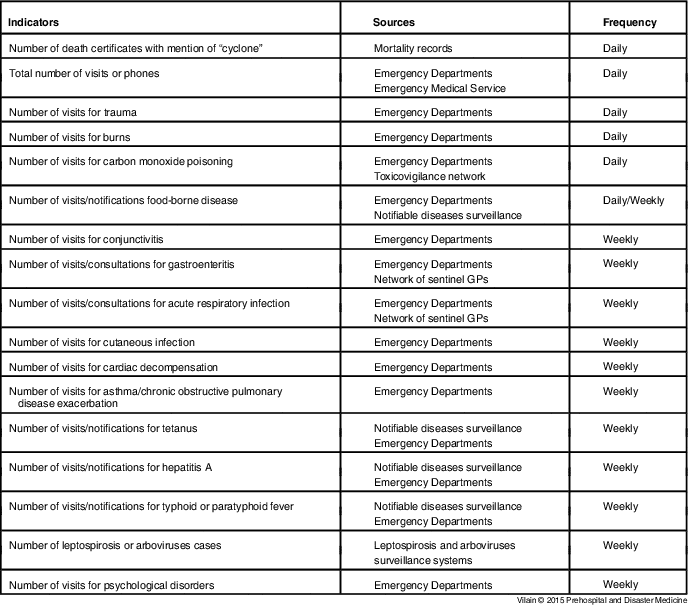
Several health indicators were collected from the literature review and past experiences (Table 1). At the same time, ED physicians were requested by mail and fax to code all visits related to the cyclone in secondary diagnosis (ICD-10:X37).
Indicators Collected for the Health Impact Assessment of Cyclone Bejisa, Reunion Island, France

Abbreviation: GPs, general practitioner.
Analysis
Daily indicators were analyzed using the C2 aberration detection algorithm. For this method, the baseline used for the mean and standard deviation was 28 days and began two days before the current day (ie, t-3 to t-30). For weekly indicators, the threshold was defined using the method of Farringhton with a baseline of three years. This method uses a model of log-linear regression that takes into account the trend, the seasonality, and the previous epidemics.
Retrospective Study of ED Visits
A retrospective study of ED visits was conducted in order to complete the health impact assessment. All medical charts recorded in the EDs of Reunion Island from January 2, 2014 through January 5, 2014 were reviewed according to the standards for chart review.Reference Worster, Bledsoe, Cleve, Fernandes, Upadhye and Eva 8 Medical records were included in the study according to the following case definitions:
-
1. directly related visits corresponded to visits caused by the physical forces of the cyclone; and
-
2. indirectly related visits were defined by an alteration of health conditions, or by the exacerbation of a chronic disease or trauma consecutive to the damage caused by the cyclone.
Data were collected anonymously from medical records using a standardized form made up of three parts:
-
1. visit information (hospital, date and time of visit, and city);
-
2. patient information (gender and age); and
-
3. reason for visit (type and mechanism of injury, acute illness, exacerbation of chronic disease, mental health, and accommodation).
Data were entered into Microsoft Office Access 2007 (Microsoft Corporation; Redmond, Washington USA). The descriptive analysis was performed with STATA 11.0 (College Station, Texas USA).
This study was conducted in accordance with the authorization n°314194 V42 National Commission on Information and Liberty relating to urgent investigations.
All institutional review boards of the hospitals included in this research approved the study for expedited review with waivers of patient consent.
Results
The number of calls to the EMS peaked the day of the cyclone. During that day, EMS received 5,110 calls (1,500 medical records). Among medical records, 10% were linked to the cyclone (anxiety, injuries, and interruption of oxygen therapy at home due to power outages).
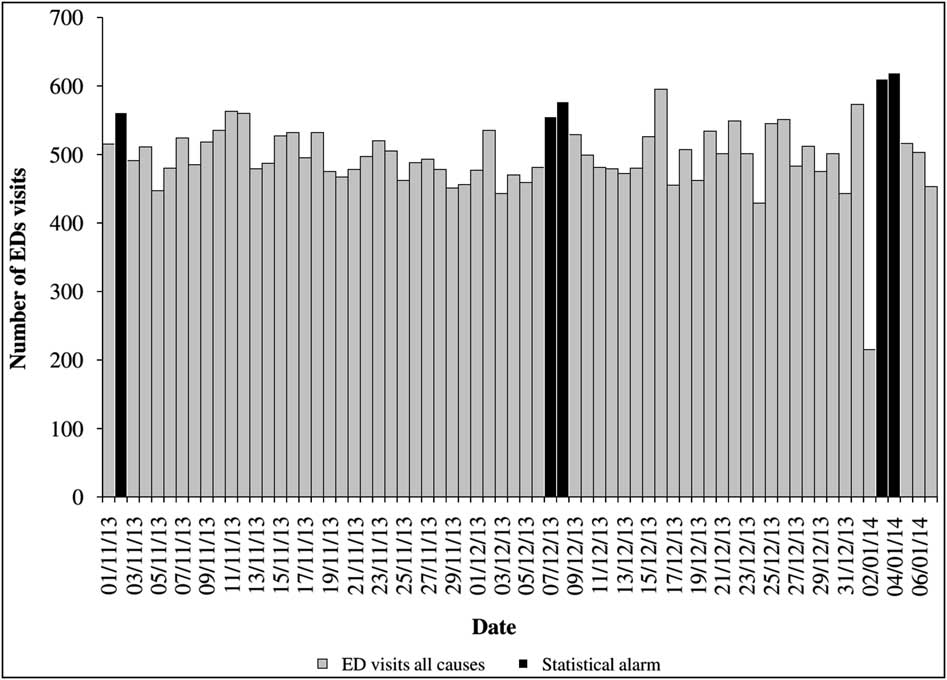
The number of ED visits dropped the day of the cyclone, then increased markedly over the next two days. Between January 3, 2014 and January 4, 2014, respectively, 610 and 619 visits were recorded (Figure 1). This increase was significantly higher in the western (January 3) and southern (January 4) EDs.
Daily Visits to Emergency Departments, Reunion Island, France; November 1, 2013 through January 7, 2014.
Abbreviation: ED, emergency department.

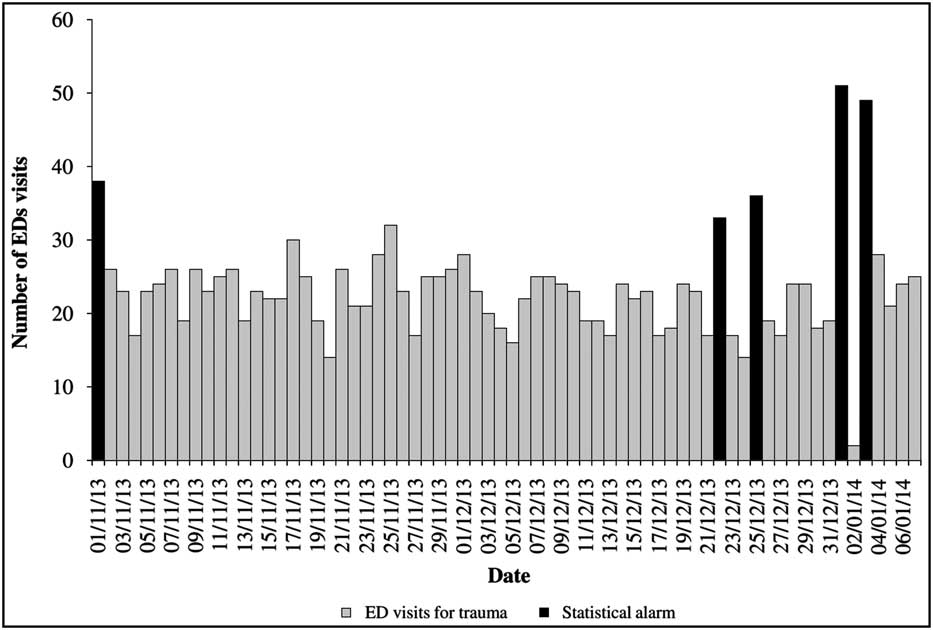
At the same time, a significant increase in visits for trauma and burns was detected. However, it regarded mainly the western EDs of the island as the most-affected area (Figure 2). The increase in visits for trauma observed on January 1, 2014 was related to a mass gathering for New Year’s Day (about 20,000 people on the west coast). This phenomenon had already been observed in previous years.
Daily Visits to Emergency Departments for Trauma, Hospital Center of the Western Reunion Island, France; November 1, 2013 through January 7, 2014.
Abbreviation: ED, emergency department.

From January 2, 2014 through January 7, 2014, six visits for carbon monoxide poisoning were detected in the southern ED by the syndromic surveillance system. Epidemiological investigations allowed the authors to identify an inappropriate use of generators. Two death certificates stating “cyclone” were recorded. The deceased persons lived alone, and for each of them, a mechanism of fall was identified.
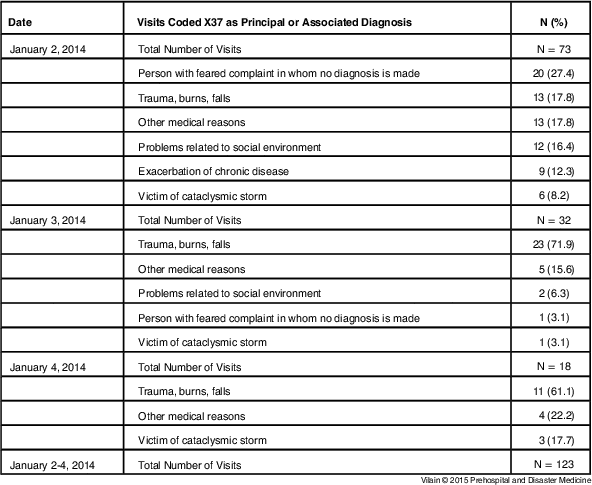
Table 2 shows the distribution of visits coded “X37” as principal or associated diagnosis in the EDs of Reunion Island. Between January 2, 2014 through January 5, 2014, 123 visits were identified as directly or indirectly related to the cyclone.
Distribution of Visits Coded X37 in Principal or Associated Diagnosis, January 2 through January 5, 2014 in Emergency Departments, Reunion Island, France

During the red alert (January 2, 2014), these visits mainly regarded patients who required continuity of care (home care patients). For January 3, 2014, trauma and burns were the leading etiology of visits.
No significant increase in visits for cardiac decompensation, asthma or chronic obstructive pulmonary disease exacerbation, food-borne disease, acute respiratory or diarrhea illness, cutaneous infection, and psychological disorders were detected in the weeks after Bejisa. However, an increase in visits for conjunctivitis was reported the week of the cyclone, among which, 70% occurred between January 3, 2014 and January 5, 2014. No autochthonous case of typhoid or paratyphoid fever and hepatitis was reported. During the five weeks after the cyclone, 10 confirmed cases of leptospirosis were identified. Among them, the epidemiological investigation enabled a link of seven cases to the cyclone.
Records of all ED visits from January 2, 2014 through January 5, 2014 were reviewed. Among 1,748 medical records, 216 were included in the study. Eight visits were directly related to the cyclone and 208 were indirectly related. Male/female sex ratio was 1.7 (136/80). Average age was 55 (4-98) and significantly different (P<.05) of average age (42 years) of all visits.
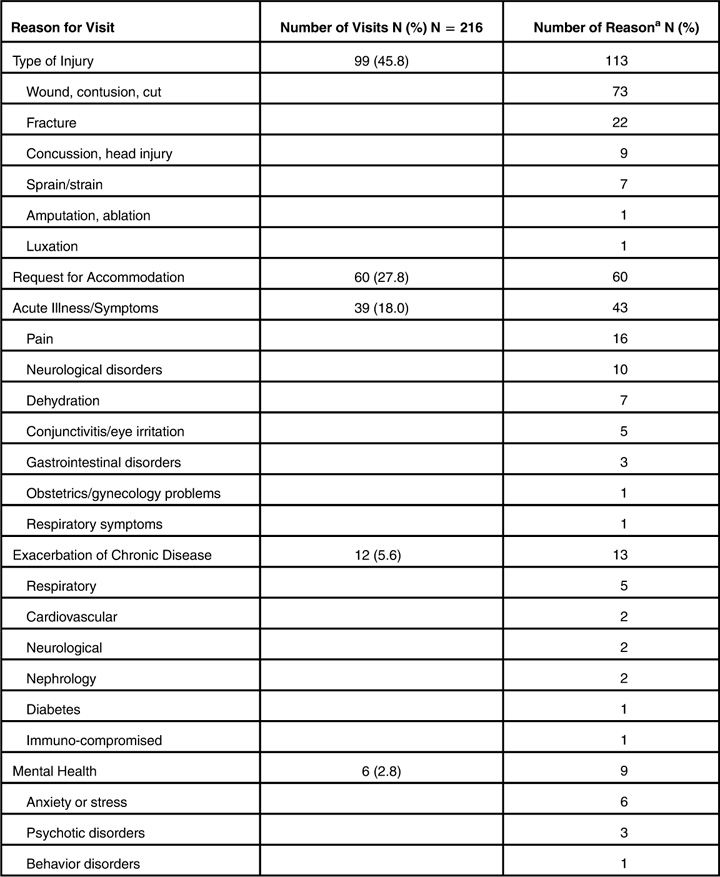
Table 3 shows the reasons of visits related to Cyclone Bejisa. Injuries represented nearly half of the visits (45.8%), mainly for wounds, contusions, and fractures. The second most common reason was a request for accommodation (27.8%), whose majority occurred on January 2, 2014 during the red alert. It regarded home care patients requesting a continuity of care. For January 3, the visits were related to power outages for patients with oxygen therapy at home. Acute illnesses represented only a small proportion of visits (18.0%) directly or indirectly related to the cyclone. The most common symptoms were pain (mainly thoracic and abdominal) and neurological disorders (of which, more than half were seizures due to alcohol withdrawal). For conjunctivitis, no infectious agent was identified because it corresponded to a trauma related to the introduction of a foreign body. To a lesser extent, an exacerbation of a chronic disease (5.6%) or neurological disorder (2.8%) was also identified.
Number of Directly and Indirectly Related Visits to Cyclone Bejisa by Reason, January 2 through January 5, 2014, in Emergency Departments, Reunion Island, France

a A patient could have several reasons.
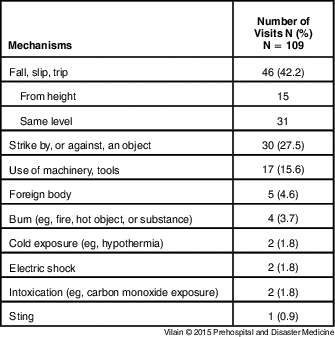
Table 4 shows the distribution of mechanisms causing injury, pain, or conjunctivitis. In 42% of cases, a fall from a height (most often a ladder) or from the same level (mainly slippery surfaces) was reported. About 30% of patients with a trauma were struck by, or against, an object. The most frequently identified elements were metal slabs, doors, and wood. The use of machinery or tools during clean-up or repair works was reported for 15.6% of injuries. In most cases, the trauma was due to the use of a chainsaw or a saber. Other mechanisms were burns (3.7%), hypothermia (1.8%), electrocution (1.8%), carbon monoxide poisoning (1.8%), and sting (0.9%).
Distribution of Mechanisms Causing Injury, Pain, or Conjunctivitis, January 2 through January 5, 2014, Emergency Departments, Reunion Island, France

Discussion
The epidemiological surveillance established by the Cire OI allowed the authors to assess rapidly the health impact of Cyclone Bejisa on Reunion Island. Short-term health effects were evaluated thanks to the reactivity and flexibility of the syndromic surveillance system based on the near real-time transmission of data from EDs. Indeed, health authorities need reliable information rapidly on health risks for the exposed population. However, traditional data sources focuses on notifiable diseases with significant time delays. Therefore, the syndromic surveillance system OSCOUR appears to be an adapted response in this context.Reference Hope, Merritt and Eastwood 9 At the end of the red alert, a preliminary report was written and sent to health authorities.
A peak of calls to EMS was recorded during the red alert (January 2, 2014) and a situation of overcrowding was observed in EDs during the post cyclone period (January 3 and January 4, 2014). These trends had also been described during Hurricanes Gloria (1985), Elena (1985), and Isabel (2003) in the United States. 10 , Reference Smith and Graffeo 11 However, the flow of patients in EDs may have intensified due, on the one hand, to a reduced care access in private practice the next day (Friday, January 3, 2014) and the weekend following the cyclone (Saturday, January 4 and Sunday January 5, 2014), and on the other hand, to a possible postponement of ED visits from Thursday to Friday caused by a traffic ban during the red alert (Thursday, January 2, 2014). 10
Overall, the data of OSCOUR network allowed the authors to detect a significant increase in visits for trauma, 10 , Reference Miller, Kearney and Proescholdbell 12 , 13 burns,Reference Rainey, Cruse, Smith, Smith, Jones and Cobb 14 and carbon monoxide poisoning, 15 - 17 as described in the literature, more particularly on EDs located in the west of the island (the area which was the most affected by the cyclone).
The specific coding implemented in EDs and EMS attributed the trends (increase in calls and ED visits) to the cyclone, although the main diagnosis was not specified for 12% of visits coded “cataclysmic storm” (X37). In fact, the continuity of this specific encoding could not be carried out by ED physicians because of the overcrowding and computer failures (due to power outages). Consequently, there was probably an underestimation of visits directly or indirectly related to the cyclone, especially for trauma.
In order to improve the assessment of health impact and to overcome the difficulties of coding, a retrospective study was carried out in EDs based on a medical chart review over the period of January 2, 2014 through January 5, 2014. Data allowed the authors to identify visits related to Cyclone Bejisa and to describe the causes and associated mechanisms. Visits related to the physical forces of the storm actually constituted a small proportion (4%) due to a compliance with safety procedures by the population. As for visits indirectly related to the cyclone, about 50% were due to trauma, as described in other studies. Usually, during a post-cyclone period, trauma represent the main cause of ED visits. 13 , 18 - 20 These traumas are mainly minor injuries such as lacerations, abrasions, contusions, puncture wounds, sprains, and fractures.Reference Shultz, Russell and Espinel 1
In 40% of cases, a fall was identified as the mechanism of these injuries; a similar result was found after Hurricane Irene in Eastern North Carolina (USA).Reference Miller, Kearney and Proescholdbell 12 In this study, as in the literature, injuries resulting from the use of machinery or tools (eg, chainsaw and saber), or from a shock by, or against, an object (eg, sheet metal and branch) were observed during clean-up or repair works.Reference Miller, Kearney and Proescholdbell 12 , Reference Noji 21 - Reference Sullivent, West, Noe, Thomas, Wallace and Leeb 23 For burns,Reference Miller, Kearney and Proescholdbell 12 , 13 , 18 hypothermia, 20 electrocution, 13 dog bites, 13 , 24 or carbon monoxide poisoning, 20 , 25 the results were comparable to those found in similar events.
This retrospective study was carried out in accordance with most of the chart review standards.Reference Worster, Bledsoe, Cleve, Fernandes, Upadhye and Eva 8 Only the criteria concerning the abstractors (from five to eight) couldn’t be respected since the review was performed by the two epidemiologists who investigated.
The reactivity of EMS with health authorities allowed to orientate the patients hospitalized at home or in institutions toward EDs during the red alert. However, 20% of accommodation requests for care continuity occurred in the days after Bejisa due to prolonged power outage. Among the 12 patients with an exacerbation of a chronic disease, five of them decompensated for a chronic obstructive pulmonary disease due to the absence of oxygen or aerosols at home (also related to power failure). During a post-cyclone period, the management of patients with chronic diseases constitutes a public health priority. In fact, past experiences showed a high morbidity and mortality among such patients, mostly due to an interruption in the continuity of care.Reference Mokdad, Mensah, Posner, Reed, Simoes and Engelgau 26 After Hurricane Katrina (2005) in the United States, chronic diseases (renal failure, asthma, and diabetes) accounted for nearly 33% of consultations. 19
In total, 70% of visits coded X37 by ED physicians have been identified by this retrospective study. For the remaining 30%, case definitions had not been respected. Although the results of this study allowed the authors to characterize and to assess short-term health effects of Bejisa, these effects might still be underestimated. Indeed, during the study, some visits were not included because complementary elements did not allow the authors to attribute them to the cyclone. This limit has also been described in the literature. 10
The analysis of death certificates identified two deaths caused by the cyclone; however, this number is probably underestimated because other deaths due, for example, to an exacerbation of a chronic condition, may have occurred later.
Contrary to similar events, 19 , 27 , Reference Lee, Fonseca and Brett 28 no increase in gastrointestinal or respiratory disease was detected during the weeks following the cyclone. In parallel, no increase in hepatitis A, typhoid, or paratyphoid cases was notified. These diseases are frequently observed in countries where health and water infrastructures are not developed.Reference Shultz, Russell and Espinel 1
Data from laboratories allowed the authors to detect an increase in leptospirosis cases two weeks after the cyclone. This result had already been described in the literature.Reference Sanders, Rigau-Pérez and Smits 29 , 30 Epidemiological investigations allowed to link part of these cases to post-cyclone clean-up or repair works.
Limitations
The absence of data about the psychological impact is one of the main limits of this assessment. During the storm Xynthia in France in 2010, this impact had been measured from data of medico-psychological emergency cell,Reference Raguenaud, Germonneau and Leseigneur 31 which has not been activated in Reunion Island.
Despite the available data, the health impact might still be underestimated. In fact, as general practitioners took up their activities on January 6, 2014, patients suffering from minor injuries or from injuries that occurred during clean-up works may have seen a doctor directly in town.
In the future, several lines of work should be planned by the authors in order to improve the assessment:
-
1. provide feedback to emergency physicians in order to improve the coding;
-
2. collect data of the National Health Insurance on the consumption of anxiolytic and antidepressant drugs in order to assess the psychological impact; and
-
3. develop a partnership with EMS in order to get individual data regarding the calls.
Conclusion
Information based on the syndromic surveillance system OSCOUR allowed the authors to assess rapidly the health impact of Cyclone Bejisa in Reunion Island. This impact was observed essentially in EMS and EDs because care access was reduced in private practices after the cyclone. During the red alert, the health component of the response plan was activated: home care patients were oriented to EDs. The days after the cyclone were characterized by an increase in trauma due to clean-up and repair works.