INTRODUCTION
Cold exposure is one of the stresses which result in a variety of negative effects on productivity of livestock through modified digestive, metabolic and endocrine functions (Kennedy et al. Reference Kennedy, Christopherson and Milligan1976; Young et al. Reference Young, Walker, Dixon and Walker1989; von Keyserlingk & Mathison Reference von Keyserlingk and Mathison1993). Animals exposed to cold must generate more heat from oxidation of substrates from their diet and body reserves to maintain their body temperature. Heat production and pool size and turnover rate of blood glucose, one of the major energy sources, increase during cold exposure in ruminants (Sano et al. Reference Sano, Nakamura, Kobayashi, Takahashi and Terashima1995, Reference Sano, Sawada, Takenami, Oda and Al-Mamun2007).
Dietary intake level also influences intermediary and protein metabolism in ruminants (Schmidt & Keith Reference Schmidt and Keith1983; Savary-Auzeloux et al. Reference Savary-Auzeloux, Hoskin and Lobley2003). Intake level and metabolizable protein (MP), consisting of digestible microbial true protein and digestible undegradable feed protein, influence whole body protein synthesis (WBPS) in lactating cows, growing beef steers and young sheep (Liu et al. Reference Liu, Mata, O'Donoghue and Masters1998; Lapierre et al. Reference Lapierre, Bernier, Dubreuil, Reynolds, Farmer, Ouellet and Lobley1999, Reference Lapierre, Blouin, Bernier, Reynolds, Dubreuil and Lobley2002). Less is known regarding the effects of cold exposure on amino acid metabolism and WBPS under varying dietary inputs. It was hypothesized that intake level might modulate the stress of cold exposure on animals through modification of intermediary metabolism and endocrine function. However, less information about the effects of intake level and cold exposure on amino acid and protein metabolism using isotopic measurements is available in ruminants. Scott et al. (Reference Scott, Christopherson, Thompson and Baracos1993) reported that in Holstein calves phenylalanine flux was elevated during prolonged cold exposure (−5°C for 57 days), but the response of fractional and absolute protein synthesis to prolonged cold exposure differed between two dietary intake levels.
The current experiment was designed to measure kinetics of plasma leucine (Leu), as measured by the isotope dilution method, and to calculate WBPS combined with determination of Leu oxidation (LeuOX) rate using open-circuit calorimetry in sheep fed at two intake levels and changed from a thermoneutral environment to a cold environment.
MATERIALS AND METHODS
Animals, diets and cold exposure
All the experimental procedures were reviewed and approved by the Animal Care Committee of Iwate University. Experiments were carried out without noticeable stress to the animals, except for cold exposure.
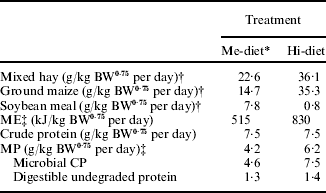
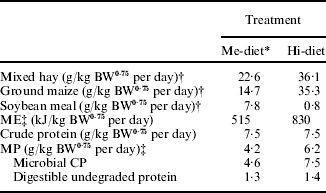
Six crossbred (Corriedale×Suffolk) shorn sheep (three non-lactating, non-pregnant ewes and three rams), aged 2–3 years and weighing 46±1 kg, were used. The sheep were surgically prepared under general anaesthesia with a skin loop enclosing the left carotid artery (Linzell Reference Linzell1963) at least 3 months before the experiment began and shorn closely immediately before the start of the experiment. The experiment utilized a crossover design with two 23-day periods. Animals were housed in individual pens in an animal room during the preliminary period and the first 2 weeks of the experiment. The sheep were then moved to metabolic cages in a controlled environment chamber at an air temperature of 23±1°C, and lighting present from 07.00 h to 21.00 h. The temperatures of the thermoneutral (23°C) and cold (2–4°C) environments in the present experiment were similar to those used by Kennedy & Milligan (Reference Kennedy and Milligan1978). The basal diet consisted of mixed hay of orchardgrass (Dactylis glomerata L.) and reed canarygrass (Phalaris arundinacea L.) (combined metabolizable energy (ME): 9·2 kJ/g air dry matter and 122 g crude protein (CP)/kg air dry matter), ground maize (ME: 13·8 kJ/g air dry matter and 77 g CP/kg air dry matter) and soybean meal (ME: 13·3 kJ/g air dry matter and 461 g CP/kg air dry matter). Two dietary treatments were designed according to intake level; medium intake (Me-diet; 1·02 and 1·11 of maintenance ME and MP requirement, respectively) and high intake (Hi-diet; 1·65 and 1·64 of maintenance ME and MP requirement, respectively) as shown in Table 1 (NRC 1985; AFRC 1993). Crude protein intake was the same in both dietary treatments. The animals were fed the diets once daily at 14.00 h and they consumed all the diets which were fed. Water was available ad libitum. Three sheep were fed the Me-diet during the first period and then fed the Hi-diet during the second period. The other three sheep were subjected to these dietary treatments in reverse order.
Diet formulations and intakes of ME, CP and MP of the dietary treatments
On the 18th day of each dietary period, a primed-continuous infusion of [1-13C]Leu and open-circuit calorimetry were conducted to determine kinetics of plasma Leu and WBPS in the thermoneutral environment. On the 19th day, the sheep were shorn again and exposed to a cold environment for 5 days. The same combined experiments were performed on the 5th day of cold exposure. During the cold exposure period, the temperature in the chamber was maintained at 2±1°C from 10.00 h to 21.00 h and at 4±1°C from 21.00 h to 10.00 h. The sheep were weighed on the day before each dietary treatment began (day 0), on the 15th and 19th days of the treatment and on the day after the treatment ended (day 24).
A catheter for infusion was inserted into a jugular vein on the day before and a catheter for blood sampling was inserted into the skin loop of the carotid artery in the morning of each isotope dilution method. Catheters were filled with a sterile solution of 0·15 mol/l trisodium citrate.
Experimental procedures
At 11.00 h on the day of the isotope dilution method, the sheep were fitted with a clear head chamber (approximately 0·2 m3) for collecting gaseous samples throughout the samplings of blood and exhaled gas. After collecting blood and gaseous samples at the preinfusion period, 150 μmol of [1-13C]Leu (l-leucine-1-13C, 99 atom% excess 13C; Cambridge Isotope Laboratories, USA) and 50 μmol of NaH13CO3 (sodium bicarbonate-13C, 99·2 atom% excess 13C; Isotec Inc., A Matheson Co., USA) dissolved in 10 ml of saline solution (0·15 mol/l sodium chloride) were injected into the jugular catheter as priming doses at 12.00 h. Then, [1-13C]Leu (4 mmol/l in saline) was continuously infused by a multichannel peristaltic pump (AC-2120, Atto Co., Japan) at a rate of 10 μmol/kg BW0·75 per h through the same catheter for 6 h. A blood sample (5 ml) was taken immediately before and four blood samples (5 ml) were taken at 30-min intervals during the last 90 min of [1-13C]Leu infusion. Samples were transferred into centrifuge tubes containing heparin sodium and were chilled in ice until centrifugation (Sano et al. Reference Sano, Kajita and Fujita2004, Reference Sano, Kajita, Ito, Fujita and Takahashi2008).
Respiratory exchange (Metabolic Monitor, Coast Electronics, UK) was used to determine carbon dioxide (CO2) production and 13CO2 enrichments of exhaled CO2 derived from LeuOX. An aliquot of exhaled CO2 was collected in 4 ml of 1 mol/l NaOH for 30 min immediately before and three times during the last 90 min of [1-13C]Leu infusion to determine the isotope enrichment of exhaled 13CO2 (Sano et al. Reference Sano, Kajita, Ito, Fujita and Takahashi2008).
Analyses
Blood samples were centrifuged at 8000 g for 10 min at 4°C (RS-18IV, Tomy, Japan) and the plasma was stored at −30°C until further analysis. The concentrations of plasma Leu and α-keto-isocaproic acid (α-KIC) and enrichments of plasma [1-13C]Leu and α-[1-13C]KIC were determined with gas chromatography mass spectrometry (QP-2010, Shimadzu, Japan) by the procedures of Rocchiccioli et al. (Reference Rocchiccioli, Leroux and Cartier1981) and Calder & Smith (Reference Calder and Smith1988) as described previously (Sano et al. Reference Sano, Kajita and Fujita2004). The isotopic abundance of exhaled 13CO2 was determined with a gas chromatography/combustion/isotope ratio mass spectrometric system (DELTAplus, Thermo Electron, USA) as described previously (Sano et al. Reference Sano, Kajita, Ito, Fujita and Takahashi2008). Plasma-free amino acids and urea concentrations at the preinfusion period were determined with an automated amino acid analyser (JLC-500/V, Jeol, Japan) based on high-performance liquid chromatography.
Calculations
Rates of plasma Leu turnover (LeuTR) and LeuOX were calculated using equations described by Wolfe et al. (Reference Wolfe, Goodenough, Wolfe, Royle and Nadel1982).

where I is the infusion rate of [1-13C]Leu and E KIC is the plasma isotope enrichment of α-[1-13C]KIC during the steady states.

where  is the isotope enrichment of exhaled 13CO2, and
 is the CO2 production rate. The recovery fraction of exhaled CO2 to CO2 produced in the animal body was estimated to be 0·81 (Allsop et al. Reference Allsop, Wolfe and Burke1978; Wolfe et al. Reference Wolfe, Goodenough, Wolfe, Royle and Nadel1982). WBPS was calculated from the following equation as described by Wolfe et al. (Reference Wolfe, Goodenough, Wolfe, Royle and Nadel1982) :

Leu concentrations in carcass protein (66 g/kg) were used as described by Harris et al. (Reference Harris, Skene, Buchan, Milne, Calder, Anderson, Connell and Lobley1992).
Statistics
Data were analysed by a split-plot design with the MIXED procedure (SAS 1996). Main plots were period and diet and sub-plots were environment and diet and environment interaction. Results were considered significant at the P<0·05 level. The tendency was defined as 0·05⩽P<0·10. Repeated measures were used for the time course of changes during the isotope dilution method, and the difference in least square means with Tukey adjustment was used (P<0·05).
RESULTS
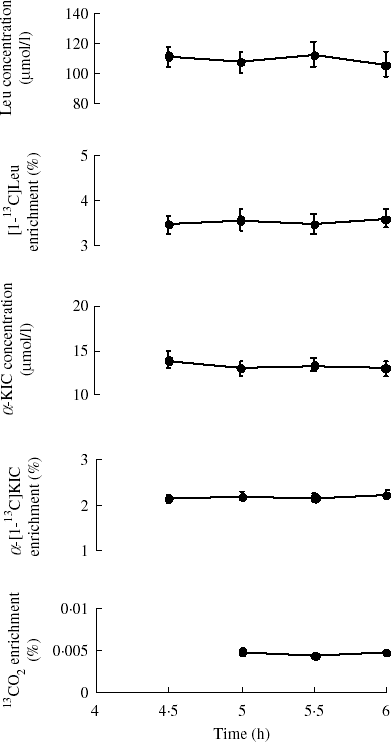
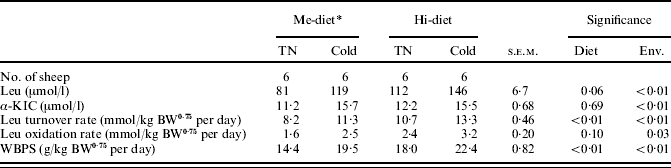
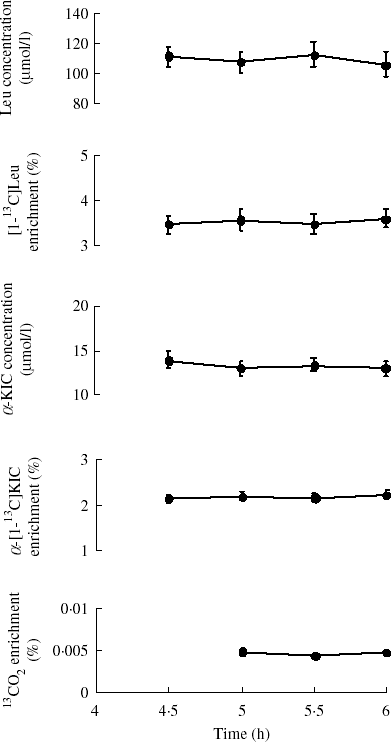
Mean values with standard errors of the means (s.e.m.) are given. No time relative trends (P>0·05) of concentrations of plasma Leu and a-KIC and enrichments of plasma [1-13C]Leu and a-[1-13C]KIC and exhaled 13CO2 were detected during the latter periods of the isotope dilution method (Fig. 1). The mean coefficients of variances during the corresponding period were 10·6, 10·7, 8·2, 5·4, and 11·2% for concentrations of plasma Leu and a-KIC and enrichments of plasma [1-13C]Leu and a-[1-13C]KIC and exhaled 13CO2, respectively. Therefore, Leu metabolism was expected to be steady state during the period. Plasma LeuTR was greater (P<0·01) for the Hi-diet compared with the Me-diet and increased (P<0·01) during cold exposure (Table 2). The LeuOX was numerically greater (P=0·10) for the Hi-diet compared with the Me-diet and increased (P=0·03) during cold exposure. WBPS was greater (P<0·01) for the Hi-diet compared with the Me-diet and increased (P<0·01) during cold exposure. The diet×environment interaction was not significant for all variables of Leu and protein metabolism.
Time course of changes in plasma Leu and α-KIC concentrations and enrichments of plasma [1-13C]Leu, α-[1-13C]KIC, and exhaled 13CO2 during the latter period of the primed-continuous infusion of plasma [1-13C]Leu in sheep. Each point represents pooled data of four treatments (medium and high intake in the thermoneutral and cold environments).
Effects of diet and cold exposure on plasma Leu and α-KIC concentrations, rates of LeuTR and LeuOX, and WBPS in sheep
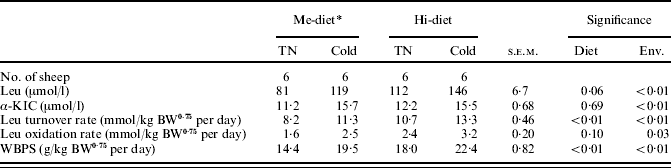
* Me-diet=medium intake; Hi-diet=high intake; TN=thermoneutral (23°C); Cold=cold exposure (2–4°C); Env.=environment.
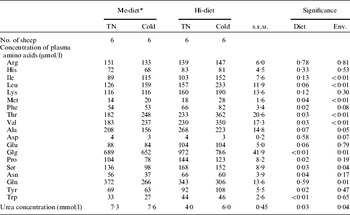
Of the plasma-free amino acids, concentrations of plasma methionine, phenylalanine, threonine, valine, glycine, proline, serine, asparagine, tyrosine and tryptophan were higher (P<0·05) for the Hi-diet compared with the Me-diet (Table 3). Concentrations of plasma isoleucine, Leu, methionine, threonine and valine increased (P<0·05) in response to cold exposure, whereas those of plasma glycine, serine and glutamine decreased (P<0·05). Plasma urea concentrations were lower (P=0·03) for the Hi-diet compared with the Me-diet and increased (P=0·04) during cold exposure. No significant interaction of diet and environment was detected in plasma amino acids and urea concentrations.
Effects of diet and cold exposure on plasma amino acid and urea concentrations in sheep

* Me-diet=medium intake; Hi-diet=high intake; TN=thermoneutral (23°C); Cold=cold exposure (2–4°C); Env.=environment.
DISCUSSION
The current experiment demonstrated that both dietary intake level and cold exposure influenced plasma Leu kinetics and WBPS in sheep. Savary-Auzeloux et al. (Reference Savary-Auzeloux, Hoskin and Lobley2003) used the isotope dilution of 15 [U-13C]amino acids to determine the effect of dietary intake level from 0·5 to 2·5 times of energy maintenance on irreversible loss rates of plasma amino acids and whole body protein flux in sheep. They reported that irreversible loss rates of plasma amino acids, including Leu, and protein flux increased with increasing dietary intake regardless of amino acids used for calculation. Harris et al. (Reference Harris, Skene, Buchan, Milne, Calder, Anderson, Connell and Lobley1992) reported that in young growing sheep turnover rates of Leu and phenylalanine increased as dietary intake level increased. Raggio et al. (Reference Raggio, Lobley, Lemosquet, Rulquin and Lapierre2006) reported that in lactating dairy cows fitted with duodenum and rumen cannulas, protein supply as casein infusion had a much greater impact on WBPS than energy supply as propionate. In contrast, Fujita et al. (Reference Fujita, Kajita and Sano2006) studied the effect of supplemental starch (0·5 and 1·0 times of maintenance energy) on WBPS with the [2H5]phenylalanine model in goats and observed that supplemental starch increased plasma phenylalanine and tyrosine turnover rates and WBPS through enhanced microbial protein synthesis in the rumen and amino acid absorption. Dietary energy intake may be one of the major factors to influence WBPS in goats. The inconsistent results may be due to species, physiological status or experimental procedure. Nevertheless, MP supply has been shown to be a major determinant of amino acid and protein metabolism in ruminants (Lapierre et al. Reference Lapierre, Blouin, Bernier, Reynolds, Dubreuil and Lobley2002; Raggio et al. Reference Raggio, Lobley, Lemosquet, Rulquin and Lapierre2006).
Cold exposure increased plasma LeuTR and, despite an increment in LeuOX, WBPS also increased under cold environment. The effect of cold exposure on plasma-free amino acid kinetics has not been well investigated in ruminants. Tsuda et al. (Reference Tsuda, Ambo, Shoji, Fujita and Sunagawa1984) reported that in sheep fed a maintenance diet, turnover rates of plasma glutamic acid and alanine, glucogenic amino acids, were not influenced by acute cold exposure (0°C for 4 days). Early et al. (Reference Early, Thompson and Christopherson1990) reported that in sheep fed at 1·5 times maintenance energy intake in a thermoneutral environment, turnover rates of plasma alanine did not increase significantly during chronic cold exposure (0–4°C for 21 days), whereas the percentage of alanine used for glucose synthesis increased. Scott et al. (Reference Scott, Christopherson, Thompson and Baracos1993) applied the isotope dilution method of l-[ring-2,6-3H]phenylalanine to determine protein metabolism in Holstein calves. They reported that phenylalanine whole body flux increased, but fractional and absolute synthesis rates of protein in tissues decreased during cold exposure (−5°C for 57 days) when calves were fed to meet requirements at thermoneutrality, suggesting increased phenylalanine oxidation. Thus the responses of amino acid and protein metabolism to cold exposure differed from the present results. The differences may be due to species, age, and temperature and duration used for cold exposure. Moreover, the possibility that the effect of cold exposure on protein metabolism differs between amino acids used as tracers cannot be excluded, because the response of turnover rate of the amino acids to cold exposure differed as described above.
No clear evidence that large changes in intake level moderated the effect of cold exposure was obtained in the present study. However, the above results do not necessarily imply intake level does not modify stress of cold exposure to sheep, because ME intake for the Hi-diet during cold exposure seems close to the maintenance level at cold exposure (Sano et al. Reference Sano, Nakamura, Kobayashi, Takahashi and Terashima1995). Moreover, apparent digestible N was reduced with increasing ME intake in goats (Fujita et al. Reference Fujita, Kajita and Sano2006). These factors may partly explain why no effect of diet×environment interaction on plasma Leu and protein metabolism was obtained in the present experiment.
Hoskin et al. (Reference Hoskin, Sarvary, Zuur and Lobley2001) reported that, in wether lambs, arterial concentrations of phenylalanine and branched chain amino acids increased significantly and other essential amino acids also increased numerically with increasing feed intake. Fujita et al. (Reference Fujita, Kajita and Sano2006) reported that, in goats, supplementation of starch increased total amino N and decreased urea N. These results were similar to those in the present experiment. Therefore, changes in diet probably altered amino acid and ammonia absorption in the present study. Concentrations of some plasma amino acids and urea increased but those of some other amino acids decreased in response to cold exposure. Blood amino acid concentrations were reported to decrease during cold exposure in sheep and young steers (Bell et al. Reference Bell, Gardner, Manson and Thompson1975; Miaron & Christopherson Reference Miaron and Christopherson1997). Although in the present study changes in amino acid concentrations do not agree with these previous reports, increased protein kinetics in sheep exposed to cold in the present study were reflected by changes in amino acid and urea concentrations.
In conclusion, both intake level and cold exposure influenced plasma LeuTR and WBPS in sheep, when [1-13C]Leu was used as a tracer, but intake did not modify the effect of cold exposure on kinetics of plasma Leu and protein metabolism. This may be partly related to increased LeuOX and reduced digestion (Kennedy et al. Reference Kennedy and Milligan1976; Fujita et al. Reference Fujita, Kajita and Sano2006). Further studies are needed to clarify protein metabolism during cold exposure including other methods of isotope dilution such as the [2H5]phenylalanine model to determine whole body protein kinetics.
This work was in part supported by a research grant from the Kuribayashi Foundation. We are grateful to Kim Taylor for helpful comments on the manuscript.