In two interconnected theoretical works published in 1962, Lévi-StraussFootnote 1 argued that the tendency among primitive societies to formulate animal classification systems and to express these systems ritually cannot be explained as a side-effect of social classification, as Durkheim and Mauss had argued,Footnote 2 nor can it be explained on the narrow materialistic grounds posited by Radcliffe-Brown and Malinowski.Footnote 3 The negative evidence adduced by Lévi-Strauss is empirical: animal classification systems are neither limited to societies in which there exists a fixed correlation between social groups and animal species, nor do they pertain to species that are of significant material or symbolic value to the classifying culture. According to Lévi-Strauss, the ritual expression of the mental act of classification functions like a language, containing “stressed” and “unstressed” elementsFootnote 4 and aiming to convey theoretical messages.Footnote 5
Taking his cue from Bergson,Footnote 6 Lévi-Strauss shows that the reason primitive cultures tend to choose animal species as the basic units of their ritual classification systems lies primarily in the structure of these systems: animal taxonomy is a useful model for categorization, since in the division of animals into species nature offers primitive man a rare example of discreteness. Whereas most natural phenomena are encountered as a continuous spectrum (e.g., the light spectrum), animal taxa are by nature distinct.Footnote 7 Furthermore, there exists a homologous relationship between the distribution of individuals among social groups in a human society on the one hand, and the distribution of individual animals among species in the animal kingdom on the other hand. Thus, claims Lévi-Strauss, animal species have become the object of ritual attitudes not due to their material value, that is to say, not because they are “good to eat,” but rather because they are “good to think,” serving as a useful model for differentiating thought.Footnote 8
However, in Lévi-Strauss's view, animal taxonomy was chosen as a model for categorization not merely because of its formal structure but also due to the primordial affinity between human and animal. Thus, the basic elements in the “language” of classification—animal species—are themselves a clue to what the contents of a message conveyed through a classification system might be: these messages pertain to what Lévi-Strauss considers the central problem of human culture—the relation between human and animal, between culture and nature.
This approach, which views animal classification systems as essentially theoretical in character, is faced with several difficulties. Firstly, it tends to ignore concrete social and economic needs, projecting whole systems of ritual onto an intellectual plane.Footnote 9 Secondly, the need to express these theoretical systems of classification ritually remains unexplained.Footnote 10
The most severe difficulty in applying Lévi-Strauss's general theory to particular systems of classification is that although he asserts that classification systems function like a language, conveying theoretical messages, his reticence regarding the possible semantics of such a “language” renders the possible contents of these messages rather obscure. Centering instead on the formal structure of classification systems, Lévi-Strauss only vaguely hints that these messages pertain to the relation between culture and nature.
One possible solution to this difficulty, hinted at in the last chapter of Totemism, is that the message lies in the very act of classification.Footnote 11 Thus, the mental act of categorization is to be considered the cultural act par excellence, distinguishing humans from animals and expressing the shift of human communities from nature to culture.
This solution accounts neither for the wide diversity of classification systems nor for the complexity of their inner structures. However, one may accept it as a partial solution, and still leave open the possibility that the details of the classification system, not only its very existence, convey a message pertaining to the relation between nature and culture. In order to determine whether this second possibility is in fact realized in a particular classification system, one must first analyze the basic elements constituting that system and the relations between them, and inquire: do the details of this system encode a message regarding the nature of the relationship between nature and culture that is different from what is implied in other, alternative systems of categorization? If the analysis offered here is correct, one may conclude that at least in the case of one ancient Israelite system of animal categorization, the system preserved in the text of Leviticus 11, the answer to this question is affirmative.
In order to accomplish this, it will first be necessary to examine two general categorization systems central to Biblical law, the system distinguishing between pure and impure and the system distinguishing between prohibited and permitted;Footnote 12 only then will it be possible to turn to the Biblical texts concerned with ritual taxonomy, particularly Leviticus 11 and its parallel Deuteronomy 14.
Impurity and Prohibition
The complex interrelations between impurity and prohibition are rooted, as Ricœur has argued, in a religious sphere that precedes—logically and chronologically—the texts preserved in Leviticus 11.Footnote 13 However, the Bible is steeped in echoes of these earlier stages, and they resound clearly in the theology of priestly literature.Footnote 14
One attempt to record these echoes—or, more precisely, to delineate their boundaries—is Wright's distinction between “tolerated” and “prohibited” impurities.Footnote 15 Prohibited impurities stem from deliberate as well as inadvertent transgressions. Impurity stemming from inadvertent transgressions accumulates—as Milgrom has shown—in the sanctum instead of on the transgressor, and is removed from the sanctum by prescribed rituals of purgation.Footnote 16 Impurity stemming from deliberate transgressions may accumulate not only in the sanctum but also upon the transgressor and upon the land. It is removable from the sanctum by means of the ritual described in Leviticus 16, but no prescribed ritual enables the community to remove it from the land.
Tolerated impurities, on the other hand, stem from natural situations such as death and bodily emissions. Wright terms them “tolerated” since, though unwelcome, they often arise from involuntary situations or from situations that are desirable in and of themselves. Impurities of this type accumulate in physical bodies, are transmitted from one object to another according to a fixed set of regulations, and may be removed by a fixed set of purification rituals such as bathing and laundering. In addition, these impurities accumulate in the sanctum, contracted from afar like the prohibited impurities, and may be removed from the sanctum by a fixed set of purgation rituals.Footnote 17
However, the dichotomy between “tolerated” and “prohibited” impurities is not always so clear-cut, and there are several borderline cases where an act is both defiling and prohibited. The most obvious examples are: sexual relations with a menstruant according to Lev 18:19 (cf. Lev 15:19–24); consumption of the flesh of an animal that was torn by wild beasts (according to Exod 22:30) or that died naturally (according to Deut 14:21);Footnote 18 and certain prohibitions pertaining to priests and nazirites in the priestly literature (Lev 21:1–4; 11; 22:8; Num 6:6–7).Footnote 19
One such borderline case is the system distinguishing between pure ( ) and impure (
 ) animal species. At first glance, the impurity of the so-called “impure” (
 ) species ought to belong to the realm of tolerated impurities, stemming from physical bodies (animal flesh) and contracted by direct physical contact. However, as opposed to other impurities stemming from physical situations, a large number of animal impurities are by no means tolerated by the law—in fact, the law explicitly prohibits all Israelites to contract them. It seems that the intuitions underlying the distinction between pure and impure animal species are quite different from those underlying the system of tolerated impurities. This distinction is aimed at the categorization of the animal kingdom as such and is only indirectly linked to death-related impurity.Footnote 20 Evidence for this is the fact that the species itself is termed “pure” (
 ) or “impure” (
 ) in legal as well as non-legal contexts, regardless of the status of the particular animal. Thus, even when the specimens in question are alive, the species is termed “impure,”Footnote 21 though live animals were certainly not considered rituallyFootnote 22 defiling.Footnote 23
The Ritual Classification of Animal Species in Ancient Israel
Information about the ritual classification of animal species in ancient Israelite religion, outside Leviticus 11 and Deuteronomy 14, is sparse.Footnote 24 One important source of information is the non-Priestly Flood narrative in Genesis (the J account, along with several interpolations),Footnote 25 which refers to species that are “pure” ( ) and “not pure” (
 , Gen 7:2, 8; 8:20). For the present argument it will suffice to note that, according to this story, the distinction between pure and impure animal species is no innovation of Israelite religion, but was recognized in antediluvian times. Furthermore, since Noah is intuitively familiar with it, yhwh has no need to enumerate the pure and impure species. Footnote 26 Thus it appears that the distinction does not stem from a divine decree, but rather from naturally inherent traits, easily discernible by any human being, Israelite and non-Israelite alike.
Leviticus 11 and Deuteronomy 14
The remarkable similarity between Leviticus 11 and Deut 14:3–21a, especially in their respective lists of prohibited quadrupeds and birds, indicates that there exists a genetic relation between these two texts. Several models of this relation have been presented, scholars often emphasizing the textual evidence that accords with their general conception of the relationship between P and D, and explaining away the contradictory data accordingly. For the present context it will suffice to say that the most likely explanation is that a common Vorlage underlies the two texts, which can in fact be reconstructed with a relatively high degree of certainty.Footnote 27 This will not be attempted here, but reference will be made to the presumed Vorlage as necessary.
Deuteronomy 14:3–21a
The general injunction at the head of the passage (14:3) indicates that the legislator is not attempting to define what is abominable and what is not. It is simply assumed to be common knowledge that certain species and the flesh of animals that died naturally are—by nature— , i.e., abominable (though not physically inedible). Based on this assumption, the legislator formulates categorical injunctions, addressed to the Israelites as a whole, prohibiting the consumption of such meat. Just as H forbids those whom it considers inherently holy, i.e., the priests,Footnote 28 to eat carrion (Lev 22:8), since, apparently, carrion is self-evidently, inherently impure, so D (like E, in Exod 22:30) prohibits those whom it considers inherently holy, i.e., all Israelites, to eat certain species as well as carrion, since these are self-evidently despicable by their very nature (14:21).Footnote 29 Further, the commands in vv. 11 and 20 (
 , “You may eat any pure bird”;
 , “You may eat any pure winged creature”), presuppose that the audience knows which species are “pure” and which are not; the law simply asserts that whatever is known to be “pure” is permitted for consumption. No objection should be raised from the fact that D enumerates the “impure” birds even though it assumes that they are known, or from the fact that, having listed the criteria for the purity of large quadrupeds, it proceeds to enumerate ten pure species. By analogy to a modern situation, this would be similar to a general ban on cheap meat, followed by a list of fast food chains for clarification.
D mentions four main categories of animals: large quadrupeds, water animals, birds and flying insects, consistently distinguishing between species permitted for consumption ( , “you may eat,” 4, 6, 9, 11, 20) and species prohibited for consumption (
 , “you shall not eat,” 7f., 10, 12, 21, see 19). The adjectives
 (“impure,” 7, 8, 10, 19) and
 (“pure,” 11, 20) are distributed less symmetrically, but in a manner that leaves little doubt that the dichotomy in its entirety holds true in each of the four groups: the species permitted for consumption are all “pure” and the prohibited species are all “impure.” What is not entirely clear is the precise semantic intent of these terms. The author may have intended “pure” and “impure” to serve as mere labels, designating species permitted and prohibited for consumption respectively, and nothing more; this is clearly how the terms are used in Gen 7:2, 8, Lev 27:11, 27, Num 18:15, where they refer to live specimens, which are certainly not considered ritually defiling. The author may, however, have been expressing the idea that species prohibited for consumption are also ritually defiling. We will return to this problem below.Footnote 30
In light of D's general lack of interest in (“tolerated”) ritual impurity, the former possibility seems more likely. It appears that D adopted the terms “pure” and “impure” from its Vorlage, deliberately or unintentionally ignoring the ritual implications of these labels. Of course, D does not deny the existence of ritual impurity per se; thus, it does not discard the command “and their carcasses you shall not touch” in v. 8. But for D, the main function of the terms  and
 , when pertaining to animal species, is to indicate permissibility or impermissibility for ingestion, not the power to contaminate.
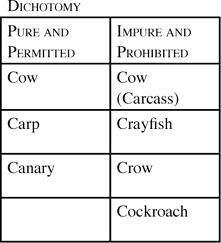
Deuteronomy 14 thus presents a simple dichotomy: “okay” species on the one hand, i.e., species that are termed , which may be eaten; and “not okay” species on the other hand, i.e., species termed , which may not be eaten.Footnote 31 Presumably, the author(s) of the Vorlage postulated the same simple dichotomy. This traditional dichotomy is also found in Lev 20:25, a passage belonging to the Holiness Code.Footnote 32
It is necessary to keep in mind that although the formulation of this system in Deuteronomy is the work of a literate elite, its presence in several pentateuchal sources (D, H, J, and presumably in the Vorlage, as we have seen), and its correspondence to the little corroborating evidence that archaeology is able to supply,Footnote 33 suggests that it reflects widespread conceptions, and—at least in part—common practice.
Therefore, if one were to endorse Lévi-Strauss's approach in this case, and attempt a reconstruction of a theoretical message encoded in this system, this reconstruction would presumably reflect certain basic conceptions prevalent in the society where the system was practiced. Such an attempt to reconstruct the unconscious conceptions of a culture no longer alive, through the medium of the texts its literary elite has produced, is fraught with tremendous difficulties.Footnote 34 As we shall see, the situation in Leviticus 11 is quite different.
Impurity and Prohibition in Leviticus 11
In contrast to the simple dichotomy in Deuteronomy 14, Leviticus 11 presents a complex legal grid, which will be examined in what follows.Footnote 35 In order for this complex grid to become apparent, it will be necessary to reconsider some widely circulating preconceptions and, in my view, misunderstandings, pertaining to the text of Leviticus 11 and to the perception of the relation between impurity and prohibition in Priestly literature. As will become apparent, the “Milgrom school” has done much to point out the misconceptions of previous interpretations in this regard, but in reality, Priestly legislation is even more radical in its innovative classification than Milgrom and some of his students have been disposed to acknowledge. The following analysis of Leviticus 11 will show that the legal categories, “impure,” “prohibited for consumption,” and “prohibited for contact” are entirely contingent, and—wherever possible—legally unrelated.
However, before analyzing the system portrayed in Leviticus 11, one must first acknowledge a general tendency in the priestly writings: The priestly legislators generally refrain from prescribing the required measures for ritual purifications in cases where ritual contamination should not have occurred in the first place. Thus, no purification instructions are prescribed for impurity contracted through the consumption of animals that are forbidden for consumption, or—as argued below—for impurity contracted through contact with animals whose carcass one is forbidden to touch. Priests, who are forbidden to eat carrion, are not told how to purify themselves if they do so (Lev 22:8); but Israelites, who may freely contaminate themselves by eating carrion according to the priestly legislators (though certainly not according to Exod 22:30 and Deut 14:21a), are told exactly how to purify themselves (Lev 11:40; 17:15).Footnote 36
Thus one may formulate a rule of thumb, which can serve as a working hypothesis elsewhere in priestly literature: wherever the author supplies instructions for purification from impurity, the impurity in question is “tolerated”; but where the author does not supply these instructions, the impurity is of the prohibited type. Once this characteristic is acknowledged, it is possible to demonstrate how the authors of Leviticus 11 understood the relation between impurity and prohibition.
The First Tetralemma in Leviticus 11
The chapter treats several groups of animals, presented in a seemingly disorderly manner: large quadrupeds (2bβ–8), water animals (9–12), large flying creatures (or, for the sake of simplicity, “birds,” 13–19), flying insects (20–23), again large quadrupeds (24–28), land swarmers (29–38), again large quadrupeds (39–40), and once again land swarmers (41–44). An explanation of this apparent disorder would entail a detailed diachronic analysis of the text, which is outside the scope of the present study.Footnote 37 For the sake of clarity, the discussion will be confined at first, for the most part, to the text in its final form; only in conclusion will detailed reference be made to the strata of the chapter.
It has long been noticed that in the main body of the chapter (vv. 1–42, 46–47),Footnote 38 the terms  and appear to be mutually exclusive. An animal is either termed or , never both. Hence, Milgrom's insightful distinction, intimated in the Sifra and noticed by David Zvi Hoffmann,Footnote 39 is basically true: , when attributed to a species, designates “ritually defiling, and also prohibited for consumption”; indicates “prohibited for consumption, but not ritually defiling.” However, if one wishes to account for the MT of 7:21, which, unless emended, mentions an impure , and to take the term
 in 11:41 as covering all land-swarmers, including the impure ones listed in vv. 29–30, it may be more accurate to modify Milgrom's definition of to “prohibited for consumption” (with nothing said of ritual impurity). Furthermore, contrary to a common misconception, there is little reason to imagine that in P's view, animals could ritually defile even through ingestion.Footnote 40
Milgrom notes correctly that the author of the H appendix (vv. 43—45, according to Milgrom) was unaware of this distinction, as terms derived from the stems  and
 are used interchangeably in those verses.
The terminological distinction between and has immediate legal implications: not every animal that is prohibited for consumption is considered ritually impure. Thus, only the flesh of large quadrupeds and of eight species of land-swarmers, which are termed , may convey ritual impurity (see Lev 5:2, as well as the precise wording of 11:29a and 22:5, regarding land-swarmers).Footnote 41 All other land-swarmers, as well as all birds and water animals, whether permitted for consumption or not, are ritually pure; i.e., they convey impurity neither by contact nor by consumption. Like any other transgression in P, consumption of prohibited birds or fish may give rise to a miasma-like substance, which clings to the sanctum and must be purged by the blood of a purgation offering,Footnote 42 but the individual remains pure: he need not undergo ritual ablutions or wait until sunset before approaching the sanctum.
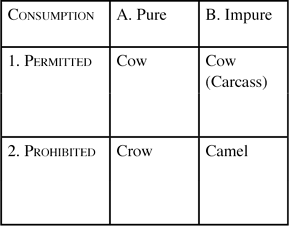
The other side of this legal distinction between impurity and prohibition is that not every animal said to be impure, i.e., that ritually contaminates, is prohibited for consumption. Although every species that is termed is, in fact, prohibited for consumption, there is a type of meat that, though ritually contaminating, is permitted for consumption. Verses 39–40 specify that if a quadruped of a species permitted for consumption—e.g., a cow—dies of itself, its carcass is ritually contaminating. However, here, as elsewhere in priestly literature,Footnote 43 it is evident that lay Israelites are permitted to become contaminated by eating the flesh of a cow that died of itself; it is only priests that are prohibited to do so (7:24; 22:8). To understand this point in context, it need only be remembered that in priestly literature, becoming ritually impure is generally not considered a vice—though subsequent purification may be demanded. Impurity is often inevitable, and it is even expected of Israelites as well as priests to become ritually impure at times (e.g., 15:18, 21:2–3).
Application of the rule of thumb we have formulated above confirms this. When discussing the eight impure land-swarmers (v. 31) and most quadrupeds (vv. 24–25), the legislator offers instructions for purification from external contact only, not from consumption, since such flesh should not be consumed in the first place. By contrast, vv. 39–40 supply instructions for purification from touching, carrying and eating the flesh of a permitted quadruped that died naturally, since contacting and eating such flesh are equally permitted.
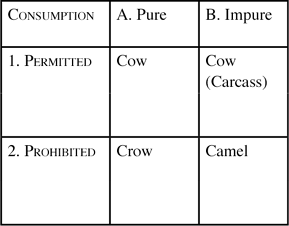
Thus it becomes evident that in the ritual taxonomy of Leviticus 11 a simple dichotomy has been replaced by a tetralemma, where all combinations are possible: pure and permitted for consumption, pure and prohibited, impure and permitted, impure and prohibited, as demonstrated in Tables 1 and 2.
The Traditional Dichotomy
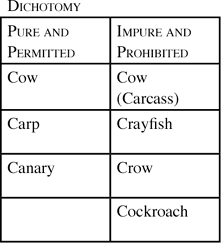
Leviticus 11 (Consumption)
However, this is only half of the picture. For the legislators have in fact created a much more complex system of categorization, applying this differentiating logic (“compartmentalizing,” as Klawans would term it),Footnote 44 not only to the consumption of animals but also to contact with their carcasses.
The Second Tetralemma in Leviticus 11: The Same Pattern Repeated
Verse 3 creates a simple distinction: quadrupeds with split hoofs that chew their cud may be eaten, all others by implication may not. In vv. 4–8 four species are named—the only examples known to the author—which were believed to fulfill one of the criteria but not the other.Footnote 45 Verse 8 clearly declares these four species impure, and forbids both touching their carcasses and eating their flesh.
Since the laity is not normally commanded to avoid ritual impurity, commentators ancient and modern have refrained from interpreting the command “and their carcasses you shall not touch” (8aβ) literally.Footnote 46 Instead, some have viewed these words as a precaution, a warning not legally binding, to keep away from prohibited flesh.Footnote 47 However, the unequivocal imperative does not warrant exegetical twists of this sort, and leaves little doubt as to the general purport of the verse, prohibiting the laity from becoming ritually defiled by the carcasses of (at least) four animals.Footnote 48
Presumably, this law, which is paralleled in Deut 14:8 and probably derives from the common Vorlage,Footnote 49 was originally intended to apply to quadrupeds lacking both criteria as well, such as dogs and donkeys; in their original context, the four exceptions were probably named simply to remove all doubt. Yet, in the context of Leviticus 11, I submit, an interesting transformation took place.
Technically speaking, though quadrupeds lacking both criteria are prohibited for consumption by implication (v. 3), vv. 2–8 say nothing at all of their ritual impurity, leaving at least two theoretical possibilities open: a) pawed quadrupeds and perissodactyla (e.g., donkeys) are ritually pure, like the prohibited birds and all but eight species of land-swarmers; or b) they are ritually impure, but in contrast to the four exceptional species, it is permissible to become defiled by touching their carcasses, just as lay Israelites are permitted to become defiled through contact with a human corpse.
Verses 24–28 solve this dilemma, addressing precisely those groups of animals not discussed in vv. 2–8: quadrupeds lacking both criteria for purity, having either plain hoofs or no hoofs at all. The very fact that these verses settle what vv. 2–8 had left unsettled suggests that they are logically dependent upon them. Furthermore, their dependency on vv. 2–8 is demonstrable on grammatical grounds as well, as soon as one recognizes the precise purport of the opening words of v. 24,  . Milgrom and others understand this formula simply to mean “and by these you shall become impure”;Footnote 50 but this formulation probably has a more precise legal thrust. A nearly identical formulation, in which the indirect object irregularly precedes the
 form of a verb, is found in Lev 21:3 in a similar context, where it is both connective and contrastive in relation to what precedes it. The formula
 , used by the priestly legislators in Lev 21:3, indicates that whereas it is generally forbidden for a priest to become defiled through contact with the dead (21:1b, 4b), he is nevertheless permitted to become defiled through contact with the corpse of a close relative, such as his virgin sister. Therefore, these words should be translated “by her (in contrast to most others) he is permitted to become defiled.”Footnote 51 Similarly, in Lev 11:24, this contrastive and connective formula should be translated: “By these, however, you are permitted to become defiled.” This rendering has immediate legal implications: it appears that the legislators wished to contrast the law of the four exceptional quadrupeds with that of all other quadrupeds prohibited for consumption. Whereas one is forbidden to become ritually defiled by contacting the former (8aβ), the latter—though no less defiling—may be touched at will.
This counterintuitive conclusion stands in contrast to the ancient view, held by modern commentators as well. However, it seems to be the correct reading, since, aside from the fact that it accords with the simple words of the legislators, which could not be more explicit, this view is also supported by the fact that, according to the rule of thumb we have formulated, the priestly legislators tend to offer instructions for purification only where defilement is not prohibited in the first place. In contrast to the elaborate laws of purification from contact with the eight impure land-swarmers, perissodactyla and hoofless animals, in the case of the four exceptional species, no instructions for purification are offered at all, since, as v. 8 explicitly states, it is forbidden to eat or touch their carcasses.
The juxtaposition of vv. 2–8 and 24–28, noted above, establishes the distinction between impure animals whose carcasses may be touched and impure animals whose carcasses may not be touched. As for the ritually pure animals, based on all that is known about ancient Israelite religion, there ought to be no reason to prohibit physical contact with their carcasses. And yet, in addition to the prohibition against eating the flesh of certain species of water animals (11bα), v. 11 also contains a prohibition against coming in contact with their carcasses (11bβ:  , “and you shall abominate their carcasses”), even though they are ritually pure!
This command has been a stumbling block for commentators ancient and modern.Footnote 52 It has been explained away as an interpolation, as a stylistic device aimed at mirroring v. 8, or as a mere attempt to lend force to the prohibition against consumption, but carrying no legal force of its own.Footnote 53 However, these attempts only reveal how difficult it has been for commentators to accept the unequivocal command as it stands, contradicting, as it were, their own preconceptions about the relation between prohibition against contact on the one hand, and ritual impurity on the other hand. Rather, it appears that here, the legislator made use of the non-technical sense of the verb , attested in Deut 7:26 and elsewhere, refining its meaning to carry a new legal sense: prohibition of contact that is unlinked to ritual impurity.
This counterintuitive hypothesis is supported by two facts: firstly, 11b is structurally identical to 8a. One may infer that just as the syndetic structure in v. 8 serves to present two distinct prohibitions ( , literally: “Of their flesh you shall not eat, and their carcasses you shall not touch”) linked to a single definition (
 , 8b), by the same token, the same structure in 11b (
 , literally: “Of their flesh you shall not eat, and their carcasses you shall regard as detestable”) indicates two different prohibitions, linked to a single definition (, 10–11a). Secondly, the choice of the term
 (“carcass”) in 11bβ, as opposed to
 (“flesh”) in 11bα is significant: it indicates that the first command refers to the status of the carcass as potential food (meat), whereas the second refers to its status as a material body (a carcass) susceptible to physical contact. This same exact terminological distinction is found in v. 8: is the object of dietary laws, whereas
 is the object of legislation concerned with ritual impurity.Footnote 54
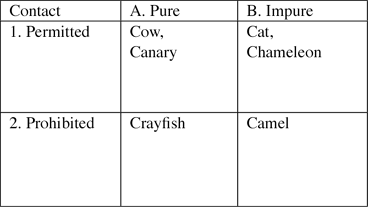
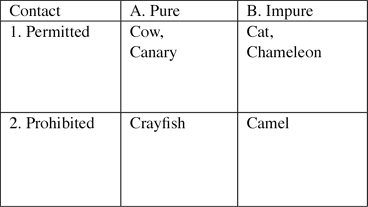
This intriguing legislation completes the logical symmetry of P's ritual taxonomy: not only is there a distinction between animals that are pure and permitted for consumption; pure and prohibited for consumption; impure and permitted for consumption; or impure and prohibited for consumption; but also between species that are pure and permitted to touch; pure and prohibited to touch; impure and permitted to touch; or impure and prohibited to touch, as demonstrated in Table 3.
Leviticus11 (Contact)
Theoretical Implications: Conceptual Legislation and Normative Legislation
The complex system of classification we have identified in Leviticus 11 is, admittedly, not laid out explicitly and systematically in the text. From the substantive point of view as well, it definitely appears to be an artificial (literary) construction, not common practice in ancient Israel. Yet this is the edifice created by the priests who formulated the chapter, not a figment of the modern reader's imagination: all eight permutations enumerated above are indeed present in the chapter in its given form.
Most likely, the complex system crystallized in Leviticus 11 never took root in Israelite society. It stands to reason that a farmer, finding a dead mouse (which, according to Leviticus 11, one is permitted touch, though it is ritually defiling) in the barn, would be likely to refrain from touching it, and that the same farmer would find it more practical to drag away a dead camel (which, according to Leviticus 11, one is prohibited to touch or carry) than to ask a non-Israelite to do so. Even if one does not accept the position that P originated as a secret document, known only to priests,Footnote 55 it is doubtful that Leviticus 11 ever served as a normative basis for Israelite society at any given historical period. The very fact that the law refers to seemingly unlikely situations (e.g., touching a dead shark, eating a bat) and to species that according to textual evidence as well as osteonic findings were not commonly considered potential food in ancient Israel,Footnote 56 indicates that the legislators' interest was conceptual rather than normative.Footnote 57
What was the theoretical goal that the authors hoped to achieve by arranging the animal kingdom according to two contingent systems of classification? What motivated them to reject the traditional dichotomy and reclassify the animal kingdom in a more complicated and less practicable way than their predecessors?
The traditional conception, which the authors of Leviticus 11 rejected, assumed that the set of species prohibited for consumption and the set of species designated as “impure” are equal sets, as are the set of species permitted for consumption and the set of species designated as “pure.” Thus, according to Deuteronomy 14, the status of a species as permitted or prohibited for consumption follows from its natural statusFootnote 58 as “pure” or “impure,” respectively. D's law, which reads literally “any pure bird—you may eat” ( , Deut 14:11), says simply: that which is by nature known to be pure is permitted as food.
The Priestly legislators, too, accepted the basic assumption that the impurity of certain species is naturally inherent and obvious to all human beings, Israelite and non-Israelite alike.Footnote 59 However, they sought to sever the link between impurity, a biological trait they assumed to be present in specific species since creation, and prohibition, a religious category.Footnote 60 In fact, what we have here is a clash between  and
 in ancient Israelite religion. By claiming that the status of an animal as permitted or prohibited for consumption or contact is independent of its status as pure or impure, the legislator argued that permission and prohibition are divine decrees, which are imposed upon, not derived from, the natural order.
It should be noted that the juxtaposition of the categorization systems permitted/ prohibited and pure/impure is not only implicit in the legal system of Leviticus 11; it is also explicitly referred to in the colophon of the chapter (v. 47): “to make a distinction between the impure and the pure, and between the living creature that may be eaten and the living creature that may not be eaten.”Footnote 61 In light of Lévi-Strauss's theory, which views animal categorization systems as a framework within which societies tend to formulate their conceptions of the relation between culture and nature, it is striking that an explicit juxtaposition of the two categorization systems, pure/impure and permitted/prohibited, is found only in Leviticus 11, a chapter dedicated to the ritual taxonomy of animals, and nowhere else in Biblical law.
The Text-History of Leviticus 11
Thus far it has been shown that Leviticus 11, in its final form, encodes a theoretical argument in the innovative, complex ritual taxonomy that it presents. However, the complex symmetrical structure, reconstructed in the tables above, was not arrived at at once, but is rather the result of gradual crystallization.
In the early 1990's, Milgrom and Wright engaged in a discussion aimed at reconstructing the text-history of Leviticus 11.Footnote 62 According to Milgrom's hypothesis, accepted for the most part by Wright, the chapter consists of three Priestly strata (designated P1, P2 and P3, respectively) and one stratum of H.Footnote 63 Though their relative dating of these strata may require further examination,Footnote 64 it is clear from internal evidence that there are in fact at least three Priestly strata in the chapter, each logically dependent upon its predecessors. Furthermore, when read in light of Lévi-Strauss's theory, it is evident that the three Priestly strata in the chapter were aiming at a single theoretical goal: the complete distinction between the natural category, “impure,” and the cultural category, “prohibited.” Each stratum pressed this theoretical development a step further, so that the distinction took shape gradually. This process may be described in short as follows:
The ancient text that served as the Vorlage of the chapter (and, it will be recalled, of Deuteronomy 14 as well),Footnote 65 referred to four groups of animals: large quadrupeds, water animals, birds, and flying insects. In each group, the species prohibited for consumption were defined as “impure,” and at times the author added the phrase “you shall not eat” ( ) or “they shall not be eaten” (
 ). Regarding four exceptional species listed by name, a command was added prohibiting contact with their carcasses, but context made it clear that all impure large quadrupeds (at least) were included in the prohibition.
The earliest Priestly stratum (P1, which consisted of vv. 1–23, 41–42), was a reworking of this Vorlage. In the alterations introduced by P1 in this Vorlage we can detect, in a nascent form at least, the distinction between the prohibited and the impure, which presents the two systems as independent. P1 argued that not all animals prohibited for consumption were ritually defiling. In order to make this point, P1 coined a new, technical use of the term , and claimed that only the prohibited large quadrupeds were ritually impure, whereas the prohibited water animals and birds were ritually pure.
The author who appended P2 (vv. 24–38) to P1 recognized the conceptual innovation of P1 and wished to develop it, distinguishing between impure animals whose carcasses one may touch and become ritually contaminated by, and other impure animals whose carcasses must be avoided. Furthermore, this author noted that eight of the land-swarmers, and those eight alone, are ritually impure, and that it is perfectly permissible to touch their (ritually contaminating) carcasses.
The third stratum, P3 (vv. 39–40), in an unprecedented, strict ruling, defying what is known from other priestly laws,Footnote 66 formulated the missing example necessary to complete the symmetry—an animal permitted for consumption but ritually defiling by contact (Table 2, category B-1).Footnote 67
Already with the juxtaposition of P2 and P1, a distinction was made between impure animals whose carcasses may be touched at will and impure animals whose carcasses should not be touched. According to the text at this stage (P1 + P2) there was no reason to prohibit physical contact with the carcass of a ritually pure animal. However, an interpolator, perhaps the very same author of P3,Footnote 68 formulated a counterintuitive law, prohibiting physical contact with the carcasses of water animals that are prohibited for consumption, although they are considered ritually pure (Table 3, category A-2). With the interpolation of this injunction, the legislator elegantly achieved complete symmetry pertaining to contact as well as consumption, as illustrated in the following diagram:

Reconstructing the Logical Process
The position of P in two instances discussed so far—the flesh of the and that of certain animal species—is that the status of an animal as pure or impure does not determine its status as prohibited or permitted (for contact or for consumption). However, the logical process of arriving at this position is not identical in both cases: in the case of an animal that died of itself, P adheres to an ancient lawFootnote 69 which considered the impure, but prohibited only the holy—that is, the priests—to eat from its flesh. The innovators in this case were E (Exod 22:30) and D (Deut 14:21), who—viewing all Israelites as holy—extended the scope of the prohibition accordingly.Footnote 70
In the case of the animal categorization systems, the process was apparently complex: in the Vorlage, the term may simply have been a fossilized term referring to species prohibited for consumption. P rejected the traditional terminology and asserted that a distinction should be made between species that are ritually defiling and species that are prohibited for consumption, though ritually pure. D and H, on the other hand, accepted the traditional terminology, emphasizing that it is unbecoming to a holy nation (D) or to a nation continually sanctified by  (H)Footnote 71 to eat of the “impure” species.Footnote 72
It is unclear whether the Vorlage or Deuteronomy 14 considered the “impure” water animals, birds and flying insects to be ritually defiling (in which case P would be rejecting the traditional practice as well as the traditional terminology). The question as such may simply not have arisen for the legislators responsible for these texts, who did not formulate their thoughts in terms of a complex system of ritual contamination and stages of purification, but commanded rather generally, in the cases of the “impure” quadrupeds—“you shall not touch their carcasses” ( , Deut 14:8). However, there is reason to hypothesize that the terms and served in these legal codes as mere labels indicating “permitted for consumption” and “prohibited for consumption” respectively, and did not indicate ritual purity or impurity.
The evidence for this last hypothesis is circumstantial. The terms and are laden with positive and negative metaphoric meaning. That they may serve as labels to indicate permission or prohibition for consumption is evident from the fact that the Holiness Code, which, in the context of ritual impurity (Lev 22:5) admits that not all land-swarmers are ritually impure, still refers to all land-swarmers as in the context of food prohibitions (Lev 20:25, see also 11:43 [H]). Furthermore, even P, in a slip of the tongue, uses the phrase “pure ( ) birds” (14:4), though according to P there is no such thing as a bird that is not ritually pure. This slip indicates that in the parlance of the time, with which the authors of P were naturally acquainted, the term served as a label similar in meaning to “of which you may eat” (
 , Lev 11:39).Footnote 73
Conclusion: Sagacious Savages
Thus far we have distinguished between a popular, relatively simple system of categorization that appears to have been prevalent in ancient Israel and is widely attested in pentateuchal literature and an alternative, relatively complex system, found in P. Textual analysis provides unequivocal evidence that the latter system presupposes the former, and was devised to replace it. Internal analysis of Leviticus 11 suggests that the Priestly system itself is the product of a gradual process, in which each textual stratum appears to be a conscious reaction and response to its predecessors.
Lévi-Strauss's theory has been instrumental in elucidating these ancient Israelite classification systems in several ways. Methodologically, we have followed Lévi-Strauss in approaching the classification systems from a purely formal point of view. We have not inquired why a particular species came to be regarded as impure whereas another was considered pure, but have centered instead on the structural categories that constitute the system of classification, and on the relations between them.
This approach, though it takes us a step further away from the concrete objects that are subject to classification, is practically essential in the case of ancient Israelite society, where one lacks firsthand evidence of any symbolic or other meaning that may have been attributed to the species referred to in the texts, even in those cases where the species are identifiable. The vast variety of interpretations of the meaning of the classification systems in Deuteronomy and Leviticus is in itself evidence of how precarious such guesswork can be at times.Footnote 74 The interpretation offered here avoids these stumbling blocks since it obviates the necessity to identify the species and to guess what their symbolic value may have been. In Lévi-Strauss's terms, the same system could have been inverted, with all pure animals designated as impure and all impure animals designated as pure, and it would still convey the same message;Footnote 75 for it is not the species themselves, to use Lévi-Strauss's terminology once again, but the differences between the species that are of interest.Footnote 76
Furthermore, it has been possible to demonstrate, particularly in the case of Leviticus 11, that the formulation of the ritual taxonomy was not motivated merely by materialistic considerations, but rather testifies to a consistent mental operation, carried through in a series of binary oppositions: pure // impure; prohibited // permitted; external contact // internal ingestion.
Most importantly, it appears that Lévi-Strauss's theory, despite its faults, has predicted quite accurately what the contents of a message “encoded” in a classification system might be: a coherent argument regarding the relation between culture and nature. As we have seen in the case of Leviticus 11, this argument is not expressed by means of abstract terminology. Instead, it is presented through a complex ritual grid that can be likened to a logical formula in which animal species serve as variables, and ritual categories serve as logical operators.
This brings us to the question of the applicability of Lévi-Strauss's theory to the Biblical texts examined here. In The Savage Mind, Lévi-Strauss's methodology appears, at times, to be etic in the extremeFootnote 77: the anthropologist encounters complex systems practiced among preliterate societies, and regards them as an encoded message which the practitioners themselves may never have been conscious of, though they may have somehow divined the message intuitively. The interpretations of the practitioners themselves are often irrelevant, or even obstructive, to the understanding of these “encoded” messages.Footnote 78 This is particularly evident from the analogy to deciphering the grammar of a language, an analogy that Lévi-Strauss often invokes.Footnote 79 This attitude, however, is hardly commensurable with another general tendency of Lévi-Strauss's writings, to portray the preliterate societies, with unconcealed admiration towards the veritable complexity of some of their ritual systems, as “savage philosophers,” employing a complex logic in no way inferior to that current in societies that are technologically more highly advanced.Footnote 80
In the concluding chapter of The Savage Mind, Lévi-Strauss suggests a solution to this problem, though not without some uneasiness: the complex and rigid logic current among preliterate societies is often expressed, he suggests, not “spontaneously and forcefully in the praxis of groups” (i.e., like the unconsciously internalized grammar of a spoken language) but in “the conscious and deliberate rules by which these same groups—or their philosophers—spend their time in codifying and controlling it.” Footnote 81
Despite the belated and half-hearted nature of this recantation, and its adverse effect on his theory as a whole,Footnote 82 it is worth considering at least for methodological purposes, when applying Lévi-Strauss's insights to the Biblical texts. We have already suggested that the systems preserved in Leviticus 11 and Deuteronomy 14 are not of the same nature. Though both systems have been preserved in a textual form, I have suggested that the system described in Deuteronomy 14 is to a certain extent descriptive, i.e., it records what was probably common practice in ancient Israelite society. It is quite possible that this system encodes an (unconscious) underlying belief that cultural and natural categories are congruous and mutually dependent. However, here one is on precarious footing, as I have noted.Footnote 83
In the case of Leviticus 11, on the other hand, one is on relatively solid ground. The text of Leviticus displays a conscious, gradual, consistent differentiation of the categories “impurity” and “prohibition,” presented not in abstract terms but through a grid of ritual regulations. The system does not reveal an underlying “grammar” which the practitioners were unaware of, but—to the contrary—it is in itself a formulation of such a “grammar,” to be thought out rather than acted out.
 and
 are found, with diverse semantic values, throughout Biblical literature. By contrast, there is no precise legal terminology in Biblical Hebrew for the categories “prohibited” and “permitted” (MH
 and
 are not attested in this sense in BH), although these legal categories do underlie Biblical legislation and may serve as an organizing principle of a set of rules (e.g., Lev 21:1–4). Biblical law distinguishes between these categories by juxtaposing two verbal clauses, e.g., two yiqtōl verbs, one of which is negated (see Exod 12:16; Deut 23:21a); or the form w eqātal . . . welō yiqtōl (Deut 23:25, 26); see GKC §107s, and Aba Bendavid, Biblical Hebrew and Mishnaic Hebrew (Hebrew: Leshon mikra u-leshon hakhamim; 2 vols.; 2d ed.; Tel Aviv: Dvir, 1967–1971) 2.518. The adjectives “permitted” and “prohibited” may be formulated periphrastically, e.g.,
 (Lev 17:13);
 (11:39) or
 (as opposed to
 11:47, compare
 Lev 4:2,13, 22, 27)
 is not explicitly mentioned in the sacrificial instructions in Leviticus 4–5, Leviticus 16 explicitly states that the
 blood sprinkled “inside the veil” (v. 15) and elsewhere in the Tent of Meeting (16b) is used to purge (
 ) the adytum and the Tent “of the pollutions (
 ) and transgressions of the Israelites, including all of their sins” (v. 16). For a detailed discussion and evaluation of Milgrom's theory see Roy Gane, Cult and Character: Purification Offerings, Day of Atonement, and Theodicy (Winona Lake: Eisenbrauns, 2005).
 ) and the pronoun “they” (masculine, i.e., the animals) are interchangeable (24b//26b [MT]; 33a//35aá; note the clarification “when they are dead” in vv. 31, 32; and Ibn-Ezra, The Commentary of Abraham ibn Ezra on the Pentateuch [trans. J. F. Schachter; vol. 3; Hoboken: Ktav, 1986] on v. 26). Martin Noth (Leviticus: A Commentary [trans. J. E. Anderson; OTL; London: SCM, 1965] 95) presumed that v. 26b refers to living beasts, but see Elliger, Leviticus, 152–53. LXX (or its Vorlage), apparently wishing to prevent such a misunderstanding, replaced
 in 26b by των θνçσéμαων αντων. In other ancient Near Eastern cultures, some animals were considered defiling while alive; see Herodotus, Historia 2.47; the Hittite “Instructions for Temple Officials,” (ANET 3 207–10); and James C. Moyer, “Hittite and Israelite Cultic Practices: A Selected Comparison,” in Scripture in Context (ed. William W. Hallo, James C. Moyer and Leo G. Perdue; vol. 2: More Essays on the Comparative Method; Winona Lake: Eisenbrauns, 1983) 29–33. The Temple Scroll (46:1–3), according to Elisha Qimron's reasonable reconstruction (The Temple Scroll [Beer Sheva: Ben-Gurion University Press; Jerusalem: Israel Exploration Society, 1996] 66), requires that impure birds be kept away from the temple precincts (see m. Mid 4.6). This implies not only that the author considered impure birds to be ritually defiling (contrary to Mishnaic halacha), but also that they were considered defiling even while alive.
 (21:8aα rendered correctly as: “you must treat [him] as holy” [JPS]), nor the command
 (he shall be holy to you; 8bα) imply that the priest is not holy to begin with. See Baruch J. Schwartz, “Israel's Holiness: The Torah Traditions,” in Purity and Holiness: The Heritage of Leviticus (ed. M. J. H. M. Poorthuis and J. Schwartz; JCPS 2; Leiden: Brill, 2000) esp. 52–58.
 in P; see Milgrom, Leviticus 1:940–41 and below, n. 72.
 “defile not by contact but only by ingestion” (Leviticus 1:648, see also 656, 694), insinuating that these animals are ritually impure, though defiling only through ingestion (like the flesh of an animal that dies of itself in most strata of P, except for Lev 11:39–40, on which see below, n. 43). However, he also explicitly states that “šeqes animals are cultically pure” (656), indicating that in the above-mentioned use of “defile”, he may have meant metaphoric defilement. Wright, however, presumes that “all the prohibited animals . . . probably polluted by eating” (“Spectrum”, 167, n. 1; see also idem, The Disposal of Impurity: Elimination Rites in the Bible and in Hittite and Mesopotamian Literature [SBLDS 101; Atlanta: Scholars, 1987] 203–4), meaning that the prohibited water animals, birds and flying insects conveyed ritual impurity by ingestion, though not by contact. I find little textual evidence for this presupposition.
 ), indicating that not every swarming thing conveys impurity (just as not every human conveys impurity). The precise wording of 11:29a, “The following shall be impure for you from among the things that swarm on the earth” (
 ), with its use of the partitive - b, unambiguously implies the same.
 of “pure” animals ritually defiles only by ingestion, the law in vv. 39–40 explicitly states that it ritually defiles by external contact as well; see idem, Leviticus 1:681–82, where the proof from Lev 5:2; 7:21; 22:8 (but not the additional argument based on 7:24; 22:5) is conclusive.
 or
 is also ritually defiling and furthermore—must not be contacted, had no qualms about interpreting this verse literally.
 is a late interpolation (thus A. B. Ehrlich, Leviticus—Numeri—Deuteronomium (vol. 2 of Randglossen zur hebräischen Bibel [Leipzig: Hinrichs, 1909; repr. Hildesheim: Olms, 1968] 38), since it appears in Deuteronomy 14 as well.
 , as most commentators note, is the beginning of a new passage. See Rolf Rendtorff, Die Gesetze in der Priesterschrift. Eine gattungsgeschichtliche Untersuchung (FRLANT, n.F. 44; Göttingen: Vandenhoeck & Ruprecht, 1954) 41–42 and n. 15; Noth, Leviticus, 94; Levine, Leviticus, 69; Milgrom, Leviticus 1:667. However, several scholars adopt the view held by Ibn Ezra, that the demonstrative here refers back to the species mentioned in the previous verses; see B. D. Eerdmans, Das Buch Leviticus (Alttestamentliche Studien 4; Giessen: A. Töpelmann, 1912) 60. Dillmann and Wright opine that two readings are possible: a minimalist reading, according to which the demonstrative
 refers only to what follows, and a more inclusive reading, according to which both what precedes and what follows are intended. See Dillmann, Exodus und Leviticus, 545; Wright, Disposal, 204.
 indicates becoming impure by (i.e., by coming in direct of indirect contact with) a ritually contaminating person or object (see Lev 22:5). In the case of Lev 21:3 (though clearly not in 11:24), the idiom may carry overtones of becoming defiled for the sake of (burying) a person, though this is probably not the primary reading (see Num. 9:6–7). For an attempt to draw important theoretical conclusions from the distinction between
 and
 , see Hoffmann, Leviticus, 1.340. However, the linguistic data adduced by Hoffmann are inconclusive (see for example Lev 5:3).
 and
 . Paradoxically, commentators who were not aware of this distinction had no qualms about understanding this command literally, and therefore interpreted it correctly (e.g., Noth, Leviticus, 93).
 (v. 8) and
 (v. 11).
 (“flesh”) and
 (“carrion, carcass”) here is not in the way in which the animal is killed (contra Milgrom, Leviticus 1:653), as Exod 22:30 indicates, but in the point of view of the writer. The cadaver of an animal may be termed
 only inasmuch as it is conceived as potential food (even prohibited food, 8aα, libα, or food for animals Gen 40:19, II Kgs 9:36). When it is viewed not as food, but as a physical body carried or touched, it is termed
 (8aβ, llbβ, 25).
 ). This would corroborate the view that the authors are interested in theoretical formulations, not merely in practical legislation. However, textual evidence is somewhat uncertain (LXX has fve
 , and the reading
 may be preferable to
 , thus making twenty-one birds). Furthermore, some of these “quadruples” were not formulated by P but were dictated by the Vorlage (twenty birds) or determined by the zoological horizons of the authors (four quadrupeds lacking partial criteria for purity). At best, the authors of Leviticus 11 may have noticed the (fortuitous) phenomenon in the Vorlage and imitated it, as in the case of the locusts and the eight land swarmers (assuming that this list is not a legacy from an earlier source). In Deut 14 this numerical order is not observed, since D inserted a list of ten permitted quadrupeds.
 vv. 4, 5, 6, 8, etc.), should not mislead one to conclude that the authors considered the animals to be impure only from an Israelite point of view. By the specification, “for you,” the authors wished to indicate that the legal implications of this universally acknowledged impurity apply to Israelites only. A telling example of such usage is found in Exod 31:12–17. Although the holiness of the Sabbath is clearly believed to be inherent in nature, stemming from Creation (v. 17), the legislator still refers to it as holy “for you” (v. 14), since the legal implications of this natural holiness apply to Israelites alone.
 X
 B
 A
 always designates two distinct dichotomies which do not overlap, as in Gen 13:8, where the two dichotomies refer to two distinct aspects of a conflict; in Lev 10:10; 20:25, 1 Sam 20:42, where two distinct applications of a single treaty are indicated; and in Ezek 22:2; 44:23. When two dichotomies fully overlap, the structure is asyndetic (see Mal 3:18). Thus, the colophon perfectly summarizes the two main distinctions made in the chapter, between pure and impure animals on the one hand, and between animals prohibited and permitted for consumption on the other hand.
 is permitted though ritually contaminating, is no innovation of P3 and would have sufficed to complete the symmetry demonstrated in
 communicates impurity not only by consumption but also through contact.
 , 11bα), whereas P3 speaks of the consumption of permitted quadrupeds as eating “from its carcass” (
 , 40aα); see above, n. 54.
 in Leviticus. However, the wording of the rationale for prohibiting the consumption of the
 and
 in E (Exod 22:30a) and in D (Deut 14:21aβ) respectively suggests that the impurity of such flesh preceded its prohibition logically and chronologically. Both legislators presuppose that the holy may not consume impure flesh; and since both require of the Israelites what is normally expected only of the holy (e.g., the priests), they prohibit all Israelites to consume such flesh. On the other hand, the wording of P suggests that the legislator assumed the
 to be permitted, since P does not find it necessary to explicitly permit it, but only provides the instructions for purification from eating it (Lev 11:30a). Furthermore, several other laws in priestly literature suggest that the permission for Israelites to eat the flesh of an animal that died of itself is not an innovation but a presupposition (7:24; 17:15; 22:8).
 and
 as such labels is found in Lev 27:11, 27, Num 18:15, referring to live animals. However, the argument cannot be proved from these verses, since the use of the label
 would not be a mistake in the system of P, since the “impure” animals really are, in a sense, more (ritually) impure than the “pure” animals. Firstly, an “impure” animal is always ritually defiling after death, regardless of how it is killed. Secondly, in P (with the exception of P3) the impurity of the carcass of “impure” animals is graver than that of “pure” animals.