In September 1995, the Times published a simple chronology of the history of male grooming in which shaving, and particularly the introduction of the safety razor to British markets in the early twentieth century, figured prominently.Footnote 1 The chronology dated the safety razor's first appearance to 1903, likely a reference to the year in which the American-based firm Gillette introduced the product to the buying public.Footnote 2 The event signified a crucial moment in the history of male beauty and ushered in a veritable revolution in grooming practices and advertising techniques. Indeed, this relatively simple device—consisting initially of a metal handle, a disposable double-edged blade, and a safety cover—functions as an important point of access for understanding a broad range of themes in British history: the relationships between personal success, self-improvement, and good grooming in definitions of masculinity; the growing influence of American culture and business practices; and the intricacies of the consumer economy.Footnote 3
As a male beauty industry flourished in the age of industrial capitalism and catered to a growing trend toward exposed cheeks and chins,Footnote 4 many inventors sought to improve on how men removed their facial hair. Efforts to create a new type of shaving experience that moved away from the ubiquitous straightedge, or cutthroat, razor were made in France and in Britain, where the northern English city of Sheffield (known for its cutlery production) was one center of innovation. By the late eighteenth and early nineteenth centuries, devices that made shaving with a cutthroat less dangerous were beginning to emerge, along with prototypes for the safety razor. In 1847, the British inventor William Henson created a razor that was covered with a kind of protective comb and attached perpendicularly to a handle (usually described as “hoe-like”). By the late nineteenth century, the desire for quicker and easier shaves led to new developments on both sides of the Atlantic, with increasing emphasis on comfort and ease, and, eventually, the disposability of razors.Footnote 5 Indeed, by the end of the Victorian era, a variety of new products were appearing on the market, with Wilkinson Sword, for instance, producing straightedge razors in 1890 and a safety razor kit called the Pall Mall in 1896.Footnote 6 Alongside foreign concerns like Gillette and Valet-Autostrop,Footnote 7 a number of other British firms, such as Clemak and Rolls Razor, in addition to the Sheffield-based blade manufacturer Darwin, became important players in the market, with the Rolls razor being billed in the 1930s as the “world's most economical safety.”Footnote 8
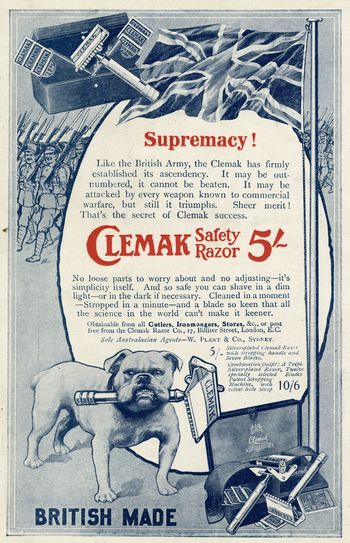
The popularization of the safety razor coincided with the growing prominence of a clean-shaven male aesthetic and increasingly body-oriented understandings of masculinity that placed a higher premium on muscularity and youthful fitness.Footnote 9 An accompanying proliferation of new products and advertising techniques emphasized the individual consumer's investment in modernity, the notion of perfectibility, and the importance of orderly and healthy daily routines.Footnote 10 In an early men's fashion and lifestyle magazine, Modern Man, the clean-shaven look was celebrated not only as fashionable but also as a particular kind of asset that allowed men to appear younger and to compete more successfully in the modern British economy: “The majority of us find it necessary to give the impression that we are younger than we are, for it is the young man who gets the big salary in the business world to-day.”Footnote 11 Advertisements for shaving accoutrements in this period also provided an opportunity to reflect on British national identities in instructive ways. Clemak, for instance, in an announcement that appeared in 1915, mobilized national symbols like the bulldog while invoking the commonly accepted tropes of superiority and ascendancy—at a time, tellingly, when the outcome of the First World War was anything but certain (figure 1). The company also cast their product as a potentially beneficial tool to British troops, simple to use in battle conditions and reliable, like the trusty canine pictured in the image.
Magazine Advertisement for Clemak Safety Razor, 1915.

In the interwar period, domestic and international companies alike introduced shaving-related products and preparations to serve a growing market of what was estimated to be roughly fifteen million “shaveable men.”Footnote 12 In selling toilet preparations, these businesses employed a range of advertising gimmicks that established the importance of a good, efficient shave and provided instructive lessons to British men on how to achieve good looks, to comport themselves properly, and to be successful. Gillette razors and Williams shaving sticks and creams were heralded for their quickness and efficiency in the 1920s, establishing them as aides to busy men who needed precise, handy solutions for everyday ablutions and chores.Footnote 13 In the 1940s, men were encouraged to be careful consumers who, by purchasing razors, shaving creams, and various aftershave astringents and lotions, were participating in a vital masculine ritual that allowed them to display self-respect and personal economy.Footnote 14 In another strategy, Ever-Ready in 1949 peddled a vision of heterosociability to establish an explicit relationship between good shaving habits and romantic success: “Women admire men with a smart well groomed appearance.”Footnote 15
While the influence of the safety razor continued for much of the twentieth century, its supremacy did not go unchallenged. In one notable instance, the device was improved upon by utilizing new technology. From the 1930s through the 1950s, electric razors were introduced to the British market as a fast, modern means for achieving a smooth shave, with an American-based company (Remington) once again emerging as a major player.Footnote 16 By the 1960s and 1970s, disposable plastic razors with cheap metal blades began to appear. At least as important in an era when most continued to use safety razors was Wilkinson Sword's introduction of the stainless-steel blade in the 1960s, a rustproof product that lasted longer than ordinary blades and briefly challenged Gillette's dominance in British households.Footnote 17 Since then, other innovations have served to displace the traditional safety razor, most notably the rise of multi-edge disposable razor heads. Within this context, companies such as the Personal Barber (a UK-based online retailer) and Truefitt and Hill have capitalized on a growing desire for luxurious grooming experiences and in the process have promoted embracing the safety razor as a tried and true alternative to newfangled innovations. In this way, what was once considered the epitome of scientific progress has been harnessed by entrepreneurs as a symbol of traditional, classic styling.
Although a seemingly mundane item, often taken for granted and rarely considered as a vitally important artifact, the safety razor tells us much about the history of Britain in the twentieth and early twenty-first centuries. Encountered on a nearly daily basis by most men (and many women), the device and its successors provide a revealing point of access for understanding the inner workings of international capitalism, industrial competition, and technological innovation. When considered in tandem with various advertising techniques, the safety razor is especially useful for dissecting the relationships that existed between masculinity, consumerism, and grooming on the one hand, and ideas of personal success, achievement, and self-improvement on the other. This relatively simple assemblage of metals and sharp edges, honed in purpose-specific factories around the world and sold in chemist shops, department stores, and hairdressing establishments, presents opportunities for historians of every ilk interested in understanding the British engagement with modernity and its attendant material markers.