Introduction
Understanding how the population dynamics of insect pests are linked to environmental factors and agricultural practices remains an important research area in pest management (Barberi et al., Reference Barberi, Burgio, Dinelli, Moonen, Otto, Vazzana and Zanin2010; Rusch et al., Reference Rusch, Valantin-Morison, Sarthou and Roger-Estrade2012). Determining the influence of environmental factors on insect populations in the field is a difficult task because the data are often highly variable. In the case of insect pests of crops, the task is even more difficult because agricultural practices introduce additional variation that must be disentangled from the variation caused by environment. Environmental factors, such as temperature and rainfall, are known to have a huge influence on pest distribution and population dynamics (Huffaker & Gutierrez, Reference Huffaker and Gutierrez1999). In addition, the distribution of insects at the landscape scale may result from dispersal by humans and may, therefore, reflect the invasion history of the insects (Tscharntke et al., Reference Tscharntke, Steffan-Dewenter, Kruess and Thies2002).
One way to study the influence of environmental factors on populations in the field is to use an extensive data set that includes, in addition to data on insect abundance, wide ranges in soil type, temperature, rainfall and other environmental factors over a relatively small area. Such a data set should enable researchers to identify correlations despite the high variability of data. The island of Martinique (area=1128 km2) is especially suitable for this kind of study because the abiotic environment of Martinique, like that of other volcanic tropical islands, changes greatly in a relatively small area. Because rainfall is linked to topographic relief, annual rainfall on Martinique can range from 1000 mm at sea level to >6000 mm at higher elevations. Given this great range of climate and also a great range in the nature and age of the source rocks, soil on Martinique is also quite variable (Colmet-Daage et al., Reference Colmet-Daage and Lagache1965).
The banana weevil, Cosmopolites sordidus (Coleoptera: Curculionidae) (Germar, 1825), is the most serious insect pest of banana and plantain in the West Indies and other areas (Gold et al., Reference Gold, Pena and Karamura2001). Cosmopolites sordidus is a narrowly oligophagous pest, attacking wild and cultivated clones in Musa (banana, plantain and abaca) and the related genus Ensete (Gold et al., Reference Gold, Pena and Karamura2001). Banana fields can be infested with C. sordidus through the planting of infested material (resulting in random distributions), through spread from a heavily infested neighbouring field (resulting in linear distributions) or through adults that have survived the last planting (resulting in patchy distributions) (Vinatier et al., Reference Vinatier, Chailleux, Duyck, Salmon, Lescourret and Tixier2010). Adult weevils usually disperse by walking on the soil during the night (Vinatier et al., Reference Vinatier, Tixier, Le Page, Duyck and Lescourret2009, Reference Vinatier, Chailleux, Duyck, Salmon, Lescourret and Tixier2010). After eggs have been laid on the banana corm, larvae hatch and bore galleries inside the corm for feeding (Koppenhofer, Reference Koppenhofer1993). Although C. sordidus is found under different climatic conditions, the effects of abiotic factors and season on C. sordidus population dynamics are still unclear (Gold et al., Reference Gold, Pena and Karamura2001). As is the case for most insects, increasing temperatures support faster C. sordidus life cycles, and the upper elevation threshold for C. sordidus (1600–2000 m) is likely to be temperature related (Gold et al., Reference Gold, Pena and Karamura2001).
Control of C. sordidus is mainly based on pheromone mass trapping (Tinzaara et al., Reference Tinzaara, Gold, Dicke, van Huis and Ragama2005; Rhino et al., Reference Rhino, Dorel, Tixier and Risede2010). Yellow pitfall traps containing the Sordidin aggregation pheromone, which is emitted by C. sordidus males (Beauhaire et al., Reference Beauhaire, Ducrot, Malosse, Ndiege and Otieno1995), are buried in the soil. Cosmopolites sordidus populations are also likely to be affected by fallow periods, which are increasingly used to control plant-parasitic nematodes (Duyck et al., Reference Duyck, Pavoine, Tixier, Chabrier and Quénéhervé2009). The effects of fallow periods on C. sordidus population dynamics, however, are poorly known and controversial. On the one hand, fallow could increase problems with C. sordidus control because the destruction of the host plant may cause significant dispersion of adults. Similarly, the decomposing banana pseudostems that remain during fallow may represent a high quantity of resource for larvae and may lead to an increase in C. sordidus numbers. On the other hand, the combination of fallow and mass trapping could drastically reduce pest numbers before banana planting (Rhino et al., Reference Rhino, Dorel, Tixier and Risede2010).
To study the influence of environmental factors and fallow periods on the abundance of the banana weevil, C. sordidus, we first built an extensive data set based on the trapping (18,130 observations) of the weevil. Using this data set and generalized mixed-effects models, we then studied the influence of temperature, rainfall, soil type, plantation duration and fallow duration on C. sordidus population dynamics.
Materials and methods
Collection of field data
Cosmopolites sordidus was surveyed during three years (from January 2006 to January 2009) in 12 commercial banana plantations (600 ha total area) in Martinique (French West Indies, 14°N, 61°W). The abundance of C. sordidus was assessed using pitfall traps (APEX, France, Martinique) with the Sordidin aggregation pheromone (Cosmolure®, ChemTica Internacional, S.A., San José, Costa Rica) that were randomly in a total of 128 plots at the mean density of one trap per ha (with a total of 600 traps). The pheromone was changed every four weeks (Beauhaire et al., Reference Beauhaire, Ducrot, Malosse, Ndiege and Otieno1995). The C. sordidus in each trap (18,130 observations in total) were counted once per month. Although the effectiveness of pheromone traps can be influenced by numerous factors, including temperature, wind speed and relative humidity that may modify the diffusion of the pheromone in the air, we considered that uncertainty about trap effectiveness was reduced by the high number of observations.
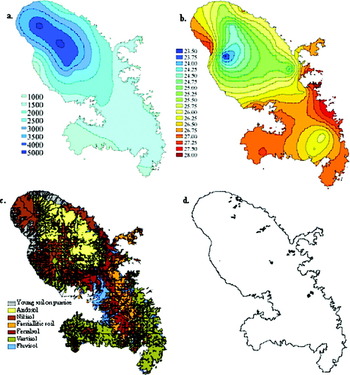
Mean annual temperature and cumulative annual rainfall in the different locations on Martinique were provided for a 30-year period by Météo-France Martinique, Service Climatique (fig. 1). Soil types (young soils on pumice, andosols, nitisols, ferralsols, vertisols and fluvisols) were determined using a soil type map (Colmet-Daage et al., Reference Colmet-Daage and Lagache1965).
Rainfall, temperature, soil types and sampling locations on Martinique. (a) Mean annual rainfall (mm) from 1971 to 2000; (b) mean annual temperature (°C) from 2007 to 2008; (c) distribution of soil types (Colmet-Daage & Lagache, Reference Colmet-Daage and Lagache1965); (d) distribution of traps.

Statistical analysis
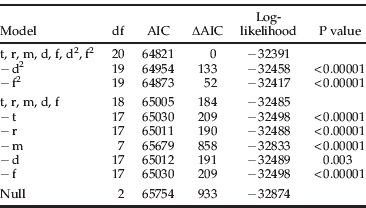
Generalized linear mixed-effects models (GLMM (Bolker et al., Reference Bolker, Brooks, Clark, Geange, Poulsen, Stevens and White2009)) with a Poisson error were used to examine the relationship between C. sordidus abundance and mean annual temperature, mean annual rainfall, soil type, month of trapping, duration (months) since planting, duration of fallow period and interactions. In this type of model, the linear predictor contains random effects in addition to fixed effects. The inclusion of random effects allowed us to account for the effect of variables that create variance but that are not important to be tested. We treated ‘plot’ as a random effect to account for pseudo-replication and because we assumed that plots contained unobserved heterogeneity that we could not model. Overdispersion was taken into account by using ‘sample number’ as an individual-level random variable. The GLMMs were fitted by the Laplace approximation using the glmer function in ‘lme4’ (Bates et al., Reference Bates, Maechler and Bolker2011) in the statistical programme R 2.12.1 (R Development Core Team, 2010). We started from the most complex model (including all interactions and quadratic terms for continuous variables) and kept eliminating higher-order terms as long as they remained insignificant. The significance of each term was assessed by comparing models with and without that term. ΔAIC (difference in Akaike information criterion) assesses the difference between each model and the best model. A null model with no environmental variables was included for comparative purposes.
Results
The total number of samples was 18,130. The mean (±SE) number of C. sordidus captured per month from all traps was 24.34 (±9.30). The largest number of individuals collected per sample was 600, and 3254 samples had zero C. sordidus (1st quartile=2, median=11, and 3rd quartile=30 individuals collected).
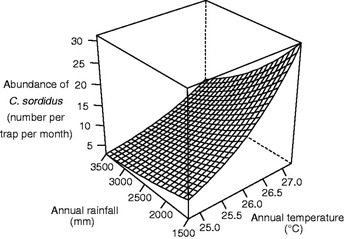
The GLMMs indicated significant effects of mean annual temperature, mean annual rainfall, month of trapping, duration since planting and duration of fallow period on C. sordidus abundance (table 1). Soil type had no significant effect on abundance (P>0.05) and was removed from the model. Quadratic terms of duration since planting and duration of fallow period had significant effects on C. sordidus abundance, while this was not the case for annual temperature and rainfall. Mean abundance of C. sordidus increased greatly as mean annual temperature increased and decreased as mean annual rainfall increased (fig. 2).
Analyses of the abundance of Cosmopolites sordidus by generalised mixed-effect models with Poisson error (18, 130 samples). Abundance was determined with pheromone traps, and the values indicate the number captured per trap per month. All models include two random effects: ‘sample’ and ‘plot’. A null model with no environmental variables is included for comparison. The significance of each effect was tested by removing the variable from one of the two complete models. ΔAIC (difference in Akaike information criterion) assesses the difference between each model and the best model.
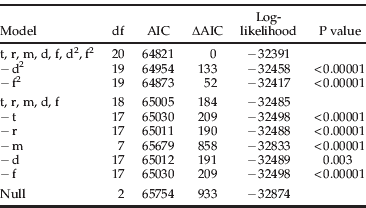
t, mean annual temperature; r, mean annual rainfall; m, month of trapping; d, duration since planting; f, duration of fallow period
Influence of temperature (t, °C) and rainfall (r, mm) on the abundance of Cosmopolites sordidus. Abundance was determined with pheromone traps, and the values indicate the number captured per trap per month. Because there was no interaction between climate (rainfall and temperature) and plantation age (duration of banana cultivation) and duration of fallow, the effect of climate is presented using data for plantation age=3 months and duration of fallow=3 months. For other plantation ages and durations of fallow, the absolute values may differ but the effect of temperature and rainfall will be the same.

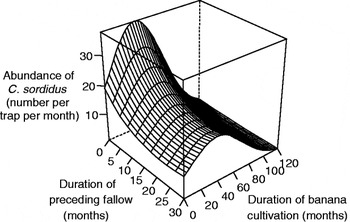
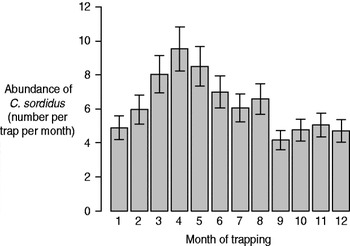
Mean abundance of C. sordidus increased during the first 36 months after planting and then decreased (fig. 3). Abundance of C. sordidus decreased drastically during the first 12 months of fallow and then tended to plateau for the next 18 months of fallow (fig. 3). The effect of the fallow period declined with increasing duration of banana cultivation and was negligible after 80 months of cultivation. The peak in C. sordidus abundance that occurred after 12 months of cultivation was largest if the cultivation was not preceded by fallow and decreased with increasing duration of the preceding fallow. The abundance of C. sordidus was larger from March to June (fig. 4), corresponding to the driest months in Martinique.
Abundance of Cosmopolites sordidus as a function of duration of banana cultivation and of duration of preceding fallow. Abundance was determined with pheromone traps, and the values indicate the number captured per trap per month. Because there was no interaction between climate (rainfall and temperature) and plantation age and duration of fallow, data are presented for temperature=25.75°C and rainfall=2100 mm. For other temperatures and rainfall levels, the absolute values may differ but the effect of plantation age and duration of preceding fallow will be the same.

Influence of the month of trapping (1=January through 12=December) on the abundance (mean±SE) of Cosmopolites sordidus. Abundance was determined with pheromone traps, and the values indicate the number captured per trap per month. Because there was no interaction between month of trapping and other factors, data are presented for temperature=25.75°C, rainfall=2100 mm, plantation age=3 months and duration of fallow=3 months.

Discussion
Effect of length of fallow and banana cultivation on C. sordidus abundance
Our study shows that fallow decreases the abundance of C. sordidus at the scale of Martinique. The abundance of C. sordidus in the banana crop following the fallow period decreases as the fallow period increases up to 12 months but does not decrease further with longer fallow periods. These findings are important because destruction of the resource may cause significant dispersion of adults (Vinatier et al., Reference Vinatier, Chailleux, Duyck, Salmon, Lescourret and Tixier2010, Reference Vinatier, Lescourret, Duyck, Martin, Senoussi and Tixier2011) and because of concerns that the banana residues that decompose during fallow may be a favourable resource for larvae. This study shows, however, that 12 months of fallows, which is usually recommended for nematode control (Duyck et al., Reference Duyck, Pavoine, Tixier, Chabrier and Quénéhervé2009), can be useful for banana weevil control. Although banana plants are absent during the fallow period, many other plants are usually present; and these support communities of soil organisms, including potential predators of C. sordidus like ants (Abera-Kalibata et al., Reference Abera-Kalibata, Gold, Van Driesche and Ragama2007; Duyck et al., Reference Duyck, Lavigne, Vinatier, Achard, Okolle and Tixier2011). In addition to contributing to pest control, fallows improve soil fertility (Ayuke et al., Reference Ayuke, Brussaard, Vanlauwe, Six, Lelei, Kibunja and Pulleman2011).
Regardless of fallow duration in the current study, C. sordidus abundance decreased when banana was cultivated for more than 36 months. This decrease can be explained by two mechanisms. First, the pheromone traps could have progressively reduced the numbers of C. sordidus, i.e. the pest may have been controlled by mass trapping (Gold et al., Reference Gold, Pena and Karamura2001; Tinzaara et al., Reference Tinzaara, Gold, Dicke, van Huis and Ragama2005). Second, Beauveria bassiana (Gold et al., Reference Gold, Pena and Karamura2001) and other entomopathogenic fungi, as well as generalist predators (Duyck et al., Reference Duyck, Lavigne, Vinatier, Achard, Okolle and Tixier2011), could have increased and contributed to C. sordidus control.
In choosing the duration of the fallow period, farmers attempt to optimize the trade-off between the gain from reducing pest numbers and the loss from extending the non-productive period. The current results indicate that fallows should last about 12 months. The current results also indicate that mass trapping should focus on the critical period that extends between 40 and 80 months after planting.
Effect of temperature, rainfall, and soil type on C. sordidus abundance
Our analysis indicates that temperature and rainfall greatly affect the abundance of C. sordidus. Temperature almost always affects the distribution and the population dynamics of insects because it greatly affects insect metabolism (Birch, Reference Birch1948). The effect of temperature on C. sordidus populations has already been mentioned with respect to altitude (Gold et al., Reference Gold, Pena and Karamura2001). Lescot (Reference Lescot1988) surveyed 45 sites in Cameroon and found a negative correlation between weevil damage and elevation; damage was greatest at altitudes below 1000 m, was very low between 1500 and 1600 m, and was absent (as was the weevil) at altitudes greater than 1600 m. Lescot (Reference Lescot1988) also indicated that elevation thresholds were similar in Burundi, Rwanda and Colombia. The upper elevation threshold for the banana weevil is likely to be temperature related. Cuillé (Reference Cuillé1950), Mesquita & Alves (Reference Mesquita and Alves1983) and Lescot (Reference Lescot1988) suggested that the minimal thermal threshold for adult activity was 15–18°C, while the optimal temperature has been estimated to be 25°C (Cuillé, Reference Cuillé1950). In a controlled study, Traore et al. (Reference Traore, Gold, Pilon and Boivin1993, Reference Traore, Gold, Boivin and Pilon1996) found that the minimal thermal threshold was 12°C for eggs and 10°C for larvae and that the highest rates of hatching and larval development occurred between 25°C and 30°C. These data suggest that extended periods with low night temperatures at higher elevations may severely limit larval development and/or adult survival. In Cameroon, for example, night temperatures fall below 12°C at 1300 m (Lescot, Reference Lescot1988).
The effect of rainfall and, more generally, humidity on insects is variable and is often species specific (Juliano et al., Reference Juliano, O'Meara, Morrill and Cutwa2002; Duyck et al., Reference Duyck, David and Quilici2006). Even within the species C. sordidus, the effect of humidity is controversial. While adult banana weevils are susceptible to desiccation (Cuillé, Reference Cuillé1950; Roth & Willis, Reference Roth and Willis1963), researchers have reported a positive effect, a negative effect or no effect of humidity on the number of weevils trapped (Gold et al., Reference Gold, Pena and Karamura2001). Our study shows a negative effect of annual rainfall on C. sordidus abundance at the scale of Martinique. This is consistent with reports that numbers of weevils trapped were greatest during the driest period in Uganda (Gold et al., Reference Gold, Pena and Karamura2001, Reference Gold, Okech and Nokoe2002).
Cosmopolites sordidus abundance was unrelated to soil type in the current study, and to our knowledge, no effect of soil type on C. sordidus has been reported in other studies. Although no direct effect of soil type on the insect was anticipated, soil type could affect the adults by affecting soil moisture and by affecting entomopathogenic nematodes and fungi (Gold et al., Reference Gold, Pena and Karamura2001, Reference Gold, Okech and Nokoe2002).
Influence of season on C. sordidus abundance
We showed that the abundance of C. sordidus, as indicated by the number of adults trapped, was highest from February to August, and especially from March to May, which is the dry season. This can be explained by higher numbers of C. sordidus during the driest season or by an increase in trap efficiency during the driest season, or both. In Africa, most researchers have reported the highest trapping rates during the rainy season, but some researchers in South America and the Caribbean have reported highest trapping rates during the dry season (Gold et al., Reference Gold, Pena and Karamura2001). We can hypothesize that, given the soil and climate of Martinique, the negative effect of humidity indicated in figs 2 and 4 may be the result of two complementary mechanisms. First, high soil moisture potentially results in an increased number of suitable ‘resting sites’ for adults (for example, the adults could remain under wet residues), which would reduce the proportion of C. sordidus that move, as demonstrated in another study on weevil dispersal (Vinatier et al., Reference Vinatier, Lescourret, Duyck, Martin, Senoussi and Tixier2011). Second, rain and high humidity could reduce the evaporation and diffusion of the pheromone in the air, and there is usually less wind during wet season; these wet-season factors could reduce perception of pheromone and result in reduced movement. Why numbers of C. sordidus trapped were highest in the dry season in this and other studies in the Caribbean and South America but were highest in the wet season in Africa is unclear but might reflect differences in the nature of the dry seasons and wet seasons in the two areas. We note, however, that the trends observed in African studies were not strong and were not based on extensive data sets.
Conclusion
Although several studies have shown that fallow reduces nematode numbers in banana plantations (Okolle et al., Reference Okolle, Fansi, Lombi, Sama Lang and Loubana2009), only one has reported the effect of this cultural practice on the banana weevil; Price (Reference Price1994) reported that fallow reduced the damage caused by the banana weevil. According to Rhino et al. (Reference Rhino, Dorel, Tixier and Risede2010), the prevention of the build-up of C. sordidus populations in banana fields requires that mass trapping be associated with a high level of field sanitation. Our results are consistent with the view that fallows, in association with pheromone traps, are effective for the control of the banana weevil. By using a data set covering a wide range of soil and climate conditions in Martinique, we disentangled the effects of soil and climate conditions on the efficiency of fallow (combined with mass trapping) for C. sordidus control. From an applied perspective, these results suggest that trapping should be conducted during two periods when the largest numbers of C. sordidus are trapped; these periods are (i) between the 40th and 80th month after planting and (ii) during the dry season. In addition, fallows should last at least 12 months. Finally, future research should explicitly investigate the effect of spatial distribution of traps within and between plots on the efficiency of mass trapping.
Acknowledgements
This work was supported by CIRAD. The authors are grateful to Kevin Pinte and Marine Dumas (Cemagref) for their help with the Geographic Information System. We thank Pierre René and Patrick Legares (APEX) for monitoring C. sordidus in the field. We also thank David Dural and Karine Vincent (BANAMART) and farmers for providing field data.