It's very important for being a judge—judicial discretion. It's important in specialized dockets. Like with OVIs [Operating a Vehicle under the Influence], [the legislature] gives us standard sentences for first, second, [and] third [offenses]. Heck, you could have a monkey up there doing that. It's important to see when somebody needs our arm wrapped around them, trying to give them a pep talk or try to get them fired up about positive things in life and other people who deserve a kick in the butt. It depends on the person; it depends on the circumstances. It's very important not to take that discretion away from judges. People see the value of judges in that regard when we have courts like this.Footnote 1
Introduction
One of the most significant innovations in criminal justice reform in the past few decades has been the emergence and expansion of mental health courts (MHCs). First developed in the late 1990s, these specialized criminal court dockets utilize a designated judicial, legal, and clinical treatment team in lieu of traditional case processing and sentencing in order to divert individuals from the criminal justice system into community-based treatment. MHCs take a variety of forms, including misdemeanor and felony MHCs (Redlich et al. Reference Redlich, Steadman, Monahan, Petrila and Griffin2005), substance abuse and mental illness (SAMI) courts, and juvenile and gender-specific MHCs.Footnote 2 MHCs are part of the broader problem-solving court (PSC) movement, which includes drug courts, domestic violence courts, and veterans treatment courts (Ostrom Reference Ostrom2003; Miller and Johnson Reference Miller and Johnson2009; Paik Reference Paik2011; Tiger Reference Tiger2012; Knudsen and Wingenfeld Reference Knudsen and Wingenfeld2016). These courts are based on a philosophy of law that views judges as uniquely positioned to help offenders resume productive lives, a precept commonly referred to as therapeutic jurisprudence (Wexler Reference Wexler1992; Hora, Schma, and Rosenthal Reference Hora, Schma and Rosenthal1999; Corvette Reference Corvette2000; Nolan Reference Nolan2001; McCoy Reference McCoy2003; Winick and Wexler Reference Winick and Wexler2003; Odegaard Reference Odegaard2007). Frustrated with the rising tide of mentally ill offenders,Footnote 3 judges led the grassroots effort to initiate and establish MHCs by making moral claims about the reduced criminal culpability of offenders with psychiatric disabilities. With more than 300 MHCs in operation today (Fisler Reference Fisler2015), as well as thousands of other PSCs, the rapid and widespread adoption of these specialty dockets has engendered a fundamental shift in judicial power.
The majority of research on MHCs consists of evaluation studies that measure the programmatic success of court actors in reducing recidivism and attaining treatment goals (Moore and Hiday Reference Moore and Aldige Hiday2006; McNiel and Binder Reference McNiel and Binder2007; Sarteschi, Vaughn, and Kim Reference Sarteschi, Vaughn and Kim2011; Hiday, Ray, and Wales Reference Hiday, Ray and Wales2016; Woojae and Redlich Reference Woojae and Redlich2016). While research has not yet determined whether the judge-offender relationship directly impacts case outcomes (McNeil and Binder 2010; Wales, Hiday, and Ray Reference Wales, Aldigé Hiday and Ray2010; Ray, Dollar, and Thames Reference Ray, Brooks Dollar and Thames2011; Goffried, Carbonell, and Miller Reference Goffried, Carbonell and Miller2014; Mahoney Reference Mahoney2014), the types of decisions that judges make and the factors that influence those decisions have been at the forefront of the PSC movement. To date, few studies have explored how trial judges who are now in the business of treatment and recovery acquire the skills necessary to achieve the objectives of MHCs.
This article addresses this gap in the literature by using ethnographic data to examine the professionalization of MHC judges in this alternative court organization. As Judge Phillip Travers indicated in the opening epigraph, specialized dockets allow judges to break free from the statutory shackles that “transformed them into mid-level bureaucrats” (Boldt and Singer Reference Boldt and Singer2006, 84).Footnote 4 Unleashed from traditional legal restraints, judges negotiate the particulars of individual cases and inspire offenders to adopt normative patterns of social behavior. MHC judges utilize ongoing surveillance and monitoring, individualized treatment plans, and other wraparound services, such as housing and employment assistance, to help individuals transition back into their local communities (Denckla and Berman Reference Denckla and Berman2001; Steadman, Davidson, and Brown Reference Steadman, Davidson and Brown2001; Bazelon 2003; Berman Reference Berman2004; Berg Reference Berg2005). In short, the rapid rise of MHCs has catapulted judges into new roles that differ radically from their traditional set of duties in the adjudication of criminal cases.
In MHCs, a judge's primary task is to help offenders achieve emotional wellness and desist from unlawful activity. As Judge George Holbert of the Circuit Felony Mental Health Court explained: “My function is to change behavior.” MHC judges do not punish past criminal acts, as they do in traditional courts, but instead influence future behavior (Tiger Reference Tiger2012). Two central features of MHCs present challenges for judges undergoing an occupational shift from common law arbiters to therapeutic agents (Nolan Reference Nolan2001). First, in contrast to judges in traditional courts, MHC judges are expected to practice law as a healing profession (Diacoff Reference Diacoff2006). Apart from their years on the bench, however, most judges have little training or experience implementing the principles of problem-solving justice. Second, judges are cast into uncharted organizational territory when they preside over specialty dockets. Judges are no longer passive arbitrators, but are thrust into the spotlight as the star actors of the new courtroom drama (Nolan Reference Nolan2001). In short, judges must learn, often through trial and error, the “tricks of the trade” in order to navigate this new legal topography.
The focus of this article is on how MHC judges develop occupational strategies for motivating, questioning, and defending participants who have been accused of wrongdoing. In the first section of the article, I build on the sociology of law and organizations by developing a theory of judicial behavior in the context of the problem-solving courtroom. First, I compare traditional and alternative courts to highlight the ways MHC judges evolve, in role and scope, as organizational actors. Second, building on the concept of craft (Flemming, Nardulli, and Eisenstein Reference Flemming, Nardulli and Eisenstein1992; Kritzer Reference Kritzer2007), I suggest that as judges operate in this novel legal arena, they create new professional practices to motivate offenders to comply with treatment. In the second section of the article, I examine ethnographic data, gathered over sixteen months from 2007 through 2011, from four MHCs in the United States. After providing an overview of the ethnographic setting and the substantive focus of the research, I present the empirical findings on types of craft. The data show that judges' capacity to positively influence individuals is shaped by their ability to utilize new institutional resources and manage uncommon constraints. I conclude that the art of judging in the MHC is facilitated as well as bound by the broader ecology and spatial dynamics of the alternative courtroom, what I call the politics of benchcraft.
Judges in Traditional and Problem-Solving Courts
US judges are held in occupational reverence and invoke cultural ideals of austerity, fairness, and unbiased application of the common law (Holmes Reference Holmes1881; Llewellyn Reference Llewellyn1960; Glendon Reference Glendon1994). Lower court justices arbitrate the vast number of criminal cases, and most of the research on traditional criminal courts focuses on judges as rational legal actors who ensure that proper procedures are followed and the defendant's due process rights are protected. Judges are required to abide by statutory law and to rule in a fair, impartial manner, obligations that Glendon called “interpretative and personal restraints” (1994, 118). Ostensibly, judges play a passive role; their primary adjudicatory functions include setting appropriate sentences, making formal determinations of guilt and innocence, and ruling on motions (Alschuler Reference Alschuler1976; Feeley Reference Feeley1979; Maynard Reference Maynard1983). Few cases go to trial and, faced with limited time and case information, judges render dispositions via plea bargains in a routine, predictable fashion. As a result, judges are often characterized as simply cogs in a bureaucratic machine.Footnote 5 For example, when discussing their work in traditional courts (before their appointments in MHCs), the judges in this study reported feeling external pressure to clear the calendar and described carrying out assembly-line justice in order to quickly and judiciously dispose of criminal matters.
In addition to time constraints and obligations of impartiality, the social and political organization of the traditional courtroom also shapes judicial behavior. In The Process is the Punishment, Feeley (Reference Feeley1979) explained that the New Haven justice system rotated judges to different courtrooms to prevent them from becoming too complacent with legal counsel. Rather than develop their own rules or bench persona (BIIJ 2007), judges acclimated to the normative adjudicative patterns of the courtrooms to which they were assigned, which further legitimized the practices and requests of prosecutors who held long-term appointments.Footnote 6 Elsewhere, Maynard (Reference Maynard1983), in writing about the ecology of the traditional court setting, theorized that magistrates are symbolically and physically isolated from the politicking of plea deals.Footnote 7 To uphold standards of impartiality, the architecture of the courtroom limits judges' interactions with the majority of actors, particularly criminal defendants.Footnote 8
MHC judges, in contrast, play a vastly different role that represents a marked shift from the traditional boundaries of law—Nolan called this novel process the practice of uncommon law (2001). Judges who preside over specialty dockets differ from their conventional counterparts in two significant ways. First, a hallmark feature of problem-solving courts is that judges speak directly to offenders with empathy and enthusiasm. Empirical accounts almost universally depict drug and mental health court judges as exuding a new type of bench style or persona (Nolan Reference Nolan2001; Berman and Feinblatt Reference Berman and Feinblatt2002; Boldt and Singer Reference Boldt and Singer2006; Talesh Reference Talesh2007; Paik Reference Paik2011; Tiger Reference Tiger2012; Lyons Reference Lyons2013; Perlin Reference Perlin2013).Footnote 9 These judges symbolically “cast [their] robe aside” (Perlin Reference Perlin2013, 1) and shed the traditional expectations of neutrality and passivity when they step up to the problem-solving bench. Part of this role shift requires judges to adopt new types of legal-speak, such as rhetorical persuasions used to keep clients on the road to recovery. Nolan, for example, called these discourses emotivist storytelling (2001, 111–32) in his book on the drug court movement. The literature has repeatedly shown that this type of charismatic authority is an essential element of judges' ability to achieve the complex tasks of building trust and managing risk among chronic reoffenders (Fisler Reference Fisler2005; Talesh Reference Talesh2007). However, in spite of the challenges associated with adopting a new discourse, many judges find this aspect of their new appointment quite satisfying because they believe communicating directly to participants makes a difference in their lives (McNeil and Binder 2007; Wales, Hiday, and Ray 2010; Ray, Dollar, and Thames 2011; Goffried, Carbonell, and Miller Reference Goffried, Carbonell and Miller2014; Mahoney Reference Mahoney2014).
Second, while MHC judges assume a new hybrid role as “social workers and probation officers” (Talesh Reference Talesh2007, 96),Footnote 10 they must also acclimate to the unique ecology of the alternative courtroom and its varied clientele. Courts, as social scientists have long documented, are governed by political maneuvering, and the makeup of the local courthouse community influences how judges adjudicate cases (Eisenstein and Jacob Reference Eisenstein and Jacob1977; Flemming, Nardulli, and Eisenstein Reference Flemming, Nardulli and Eisenstein1992). MHC judges participate in what Flemming, Nardulli, and Eisenstein called a “professional setting and a political arena” (1992, 10). The everyday work lives of MHC judges are embedded in a new set of spatial dynamics that differ from those in traditional courts. Most notably, mental health courts play out as therapeutic theater (Nolan Reference Nolan2001), which transforms the architectural dictates of the traditional courtroom and emboldens actors by granting them new opportunities to influence case outcomes. For example, case managers are authorized to introduce or withhold evidence and to control the direction of the courtroom dialogue (Castellano Reference Castellano2011). Similarly, the participatory role of “offenders turned clients” empowers individuals to refute claims of noncompliance and justify their actions as worthy of judicial leniency. In short, the underpinnings of this new court organization reflect a seismic shift in judges' interactional strategies for both addressing noncompliance and stage-managing other types of disputes (Conley and O'Barr Reference Conley and O'Barr2005).
Given judges' unique role in the mental health courtroom, I posit that they practice a new kind of occupational craft. As Flemming and his colleagues observed in their book The Craft of Justice, “[j]udging is about deciding” (1992, 79), and the act of decision making on the bench involves legal reasoning and applying judgment to solve routine problems. The concept of “judgecraft” (Flemming, Nardulli, and Eisenstein Reference Flemming, Nardulli and Eisenstein1992) offers a general description of how traditional lower court judges apply their “practical knowledge and prior experience” (Kritzer Reference Kritzer2007, 322) to the routine administration of justice. A 2007 special issue of Social & Legal Studies investigated craft as an essential element of the court's adjudicatory function and offered new theoretical perspectives for analyzing judicial decision making in other legal contexts. As a promising facet of law-in-action, the concept of craft offers promising explanatory power for the analysis of how judges evolve as organizational actors with new institutional practices in the problem-solving court.
The current article contributes to the literature on occupational craft by showing how MHC judges professionalize their role by developing, albeit by trial and error, the artistry of therapeutic adjudication (Nolan Reference Nolan2002). In empirical analyses of MHC judges, conceptualizing craft in the problem-solving courtroom offers a robust way to examine judicial behavior. In particular, Kritzer's (Reference Kritzer2007) rubric of elements offers new insights into how MHC judges achieve the goals of therapeutic jurisprudence from behind the bench and beyond. According to the data, judges discover how to aesthetically convey information to clients, cleverly repackage their traditional legal tactics to exact certain truths, and deftly protect clients' due process rights given the diminished role of defense counsel. Further, the empirical findings illustrate that MHC judges both capitalize on their enhanced discretion and realize its limitations. I conclude that the art of judging in the new ecology of the MHC involves learning to finesse elements of treatment and law into new professional practices, what I call the politics of benchcraft.
Methodology
The article is based on a larger ethnographic study of four US mental health courts. Between 2007 and 2011, I spent four nonconsecutive months conducting fieldwork at each MHC site. During my field studies, I directly observed court proceedings and team meetings, interviewed study participants, and compiled archival materials. The work of MHC judges is enormously challenging and, like any craft, many of its subtleties are overlooked or not easily articulated. The ethnographic method of data collection, therefore, is best able to provide a deep understanding of MHC judges, and the resulting data yield a rich description of the organizational settings in which these judges operate. First, to capture and record the observational data, I took extensive field notes in two key venues where judicial encounters and the activities of judicial decision making occurred: the courtroom and judicial chambers. Each week, I observed the precourt staffing sessions in chambers, in which judges met with other team members to discuss the progress or troubles of each client on the docket. I also observed the court proceedings (also called status hearings or review hearings) in which clients stood before the judge to report on their progress.
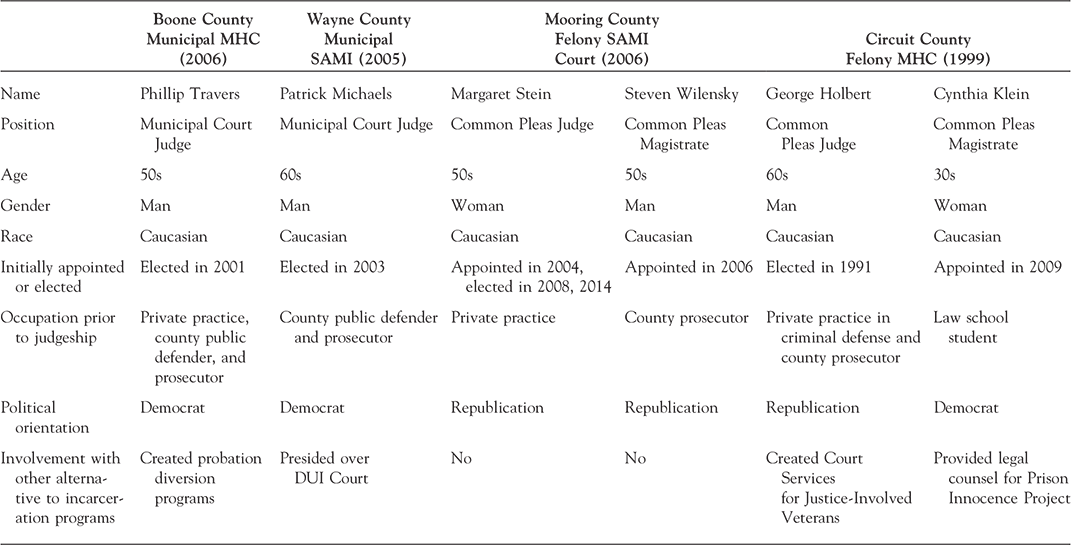
The second component of data collection was conducting in-depth, semi-structured interviews with judges and magistrates. The focal judges presided over both traditional court calendars and the mental health court docket (see Table 1).Footnote 11 Judges came to their position on the mental health court after long and relatively distinguished legal careers, and most began their occupational trajectory as prosecutors or public defenders. Prior to and during their tenure on the mental health court, many of the judges in the sample were involved in programs that offer alternatives to prosecution and incarceration. The interview questions focused on how and why the judges came to preside over the mental health court, the formal and informal protocols under which defendants are referred to and accepted in the court, how the judges respond to various forms of compliance and noncompliance, and their working relationships with team members.
Demographics of Mental Health Court Judges

| Boone County Municipal MHC (2006) | Wayne County Municipal SAMI (2005) | Mooring County Felony SAMI Court (2006) | Circuit County Felony MHC (1999) | |||
|---|---|---|---|---|---|---|
| Name | Phillip Travers | Patrick Michaels | Margaret Stein | Steven Wilensky | George Holbert | Cynthia Klein |
| Position | Municipal Court Judge | Municipal Court Judge | Common Pleas Judge | Common Pleas Magistrate | Common Pleas Judge | Common Pleas Magistrate |
| Age | 50s | 60s | 50s | 50s | 60s | 30s |
| Gender | Man | Man | Woman | Man | Man | Woman |
| Race | Caucasian | Caucasian | Caucasian | Caucasian | Caucasian | Caucasian |
| Initially appointed or elected | Elected in 2001 | Elected in 2003 | Appointed in 2004, elected in 2008, 2014 | Appointed in 2006 | Elected in 1991 | Appointed in 2009 |
| Occupation prior to judgeship | Private practice, county public defender, and prosecutor | County public defender and prosecutor | Private practice | County prosecutor | Private practice in criminal defense and county prosecutor | Law school student |
| Political orientation | Democrat | Democrat | Republication | Republication | Republication | Democrat |
| Involvement with other alternative to incarceration programs | Created probation diversion programs | Presided over DUI Court | No | No | Created Court Services for Justice-Involved Veterans | Provided legal counsel for Prison Innocence Project |
The third component of data collection was gathering official court transcripts, newspaper articles on the courts, judges' profiles on courthouse websites, and the electoral platforms judges' advanced when they ran for office, which were posted on Web sites and published in past news coverage. In combination, these data best identified the features and contingencies of the judge's role in the mental health court. The research design was rigorously reviewed and approved by both an institutional review board at the university level and the external granting agency. All study participants signed informed consent forms.Footnote 12
I utilized the grounded theory approach to analyze the data (Strauss and Corbin Reference Strauss and Corbin1998; Charmaz Reference Charmaz and Emerson2001), beginning with the process of open coding to identify general patterns of social behavior. As I became more familiar with the data, I began focused coding (Lofland et al. Reference Lofland John, Anderson and Lofland2006). As coding and analysis proceeded, I refined the initial concepts, ultimately producing a set of coded data categories to explain social behavior more generally (Strauss and Corbin Reference Strauss and Corbin1998). My field notes showed that judges are deeply involved in investigating problems, collecting personal client information, and actively consulting with treatment professionals and law enforcement officers. My emerging analysis focused on judges' patterned responses to allegations of client misconduct. Specifically, I found that judges purposefully crafted three strategies: therapeutic interventions to encourage struggling participants, prosecutorial tactics to test clients' commitment to the program, and defense protocols to grant impartiality when clients were accused of wrongdoing. However, the judges' ability to strategically respond to client noncompliance was circumscribed by the uncommon constraints on their discretionary powers in the alterative courtroom. In short, judging in the mental health courtroom is a practiced skill and, once judges become accomplished in their new context, a masterful execution of subtle and astute expertise.
Crafting Problem-Solving Justice
Launching a new career in a mental health court involves a steep learning curve; it is not an easy transition for judges, nor does it come naturally for most. Indeed, a publication called Judge's Guide to Mental Health Jargon Footnote 13 offers professional guidance to judges with no clinical training. Seeking to increase their skill in formulating therapeutic responses, judges sought mentorship from colleagues who presided over MHCs in neighboring counties as well as members of the treatment team. Once they “got [their] sea legs,” as one judge put it, they embraced opportunities to address the root causes of client problems. Although the number of cases adjudicated on a given day is often used as a measure of judicial competency in trial courts (Berman Reference Berman2000), MHC judges described being held to different standards. Judges reported feeling pressured by court staff and experiencing self-generated pressure to come across convincingly on the bench as the “disappointed parent” for one client and the “encouraging guidance counselor” for another. As Magistrate Cynthia Klein of the Circuit Felony SAMI court said: “Law school, it's mostly theoretical. It's all reading cases. It's not really any hands-on doing anything. So, coming in here and taking this role, you are on your own a little bit.” Although judges received informal advice from the team, and some had “cheat sheets” in hand if they forgot their lines (Castellano Reference Castellano2011), they often had to “go by the seat of [their] pants,” as Judge Travers explained. Judges admitted that they sometimes struggled to come up with things to say to clients, suggesting that improvisation was an essential attribute.
Types of Judgecraft in Mental Health Courts
| Motivational Shocking | Cross-Examining Commitment | Defending the Mark | |
|---|---|---|---|
| Type | Therapeutic | Prosecutorial | Defensive |
| Defined | Judges utilize psychological principles in response to violations of the treatment contract. | Judges employ interrogative tactics in response to allegations of client manipulations or exploitations. | Judges adopt defense strategies in response to evidence of legal wrongdoing. |
| Purpose | Encourage a struggling participant to reengage with his or her recovery plan. | Solicit information, provoke client confessions, and test readiness to change. | Protect due process rights, and ensure fairness as well as procedural transparency. |
| Elements of Craft | Rhetorical techniques. Staged theatrics. Clinical knowledge. |
Trial lawyering tactics. “Gut instincts” and improvisational skills. Creativity and flexibility. |
Judicial restraint and independence. Power brokering skills. Perception and foresight. |
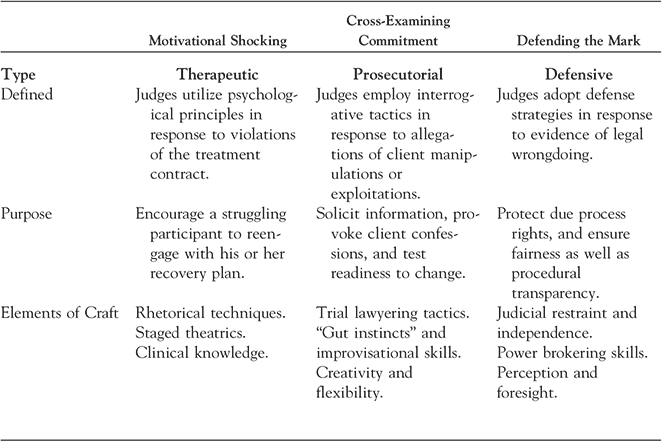
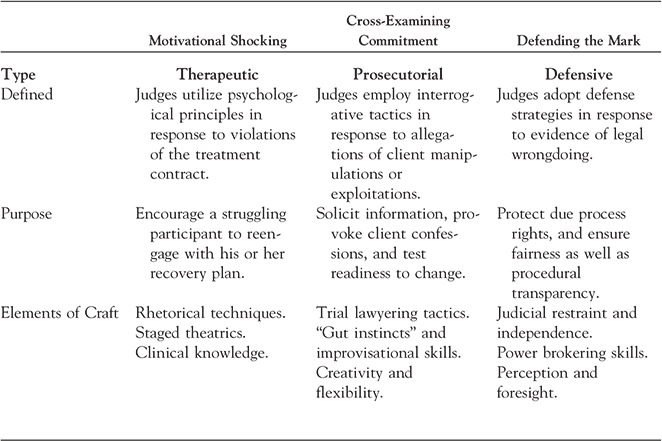
The empirical sections that follow highlight three types of craft that illustrate how judges motivate, interrogate, and protect clients accused of program noncompliance (see Table 2). The first section shows how judges employ dialogic and dramaturgical tactics to “shock” a recalcitrant participant into reengaging with treatment. The second section illustrates that judges facilitated program compliance by employing lawyerly tactics of inquisition to solicit information and test a client's commitment to recovery. The third section demonstrates how judges adopted defense strategies to protect a participant's due process rights while persuading him or her to accept a perceived injustice. I conclude that for judges, problem-solving jurisprudence is a nascent professional practice shaped by the uncommon political ecology of the alternative courtroom.
Motivational Shocking
Research on drug courts has found that judges routinely use “tough love” (Burns and Peyrot Reference Burns and Peyrot2003) jail sanctions, also called shock incarceration or flash incarceration, for clients who fail to conform to the behavioral expectations of the program (Nolan Reference Nolan2001; Griffin, Steadman, and Petrila Reference Griffin, Steadman and Petrila2002; Baker Reference Baker2013). MHC judges, however, are keenly aware that using incarceration as a “brute force” (Kleiman Reference Kleiman2009) response to program noncompliance is not always a necessary or even morally appropriate way to advance the court's objectives for persons with severe mental illnesses. Motivational shocking refers to how judges utilize dialogic and dramaturgical features of the alternative courtroom to encourage a recalcitrant client to reengage with treatment. An example from the Mooring Felony MHC illustrates how judges “learned to motivate” clients by manipulating the client audience and transforming the symbolic meaning of the courtroom venue.
On Thursday afternoons, the treatment team—Judge Margaret Stein, Magistrate Steve Wilensky, two case managers, a probation officer, and the bailiff—gathered in the ornate Common Pleas courtroom for the weekly case review meeting. If Judge Stein was adjudicating other criminal matters, the magistrate presided over the mental health court docket.Footnote 14 By nature of his position, the magistrate had markedly less bench experience than Judge Stein. During my interview with Magistrate Wilensky he reported that chairing the status hearings was daunting at first and initially he relied on team members, case managers in particular, for guidance on how to talk to clients in ways that were both supportive and authoritarian. I observed Wilensky's judging style mature over time, and even the court staff remarked: “[Wilensky] is getting better.” Judge Stein offered a soothing, maternal bench presence (which many clients preferred), but rarely created much courtroom drama. In contrast, the magistrate developed a reputation for putting on a good show. Indeed, Case Manager Roy Smith said with a wry smile, “I look forward to it [when Wilensky takes the bench].”
When Macon, a thirty-three-year-old African American man diagnosed with bipolar disorder, was caught using someone else's urine sample for a drug test, Magistrate Wilensky began the meeting by stating, “We have to put our foot down with the new people,” and the team commenced discussing Macon's quandary. The magistrate, prone to crafty maneuvers, decided to let Macon think he was going to jail as punishment. As part of his staged theatrics during the status hearings, Wilensky called on Macon to approach the podium first, which cued two deputies to flank the bench and stand perpendicular to Macon, arms cupped behind their backs. The following dialogue ensued:
Magistrate Wilensky: Talk to me, Macon.
Macon: I was not honest about my alcohol and drug problems.
Wilensky: What do you think your punishment should be?
Macon: I don't know.
Wilenksy: What's appropriate? We are here to help. Marijuana is still illegal. The punishment is for the deception, not the drug use.
Macon: (Silent. He looked down, appeared distraught, and slowly shook his head.)
Magistrate (to deputies): Take him into custody. Wait in the jury room. I'll decide when I'm done with everyone else. I'm not in a good mood. (With a furrowed brow, he glared out at the audience).
After the other hearings, Magistrate Wilensky brought Macon before the bench once again and mandated him to serve three days of sheriff's work detail, attend daily Alcoholic Anonymous (AA) meetings, and attend therapy at the local mental health clinic. This case in one example of benchcraft—the magistrate orchestrated Macon's sanction by utilizing the jury room as an ecological extension of his carceral powers. He used other law enforcement props, such as two deputies, to further contribute to the intended shock value. Moreover, his feigned deliberations about Macon's fate (he never planned to send Macon to jail) were presented to a full audience of clients. Because the Mooring court required all clients to stay for the entirety of the status hearings,Footnote 15 all participants both spoke to the judge and observed the therapeutic justice bestowed on others. Wilensky wanted to achieve two goals by ordering Macon to the jury room: teach Macon about the consequences of dishonesty, and “jolt” the other clients into “shaping up or shipping out.” Next, I describe a second type of motivational shocking that relies on this metaphor.
An example from the Circuit Felony SAMI (Substance Abuse and Mental Illness) Court illustrates how judges employed metaphorical and penal elements to “shock” clients into compliance. Clinical terminology and the language of informal recovery were important new tools for judges, which they learned to use rather skillfully. Christine, a twenty-six-year-old Caucasian woman diagnosed with bipolar disorder, had been a client in Judge George Holbert's court for about a year. As evidenced by positive drug tests, she continued to use illegal substances. She also repeatedly missed group therapy sessions. The judge expressed his concern. He noted that her new medication for bipolar disorder was taking effect, and she exhibited a stable affect. Given her new maladjustment problems, he pondered aloud, “I wonder if she's now exhibiting Axis Two behaviors.”Footnote 16 He paused, and said with surprised smile: “Boy, I'm getting good at this.” The staff laughed in agreement. Each week, the team met in the jury deliberation room to discuss clients' achievements and problems. Judge Holbert initiated the “Christine conversation” with Marlene Franklin, Christine's case manager. Due to a history of self-mutilation, Christine had been denied admittance to an inpatient substance abuse program. Holbert and Franklin engaged in the following discussion about Christine's case:
Judge Holbert: Let's talk about your shipwreck.
Marlene: She needs a higher level of care. I thought about sending her to [prison] for a year but short-term shocks don't work. The client assumes we will get her out.
Holbert: The law is odd about judicial release. I could give her three years. I don't want to give up [on her] but what's left? In-prison treatment is not an option. She would have to be probated [civilly committed].Footnote 17
The craft of language was revealed in Judge Holbert's use of the metaphor “shipwreck” to describe and dramatize Christine's problem; he characterized her as having been run aground by the stormy seas of self-destruction. Convinced that his court was unable to meet Christine's immediate therapeutic needs, the following week Holbert informed the team that he had “sentenced” Christine to three years in prison. Marlene added: “She'll be shocked and out after six months.” Judge Holbert used what he called “the ‘ole ship and shock” in an attempt to help Christine. MHC judges generally prioritize noncarceral responses to wayward clients, such as more frequent court hearings or mandated counseling sessions.Footnote 18 However, if the judge, in consultation with team members, concludes that the client's misbehavior is criminogenic (as opposed to psychiatric) in nature, incarceration as a sanction for noncompliance is one option.Footnote 19 The “ship and shock” strategy is unusual in that most instances of flash incarceration, judges invoke a short-term jail sanction (typically a few days). Holbert's technique “ships” the client off to prison under the auspices that he or she is kicked out of the program, and the original sentence, which was held in abeyance when the client pled into the MHC, will now be entered into judgment. Then he “shocks” the client by releasing them back into the program after three to six months.
Interestingly, although Judge Holbert had the legal authority to file a probation violation (PV) for clients such as Christine, he preferred not to. He explained, “[filing a PV] leaves a paper trail,” which sets in motion other legal machinery, such as probation revocations. MHC judges, tapping into their discretionary prowess, often bypassed formal responses to noncompliance because subjecting clients to “shock treatment” allowed the judge to retain jurisdictional authority over the case. Importantly, part of Judge Holbert's “Christine strategy” was a response to a growing problem among the SAMI clients. According to Marlene, participants had caught on to the theatrics of the “ship and shock.” Because clients believed they would be granted early release, the “shock” was becoming less beneficial. Judge Holbert incarcerated Christine for six months instead of three months to enhance the intended therapeutic effect. In short, these examples from Judge Holbert and Magistrate Wilensky show that MHC judges were aware of the inherent advantages of unpredictability as a mechanism for reclaiming their judicial discretion (Burns and Peyrot 2008), and addressing a pattern of compliance problems among the client population.
Yet another way in which judges crafted a “motivational shock” was to relegate clients to an earlier phase of the program. MHCs are structured by graduated treatment phases, and clients must advance through each phase to successfully complete the program. After Christine was released from prison, she was scheduled for a status hearing. At the hearing, the judge demoted her to the first phase of the program. The Circuit's status hearings are unique even within the social world of problem-solving courts. The treatment team physically surrounds each client with what the judge calls the “circle of support.”Footnote 20 The judge speaks first and then directs the client to face each staff member as they in turn offer words of encouragement, issue reprimands, or offer general advice.Footnote 21 As Christine stepped into the center, Judge Holbert commenced the ritual-like proceedings:
Judge Holbert: Sending you to prison wasn't easy. [You] need a sense of what it was like. Part of the recovery process is taking charge of your own life. [We'll] start you all over again. Put the past behind us, a clean slate.
Christine: I have great appreciation for you and your position. You really care and listen to people.
Holbert: Thank you, but the job I do is nothing compared to them. [He directs her to face the treatment team.]
Marlene: [We are] trying to do a clean slate here. Take the cotton out of your ears and put them in your mouth. Stop doing it your way.
In this situation, Christine was “shocked” once again when Holbert downgraded her to the program's first phase.Footnote 22 This example offers a sense of what Kritzer (Reference Kritzer2007) meant by the aesthetic element of judgecraft and how it influences the conveyance of ideas. Judge Holbert first shared the burden of Christine's imprisonment—it was painful, a hardship for him, to send her away. Using the narrative of self-reliance, he counseled her to halt her old ways and embrace a commitment to recovery with a “clean slate,” suggesting that her past mistakes would not be held against her if she moved forward in a positive way. This example of benchcraft highlights how judges rhetorically create a shared vision of success with the client to help ease their uphill ascent toward recovery. Finally, the dramaturgy of problem-solving justice comes full circle. To protect Judge Holbert's role as Christine's friend and supporter, Marlene stepped up and played “the heavy,” warning Christine that she should “shut up and listen” and stop doing it her way. I contend that these micro interactions are necessary to reinforce the legitimacy of the judge's craft.
Cross-Examining Commitment
As explained above, a trademark feature of judging in the problem-solving courtroom is the use of psychological principles, such as increasing self-esteem, to facilitate health and wellness (Nolan Reference Nolan2001; Eaton and Kaufman Reference Eaton and Kaufman2005; Lyons Reference Lyons2013). The MHC judges in this study, however, frequently utilized their prior legal training to craft creative solutions from the bench. Cross-examining commitment illustrates how MHC judges, relying on well-honed interrogative skills, adapted their prosecutorial strategies to launch an investigation into suspicious client activity. Although motivational interviewing (Petrucci Reference Petrucci2002; Perlin Reference Perlin2013) and therapeutic discourse were newly acquired skills for judges, questioning witnesses was a familiar art form. During my interviews with judges, they spoke about how years of experience on both sides of the courtroom served them well in the mental health court. As Judge Travers explained, “I've been a prosecutor and I know how they deal with things. I was a public defender and I think that's very valuable for me.” Judges drew on their legal instincts and transformed traditional courtroom tactics into “lie-detecting” tools.
Consider the following example from the Mooring Felony MHC. Carter, a nineteen-year-old Caucasian man diagnosed with bipolar disorder, was charged with felonious assault and pled into the court program. He was scheduled on the docket for a progress report while Wilensky was presiding. Carter was living with his grandparents, but wanted to find his own apartment. Case Manager Roy Smith developed a “readiness” treatment plan that required Carter to cook one meal for his grandparents every day. Carter had previously tried the court's patience. In fact, the magistrate had nicknamed him “Conman” for his seemingly natural tendency to obstruct the truth. As he gathered his paperwork for the hearings, Magistrate Wilensky said, “I will ask him about this.” In contrast to Judge Stein, who had no prosecutorial experience, Wilensky had worked as an assistant district attorney for years. During an interview, Wilensky explained:
One of the things that I try to do is see where they are coming from. Are they being honest and how are they going to be honest. Are they going to directly lie to you? What they tell [the case manager] might be different from what they tell me. There are strategies to find out if they are telling the truth, being honest. Just like cross-examination.
Wilensky cultivated a growing admiration among his staff for wittingly catching clients off guard.
Each Thursday afternoon when the deputies opened the baroquely hand-carved doors, clients silently filed into the courtroom and sat in the first two rows of the audience section. This particular week, Magistrate Wilensky summoned Carter to the podium. Wilensky first initiated an exchange of pleasantries about Carter's life at his grandparents' house and his plans to move into his own apartment. Magistrate Wilensky then moved to his line of questioning.
Wilensky: Do you know how to cook?
Carter: Yeah, [my grandma] is teaching me.
Wilensky: Cook what?
Carter: Well, she told me how to cook tuna casserole.
Wilensky: Did you make macaroni and cheese?
Carter: Yeah, I can make that.
Wilensky: From the box? Do you know what the ingredients are?
Carter: The macaroni and the cheese.
Wilensky: Yeah. How do you make Kraft macaroni and cheese?
Carter: You boil the water, put the noodles in it. When that's done, you get one fourth of milk and the cheese, and some butter.
Wilensky: Very good. You want to live on your own, so you have to know how to cook. I was going to ask you how to boil an egg, but that's a trick question. Boil an egg; put it in boiling water, right? (smiled) [Carter nodded in affirmation] At least you passed the macaroni and cheese question so you're on the right track.
This example illustrates how the magistrate transported and repackaged lawyering skills to fit the mental health courtroom, in this case to assess whether Carter was serious about living on his own. Wilensky controlled the interrogation of the witness, keeping his questions short and direct. He first drew Carter into the conversation with seemingly harmless inquires but, like a good prosecutor, he knew exactly where he would take the witness. He adopted a casual posture, rocked back in his large padded chair, and twirled his pen. He then asked Carter how to make macaroni and cheese, which was not something Carter could have anticipated. To foster trust, Wilensky's questioning also invoked references to material culture (Kraft mac and cheese) and used humor (“How do you boil an egg?”), which connects with Carter in a personal, accessible way. Further, the ecology of the Mooring MHC status hearings facilitated this method of questioning. Carter was essentially “subpoenaed,” called forward to testify for the record. The rest of the treatment team remained seated and silent; no circle of support surrounded the client (as was the case in the Circuit court). Participants literally and figuratively stood on their own two feet, which reflected the court's larger objective of helping clients achieve greater self-reliance.
As a counternarrative, an incident at the Boone Misdemeanor MHC illustrates how cross-examining commitment can be derailed by clients' surprising testimonials, resulting in a “teachable moment” for the judge. The precourt staffing meetings were held in a large meeting room in the criminal court division of the municipal building. Judge Travers rarely attended the weekly meetings, but on this particular day he stepped into the room just as the discussion was ending. Case Supervisor Jaime Evans said the team was unsure what to do about Jon, a forty-four-year-old Caucasian man who had recently pled into the program on a theft charge. Jon had missed several clinical appointments at which a therapist was to assess and diagnose his mental illness. He also had transportation troubles due to recent cutbacks to bus routes, and his housing situation was tantamount to “couch surfing” at friends' houses. Adopting an accusatory tone, Jaime exclaimed: “You wanted us to help him with this. He has no meds and needs to see us before we can help him.” Judge Travers asked, “Get rid of him or one [more] shot?” Jaime replied: “He's had one shot. We are setting him up for failure. We could sanction him to jail for a week and then assess him [in custody].” The team tossed around other ideas but Travers did not endorse a particular resolution prior to taking the bench. In an interview with the judge, the judge expressed confidence in his ability to, as he said, “read between the lines” when speaking with clients. He explained further: “It's a trained gut feeling. There are signs I can look for and I can tell [by] their face, their actions. Are they really trying to help themselves or are they BS-ing me?” He relied on this skill when he took to the bench, called Jon forward, and engaged in the following line of questioning:
Travers: Why wouldn't you come for your assessments?
Jon: I'm trying [mentions his transportation problems].
Travers: Maybe I should put you in jail. Then I can make sure that you showed up. Let's do the jail route.
Jon: Please, please sir. I've been doin' everything I can.
Travers: I'm gettin' tired. Would you rather just have me sentence you to jail and then you'd be done?
Jon: I want to be in the [MHC] to benefit myself.
Travers: Well, I know if I had to be somewhere, I'd walk.
Jon: I did last week. I'm gonna have to walk home now.
Travers: You are strong; go on.
Jon: Well, I have my, my girl with me though. I gotta carry her. (A small child emerged, clutching Jon's leg. Laughter filled the courtroom).
Travers: (Sighs audibly) Alright. Jaime?
Jaime: (Throws up hands) It's up to you, Your Honor.
Travers: It's always up to me. (His voice was tinged with aggravation) (more laughter). Look, (to Jon) we can't get started until you get an assessment. This is like baseball—three strikes you're out. This is two [strikes].
Lessons in cross-examining commitment are evident in this scenario, as Judge Travers used various prosecutorial tactics to test Jon's resolve. He first adopted a somewhat cagey approach, stating that “maybe [he] should put [him] in jail” to be sure he would be present for the assessment. In his shotgun prosecutorial style, Travers then intimated that he would be doing Jon a favor by terminating him, saying, “You won't have to do the program.” Prosecutors often use a range of rhetorical tactics to query witnesses, such as provoking them into a defensive corner. Yet in this case, Travers's control over his witness unraveled as Jon showed that he was making a good-faith effort to comply with the program. Jon gained unexpected support for his plight, while the audience laughed at the judge's missteps and his open conflict with Jaime. As Burns and Peyrot (2008) described in their study of Prop 36 judges, however, Travers managed to “reclaim discretion” by defining Jon's missing assessment as a violation, drawing on the baseball metaphor of “three strikes and you're out” to assert that Jon had reached the “statutory” limits on leniency.
The examples of Carter and Jon demonstrate that such lawyer-inspired types of benchcraft are calculated efforts on the part of judges to extract the truth from the client and effectively create a sense of emotional honesty about what has transpired. The data show that spontaneity and inventiveness are also important qualities for MHC judges. For example, Wilensky's “in the moment” decision to ask Carter how to make macaroni and cheese (and not tuna casserole) is a good example of judicial improvisation. Finally, I argue that the social and spatial dynamics of each court influenced how well judges executed their craft. In the Boone MHC, for example, courtroom encounters were less well coordinated by the judge, and negotiations transpired informally and often with contention. A seated Jaime did not attempt to help Travers when he foundered on the bench; this omission reflected Jaime's disapproval of Judge Travers's decision to accept Jon into the program.Footnote 23 In contrast, the spatial organization of the Mooring MHC hearings leveraged the magistrate's ability to create an atmosphere of controlled theatrics without interference from other staff members.
Defending the Mark
In his classic piece “The Practice of Law as a Confidence Game,” Blumberg (Reference Blumberg1967) applied the Goffmanian concept of cooling the mark (Goffman Reference Goffman1952) to the courtroom arena by showing how defense attorneys use duplicitous tactics to induce a guilty plea from the accused (Blumberg Reference Blumberg1967). The defense attorney's legal relationship to the defendant is analogous to a confidence game and the client is the mark (Blumberg Reference Blumberg1967). To settle the case quickly, the lawyer seeks to assuage the client's frustration and encourage him or her to accept the inevitability of the legal outcome. I introduce the concept of defending the mark to illustrate how MHC judges protect participants' right to due process while issuing a sanction for wrongdoing. Blumberg theorized that judges could facilitate a defense lawyer's deception of a client in several ways, including keeping the defendant jailed to secure the lawyer's fee and lending the lawyer the “official aura of his office and courtroom” (1967, 30) to stage a performance in which the lawyer ultimately betrayed his client.Footnote 24 Yet as Blumberg wrote: “A resourceful judge can, through his subtle domination of the proceedings, impose his will on the final outcome of a trial” (1967, 10). In Blumberg's court, the judge usually accommodates the ambitions of the defense attorney; however, I found that MHC judges deployed their craftwork to derail staff members' efforts to terminate clients for infractions.
Consider the following example from the Wayne Misdemeanor SAMI Court led by Judge Patrick Michaels. During weekly staff meetings, the lead case manager, Karen Vaughn, dominated in Judge Michaels's chambers. She pointedly directed the discussion, speaking about each case from “the treatment perspective,” as she put it, and boldly questioned others. Karen set up her “mark” for program termination, what she called “The Jeffrey Problem.” Jeffrey, a forty-four-year-old Caucasian man diagnosed with major depression, pled into the SAMI court on alcohol-related charges. Sheriff's deputies were recently called to his home to respond to a domestic dispute, and the ensuing report referenced Jeffery's inebriation. After listening to Karen's account, Judge Michaels inquired about the veracity of the allegation, “Was he drinking?” Karen replied with measured words: “Yes, the officers said Jeff had been drinking.” At the meeting's end, Judge Michaels had not yet voiced his decision about how to handle Jeffrey. This characteristic of his bench persona—the tendency to not reveal his final decision until he took the bench—earned him the nickname “wild card” amongst his begrudging staff. During an informal interaction, Judge Michaels explained to me that his years of experience as a defense attorney taught him to keep his options open. For Michaels, retaining his judicial independence was a fundamental aspect of his craft. Once in the courtroom, he called Jeffrey forward. Jeffrey approached the podium and stood next to Karen:
Judge Michaels: (to Jeffrey) I was told that the police were at your house and you were drinking?
Karen: (to Jeffrey) This should not be a big surprise to you. Whenever you are in a tight spot, you explain away visits from law enforcement.
(Jeffrey denies he was drinking and starts to talk about his wife)
Karen: (Interrupting) It's not about her, it's about you.
Michaels: So, you're saying that you weren't drinking?
Jeffrey: No, I wasn't drinking. No.
Michaels: If I bring the officers in, are they going to agree with that?
Jeffrey: They'll say I was, but I wasn't.
Michaels: I can schedule a hearing. If I find you were drinking, there'll be a sanction [and] a sanction for lying to me. What is it you'd like me to do?
Jeffrey: (after a long silence) I guess I'll take the sanction ‘cause I'll lose either way.
Michaels: You will serve two days in jail for drinking.
Judge Michaels first offered Jeffrey an opportunity to address the accusations, which, if proven true, would constitute a probation violation. Karen, however, interjected to engage Jeffrey in her self-directed line of questioning about his troublesome behavior patterns. Judge Michaels shifted the encounter back to the allegations and “cooled the mark” by allowing Jeffrey to explain what occurred on the night in question. Because Jeffrey continued to deny the charges, the judge gave him the opportunity to testify at a formal hearing in the interest of fairness. Faced with conflicting or insufficient evidence of noncompliance, Michaels protected the participant's right to have the facts of the case publicly vetted. Yet he forewarned that if Jeffrey exercised his procedural rights and was found guilty, he would face a harsher punishment. This approach is a classic plea bargaining tactic that defense attorneys use to avoid trial. Although Jeffrey never admitted to drinking, he did accept the sanction, which, in legal terms, is equivalent to a petition of “no contest.”
An examination of Jeffrey's case leads to two additional observations about the court process. First, the case sheds light on whether MHC proceedings allow for an open and adversarial review of evidence proving a client's failure to abide by program rules (Boldt Reference Boldt, Higgins and Mackinem2009). Opting not to pass judgment, Michaels essentially crafted an appeals process, clearly mapping out Jeffrey's choices and their probable consequences; this process was roughly equivalent to the therapeutic expression of dignity in jurisprudential practice. Ronner (Reference Ronner2010), who is both a lawyer and literary scholar, advocated for inculcating the principles of therapeutic jurisprudence, in particular “voice, validation and voluntariness,” into contemporary legal environments, such as MHCs. Unlike the double agents in Blumberg's study of defense attorneys, Judge Michaels guarded against seemingly arbitrary staff decisions by negotiating directly with Jeffrey in open court rather than shrewdly working behind the scenes to extract a guilty plea. Second, Judge Michaels's circumnavigation of Karen's campaign to terminate Jeffrey's participation in the program raises the question of which mark the judge was cooling—the client or the case manager. The Wayne SAMI courtroom empowered Karen to dominate the discussion in Michaels's chambers and co-opt the proceedings dialogically. Michaels, aware of the diffused loci of power, devised a law-oriented pathway to prevent a possible obstruction of justice. In the end, he “benched” Karen by blocking her attempt to influence the adjudication of an open case without a procedural review of the evidence.
Conclusion: The Politics of Benchcraft
This article reported the findings from an ethnographic study of four US mental health courts and focused on the professionalization of judges and the emergent craft of therapeutic adjudication. The study complements and extends prior research on the innovative role of judges in problem-solving courts, which are characterized by uncommon law and bear little resemblance to traditional dockets. Prior to the current research, scholars had little understanding of what judges do when they engage in therapeutic jurisprudence or what specific skills, knowledge, and instincts judges utilize to achieve the court's objectives. The data show that MHC judges develop strategies to motivate, question, and defend wayward participants. Building on Kritzer's (Reference Kritzer2007) theorization of craft, I empirically identified key elements of judicial behavior in this novel courtroom drama. Although MHC judges are symbolically liberated from the manacles of common law, they are not granted unlimited discretionary power. Certain important factors manifest as uncommon constraints on judges' emergent role as treatment team leaders. I argued that MHC judges must rise to the larger challenges embedded in the alternative courtroom, a process I call the politics of benchcraft. The analytical findings, in turn, challenge scholars to think differently about the nature and manifestation of risk management in the mental health courtroom (Talesh Reference Talesh2007). In the conclusion, I outline several additional lessons that MHC scholars and practitioners can learn about how judges craft problem-solving justice as well as master the art of risk taking.
The first lesson we can learn from this study is that while most sociological studies of PSCs explore how justices grapple with the opposing logics of treatment and punishment to advance the court's objectives (see Burns and Peryot 2003, 2008; Paik Reference Paik2011; Baker Reference Baker2013; Lyons Reference Lyons2013), the construct of benchcraft allows scholars to move beyond the “carrot and stick” approach to program compliance, and focus on other dimensions of judicial behavior in MHCs. Specifically, the data reveal that judges engage in a kind of bricolage (Levi-Strauss [Reference Levi‐Strauss1962] 1966). They selectively apply, blend, and transform elements from the treatment and legal spheres to adjudicate cases therapeutically (Heimer Reference Heimer1999; McPherson and Sauder 2013). For example, while mental health courts were created to help relieve overcrowded jails and prisons, judges justified their increased use of carceral facilities for MHC clients by claiming that incarceration offered a therapeutic benefit, which changed both its material use and symbolic meaning. In addition, as we read, MHC judges, who had previous careers as prosecutors or criminal defenders, transformed legal tactics into lie-detecting tools.
The judges' bricolage approach also reflects components of craft identified in Kritzer's (Reference Kritzer2007) rubric. Judicial aestheticism was evident in justices' artful de-escalation of tensions via a subtle turn of phrase or the use of a metaphor to communicate a difficult decision. The “circle of support” at the Circuit SAMI court shows how judges parlayed a set of guiding principles into spatial symbols of compassion. While some scholars have categorized judicial decision making as either embracing collaboration or “going it alone” as the patriarch of the “drug court family” (Baker Reference Baker2013, 50–51), the data suggest that MHC judges, who are granted greater flexibility, benefit from borrowing and blending ideas from both staff and clients to generate more effective solutions. Judges working at the interstices of multiple institutional environments are afforded differential access to tools (e.g., cell space), skills (e.g., prior occupational experiences), and other assets (e.g., personal attributes such as humor), which leads to opportunities for organizational innovation. Although beyond the scope of the current article, as a larger theoretical exercise, legal scholars might consider whether the bricolage strategy adopted by MHC judges changes the nature and perception of the problem to be solved.
A second lesson we can learn from this research is that the structure and culture of MHCs are critical aspects of judges' performative role and reveal a great deal about the “staging” of the therapeutic theater. The data highlighted different MHC models that judges adopt and showed how the utilization of new spatial schemes can dramatize the intended effects of their therapeutic practices. As Mulcahy wrote: “It is possible to both condition the design and design the conditions of judgecraft … to promote new ideologies of adjudication through design which focus on inclusion and participatory justice” (2007, 384). Mulcahy's emphasis on courtroom design in relationship to therapeutic adjudication certainly applies to cases on the MHC docket. In essence, judges' organizational management of the status hearings is an important factor in shaping the type of justice that clients experience;Footnote 25 following Mulcahy (Reference Mulcahy2007), I argue that scholars should pay more attention to how the courtroom environment affects public perceptions of judicial transparency and fairness. Problem-solving judges, as theatrical directors, are uniquely positioned to engender a collective sense of belonging and accountability, ideally fueled by the purposeful repositioning of staff and clients. Bringing the physical features of the MHC into stark relief also raises new questions about how justice (and injustice) is routinely carried out. Does it matter if and where treatment team members and clients stand during hearings? Does it matter whether clients are able to leave or are required to stay for the duration of the proceedings? I contend that the unique ecologies of MHCs are understudied and often overlooked. In turn, MHC actors' ability to modify the court's social and spatial makeup creates the potential for innovative forms of risk management. Consequently, as the data suggest, judicial failure to understand these dynamics may well create unintended problems. In short, variation in the organizational models of MHCs accounts for some of the variation in judicial behavior on the problem-solving bench and might also account for aggregate differences in case outcomes.
As a third lesson, the conceptualization of benchcraft helps scholars to better understand how judges put the principles of therapeutic jurisprudence into practice and commit to a new professional set of standards (Wexler Reference Wexler1992; Lurigio et al. Reference Lurigio, Watson, Luchins and Hanrahan2001). A core component of therapeutic jurisprudence is achieving positive individual outcomes without compromising the basic tenet of due process (Lane Reference Lane2002; Winick and Wexler Reference Winick and Wexler2003). Some scholars claim that specialty court judges violate this principle and legally punish offenders for treatment failures (Lane Reference Lane2002; Spinak Reference Spinak2008; Boldt Reference Boldt, Higgins and Mackinem2009). While these critiques reflect an important schism in the problem-solving court movement, the empirical examples in this article show that careful planning as well as self-awareness of their strengths and weaknesses enabled judges to reduce the risks of this kind of injustice occurring in the MHC. Thus, MHC judges are not “occupational hazards,” as Kahn (Reference Kahn1953, 115) concluded based on an analysis of juvenile court judges' inability to encode the doctrine of patrens patriea.Footnote 26 In contrast, I found that judges are cognizant of potential conflicts between individual outcomes and due process, and seek ways to achieve a balance between the two, often in the absence of lawyers. Judges carefully consider both the utility of various approaches and ways to improve their techniques by learning from past mistakes. They apply legal reasoning, humanitarian ideals, and sound judgment to problem-solving activities as a means of protecting individual rights. A second example of how judges craft new professional standards to enact the principles of therapeutic jurisprudence is by limiting the discretionary powers of treatment professionals (Winick Reference Winick2002). The literature on problem-solving courts has documented the propensity of case management professionals to advocate for jail sanctions and terminations for nonperforming participants. The current data shows that judges, wary of the competing orientations and self-interests of clinicians, took steps to limit the influence of these team members when their actions proved detrimental to clientele. In all, the judges in my study demonstrated an abiding obligation to adapt aspects of morality, social responsibility, and consistency to the therapeutic adjudication of cases.
A fourth lesson is that MHC judges believe they have a fundamental responsibility to develop the skills associated with effective benchcraft. In 1999, Eric Lane facilitated a group discussion with MHC specialists; one topic of conversation was what makes a “good” judge (see Berman Reference Berman2000). The ensuing dialogue put an interesting twist on the “nature versus nurture” debate. Participants asked: Can any judge serve effectively or should MHC judicial positions be reserved for only a few? Do the necessary skills come naturally or can they be learned? Understanding the craft of judges on the problem-solving bench is a major step toward developing more effective leadership at the frontier of criminal justice reform. Given the intractable social problems that characterize the justice-involved population—drug addiction, mental illness, homelessness, and domestic violence—it is essential to identify and validate the act of judging in the problem-solving court as a teachable practice that can be passed on to others. Relatedly, MHC judges seek formal appreciation for their growing expertise and consciously orient their actions to build satisfying and productive relationships with staff and clients alike. Certainly, then, a larger project for MHC judges is managing their own reputations in the courtroom. Reflexivity is part of honing an occupational craft and, as such, judges should ask themselves: Am I presenting myself as fair, consistent, caring, and competent? Am I fostering trust and respect with both clients and team members? These are core aspects of judges' craft and should be substantively evaluated. Otherwise, justices and magistrates may cause undue harm to participants. In the end, defendants who plead into an MHC deserve a capable judge—they also take a personal risk in choosing treatment over punishment.
Lastly, the data suggest that judges endeavor to promote their craftwork beyond the courtroom, which leads to a fifth and final lesson: the concept of benchcraft and its potential to positively affect case outcomes should be communicated to larger audiences. During his reelection bid, Judge Travers fashioned a refrain in defense of his MHC: “We're not being soft on crime; we're being smart on crime.” This motto is more than a catchy campaign slogan—it suggests that the work of problem-solving court judges must be translated and taught to other public constituencies in hopes of gaining broader recognition that something special is transpiring and, more importantly, is working in the criminal justice system. In short, the emergent professionalism of MHC judges is closely connected to efforts to procure legitimacy, both internally and externally, for their craft (Suchman Reference Suchman1995).