

When states suffer a sharp and severe drop in capacity, it is often assumed that violent conflict will break out, and then escalate to a high level of intensity. After all, the logic goes, if states use their coercive capacities to close down opportunities for violence, then a dissolution of state capacity will open up opportunities for non-state actors to organise, arm, and fight. Over the past two decades, a significant body of work has given empirical weight to this claim, and so we now recognise that a dissolution of state capacity does indeed increase the danger of armed conflict, generally.Footnote 1 However, our understanding of outliers and variation remains poor. For example, we cannot explain why states sometimes become dysfunctional, but there is little or no escalation of collective violence – as was the case in Albania when the state folded alongside the end of communist rule in 1991.Footnote 2 Nor can we explain why a dissolution of state capacity sometimes triggers an increase in violent conflict, but that violence does not spiral to unfettered war. When state organisations collapsed in Somalia following the fall of Siad Barre in 1991, for example, there was an upswing of conflict in Somaliland, but the region escaped the intense violence that engulfed much of rump Somalia at the time.Footnote 3
This article offers a framework for understanding cross-case variation in the intensity of violent conflict following a dissolution of state capacity. Taking a historical institutionalist approach, I argue that the strength of state and societal organs before a severe loss of state capacity shapes the broad trajectory of violence after such a loss. Since diverse, context-dependent factors also inform the likelihood, and level, of violence in any given case, I do not claim that this framework is sufficient to explain all variation. Rather, I argue that it offers a useful starting point for onward analysis. In making that case, I propose that three sets of state-society arrangements before a loss of state capacity lay the structural foundations for three, varying levels of subsequent collective violence.
I first argue that the most intensely violent conflicts are likely to break out where state and societal organisations have both previously been strong (‘State and Society’). Where that is the case, a sharp drop in state capacity will open up opportunity space for violence. Individuals then look beyond the state for protection and, given the abiding strength of societal organisations, armed groups may form around ready-existing networks of social trust and communication. In the absence of state regulation and mediation, however, relations between emerging militias are likely to turn violent, and escalate to an unfettered level of conflict.
While the above scenario is often seen as the ‘typical’ outcome when states dissolve, I also argue that two – polar – state-society arrangements before state dissolution can give rise to two alternate security outcomes. In one such arrangement, powerful and pervasive state authorities have previously dominated an atomised society (‘State over Society’). Should the dominant state then fold, opportunities for violence will open up. Given the fragmentation of society, however, prospective rebels or racketeers may not have access to the kinds of societal organisations and associated networks of trust that ordinarily underwrite militia mobilisation. Consequently, armed groups may not form in such an environment – and where there are few (or no) violent groups, there will be limited (or no) violent conflict.
In a contrasting arrangement, state structures have previously been extremely frail and, as such, state authorities have ceded certain governance and security responsibilities to powerful societal actors, such as tribal or religious leaders (‘Society over State’). If fragile state organs should then fail altogether, diverse societal actors are likely to take up arms, with a view to protection and/or predation. Such a situation is evidently insecure. Importantly, however, armed groups may be partly constrained by existing customary laws and non-state structures of governance, which are likely to persist in the face of a dissolution of state capacity. Where that is indeed the case, informal governors can mediate between armed groups, monitor agreements, and threaten social sanctions for violating non-aggression pacts – all of which facilitate the peaceful resolution of conflicts in the absence of a state. Thus, although some violence can be expected when fragile state structures disintegrate altogether, informal governance may also ensure that conflict is moderated in the short-term.
In the sections that follow, I develop this argument in five steps. I first outline current thinking on the relationship between low state capacity and violent conflict. I then define the outcome under investigation and delimit the scope of the study. In the third section, I develop my claim that the strength of state and societal actors prior to a loss of state capacity provides a starting point for explaining variation in the intensity of subsequent violence. In the fourth section, I illustrate that claim by presenting brief studies of disintegrating state capacity and varying levels of conflict in Georgia (1991–3), Albania (1991–2), and Yemen (2011–13). I then conclude by suggesting how the explanatory framework proposed here might shape the way we think about responses to the dissolution of state capacity.
Current thinking on state capacity and violent conflict
How do we currently explain variation in the presence, absence, and intensity of violent conflict when states lose all capacity? In practice, not very well – simply because such variation is rarely considered. That neglect does not reflect a lack of scholarly and policy interest in the relationship between low capacity states and violence, broadly speaking. To the contrary, there have been numerous studies of security issues in so-called ‘failed states’ in recent yearsFootnote 4 – partly as a response to the perception that such territories constitute threats to international security,Footnote 5 and partly due to recognition that the international community has a ‘responsibility to protect’ individuals who live in states that do not protect their own citizens.Footnote 6 But, despite the large body of work on security issues in fragile and failing states, few scholars have tried to explain variation in levels of violent conflict when states lose all capacity.Footnote 7
One group of authors has not even considered the possibility of varying levels of violence ‘when states fail’.Footnote 8 Instead, they have simply assumed that dysfunctional states play host to unfettered violent conflict.Footnote 9 This thinking builds on Weberian logic; if a functional state successfully monopolises the legitimate use of force in a given territory, then a dysfunctional state must be a territory in which there is no such monopoly – a land ‘consumed by internal violence’, in the words of Robert Rotberg.Footnote 10 This logic has underwritten works by Rotberg himself, Robert Bates,Footnote 11 Tiffiany Howard,Footnote 12 and members of the State Failure Taskforce,Footnote 13 all of whom effectively equate the dissolution of state capacity with a condition of sustained armed conflict. Although widely-accepted, such an equation is limiting.Footnote 14 After all, if we simply assume that states that have lost all capacity play host to large-scale violent conflict, it becomes impossible to even consider the idea that state capacity could collapse without triggering a large-scale escalation of violence. Consequently, it becomes impossible to recognise – much less explain – variation in the intensity of conflict within such a context.
Rather than assuming that low-capacity states are necessarily characterised by high-level violence, a second set of scholars has investigated that assumption. Specifically, James Fearon and David Laitin,Footnote 15 and Paul Collier et al.,Footnote 16 have looked at whether there is a correlation between state incapacity and civil war. Both sets of authors find that to be the case. This conclusion is evidently important, but the cited studies give us limited insight into whether a decrease in state capacity leads to an increase in the likelihood of violent conflict, and similarly little insight into variation in the intensity of any such conflict. These limitations stem from the fact that both sets of authors use proxies of state capacity that show little or no variation over time (ranging from topography to colonial history and per capita income), and measures of violent conflict that are similarly static (civil war, defined by a threshold of 1,000 battle deaths). Recognising that static measures produce static findings, Kristian Skrede Gleditsch and Andrea Ruggeri have since adopted a more dynamic proxy for state capacity (that is, changes of regime and leadership) and a lower threshold for measuring armed conflict (25 battle deaths), in order to investigate whether a weakening of the state increases the probability of violent conflict.Footnote 17 They find that it does.
The work of Gleditsch and Ruggeri certainly advances our thinking, but their quantitative study only aims to identify the general relationship between enfeebled states and the incidence of armed conflict. As such, they do not isolate or explain outliers; that is, they do not consider cases in which state capacity suddenly drops, but there is little or no subsequent violence. If we are to address the question of variation, however, then outliers demand attention. Qualitative scholars have arguably been best-placed to examine such puzzling cases, but have rarely done so until now – possibly because we tend to suffer from something of a ‘violence bias’. That is, we typically focus on cases in which large-scale violence is present, rather than cases in which violent conflict is unexpectedly limited or absent. In the discussion that follows, I aim to counter that bias by not only considering cases in which a severe loss of state capacity triggers unfettered violent conflict, but also cases in which violence remains limited or moderated.
Terms and (scope) conditions
Any study of the relationship between state capacity and violent conflict is a conceptual minefield because each of the core terms under investigation is contested. This is not the place to contribute to that contestation in a meaningful way. It is the place, however, to clarify ground rules for the discussion at hand by identifying the outcome under investigation, delimiting the scope of the study, and defining the explanatory factors.
The outcome to be explained is variation in the intensity of an episode of violent conflict, where the latter term is understood as a forceful confrontation between two or more domestic belligerents, within the boundaries of a state. The start of a violent episode is marked by a significant escalation in the number and scale of violent clashes, and its end is marked by a significant de-escalation of violence. Building on the work of Nicholas Sambanis,Footnote 18 I assume that violent episodes differ more in magnitude than form and, as such, our task should be to understand why some civil conflicts remain limited in scope, while others escalate to varying degrees of intensity. To meet that task in a parsimonious fashion, I distinguish between just three levels of conflict intensity: limited, moderated, and unfettered. These categories map onto the tripartite classification of violent conflict intensity that has been used by the Heidelberg Institute in their annual ‘Conflict Barometer’. I detail the attributes of each category in the methodological section, below.
The study is limited to contexts in which there has been a sharp and severe dissolution of state capacity, to such an extent that key state organs have ceased providing basic public services.Footnote 19 In operationalising that scope condition, I accept the emerging consensus that state capacity – and the loss thereof – can be best assessed by considering indicators under three categories: coercive capacity, financial capacity, and administrative capacity.Footnote 20 With these categories in mind, the universe of cases for the study is restricted to states in which: (1) Security forces have become dysfunctional; (2) State authorities have become incapable of raising meaningful levels of state revenue; and (3) Legislators have become incapable of producing laws and administrators have become incapable of providing basic public services. While I recognise that diverse shocks can trigger a sudden loss of capacity on each of these fronts, I do not address the causes of incapacity here. Rather, I offer a framework for understanding the consequences of a dissolution of state capacity for security. To facilitate observation and assessment of those consequences, the study is restricted to cases in which state organs fold over the course of one year or less.
As suggested above, my explanatory framework is built around consideration of the strength of state and societal organs prior to a dissolution of state capacity. In offering such a consideration, I assess state strength before dissolution by considering states’ coercive, financial, and administrative capacities – in line with the logic outlined above. My understanding of societal capacity, meanwhile, builds on Joel Migdal’s definition of society as ‘a mélange of social organizations’ that exercise some kind of influence over a given population.Footnote 21 Those organisations can be diverse in form, ranging from sociocultural associations through to private economic institutions. While I recognise that, in practice, the distinction between state and society is sometimes blurred, I also assume that societal organs can be structurally and functionally independent from the state. That assumption then informs the way in which I assess the strength of society, which combines two approaches.Footnote 22 I first follow Robert Putnam and his advocates, by accepting that strong societies are characterised by a high density of non-state associations and, by extension, a high degree of intra-communal trust.Footnote 23 And I complement this focus on ‘social capital’ with the more functional approach taken by historical institutionalists, who see that a strong society is one in which non-state organisations have significant and autonomous impact on social, economic, and political outcomes within a given territory.Footnote 24
Theorising dissolving state capacity and levels of violent conflict
In this section, I combine insights from the literatures on state-society relations, state fragility, social mobilisation, and insurgency to argue that the broad trajectory of insecurity following a severe loss of state capacity is shaped by the strength of state and societal organisations before state structures disintegrate. In so doing, I offer an analytic framework that ties three state-society arrangements before a dissolution of state capacity to three levels of conflict, after dissolution.
Arrangement 1: From ‘state and society’ to unfettered violent conflict
Prior to a dissolution of state capacity, the most common state-society dynamic is one in which state and societal organisations are both strong sets of actors, albeit to varying degrees across cases. In such an arrangement, state organs and various non-state actors compete and/or cooperate to provide security, manage the economy, and shape social norms throughout a given territory.Footnote 25 Ordinarily, interactions between state and societal actors on these fronts give rise to an informal division of labour. On one side, strong state forces claim a right to monopolise violence, and they generally succeed in exercising that right. At the same time, well-organised societal groups often exercise considerable control over the economic and sociocultural spheres. For example, private economic actors use their control of financial capital to shape markets, inform consumer behaviour, and influence economic policy. And societal actors such as religious groups, educational institutions, and advocacy networks use their social capital to generate and diffuse norms about ‘appropriate’ behaviour.
As long as states remain functional, the co-existence of strong state and societal actors is unproblematic. In fact, where both sets of actors retain significant degrees of autonomy and capacity, state and society can provide mutual checks on one another’s activities and, in so doing, offer layers of protection against despotism.Footnote 26 That said, although a balance between state and society can be a source of stability while an equilibrium is in place, a shock to the system can be a source of instability, and violence. One such shock can come through a sudden dissolution of state capacity.
Post-dissolution: Opportunities, motives, and organisational resources for collective violence
When a previously strong state suffers a sharp loss of capacity, we typically assume that opportunities and motives for armed conflict will crystallise. On the opportunity side, the collapse of a state’s coercive capacity is seen to make it possible for actors to mobilise for, and realise, acts of coordinated violence without fear of state sanction.Footnote 27 And on the motives side, ‘predators’ are assumed to develop an interest in exploiting those opportunities for reasons of power and/or profit,Footnote 28 while ‘protectors’ become interested in organising to defend against such predation.Footnote 29 As motives and opportunities take shape in this way, armed conflict becomes a possibility – but not a certainty, contrary to the assumptions of those who understand violent conflict as essentially greed-driven opportunism within enabling environments.Footnote 30 After all, armed conflict involves armed groups, and we know that there are considerable collective action / free-rider barriers to the formation of such groups following a collapse of state capacity (and indeed, more broadly).Footnote 31 Thus, even when opportunity space for violence opens up alongside state dissolution, motivated actors will not exploit that space collectively unless they are able to organise.
Despite the barriers to militia mobilisation, recent studies of the micro-mechanisms of insurgencyFootnote 32 have demonstrated what scholars of contentious politics have long known,Footnote 33 which is that the likelihood of mobilisation increases when societal organisations are strong, and associated social networks are dense, for two reasons. First, members of tight-knit societal associations – such as ethnic groups, trade unions, sports clubs, and beyond – tend to share high levels of within-group trust and mutual commitment, which increase the will and capacity of individuals to cooperate in the realisation of high-risk collective actions, such as armed insurgency.Footnote 34 Second, well-endowed societal organisations sometimes provide potential militants with access to funds and/or networks of communication, both of which are seen to facilitate the formation and maintenance of armed groups, in practice.Footnote 35 Thus, where society has been strong prior to a dissolution of state capacity, and it remains so as a state folds, barriers to the formation of armed groups will be lowered, and the possibility of militia mobilisation will rise commensurately.
The expected outcome: Unfettered violent conflict
When the dissolution of previously-strong state organs creates opportunities for violence, and persistently-strong societal organisations are on hand to provide the scaffolding around which gangs/militias can mobilise, there is a strong likelihood that violent conflict will erupt and escalate. The best-known articulation of that escalation has come from scholars who have adapted the logic of the ‘security dilemma’ to the context of intrastate conflict.Footnote 36 For these authors, a dissolution of state capacity generates fear, which drives individuals to seek out non-state (that is, societal) sources of protection. As non-state groups mobilise and arm, however, they have no reliable way of identifying which emerging groups have predatory goals and which are arming for self-defence. Within such a context of uncertainty, mistrust increases until one group takes pre-emptive action against perceived rivals. The conflict that follows is then difficult to contain because there are no state actors on hand to mediate relations between armed collectives. Thus, when strong state organisations fold and strong societal organs persist, the expected trajectory of insecurity is a spiral toward an unfettered level of violent conflict – as was the case in the Caucasus following the collapse of the Soviet Union (detailed below),Footnote 37 in postsocialist YugoslaviaFootnote 38 and, more recently, in Libya alongside the dissolution of the Gaddafi regime.Footnote 39
Arrangement 2: From ‘state over society’ to limited violent conflict
While state and societal actors are typically locked in a struggle for authority and control, states occasionally win that struggle and, thus, completely dominate society.Footnote 40 Under such an extreme – and rare – arrangement, state organs and ruling elites accrue vast quantities of what Michael Mann calls ‘despotic power’, or the ability to act without consulting civil society.Footnote 41 The most dominant states actually try to render such consultation impossible by crushing all non-state economic and sociocultural organisations.Footnote 42 To do so, the state may take control of economic production, trade, and distribution. And in the social sphere, repressive authorities may colonise civic associations and make them clients of the state. Where colonisation efforts fail, the most repressive state authorities simply dissolve societal organisations. No matter the strategies of domination, however, where pervasive and powerful states suppress all autonomous economic and associational activity, the outcome is the same: a breakdown of societal trust and a complete atomisation of society.Footnote 43
Post-dissolution: Opportunity space without organisational resources for collective violence
Dominant states and their repressive governments tend to be vulnerable because they intertwine the political structures of the regime with the administrative and security structures of the state. Thus, if a totalising regime should crumble under the weight of its own illegitimacy, then state structures will also dissolve,Footnote 44 opening up opportunities for violence. Such an opening, however, will not automatically trigger an outbreak of collective violence. Rather, as argued above, violent conflict involves violent groups, and such groups only tend to form in the presence of strong societal associations and related networks of trust.
Given the centrality of societal organisations to militia mobilisation, armed groups may not form where structures of society are highly fragmented – and this may be the case immediately after a dominant state folds. After all, totalising states repress societies with the express aim of undermining independent collective action and, although a collapse of state capacity will bring an end to state repression, the fabric of a decimated society will not regenerate immediately. Rather, years of repression can leave a legacy of social atomisation that persists for days, months, or years thereafter.Footnote 45 Where that is indeed the case, the mistrust and social fragmentation that acted as barriers to mobilisation under the previously dominant state will also persist, and continue to place a brake on collective action even after the state seizes up. Problematically, this will undermine the potential for ‘civil’ society to develop and contribute to post-collapse reconstruction. At the same time, however, it may also undermine the potential for ‘uncivil’ societal groups – such as gangs and militias – to mobilise and contribute to post-collapse destruction.
The expected outcome: Limited violent conflict
Armed conflict involves armed groups and, so, where societal atomisation effectively blocks the formation of such groups, the likelihood of violent conflict will be low – even when a state has become dysfunctional. That said, there may be an increase in individual-level, criminal violence, as unorganised actors exploit the collapse of state sanctioning for opportunistic ends. Such individual violations are certainly grave, but they are unlikely to trigger high-intensity violent conflict. After all, in the words of Nelson Kasfir, ‘Unorganized individuals … cannot create a security dilemma.’Footnote 46 Consequently, when a previously dominant state folds alongside a fragmented society, the expected trajectory is for any violent conflict to be disorganised in form, and limited in intensity.
In practice, this outcome is likely to be rare, simply because few states totally dominate society in the manner described, and so few societies are wholly atomised when a state loses all capacity. That said, the lack of collective violence in post-totalitarian Albania, detailed below, can be seen as a paradigmatic example of this outcome. The case of Burma/Myanmar, where there was little or no increase in violent conflict when the state weakened alongside the devastation of Cyclone Nargis in 2008,Footnote 47 could also be understood through these lenses.Footnote 48
Arrangement 3: From ‘society over state’ to moderated violent conflict
While the atomisation of society by a dominant state sits at one end of the state-society continuum, the opposite end of that spectrum sees powerful societal actors regularly challenge – and sometimes trump – the power of chronically fragile states. In such an arrangement, weak state organisations perform only the most basic functions, such as providing a minimal degree of security. And, even then, state control may be limited to the capital city.Footnote 49 Outside of urban centers, state authorities delegate – or simply default – governance to strong societal actors.Footnote 50 Such non-state ‘governors’ vary greatly in form.Footnote 51 Gangs and warlords, for example, tend to rule over finite territories in an extortionate fashion, offering few public services.Footnote 52 Tribal or religious customary governors, by contrast, often function more like quasi-states; they collect ‘taxes’ from populations under their control and use those funds to support the provision of a wide range of public goods – ranging from education and health care, through to security and justice.Footnote 53 It is the delegation of security and justice functions to non-state actors that most clearly distinguishes the dominance of ‘society over state’ from the first arrangement described above (‘state and society’), where a strong state monopolises the provision of security, while strong societal actors only assert influence within the economic and sociocultural domains.
Post-dissolution: Constrained opportunity space for collective violence
To be sure, the security forces of fragile states do place some constraints on violence. Thus, when the capacity of such feeble states dissolves altogether, opportunity space for violence expands. Importantly, however, the resulting environment is unlikely to be anarchic.Footnote 54 Rather, since fragile states share governance responsibilities with non-state actors, the collapse of a low-capacity state may only have a limited impact on the overall provision of governance; formal structures of government will dissolve, but informal and customary forms of governance will persist. In fact, non-state governance is likely to strengthen following a dissolution of state capacity because non-state actors will no longer need to compete with the state for authority, and there will be increased popular demand for their services in the absence of the state, particularly in the key domains of security, conflict management, and justice.
Where customary, traditional, or religious governors take the lead in providing security and justice following a dissolution of state capacity, they can constrain violence in least three ways.Footnote 55 First, where disputes emerge within, or across communities, those conflicts can be managed through customary channels of negotiation, rather than violent confrontation. Second, when disputes turn violent, non-state governors can provide forums for mediation and arbitration, thereby limiting the escalation of violence.Footnote 56 And third, in the wake of violence, societal leaders may arrange for compensation and promote forgiveness, with a view to preventing a relapse of conflict.Footnote 57
The expected outcome: Moderated violent conflict
Notwithstanding the promise of non-state governance, environments in which formerly fragile states have ceased functioning altogether are still insecure because there are no formal constraints on collective violence, and there are strong societal organisations on hand to underwrite the mobilisation of armed groups. Indeed, where society has previously dominated the state, it is likely that a number of well-armed non-state militias already exist. As those extant groups compete with any new armed actors that form when state capacity dissolves, collective violence is likely to break out. But it may not spiral – at least not immediately. Rather, where non-state actors are able to provide a degree of ‘governance without government’Footnote 58 along the lines described above, there will be institutionalised checks on the escalation of violence. Consequently, although the collapse of an already-frail state and the persistence of strong societal structures is likely to trigger an episode of violent conflict, the intensity of that episode may be moderated. Below, I argue that this dynamic played out in Yemen, as the state folded with the Saleh regime in 2011. Non-state governance also arguably checked violence in Mali, for example, when the already-fragile state weakened alongside the coup that ousted President Amadou Toumani Touré in 2012,Footnote 59 and in Somaliland following collapse of the central Somali state in 1991.Footnote 60
A note of caution. While non-state governance may limit the intensity of violent conflict, it should not be valorised. After all, the principles upon which some forms of customary rule are based, the structures of deterrence upon which they rely, and the mechanisms of punishment that customary laws prescribe can be illiberal and harsh.Footnote 61 Also, on a purely practical front, customary governors often have few means of enforcing their rulings beyond threats of social sanction for non-compliance.Footnote 62 These limitations mean that, although non-state governance may check the escalation of violence in a fragile-turned-dissolved state, such an institutional environment is ultimately unstable.
Illustrating the mechanisms: Three cases, three trajectories
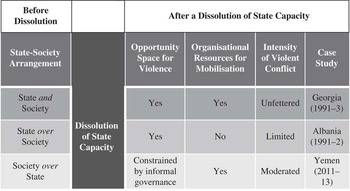
Having sketched a logic that connects three state-society dynamics before a dissolution of state capacity with three subsequent trajectories of violent conflict, I now present three, ‘diverse’ case studies,Footnote 63 which illustrate each of the proposed causal dynamics (see Figure 1).
Logic of the argument and case studies.

The first study details the strength of both ‘state and society’ in late-era Soviet Georgia, the collapse of state structures alongside the end of Soviet rule, and a subsequent slide into unfettered violent conflict between 1991 and 1993. The second case gives an account of the dominance of ‘state over society’ in communist Albania, the dissolution of state capacity during the transition from communist rule in 1991, and the limited level of subsequent violent conflict. And the third narrative details the long-term strength of ‘society over state’ in Yemen, the collapse of state capacity alongside the end of Ali Abdullah Saleh’s regime, and the development of violent conflict that was moderated by informal governance between 2011 and 2013.
The case studies are illustrative, rather than probative. Indeed, theory-testing would not be possible because I followed a ‘pragmatic’ approach to research.Footnote 64 That is, I combined deductive reasoning with an inductive reading of the cases as I formulated the theoretical framework introduced above, and the measures specified below. Thus, the theory, measures, and cases are not sufficiently independent from one another to allow for theory-testing. That said, the cases do allow me to illustrate the theoretical framework offered above and, in so doing, explore whether theory-testing would be warranted.
Each case study is necessarily brief, given space constraints, and this is acknowledged as a limitation. However, the three studies draw on extensive, and diverse, sources – including interviews gathered through multi-country fieldwork.Footnote 65 I use these sources to present narratives that each follow the same, tripartite structure. In the first section, I gauge the respective strengths of state and societal organs before the dissolution of state capacity. In the second section, I sketch how the state in question lost capacity, and indicate how that loss shaped opportunities for violence. In the third section, I show how the abiding capacity of societal actors informed the potential for armed groups to mobilise, I detail the evolution of conflict among such groups, and conclude by measuring the intensity of violent conflict.
When considering the capacity of state organs prior to their dissolution, and assessing the extent to which those organs later became dysfunctional, I provide a qualitative measurement of the three categories of state capacity that I identified in the earlier conceptual discussion: security, finance, and administration. I assess security capacity by considering the internal organisational coherence of the armed forces and the material resources available to those forces.Footnote 66 Financial capacity is gauged by considering the ability of state authorities to generate the level of public funds needed to provide basic public services.Footnote 67 And I measure administrative capacity by assessing the ability of legislators to generate and enforce laws, as well as the ability of state organisations to provide basic public services.Footnote 68
When evaluating the outcome of each case – understood as the intensity of violent conflict – I first note the number of conflict fatalities reported by the Uppsala Conflict Database Program (UCDP), as well as further sources, for verification.Footnote 69 To facilitate comparison across cases, I also calculate the average annual number of fatalities for the duration of the conflict episode, relative to population size. Finally, I combine these data with a qualitative assessment of the dynamics of violence, and then categorise the outcome as a limited, moderated, or unfettered episode of violent conflict. As suggested above, these categories echo the three levels of violence intensity that have been used by researchers from the Heidelberg Institute, in their annual ‘Conflict Barometer’. Specifically, my understanding of limited intensity violent conflict matches what they have called a ‘crisis’, when ‘at least one of the parties uses violent force’. My category of moderated violence is equivalent to their concept of a ‘severe crisis’, understood as a condition in which ‘violent force is used repeatedly in an organized way’. And my category of unfettered violent conflict is akin to their category of ‘war’, which sees ‘violent force … used with a certain continuity in an organized and systematic way … [such that] the extent of destruction is massive’.Footnote 70
Case 1: From ‘state and society’ to unfettered violent conflict in Georgia (1991–3)
The conditions: Strong state and strong society in Soviet-era Georgia
As a constituent part of the Soviet Union, the Soviet Socialist Republic of Georgia initially played host to one of history’s most powerful and pervasive states.Footnote 71 Under Stalin, in particular, Soviet authorities used the coercive power at their disposal to extend the reach of the state into the local economy (through nationalisation and central planning), and local society (through a complex and politicised nationalities policy).Footnote 72
After Stalin’s death triggered a degree of liberalisation across the Soviet Union, however, civil and ‘uncivil’ societal groups increased in Georgia – both in number, and in power. Soviet forces continued to dominate the security sector, to be sure, but Georgia’s economy moved steadily out of the influence of local state actors, who proved unable (and perhaps unwilling) to stem the growth of an underground market, to such an extent that the informal economy rivalled the formal sector for size by the 1980s.Footnote 73 Vast networks of illicit private exchange flowed through the close kin and communal ties that had been at the heart of Georgian society for centuries.Footnote 74 Where informal trade deals broke down, a group of highly-organised criminals (known as ‘thieves-in-law’) were on hand to offer contract enforcement services,Footnote 75 providing a kind of parallel judicial system.Footnote 76 Born out of the Soviet prison system, these bandits had a particularly large presence in Georgia during the 1970s and 1980s.Footnote 77 Civil society activists were also beginning to organise in Georgia at that time, as intellectuals such as Merab Kostava used human rights-based claims to advance Georgian nationalist agendas.Footnote 78 Minority nationalities within Georgian territory – particularly Abkhazians and South Ossetians – responded to those claims by starting their own ethno-nationalist movements.Footnote 79
Thus, by the late 1980s, the famously strong Soviet state had become counterbalanced by an equally strong set of societal actors in Soviet Georgia.
The dissolution of state capacity in Georgia, 1990–1
Across the course of 1990 and 1991, the Soviet Union unravelled and 15 new republics were born, most of which had no previous experience of statehood. While authorities in all of the new states struggled to establish functional state organisations, Georgia faced three particular challenges on that front. First, the rupture between Tbilisi and Moscow was faster and deeper than elsewhere because Soviet authorities had previously lost all popular legitimacy in Georgia after they ordered a crackdown on unarmed demonstrators on the streets of Tbilisi in April 1989, killing 19.Footnote 80 Second, when independence was declared in April 1991, Georgia faced a ‘stateness problem’.Footnote 81 That is, the territorial reach of the new state was unclear because Soviet Georgia had housed several autonomous regions and, after independence, the status of those regions was disputed. Specifically, Tbilisi claimed sovereignty over Abkhazia and South Ossetia, but local officials there refused to recognise Georgian authority.Footnote 82 Third, leaders who took responsibility for guiding the country through its transition from Soviet rule lacked political experience. In particular, the state’s first chief executive, Zviad Gamsakhurdia, was an anti-Soviet dissident who had few skills as a manager, administrator, or state-builder. In the words of one interviewee, he ‘was a destroyer … [rather] than a builder’.Footnote 83
Under the watch of Gamsakhurdia and his coalition government, state officials failed to establish any meaningful financial, administrative, or coercive capacity across the course of 1991. On the economic front, sources of state revenue dried up as output from state-owned industry fell by 19 per cent,Footnote 84 and overall productivity dropped by almost 16 per cent.Footnote 85 Also, as trade links were broken with the Soviet Union, exchange shifted over to the already-large underground economy, where revenue fell out of the reach of the state’s collectors.Footnote 86 Drained of resources and lacking experience, Georgia’s new legislators struggled to translate their laws and decrees into effective administration.Footnote 87 Indeed, according to a senior bureaucrat from the period of transition, Gamsakhurdia was the president in name, but he was not able to realise any policy outcomes, in practice.Footnote 88 That said, he did manage to deconstruct the Soviet security apparatus by banning conscription to Soviet armed forces,Footnote 89 and cutting funding to the intelligence services.Footnote 90 Deconstruction was not matched by reconstruction, however. Gamsakhurdia’s lack of experience in governing no doubt played a part in that failure, but even the most seasoned leader would have struggled to manage the security sector as paramilitary groups began to mobilise alongside the dissolution of the Soviet state.Footnote 91
The outcome: Unfettered violent conflict
The collapse of state capacity created opportunity space for violence in Georgia, but it was the country’s strong societal organisations that provided the frameworks around which criminal gangs and militias mobilised to collectively exploit that space. Kinship networks were a particularly common basis for mobilisation. As Jesse Driscoll notes, familial ties had been ‘necessary for everyday life’ during the Soviet era, and the ‘dense networks of social capital’ that developed around those ties then underwrote militia mobilisation when Soviet power dissolved.Footnote 92 Regional kinship ties were central to the formation of so-called Zviadist militias,Footnote 93 for example, which rallied around Gamsakhurdia when his presidential power was challenged by two paramilitary organisations: the Mkhedrioni (Horsemen) and the National Guard.Footnote 94 Since the leader of the Mkhedrioni – Jaba Ioseliani – had been a prominent thief-in-law, his organisation drew on the ‘thieves’ traditions’,Footnote 95 and on the personnel of various criminal organisations.Footnote 96 The Mkhedrioni and National Guard also reinforced their ranks by absorbing smaller, volunteer militias that initially formed around local community ties in Tbilisi, on a street-by-street basis.Footnote 97 And, outside Tbilisi, governing elites in Abkhazia and South Ossetia combined residual Soviet forces with local kinship groups to form their own paramilitaries, which were bolstered by members of sympathetic societal organisations from across the northern Caucasus and, allegedly, material support from Russia.Footnote 98
Given the rapid proliferation of armed groups in post-Soviet Georgia, it is not surprising that collective violence soon erupted. Most immediately, it took the form of organised, violent criminal activity, which spiralled as the country fell into a condition of functional anarchy.Footnote 99 Alongside (and interwoven with) this criminal activity, tensions between the country’s organised paramilitary groups also gave rise to three, discrete armed confrontations. One dynamic saw the Mkhedrioni and National Guard challenge Gamsakhurdia and his supporters on the streets of Tbilisi in December 1991, eventually ousting the elected president.Footnote 100 Zviadists then relocated to Gamsakhurdia’s home region of Samegrelo (in the west), where they continued a low-level insurgency until October of 1993.Footnote 101 A second confrontation saw various Georgian paramilitaries, led by the MkhedrioniFootnote 102 and National Guard,Footnote 103 repeatedly clash with South Ossetian-aligned forces across the course of 1991 and 1992, when a ceasefire was agreed and peacekeeping forces were deployed.Footnote 104 And, just as the Ossetian conflict was drawing down, a third – and particularly brutal – confrontation escalated between various Georgian paramilitaries and armed groups aligned with the Abkhaz regional government.Footnote 105 War raged in Abkhazia until late 1993, when the Georgian paramilitaries were expelled.
Combined casualty estimates for Georgia’s post-Soviet episode of violent conflict vary enormously, running between a low-end estimate of 2,660 fatalities from 1991 through to the end of 1993 according to the UCDP,Footnote 106 to higher-end estimates of around 12,700 deaths from area-specialist Christoph Zürcher,Footnote 107 and an estimated 13,300 fatalities in data compiled by Nicholas Sambanis.Footnote 108 Given that Georgia’s population at the time was just 4.85 million, these figures suggest an annual average of between 18 and 91 conflict fatalities per 100,000, for each of the three years that spanned Georgia’s post-Soviet episode of violence.Footnote 109 Conflict also displaced an estimated 350,000 civilians during that period.Footnote 110 When the scale of that displacement is combined with recognition of the wide geographic spread of conflict, and the high intensity of criminal violence that gripped Georgia at the time, the dissolution of previously strong state structures in the presence of strong societal networks can be seen to have triggered an unfettered episode of violent conflict in Georgia.
Case 2: From ‘state over society’ to limited violent conflict in Albania (1991–2)
The conditions: State domination of society in communist-era Albania
During Albania’s period of communist rule (1944–91), state actors dominated society to a far greater degree than was the case in neighbouring communist regimes.Footnote 111 Indeed, the state’s repression of society was so complete that some commentators now describe communist Albania as ‘the North Korea of its time’.Footnote 112 To establish such absolute control, long-term dictator Enver Hoxha constructed a vast coercive apparatus around the principle of ‘people’s war’,Footnote 113 which held that the masses should be mobilised to protect the social revolution from external and internal enemies – and Hohxa saw enemies everywhere. Fearing foreign invasion, specifically, the dictator forced Albanians to participate in bizarre schemes, such as building 700,000 concrete bunkers around the country for civil defence, and fixing spikes to trees as a makeshift form of protection against invading paratroopers. To prevent internal insurrection, Hoxha set up a highly repressive secret service known as the Sigurimi, which crushed dissent by establishing complex surveillance networks, purging party leaders, imprisoning dissidents, and controlling public information.Footnote 114
State authorities also used their massive coercive power to close down all private space in Albania. On the economic front, industry and agriculture were nationalised, private trade was banned,Footnote 115 and authorities refused to countenance any underground economic activity.Footnote 116 Nor did they allow independent sociocultural associations.Footnote 117 Religious organisations were outlawed in 1967,Footnote 118 for example, and other social spheres were brought under state control through the establishment of state-run ‘mass organizations’, such as artists’ leagues, youth movements, and trade unions. Although these organs officially encouraged civic life, they were effectively tools for the vertical dissemination of party doctrine and surveillance, rather than the development of horizontal ties and social capital.Footnote 119 Consequently, over time, family became the only private space in Albania. But such was the level of mistrust within a heavily-monitored society that even familial bonds became strained.Footnote 120 Thus, by the time communism folded, society had effectively disintegrated in Albania.
The dissolution of state capacity in Albania, 1991
As communist regimes fell across Central and Eastern Europe in 1989, Albania’s (communist) Party of Labor initially dug in its heels and insisted that Albania would ‘go [its] own way’.Footnote 121 But the writing was on the wall for the regime and so, when students and intellectuals hit the streets to call for change in late 1990, Hoxha’s successor, Ramiz Alia, responded by agreeing to reforms, including elections in March 1991. The Party of Labor actually won those ballots on the back of the rural vote,Footnote 122 but it struggled to govern in the absence of urban support. Thus, following protests and a general strike, the communist government stood down in June 1991 and was replaced by successive provisional governments.Footnote 123
Since regime and state had been wholly intertwined under communist rule, collapse of the communist system precipitated a complete dissolution of the Albanian state’s financial, administrative, and coercive capacities. In the words of provisional Minister of the Economy, Gramoz Pashko, Albania’s economic situation in 1991 was ‘catastrophic’.Footnote 124 Industrial and agricultural output dropped massively between 1989 and the end of 1991, for example, as worker absenteeism skyrocketed and collective farms spontaneously decollectivised. Together, these dynamics triggered a 25 per cent drop in GDP between 1991 and 1992 alone,Footnote 125 which led to a massive shortfall in state revenue.Footnote 126 With few resources at its disposal, the state became incapable of providing basic services: electricity stopped regularly;Footnote 127 water supplies dried up;Footnote 128 sewerage festered;Footnote 129 and garbage was not collected.Footnote 130
In the security sector, the military, secret services, and police all suffered from divisions and desertions. In the army, specifically, a schism developed among those from the Military Academy who supported political reform, and those who opposed it.Footnote 131 Morale and discipline also collapsed among active army infantry after provisional governments repeatedly failed to come good on promises of a pay rise and improved conditions for troops.Footnote 132 Meanwhile, the much-feared Sigurimi became dysfunctional, as secret service officers withdrew from public life – possibly out of fear of prosecution for past repressions.Footnote 133 In July 1991, the agency was disbanded and replaced by the National Intelligence Service.Footnote 134 The regular police forces remained organisationally intact, but the overt police had never been as well-resourced as their covert colleagues, and so they could not cope with the rising disorder. Indeed, such was their frailty that Police Chief Fadil Canaj admitted by early 1992 that ‘the general situation in Albania [had become] anarchic’.Footnote 135 That condition was most evident in the failure of Albania’s security forces to control the country’s borders, which were the scene of massive, unregulated refugee flows in 1991; west to Italy, and south to Greece.Footnote 136
The outcome: Limited violent conflict
Collapse of the state’s coercive power opened up opportunity space for violence in Albania. However, no armed groups went on to exploit that space by using violence as a tool for gaining power or profit. The most common explanation for the lack of organised violence in transitional Albania is that no collective actors were willing to use violence to realise political or criminal ends at that time.Footnote 137 While this certainly seems to have been the case, framing the argument solely in terms of a lack of motives for violence may mask another cause: No social groups were willing to use violence simply because there were no tight-knit social groups in existence. Rather, Albanian society remained atomised and fragmented after decades of totalitarian repression and, as such, there were no societal structures and associated networks of trust around which high-risk (violent) collective action could have been organisedFootnote 138 – be it predatory, protective, or otherwise.
The impact of atomisation on (the lack of) mobilisation can be indirectly gauged by noting several conspicuous absences that characterised Albania as state capacity dissolved. Although crime quickly spiralled, for instance, neighbours did not organise community protection groups, as may have been expected.Footnote 139 Rather, in the words of one interviewee, ‘There was no community protection … because we … didn’t have a sense of community.’Footnote 140 In contrast with the Georgian case, at least, there was little organised crime to fight – simply because there had been no organised criminal groups under communist rule and, thus, there were no such groups on hand to exploit the opportunities for racketeering that arose as state organs folded in 1991.Footnote 141 Nor did armed groups mobilise along regional lines at that time, despite the existence of ethno-regional identities (Gheg and Tosk) that could have become subject to manipulation and mobilisation, as was the case in neighbouring countries. In fact, the only social ties that seem to have offered bases for mobilisation in the wake of communist rule were political party allegiances – to the outgoing communists, or to incoming reformists. To that end, there were early rumours that party-aligned militants were actually trying to organise and arm themselves in early 1991.Footnote 142 But if those rumours were true, then it seems that ringleaders failed to bring atomised Albanians together in support of insurgency, since there is little evidence of armed activity by such groups.
While the absence of armed actors in transitional Albania meant that there was no armed conflict, belligerent individuals did take advantage of the lack of state sanctioning capacity. Thus, over the course of 1991 and into 1992, there was a spree of unorganised looting, which led to the destruction of hospitals, schools, shops, and even nurseries.Footnote 143 Interpersonal violent crime also increased by an estimated 70 per cent,Footnote 144 and there were up to fifty deaths in riots that broke out as individuals fought to access limited food reserves or flee the country.Footnote 145 Together, these unorganised violent incidents generated a deep sense of insecurity and deprivation in Albania. Importantly, however, they did not trigger an outbreak of sustained violent conflict, despite occasional provocations from dissolving state forces.Footnote 146 Rather, the violence that unfolded across 1991 and early 1992 was largely restricted to individual-level, criminal attacks. Thus, although the near-complete dissolution of state capacity in transitional Albania give rise to a sharp rise in human insecurity, the country played to host to a limited level of collective violence.
Case 3: From ‘society over state’ to moderated violent conflict in Yemen (2011–13)
The conditions: Societal strength and state fragility in Saleh-era Yemen
The state has never been strong in Yemen. Colonial powers that moved through the region failed to assert authority over strong societal groups, and subsequent efforts to build modern state structures in the (northern) Yemen Arab Republic and (southern) People’s Democratic Republic of Yemen were challenged by tribal and religious authorities. In 1990, there was a hope that state structures would consolidate after the north and south were merged into a unified Yemeni state, under Ali Abdullah Saleh. However, that hope proved illusory, and, instead, the country fell into civil war in 1994.Footnote 147
Throughout the war and beyond, Saleh used patronage politics to hold Yemen together, but he never managed to establish the supremacy of state authority. State fragility was rooted in the inefficacy of the security services, which had limited capacity, particularly outside of urban areas.Footnote 148 Although there were vast numbers of troops on the books, the security forces were racked by patronage politics, internal divisions, and inter-agency competition – all of which were encouraged by Saleh as means of coup-proofing his regime.Footnote 149 Funding was also a challenge for the state in the security sector and beyond; oil provided almost all government revenue,Footnote 150 but global oil prices were fickle and the country’s reserves were limited.Footnote 151 Moreover, when public funds were available, Saleh distributed those resources according to a logic of patronage, rather than need.Footnote 152
Where Saleh could not buy support, societal actors – mainly tribes and religious groups – remained the dominant local authorities.Footnote 153 This was particularly the case in the north of the country. In those tribal regions, customary authority was underwritten by a rich set of traditional laws, known as ‘urf. Footnote 154 According to this code, non-state actors played a variety of governance roles, particularly in the provision of protection and justice.Footnote 155 On a day-to-day basis, for example, tribal militias offered security in areas they designated as ‘safe havens’, such as markets, mosques, and hospitals.Footnote 156 Where inter-personal disputes arose in those areas, tribal sheikhs served as mediators and arbitrators, aiming to restore balance within communities by having parties responsible for violations acknowledge their responsibility and offer compensation.Footnote 157 Often, that aim was realised.Footnote 158 Thus, in contrast with the case of Soviet Georgia described above, non-state actors in Saleh-era Yemen regularly played key roles in providing security in territories that fell outside of state control.
The dissolution of state capacity in Yemen, 2011
Given their abiding weakness, state organs in Yemen effectively folded when capacity ‘dropped tremendously’Footnote 159 alongside the collapse of Ali Abdullah Saleh’s regime in 2011.Footnote 160 Saleh’s fall triggered a dissolution of state capacity because he had systematically intertwined the political structures of his regime with the administrative and security structures of the state. Thus, when his regime came to an end in late 2011 – following months of protests, defections, and confrontations on the streets of Sanaa – the patronage networks that he had used to prop up state organs weakened. And, as they did, competition for the spoils of the state intensified, which enfeebled state structures.
Across the course of 2011, all indicators of state capacity plunged. On the financial front, sources of government revenue shrank rapidly, as oil production dropped by around 35 per cent in 2011.Footnote 161 Other sources of revenue also fell when the economy contracted by nearly 13 per cent that year.Footnote 162 Where taxes were owed, meanwhile, the government struggled to collect those levies.Footnote 163 As state coffers dried up, the government risked defaulting on the payment of state salaries,Footnote 164 which undermined the confidence of state officers in their employer and, thus, their compliance with directives. Consequently, the writ of the government began to run thin outside of Sanaa; electricity, oil, and communications grids came under attack;Footnote 165 the south of the country became restive;Footnote 166 and the state simply ceded governance to the Houthi movement in the far north.Footnote 167
As regions slipped out of state control, security forces seemed powerless to stop the rot. The military was racked by factional strife after the powerful general, Ali Mohsen and his supporters split with forces that remained loyal to Saleh.Footnote 168 The police, meanwhile, were simply ineffective, as shown by a poll taken in 2012, which revealed that 60 per cent of the population had little or no confidence in the police forces. In the southern region of Abyan, in particular, 98 per cent of respondents suggested they did not even know of a police station in their area.Footnote 169
The outcome: Moderated violent conflict
As the Yemeni state unravelled across the course of 2011, opportunity space for violence expanded, and a host of armed non-state actors soon stepped into that void. Many of the groups that mobilised had previously existed in some form, typically as tribal militias. But new armed groups were also able to form, given the density of social ties in Yemen and the wide availability of weapons.Footnote 170
As established and emerging groups tested the boundaries of their power in the emerging institutional environment, violent conflicts broke out. While the intricacies of those conflicts are too complex to effectively relay here, three broad dynamics can be identified. First, there was a violent struggle for national-level power between forces that remained loyal to Saleh, on one side, and a loose alliance of militias led by Ali Mohsen and the powerful al-Ahmar family on the other.Footnote 171 Second, at the subnational level, there was low-level violence from regional movements in the north and south,Footnote 172 as well as a series of more intensive attacks perpetrated by al-Qaeda in the Arabian Peninsula (AQAP) and its affiliate, Ansar al-Sharia.Footnote 173 Those attacks triggered the mobilisation of so-called ‘Popular Committees’, which were tribal militias that worked with government forces to repel Ansar from the southern region of Abyan.Footnote 174 And finally, at the local level, there were a number of low-level clashes between tribes over land, loot, access to water, and family honour.Footnote 175
Together, these three layers of armed conflict generated deep insecurity in Yemen between 2011 and 2013. However, violence at that time did not escalate to a condition of unfettered civil war, despite early predictions to that effect.Footnote 176 In fact, although conflict fatalities increased in 2011, they then decreased over the two years that followed. Given the vast number of armed actors in Yemen, this pattern would be puzzling if Yemen had been void of governance. However, it was not. Rather, although formal state governance and security became limited in 2011, institutions of customary governance remained intact, and those non-state structures provided a check on the escalation of violent conflict.
The capacity of tribal governors to constrain violence varied across the cited levels of conflict. Unsurprisingly, perhaps, customary governors proved most effective at managing local-level, tribal conflicts, which actually seem to have dropped in number from 2011.Footnote 177 At the city level, meanwhile, tribal mediators made efforts to broker deals with AQAP and its affiliates. On occasion, those efforts met with success – most notably in the city of Radaa, where tribal leaders were repeatedly able to negotiate the withdrawal of AQAP forces over several years.Footnote 178 At the provincial level, some tribal leaders sought to limit the diffusion of violence that broke out in Sanaa, by agreeing that tribes in their regions would not take sides in the national-level conflict.Footnote 179 And at the national level itself, tribal leaders went even further by trying (albeit with limited success) to broker deals between government and opposition forces as violence continued in the capital throughout 2011.Footnote 180
Overall, then, tribal governance seems to have played a role in checking the escalation of violence in parts of Yemen following the dissolution of state capacity in 2011,Footnote 181 alongside international mediation efforts and a formal domestic-level negotiation process known as the National Dialogue. There were, however, still large numbers of conflict fatalities between 2011 and 2013. The UCDP reports a total of 4,212 deaths for the conflicts they identify in Yemen at that time.Footnote 182 The International Institute for Strategic Studies, meanwhile, offers a higher overall estimate for the period, reporting 3,000 conflict fatalities in 2011, then a decline to 2,300 in 2012, and a further decline to 950 in 2013 (which was nearing the level of pre-dissolution violence), for a total of 6,250 conflict-related deaths during the three-year post-Saleh episode of violence.Footnote 183 In a country of 24.2 million (2011),Footnote 184 these two estimates suggest an annual average of between six and nine conflict fatalities per 100,000, over each of three years. When these figures are combined with recognition of the human insecurity that characterised Yemen between 2011 and 2013, and population displacement within the country at that time, the episode of violence that followed the 2011 dissolution of state capacity in Yemen can be described as an extremely grave, but moderated, episode of violent conflict.
In 2014, a new – and more intense – conflict episode erupted in Yemen, after Houthi rebels from the north began to move steadily southwards, taking control of Sanaa, and beyond. As they headed down to Aden, local coping mechanisms initially seemed to mitigate the intensity of violence. However, when Saudi Arabia intervened by air, the Yemeni conflict became part of a regional struggle. As it did, informal governance could no longer contain the conflict, which then escalated to an unfettered level of intensity.
Conclusion
This study has proposed that the strength of state and societal organisations before an acute drop in state capacity sets parameters for variation in the presence, absence, and intensity of violent conflict after state capacity dissolves. Since context-specific dynamics following a dissolution of state capacity also shape the likelihood and scale of violence, the framework provided does not offer a sufficient explanation of all observed variation in levels of post-dissolution violence. That said, on the assumption that structural factors narrow the scope of possible outcomes, I have argued that consideration of state and society prior to a dissolution of state capacity can provide a good starting point for analysis.
To illustrate that claim, I have explored three cases, which span the full range of variation in levels of violence ‘when states fail’.Footnote 185 In Georgia, both state and society had previously been strong sets of actors. When dissolution of the Soviet state then opened up opportunity space for collective violence, societal actors used their organisational networks as bases for militia mobilisation. As armed groups competed for power and position over a three-year period, violence escalated to an unfettered level. In Albania, pervasive state structures folded alongside the end of communist rule, creating opportunities for violence. However, since society had been atomised under the outgoing regime, there were few societal frameworks around which militias could mobilise. Consequently, although there was a high degree of unorganised criminal violence and human insecurity in transitional Albania, violent conflict was limited. Finally, when the Yemeni state became dysfunctional in 2011, expanding opportunity space for violence was exploited by existing and emerging armed groups. Despite early predictions, however, the episode of conflict that played out between 2011 and 2013 did not spiral into civil war. Rather, partly due to the interventions of societal governors, violence was moderated, and then receded.
Given the exploratory nature of this study, it would be premature to use the arguments presented here as a basis for making clear policy recommendations. Nevertheless, perhaps it is worthwhile to close by reflecting on how the proposed arguments could shape the way we think about responses to ‘state failure’, if those arguments are explored further and found to be convincing. With that in mind, the logic presented above points to three post-dissolution contexts of insecurity, and three associated frameworks of conflict response.
First, where previously strong states fold and previously strong societies remain in place, a case could be made for the early deployment of robust external security guarantees (that is, peacekeeping forces), with the aim of preventing well-organised societal actors from taking up arms and then competing violently for power and profit. The potential merits of such a preventive deployment were seen in Macedonia from 1993, when a small United Nations force was able to contribute to the prevention of violent conflict in the new, feeble state – even as Yugoslavia dissolved and surrounding regions fell into civil war.Footnote 186
Second, where a previously dominant state becomes dysfunctional and society remains atomised, low-level external security guarantees may be necessary to assure basic order in the face of rising criminal violence. Those guarantees, in turn, may need to be complemented by significant levels of humanitarian aid. After all, years of state repression and economic mismanagement under totalising rule are likely to produce extreme levels of human insecurity. In view of this, Bruce Bennett and Jennifer Lind have argued that vast humanitarian assistance would be needed in case of regime collapse in North Korea, even though physical security conditions on the ground could remain relatively benign.Footnote 187
Finally, where a previously fragile state folds altogether, but customary systems of governance are left standing, external efforts to provide stability may benefit from working closely with traditional governors, rather than pushing against customary rule or simply ignoring traditional authorities – as has occasionally been the case.Footnote 188 Such cooperation would ensure that local stakeholders have an interest in ensuring the success of a state reconstruction effort. By contrast, failure to include local governors in processes of state-building could run the risk of transforming potential peacemakers into potential peace spoilers.Footnote 189
Biographical information
John Gledhill is Associate Professor of Global Governance in the Department of International Development, University of Oxford. In his research, writing, and teaching, he investigates conflict processes, non-violent protest movements, state formation and dissolution, peacekeeping, and transnational social mobilisation. His recent publications have appeared in PS: Political Science and Politics, Security Studies, and Asian Security. He can be reached at john.gledhill@qeh.ox.ac.uk
Acknowledgements
I thank Ariel Ahram, April Alley, Thomas Carr, Neil MacFarlane, Ian Madison, Jonathan Monten, Kate Roll, Oisín Tansey, commentators at various public forums, anonymous reviewers, and the editors of the European Journal of International Security for feedback on earlier drafts of this article. I also thank Iveta Gogava and Sashenka Lleshaj for their excellent research and translation assistance while I collected data for this project. All views, along with any errors, omissions, and/or misrepresentations are, of course, my own.