INTRODUCTION
Carybdea marsupialis (Linnaeus, 1758) is a venomous box jellyfish widely distributed in tropical waters of the Atlantic Ocean. It is also found in large aggregations in the Caribbean Sea (Kramp, Reference Kramp1961; Sánchez-Rodríguez et al., Reference Sánchez-Rodríguez, Torrens and Segura-Puertas2006) where the species is present all year around in bays, harbours and mangrove channels. Moreover, ripe specimens may be found in any season in Puerto Rico (Cutress & Studebaker, Reference Cutress and Studebaker1973).
In the Mediterranean basin and adjacent areas, this carybdeid is the only known cubomedusa species. It is frequently found in the Adriatic Sea (Boero & Minelli, Reference Boero and Minelli1986; Di Camillo et al., Reference Di Camillo, Bo, Puce, Tazioli and Bavestrello2006), where massive aggregations have sporadically been observed (Giampiero et al., Reference Giampiero, Rafanelli, Galassi, Di Bartolo, Bertini, Alberani and Beccari1997). In the western Mediterranean, adult individuals of C. marsupialis have been spotted in summer along the south-east coastline of Spain by SCUBA divers, but to the best of our knowledge, these observations have never been reported in the scientific literature. In some of the Spanish Mediterranean diving guides this species is shown as rare, consequently very few divers have seen it.
Carybdea marsupialis has a bi-partite life cycle, is oviparous and settlement of planulae occurs about two days after fertilization of ova. The polyp stage has been found only once on dead bivalve shells on the bottom of mangrove channels (Cutress & Studebaker, Reference Cutress and Studebaker1973). Moreover, there is evidence from experimental work of the capacity of the polyps to develop in cysts when the conditions are not adequate (Straehler-Pohl, personal communication). The cubopolyp reproduces asexually through lateral budding and by transforming the polyp into a cubomedusa. Budding rate is positively correlated with feeding frequency, in contrast to conditions leading to the medusa formation, and increases in darkness. Furthermore, the polyp seems to have a high regeneration potential (Fischer & Hofmann, Reference Fischer and Hofmann2004). A second type of metamorphosis, leaving a regenerative remnant, is also frequent and can reach up to 45% of the total number of metamorphosis. This mode of medusa formation seems to be derived from the strobilation process common to scyphozoans (Straehler-Pohl & Jarms, Reference Straehler-Pohl and Jarms2005). Nevertheless, considering the importance of benthic stages for jellyfish outbreak formations (Boero et al., Reference Boero, Bouillon, Gravili, Miglietta, Parsons and Piraino2008) there exists a lack of information about other important topics such as: substrate choice; food limitation; predators; and competitors.
The nematocysts and the venom of Carybdea marsupialis have been widely studied (Golz, Reference Golz1993; Avian et al., Reference Avian, Budri, Rottini Sandrini, den Hartog, van Ofwegen and van der Spoel1997; Di Camilo et al., 2006; Sánchez-Rodriguez et al., 2006). The contact between human skin and Carybdea tentacles causes severe pain, burning sensation, erythematous-vesicular eruption and local oedema (Kokelj et al., Reference Kokelj, Del Negro and Montanari1992; Milla et al., Reference Milla, Segura-Puertas and Celis2000; Sánchez-Rodríguez et al., Reference Sánchez-Rodríguez, Torrens and Segura-Puertas2006).
Moreover, the potential proliferation of this species as a gelatinous predator represents a threat to the ecosystem due to its ecological effects. Cubozoans consume zooplankton, as well as ichthyoplankton (Larson, Reference Larson and Mackie1976; Nogueira Jr & Haddad, Reference Nogueira and Haddad2008); therefore, zooplankton populations and the juvenile fish community could potentially be reduced and modified. Such situations can cause a direct or an indirect cascade effect in marine food webs and natural populations.
During summer 2008, a high number of stings caused by the unusual and abundant presence of Carybdea marsupialis were reported along 17 km of the coastline near Denia (south-eastern Spain, north-western Mediterranean). Because this was such an unusual event, a sampling strategy was developed to quantify stung bathers, and evaluate abundance, as well as size distribution of C. marsupialis.
MATERIALS AND METHODS
The study area extends to include coastline to the north of Denia, which consists of long sandy beaches with a gentle slope where Posidonia oceanica meadows coexist with rocky and sandy bottoms. The northern and southern limits of the study area are the Racons-Molinell River (38°53′09″N 0°02′14″E) and 2 km south from Denia harbour (38°50′55″N 0°02′14″E) respectively (Figure 1). The area absorbs river run-off which contains high levels of nitrate and other crop fertilizers. There are 4 perpendicular dykes (from 100 to 230 m long), 3 at L'Almadrava beach and 1 at Les Marines. Both beaches have been replenished with sand: Les Marines beach, in 1987, and L'Almadrava beach, in 2005. The region is a popular tourist spot in this part of Spain where bathing, yachting and other aquatic activities take place during summer months.
Studied area in the south-western Mediterranean. Coast of the municipality of Denia (Spain).

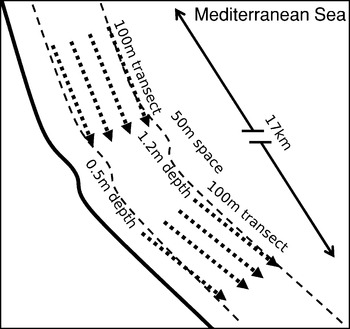
In order to conduct the sampling programme, 17 km of the coastline was divided into 8 beaches (from north to south): Racons, Deveses, Almadrava, Molins, Marines, Raset, Marineta and Rotes (Figure 1). Quantitative sampling commenced on 15 September, just two months after a high number of stings had been detected by the Red Cross at Raset beach. Sampling was completed on 21 November, two weeks after the last organism of Carybdea marsupialis was found. Since the animals were detected in a very shallow area, samples were taken using a hand net (5 mm mesh size) of 949 cm2 of filtering surface (30.9 × 30.8 cm) and by walking in a parallel direction to the coastline. While walking, the net was kept 0 to 5 cm off the bottom and a total distance of 100 m was covered in each transect. Each sampling point consisted of 4 transects, each of them parallel to the other at a distance of 1.5 m, covering approximately from 0.5 to 1.2 m depth. The distance between sampling points was 50 m (Figure 2). All data were collected in spreadsheets, including GPS coordinates, individual references for starting and finishing points, water temperature (T data logger ±0.1°C) and the number of individual C. marsupialis collected. Density data are calculated using individuals per square metre (to obtain densities in cubic metres, multiplied by net height, 0.308 m). We randomly chose 150 individuals to measure (umbrella height and width) and a linear correlation was undertaken between both measures, obtaining correlation coefficient R2.
Sampling procedure.

All Carybdea marsupialis individuals collected were preserved in 4% formalin for further analysis.
The other set of data used for this study was based on the information supplied by the Red Cross emergency services who kindly gave us permission to use official information related to the number of people stung by jellyfish and the total number of incidences at the beaches located along the Denia coastline. The Red Cross beach service commences each year on 1 July and finishes at the end of August; hence no data on stung people can be obtained after this date.
To assess if 2008 was an exceptional year in relation to jellyfish stings, data from previous years were also analysed and compared with the years 1996 to 2007.
Individuals who have been stung by the Carybdea marsupialis are easily recognized because they suffer a burning pain which lasts for several hours, accompanied by a self-limiting (1–2 days) localized erythematous eruption. Small vesicles and hives can also appear in the affected area.
RESULTS
Carybdea marsupialis abundance and distribution
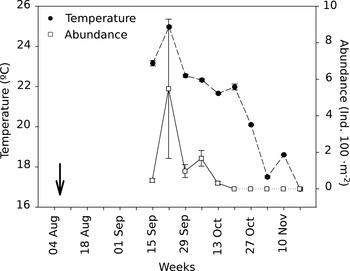
As shown in Figure 5, Carybdea marsupialis density was measured from 15 September until 21 November 2008, and during this period, a total of 476 C. marsupialis were collected. No cubozoans were found in the area after 10 November. Some adults of C. marsupialis were captured in the second week of August, 5 weeks prior to the quantitative sampling period. Density of C. marsupialis decreased from a maximum of 5.4 ± 3.8 ind 100 m2 (Figure 5) at the end of September to zero on 10 November.
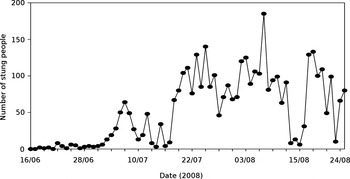
The highest number of stinging incidences was recorded during the first week of August (Figure 3). The peak water temperature (25 ± 0.5°C; Figure 5) occurred during the fourth week of September which was when C. marsupialis was abundant (5.4 ± 3.8 ind 100 m2; Figure 5). Temperatures fell from 25 ± 0.5°C at the end of September to 16.8 ± 0.5°C on 17 November.
Red Cross records of people stung from 16 June to 25 August 2008 in all stations in Denia's beaches. Raset, Marines and Molins beach had altogether 88% of the stings (58%, 25% and 5% of stings respectively).

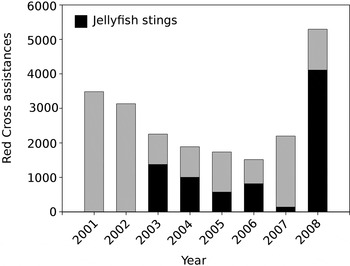
Red Cross records of total assistances in beaches, differentiating people stung by jellyfish (dark bar) in Denia's beaches from 1996 to 2008. Stung people data in 2001 and 2002 are not known.

Abundance of Carybdea marsupialis and water temperature during the sampling period (4 August to 21 November). Values are shown as averages ± standard error. The arrow indicates the occurrence of the first stinging events in mid-August.

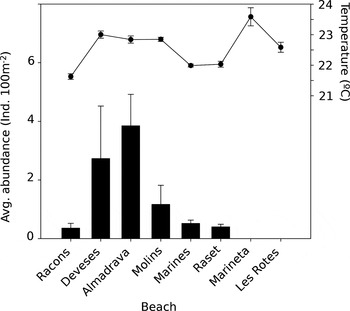
When data are analysed from each of the beaches sampled (Figure 6), it can be observed that the highest average abundances were found in L'Almadrava and Deveses beach (3.85 ± 1.1 ind 100 m2 and 2.73 ± 1.8 ind 100 m2, respectively). In contrast, no organisms were captured in Les Rotes, neither at Marineta beach. Despite the fact that the maximum number of sting incidences was recorded at Raset beach, the highest densities of Carybdea marsupialis were recorded at L'Almadrava and Deveses beach. Records for highest abundances ranged from 0 organisms in Marineta and Les Rotes beaches to 265 per 100 m2 in Deveses beach. Scaling was clearly different between both beaches (Figures 7 & 8), where average abundances ranged from 0 to 3.85 ind per 100 m2, while the highest abundance ranged from 0 up to more than 250 ind per 100 m2. Figure 6 shows the abundances at each sampling beach between 15 September and 20 October. We found that average abundances were constant during different weeks, with the exception of Deveses and L'Almadrava, where a decrease, as well as an increase, of this parameter was recorded respectively.
Abundance of Carybdea marsupialis in the different beaches along Denia's coast. Values are shown as averages ± standard error. Avg, average.

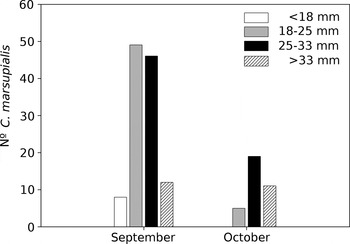
Size distribution of Carybdea marsupialis during September and October 2008.

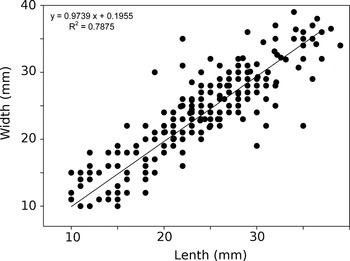
Relationship between length and width of Carybdea marsupialis.

A total of 150 individuals were measured from the 476 samples that were collected. There was a clear dominance of mid-class sizes in September (18 to 33 mm width and 25 to 33 mm length; Figure 7). However, big-sized classes were dominant in October and individuals smaller than 18 mm were not detected (Figure 7). A linear relationship was detected between length and width (Figure 8), which reveals a high correlation value (R2 = 0.788).
During the third week of August 2009, we randomly sampled approximately 10 m3 of water in three different localities (Fonts, Raset and L'Almadrava beaches) to test whether Carybdea marsupialis populations were the same as in 2008. We sampled a total of 33 organisms of C. marsupialis (5, 2 and 26 individuals respectively) which seems to infer that a population may be permanently established in the area.
Red Cross records of stinging incidences
Between 18 July and 25 August 2008, an unusually high number of stinging incidences were registered at the beaches that surround Denia. During this period, more than 3330 jellyfish stings were recorded by the Red Cross. Figure 3 shows the number of people with jellyfish stings treated at the Red Cross facilities on a daily basis, which illustrates that between 18 July and 13 August there had been a significant increase in the number of bathers affected compared to other years. The average number of stinging incidences increased from less than 50 a day to more than 100, with the highest occurrence on 7 August when 185 people were stung. This pattern was not common at all of the beaches that are included in the study or in other coastal cities, and such an increase in the number of people affected was due, almost exclusively, to the number of bathers stung at Raset beach. Visits to Red Cross facilities were almost constant during the study period at Molins and Marines Beaches, however, at Raset, more than 100 people were treated on a daily basis compared to less than 20 in previous years.
Between 2003 and 2007, the total number of people treated for jellyfish stings ranged from 138 (2007) to 1378 (2003) (Figure 4). However, the total number of stings rose to 4116 in 2008, indicating an unusually exceptional year, not only for a single event, but also for an extended period during the summer. Moreover, the amount of assistance given by the Red Cross for stings other than jellyfish in 2008 was similar to previous years. These data point to the fact that 2008 was characterized mainly by a high number of people stung (Figure 4). No data were located for 2000, or for 2002 (Figure 4).
DISCUSSION
Prior to this study, Carybdea marsupialis had never been detected in such high abundance in the Spanish Mediterranean. In Italy similar abundances of C. marsupialis have been found in Tuscany, as well as Ligury (western Italian coast) and along the northern Adriatic coastline (Boero, personal communication; unpublished data). Many factors may have been responsible for this atypical abundance. It is therefore necessary to carry out long-term monitoring surveys of several variables that would have boosted the studied population, such as available food, salinity, temperature or rainfall as was done for the scyphozoan Pelagia noctiluca (Goy et al., Reference Goy, Morand and Etienne1989). Carybdea marsupialis presents a benthic polyp stage, consequently, availability of suitable settling surface and adequate conditions for polyps survival must be key factors contributing to the proliferation of this species in 2008 (and possibly, in the following years).
Carybdea marsupialis has been mainly reported in shallow waters such as slow bays that have low water movement (Bigelow, Reference Bigelow1918; Larson, Reference Larson and Mackie1976). However, in this study the highest abundances were found at a turbulent beach (L'Almadrava) with a slope of 15° to 20° (6.5 m horizontal from 0 m to –3 m depth). In addition, the limitations of the sampling methodology limits spatial observations from 0.5 to 1.2 m deep, therefore we currently cannot offer conclusions regarding distribution of C. marsupialis across the water column.
Three stone breakwaters (200 to 230 m long, perpendicular to the coast) were built in 2004 in L'Almadrava beach and they may have favoured settlement of the benthic stage of C. marsupialis, increasing substrate availability for polyps to settle and develop.
Measures of the size of Carybdea marsupialis matched those taken by Kramp (Reference Kramp1961), who reported body lengths, as well as widths of 40 and 30 mm respectively, but these numbers seem to be small when compared with the large-sized cubozoans (up to 190 mm bell length) reported in Pakistan waters (Kazmi & Sultana, Reference Kazmi and Sultana2007).
Several jellyfish species such as Chrysaora melanaster, Chironex fleckeri, Carukia barnesi and Pelagia noctiluca can severely affect local socio-economies because bathers are stung and fishing, aquaculture, as well as power plant operations can be interfered with (Purcell et al., Reference Purcell, Uye and Lo2007).
The coastal bloom of Carybdea marsupialis located around Denia can be related to a combination of coastal features (currents, temperature, available substrates for polyps, predation, etc.) and more likely than not, anthropogenic causes (artificial substrates, eutrophication, fishing, etc). However, the influence of all these factors on this Carybdea marsupialis bloom still remains unclear and requires further investigation.
ACKNOWLEDGEMENTS
We would like to thank: Ports Service and Conselleria de Medi Ambient from Generalitat Valenciana, personnel from TRAGSA in Alicante for their contribution to the sampling work, personnel from the Red Cross in Denia, the Real Club Náutico de Denia (www.cndenia.es) and Baleària Company (www.balearia.com) for their support. This work was supported by the Ministry of the Environment of Spain (Dirección Provincial de Costas in Alicante (Spain) (TEC2136-09 to C.B.) and División de Protección del Mar y Prevención de la Contaminación Marina) and co-financed by the LIFE Programme of the European Commission (LIFE08 NAT ES64 www.lifecubomed.eu to the Universidad de Alicante and Institut de Ciencies del Mar CSIC, Spain).